The Development of Learning Devices Based on Discovery
Learning to Improve Mathematical Creative Thinking
Ability of Students Class V at SD Negeri 060827
Medan Amplas
Juli Asmida Rambe1 Bornok Sinaga2 Yusnadi3
1.Post graduate student, State University of Medan, UNIMED. Jln. Willem Iskandar Psr V Medan Estate, 20221, Indonesia
2.Mathematic Department , Faculty of Mathematics and Science, State University of Medan, UNIMED. Jln. Willem Iskandar Psr V Medan Estate, 20221, Indonesia
3.Out of School Education Department , Faculty of Education Science, State University of Medan, UNIMED. Jln. Willem Iskandar Psr V Medan Estate, 20221, Indonesia
Abstract
The aims of this study to develop a product in the form of mathematics learning discovery learning which consist: lesson plan, students work sheet,and students textbook.and the purposes of this study to determine: (1) How does the development of learning devices based discovery learning to improve creative thingking of student are practical. (2) How does the development of learning device based discovery learning to improve creative thinking of students are effective. (3) How to increase creative thinking of students by using learning devices based discovery learning approach that has been developed. The device whice was developed consists of: lesson plans worksheets and Las. The population in this students of one class V SD Negeri 060827 Medan Amplas totaling 25 students, by taking samples of one class. as for learning device is developed because in place of researcher less use of learning device even do not use at all so that student less active in process of learning, teacher only as facilitator only and with existence of learning device based on discovery learning researcher can use and practice or apply learning or use device which researchers have done so that it can add insight to researchers The development research. The development process consists of four stage , namely: define, design, develop, disseminate. Result of test I and test II shows that 1)teaching and learning tools developed is valid both in terms of content and construct, 2) teaching and learning tools developed is easily used, 3)teaching and learning tools developed is effective, seen from studens learning complete achievement, student activity in tolerance limit specified and student respone to teaching and learning is considered good, 4) there is a raise in student creative thinking skill from test I 74,25 to 80,33 on test II. Of the data analysis has benn obtained indicates that the learning device-based discovery learning in pecahan material on class V SD Negeri 060827 Medan Amplas is practical and effective. Student’ creative thinking abilities of student has benn increased.
Keywords: Learning device, discovery learning, Creative thinking ability.
I.Introduction
Education has a dynamic power or influence in human life. It can develop a variety of potencies that are optimally possessed, namely the development of individual potentials as high as in the physical, intellectual, emotional, social, and spiritual aspects, according to the stage of development.
In Indonesia, the quality of education is still low. Many data support opinion, one of them is UNESCO data shows, Indonesia's math rank is in the list of 34 from 38 countries, so far, Indonesia still cannot escape from the row of bottom boarders (http;//suaramerdeka.com). Based on the results of the PISA 2009 analysis (Team Center for Professional Development of Educators, 2014: 7), it is found that from 6 levels of ability formulated in the PISA study, almost all Indonesian students are only able to master lessons up to level 3 only, while other countries reach the 4th, 5th and 6th levels. It is believed that all human beings are created equal, the interpretation can be inferred from the results of this study, only one, that is what we teach differ from the demands of the times.
In facing the complexity of the problems of mathematics education, the first thing to do is to cultivate students' interest in mathematics, because without interest, students will find it difficult to learn, and then difficult to master mathematics perfectly, Sriyanto (2007: 28) says that to be able to learn math well we must be actively involved in the learning process of mathematics. It is not all the material can be well understood by the students. Other words, students have difficulty in learning that results low student learning outcomes
Mathematics as a basic science is needed to prepare a reliable and capable human resource compete
But in fact mathematics is one of the subjects that are considered difficult by students. One of the cause is the abstract, conceptual, and tiered principle and procedures that manipulate many forms. There are many factors that cause low or lack of ability of students in learning mathematics, among others is the inappropriate approach of learning oriented to the traditional approach that put the student as a listener. The reality shows that during
this time most teachers use conventional learning method and dominated by many teachers
The fact above hints that the mastery of students to learn mathematics is still low. Indeed, we cannot blame anyone in this case, but obviously many factors that influence the low learning outcomes mathematics. Besides the delivery of inappropriate material, the ability or competence of students which is less, strategies or methods are less appropriate that can also be a factor why mathematics is difficult to be understood. The reality of the field of observations conducted in SD Negeri 060827 are: (1) lesson in learning mathematics involving students or in other words students become listener, (2) the learning is still teacher-centered, (3) the teacher considers the learning device as a secondary source of information for the students.
In addition to the findings of the field, it is also found the existence of teachers who do not use completeness in learning in the classroom is not in accordance with the needs of students because the device designed with a particular learning model only ends with conventional learning in class. So that learning is only one way and students are not active in learning. In addition, between textbooks and LAS are less coherent and also do not use a learning model that can support the achievement of learning objectives. The limited time and resources of teachers' reading in designing learning tools is thought to be one of the constraints of teachers in designing their own learning devices. The importance of learning tools for a teacher, where the learning tool is a guide, meaning that learning tools provide direction to teachers in implementing the learning process that has been arranged systematically, which have previously been compiled by the teacher. Basically the learning devices that teachers often use are monotonous, teachers tend to center on the handbook given the school and deliver the material in the usual way, without modification to the learning model. In fact, in accordance with the Laws of the Republic of Indonesia number 14 of 2005 chapter 20 on teachers and lecturers mentioned that in carrying out professional duties, teachers are obliged to plan lessons, conduct quality learning process, and assess and evaluate learning outcomes. It is then reinforced by Regulation No. 19 of 2005 relating to the standard process indicating that teachers are expected to develop lesson planning. Each teacher in the educational unit is obliged to develop a complete and systematic lesson plan for learning to take place in an interactive, inspiring, fun, challenging, motivational way for active participation, and to provide sufficient space for initiative, creativity and independence according to talent, interests, and physical development as well as appropriate learning.
Currently, it is very difficult for teachers to look for learning devices in accordance with the model of learning used. Learning devices refers to conventional learning that directly presenting material in the form of concepts and formulations directly without any scientific discovery of the concept of thinking. Therefore, one possible solution is to develop the learning devices and assessments in accordance with the learning used. To develop learning tools in accordance with selected learning, teachers must know the characteristics of the learning and activities that will be implemented in accordance with the student syntax learning model. Difficulties that must be taken is what makes the teacher has not developed a learning device that applies innovative learning model.
One of the learning that is expected to be able to involve students' activity is discovery learning. It differs from expository, where the expository of instructional material is delivered in the finished form and the students are required to master the material. Meanwhile, model of invention are sought and discovered by the students through various activities. In this case the teacher's duty is only as a facilitator, and student counselor. Discovery learning is a learning that connects the interconnection between concepts and applying the concept in solving existing problems. It is one model that allows students to be directly involved in teaching and learning activities, so that they are able to use their mental processes to find a concept or theory being studied.
Discovery learning is a learning theory defined as a learning process that occurs when the learner is not presented with a lesson in its final form (Hanafi:2013) but is expected to organize it. Brunner argues discovery learning can be defined as subject matter in the final form, but rather is required to organize it. (Lefancois and Emetembum, in Team Development Center Educator Profession, 2014: 50). What makes Brunner's idea base is the opinion of Piaget that states that children must play an active role in classroom learning. Brunner uses a model called discovery learning, in which pupils organize the material learned in a final form. Discovery learning is to understand concepts, meanings and relationships, through an intuitive process to finally come to a conclusion (Budiningsih, 2005: 43). Discovery occurs when individuals are involved, especially in the use of their mental processes to discover some concepts and principles. Discovery is done through observation, classification, measurement, prediction, and invasion. The process is called cognitive process while discovery itself is the mental process of assimilating concepts and principles in the mind (Robert B. Sund in Hamalik, 2001: 219). By applying discovery learning repeatedly can improve the capabilities of individual self-discovery concerned. The use of discovery learning, want to change the passive learning conditions become active and creative. Change the learning that is teacher oriented to student oriented. Changing the expository mode students only receive the overall information from teacher to discovery mode students find their own information.
There are two kinds of learning discovery, namely learning with free invention (free discovery learning) and learning with guided discovery (guided discovery learning). In the implementation of learning with guided
discovery is more applied than the free invention study, because learning with guided discovery there is a teacher guide, so that students can work more directed in order to achieve goals that have been set. This teacher guidance / instruction is not to curb the creativity of students, but just the direction of work procedures that need to be done. In addition to presentation or delivery of learning materials undertaken, this research also plays a very important role in improving student learning outcomes. Teachers as professionals should be able to master both. But in reality, some teachers are less concerned about or not doing good judgment. Such an assessment does not assess the active participation of students during the learning process. In addition, attitudes and skills that students do when learning takes place are also not an aspect that needs to be assessed. Teachers generally feel sufficient to measure student learning outcomes based on tests provided both in writing and orally. Teachers only see if students are able to carry out the expected activities or not. Teachers do not feel the need to know the cause of the students' inability to perform the expected activity.
The assessment should be used to gather as much information as possible about the learning progress of learners or to encourage improved learning of learners. Encourage the improvement of learning can arise from the students themselves after knowing the results of the assessment, or can also be attempted by teachers who have utilized the results of the assessment to be able to take decisions about learners. Technique to collect information in principle is the way of assessment of learning progress learners against the achievement of core competencies and basic competencies. Assessment of a basic competence is done based on indicators of achievement of learning outcomes, either in the form of cognitive, affective, and psychomotor domains. In the classroom assessment, teachers require not only a written test, but a more conformational assessment form to obtain information about students' abilities. Similarly, an overview of students' learning abilities throughout the learning process, therefore assessment is not only done at the end of the period (semester), but is carried out in an integrated or inseparable way from the learning activities.
Based on the result of interview (January 11, 2017) with one of the teachers at SD Negeri 060827 Medan Amplas, most of the students of class v did not like the math lesson because the students feel the math lesson is difficult especially in the material of the sum of the common denominations. In fact, in the 2004 curriculum the purpose of learning mathematics is:
(1) Train thinking and reasoning in drawing conclusions, 2) develop creative activities involving imagination, intuition, discovery, 3) develop problem-solving skills, 4) develop the ability to convey information. The ability to think creatively is a process used when we bring in / bring up a new idea. According to Siswono (2005: 5), improving students' creative thinking skills in solving math problems includes the ability:
a. To understand the problem information, i.e. show what is known and what is asked. b.To solve problems with various answers (fluency)
c. To solve the problem in a way later in another way and the student gives an explanation of the various methods of completion (flexibility).
d. To examine the answers with various methods of completion and then create different new methods
Students are said to understand problems when showing what is known and what is in question, students have eloquence in solving problems if they can solve problems with logically correct various answers. Students have flexibility in solving problems if they can solve problems in two or more different and correct ways. Students have novelty in solving problems if they can make answers that are different from previous answers or that are generally known to students.
Furthermore, Munandar (sumarno, 2013: 481) specifies the characteristics of the four components of creative thinking as the following process, the characteristics of fluency include: (1) triggering many ideas, many answers, problem solving, many questions fluently, (2) ) provides many ways or suggestions for doing things. (3) always thinks of more than one answer. According to munandar clearly indicates an indication of creative thinking in the definition that creativity is the ability to find many possible answers to a problem, where the emphasis is on quantity, usability, and diversity of answers. This understanding shows that one's creative ability is higher, if he is able to show many possible answers to a problem. All answers should be appropriate and appropriate. In addition the answers should vary. Suppose the child is asked to think about the unusual use of everyday differences. For example "a child is asked what is the use of a palm fiber broom?". If the child's answer says: to hit a chicken, play a horse, to make doll hair, to clog holes, or make ornaments. The answer indicates variation or diversity. If he calls to clean the floor, sweep the yard, clean the ceiling, or pick up the trash, then the answer does not show much variation, as it all involves a palm broom to clean something. On the contrary, it shows that one's creative thinking ability is still low, because it has not been able to show many possible answers to a problem.
In addition to developing learning tools in schools, in the education system is often found that always want to be improved the validity and effectiveness of learning tools, it gets special attention, because students who have good creative thinking skills, will be easier in receiving lessons. This can be seen from the students 'activities in the learning both contained in the curriculum, learning strategies and other learning tools so that each learning activity can be more meaningful and improve students' creative thinking ability. Thus the world of
education will contribute greatly to the development of human resources who have the ability to think creatively reliable to live a challenging future. The reality of the field of observation by asking questions that measure the ability to think creatively to students at SD Negri 060827 Amplas Medan, the ability to think creative students are still low, students difficulty in solving problems related to the ability to think creatively math. From the above explanation of the problems encountered in learning mathematics is that learning has not been directed to build knowledge in students so that students' thinking processes tend to be inactive, students tend to avoid math and students are not interested to answer mathproblems. From the cases and findings in the field, the low ability of students' creative thinking is caused by several factors, among others: firstly, the teacher's learning plan is not in accordance with the criteria of the development of good learning tools. The lesson plan is just a complementary administration, the teacher does not develop his own learning plan, the lesson is impressed situational and not directed. This leads to passive and less motivated students in learning. Second, the students do not have activity sheets or called LAS so that the process of developing the ability of creative thinking is not well developed. The three problems presented in the learning support book used have not been able to measure the ability of students' creative thinking mathematics. From some of the above factors, learning tools become the dominant factor of the low ability of creative thinking of the students. To develop the learning device according to the chosen learning, the teacher must know the learning characteristic as well as the activities to be studied by the students according to the syntax of the learning model. Difficulties that must be taken is what makes the teacher has not been able to shift learning devices that apply innovative learning models. From the description above can be concluded that it is necessary to develop a learning device adapted to the condition of the students. The purpose of learning device development is to improve and produce a new product. Learning devices need to be associated with the goals to be achieved in the learning process, especially in improving students' creative thinking skills.
II. Research Methodology
Based on the purpose and objectives, this research is classified as development research, that is research which aims to make a product in the form of learning device based on Discovery Learning to improve students' creative thinking ability and to develop learning tool that is useful for school. The development model that will be used to develop the learning device in this study is a modification of the Thiagarajan model known as Four-D Models (Model 4D) .The 4D model is chosen because it is systematic and suitable for developing learning devices, but in this study the researchers modified 4D model This is done because the 4D model is designed for learning for exceptional pupils while the subjects of this study are ordinary students
1. Simplification of the model from four stages into three stages, namely, define, design , develop. This is done because of limited time and ability of researchers.
2. Analysis of the concept and analysis of the original parallel task, changed into a sequence from concept analysis to task analysis. This is done because in the math the material is structured, so the order of the task depends on the order of the material or concept.
3. The term concept analysis is changed to material analysis. This is done because that will be developed is a learning device. The material has a wider scope than the concept. In one material may consist of several concepts. This research is conducted at SD Negeri 060827 Medan Amplas, grade five students. The selection of this location is based on consideration, the reason why the researchers chose this school, because the result of preliminary research and observation shows that the ability to think creatively mathematics of grade five students is low and the school has never done the same research with the problem to be studied. This research takes place between August to September of 2017. The subject of this research is the students of class V SD Negeri 060827 Medan Amplas that numbered 25 students. The object of research is a math learning device of the usual fractional addition of the Lesson Plans (RPP), Textbooks, and Student Activity Sheets
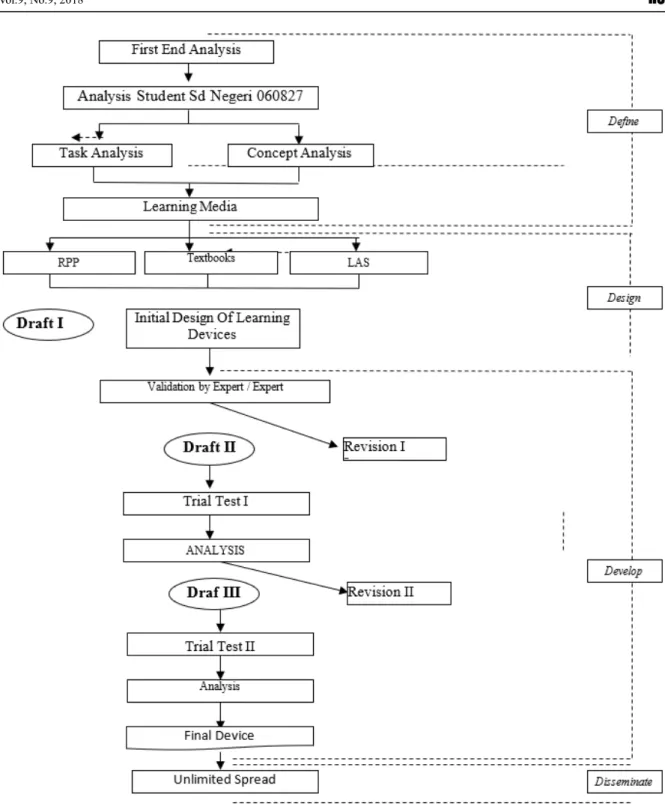
This research is divided into two stages, namely the first stage is the development of learning tools. Development of learning tools includes the validity of the learning implementation plan, the validity of textbooks, the validity of the student activity sheet, and the creative thinking skills test. The second stage is the implementation of learning tools that have been validated to see their effectiveness.The development of learning tools in this research refers to the model of learning device development according to Thiagarajan, semmel and semmel (in Trianto, 2011: 189), 4-D models consisting of 4 stages, i.e. define, design, develop and disseminate. For the development of this research is schematically illustrated in Figure 3.1 below:
Figure 3.1. Learning Device Development Chart of Model 4-D (modified from Trianto, 2011)
Research instruments and data collection techniques were developed to measure the validity and effectiveness of the development of learning tools with discovery learning. The instruments used in this study were the Learning Device Validation Sheets (Lesson Plan and Textbooks ), student activity sheets, teacher observation sheets managing the lesson , a student response questionnaire. Quantitative data obtained from the implementation of tests that include: pretest score data, and posttest score data. Qualitative data include student activity data during learning process with discovery learning model, and student attitude data on learning discovery learning after following learning.
III. Research Result
The results of the research should be the development of learning tools that meet the criteria and effective and this research is a developmental research so that the product of this research is a learning device that meets the
criteria of validity and effectiveness. Learning tools developed include textbooks, lesson plans and student activity sheets. Discovery learning aims to improve students' creative thinking skills math.
Data obtained from the test results I and II will be known whether the problem formulation and research questions raised have been answered or not. The results of data analysis obtained from experiments I and II show: (1) learning tools developed discovery learning valid; (2) learning discovery learning tools developed practically; (3) learning discovery learning tools developed effectively; (4) improvement of students' mathematical communication ability through learning discovery learning model developed; and (5) the improvement of students' creative thinking ability through learning discovery learning tools developed.
3.1. The Validity of Devices of Developed Discovery Learning
Based on the result of The Validity of Learning Devices of Developed Discovery Learning, it is obtained that Device of Model Discovery Learning is lesson Plan , Books, and Student Activity Sheet declared valid or have a good degree of validity. Furthermore, the validation of the test of mathematical creative thinking ability is also valid or has a good degree of validity. This demonstrates the Discovery Learning Tool developed lesson plan, Textbooks, students activity sheet, and creative thinking skills tests have met the criteria of validity. The criterion of validity is obtained through expert assessment of the developed Discovery Learning Tool. The acquisition of a valid learning device is caused by several factors, including: (1) developed Discovery Learning Tool has fulfilled the content validity. This means that in the development of Discovery Learning tool has been in accordance with the demands of the existing curriculum. This curriculum demands the competency standard and basic competency that students must achieve in learning activities that are tailored to the subject matter or content provided and adapted to the steps of Discovery Learning. The above is similar to the opinion of Arikunto (2012: 57) which states that, the validity of good content is when a learning device can measure certain specific goals parallel to the material or content of the given lesson. The validity of this content, also often referred to as the curriculum validity.
The developed Discovery Learning Tool has fulfilled the construct validity. That is, in the development of Discovery Learning tool has been in accordance with the concepts and indicators of the ability of creative thinking which is then combined with Discovery Learning (tailored to the characteristics and principles of Discovery Learning. Learning tool is compiled to complement between the Lesson Plans, Textbooks and Student Activity Sheets tailored to Discovery Learning Model Learning to measure the ability of mathematical creative thinking.
3.2. The practicality of Developed Discovery Learning Device
The data are obtained from the tests and questionnaires. The mathematics is given for mathematical disposition. In mathematical position, there is a difference of mathematical disposition in the whole group between groups of students who received guided inquiry learning with groups of students who received conventional learning (sig. 0,000 = 0.025). From the validation of expert team and student response, it can be concluded that learning tools are based on "practical" learning discretion to be used in learning.
3.3. The effectiveness of Developed Discovery Learning Device
Based on the results of experiments I and II, the developed discovery learning tools have met the effective category in terms of: (1) mastery learning students in classical; (2) student activity within the specified ideal time tolerance limit; (3) as well as students give a positive response to the learning device components developed. Every aspect of the above effectiveness is described as follows:
1. Students’ Learning Complete Classically
Based on the result of posttest analysis of experiment I and II, it is found that students' mathematical creative thinking ability has fulfilled the criteria of classical mastery. It is due to material and the problems that exist in textbooks and activity sheets developed in accordance with local culture and refer to learning discovery learning. With the application of these devices, students will be actively involved in finding concepts. This is reinforced by Vygotsky (Rusman, 2011: 244) i.e., learning based on the problem is an effort to connect new information with the cognitive structure that has been owned through learning activities in social interaction. Vygotsky (in Arends, 2008b: 47) adds social interaction with others both teachers and peers referring to the construction of new ideas and improves students' intellectual development. With appropriate challenges and help from more capable teachers and peers, students will progress to the zone of proximal development where new learning takes place. The above opinion, directs the student actively in the group and handles his duties so that effective classroom learning will further impact on student learning outcomes.
2. Student Activity
Based on data analysis on student activity in experiment I, it is found that three of the four categories of students' activities meet the ideal time criteria set and there is only one category of student activity that has not been fulfilled, the fifth activity category performs something that is not relevant to the learning. While in trial II, all
categories of student activities have met the percentage of ideal time. It can be concluded that the student activity using developed discovery learning device has met the effective criteria both in trial I and trial II.
The fulfillment of the ideal time criteria set for student activity through the application of learning discovery learning is supported by research conducted Marzuki (2012) states that the activities of students with problem-based learning is effective and meet all the criteria of activity and ideal time set when compared with student activity through learning directly
3. Students’ Response
Based on the data analysis of test results I and trial II, it is obtained the average percentage of student responses on each test is positive. This means that students give a positive response to the components of developed Discovery learning devices. The student response given in each trial has reached the predefined criteria category that is > 80%. This indicates that the developed Discovery Learning device meets the effective criteria in terms of student responses.
3.4. The Enhancement of Creative Thinking Ability Using Developed Discovery Learning Devices
The improvement of students' creative thinking ability is the fulfillment of the indicators of mathematical creative thinking toward better categories. It is line with the criteria established through the process of improving the development of teaching materials and reflection on the practice of learning. The improvement of creative thinking ability is influenced by learning device developed with discovery learning model. The integration of learning with the local culture can increase students' interest in mathematics. Thus, students will feel that mathematics is derived from him so that students have a positive attitude towards learning. Thus, improving the ability of mathematical creative thinking caused by learning tools developed Discovery Learning have a positive impact on improving the ability of creative thinking.
IV. Conclusions and recommendations
4.1. Conclusion
The development of learning devices based on discovery learning using Thiagarajan development model is aimed to improve the creative thinking ability of elementary school students at SD 060827 Medan Amplas. Where learning tools are produced in the form of Learning Implementation Lesson Plan, Textbooks, and Student Activity Sheet based on discovery learning, the learning process development process starts from the define, design, develop and disseminate stages. On this stage design obtained a learning device (draft I). Subsequently entered into the develop stage by validating draft I to the expert team of three experts and then draft II, after which the revision and experimentation test is done. The result is done by field testing and final device.
1. Discovery learning based learning device fulfills the requirements of the practitioner, namely: (1) validation results by experts, stating that the developed device can be applied in the field with little or no revision, (2) the results of interviews conducted to students about the developed learning devices can help and facilitate the students in the learning process, (3) Teacher activity in managing the learning done on field trial is in the "good" category. Thus, it can be concluded that discovery learning based learning tools that have been developed already meet the "practical" category.
2. Discovery learning based learning devices has fulfilled from the effective namely: (1) Student activity in the learning process is in good category. (2) students' mastery of creative thinking ability is said to be complete. Thus, it is concluded that discovery learning based learning device has met the "effective" category.
3. The ability to think creatively after using the developed discovery learning device has increased, it can be seen from the average rat ability of the test, the percentage of completeness in the classical as well as each measured indicator.
4.2. Suggestion
Based on the results of the research and the above conclusions, the researcher suggests the following:
1. Teachers can use discovery learning based learning devices as an alternative to math learning on fractional materials in the classroom.
2. There are four indicators in the ability to think creatively namely: fluency, flexibility, original and elaboration. The four indicators that have the smallest value is the elaboration indicator. Researchers suggest to advanced researchers and teachers, this indicator can help students build on existing ideas in solving problems so that they can solve problems in different ways.
3. For teachers who want apply discovery-learning-based learning tools on other subject matter in mathematics or to other appropriate lessons, may design or develop the necessary learning tools by taking into account the components of the learning model and the characteristics of the subject matter to be expanded.
References
Arastirmalari-Eurasian Journal of Educational Research, 35, 1-20.
Craft, A. (2003). The Limits To Creativity In Education: Dilemmas For The Educator. Depdiknas. (2006). Guidance on Selecting and Preparing Materials, Jakarta: Depdikbud.
Nieveen, N. (2007). Formative Evaluation in Education Design Research in An introduction to Educational Design Research (Ed). Presented at a seminar at East China Normal University, Shanghai, 23-26 November 2007.
Sinaga, B (2007). Development of Mathematical Learning Model Based on Batak Culture-Based Problems
(PBM-B). Surabaya: Universitas Negeri Surabaya (Report of Competitive Grant Research).
Wahyudiati, D. (2010). Development of Learning Aid Based on Discussion Learning Model on Energy Principles and Its Changes To Grow Scientific Attitudes. Journal of Educational Innovation, December 2010 Edition: 1-21.
Yannidah, N. (2013) .Development of Mathematics Learning Device with Aptitude Treatment Interaction Approach to the Effectiveness of Mathematics Learning. Journal of Mathematics Education, STKIP PGRI Sidoarjo, vol (I): 1-12.