University of Puget Sound University of Puget Sound
Sound Ideas
Sound Ideas
School of Occupational Master's Capstone
Projects Occupational Therapy, School of
5-2018
Utilizing the Cognitive Orientation to Occupational Performance
Utilizing the Cognitive Orientation to Occupational Performance
Approach For Improved Performance and Executive Functioning
Approach For Improved Performance and Executive Functioning
Casey Mendoza
University of Puget Sound Caitlin Mitchell
University of Puget Sound Emily Reynolds
University of Puget Sound
Follow this and additional works at: https://soundideas.pugetsound.edu/ot_capstone Part of the Occupational Therapy Commons
Recommended Citation Recommended Citation
Mendoza, Casey; Mitchell, Caitlin; and Reynolds, Emily, "Utilizing the Cognitive Orientation to Occupational Performance Approach For Improved Performance and Executive Functioning" (2018). School of
Occupational Master's Capstone Projects. 42. https://soundideas.pugetsound.edu/ot_capstone/42
This Article is brought to you for free and open access by the Occupational Therapy, School of at Sound Ideas. It has been accepted for inclusion in School of Occupational Master's Capstone Projects by an authorized administrator of Sound Ideas. For more information, please contact [email protected].
Running head: CO-OP FOR PERFORMANCE AND EXECUTIVE FUNCTION
Utilizing the Cognitive Orientation to Occupational Performance Approach
For Improved Performance and Executive Functioning
May 2018
This evidence project, submitted by
Casey Mendoza, Caitlin Mitchell, and Emily Reynolds
has been approved and accepted
in partial fulfillment of the requirements for the degree of
Master of Science in Occupational Therapy from the University of Puget Sound.
___________________________________
Project Chairperson: Jennifer Pitonyak, PhD, OTR/L, SCFES
_________________________________ ________________________________ OT635/636 Instructors: George Tomlin, PhD, OTR/L, FAOTA; Renee Watling, PhD, OTR/L,
FAOTA
________________________________________
Acting Director, Occupational Therapy Program: Anne B. James, PhD, OTR/L, FAOTA
_________________________________________ Dean of Graduate Studies: Sunil Kukreja, PhD
Key words: Cognitive Orientation to Occupational Performance, Intellectual Disability, Direct Instruction, Executive Functioning
CO-OP FOR PERFORMANCE AND EXECUTIVE FUNCTION 2
Abstract
The Outreach Program (TOP) in the Kent School District assists young adults in their transition from high school to adulthood. The research team and Dr. Abbott, an occupational therapist at TOP, sought to address whether better outcomes when teaching instrumental activities of daily living (IADLs) to adolescents with intellectual disabilities occur when
addressing underlying performance skills and client factors through the Cognitive Orientation to Occupational Performance (CO-OP) approach or when addressing them through traditional occupational therapy practices. There is strong evidence to support CO-OP as an effective strategy to improve performance and moderate evidence indicating that it improves executive functioning and cognitive flexibility for a variety of diagnoses. We recommend CO-OP be integrated into traditional therapy practices and that additional research is conducted to explore group implementation and include more diagnoses.
Student researchers developed and presented an inservice presentation on the use and implementation of CO-OP in the school setting. An opportunity to receive Competency
Assessment Units for NBCOT certification renewal through participation in a study group was provided during the inservice presentation to occupational therapists in Kent School District. Outcomes of this presentation were monitored through a survey to gain an understanding of whether the occupational therapists present would consider implementing CO-OP in their everyday practice. The findings suggest that the majority of people who attended the inservice presentation were interested in seeking more information regarding CO-OP without participating in the NBCOT study group. Additional research in the form of a scoping review is recommended in order to investigate what approaches best support developing autonomy and independent problem-solving in adolescents with intellectual disabilities.
CO-OP FOR PERFORMANCE AND EXECUTIVE FUNCTION 3
Executive Summary
At the beginning of the year, the student researchers sought to investigate the following research question: When teaching adolescents with intellectual disabilities instrumental activities of daily living (IADLs), does the CO-OP model or direct instruction facilitate faster skill
acquisition? Throughout the research process, the question developed to compare the CO-OP approach to traditional occupational therapy practice. While there is strong evidence to support CO-OP as an effective strategy to improve perceived performance in client-determined goals as reported on the Canadian Occupational Performance Measure (COPM), there is mixed evidence to support that the CO-OP approach also improves client satisfaction with their performance. There is moderate evidence indicating that this approach improves executive functioning and cognitive flexibility, which may explain the mixed evidence found regarding client satisfaction levels of performance. It has been hypothesized that as insight increases, satisfaction decreases. Limited evidence was found to support improvement of occupational performance through direct instruction in occupational therapy treatment.
The CO-OP approach provides consumers a unique opportunity to collaborate and receive semi-structured guidance from the occupational therapist while completing both familiar and unfamiliar tasks that are important to them. Due to this opportunity for collaboration,
consumers can expect to take a more active role in their treatment by learning how to assess their own motor movement to improve performance; open collaboration between consumer and practitioner also prioritizes the client’s culture, values, and goals for treatment, allowing for optimal client-centered care. However, a balance between consumer decision-making autonomy and practitioner support needs to be considered when implementing this approach in order to achieve the best outcomes for each individual consumer. Practitioners can also expect for this
CO-OP FOR PERFORMANCE AND EXECUTIVE FUNCTION 4
approach to be effective in teaching IADL and activities of daily living (ADL) skills to
individuals with cognitive dysfunction. Additional research is necessary to compare the CO-OP approach with other established teaching approaches beyond typical occupational therapy, and to determine ideal group-size, length of session, and amount of sessions needed for CO-OP to remain effective. Further research also needs to be implemented to determine the cause for decreased ratings of client satisfaction post CO-OP intervention.
Through our research, we conclude that CO-OP is an appropriate and effective approach for many diverse populations seen in occupational therapy, including those with stroke,
developmental coordination disorder, and cerebral palsy. Implementation of the principles of the CO-OP approach into everyday practice can be done easily and can promote client-centered care. However, we recommend that practitioners consider the individual needs of their clients and the balance of decision making autonomy and client support during intervention.
To complete the knowledge translation of this research, the student researchers gave an inservice presentation to 19 practicing occupational therapists in the Kent School District regarding the implementation of the CO-OP approach into the school system. The student researchers also made the presentation available online to increase dissemination of the information. Student researchers conducted a survey to assess the occupational therapists’ likelihood of implementation of CO-OP strategies in an effort to determine barriers to
implementation. Ten occupational therapists said that they were very likely to implement CO-OP strategies and nine reported that they were somewhat likely to implement CO-OP strategies. Several attendees remarked upon how appropriate the CO-OP approach could be in addressing their student’s goals.
CO-OP FOR PERFORMANCE AND EXECUTIVE FUNCTION 5
CRITICALLY APPRAISED TOPIC (CAT) PAPER
Focused Question:
When teaching IADLs to adolescents with intellectual disabilities, do better outcomes occur when addressing underlying performance skills and client factors through the CO-OP approach or when addressing them through traditional occupational therapy
practices?
Collaborating Occupational Therapy Practitioner:
Barbara Abbott, DOT OTR/L
Prepared By:
Casey Mendoza, Caitlin Mitchell, Emily Reynolds
Chair:
Renee Watling, PhD, OTR/L, FAOTA
Course Mentor:
Jennifer Pitonyak, PhD, OTR/L, SCFES
Date Review Completed:
11/14/2017
Clinical Scenario:
The Outreach Program (TOP), in the Kent School District, serves young adults ages 18-21 in developing life and employment skills to assist them in their transition from high school to adulthood. Dr. Abbott serves as the only full-time occupational therapist in TOP where she addresses the individual needs of more than 30 adolescents transitioning out of highschool. Due to her desire to address broader intervention needs with her students in a limited amount of time, Dr. Abbott must implement the most effective method for improving IADL skills. Additionally, Dr. Abbott has observed challenges for some of her students in IADL skill acquisition with direct instruction alone, causing her to seek other strategies, such as visual schedules. Due to the need for multiple strategies, she has begun to implement the CO-OP approach to determine its efficacy in improving functional performance.
CO-OP FOR PERFORMANCE AND EXECUTIVE FUNCTION 6
Review Process
Procedures for the selection and appraisal of articles
Inclusion Criteria:
Articles published between 1997 and 2017; individuals with diagnoses in addition to intellectual disabilities such as traumatic brain injury, autism spectrum disorder, and Alzheimer’s; articles that have adults, teenagers, adolescents, and children participants; articles that examine the instruction of ADLs and IADLs; those that examine the effectiveness of direct instruction or the CO-OP approach regardless of what outcomes are being studied; and articles that are intervention-based.
Exclusion Criteria:
Articles published before 1997; articles that were not peer reviewed; articles that are theory-based; posters and brief reports. When reference tracking articles, pilot studies were excluded due to their preliminary nature. Additionally, articles by the same authors that were initially pilot studies and then replicated into studies of higher rigor were excluded.
Search Strategy
Categories Key Search Terms
Patient/Client Population Adolescents
Intervention (Assessment) Cognitive Orientation to Occupational Performance (CO-OP)
Comparison Traditional Occupational Therapy Practice
Outcomes Improved performance in Instrumental Activities of Daily Living (IADLs) and Activities of Daily Living (ADLs)
Databases and Sites Searched
PubMed
CO-OP FOR PERFORMANCE AND EXECUTIVE FUNCTION 7
CINAHL
ERIC
EBSCOHost
Quality Control/Review Process:
The student researchers met with Dr. Abbott to formulate a research question.After discussing the needs of her transition program, the students and collaborating practitioner agreed upon a research question that would explore the evidence in support of the CO-OP approach. Dr. Abbott stated in the initial meeting that she would like to compare this approach to that of “direct instruction”. The student clinicians requested more
information regarding her interest in the CO-OP approach as compared to direct instruction and Dr. Abbott confirmed that her interest was specifically in evidence regarding use of the CO-OP approach as a teaching method and as direct evidence to justify advanced training and her professional development. The student researchers then collaborated to determine the 5 databases mentioned above within occupational therapy and tangentially question-specific fields, such as education and psychology, to narrow the initial search. The criteria excluded non peer-reviewed articles as well as posters and brief reports in order to promote well researched literature. Searching these databases allowed the student researchers to develop a broader search of relevant literature in various disciplines. In searching through these databases, literature addressing specific “direct instruction” was limited, however, studies did compare the CO-OP approach with traditional occupational therapy practice. The list of search terms was reviewed by two occupational therapy faculty members at the University of Puget Sound specialized in pediatrics and determined to be a thorough list of search terms.
Comprehensive searches of PsycINFO, PubMed, CINAHL, EBSCOhost and ERIC returned 430 results, with an additional 207 initial hits from citation tracking and 328 initial hits from reference tracking. Of those initial 430, 48 were selected for more thorough review, and of those, 24 were excluded; the remaining 24 were kept and included in this analysis. The 24 were excluded because they either did not measure the intended outcomes, were populations that did not meet our inclusion criteria, or were not published within the last 20 years. Of the 207 hits from citation tracking, 183 were excluded for not meeting the inclusion criteria. Of the remaining 24 articles, 21 were duplicates and 3 were included in the final analysis and added to the table to total 27 articles. Additionally, of the 328 hits from reference tracking, 300 were excluded for not meeting inclusion criteria; the remaining 28 articles found from reference tracking were duplicates of studies previously entered into the table.
CO-OP FOR PERFORMANCE AND EXECUTIVE FUNCTION 8
Three student researchers conducted the searches, reviewed results, and collaborated to reach consensus if uncertain whether to include or how to classify an article. The student researchers also worked collaboratively with two occupational therapy faculty advisors in developing the language and concepts to complete this initial search. Finally, the collaborating practitioner, Dr. Abbott, helped to focus and narrow the strategy.
Results of Search
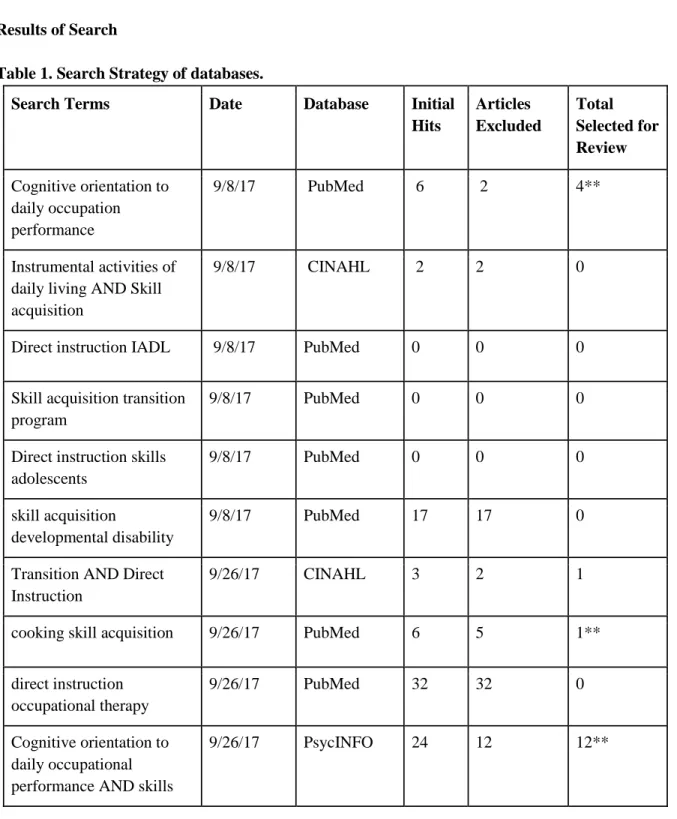
Table 1. Search Strategy of databases.
Search Terms Date Database Initial Hits Articles Excluded Total Selected for Review Cognitive orientation to daily occupation performance 9/8/17 PubMed 6 2 4** Instrumental activities of daily living AND Skill acquisition
9/8/17 CINAHL 2 2 0
Direct instruction IADL 9/8/17 PubMed 0 0 0
Skill acquisition transition program
9/8/17 PubMed 0 0 0
Direct instruction skills adolescents
9/8/17 PubMed 0 0 0
skill acquisition
developmental disability
9/8/17 PubMed 17 17 0
Transition AND Direct Instruction
9/26/17 CINAHL 3 2 1
cooking skill acquisition 9/26/17 PubMed 6 5 1**
direct instruction occupational therapy
9/26/17 PubMed 32 32 0
Cognitive orientation to daily occupational performance AND skills
CO-OP FOR PERFORMANCE AND EXECUTIVE FUNCTION 9
direct instruction in special education AND skills training
9/26/17 PsycINFO 4 3 1
direct instruction cooking 9/26/17 PubMed 3 3 0
occupational therapy skill acquisition adolescents 9/2617 PubMed 6 6 0 adolescent transition programs occupational therapy 9/26/17 PubMed 10 10 0 adolescent transition programs AND occupational therapy 9/26/17 PsycINFO 1 1 0
skill acquisition AND transition programs
9/26/17 PsycINFO 7 7 0
cooking skill acquisition 10/4/17 CINAHL 0 0 0
cooking skill acquisition 10/4/17 ERIC 1 0 1
Cognitive orientation to daily occupation performance 10/4/17 ERIC 0 0 0 Cognitive orientation to daily occupation performance 10/4/17 CINAHL 2 1 1**
direct instruction cooking 10/12/17 CINAHL 0 0 0
direct instruction cooking 10/12/17 ERIC 0 0 0
direct instruction occupational therapy 10/12/17 ERIC 0 0 0 direct instruction occupational therapy 10/12/17 CINAHL 0 0 0
direct instruction AND occupational therapy
CO-OP FOR PERFORMANCE AND EXECUTIVE FUNCTION 10
direct instruction AND occupational therapy
10/12/17 ERIC 2 2 0
direct instruction in special education AND skills training
10/12/17 CINAHL 0 0 0
direct instruction in special education AND skills training
10/12/17 ERIC 3 3 0
"direct instruction" AND "CO-OP"
10/12/17 ERIC 1 1 0
"direct instruction" AND "CO-OP"
10/12/17 CINAHL 0 0 0
direct instruction effectiveness
10/12/17 CINAHL 3 2 1**
skill acquisition transition program
10/15/17 PsycINFO 1 1 0
occupational therapy skill acquisition adolescents 10/15/17 PsycINFO 0 0 0 cognitive orientation to daily occupation performance skill acquisition 10/15/17 PubMed 0 0 0
occupational therapy skill acquisition adolescents 10/15/17 PyscINFO 0 0 0 Cognitive orientation to daily occupational performance 10/15/17 PsycINFO 1 0 1**
skill acquisition AND developmental disability
10/15/17 PsycINFO 155 155 0
skill acquisition transition program
10/15/17 CINAHL 1 1 0
skill acquisition transition program
CO-OP FOR PERFORMANCE AND EXECUTIVE FUNCTION 11
skill acquisition transition program AND intellectual disability
10/15/17 ERIC 0 0 0
skill acquisition transition program AND intellectual disability
10/15/17 CINAHL 0 0 0
occupational therapy skill acquisition adolescents
10/15/17 CINAHL 0 0 0
occupational therapy skill acquisition adolescents
10/15/17 ERIC 0 0 0
CO-OP bibliography 10/15/17 http://co-opacademy.c a/
46 29 17
Direct Instruction AND Skill Acquisition
11/2 EBSCOhost 7 6 1
Money management AND CO-OP
11/2 EBSCOhost 1 1 0
Cooking AND CO-OP 11/2 EBSCOhost 3 3 0
IADL AND Cognitive Orientation
11/2 EBSCOhost 3 2 1
Skill acquisition AND CO-OP Approach
11/2 EBSCOhost 12 11 2 (1**)
Skill Acquisition AND Direct Instruction
11/2 EBSCOhost 64 63 1
Total number of articles found = 44
Total number of articles used in review from database searches = 24 **Duplicate articles = 20
Table 2. Articles from citation tracking.
Article Date Database Initial
Hits Articles Excluded Total Selected for Review Cognitive orientation to daily occupational 10/19/17 EBSOhost 34 29 5 (3**)
CO-OP FOR PERFORMANCE AND EXECUTIVE FUNCTION 12
performance (CO-OP): A new approach for children with cerebral palsy. Cognitive orientation to daily occupational performance (CO-OP) as group therapy for children living with motor coordination difficulties: An integrated literature review 11/8/17 Google Scholar 1 1 0 Cognitive strategy use in school-aged children with developmental coordination disorder 11/8/17 Google Scholar 42 35 6 (5**) Cognitive orientation to daily occupational performance (CO-OP): A new approach for children with cerebral palsy 11/8/17 Google Scholar 4 1 3** Exploring inter-task transfer following a CO-OP approach with four children with developmental coordination disorder: A single subject multiple baseline design. 11/8/17 Google Scholar 0 0 0 Occupation-based strategy training for adults with traumatic brain injury: A pilot study 11/8/17 Google Scholar 27 26 1**
CO-OP FOR PERFORMANCE AND EXECUTIVE FUNCTION 13 Using the cognitive orientation to occupational performance (CO-OP) with adults with executive dysfunction following traumatic brain injury 11/8/17 Google Scholar 71 64 7** Effectiveness of CO-OP on children with cerebral palsy: A mixed design 11/8/17 Google Scholar 0 0 0 Effects of computer-based video instruction on the acquisition and generalization of grocery purchasing skills for students with intellectual disability 11/8/17 Google Scholar 1 1 0 Cognitive approach to improving participation after stroke: Two case studies
11/8/17 Google Scholar
27 25 2**
Total number of articles found from citation tracking = 24 Total number of articles used in review from citation tracking = 3 **Duplicate articles = 21
Table 3. Articles from reference tracking.
Article Date Articles
Referenced
Articles Excluded
Total Selected for Review
Cognitive orientation to daily occupational performance
CO-OP FOR PERFORMANCE AND EXECUTIVE FUNCTION 14
OP) as group therapy for children living with motor coordination difficulties: An integrated literature review. Cognitive strategy use in school-aged children with developmental coordination disorder.
11/12/17 28 28 0
Cognitive orientation to daily occupational performance (CO-OP): A new approach for children with cerebral palsy.
11/12/17 39 35 4**
Using the cognitive orientation to occupational performance (CO-OP) with adults with executive dysfunction following traumatic brain injury
11/12/17 52 52 0
Effectiveness of CO-OP on children with cerebral palsy: A mixed design
11/12/17 44 38 6**
Cognitive approach to improving participation after stroke: Two case studies.
11/12/17 40 36 4**
‘There's a real plan here, and I am responsible for that plan’: Participant
experiences with a novel cognitive-based treatment approach for adults living with chronic stroke.
11/12/17 41 36 5**
Inter-task transfer of
meaningful, functional skills following a cognitive-based treatment: Results of three multiple baseline design experiments in adults with chronic stroke.
11/12/17 41 34 8**
Total number of articles found from reference tracking = 29 Total number of articles used in review from reference tracking = 0
CO-OP FOR PERFORMANCE AND EXECUTIVE FUNCTION 15
**Duplicate articles = 29
Total number of articles used in review from database searches = 24 Total number of articles used in review from citation tracking = 3 Total number of articles used in review from reference tracking = 0 Total number of articles used in review from UPS Master’s Thesis = 0 Total number of articles used in CAT = 27
Summary of Study Designs of Articles Selected for the CAT Table
Pyramid Side Study Design/Methodology of Selected Articles Number of Articles Selected
Experimental ___Meta-Analyses of Experimental Trials _4_Individual Randomized Controlled Trials _1_Controlled Clinical Trials
_7_Single Subject Studies
12
Outcome ___Meta-Analyses of Related Outcome Studies ___Individual Quasi-Experimental Studies _2_Case-Control Studies
_8_One Group Pre-Post Studies
10
Qualitative ___Meta-Syntheses of Related Qualitative Studies ___Small Group Qualitative Studies
___brief vs prolonged engagement with participants
___triangulation of data (multiple sources) ___interpretation (peer & member-checking) _X_a posteriori (exploratory) vs a priori (confirmatory) interpretive scheme
_1_Qualitative Study on a Single Person
CO-OP FOR PERFORMANCE AND EXECUTIVE FUNCTION 16
Descriptive _3_Systematic Reviews of Related Descriptive Studies
___Association, Correlational Studies
___Multiple Case Studies (Series), Normative Studies
_1__Individual Case Studies
4
Comments:
X - McEwen, Polatajko, et al. (2010) rigor methods AOTA Levels I- 6 II- 4 III- 6 IV- 9 V- 2 TOTAL = 27
CO-OP FOR PERFORMANCE AND EXECUTIVE FUNCTION 17
Tables Summarizing COPM Outcome Measure
Quantitative Articles Author, Year, Journal Abbreviation, Country Study Objectives Study Design, Level of Evidence, PEDro score Participants: Sample Size, Description, Inclusion and Exclusion Criteria
Interventions & Outcome Measures
Summary of Results Study Limitations
Cameron, Craig, et al.
2016
Phys. & Occ. Therapy in Peds Canada Examine feasibility of CO-OP for children w/ CP and determine effects of CO-OP compared to CUPA. Pilot RCT I E2 8/10 N = 18
In: 7-12 yo, dx of CP, rated level I, II, or III on
GMFCS, typical intelligence,
typical/corrected to typical hearing and vision,
sufficient language skills to communicate.
Ex: previously received or currently receiving cognitive tx, used AAC, regularly received BOTOX during intervention. Tx: 10 1hr/wk sessions at home. CO-OP: n = 9, CUPA: n = 9. O: COPM and PQRS. KBIT-2, GMFCS used as screening tools; self-efficacy probe used to track freq of + and neg self-statements.
CO-OP participants met all set goals, demonstrating perf imp in tasks. CO-OP and CUPA promoted skill acquisition and maintenance at follow-up. CO-OP: small effect size (d = 0.32) at time 2 over CUPA perf on COPM. CUPA: med effect (d = 0.4) at time 3 over CO-OP for COPM sat.
Small sample size led to low statistical power. No statistical sig between group difference likely due to Type II error. Lack of other interventions and similarities in the underlying methods of each intervention may have caused contamination between 2 txs. Polatajko, McEwen, et al. 2012 AJOT US Compare effect of CO-OP vs standard OT in performance on goals for post-stroke patients. Pilot RCT. I E2 7/10 N = 20 (M = 60.4 yo; 57.9% women). 12 participants w/d from study.
In: ≥ 6 mo post CVA, living in community, no more than min aphasia, NIHSS score ≤ 13; IQ ≥ 80.
Tx: 10 sessions CO-OP (n = 4) or standard OT (n = 4). Each group created own goals. O: goal performance measured by PQRS and COPM. CO-OP: ↑ in perf (U = 0.0, p = 0.02) on COPM compared w/ standard OT, but no sig difference in sat. CO-OP had + tx effect on PQRS and COPM perf.
Non-blinding of assessment
administration, high w/d rates, and high recruitment - to - enrollment ratio.
CO-OP FOR PERFORMANCE AND EXECUTIVE FUNCTION 18
Dawson, Binns, et al.
2013
Archives of Phys Med and Rehab US Determine effectiveness of CO-OP for changing behavior and whether far transfers occurred, including participation in everyday life. Partial RCT w/ pre and post Tx assessments masked to tx. II E3 8/10 N =13 w/ TBI.
In: ≤ 1 yr post-TBI, ≥ 18yo, English speaker, no other sig neuro or psych hx, evidence of ED on testing, and able to identify specific day-to-day difficulties. Exclusion: not stated
Tx: CO-OP 1hr, 2x/wk for 10wks (n = 7), control (n = 6).
O: COPM, Dysexecutive Questionnaire, M2PI, Participation Index, and AMPS.
CO-OP ↑ far transfer on COPM perf (p = .04,
d = 1.33) and sat (p = .03, d = 1.53) for untrained goals and ↑ on participation (M2PI) (p = .01, d = 1.82).
Small sample size limits generalizability. Poulin, Korner-Bitensky, et al. 2017 Disability and Rehab Canada Examine feasibility and preliminary efficacy of occupation - based strategy training using adapted CO-OP compared to computer-based training. Pilot single blind partial RCT. II E2 8/10 N= 12 (attrition = 2). In: dx of first or recurrent CVA w/in 12 mo, evidence of ED, living at home, proficient in
English/French, able to identify day-to-day difficulties.
Exclusion: hx of severe psych problems, severe uncorrected visual problems, post-stroke language problems, pre-existing disabling neuro functions.
Tx: CO-OP (n = 6) or computer training (n = 5) 2x/wk for 8 wks. Computer group had 4 computer tasks using NeuroActive
software.
O: COPM; mod LIFE-H.
Both CO-OP and computer Tx had sig sat in COPM. Both groups had clinically sig ↑ in perf and sat. Both groups ↑ self-efficacy and reduced impact of ED symptoms. No sig between group differences on outcomes.
Small sample size, absence of control group, inability to randomize 2
participants, and some + changes could be due to spontaneous recovery. Rodger, & Brandenburg 2008 AOTJ Australia Examine 2 case studies of children w/ AS to assess effectiveness of CO-OP. Case study w/ pre-post- test. II O4 5/6 N = 2 (siblings). Alice: 11:5 yo girl; Bob: 9:6 yo boy. In: 5-12 yo, dx of AS, avg intelligence.
Exclusion: Not stated
Tx: CO-OP approach for 10 sessions 1hr/wk. O: COPM, VABS Scales, PQRS, and M-ABC.
Alice: clinically sig ↑ in perf, but not sat in using cutlery, tying shoes, and styling hair. Bob: clinically sig ↑ in communication on VABS; ↑ perf and sat in all 5 goals on COPM.
Small sample size and the participants were siblings. Same therapist provided Tx to both children, creating potential bias.
CO-OP FOR PERFORMANCE AND EXECUTIVE FUNCTION 19 Ghorbani, N., Rassafiani, M. et al. 2017 Research in Developmental Disabilities Iran Determine whether CO-OP improves motor skills and achievement in motor-based occupational perf goals in children w/ CP. Mixed: Multiple baseline and 1 group pre/post- test. III E4 4/7 N = 5.
In: 7-9 yo, CP, level I, II, III on GMFCS; Level I, II, III on MACS, motor perf problems in ADLs, IQ ≥ 85, no visual/hearing problems. Attrition = 1 due to surgery.
Exclusion: Not stated
Tx: Total of 12 CO-OP sessions, 45-60 min 2x/wk. Children divided into 3 groups on the basis of when they started tx according to baseline period. O: BOTMP. COPM and GAS to measure goals.
CO-OP improved motor perf for children w/ CP in level I of the GMFCS and levels I, II, III of the MACS. Perf and sat ↑ for all participants on COPM ≥ 2. All dimensions of BOTMP sig ↑ in CO-OP.
Small sample size limits generalizability. 1st edition BOTMP used because of limited access to 2nd edition. Henshaw, Polatajko, et al. 2011 AJOT US Investigate use of CO-OP w/adults post stroke. 2 in-depth case studies III O3 3/6 N = 2 African- American females
In: mild-mod CVA (≤ 13 on NIHSS), ≥40 yo, 6-18 mo poststroke, English speaking, informed consent, 3 client-identified goals
Ex: severe mental illness other than depression, global aphasia in acute setting, severe language impairment, dementia or tactile neglect, severe impairment in gen intellectual functioning, concurrent neuro dx, current drug/ alcohol abuse, receiving rehab or in other studies.
Descriptive and pre-post measures administered by an ind-tester. Response tracking and pre-post Tx measures administered throughout and before/ after Tx. Posttest measures re-administered by third-party rater. COPM, PQRS and post - Tx interview conducted by Henshaw.
Themes in using CO-OP: impact of motivating goal; customized guidance, structure, and support; resistance to new approach; impact of rapport; social support. Perf and sat on COPM ↑ from pre- to posttest for each goal except for third goal. Clinically sig imp for all goals for one participant and for all but one goal for second participant. Statistical sig is debatable. No participants w/ severe ID - limiting transfer of results to that pop. Participants were
African-American females (65 and 70 yo); case study limits determination of causality or
generalization of results to wider pop. PQRS was rated by treating therapist instead of an objective third-party. Lack of follow-up.
CO-OP FOR PERFORMANCE AND EXECUTIVE FUNCTION 20 McEwen, Polatajko, et al. 2010b Neuropsych Rehab Canada Investigate whether CO-OP improves perf in trained and untrained self-selected skills in adults w/ CVA. Single case, multiple baseline, ABABABA B. III O4 4/7 N = 3.
In: recruited upon discharge from outpt CVA program; motivated to participate in research; ≥ 1yr post - CVA, living in the community, min score of 24/30 on MMS Exam. 5 recruited, 2 w/drew due to illness. Ex: Not stated
Tx: CO-OP for perf on 3 trained and 1 untrained skills.
O: health status, self-efficacy, motor control, and UE activity; PQRS, COPM, SIS, RNLI, MAL,
SSEMCD, ASBCS, and Chedoke-Mcmaster Stroke Assessment.
COPM perf sig ↑ on 9/9 trained skills and 2/3 untrained skills at post- and 1 mo follow-up. COPM ↑ in sat on all trained and
untrained skills (12/12) at both post- and 1 mo follow-up.
Small sample size. During baseline phase there was a trend toward perf ↑ which reduces the certainty that perf ↑ was related to CO-OP Tx.
Missiuna, DeMatteo, et al.
2010
Phys & Occ Therapy in Peds Canada Determine if CO-OP is associated w/ functional perf changes in children w/ ABI and whether changes are maintained after 4mo. One-group pre-post study III O4 5/6 N = 6
In: 6-15 yo, initial GCS w/in mild-mod range (9-15), attending school full-time w/o full-full-time edu assistant, scores ≤ 5 on 2 or more sections of SFA. Ex: Not stated
Tx: 10 CO-OP sessions 1hr/wk. O: COPM or PEGSS, PQRS, and VABS.
All participants had sig ↑ in perf & sat on COPM post-Tx and at 4mo follow-up (p < .01). ↑ on VABS (p < .01), and PQRS (p < .01).
Small sample size and heterogeneity in sample. Thornton et al. 2016 Disability and Rehab UK Determine if 10 wk group-based CO-OP intervention improved outcome measures across impairment, activity, and participation levels of ICF framework. Quasi - experimental , pre-post-test. III O4 7/7 N = 20 male children 8-10 yo w/ dx of DCD from DSM-IV.
Ex: Not stated.
Tx: 10 wk CO-OP group Tx (n = 10) or regular activity (n = 10).
O: MABC-2, COPM, and GAS.
Children in CO-OP group had ↑ in impairment, activity, and participation outcomes. ↑ parent and child perf and sat on COPM.
Results are limited to boys with DCD and focused on fine motor tasks. Lack of follow-up.
CO-OP FOR PERFORMANCE AND EXECUTIVE FUNCTION 21 Capistran, & Martini 2015 Human Movement Science Norway Determine whether CO-OP leads to improved perf in untrained tasks. Single subject, ABA, multiple baseline across skills, w/ 3 replications. IV E4 4/7 N = 4 children w/ DCD (7-12 yo). In: motor perf difficulties co-occurring w/ attention deficit and/or language difficulties. Ex: previously treated w/ CO-OP, presently receiving cognitive Tx, or not able to engage in therapy due to behavioral issues.
Tx: 10 CO-OP sessions on 3 tasks w/ a 4th identified but not worked on to verify transfer. Global strategies used w/ guided discovery to identify DSS.
O: Perf rated over 4 phases using PQRS, DCDQ-FC, MABC-2, TONI-4, COPM. Caregiver logbook describe use of CO-OP at home.
Sig imp 11/12 trained tasks and 2/4 untrained tasks. Statistically sig change at post for 10 tasks. At follow-up 10 tasks maintain
statistically sig change. When transfer not found, parents reported that global strategy use at home was limited.
Low number of repetitions of tasks for some phases made it difficult to verify auto - correlation. Level of parental involvement was impossible to control. First author did both tx and the analysis, increasing the possibility of bias. Dawson, & Gaya 2009 CJOT Canada Test applicability of CO-OP for adults with ED from TBI. Pilot case series design IV O4 4/6 N = 3 w/ TBI and ED + SO familiar w/ their needs. In: complicated mild, mod, or severe TBI, > 1 yr prior, no concurrent depression, > 18yo, ED, ability to identify goals. SO must be close friend or family, at least 18 yo, willing to learn CO-OP. Ex: Not stated.
Tx: 20 CO-OP training sessions and 3 mo follow-up
O: COPM.
Perf on 7/9 trained and 4/7 untrained goals ↑ post tx and 7/9 untrained and 3/7 untrained ↑ at 3-mo follow-up.
7/9 trained goals and 7/7 untrained goals ↑ sat post-tx; 7/9 trained and 3/7 untrained goals ↑ sat at 3-mo follow-up.
Participants had difficulty identifying goals and some untrained goals required add’l intervention not addressed w/ CO-OP alone. Discrepancy between self-report and SO report. Ng, Polatajko, et al. 2013 Brain Injury Canada Investigate feasibility of CO-OP in telerehab for adults w/ TBI in 3/5 client directed goals. Pilot series 3 case studies w/ 3 mo follow-up IV O4 3/6
N = 3 w/ TBI and their SO (parent or spouse)
In: > 18 yo, > 1 yr post-TBI, no concurrent depression, high speed internet access, ED, and self-identify goals. Ex: Not stated.
Tx: 1hr sessions: telerehab CO-OP instruction 2x/wk for 10wks.
O: Adherence to 7 principles of CO-OP; COPM perf and sat: pre/post; 3 mo follow-up.
All adhered to most CO-OP strategies. COPM perf: 5/10 sig ↑ on trained goals at post-tx; 5/6 ↑ at follow-up. 2/8 sig ↑ on untrained goals at post-; 4/6 ↑ at follow-up.
Missing some follow-up data. High speed internet inclusion criteria limits reach of study. Limited observation of perf to assess and provide feedback.
CO-OP FOR PERFORMANCE AND EXECUTIVE FUNCTION 22 Phelan et al. 2009 CJOT Canada Investigate use of CO-OP w/ individuals w/ PDD. Single case design, ABA IV E4 1/3 N = 2 males. Child A: 9 yo w/ AS Child B: 10 yo w/ ASD. In: dx of ASD or AS w/ good verbal communication skills; 7-14 yo; identified motor difficulties and perf problems; child and parental consent. Ex: limited verbal communication.
Tx: CO-OP 1hr 1x/wk 10 sessions teaching Goal- Plan- Do- Check strategy applied to client chosen tasks.
O: PQRS, COPM.
General trend of improved perf w/ chosen goals on PQRS and single-case data graph. All goals in COPM reached clinically sig ↑ in perf and sat.
Small sample size. Limits generalizability across the population. Visual trend analysis of the data only.
Taylor, Fayed, et al. 2007 OTJR: Occupation, Participation and Health Canada Determine effectivenes s of CO-OP w/ young children (5-7 yo) Experimental single case design, ABA IV E4 3/7 N = 4 boys (5-7 yo) In: DCD movement impairment profile consistent w/ DSM IV, typical intelligence, intact hearing and vision or correct to normal vision and hearing, both child and parent provide consent. Ex: not stated
Tx: CO-OP for 10 40-60 min sessions on 3 child-identified target goals. O: COPM and PQRS pre-/post-test. Videotaped observational data for 3 repetitions of target goals, scored using PQRS.
All showed imp in chosen tasks and reported ↑ in perceived perf on COPM. Parent, child and therapist ratings of ↑
performance indicates that CO-OP is suitable for 5-7 yo children.
Caution in generalizing single-case study results. Study did not have a comparison tx or control group. Slight modifications to the administration of CO-OP measures were necessary w/ younger children. Skidmore, Holm, et al. 2011 Neuropsycholog ical Rehab US Examine feasibility of administerin g CO-OP during inpt rehab. Case report V D4 2/3 N = 1 (31 yo) male w/ mild-mod severe embolic CVA.
In: dx of acute CVA, impairment in EF (≥ 11 on EI), and written informed consent. Ex: Pre-existing disabling neuro condition, pre-existing cog
impairment, current sig immediate memory impairment, severe aphasia, major
depressive/bipolar/psychoti c disorder, and alcohol/
Tx: CO-OP for 45 min/day 5 days/wk for 14 days. O: COPM and the Pittsburgh Rehab and Participation Scale. ADL perf measured using the FIM and PASS.
Participant met own target perf quality rating for 4/8 participant identified goals. Demonstrated clinically meaningful ↑ in rehab engagement and ADL perf while receiving training.
Case study, not generalizable.
CO-OP FOR PERFORMANCE AND EXECUTIVE FUNCTION 23
substance abuse w/in the past 6 mo.
Key to Abbreviations (Alphabetical)
↑ = Increase; + = Positive; ABI = Acquired Brain Injury; Add’l = Additional; ADL = Activities of Daily Life; AJOT = American Journal of Occupational therapy; AMPS = Assessment of Motor and Process Skills; ASPCS = Activity Specific Balance Confidence Scale; AS = Asperger’s Syndrome; Avg = Average; B/c = Because; BOTMP = Bruininks-Oseretsky Test of Motor Proficiency Measure; CIHI = Canadian Institute for Health Information; COPM = Canadian Occupational Performance Measure; Cog = Cognitive; CO-OP = Cognitive Orientation to Occupational Performance; CUPA = Current Usual Practice Approach; CVA = Stroke; DKEFS = Delis-Kaplan Executive Function System; DCD = Developmental Coordination Disorder; DCDQ-FC = Developmental Coordination Disorder Questionnaire -French; DSS = Domain specific strategies; Dx = Diagnosis; Diff = Different; ED = Executive dysfunction; EF = Executive function; EI = Executive Interview; Ex = Exclusion; Freq = Frequency; FIM = Functional Independence Measure; GAS = Goal Attainment Scale; GCS = Glasgow Coma Scale; GMFCS = Gross Motor Function Classification Scale; Hr = Hour; hx = history; ICF = International Classification of Functioning, Disability and Health; Imp = Improvement; In = Inclusion; Ind = Independent; Inpt = Inpatient; KBIT-2 = Kaufman Brief Intelligence Test; LIFE-H =
Assessment of life habits; M2PI = Mayo-Portland Adaptability Inventory-4;Min = Minimum; MMS = Mini Mental State; MACS = Manual Ability Classification System; Mod = Moderate; Mo = Month; MAL = Motor Activity Log; M-ABC = Movement Assessment and Battery for Children; M-ABC-2 = Movement Assessment Battery for Children 2; Neg = Negative; NIHSS = National Institutes of Health Stroke Scale; O = Outcome; Outpt = Outpatient; PACS = Pediatric Activity Card Sort; PASS = Performance Assessment of Self-Care Skills; PEGSS = Perceived Efficacy and Goal Setting System; Perf = Performance; Pop = Population; PQRS = Performance Quality Rating Scale; RCT = Randomized Control Trial; Rehab = Rehabilitation; RNLI = Reintegration into Normal Living Index; Sat = Satisfaction; SFA = School Function Assessment; Sig = Significant; SIS = Stroke Impact Scale; SSEMCS = Stanford Self-Efficacy for Managing Chronic Disease; SO = Significant other; TBI = Traumatic Brain Injury; Tele-rehab = Telerehabilitation; TONI-4 = Test of Nonverbal Intelligence-4; Tx = Treatment; VABS = Vineland Adaptive Behavior Scales; Wk = Week; W/ = week; W/d = withdrawal; W/in = Within; Yr = Year; Yo = Years old
CO-OP FOR PERFORMANCE AND EXECUTIVE FUNCTION 24
Tables Summarizing COPM Outcome Measures
Meta-Analyses/Meta-Syntheses/Systematic Review Articles Author, Year, Journal Abbreviation, Country Study Objectives Study Design, Levels of Evidence of Studies
Number of Papers Included, Inclusion and Exclusion Criteria
Interventions & Outcome Measures
Summary of Results Study Limitations
Anderson, Wilson, et al. 2017 AOTJ Australia Explore evidence for CO-OP in group tx for children w/ motor coordination difficulties. Integrative literature review. I D1 1/3 6 articles (4 quantitative, 1 qualitative, and 1 mixed - method design).
In: articles relating to children w/ motor coordination difficulties and CO-OP Tx in group format. Theoretical, quantitative, qualitative, or mixed methods. Published in a peer-reviewed English journal. Ex: not specified.
Critical analysis done by McMaster Guidelines for Critical Review and CASP checklist. COPM used in 4/5 studies, CSQ used in 1/5, MABC used in 3/5 of studies as outcome measures.
One study found that at 4-6wk follow-up skills did not transfer. All using COPM reported clinical sig. Lack of sig outcomes w/ MABC. +
outcomes in self-rated perf and sat.
Limited number of studies included. Transferability of findings to other ped pop outside of those w/ movement coordination difficulties is limited. Scammell, Bates, Houldin, & Polatajko 2016 CJOT Canada Examine extent and nature of the literature on CO-OP. Systematic Review I D1 1/3
26 articles examining the application of CO-OP w/ 8 populations including: DCD, ASD, PDD, AS, and ABI.
Tx: CO-OP. O: COPM, PQRS All articles: effectiveness w/ CO-OP. + ↑ in perf on COPM and PQRS. Adaptations to format and session structure did not impede the effectiveness of the CO-OP approach and seemed to imp feasibility.
No critical appraisal done or any analysis of data from articles conducted.
CO-OP FOR PERFORMANCE AND EXECUTIVE FUNCTION 25 Weaver 2015 AJOT US Examine interventions addressing work, ADLs, IADLs, education, and sleep for people w/ ASD. Systematic review I D1 1/3 23 studies: 9 work, 11 ADL/IADL, and 3 edu-related tx.
In: peer- reviewed scientific literature published in English, Tx approaches w/in scope of OT, published between 2006-2013 and participants w/ ASD; studies of Level I, II, and III evidence (Level IV and V when higher level evidence not found).
Ex: data from presentations, conference proceedings, non-peer-reviewed research, dissertations and theses; Level IV and V evidence. COPM, qualitative analysis to determine imp of goals. Support for ADL/IADL Tx is variable w/
indications that CO-OP, SI, and contextual Txs may
↑ occupational perf. CO-OP is likely an effective Tx for ↑ ADL and IADL task perf among youth w/ ASD.
Overall mod evidence to support CO-OP w/ ADL/IADL goals.
A small number of studies, several lacked
methodological rigor, long-term outcomes, nonrandom assignment to groups, masked assignment and scoring, and comparison groups. Many studies used concurrent interventions and separating the effects of a single Tx may be difficult.
Key to Abbreviations (Alphabetical)
↑ = Increase; + = Positive; ABI = Acquired Brain Injury; Add’l = Additional; ADLs = Activities of Daily Living; AOTJ = Australian Occupational Therapy Journal; AS = Asperger’s Syndrome; ASD = Autism Spectrum Disorder; CJOT = Canadian Journal of Occupational Therapy; COPM = Canadian Occupational Performance Measure; CO-OP = Cognitive Orientation to Occupational Performance; CSQ = Coordination Skills Questionnaire; DCD = Developmental Coordination Disorder; Edu = Education; Ex = Exclusion; Imp = Improvement; In = Inclusion; IADLs = Instrumental Activities of Daily Living; MABC = Movement Assessment Battery for Children; Ped = Pediatric; Perf = Performance; PDD = Pervasive developmental disorder; Pop = Population; PQRS = Performance Quality Rating Scale; Tx = Treatment; Sig = Significance
CO-OP FOR PERFORMANCE AND EXECUTIVE FUNCTION 26
Tables Summarizing Executive Functioning Outcome Measure
QuantitativeArticles Author, Year, Journal Abbreviation, Country Study Objectives Study Design, Level of Evidence, PEDro score Participants: Sample Size, Description, Inclusion and Exclusion Criteria Interventions & Outcome Measures
Summary of Results Study Limitations
Wolf, Polatajko, et al. 2016 AJOT US Estimate effect of CO-OP compared w/ usual OT for immediate and long-term outcomes on UE movement, cog flexibility, and stroke impact in people ≤ 3 mo post stroke. Exploratory, single-blind RCT I E2 9/10 N = 30 (26 in primary analysis; 22 in secondary analysis) w/ ischemic CVA. In: met above criteria Ex: ≥ 3 mo post stroke, not referred to OT, prior neurological dx other than stroke, any major psychiatric illness, mod or greater aphasia, sig cog impairment.
Tx: CO-OP: 10 sessions max, 1x/wk for 60 min w/ post-intervention assessment followed by usual OT as needed (n = 14) or usual OT (n = 16). Participants randomized to either group.
O: MoCA, and CIHI, COPM, PQRS: ARAT, D-KEFS Trail Making subtest, and SIS.
At post-tx CO-OP had a large effect over usual OT for SIS recovery (d = 0.8) and med effect over usual OT for changes in SIS physical summary score, SIS hand function, and D-KEFS Trail making subtest (d = 0.5). 3mo post-tx, there was a med effect for SIS hand function (d = 0.6) and D-KEFS trail making subtest (d = 0.5). + effect of CO-OP over usual OT on UE function, cog flexibility, and perceived body functions.
CO-OP group was eligible to receive add’l OT services after completing 10 CO-OP sessions (between post-intervention and follow-up assessment). Uneven number of sessions between sites. Content of add’l sessions is
unknown and may have biased results. Effect sizes cannot be compared between the two groups b/c more people dropped out of the usual OT group than the CO-OP group. Need
documentation and classification of what classifies usual care OT.
CO-OP FOR PERFORMANCE AND EXECUTIVE FUNCTION 27 Sangster, Beninger, et al. 2005 CJOT Canada Investigate impact of CO-OP on use of cog strategies in children w/ DCD.
Pilot study using data from an RCT II O3 6/6 N = 18 school-aged children from a previous study (Miller et al, 2001)
Tx: 10 sessions of CO-OP (n = 9) or CTA (n
= 9). CO-OP group, video-recorded sessions from CO-OP RCT scored for freq and type of cog strategies used. Learned global cog strategy, DSS
necessary for task perf. CTA group: NDT, multi-sensory, biomechanical, and functional approaches; sensory- integrative, fine and gross motor activities, and direct skill teaching by the therapist.
Differences w/in and between groups revealed changes in types and freq of cog strategies used. CO-OP generated sig more strategies following tx than CTA (p < .05). No sig dif in strategy generation between pre-/ posttest for CO-OP but showed sig diff between CO-OP and CTA at post- test.
Larger sample is needed to fully explore impact of CO-OP on strategy use of children w/ DCD. Due to small sample and low strategy freqs, there is an inability to investigate types of strategies used and the differential effects of tx on those strategies. Bernie & Rodger 2004 Physical & Occupational Therapy in Pediatrics US Examine type and freq of cog strategies used by children w/ DCD and investigate differences in cog strategy use in younger vs older children w/ DCD. Exploratory; case-control, preexisting groups IV O3 4/6 N = 4 w/ DCD (2: 7 and 12 yo, 2: < 7) In: Meet criteria for DCD outlined by DSM IV.
Tx: Videotaped CO-OP sessions: 1h 2x/wk for 5 wks.
O: Two 5 min sections randomly chosen from each session for analysis. Quantified descriptors of
behavior, freq of event behavior, between group comparison of behavior freq.
Three types of DSS’s were found as a result of the study to improve task perf. Task specification, body position, and verbal mnemonic. Task
specification was most freq occurring DSS used by all.
Small N of male-only participants limits ability to generalize results. Randomization resulted in uneven representation of goals.
CO-OP FOR PERFORMANCE AND EXECUTIVE FUNCTION 28 Rodger, Pham, et al. 2009 AOTJ Australia Describe types of global strategies and DSSs used by children w/ AS in CO-OP and describe types of guidance utilized while child is practicing the task. Exploratory: Two case studies
IV E4 3/7 Secondary analysis of data collected by Rodger & Brandenburg (2008). N = 2 (11 yo female and 9 yo male)
In: between 5-12 yo, have a dx of AS on the GADS and at least average intelligence using a standardized IQ measure. Tx:10 1hr/wk CO- OP sessions. Global framework used to enhance skill acquisition. Systematic behavioral observation used to investigate types of cog strategies used. O: Video analysis of 2 5-min segments for duration and freq for global strategies, DSS, and type of guidance.
Both able to use CO-OP to enhance skill
acquisition. More time spent in “Goal” phase in early sessions; time spent in plan, do, check consistent across sessions. 34 - 50% of total time spent in global strategy of ‘do’ for both children. Task
specification/mod was most freq DSS used by both.
Despite verbal guidance occurring outside of “do”, it was only coded during “do”. Limited generalizability due to sample size. Unclear whether coded video segments were
representative of I. Some goals may have been overrepresented w/ in segments.
Key Abbreviations (Alphabetical)
Add’l = Additional; AOTJ = Australian Occupational Therapy Journal; ARAT = Action Research Arm Test; AS = Asperger’s Syndrome; B/c = Because; CIHI = Canadian Institute for Health; Cog = Cognitive; CO-OP = Cognitive Orientation to Occupational Performance; CBVI = Computer-based video instruction; CTA = Current Occupational Therapy Treatment Approach; DCD = Developmental Coordination Disorder; D-KEFS = Delis–Kaplan Executive Function System Trail Making Subtest; DSM-IV Diagnostic and Statistical Manual of Mental Disorders; Dif = Difference; DSS = Domain specific strategies; Dx = Diagnosis; Ex = Exclusion; Freq = Frequency; GADS = Gilliam Asperger’s Syndrome Scale; Hr = Hour; In = Inclusion; I = Intervention; ID = Intellectual Disability; Med = Medium; Min = Minimum; Mo = Month; MoCA = Montreal Cognitive Assessment; Mod = Moderate; NDT = Neurodevelopmental treatment; ; OT = Occupational therapy; Perf = Performance PQRS = Performance Quality Rating Scale; Sat = Satisfaction; Sig = Significant; SIS =Stroke Impact Scale; Tx = Treatment; UE = Upper extremity; Wk = Week; W/ = With
CO-OP FOR PERFORMANCE AND EXECUTIVE FUNCTION 29
Tables Summarizing Executive Functioning Outcome Measure
QualitativeArticles Author, Year, Journal Abbreviation, Country Study Objectives Study Design, Level of Evidence Participants:
Number and selection, Description, Inclusion and Exclusion Criteria
Methods for Enhancing Rigor
Themes and Results Study Limitations
McEwen, Polatajko, et al. 2010a Disability and Rehab Canada Aimed at adapting the CO-OP tx approach for use w/ adults w/ CVA. Semi-structured interview. V Q3 N = 8 community - dwelling people, at least 1yr post CVA first recruited for a single case experiment. Only 5 consented to semi-structured interview. 1-hour interviews conducted, and transcriptions were coded by 2 members of the research team. Interviewed 1mo after completion of post study testing.
Reported learning and transferring strategies and suggested increasing number of sessions. Themes: Balancing autonomy w/ support. CO-OP provides participants w/ imp decision -making autonomy but may require modifications to support higher levels of independence.
Sample size was small, which limits
generalizability.
Participants may not have wanted to reveal concerns about CO-OP to therapist.
Key Abbreviations: CO-OP = Cognitive Orientation to Occupational Performance; CVA = Cerebral vascular accident; Hr = Hour; Imp = Improvement; Mo = Month; Tx = Treatment; W/ = With; Yr = Year;
CO-OP FOR PERFORMANCE AND EXECUTIVE FUNCTION 30
Tables Summarizing Direct Instruction
Quantitative articles Author, Year, Journal Abbreviation, Country Study Objectives Study Design, Level of Evidence, PEDro score Participants: Sample Size, Description, Inclusion and Exclusion Criteria
Interventions & Outcome Measures
Summary of Results Study Limitations
Goo, Hua, et al.
2016 Education and Training in Autism and Develop. Disabilities South Korea Evaluate the effects of CBVI on teaching grocery purchasing skills to students w/ mod intellectual disability. Multi - probe design. III O4 4/10 N = 4 high school students w/mild- mod ID from a large urban district in South Korea. In: present perf level of grocery purchasing skills, read sight words related to grocery purchasing, match sight words to actual
items/pictures, and use a computer mouse.
Baseline pretest and posttest Tx: CBVI program, 15 min, 1-2x/ day in a special
education classroom and 2 grocery stores. O: steps to perform grocery purchasing skills.
Each student improved in grocery purchasing skills. Generalization was between 55%-75% from pretest scores and between 0%-17.6% of correct steps.
Acquired skills limited to three grocery items that had been modeled through the CBVI. Real life distractions affected perf in grocery store. Limited measurements taken to examine generalization of acquired skills. Botts, Losardo, et al. 2014 Journal of Special Education US Examine the effectiveness of ABI and EDI. Single Case Design, ABA IV E4 2/7 N = 5 males from 4:2 yo - 5:7 yo, In: dx w/ mild-mod language impairment - characterized by difficulties w/ comprehension and language production. Ex: Not specified.
Tx: 6 wk alternating ABI and EDI sessions 20-min 2x/wk, 8 generalization sessions 1x/wk. Maintenance sessions 5 mos after I. O: LLPC, KABC, BDI, LWID.
EDI more effective acquisition of target objectives and more rapid rate of acquisition of target skills. Neither tx produced spontaneous use of the targeted skills.
Generalization unlikely due to small N. Single case design does not produce as many objective measures by which to evaluate the effectiveness or efficiency of either approach.
CO-OP FOR PERFORMANCE AND EXECUTIVE FUNCTION 31
Park, Weber, et. al. 2007 Child and Family Behavior Therapy US Determine effectiveness of model, lead, and test procedure, as well as fading procedure w/ prompts and DI Multiple baseline single case design, ABCA IV E4 2/7 N = 2 (1 male w/ CP, 1 female w/ dyslexia). In: cog and physical delays, have goals stating need for imp in academic areas as well as
physical/developmental growth.
Ex: Not stated.
Tx: A model and verbal prompts given to students to write their name. DI procedure of model, lead, and test used in the initial presentation of letter formation.
O: Number of letters in child’s name and letter legibility
Both students were able to write all the letters in their name legibly. Combination of modeling, fading, and prompting together w/ DI ↑ handwriting perf w/ preschool students w/ cog and physical delays
No comparison group. Small N with different diagnoses which could affect generalizability to others, and change outcomes. ↑ in
handwriting could have been practice effect or spontaneous.
Key Abbreviations (Alphabetical)
↑ = Increase; ABI = Activity-based intervention; BDI = Battelle Developmental Inventory; CBVI = Computer-Based Video Instruction; Cog = Cognitive; DI = Direct Instruction; EDI = embedded direct instruction; Ex = Exclusion; In = Inclusion; Imp = Improvement; I = Intervention; KABC = Kaufman Assessment Battery for Children; LLPC = Ladders to Literacy Preschool Checklist; LWID = Letter-Word Identification and Dictation subtests of the Woodcock-Johnson Psychoeducational Battery - Revised; O = Outcome; Perf = Performance Tx = Treatment; W/ = With; Wk = Week; Yo = Year old
CO-OP FOR PERFORMANCE AND EXECUTIVE FUNCTION 32
Summary of Key Findings:
Summary of CO-OP Articles using COPM as an Outcome Measure
There is strong evidence to support the Cognitive Orientation to Occupational Performance (CO-OP) Approach as an effective strategy to improve perceived performance in client-determined goals as reported on the COPM. All 20 articles* that utilized the COPM as an outcome measure found evidence that using a CO-OP approach to treatment leads to clinically significant improvement of client perception of performance. All but one of these studies (Poulin et al., 2017) found that the improvement in performance was significant compared to alternative cognitive training.
There is mixed evidence to support that a CO-OP approach also improves client satisfaction with their goal performance as reported on the COPM. One Level I study (Cameron et al., 2016) found that current occupational therapy practice generated more improvement in satisfaction than CO-OP. However, articles that compare standard occupational therapy to the CO-OP approach did not operationally define what encompasses standard occupational therapy treatment. One level I article (Polatajko et al., 2012) and two Level II articles (Poulin et al., 2017 and Rodger et al., 2008) found that there were no significant differences in satisfaction reported between interventions. However, one Level II article (Dawson et al., 2013), five level III articles (Ghorbani et al., 2017; Henshaw et. al., 2011; McEwen et al., 2010b; Missiuna et al., 2010; and Thornton et al., 2016), and two level IV articles (Dawson et al., 2009 and Phelan et al., 2009) found evidence supporting a CO-OP approach in increasing satisfaction reported on the COPM. It is worth noting, that of the seven articles that found clinically significant improvement in satisfaction, six articles did not have a comparison measure.
* Cameron et al., 2016; Polatajko et al., 2012; Dawson et al., 2013; Poulin et al., 2017; Rodger et al., 2008; Ghorbani et al., 2017; Henshaw et. al., 2011; McEwen et al., 2010b; Missiuna et al., 2010; Thornton et al., 2016; Capistran et al., 2015; Dawson et al., 2009; Ng et al., 2013; Phelan et al., 2009; Taylor et al., 2007; Skidmore et al., 2011; Anderson et al., 2017; Scammell et al., 2016; Weaver, 2015; and Henshaw et al., 2011.
Summary of Articles using Executive Functioning as Outcome Measure
There is moderate evidence indicating that the CO-OP approach improves executive functioning and cognitive flexibility in individuals with stroke. One Level I study (Wolf et al., 2016)found a medium effect on the Delis–Kaplan Executive Function System Trail Making Subtest (D-KEFS) for the CO-OP group over the usual occupational therapy group three months post-intervention. This study also found a positive effect for cognitive flexibility for the participants in the CO-OP group compared to the participants in the usual care group. Two Level IV studies (Rodger et. al, 2009 and Bernie et. al, 2004) found that the most frequently used Domain Specific Strategy (DSS) used by individuals instructed in CO-OP is task specification. Due to small sample sizes and limited generalizability, these two studies provide limited evidence that CO-OP strategies can be effective in enhancing skill acquisition through the use of DSS’s and that the strategies used may be dependent on the goal being addressed. There is insufficient evidence indicating that individuals receiving CO-OP intervention will produce more cognitive strategies than individuals receiving their current occupation therapy treatment approach (CTA). One Level IV study (Sangster et al., 2005) found that the CO-OP
treatment group generated significantly more strategies following treatment than the CTA group. One Level V qualitative study (McEwen et al., 2010b) found increased decision-making autonomy in
CO-OP FOR PERFORMANCE AND EXECUTIVE FUNCTION 33
adults with stroke one month after CO-OP treatment, suggesting that the CO-OP approach is
effective at improving decision-making in adults. It is important to note that articles stating that usual care and CTA were used as a control treatment did not operationally define those treatments.
Summary of Direct Instruction Articles
There is limited evidence supporting direct instruction in improving occupational performance as indicated by one Level III (Goo et al., 2016), and two Level IV (Botts et al., 2014; Park et. al., 2007) studies. Botts et al. (2014) found embedded direct instruction was more effective than activity-based intervention in acquisition of target objectives and produced a more rapid rate of acquisition of target skills. While direct instruction was shown to be effective in one Level III (Goo et al., 2016) and one Level II (Park et. al., 2007) studies, the results were limited due to the small sample size and lack of control group.
Implications for Consumers:
The CO-OP approach to learning is effective in achieving performance improvement in client-directed goals for children with developmental coordination disorder or cerebral palsy, adolescents with autism or Asperger’s syndrome, and adults with traumatic brain injury or stroke. Utilizing the CO-OP approach requires the client’s active participation in therapy and may result in significant improvements in performance. Consumers should be prepared to collaborate more with their therapist and learn a new approach in assessing their own motor movement to improve their performance but can expect to make significant strides with this approach. While research has also shown direct instruction to be an effective method of teaching skill acquisition, the evidence is limited. Research indicates that consumers report significant improvement in performance, but not satisfaction on the COPM when using the CO-OP approach. This finding suggests that while consumers are likely to see an improvement in their performance capabilities they may not
experience satisfaction with their results. However, this may be linked to improved insight regarding deficits due to improvements in executive functioning.
Implications for Practitioners:
A CO-OP approach is very effective in teaching IADL and ADL skills to individuals with cognitive dysfunction (Cameron et. al., 2016; Polatajko et. al., 2012; Dawson et. al., 2013; Poulin et. al., 2017; McEwen et. al., 2010b; Missuna et. al., 2010; Dawson et. al., 2009; Ng et. al., 2013; Skidmore et. al., 2011; Henshaw et. al., 2011; Wolf et. al., 2016; and McEwen et. al., 2010a). Collaboration through a CO-OP approach can improve participation in therapy and can lead to significant improvements in motor performance, therefore leading to improved outcomes for clients. It is easy to incorporate CO-OP principles into existing practice without certification, but there is an option of certification for therapists who want to implement OP into their practice in its entirety. A CO-OP approach should be implemented with client-centered considerations regarding the balance between decision-making autonomy and support. Furthermore, Wolf et. al (2016) found that CO-OP may have broader positive effects on stroke recovery as well as UE function, cognitive flexibility, and perceived body functions than usual occupational therapy care.
CO-OP FOR PERFORMANCE AND EXECUTIVE FUNCTION 34
Research suggests that the COPM is a reliable, valid, and clinically useful measurement of
performance and performance satisfaction (Carswell et al., 2004), which indicates that it is a suitable measure to use with clients who are taught the CO-OP approach. Due to the client-centered nature of the COPM, it is an appropriate measure to administer as a practitioner to measure progress of clients who are instructed in the CO-OP approach. Neglecting to use the COPM, in either a CO-OP approach or direct instruction as a measure of effectiveness, prevents practitioners from fully understanding clients’ perceptions of their performance and satisfaction.
Implications for Researchers:
Additional research needs to be done in comparing a CO-OP approach with other established teaching approaches beyond typical occupational therapy. There is some initial research regarding implementing a CO-OP approach in a group setting which needs to be further studied. Additional research also needs to be done to determine ideal group-size, length of session, and amount of sessions for a CO-OP approach. Current research indicates that ratings of performance on the COPM improve with a CO-OP approach, but ratings of satisfaction do not. Further research should be done to investigate the factors influencing consumer ratings of satisfaction. Further, additional research is needed to determine the importance of client established goals for therapy in contributing to the effectiveness of the approach. COPM is a valid, reliable, clinically useful measure that is acceptable for practitioners and researchers to utilize (Carswell, et al., 2004). Thus, the COPM should continue to be used in future research as it has shown to be an appropriate measure for this topic. In regard to usual care, therapists can incorporate aspects of the CO-OP approach into their treatment sessions by collaborating more with their clients.
Bottom Line for Occupational Therapy Practice/ Recommendations for Better Practice:
The CO-OP approach is an appropriate and effective approach for many of the diverse populations seen in occupational therapy such as those with stroke, developmental coordination disorder, and cerebral palsy (Bernie & Rodger, 2004; Cameron et al., 2016; Henshaw et al., 2011). It is easy to integrate into therapy and should be integrated into most teaching strategies. It is important to consider when implementing a CO-OP approach the individual needs of the client and consider balance in independent decision making on behalf of the client.