Reliability and validity of instruments
measuring job satisfaction—a systematic review
N. van Saane, J. K. Sluiter, J. H. A. M. Verbeek and M. H. W. Frings-DresenBackground Although job satisfaction research has been carried out for decades, no recent overview of job satisfaction instruments and their quality is available.
Aim The aim of this systematic review is to select job satisfaction instruments of adequate reliability and validity for use as evaluative tools in hospital environments.
Methods Systematic literature searches were performed in the Medline and PsycInfo databases. First, the construct of job satisfaction was operationalized by generating work factors from both theoretical studies and meta-analyses or reviews of empirical studies on job satisfaction. Secondly, emphasis was placed on the internal con-sistency, construct validity and responsiveness of these instruments. Twenty-nine job satisfaction instruments were retrieved in total.
Results Seven instruments met the defined reliability and validity criteria. Of the seven, the ‘Measure of Job Satisfaction’ had an adequate content validity. Only the ‘Job in General Scale’ provided data about ‘responsiveness’ to change.
Conclusion Few instruments have shown both high reliability and high validity, but little is known about their evaluative potential.
Key words Evaluative tools; hospital; instruments; job satisfaction; reliability; validity.
Received 7 August 2002
Revised 16 December 2002
Accepted 17 January 2003
Introduction
Retaining an adequate and qualified workforce is a prerequisite for a well-functioning organization, but is sometimes difficult to realize when conditions, such as a good economic situation, a tight labour market and an ageing workforce, tend to increase the turnover of the workforce. It can be hypothesized that job satisfaction could function as a buffer against conditions favouring a high turnover, because a small but significant relationship exists between a low level of job satisfaction and turnover [1,2]. Moreover, job satisfaction could also buffer against other negative influences in the workplace, such as occupational stress. For these reasons, attention paid to
job satisfaction of employees may prevent staff shortages in the future and may even cut costs.
Job satisfaction research has been carried out for >40 years [3–5] and several types of instruments—for example, global or multidimensional instruments, multi-or single-item instruments, instruments designed fmulti-or jobs in general or for a specific workforce—have been developed [6–8]. However, there is no overview of the different job satisfaction instruments in which the adequacy of their psychometric characteristics has been assessed. This study examines reliability and validity of job satisfaction instruments.
The conceptual foundation of job satisfaction, its content validity, is another aspect that has received little attention in the literature on job satisfaction instruments. Job satisfaction can be interpreted in different ways. While some researchers have theorized about more-or-less specific work factors relevant to job satisfaction [3,9,10], there is no ‘gold standard’ that indicates which job aspects should be taken into account when job satisfaction is measured. In this study, criteria were established to
Occupational Medicine, Vol. 53 No. 3
© Society of Occupational Medicine; all rights reserved 191 Coronel Institute for Occupational and Environmental Health, Amsterdam
Center for Research into Health and Health Care (AmCOGG), Academic Medical Center/University of Amsterdam, The Netherlands.
Correspondence to: Judith K. Sluiter, Coronel Institute for Occupational and Environmental Health/Academic Medical Center, University of Amsterdam, Meibergdreef 9, 1105 AZ Amsterdam, The Netherlands. Tel: +31 205662735; fax: +31 206977161; e-mail: [email protected]
examine the conceptual foundation of job satisfaction. Instruments that have adequate reliability and construct validity were assessed for their completeness with respect to work factors that contribute to job satisfaction.
The ‘responsiveness’ of an instrument to changes is part of its (discriminant) validity [11]. The term ‘responsiveness’ was originally used in health research and little attention has been paid to this issue in the field of industrial and organizational psychology. Marx et al.
[12] define responsiveness as the performance of an instrument over time. According to Leong and Vaux [13], job satisfaction instruments are often used in intervention studies and for evaluative purposes. One example in the health care sector is when new management models and their effect on job satisfaction is examined [14–16]. These instruments need to be sensitive enough to measure changes in behaviour. In this study, studies were selected that investigated the responsiveness of job satisfaction instruments.
In summary, the aim of this study is to review the psychometric quality, especially the internal consistency (Cronbach’s alpha), the test–retest reliability (Pearson correlation) and the construct validity of existing job satisfaction instruments and determine which of them provide evidence of responsiveness. The aim results in the following questions.
1. Which instruments measure job satisfaction? 2a. Which instruments show good reliability, construct
validity and content validity?
2b. Which of the reliable and validated instruments reveal responsiveness?
Method
Search strategyA systematic review was conducted in order to collect studies about job satisfaction instruments. Studies have been collected through different searches in the PsycInfo and Medline databases. Additional studies were identified by means of the snowball search technique, i.e. going through the references of studies already found.
The search terms used were: ‘job satisfaction’ (in the title) and ‘instruments’ (in the title or the abstract). By limiting the search term ‘job satisfaction’ to the title, studies were restricted to those that mainly focus on the job satisfaction issue.
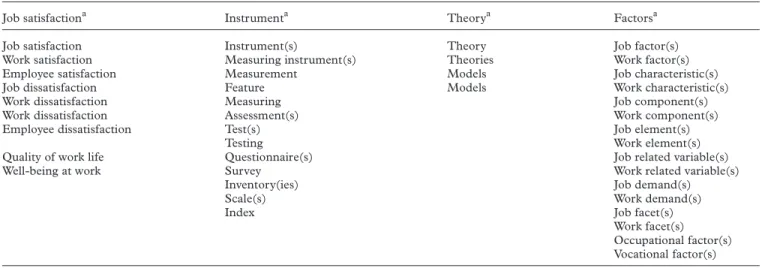
The search terms were elaborated by combining synonyms and similar words. For example, the word ‘job satisfaction’ was formed by combining ‘job (dis)satisfaction or work (dis)satisfaction or employee (dis)satisfaction or quality of work life or well-being at work’. All synonyms and similar words were connected
with the conjunction ‘or’. The search terms and their operationalization are listed in Table 1.
General inclusion criteria
To restrict the number of studies, general inclusion criteria were set. The inclusion criteria used were publication between 1988 and 2001, peer-reviewed and written in English or Dutch. Because job satisfaction is a time-sensitive subject, the choice was made to time-frame the search to 14 years. In addition, the abstract of an article had to be present in the databases. Articles from dissertation journals were not included. Studies pub-lished before 1988 were only allowed if they were added through the snowball technique. Next, assessment was made of the quality of job satisfaction instruments that were described in the articles.
Psychometric quality aspects
The instruments found with the search were assessed on their psychometric characteristics. The reliability of the instruments was assessed by means of the internal consistency (Cronbach’s alpha) and the test–retest coefficient (Pearson correlation). The validity of the instruments was assessed by means of the convergent, the discriminant and the content validity. If the convergent validity was not mentioned, other validity measures were searched for. Validity data relating to bivariate inter-instrument correlations are described. When inter-instruments showed adequate reliability and construct validity, their responsiveness and content validity were examined. As a minimum, an adequate instrument should meet criteria for internal consistency and convergent validity. The other above-mentioned criteria are additional and will bolster the quality of the instrument.
Reliability criteria
Internal consistency and test–retest
The reliability of the instruments was assessed by means of the internal consistency and the test–retest coefficient. An instrument with an internal consistency coefficient of 0.80 (scale total) or higher was considered adequate. If the scale total was not reported, the ranges of the sub-scales of the instrument were taken into account. The scale range coefficient had to be at least 0.80. Following Lloyd et al. [17], this is accepted as a reasonable reliability. The test–retest coefficient had to be 0.70 or higher, or in the absence of the total score, the test–retest range had to be 0.70 or higher [17].
Validity criteria
Convergent validity
The convergent validity of an instrument is the degree of similarity between the scores of that instrument and those of another instrument that is supposed to measure the same concept [17,18]. Therefore, a moderate to high cor-relation should be expected between both instruments. In this study, the criterion for the convergent validity was considered as acceptable at 0.50 or higher, or a sub-scale correlation range of at least 0.50.
Discriminant validity
The discriminant validity is defined as the extent to which the score of a job satisfaction instrument differs from that of an instrument that measures a related, but different concept. Three distinct features of discriminant validity [11] were examined. First, the ability to distinguish between an instrument that is related, but measures a different concept. Criteria for an adequate degree of discriminant validity were determined at a correlation of 0.50 or less. If no data about this relationship were reported, the mutual distinctiveness of the sub-scales was examined (correlation coefficient of, at most, 50). If instruments met the reliability and construct validity criteria, then their responsiveness was investigated. This condition was set because an instrument first has to show stability over time, before its responsiveness can be exam-ined in a valid way. Studies were assessed for evidence that the instruments could measure changes in job satisfaction scores after interventions. If differences in job satisfaction scores were shown after an intervention took place, the instrument used was considered responsive.
Content validity
The term ‘content validity’ refers to the extent to which an instrument covers the whole concept [18]. The content validity was assessed by examining the fit be-tween relevant work factors retrieved from the literature search, with work factors included in the multidimen-sional instruments under assessment. Two literature searches were developed to examine the content validity of the instruments. One search generated work factors described in job satisfaction theories and the second search generated work factors described in meta-analyses and reviews only.
First, the literature was searched for studies that explain the theoretical foundation of the job satisfaction concept, for which the following search terms were used: ‘job satisfaction’ (in the title) and ‘theory’ (in title or abstract). The studies found reported the following theories that are assumed to explain job satisfaction: the job characteristic model [9]; the two-factor theory [10]; the value theory [3]; the discrepancy theory [19]; the social information processing theory [20]; and the situ-ational occurrence theory [5]. Only the job characteristic model of Hackman and Oldham [9] explicitly describes five work factors relevant to job satisfaction: variety in skills; task identification; task meaningfulness; autonomy; and feedback.
Secondly, the content validity was established by searching for studies that identified work factors that are relevant in relation to job satisfaction. The search terms used were ‘job satisfaction’ (in the title) and ‘factors’ (in title or abstract). The resulting meta-analyses and reviews were studied to find related work factors that might form the basis of the job satisfaction concept [2,3,21–26]. The factors found in these studies were expected to be included in the instrument. The work factors were strictly
Table 1.Operationalization of the search terms
Job satisfactiona Instrumenta Theorya Factorsa
Job satisfaction Instrument(s) Theory Job factor(s)
Work satisfaction Measuring instrument(s) Theories Work factor(s)
Employee satisfaction Measurement Models Job characteristic(s)
Job dissatisfaction Feature Models Work characteristic(s)
Work dissatisfaction Measuring Job component(s)
Work dissatisfaction Assessment(s) Work component(s)
Employee dissatisfaction Test(s) Job element(s)
Testing Work element(s)
Quality of work life Questionnaire(s) Job related variable(s)
Well-being at work Survey Work related variable(s)
Inventory(ies) Job demand(s)
Scale(s) Work demand(s)
Index Job facet(s)
Work facet(s) Occupational factor(s) Vocational factor(s)
used to judge the content validity. The work factors were categorized in 11 related domains.
These domains were: work content (variety in skills, complexity of a job, or the challenge in a job, role ambiguity, routine); autonomy (individual responsibility for work, control over job decisions); growth/develop-ment (personal growth and developgrowth/develop-ment, training, or education); financial rewards (salary, fringe benefits, or employee benefits); promotion (possibility of career advancement, or job level); supervision (support of supervisor, recognition of supervisor, or being treated with fairness); communication (counselling oppor-tunities, feedback); co-workers (professional relations with co-workers, or adequacy of co-workers); meaning-fulness; workload (time pressure subjectively perceived, tedium, social problems, interpersonal conflict, or stress); and work demands (involuntarily doing extra work or procedures, structural complexity, insecurity of work situation, or emotional commitment).
These 11 categorized work factors were considered to represent the content of job satisfaction. The content validity was estimated as ‘adequate’ under the assumption that the greater the number of aforementioned work factors, the more this instrument would measure the concept of job satisfaction. If more than three work factors were not included in the instrument, the content validity of the instrument was considered unsatisfactory. Because the work factors are not supposed to be inter-related, no weighting score was used. The studies that were used as sources to collect work factors contained both heterogeneous and specific samples.
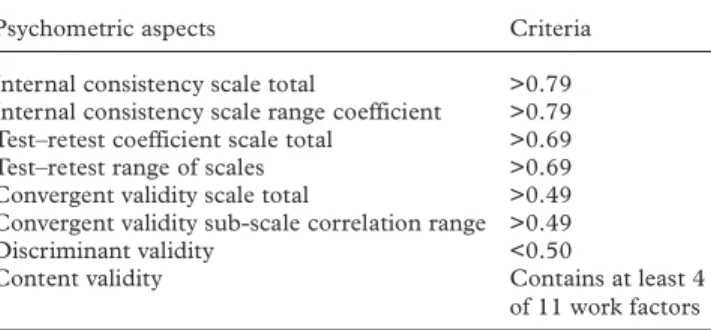
The quality criteria are summarized in Table 2.
Results
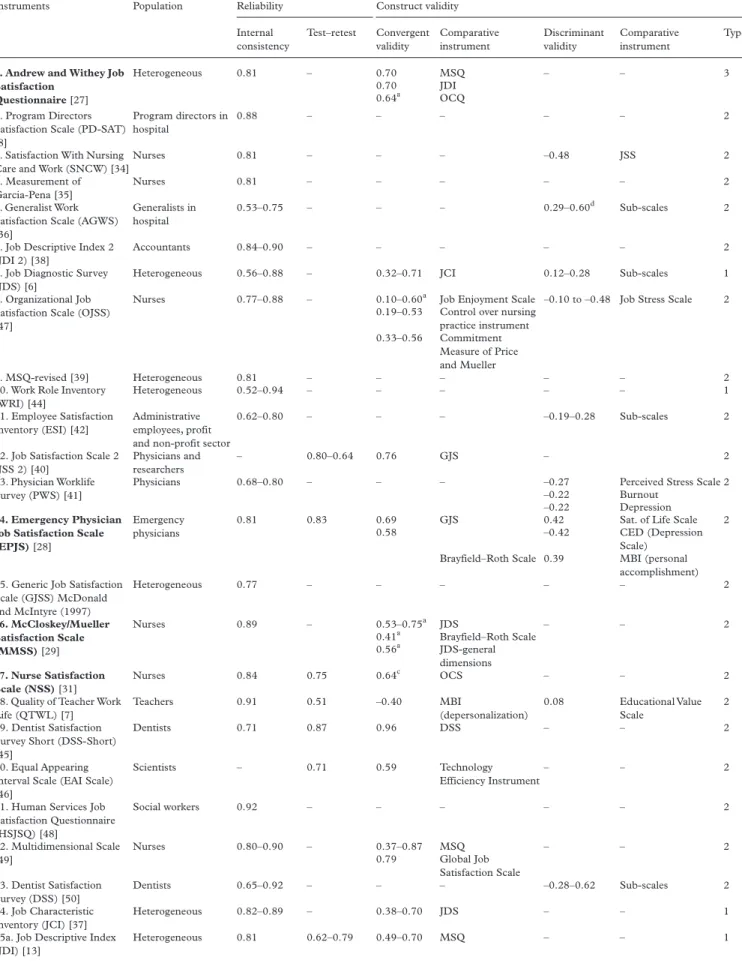
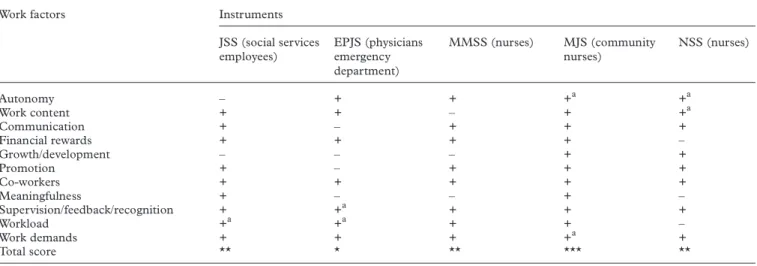
InstrumentsThirty-five relevant studies were found, eight of which were found with the snowball search technique. Twenty-nine instruments were described. Table 3 gives an overview of the instruments and Table 4 summarizes the criteria for the content validity. The instruments could be divided into three categories: multidimensional instru-ments for jobs in general; multidimensional instruinstru-ments for specific jobs; and global multi-item job satisfaction instruments.
The following instruments met the quality criteria for reliability and validity: ‘the Job in General Scale’ (JIG) [11]; ‘the Andrew and Withey Job Satisfaction Ques-tionnaire’ [27]; ‘the Job Satisfaction Survey’ (JSS) [4]; ‘the Emergency Physician Job Satisfaction Instrument’ (EPJS) [28]; ‘the McCloskey/Mueller Satisfaction Scale (MMSS)’ [29]; ‘the Measure of Job Satisfaction’ (MJS) [30]; and ‘the Nurse Satisfaction Scale’ (NSS) [31]. These instruments are described more extensively below.
The Job in General Scale
The JIG is a global job satisfaction instrument [11] and is part of the Job Descriptive Index (JDI) [32]. The JIG has 18 items. The response scaling is a three-response choice: a person agrees (yes), a person is not sure (?), or a person does not agree (no). Reliability and construct validity are indicated in Table 3. Concerning the responsiveness of the JIG, Ironsonet al.[11] have compared the response of the JIG with the response of a multidimensional scale, the JDI [32] after an intervention. There were minor, non-significant differences between two measure times.
Andrew and Withey Job Satisfaction Questionnaire
This is a unidimensional questionnaire that measures global job satisfaction [27]. It has five items. Responses are given on a seven-point Likert scale ranging from delighted (1) to terrible (7). With regard to reliability and construct validity, the internal consistency satisfied our quality criteria. The test–retest coefficient was not reported.
Job Satisfaction Survey
The JSS is a multidimensional instrument that was originally developed for the social service sector. However, Spector [4] argues that it can be used for other sectors as well. The response format is a six-point Likert scale, ranging from ‘disagree very much’ (1) to ‘agree very much’ (6). Reliability and construct validity: the time interval between the test and retest was 18 months. The stability of some sub-scales was moderate. The converg-ent validity was established with the trait multi-method and the JDI [32] was used as validity instrument. Spector [4] did not mention the total convergent validity score, but only the correlations between the sub-scales of the two instruments. The discriminant validity among the sub-scales was moderate to low. There was no evidence of responsiveness to change. Content validity: to test the content validity, the degree of inclusion of work factors in the selected instruments was examined. Table 4 shows an overview. The JSS includes nine sub-scales: salary, promotion, supervision, fringe benefits, contingent
Table 2.Psychometric quality criteria in this study Psychometric aspects Criteria Internal consistency scale total >0.79 Internal consistency scale range coefficient >0.79 Test–retest coefficient scale total >0.69 Test–retest range of scales >0.69 Convergent validity scale total >0.49 Convergent validity sub-scale correlation range >0.49 Discriminant validity <0.50
Content validity Contains at least 4 of 11 work factors
rewards, operating procedures, co-workers, work and communication. Some of the items categorized as ‘operating procedures’ refer to workload, for example the items ‘I have too much paperwork’ and ‘I have too much to do at work’. The sub-scales and the items independ-ently cover 9 out of the 11 standard work factors.
Emergency Physician Job Satisfaction Scale
The EPJS [28] is a multidimensional instrument designed for physicians working at an emergency department. The questionnaire has 79 items, including a global job satisfaction scale with 11 items. The response format is a seven-point Likert scale, ranging from ‘strongly disagree (–3) to ‘strongly agree (3)’. Reliability and construct validity: the time interval of the test–retest reliability is not known. Studies of the EPJS give no information about its responsiveness. Content validity: the EPJS measures six work factors: administrative autonomy, clinical autonomy, resources, social relationships, lifestyle (work/private life balance) and challenges.
McCloskey/Mueller Satisfaction Scale
The MMSS [29] is a multidimensional questionnaire designed for hospital staff nurses. There are 31 items; the response format is a five-point Likert scale ranging from ‘very dissatisfied’ (1) to ‘very satisfied’ (5). Reliability and construct validity: two studies described the MMSS; the internal consistency was 0.89 in Mueller and McCloskey [29] and 0.90 in Miseneret al.[33]. Both studies showed adequate internal consistency coefficients. The test–retest reliability for the sub-scales described in Mueller and McCloskey [29] ranged from 0.08 to 0.64. However, data were not described after removal of the two items with the lowest coefficients, so the final test–retest coefficient is not known. The construct validity was indicated with a criterion validity coefficient. To test this type of validity, the authors correlated the instrument with the Job Diagnostic Survey [6]. They did not give information about the responsiveness of the instrument to measure changes over time. Content validity: the MMSS measures eight work factors: extrinsic rewards (salary, vacation); scheduling satisfaction (e.g. flexible work hours); family/work balance; co-workers; interaction; professional opportunities (e.g. write and publish, participate in research); praise/recognition; and control/responsibility.
Measure of Job Satisfaction
The MJS [30] is a multidimensional instrument designed for use in the community nurse sector. It has 38 items. The stem question is ‘how satisfied are you with this aspect of your job?’ Respondents are asked to rate their degree of job satisfaction on a five-point Likert scale, ranging from ‘very satisfied’ to ‘very dissatisfied’,
including a neutral response choice. Reliability and construct validity: the time interval used to assess the test–retest reliability was 2 weeks, and the sample size was 37 persons. For validation, Traynor and Wade [30] correlated the instrument with a Price Waterhouse instrument, an instrument that covers work factors such as work volume, working relations, career development, etc. To demonstrate the construct validity, the authors gave information on its concurrent validity. This type of validity is closely related to convergent validity. In demonstration of the discriminant validity, the definition was different from that used in this study. Content validity: the MJS measures five work factors: personnel satisfaction; workload; professional support; salary; and prospects and training. Within the sub-scale of personnel satisfaction, items are included that refer to variation, challenge and satisfaction. All the 11 standard work factors are represented in the instrument.
The Nurse Satisfaction Scale
The NSS was developed by Ng [31] to measure job satisfaction among nurses. The questionnaire is multidimensional and has 24 items. The response format is a seven-point Likert scale, ranging from ‘strongly agree’ (1) to ‘strongly disagree’ (7). Reliability and construct validity: the test–retest reliability was measured over 5 months. To test the construct validity, Ng [31] compared the instrument with an Organizational Commitment Scale. The construct validity was demonstrated by means of cross-validity. Although the NSS was considered to be a valid evaluation tool for intervention studies, there are no research data that support this assumption. Content validity: the NSS includes seven work factors: admin-istration (support nurses, care about nurses, consult with nurses and nursing goals of administration); co-workers; career; patient care; relation with supervisor; nursing education; and communication. Nine aspects of the 11 standard work factors were met, although autonomy and work content were measured minimally.
The other 22 instruments [34–51] that are listed in Table 3 did not meet the aforementioned quality criteria.
Discussion
Psychometric quality characteristics
Seven job satisfaction instruments had adequate reliability and construct validity. Surprisingly, the JDI (Smith in [13]) did not meet the quality criteria, although it is the most frequently used job satisfaction instrument in organizational science [13,52].
The search yielded few studies providing information about the ability of the instruments to monitor changes in job satisfaction after an intervention. The JIG [11] was the
Table 3.Overview of the instruments
Instruments Population Reliability Construct validity
Internal consistency Test–retest Convergent validity Comparative instrument Discriminant validity Comparative instrument Type
1. Andrew and Withey Job Satisfaction Questionnaire[27] Heterogeneous 0.81 – 0.70 MSQ – – 3 0.70 JDI 0.64a OCQ 2. Program Directors
Satisfaction Scale (PD-SAT) [8]
Program directors in hospital
0.88 – – – – – 2
3. Satisfaction With Nursing Care and Work (SNCW) [34]
Nurses 0.81 – – – –0.48 JSS 2
4. Measurement of Garcia-Pena [35]
Nurses 0.81 – – – – – 2
5. Generalist Work Satisfaction Scale (AGWS) [36]
Generalists in hospital
0.53–0.75 – – – 0.29–0.60d Sub-scales 2
6. Job Descriptive Index 2 (JDI 2) [38]
Accountants 0.84–0.90 – – – – – 2
7. Job Diagnostic Survey (JDS) [6]
Heterogeneous 0.56–0.88 – 0.32–0.71 JCI 0.12–0.28 Sub-scales 1
8. Organizational Job Satisfaction Scale (OJSS) [47]
Nurses 0.77–0.88 – 0.10–0.60a Job Enjoyment Scale –0.10 to –0.48 Job Stress Scale 2 0.19–0.53 Control over nursing
practice instrument 0.33–0.56 Commitment
Measure of Price and Mueller
9. MSQ-revised [39] Heterogeneous 0.81 – – – – – 2
10. Work Role Inventory (WRI) [44] Heterogeneous 0.52–0.94 – – – – – 1 11. Employee Satisfaction Inventory (ESI) [42] Administrative employees, profit and non-profit sector
0.62–0.80 – – – –0.19–0.28 Sub-scales 2
12. Job Satisfaction Scale 2 (JSS 2) [40] Physicians and researchers – 0.80–0.64 0.76 GJS – 2 13. Physician Worklife Survey (PWS) [41]
Physicians 0.68–0.80 – – – –0.27 Perceived Stress Scale 2 –0.22 Burnout
255 –0.22 Depression
14. Emergency Physician Job Satisfaction Scale (EPJS)[28]
Emergency physicians
0.81255 0.83 0.69 GJS 0.42 Sat. of Life Scale 2
0.58 –0.42 CED (Depression
Scale) Brayfield–Roth Scale 0.39 MBI (personal
accomplishment) 15. Generic Job Satisfaction
Scale (GJSS) McDonald and McIntyre (1997) Heterogeneous 0.77 – – – – – 2 16. McCloskey/Mueller Satisfaction Scale (MMSS)[29] Nurses 0.89 – 0.53–0.75a JDS – – 2 0.41a Brayfield–Roth Scale 0.56a JDS-general dimensions 17. Nurse Satisfaction Scale (NSS)[31] Nurses 0.84 0.75 0.64c OCS – – 2
18. Quality of Teacher Work Life (QTWL) [7] Teachers 0.91 0.51 –0.40 MBI (depersonalization) 0.08 Educational Value Scale 2 19. Dentist Satisfaction Survey Short (DSS-Short) [45]
Dentists 0.71 0.87 0.96 DSS – – 2
20. Equal Appearing Interval Scale (EAI Scale) [46]
Scientists – 0.71 0.59 Technology Efficiency Instrument
– – 2
21. Human Services Job Satisfaction Questionnaire (HSJSQ) [48] Social workers 0.92 – – – – –5,5,0,0,0,0 2 22. Multidimensional Scale [49] Nurses 0.80–0.90 – 0.37–0.87 MSQ – – 2 0.79 Global Job Satisfaction Scale 23. Dentist Satisfaction Survey (DSS) [50] Dentists 0.65–0.92 – – – –0.28–0.62 Sub-scales 2 24. Job Characteristic Inventory (JCI) [37] Heterogeneous 0.82–0.89 – 0.38–0.70 JDS – – 1
25a. Job Descriptive Index (JDI) [13]
only instrument to provide information on respon-siveness. Ironson et al. [11] concluded that global instruments respond to treatments differently than multidimensional instruments. Global instruments are less suitable for detecting high and low areas of job satisfaction. If a global instrument is used with the aim of measuring a change in job satisfaction, Wanouset al.[53] suggest that a single-item instrument should be used rather than a multi-item instrument, because the
differ-ences in individual scores are ignored in the total mean score of a multi-item instrument.
It is relevant to both organizations and employees that attention is being paid to the assessment of job satisfaction. If job satisfaction is low in an organization, interventions can be implemented that may improve the quality of the employee’s work life. In this way, negative influences in the workplace, such as turnover and health-related problems (for example, occupational stress), can
Table 3.Continued
Instruments Population Reliability Construct validity
Internal consistency Test–retest Convergent validity Comparative instrument Discriminant validity Comparative instrument Type + 25b. Job Descriptive Index-revised (JDI-revised) [32] Heterogeneous 0.88 – – – – – 1
26. Job in General Scale (JIG)[11]
Heterogeneous 0.91 – 0.66–0.80 Brayfield–Roth Scale – – 3 0.76 Adjective Scale
0.75 Faces Scale
27. Job Satisfaction Survey (JSS)[4]
Social service 0.91 0.71 0.61–0.80 JDI 0.19–0.59 Sub-scales 1
28. Measurement of Job Satisfaction (MJS)[30]
Community nurses 0.93 0.89 0.83b Price Waterhouse work characteristics instrument – – 2 29. Measurement of Wade and Degerhammar [51] Nurses 0.82–0.88 – – – – – 2
The instruments that met the quality criteria are represented in bold. Internal consistency = Cronbach’s alpha; test–retest = Pearson correlation. Type of instrument (Type): 1, multidimensional instrument for jobs in general; 2, multidimensional instrument for specific job; 3, global job satisfaction instrument. Abbreviations: GJS, General Job Satisfaction Scale; JCI, Job Characteristics Inventory; JDI, Job Descriptive Index; JSS, Job Stress Scale; MSQ, Minnesota Satisfaction Questionnaire; OCQ, Organizational Commitment Questionnaire.
aCriterion-related validity. bConcurrent validity. cCross validity.
dSub-scale correlations within an instrument.
Table 4.Criteria for the evaluation of the content validity: work factors included in (parts of) the sub-scales of job satisfaction instruments
Work factors Instruments
JSS (social services employees) EPJS (physicians emergency department) MMSS (nurses) MJS (community nurses) NSS (nurses) Autonomy – + + +a +a Work content + + – + +a Communication + – + + + Financial rewards + + + + – Growth/development – – – + + Promotion + – + + + Co-workers + + + + + Meaningfulness + – – + – Supervision/feedback/recognition + +a + + + Workload +a +a + + – Work demands + + + +a + Total score ** * ** *** **
JSS, Job Satisfaction Scale; EPJS, Emergency Physician Job Satisfaction Survey; MMSS, McCloskey/Mueller Satisfaction Scale; MJS, Measure of Job Satisfaction; NSS, Nurse Satisfaction Scale. Total score: +, work factor included in item or sub-scale; –, work factor not included; ***good, less than one missing work factor; **moderate, two or three missing work factors; *unsatisfactory, more than three missing work factors.
be prevented. Furthermore, Locke [3] reported that job satisfaction was negatively associated with mortality due to heart disease and fatigue. He suggested that longevity is positively associated with job satisfaction.
The MJS [30] had the most extensive coverage of content validity. However, two work factors, ‘autonomy’ and ‘growth/development’, were covered minimally by this instrument. An advantage of this scale is the response format, in which employees are explicitly asked to rate job satisfaction. This format, which aids content validity, is not used in most job satisfaction instruments. Elizur [54] argues that there is almost no difference in item load between instruments developed to measure work charac-teristics and those developed to measure job satisfaction. He considered that the response scale should ask for the degree of satisfaction with a certain work factor, or the importance of it. The EPJS [28] had the lowest content validity. This may be because the instrument was developed specifically for physicians of an emergency department, who might give priority to work aspects other than the standard work factors described in this study.
While growth/development was a work factor identified in the meta-analyses and reviews, it was included in only two of the five multidimensional instruments. Personal growth and development through work and the possibility of participating in training sessions may be perceived as something employees and organizations place more value on nowadays than previously. This work factor should be included in modern job satisfaction instruments. Another work factor that is marginally taken into account in the selected multidimensional instruments is the ‘meaning-fulness’ of a job. Hackman and Oldham [9] considered this factor an important component and described the relationship to job satisfaction in their Job Characteristic Model.
In this study, the balance between work and private life was not found to be an explicit work factor related to job satisfaction. In a society where both men and woman participate in the labour market, an imbalance between work and private life may hinder job satisfaction. Loscocco and Roschelle [24] showed a positive relation-ship between job satisfaction and general satisfaction. We consider the work and private life factor to be covered adequately in the MMSS and in the EPJS. More research is needed to support the suggestion that the balance between work and private life is part of job satisfaction. Study limitations
A first difficulty was that some studies did not demon-strate all the psychometric characteristics needed to assess the instrument. Secondly, the quality criterion for the test–retest coefficient was difficult to determine, because the time interval between the two measurements differed in the various studies. Thirdly, some researchers
measured different types of validity, such as convergent, criterion and concurrent validity, under the term con-struct validity. However, because these types of concon-struct validity are closely related, if the convergent validity was not measured, the reported criterion or concurrent validity was taken into account. A fourth difficulty was the different interpretation researchers gave to the same work factor described in meta-analyses and reviews. For example, it is possible that the factor ‘communication’ in one review indicates the contact an employee has with his or her co-workers, while it is used in another review with a slightly different meaning, such as instrumental com-munication, or the contact one has with one’s supervisor. This limitation was partly eliminated by categorizing the work factors that were closely related.
With these limitations in mind, this study delivered a contribution to transparency in the variety of job satisfaction instruments and has shown a comparative overview of their psychometric characteristics. To achieve this aim, we chose to use a systematic method. In this way, the study is replicable and new relevant studies can easily be added.
Conclusion
It can be concluded that while many different job satisfaction instruments exist, only a few meet several criteria for a high level of reliability and construct valid-ity. Among the seven instruments that did meet the psychometric quality criteria, the MJS included most of the work factors that were considered necessary for good content validity. No instruments were found to measure responsiveness and thus we could not confirm the responsiveness of job satisfaction instruments when used as evaluative tools.
Acknowledgements
We thank Professor J. C. J. M. de Haes, Department of Medical Psychology of the Academic Medical Center, Amsterdam, for her advice during the project.
References
1. Lance CE. Evaluation of a structural model relating job satisfaction, organizational commitment and precur-sors to voluntary turnover. Multivariate Behav Res
1991;26:137–162.
2. Irvine DM, Evans MG. Job satisfaction and turnover among nurses: integrating research findings across studies.
Nurs Res1995;44:246–253.
3. Locke EA. The nature and causes of job satisfaction. In: Dunnette MD, ed. Handbook of Industrial and
Organizational Psychology. Chicago, IL: Rand McNally,
1976.
satisfaction: development of the Job Satisfaction Survey.
Am J Community Psychol1985;13:693–713.
5. Quarstein VA, McAfee RB, Glassman M. The situational occurrence theory of job satisfaction. Hum Relations
1992;45:859–873.
6. Hackman JR, Oldham GR. Development of the job diagnostic survey. J Appl Psychol1975;60:159–170. 7. Pelsma DM, Richard GV, Harrington RG, Burry JM. The
Quality of Teacher Work Life Survey: a measure of teacher stress and job satisfaction. Measure Eval Counsel Dev
1989;21:165–176.
8. Beasley BW, Kern DE, Howard DM, Kolodner K. A job-satisfaction measure for internal medicine residency program directors.Acad Med1999;74:263–270.
9. Hackman JR, Oldham GR. Motivation through the design of work: test of a theory.Org Behav Hum Perform1976; 16:250–279.
10. Thierry H. Motivation and satisfaction. In: Drenth PJD, ed.Handbook of Work and Organizational Psychology. Hove: Psychology Press/Erlbaum (UK) Taylor & Francis, 1998; 253–289.
11. Ironson GH, Smith PC, Brannick MT, Gibson WM, Paul KB. Construction of a Job in General Scale: a comparison of global, composite, and specific measures.
J Appl Psychol1989;74:193–200.
12. Marx RG, Jones EC, Answorth AA, et al. Reliability, validity, and responsiveness of jour knee outcome scales for athletic patients.J Bone Joint Surg2001;83-A:1459–1469. 13. Leong FTL, Vaux A. Job descriptive index. In: Keyser DJ, Sweetland RC, eds. Test Critiques. Austin TX: Pro-Ed, 1992; 319–334.
14. Abbott J, Young A, Haxton R, Van Dyke P. Collaborative care: a professional model that influences job satisfaction.
Nurs Econ1994;12:167–174.
15. Pierce LL, Hazel CM, Mion LC. Effect of a professional practice model on autonomy, job satisfaction and turnover.
Nurs Manage1996;27:48M–48T.
16. Song R, Daly BJ, Rudy EB, Douglas S, Dyer MA. Nurses’ job satisfaction, absenteeism, and turnover after imple-menting a special care unit practice model.Res Nurs Health
1997;20:443–452.
17. Lloyd S, Streiner D, Shannon S. Predictive validity of the emergency physician and global job satisfaction instruments.Acad Emerg Med1998;5:234–241.
18. Groot de AD.Methodologie. ‘s-Gravenhage: Mouton, 1972. 19. Lawler EE, Hall DT. Relationship of job characteristics to job involvement, satisfaction and intrinsic motivation.
J Appl Psychol1970;54:305–312.
20. Pollock TG, Whitbred RC, Contractor N. Social information processing and job characteristics: a simul-taneous test of two theories with implications for job satisfaction.Hum Commun Res2000;26:292–330.
21. Blegen MA. Nurses’ job satisfaction a meta-analysis of related variables.Nurs Res1993;42:36–41.
22. Buiser M. Surviving managed care: the effect on job satisfaction in hospital-based nursing.Official J Acad Med Surg Nurses2000;9:129–134.
23. Groenewegen PP, Hutten JB. Workload and job satisfaction among general practitioners: a review of the literature.Soc Sci Med1991;32:1111–1119.
24. Loscocco KA, Roschelle AR. Influences on the quality of work and nonwork life: two decades in review.J Vocat Behav
1991;39:182–225.
25. Robie C, Ryan AM, Schmieder RA, Parra LF, Smith PC. The relation between job level and job satisfaction.Group
Org Manage1998;23:470–495.
26. Upenieks V. The relationship of nursing practice models and job satisfaction outcomes. J Nursing Admin 2000; 30:330–335.
27. Rentsch JR, Steel RP. Construct and concurrent validation of the Andrews and Withey Job Satisfaction Questionnaire.
Educ Psychol Measure1992;52:357–367.
28. Lloyd S, Streiner D, Hahn E, Shannon S. Development of the emergency physician job satisfaction measurement instrument.Am J Emerg Med1994;12:1–10.
29. Mueller CW, McCloskey JC. Nurses’ job satisfaction: a proposed measure.Nurs Res1990;39:113–117.
30. Traynor M, Wade B. The development of a measure of job satisfaction for use in monitoring the morale of community nurses in four trusts.J Adv Nurs1993;18:127–136. 31. Ng SH. A job satisfaction scale for nurses. N Z J Psychol
1993;22:46–53.
32. Smith PC, Balzer W, Brannick M,et al.The Revised JDI: a facelift for an old friend.Ind Org Psychol1989;24:31–33. 33. Misener TR, Haddock KS, Gleaton JU, Abu-Ajamieh AR.
Toward an international measure of job satisfaction.
Nurs Res1996;45:87–91.
34. Berg A, Hallberg IR. Effects of systematic clinical supervision on psychiatric nurses’ sense of coherence, creativity, work-related strain, job satisfaction and view of the effects from clinical supervision: a pre-post test design.
J Psychiatric Mental Health Nurs1999;6:371–381.
35. Garcia-Pena MC, Reyes-Lagunes I, Reyes-Frausto S,et al.
Development and validation of an inventory for measuring job satisfaction among family physicians. Psychol Rep
1996;79:291–301.
36. Coyle YM, Aday LA, Battles JB, Hynan LS. Measuring and predicting academic generalists’ work satisfaction: implica-tions for retaining faculty.Acad Med1999;74:1021–1027. 37. Fried Y. Meta-analytic comparison of the Job Diagnostic
Survey and Job Characteristics Inventory as correlates of work satisfaction and performance. J Appl Psychol
1991;76:690–697.
38. Gregson T. Measuring job satisfaction with a multiple-choice format of the Job Descriptive Index.Psychol Rep
1990;66:787–793.
39. Hirschfeld RR. Does revising the intrinsic and extrinsic subscales of the Minnesota Satisfaction Questionnaire short form make a difference. Educ Psychol Measure
2000;60:255–270.
40. Koeske GF, Kirk SA, Koeske RD, Rauktis MB. Measuring the Monday blues: validation of a job satisfaction scale for the human services.Soc Work Res1994;18:27–35.
41. Konrad TR, Williams ES, Linzer M, et al. Measuring physician job satisfaction in a changing workplace and a challenging environment. SGIM Career Satisfaction Study
Group. Society of General Internal Medicine. Med Care
1999;37:1174–1182.
42. Koustelios AD, Bagiatis K. The Employee Satisfaction Inventory (ESI): development of a scale to measure satisfaction of Greek employees. Educ Psychol Measure
1997;57:469–476.
43. Macdonald S, MacIntyre P. The generic job satisfaction scale: scale development and its correlates. Employee Assistance Q1997;13:1–16.
44. Miller JO, Carey SJ. Work role inventory: a guide to job satisfaction.Nurs Manage1993;24:54–62.
45. Rabiner DJ, Shugars DA, Hays RD. A short-form measure of dentists’ job satisfaction. Eval Program Plann 1994; 17:271–275.
46. Sabarathnam V. An E. A. I. scale to measure job satisfaction of scientists.Indian J Appl Psychol1989;26:48–60.
47. Sauter MA, Boyle D, Wallace D, et al. Psychometric evaluation of the Organizational Job Satisfaction Scale.
J Nurs Measure1997;5:53–69.
48. Shapiro JP, Burkey WM, Dorman RL, Welker CJ. Job satisfaction and burnout in child abuse professionals:
measure development, factor analysis, and job character-istics.J Child Sexual Abuse1996;5:21–38.
49. Shouksmith G, Pajo K, Jepsen A. Construction of a multidimensional scale of job satisfaction. Psychol Rep
1990;67:355–364.
50. Shugars DA, Hays RD, DiMatteo MR, Cretin S. Development of an instrument to measure job satisfaction among dentists.Med Care1991;29:728–744.
51. Wade B, Degerhammar M. The development of a measure of job satisfaction for use in evaluating change in the system of care delivery. Scand J Caring Sci 1991;5: 195–201.
52. Buckley MR, Carraher SM, Cote JA. Measurement issues concerning the use of inventories of job satisfaction.Educ Psychol Measure1992;52:529–543.
53. Wanous JP, Reichers AE, Hudy MJ. Overall job satisfaction: how good are single-item measures? J Appl Psychol
1997;82:247–252.
54. Elizur D. Work values and job satisfaction.Psychol Rep