Gender difference in stance duration and the
activation pattern of
gluteus medius
in
pre-pubescent athletes during drop jump and cutting
maneuvers
Unnur Sædís Jónsdóttir
Thesis for the degree of Master of Science
In Movement Science
Department of Physical Therapy
Faculty of Medicine
Gender difference in stance duration and the activation pattern of
gluteus medius
in pre-pubescent athletes during drop jump and
cutting maneuvers
Unnur Sædís Jónsdóttir
Thesis for the degree of Master of Science In Movement Sicence
Supervisor: Þórarinn Sveinsson, professor Masters committee: Kristín Briem, associate professor
Lynn Snyder-Mackler, professor
Faculty of Medicine Department of Physical Therapy
School of Health Sciences, University of Iceland June 2014
Kynbundinn munur á stö
ð
utíma á kraftplötu og vö
ð
vavirkni í
mi
ðþ
jóvö
ð
va hjá í
þ
róttafólki fyrir kyn
þ
roska vi
ð
fallhopp og
gabbhreyfingar
Unnur Sædís Jónsdóttir
Ritgerð til meistaragráðu í hreyfivísindum Umsjónarkennari: Þórarinn Sveinsson, prófessor Meistaranámsnefnd: Kristín Briem, aðstoðarprófessor
Lynn Snyder-Mackler, prófessor
Læknadeild Námsbraut í Sjúkraþjálfun Heilbrigðisvísindasvið Háskóla Íslands
All rights reserved. This master’s thesis in Movement Science cannot be copied without prior permission.
© Unnur Sædís Jónsdóttir 2014
Printed by: Háskólaprent Reykjavík, Iceland, 2014
Abstract
Sport participation is a good way to increase physical fitness but it has its downsides, mainly in the form of injuries. Anterior cruciate ligament (ACL) injury can have many implications for athletes and their sport participation. The frequency of noncontact ACL injury is higher amongst females than males. It has been suggested that anomalies in neuromuscular activities of the lower extremities are one of the risk factors for this injury. Studies show that the mechanism of injury involves a multiplanar knee joint loading when the knee is almost fully extended, in a valgus position and the hip is internally rotated and adducted. This knee kinematic is often seen during landing and cutting in sports and one of the muscles that may influence the degree of adduction and internal rotation of the hip is gluteus medius. Therefore, the aim of this study is to identify whether there is a gender difference in stance duration and in neuromuscular activation of the gluteus medius during drop jump and cutting maneuver in 11-12 years old athletes. Furthermore, the aim was to evaluate the effects of fatigue on those variables.
Methods: Participants were 47 football and handball players of both genders (males=9, females=38) Surface electrodes were used to collect electromyography (sEMG) activity of gluteus medius during drop jump and cutting maneuver before and after a fatigue protocol. Activation was normalized to that obtained during a maximal voluntary isometric contraction (MVIC) and peak sEMG signals during performance were identified. Initial contact (IC) on a force plate was used as a reference point (set at zero), as was stance duration during task performance, when doing the statistical analysis.
Results: Drop jump: Stance duration was significantly longer for males than females (p=0.027) with no significant effect of fatigue. Females demonstrated an early first peak sEMG more frequently than males (p<0.001) and its normalized amplitude was significantly larger for females compared to males (p=0.003), with no significant effect of fatigue protocol. The peaks that occurred later were significantly delayed for the males after the fatigue protocol (p=0.002). Cutting maneuver: There was significant difference in the change of stance duration after the fatigue protocol (p<0.001) where the males’ stance duration increased (p=0.005) while the females’ stance duration decreased (p<0.001). Females demonstrated an early first peak sEMG more frequently than males (p<0.001). The peaks that occurred later were more delayed among females than males (p=0.020). The post-fatigue change in the amplitude of the first peak after IC, was significantly different between genders (p<0.001) where the amplitude for the males increased significantly (p<0.001) but not for females (p=0.053).
Conclusion: These results show a difference between genders in stance duration during drop jump and cutting maneuver as well as in the activation pattern of gluteus medius. Pre-pubescent females demonstrated shorter stance duration, they activated the gluteus medius earlier and of greater amplitude than the pre-pubescent males and the fatigue protocol affected the genders differently. These results indicate that preventive programs that are used to reduce risk of ACL injury should be implemented at an earlier age since there is gender difference already at 11-12 years old.
Ágrip
Íþróttir eru góð leið til að auka líkamlegt hreysti en þær hafa neikvæða hlið sem snýr aðallega að
meiðslum. Slit á fremra krossbandi getur haft margvísilegar afleiðingar fyrir íþróttafólk og þátttöku þess í íþróttum. Tíðni krossbandaslita án snertingar er hærri hjá konum heldur en hjá körlum og er talið að
einn af áhættuþáttum slitanna sé virkjunarmynstur vöðva í neðri útlimum. Rannsóknir hafa skoða margar hliðar á stjórnun og framkvæmd hreyfinga í neðri útlimum. Niðurstöður hafa sýnt að margþætt álag verður þegar hnéið er næstum alveg rétt og kiðfætt, á meðan mjöðmin er snúin inn og í aðfærslu.
Þessi stjórnun á hreyfingu kemur gjarnan fram við lendingu og gabbhreyfingu í íþróttum og einn þeirra vöðva sem hefur tök á að draga úr aðfærslu og innsnúningi í mjöðm er miðþjóvöðvi. Því er markmið þessarar rannsóknar að kanna hvort það er kynbundinn munur á stöðutíma lendingar og virkjunarmynstri miðþjóvöðva við lendingu og gabbhreyfingu 11-12 ára íþróttafólks. Einnig skal metið
hvort það er munur á því hvernig stöðutími lendingar og virkjunarmynstur vöðvans breytist eftir þreytu. Efniviður og aðferðir: Þátttakendur voru 47 fótbolta- og handboltaleikmenn af báðum kynjum (drengir=9, stúlkur=38). Yfirborðsrafskaut voru notuð til að safna vöðvarafvirkni í miðþjóvöðva við
fallhopp og gabbhreyfingar fyrir og eftir þreytu. Upphafssnerting á kraftplötu var notuð sem viðmiðunar punktur (núll) þegar tölfræðin var skoðuð og stöðutími á kraftplötu við framkvæmd hreyfinga mæld.
Niðurstöður: Fallhopp: Stöðutími á kraftplötunni varði marktækt lengur hjá drengjum en stúlkum (p=0.027) og það voru engin marktæk áhrif þreytu. Toppar meðaltalskvaðratsrótarinnar (RMS) frá yfirborðsvöðvarafritunum (sEMG) voru marktækt oftar nær upphafspunkti hjá stúlkum miðað við drengi (p<0.001). Topparnir sem voru fjær upphafspunkti seinkaði marktækt hjá drengjunum eftir þreytu (p=0.002). Kvörðuð virkni RMS toppa sem lágu nær upphafspunkti var marktækt meiri hjá stúlkum miðað við drengi (p=0.003) en þreyta hafði ekki marktæk áhrif. Gabbhreyfingar: Það var marktækur munur á stöðutíma eftir þreytu (p<0.001) þar sem tímalengd jókst hjá drengjunum (p=0.005) en minnkaði hjá stúlkum (p<0.001). Toppar stelpnanna urðu marktækt oftar nær upphafspunkti miðað við
drengi (p<0.001). Topparnir, sem voru fjær frá upphafspunkti, voru marktækt seinni hjá stúlkunum heldur en hjá drengjunum (p=0.020). Breytingin á kvarðaðri virkni RMS sem kom fram eftir þreytu var ólík milli kynja (p<0.001), þar sem virkni drengjanna jókst marktækt (p<0.001) en virkni stúlknanna hélst óbreytt (p=0.053).
Umræður: Þessar niðurstöður sýna að það er marktækur kynbundinn munur á stöðutíma á kraftplötu í fallhoppi og gabbhreyfingum sem og á virkjunarmynstri miðþjóvöðva. Stúlkur höfðu styttri stöðutíma, virkjuðu miðþjóvöðva fyrr og af meira magni heldur en drengir. Þreyta hefur stundum marktæk áhrif en það er ekki í samræmi í þeim áhrifum. Niðurstöður benda til þess að ef forvarnar prógrömmin sem eru notuð til að minnka áhættu á krossbandasliti, ættu einnig að vera notuð á börn
Acknowledgements
The research was implemented in the Research Center of Movement Science in the University of Iceland.
First of all I would like to thank all the participants for their time and willingness to help.
I would also like to thank my main supervisor, Þórarinn Sveinsson for his scientific teaching, statistical assistance and guidance through the study, constructive criticism and support.
My fellow researchers, Kolbrún Vala Jónsdóttir and Haukur Már Sveinsson, for the development and cooperation through all the data collection and for making what seemed to be endless hours of measurements more enjoyable, for the Friday fun and the laughs.
My masters committee, Kristín Briem and Lynn Snyder-Mackler for pointing out aspects that would increase the value of the study, for their guidance and proofreading.
Árni Árnason, my teacher and coworker for answering my endless questions through the years, for increasing my interest in sports physical therapy and opening my eyes to the importance of continuing education.
Anna Lára Ármannsdóttir, without her dedication to her study, I wouldn’t have gotten this far in my writings. It is priceless to have a friend that is on the same place and the same page. Thanks thousand fold. I also want to thank my friend, Hildur Guðný Ásgeirsdóttir for both the academic and the moral support through the years.
Anna Guðrún Höskuldsdóttir for the use of her summer cottage, a cozy and delightful place that is optimal for brainstorming and writings. Birna Hjaltadóttir and Björn Kristjánsson for the permission to use the facilities of my old primary school during Easters for writings.
Last but definitely not least, my mom and dad for the support and patience through the years and my sisters and brother, for endless dinner invitations when I had nothing in my fridge.
The Project Grant from the Icelandic Research Fund funded a part of this study. Thank you for your support.
Table of contents
Abstract ...ii
Ágrip ... iii
Acknowledgements ...iv
Table of contents ... v
List of figures ... vii
List of tables ... viii
Abbreviations ...ix
1
Background ...1
1.1
Sports, health, injuries...1
1.2
Frequency...1
1.2.1
Contact vs. noncontact...2
1.2.2
Female vs. male...2
1.3
Risk factors ...3
1.3.1
Anatomical, genetic and hormonal risk factors ...4
1.3.2
Neuromuscular and biomechanical factors associated with the ACL injury
mechanism ...5
1.3.3
Risk factor screening and prevention ...8
1.4
The role of
gluteus medius
...8
1.5
Puberty and adolescents...9
1.5.1
Kinematics at puberty...9
1.6
Cost of reconstruction... 10
2
Aim ... 11
3
Methods ... 12
3.1
Recruitment (study design and population)... 12
3.2
Equipment... 12
3.3
Research protocol ... 13
3.4
Statistical analysis... 14
4
Results... 15
4.1
Drop jump ... 17
4.2
Cutting maneuver ... 20
5
Discussion ... 25
5.1
The stance duration on the force plate ... 25
5.2
Neuromuscular activation... 26
5.2.1
Relative number of peaks 1 and 2 ... 26
5.2.2
The timing of the RMS peaks... 27
5.2.3
The amplitude of the normalized RMS signals... 28
5.3
Strength and limitations ... 30
6
Conclusion... 32
List of figures
Figure 1. An example of peak 1, where a peak is observed during the time period -0.1 – 0.25 s after IC ...16
Figure 2. An example of peak 2, where a peak is observed during the time period 0.25 – 0.55 s after IC ...16
Figure 3. An example where both peaks 1 and 2 are observed during the time period -0.10 – 0.55 s after IC ...16
Figure 4. Mean (SD) stance duration on the force plate during the drop jump for both genders, before (Pre) and after (Post) the fatigue protocol (*statistically significant – between genders (p<0.05) .18
Figure 5. The relative number of jumps in each group (no peaks, either peak 1 or 2, or both peaks) for both genders (***statistically significant – between genders (p<0.001))...18
Figure 6. Mean (SD) timing of the RMS peak 1 of the sEMG during the drop jump for both genders, before (Pre) and after (Post) the fatigue protocol, relative to initial contact ...19
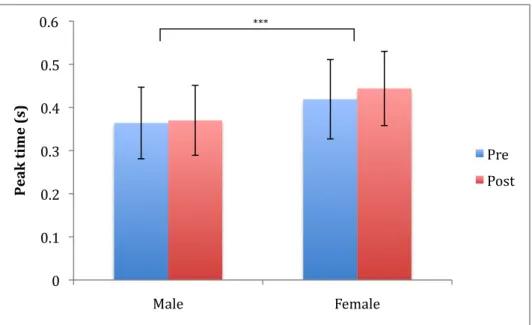
Figure 7. Mean (SD) timing of the RMS peak 2 of the sEMG during the drop jump for both genders, before (Pre) and after (Post) the fatigue protocol, relative to initial contact (*statistically significant – post fatigue, within male (p<0.05), **statistically significant – between genders (p<0.01)) ...19
Figure 8. Mean (SD) amplitude of the normalized RMS peak 1 of the sEMG during drop jump for both genders, before (Pre) and after (Post) the fatigue protocol (**statistically significant - between genders (p<0.01)) ...20
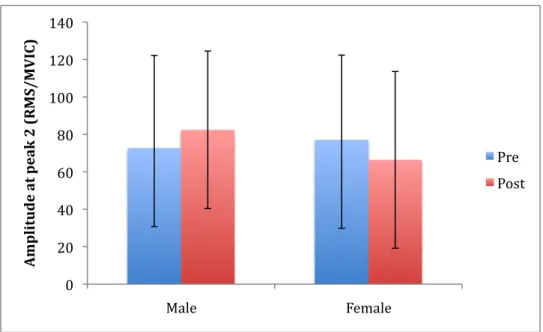
Figure 9. Mean (SD) amplitude of the normalized RMS peak 2 of the sEMG during drop jump for both genders, before (Pre) and after (Post) the fatigue protocol ...20
Figure 10. Mean (SD) stance duration on the force plate during the cutting maneuver for both genders, before (Pre) and after (Post) the fatigue protocol (**statistically significant – post fatigue, within male (p<0.01), ***statistically significant – post fatigue, between genders; post fatigue, within female (p<0.001))...21
Figure 11. The relative number of side steps in each group (no peaks, either peak 1 or 2, or both peaks) for both genders (***statistically significant – between genders (p<0.001))...22
Figure 12. Mean (SD) timing of the RMS peak 1 of the sEMG during the cutting maneuver for both genders, before (Pre) and after (Post) the fatigue protocol, relative to initial contact ...22
Figure 13. Mean (SD) timing of the RMS peak 2 of the sEMG during the cutting maneuver for both genders, before (Pre) and after (Post) the fatigue protocol, relative to initial contact (***statistically significant – between genders (p<0.001))...23
Figure 14. Mean (SD) amplitude of the normalized RMS peak 1 of the sEMG during cutting maneuver for both genders, before (Pre) and after (Post) the fatigue protocol (***statistically significant – post fatigue, within male; post fatigue, between gender (p<0.001)) ...23
Figure 15. Mean (SD) amplitude of the normalized RMS peak 2 of the sEMG during cutting maneuver for both genders, before (Pre) and after (Post) the fatigue protocol ...24
List of tables
Abbreviations
ACL – Anterior cruciate ligament ED – Emergency department IC – Initial contact
MVIC – Maximal voluntary isometric contraction
NCAA ISS – National Collage Athletic Associations Injury Surveillance System PFPS – Patellofemoral pain syndrome
PKF – Peak knee flexion
PCL – Posterior cruciate ligament RMS – Root mean square
sEMG – Surface electromyography
1 Background
1.1 Sports, health, injuries
Sports, in one form or another is one of the most popular recreational activities in the world. You don’t need to be an athlete to engage in some form of exercise that can improve your health and quality of life. Back in 1990, Thorlindsson et al (1) examined the effects of participation in sports on various direct and indirect health related behaviors through a questionnaire that was submitted to 1200 15-19 years old subjects. The results showed that athletes perceived their health as good and, compared to their peers, also had less anxiety, were less depressed and experienced less psycho physiological symptoms such as aches, pains and dizziness (1). Exercise in adulthood can positively impact health and reduce the risk of chronic diseases and disabilities or prevent weight gain that improves quality of daily living (2). Although sports have so many positive aspects there is always a risk of the occurrence of injuries, either acute injuries, i.e. they occur suddenly, or overuse injuries that develop over longer time. In the USA alone, the cost resulting from sport injuries that led to visits to the emergency department (ED) was estimated at $3.7 million per year and there of 68% was for children and young adults (5-24 years old) or $2.6 million (3).
1.2 Frequency
Danmore et al. (4) determined the frequency of sports-related injuries compared to all musculoskeletal injuries in patients 5-21 years old presenting at four pediatric ED in the United States. The results indicated that sports injuries were 41% of all musculoskeletal injuries treated at ED, by far the most common cause of musculoskeletal injuries. A recent retrospective study used a random sampling of 2133 or 5% of the medical records in a children’s hospital (aged 5-17 years old) over 10 years to evaluate and differentiate between the genders in sports related injuries (5). The overall frequency of lower extremity injuries was 60.2% of all injuries, with the females the lower extremity injuries calculated for 65.8% compared to 53.7% with the males. The overall most frequent injury was fractures (13.4%), followed by patellofemoral pain syndrome (PFPS) (9.6%) and the anterior cruciate ligament (ACL) injury (9.4%). There was not a significant difference in the frequency between genders in ACL injury.
In the United States an estimated 80.000 ACL injuries are diagnosed each year, where the highest frequency is within the age group of 15-25 year olds who participate in pivoting sports (6). Of those, 70% occur in noncontact situations. Performing a “plant-and-cut” movement or landing on an extended and slightly valgus (or varus) knee after a jump is typical of a basketball - or handball – related ACL injury (7).Even though the ACL is the most commonly injured knee ligament, an isolated ACL injury is relatively uncommon (8). Other injuries that occur with the ACL injury are for example meniscal injuries, injury of other ligaments, on joint cartilage and damage of subchondral or cancellous bone. The reason for those associated injuries might be the same mechanisms and the force that ruptures the ACL. Those injuries in addition to the ACL injury increase the risk of developing osteoarthritis (8).
1.2.1
Contact vs. noncontact
Boden et al. (9) examined the mechanisms of ACL injury. Eighty-nine subjects with 100 injured knees were questioned about their injury. Of these 100 knee injuries, 71 were noncontact, 28 with contact and 1 was unsure if there had been contact. What most of them had in common was that the injury was sustained at foot strike with the knee almost fully extended. Noncontact injury was classified as a sudden deceleration right before a change of direction or landing motion, while contact injuries occurred as a result of valgus collapse of the knee with influence from outer forces. Another finding was that the subjects who injured their ACL had higher level of laxity in their hamstrings muscle, compared to a matched group of 28 controls. The authors concluded that high activity of the quadriceps muscle during deceleration coupled with a relatively lax hamstrings muscle might lead to excessive forward translation of the tibia resulting in ACL injury (9).
In 1997 Myklebust et al. (10) conducted a registration of cruciate ligament injuries in top level handball in Norway for both males and females. Two seasons were recorded and the results were 93 cruciate ligament injuries, 87 in the ACL and 6 in the posterior cruciate ligament (PCL). Of those 93 injuries, 95% occurred without contact with other player.
1.2.2
Female vs. male
In the previously mentioned study by Myklebust et al. (10) the incidence difference between genders was reported. Within the female handball players, 1.8% suffered from cruciate ligament injury per season, compared with 1.0% within the males. That makes the females almost twice as likely as the males to suffer such an injury. Another interesting result was that 75% of the injuries occurred during matches while 25% occurred in training sessions.
In 1995, Arendt and Dick (11) published a paper trying to determine causative factors for ACL injury within collegiate men’s and women’s soccer and basketball using the National Collage Athletic Associations Injury Surveillance System (NCAA ISS). Their results showed a significantly higher ACL injury frequency amongst women compared to men’s in both sports. In soccer the injury rate for women was more than double that found for men (0.31 female vs. 0.13 male injuries per 1000 athletic-exposures), which is a significant difference. This difference was consistently demonstrated across both practices and competition. Women were three times more likely to obtain ACL injuries through noncontact mechanisms as their male counterparts, and two times as likely as a result of a player contact. In basketball women’s ACL injury rate was four times greater than the male’s (0.29 female vs. 0.07 male injuries per 1000 athletic exposure) which is a significant difference. This was consistent in practices and games. Noncontact injury was more common than a contact injury when suffering from an ACL injury (11).
These results are similar to the results of Mihata et al. (12) in their cohort study published in 2006 where they examined the difference between genders in soccer, basketball and lacrosse. Females were 2.6 times more likely to injure the ACL than males in soccer (0.32 female vs. 0.12 male injuries
per 1000 athletic exposures) and 3.5 times more likely in basketball (0.28 female vs. 0.08 male injuries per 1000 athlete exposures). There was no significant gender difference in lacrosse (0.18 female vs. 0.17 injuries male per 1000 athlete exposures). When the sports were compared, males had a significantly higher rate of ACL injury in lacrosse vs. soccer and basketball. When the sports were compared amongst the women, they had a significantly lower ACL injury rate in lacrosse vs. soccer and basketball. The authors discuss that a reason for this difference between sports might be that women’s soccer involves more contact than women’s lacrosse. Therefore small trauma during the game might disturb neuromuscular patterns during the game. Men’s lacrosse is more of a contact sport compared to women’s lacrosse and since males injure their ACL more frequently in contact than in non-contact, lacrosse has a higher ACL injury rate (12).
In 2005, Agel et al. (13) conducted a study to determine whether the frequency of women’s ACL injury had changed since 1994, given the increase in information about risk factors and prevention programs. They used the previously mentioned Arendt and Dick (11) study as their model, obtaining their information from the NCAA ISS from 1989-1990 through 2001-2002, academic years. Agel et al. results showed that in 2002 the rate of ACL injuries continue to be significantly higher for females than males, regardless of mechanism of the injury in both soccer (0.28 female vs. 0.07 male injuries per 1000 athletic exposures) and basketball (0.28 female vs. 0.07 male injuries per 1000 athletic exposures) (13). Thus although this topic had been studied and reported in various papers, little or no change had been in the prevention of the ACL injuries.
1.3 Risk factors
Regularly since 2001 (14-19) a group of physicians, physical therapists, athletic trainers, biomechanics, epidemiologists and other scientists interested in risk factors and incidence of noncontact ACL injuries, have met six times to review current knowledge on risk factors associated with noncontact ACL injuries, ACL injury biomechanics and existing ACL injury prevention programs. Their main focus was originally gender bias and risk factors that could explain why women are at more risk of ACL injuries (14-17). In the last two meetings their focus has been more about risk factors and prevention (18, 19).
The last meeting was held in 2012 (19) and participants were divided into 3 groups depending on their interests to discuss and present their findings. Although these factors are divided into different groups, they are entwined at many levels:
1. Anatomical, genetic, and hormonal risk factors
2. Neuromuscular and biomechanical contributions to ACL injury 3. Risk factor screening and prevention
In this thesis the section on risk factors will be presented in three chapters consistent with that noted above, while recognizing possible multifactorial mechanisms of noncontact ACL injury (19).
1.3.1
Anatomical, genetic and hormonal risk factors
1.3.1.1 Anatomical and structural risk factors
The anatomical and structural risk factors that have been examined are factors that cannot be changed. They are therefore impossible to control and difficult to modify (19). The factors that have mainly been examined and show gender difference are for the most part unfavorable to females. These factors are:
• ACL structure and geometry: ACL injured patients have smaller ACL’s. Females tend to be at a disadvantage in regard to length, cross-sectional area and volume even though the measurements are adjusted to body anthropometry (20, 21).
• Knee-joint geometry – tibial plateau: ACL injured patients have greater lateral posterior-inferior tibal plateau slopes and reduced condylar depth of the medial tibial plateau (22). Female have greater lateral and medial posterior-inferior tibial slopes and reduced coronal tibial slopes (23). • Knee-joint geometry – femoral notch: ACL patients generally have a narrower femoral
intercondylar notch width than controls.Females have a narrower notch than males (24). • Knee joint laxity: When the non-injured knee of an ACL injured person is compared to a
control they have greater magnitudes of anterior knee laxity, knee hyperextension, general joint laxity and internal-rotation knee laxity. All of these factors are unfavorable for females (25).
• Lower extremity alignment: There is no compelling evidence for lower extremity alignment to be a factor for ACL injury but a fully mature female has a greater anterior pelvic tilt, hip anteversion, tibiofemoral angle and quadriceps angles. There is no gender difference in tibial torsion, navicular drop or rear-foot angle (26).
1.3.1.2 Genetic risk factors
An ACL injury is a multifactorial incident where genetic factors interact with environmental (non-genetic) factors (19). The injury derives from the environmental exposures that is likely to play a causative role of the injury interacting with a genetic background (27). The genetic factors that have been examined are mainly factors that influence the structural component of the collagen in ligaments, either there is not enough renewal or they do not arrange correctly. Mutations of those factors have been associated with the risk of ACL injury (28). Another view of the genetic factor are based on the results that Flynn et al. (29) reported in their case control study where their findings showed that a subject that suffers from ACL injury is twice as likely to have a relative that has a history of ACL injury compared to a subject without an ACL injury.
1.3.1.3 Hormonal risk factors
When examining hormonal risk factors, sex-steroid hormone concentrations have been the substance that has mainly been studied. In particular the focus has been on the high concentrations and monthly variations in estrogens and progesterone that female experience at and after puberty (19). There are both estrogens and testosterone receptors on the ACL but given a higher concentration of estrogens amongst women, they are thought to have direct effects on the structure, composition and the mechanical function of the ACL. This might lead to a higher risk of ACL injuries for females, especially during puberty when the estrogens levels are increasing (30).
1.3.2
Neuromuscular and biomechanical factors associated with the ACL
injury mechanism
When examining neuromechanical factors, research studies typically utilize motion analysis with outcome measures such as kinematics, kinetics and the timing and magnitude of muscle activation and force production (19). These factors have received a lot of attention as they can be modified with training and may therefore present a feasible intervention to lower the risk of ACL injury.
1.3.2.1 Neuromuscular training
The effects of neuromuscular training were evaluated in a meta-analysis by Yoo et al. (31). A total of 2215 articles were identified from the keyword search but 7 made it through the selection criteria set by the authors. Only randomized controlled trials and prospective cohort studies were included. The researchers used plyometrics, strengthening, balancing and agility programs as prevention programs conducted either pre-season or in-season, or both. The result was that 5 of the 7 studies supported the efficacy of the prevention programs. The incidence of the 7 studies was that of the 3.999 in the trained group, 34 had ACL injury while 123 of the 6.462 untrained with an odds ratio of 0.40 (95% CI of 0.27, 0.60) in the fixed model, which demonstrated the effectiveness of the prevention programs. If divided to two groups, under 18 years old and adults, the preventive program had more favorable effect on the younger ones than the 18 year olds and adults. When looking at soccer vs. handball, training had a greater effect on soccer players. Preventive programs were effective when used both during the pre-season and in-season periods, while if used separately, pre-season or in-season training was not effective. Plyometrics and strengthening programs gave positive results while balancing programs did not.
1.3.2.2 Kinematics and muscle activation
Hewett et al. (32) published a prospective study of 205 female athletes where 3-dimensional kinematics during a drop jump, were calculated. A drop jump is the movement where the subject stands on a box, drops down on the floor and jumps up again in a motion simulating the act of taking a rebound in basketball. Of these 205 athletes 9 went on to rupture their ACL. Pre-injury measures of knee kinematics and loading for these 9 were significantly different than that generally found in the
196 that did not have ACL rupture. The knee abduction angle at landing was 8° greater in ACL-injured than in uninjured athletes (p<0.05). They also had 2.5 times greater knee abduction moment (p<0.001) and 20% higher ground reaction force (p<0.05), whereas stance time was 16% shorter. Hence, increased motion, force and moments occurred more quickly. The authors concluded that knee motion and knee loading during a landing task might predict risk of ACL injury in female athletes.
In 2003, Ford et al. (33) examined the valgus knee motion and varus-valgus angles of 81 high-school basketball players during a drop vertical jump. The results were that female athletes landed with greater total valgus knee motion and a greater maximum valgus knee angle than male athletes. Female athletes also had significant differences between their dominant and non-dominant side in maximum valgus knee angle.
Gender difference has been documented in kinematics during landing and cutting maneuver. A cutting maneuver is the movement where the athlete plants their foot and does a side step in order to change direction. In 2005, Ford et al. (34) examined the knee and ankle kinematics during a jump-stop unanticipated cut maneuver. The results demonstrated that female athletes exhibited greater knee abduction (valgus) angles than males. There was also significant difference between genders during side stepping in findings that McLean et al. reported in 2005 (35). The knee valgus moment of the females was significantly larger than among the males.
In 2008, Shimokochi et al. (36) did a systematic review where their main focus was on ACL loading patterns that could result in ACL injury. They examined and summarized both retrospective and observational studies to assess the ACL injury mechanism in vivo, in vitro and using computer simulation. Their main findings were that multiplanar knee loading appeared to lead to ACL injury. Vigorous quadriceps force combined with frontal-plane or a transverse-plane knee loading, with not enough hamstrings muscle co-contraction forces and the knee at near-extension or hyperextension, may load the ACL excessively (36).
Noncontact ACL injuries occur mostly in a closed kinetic chain situation and since there is a closed kinetic link between the hip and the knee, it is possible that kinematic and muscle activation patterns of the hip affects the knee loading (37). Papers have been published about muscle activation of the thigh muscles (38-40) and recently they have been progressing to the hip muscles (37, 41-43) as well, and even to the stabilizing muscles of the back (44). The goal of such research is to see whether activity levels or the timing of muscle activation of those muscles might affect the position of the knee and the ACL loading.
Results of a study conducted by Ebben et al. (38) showed a trend indicating that the hamstring quadriceps ratio is higher amongst males than females. That is in agreement with other papers that showed that during vertical stop-jump (39) and side steps (40), females’ demonstrated higher EMG activity in quadriceps muscles than males. More quadriceps activity could cause increased tibial forward translation that may lead to increased loading of the ACL.
In 2007, Hart et al. (41) used sEMG to evaluate gender difference of gluteus medius, biceps femoris, vastus lateralis and gastrocnemius medialis performing a single-leg forward jump. The initial heel contact from landing was used in data analysis. Average gluteus medius activity was significantly
higher in males than in females, but the other muscles did not show any difference between genders. They discussed that the reduced activity of the gluteus medius might result in less resistance to hip adduction and internal rotation (41).
Carcia and Martin (37) did not find any significant gender difference when examining in gluteus medius activity during drop jumps, pre- and post-landing. What was interesting about their results was that the results of the women were much more varied compared to the males. This agrees with what Zazulak et al. (43) concluded in their study where they didn’t find a significant difference in sEMG signal of gluteus medius between genders during single-leg landing. Their results, on the other hand, did show a difference between genders where females had decreased gluteus maximus and increased rectus femoris activity (43).
1.3.2.3 The effects of fatigue on neuromuscular and biomechanical factors
Fatigue has been put forward as a risk factor regarding the ACL injury. In a study by Myklebust et al. (10), the results showed that 53% of the injuries occur in first half of the game. This would suggest that fatigue is not a risk factor. However, the authors did not inquire about the athletes playing time during the game. Therefore, fatigue should not be ruled out as a risk factor. A study, where the effects of fatigue and gender on high-risk landing strategies using drop jump, found significant difference in angles of peak knee abduction and peak knee internal rotation (45). The fatigue protocol consisted of 4 min series of continuous drills to imitate movements of athletes. Females demonstrated larger knee abduction and internal rotation angles compared to males but the changes that occurred after the fatigue were the same between the genders.
In 2007, Jacobs et al. (46) did measurements on 30 healthy adults while performing 3 pre-exercise landing trials that required the subjects to hop from both legs and land on a single leg. Thereafter, a rest period of 15 min was conducted before doing a fatigue protocol that consisted of a 30 s bout of isometric hip abduction. Immediately after, the subjects completing 3 post exercise-landing trials. The results showed that the women had significantly lower peak torque of the hip abductors and they also demonstrated larger knee valgus. Regardless of gender, hip flexion and hip adduction were significantly increased following the 30 s bout of exercise. The authors concluded that the fatigue would potentially increase the risk of acute knee injury (46).
Patrek et al. (42) used a 3-dimentional kinematic recordings, sEMG and fatigue protocol to see how the activity of gluteus medius and biomechanics of the knee changed during a single-leg landing. The fatigue protocol, which consisted of repetitive side-lying hip abduction, delayed the onset of gluteus medius activity but there was no difference in lower extremity biomechanics. Considering that this fatigue protocol is not very functional and different from the single-leg landing task, the muscle fibers of gluteus medius used in side-lying hip abduction might not be the same as the ones used in single-leg landing (42).
Another study (47) used eccentric fatiguing protocol for gluteus medius when examining how postural balance and the quality of movement changed before and after the fatigue protocol. They used sEMG to evaluate muscle activity while doing single-leg static balance and star excursion balance test before and after the fatigue protocol. Their observations led to the conclusion that there
were impairments after the fatigue protocol, due to changes gluteus medius rather than in rectus femoris.
1.3.3
Risk factor screening and prevention
Prevention programs have shown subsequent reduction in the overall incidence of ACL injuries, without altering the difference in injury rate found between the sexes (19). These programs have to be modified and improved to increase the effectiveness and to be able to set up highly sensitive screening tools in order to detect specific risk factors and react to the identified risk factors. Screening tests have been used to identify risk factors for ACL. For example the Landing Error Scoring System (LESS) has been found valid and reliable for identifying potentially high-risk movement patterns during a jump – landing task (48). However it did not predict for ACL injury in a prospective study where just over 5000 high school students were evaluated (49).
Noyes and Barber-Westin (50) did a systematic review in 2014 on intervention programs, where their goal was to investigate whether the intervention programs had a positive influence on the incidence of ACL injuries in adolescence female athletes, i.e. to see whether the injury rate got lower. The biggest obstacle they encountered was that many studies being conducted were using different methods and, therefore, it was difficult to compare them. Of 694 studies made in 1994-2013 only 8 met the inclusion criteria and of those, 3 training programs significantly reduced noncontact ACL injury incidence rates in female adolescent athletes while 5 did not (50).
1.4 The role of
gluteus medius
The hip abductors and external rotators control internal rotation and adduction at the hip. Muscle weakness might, in theory, reduce their control and result in repetitive stress injuries such as PFPS and iliotibial band syndrome, or traumatic injury such as noncontact ACL injury. A systematic review was conducted in 2012 (51) to examine the effects of weak hip abductors or external rotators on knee valgus kinematics in healthy subjects. The author concluded that there was a small amount of evidence that healthy subjects with weak hip abductors and perhaps weak external rotators increase knee valgus. Three studies supported this conclusion while one study found no correlation between weak hip muscles and increased knee valgus. But further research is needed since the methodology was different between studies. Another point that was made in this systematic review was that one way to reduce the force that the hip abductors have to produce as a compensatory movement to the hip adduction, would be to do an ipsilateral trunk lean to move the center of mass over the stance foot when standing on one foot. This might reduce the effects of weak abductors on kinematic below the hip (51). However, if the subject does a contralateral trunk lean the effects of weak abductors would be increased and effects on the kinematic of the lower extremities might be increased. But none of the studies in the systematic review measured trunk kinematics so these speculations have yet to be examined (51).
Homan et al. (52) studied the effects of hip muscle strength and muscle activation of gluteus maximus and gluteus medius on ACL injury biomechanics, particularly knee valgus loading during landing. They examined the strength as well as using sEMG to record the activation patterns of these muscles. The results indicated that there was no difference between groups with high and low strength in abduction or external rotation on knee valgus motion. However, groups with low strength in abduction and external rotation displayed relatively higher sEMG amplitudes compared to the high strength groups. The authors concluded that individuals with weaker muscles compensated for this by increasing their neural drive resulting in greater activation levels and that hip muscle strength may influence knee valgus motion indirectly by determining neural drive requirements (52).
1.5 Puberty and adolescents
In 2012, Wild et al. (30) did a review about how changes at puberty can affect the estrogens levels, musculoskeletal structure and body function. The conclusion was that when comparing the genders, girls displayed higher incidence of noncontact ACL injuries during sport at the onset of and during puberty. There are multiple factors that can affect these results. Many studies have been made where high levels of estrogens have been examined, but the results are conflicting. Questions have not been answered without a doubt on how or whether estrogens affect the metabolic and mechanical properties of the ACL (30). Another conclusion that they discussed was that girls do not have increased strength in their hamstrings muscle to the same extent as boys do despite increased quadriceps muscle strength. There are also indications that girls have an increased knee valgus posture throughout puberty. Therefore, this deficit in hamstrings strength and increased valgus tendency might make the knee less stable and then the risk of ACL loading during landing in dynamic movements is increased (30).
In 2009, Buchanan and Vardaxis (53) assessed the gender difference of strengths of the lower-extremities of female and male 9-22 years old basketball players. Their results were in general the same; males were stronger than females and older subjects were stronger than younger ones. There was one important exception where 9-10 years old females were stronger than 12-13 years old females. The conclusion they drew from these results were that this age is an important time to target strength training.
1.5.1
Kinematics at puberty
Yu et al. (54) examined kinematic measurements during a Stop-Jump task where the subjects were youth soccer players (11-16 years old). The results showed that age and gender significantly affected the knee flexion angle at initial contact (IC) and at peak knee flexion (PKF). These variables did not change with age amongst the young males but within the young females these angles decreased with age, especially after 14 years of age. The knee valgus-varus angle at IC was also significantly affected by age and gender. Before the age of 12, both genders had a valgus knee angle. After 12 years of age, males demonstrated knee varus whereas females remained in valgus. They got the same results
at PKF, where males generally demonstrated a varus knee angle while the females had a valgus knee angle. When landing after the stop-jump, females increased their knee valgus angle as age increased while the male knees remained the same during the landing as age increased. Thus, there was significant effect of both age and gender (54).
Age and gender also significantly affected the hip flexion angle where the hip flexion angle at landing and at PKF was significantly greater within the males compared to the females (54). These angles remained the same as age increased amongst the males while they decreased after 13 years of age within the females. When looking at internal-external rotation of the hip at IC, males had a little internal rotation while the females externally rotated the hip. At PKF males internally rotated the hip and the females had little internal rotation of the hip. At these 2 angles there was significant difference between genders. These results suggest that female recreational soccer players land with their lower extremities more extended than males with the knee in valgus, and the difference between gender increases after the age of 12. This might increase the load on the ACL when landing (54).
Landry et al. (55) identified kinematic difference of side-cut maneuver of 14-18 years old soccer players. The female subjects demonstrated significantly less hip flexion at IC during the movement. The male subjects had a significantly more internally rotated femur than the female subjects. Another interesting result was that the male subjects had a significantly steadier hip rotation angle than female subjects, who went from internal to external rotation as the stance phase progressed. They concluded that because of the more erect posture of the females they would possibly have greater knee joint loading and consequently be in greater risk of injury (55). Another research studying cutting maneuver looked at lower extremity biomechanics difference between male and female football players across different stages of maturational development (pre-pubertal, pubertal, post-pubertal and young adult) (56). There was no interaction between gender and maturation. However, the results indicated that pre-pubertal athletes might have greater knee adductor moments and ground reaction force than all the other groups. Another result that they received was that the younger the athletes the slower their speed was while approaching the task (56).
1.6 Cost of reconstruction
The cost of treating knees after an ACL injury is great as all of them require non operative treatment and a large number of individuals also have surgery. The cost is approximately 17.000 US dollar per patient in orthopedic care, including ACL reconstruction and rehabilitation, which calculates to 37 million US dollars per year in the USA (57). Griffin et al. (6) give a much higher number, stating that the cost is almost a billion US dollars per year in the USA. These costs also include estimates due to the potential loss of an entire season of sports participation, loss of scholarship funding and the ensuing effects on the athlete’s mental health and academic performance (57).
2 Aim
The aim of this study is to identify gender difference between 11-12 years old children during drop jump and cutting maneuver and evaluate the effects of fatigue on:
1. Stance duration
2. Neuromuscular activation of gluteus medius
a. Relative number of peaks after initial contact on the force plate b. Timing of the peaks
c. Amplitude of the normalized RMS signals
The hypothesis is that the stance duration and neuromuscular activation of gluteus medius is the same for both genders at 11-12 years old during the drop jump and cutting maneuvers. Furthermore, the hypothesis is that any changes that occur after a fatigue protocol will not differ between genders.
3 Methods
3.1 Recruitment (study design and population)
Participants of this research were 11-12 years old handball and football players. Before recruitment started, the National Bioethics Committee and The Data Protection Authority in Iceland approved the research. Four sports clubs in Reykjavík were invited to participate, all of which had 11-12 years old players in handball and football. Head coaches or managers of youth divisions were informed about the research via a detailed leaflet and given a chance to ask questions regarding the research if any. They all showed interest in participating and signed an agreement to that. These sports clubs were invited to participate due to their geographical location, but they are all close to the research center. Parents of 206 children were sent information regarding the research and if they wished not to participate they were informed to send an email to researchers to decline participation. If no email was received, researchers called the parents to answer questions and book an appointment for conduction of the research. Of those 206 children (79 boys, 127 girls), 86 agreed to participate (27 boys, 59 girls) and the measurements were conducted in April-November 2012. Parents or a guardian brought the participant to the research center and both signed an informed consent form for the measurements.
3.2 Equipment
In short, the measurement session started with a warm up on a spinning bike (Keiser Power Pacer), after which strength measurements were conducted using a dynamometer (Lafayette Manual Muscle Tester Model 01163) during which sEMG data for normalization was collected (maximum voluntary isometric contraction (MVIC)). During performance of each dynamic task, data collection was conducted involving muscle recruitment using sEMG, motion analysis via an eight camera motion captures system (Qualisys) and two force plates (AMTI), before and after a fatigue protocol. Each session took about 1.5- 2 hours. A wireless 12-channel sEMG system from Kine (Kine, Hafnarfjörður, Iceland) was used with KinePro software, to measure muscle activity with sampling frequency of 1600 Hz. Electrodes were placed on vastus lateralis, semitendinosus, gastrocnemius lateralis and gluteus medius bilaterally. The recording units have a low pass filter at 500Hz and high pass filter at 16Hz where the signal between 16HZ and 500Hz was digitized and transferred from each unit via radio wave to the EMG receiver.
For the fatigue protocol a 2 m x 0.6 m slide board was used. The reason for using a slide board was that executing the lateral slides would require strong activation of the hip abductors and external rotators. Bumpers were placed on each end of the board and they were adjusted to the length of the participants by measuring the length of the lower extremity, from crista iliaca to the floor, and multiplied by 1.5.
3.3 Research protocol
An appointment was arranged for each subject and their guardian at the Research Centre of Movement Science (University of Iceland) where the measurements took place. Participants were given a number that was their code for the research. Participants and their guardians signed an informed consent for the measurements and were given verbal information of what they were required to do. They were given a chance to ask questions and told that they could at any time quit the measurements if for any reason they didn’t want to continue.
The first task for the participants was to answer a few questions regarding their age, sports activity, dominant leg and hand, while measuring their height and weight. When they had put shoes on they warmed up on a stationary spinning bike, where they were asked to cycle for 5 minutes at a pace where they would feel some shortness of breath without becoming exhausted.
After the warm up, sEMG electrodes were placed bilateral on the selected muscle, gluteus medius according to SENIAM protocol (www.seniam.org) (58) where the electrodes are placed at 50% on the line from crista iliaca to trochanter majoris. Thereafter MVIC measurements were conducted. The MVIC consisted of a warm up trial and then 3 trials where recorded, bilaterally. The descriptions here are measurements on the right leg.
• Hip abduction: participants lay on their left side on a treatment table. A belt was put over the hips to restrict extra movements. The dynamometer was placed on the lateral aspect of the thigh, two finger widths cranial to the right knee joint and secured by a belt. The left knee was flexed to approximately 90° and left hip flexed to 30-45° to increase stability. The participant was instructed to push the dynamometer with a straight leg and increase to maximum force. While this was done the sEMG for MVIC was collected.
At this point, reflective markers were put on for kinematic measurements but they will not be addressed further here since they are not used in this report. The drop jump and the cutting maneuvers were done in a random order.
• Drop jump: the participant got verbal instructions for the drop jump and got a few warm up trials before doing the requested 5 recorded trials. The participant stands on a 25 cm high box. The instructions were to stand on the edge of the box, let yourself fall down on the ground, land on the force plate and jump up as high as you can.
• Cutting maneuvers: the participant got verbal instructions for the cutting maneuvers and got a few warm up trials before doing the requested 5 recorded trials. The instructions were to cut past a defensive player (a home-made stick with a face on it) by placing the cutting foot on the force plate and push past the defensive player.
• Fatigue protocol: the participant changed shoes, as the bumpers on the slide board would have destroyed the reflective markers on the shoes. The instructions were to slide between the bumpers for 5 minutes, beginning slowly and increasing the speed every minute until going as fast as you can the last minute. Also, they were advised to lean forward a little and try to keep the tempo. When the 5 min were up, the subjects were asked to rate their perceived fatigue on a scale from 0 to 10, where 0 is no fatigue and 10 is exhaustion.
After the fatigue protocol the subjects changed shoes again and repeated the drop jump and cutting maneuvers, but in a reverse order.
3.4 Statistical analysis
The IC of the foot onto the force plate was used as a reference point to the activity of the sEMG signal during landing. All temporal values are expressed relative to this reference point in time. The sEMG recordings were exported from the KinePro software, and the force plate data from the Qualisys software, as text files. Further data processing was conducted by algorithms written in Matlab software (version 7.11.0.584, R2011b). The force plate data were used to identify the time of IC (reference point zero) and the duration of contact on the force plate during task performance (stance duration) during each trial of drop jump and cutting maneuver. The sEMG signal was filtered with 30 Hz high-pass 7-order Butterworth filter and RMS calculated with a linear envelope of 250 ms. For each trial, pictures were created for the unfiltered and filtered signal, the frequency spectrum and the RMS of the EMG signal from -0.5 s to +1.0 s, relative to the defined reference point (IC). The pictures were visually inspected to evaluate the quality of the data. Trials of low quality were discarded, e.g. if part of the data was missing or movement artifacts distorted the sEMG signal. Peaks in the RMS trace were identified and their amplitudes and time relative to the IC were stored in an excel file. The MVIC recordings were processed in the same way and the maximum RMS value used for normalization purposes. Statistical analysis was conducted in SAS Enterprise Guide 4.3. Fisher’s Exact test for contingency tables was used to compare number of peaks present between genders, both overall and separately for each peak group by using Bonferroni correction. Two-sample t-test was used to compare background variables between genders. Mixed-model ANOVA for repeated measurements was used to analyze continuous outcome variables. RMS values and stance durations were transformed by taking logarithm to correct for skewness in the residual distribution. Within variables (pre vs. post fatigue, repetitive trial, right/left side) were included in the models and gender as between subject factor. All two-way interactions were included in the model, but only gender, pre vs. post fatigue and gender is presented. Tukey post hoc test was used to further analyze significant interactions. Alpha was set at 0.05
4 Results
Out of 86 participants in the whole project, sEMG recordings were included for 47 participants during the drop jump and cutting maneuver (54.7%). Of these 47 participants, 9 were males (19.1%) and 38 females (80.1%). The participants’ characteristics are presented in Table 1. The age ranged from 10-12 years old, but the 10 year-olds would become 11 years old on the year of the measurements. The mean height of males was slightly higher than for females (p=0.618) but the range was very similar. The mean weight was 0.7 kg greater for males (p=0.887) although the range was greater among the females due to a single female outlier. Consequently, the difference of in mean body mass index (BMI) was 0.2 kg/m2, where females had a slightly larger BMI than the males (p=0.904) and because of the outlier the range was larger among females.
Table 1. Participants’ characteristics
Mean (SD, range)
N Height, m Weight, kg BMI, kg/m2
Male 9 1.53 (±0.10 1.39-1.71) 46.1 (±12.2 27.7-60.3) 19.3 (±3.4 14.4-24.2) Female 38 1.511.40-1.71) (±0.07 45.427.4-79.3) (±12.5 19.512.6-30.9) (±4.3
IC was used as a reference point when analyzing the results, i.e. for each trial the IC on the force plate is set at 0 s. When the RMS graphs of the sEMG during the stance duration on the force plates were examined, either none, one or two peaks were observed. Therefore the RMS sEMG of the trials of jumps and cutting maneuvers were divided into 4 groups:
1. No peak; no peaks were evident during the time period -0.10 – 0.55 s;
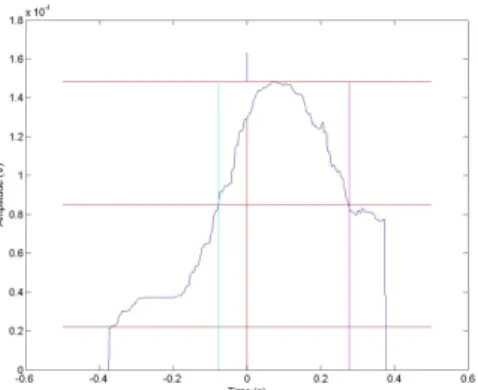
2. Peak 1; a peak was evident during the time period -0.10 – 0.25 s after IC (Figure 1); 3. Peak 2; a peak was evident during the time period 0.25 – 0.55 s after IC (Figure 2);
4. Both peaks 1 and 2; where the signal had two peaks during the time period -0.10 – 0.55 s after IC (Figure 3).
Figure 1. An example of peak 1, where a peak is observed during the time period -0.1 – 0.25 s after IC
Figure 2. An example of peak 2, where a peak is observed during the time period 0.25 – 0.55 s after IC
Figure 3. An example where both peaks 1 and 2 are observed during the time period -0.10 – 0.55 s after IC
4.1 Drop jump
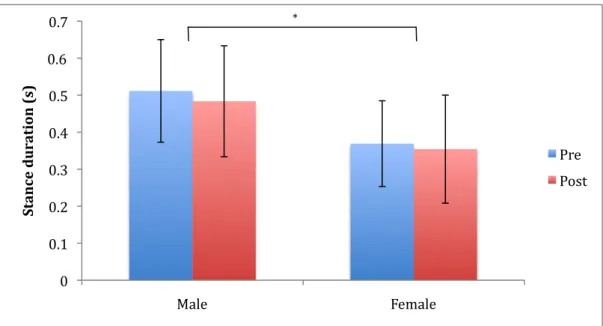
The mean stance duration on the force plates during the landing of the drop jumps was significantly longer for the males than the females (Figure 4; p=0.027). Fatigue had no effect on the stance duration across genders (p=0.933) and no interaction of fatigue and gender was found (interaction: p=0.692).
There was a significant difference between genders with respect to muscle activation patterns in reference to IC and how the RMS peaks were divided between the 4 defined groups during jump trials (Figure 5; p<0.001). Very few individuals had no peaks and no significant difference between genders was observed (p=0.112). Females had a significantly higher percentage of the jump trials with peak 1 only, than males (p<0.001). On the other hand males had a significantly higher percentage of the jump trials with peak 2 only, than females (p<0.001). There was not a significant difference between the genders on the frequency of trials where both the peaks 1 and 2 occurred in the jumps (p=0.192).
The timing of the RMS peak 1 of the sEMG obtained during the drop jump was overall not significantly different between the genders (Figure 6; p=0.212). There was no effect of fatigue on the timing of peak 1 (p=0.918) and no interaction of fatigue and gender was found (interaction: p=0.170). Also the timing of the RMS peak 2 of the sEMG during the drop jump was overall not significantly different between genders (Figure 7; p=0.184). However, the change in timing after the fatigue protocol was significantly different for males and females (interaction: p=0.002), due to a significant delay found among males (Tukey posthoc: p=0.018) that was not present for females (Tukey posthoc: p=0.405).
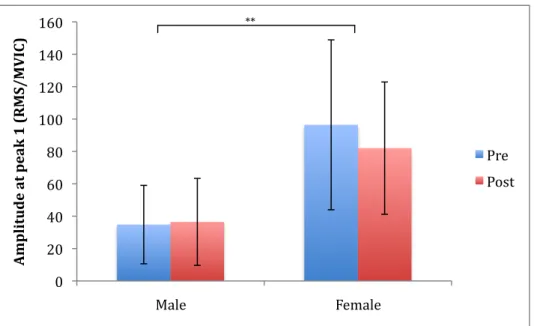
The amplitude of peak 1 during the drop jump, when present, was significantly larger for the females than males (Figure 8; p=0.003). Fatigue had no effect on the amplitude across genders (p= 0.172) and no interaction of fatigue and gender was found (interaction: p=0.941). The amplitude of peak 2 during the drop jump, when present, was not significantly different for females and males (Figure 9; p=0.467). Fatigue had no effect on the amplitude across genders (p=0.184) and no interaction of fatigue and gender was found (interaction: p=0.158).
Figure 4. Mean (SD) stance duration on the force plate during the drop jump for both genders, before (Pre) and after (Post) the fatigue protocol (*statistically significant – between genders (p<0.05)
Figure 5. The relative number of jumps in each group (no peaks, either peak 1 or 2, or both peaks) for both genders (***statistically significant – between genders (p<0.001))
0 0.1 0.2 0.3 0.4 0.5 0.6 0.7 Male Female St an ce d u ra ti on ( s) Pre Post *
0
10
20
30
40
50
60
70
80
No peak
Peak 1
Peak 2
Both peak 1
and 2
R
el
at
iv
e
n
u
m
b
er
o
f j
u
m
p
s
(%
)
Male
Female
*** ***Figure 6. Mean (SD) timing of the RMS peak 1 of the sEMG during the drop jump for both genders, before (Pre) and after (Post) the fatigue protocol, relative to initial contact
Figure 7. Mean (SD) timing of the RMS peak 2 of the sEMG during the drop jump for both genders, before (Pre) and after (Post) the fatigue protocol, relative to initial contact
(*statistically significant – post fatigue, within male (p<0.05), **statistically significant – between genders (p<0.01)) 0 0.05 0.1 0.15 0.2 0.25 Male Female P ea k ti m e (s) Pre Post 0 0.1 0.2 0.3 0.4 0.5 0.6 Male Female P ea k ti m e (s) Pre Post ** *
Figure 8. Mean (SD) amplitude of the normalized RMS peak 1 of the sEMG during drop jump for both genders, before (Pre) and after (Post) the fatigue protocol (**statistically significant - between genders (p<0.01))
Figure 9. Mean (SD) amplitude of the normalized RMS peak 2 of the sEMG during drop jump for both genders, before (Pre) and after (Post) the fatigue protocol
4.2 Cutting maneuver
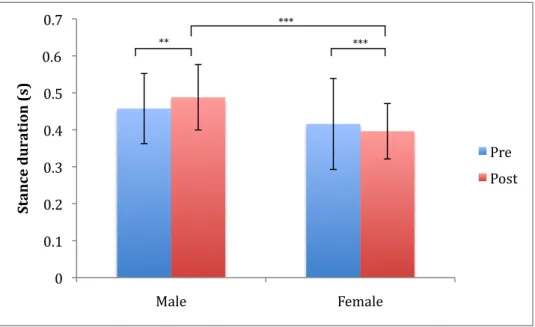
The mean stance duration on the force plate during the side step in the cutting maneuver was not significantly different between the genders (Figure 10; p=0.255). However, a significant interaction of gender and fatigue was found (p<0.001) due to an increase in post-fatigue stance duration for males (Tukey posthoc: p=0.005) while the females’ stance duration was decreased (Tukey posthoc:
0 20 40 60 80 100 120 140 160 Male Female Ampli
tude at peak 1 (RMS/
MVIC) Pre Post ** 0 20 40 60 80 100 120 140 160 Male Female Ampli
tude at peak 2 (RMS/
MVIC)
Pre Post