IDEI - 767
Regularizing
Priors
for
Linear
Inverse
Problems
Jean
‐
Pierre
Florens
Anna
Simoni
Regularizing Priors for Linear Inverse Problems
∗Jean-Pierre Florens†
Toulouse School of Economics
Anna Simoni‡
CNRS and THEMA
This draft: March 2013
Abstract
This paper proposes a new Bayesian approach for estimating, nonparametrically, parameters in econometric models that are characterized as the solution of a linear inverse problem. By using a Gaussian process prior distribution we propose the posterior mean as an estimator and prove consistency, in the frequentist sense, of the posterior distribution. Consistency of the posterior distribution provides a frequentist validation of our Bayesian procedure. We show that the minimax rate of contraction of the posterior distribution can be obtained provided that either the regularity of the prior matches the regularity of the true parameter or the prior is scaled at an appropriate rate. The scaling parameter of the prior distribution plays the role of a regularization parameter. We propose a new, and easy-to-implement, data-driven method for optimally selecting in practice this regularization parameter. Moreover, we make clear that the posterior mean, in a conjugate-Gaussian setting, is equal to a Tikhonov-type estimator in a frequentist setting so that our data-driven method can be used in frequentist estimation as well. Finally, we apply our general methodology to two leading examples in econometrics: instrumental regression and functional regression estimation.
Key words: nonparametric estimation, Bayesian inverse problems, Gaussian processes, posterior consistency, data-driven method
JEL code: C13, C11, C14
∗First draft: September 2008. A preliminary version of this paper circulated under the titleOn the Regularization
Power of the Prior Distribution in Linear ill-Posed Inverse Problems. We thank Joel Horowitz, Enno Mammen, Andrew Stuart, and S´ebastien Van Bellegem for interesting discussions. We also acknowledge helpful comments and suggestions from participants to workshops and seminars in Banff (2009), Bressanone (2009), Stats in the Chˆateau (Paris 2009), Toulouse (2009), CIRM-Marseille (2009), Brown (2010), Mannheim (2010), Northwestern (2010), World Congress of the Econometric Society (Shangai 2010), Warwick (2011), Cowles Foundation Econometric Summer conference (Yale 2011), Princeton (2012). Anna Simoni gratefully acknowledges financial support from the University of Mannheim through the DFG-SNF Research Group FOR916 and hospitality from CREST.
†Toulouse School of Economics - 21, all´ee de Brienne - 31000 Toulouse (France). [email protected]
‡French National Center of Scientific Research and THEMA, Universit´e de Cergy-Pontoise - 33, boulevard du
1
Introduction
In the last decade, econometric theory has shown an increasing interest in the theory of stochas-tic inverse problemsas a fundamental tool for functional estimation of structural as well as reduced form models. The purpose of this paper is to develop an encompassing Bayesian approach to stochastic linear inverse problems for nonparametric estimation of econometric models.
We construct a Gaussian process prior and show that the corresponding posterior mean is a consistent estimator, in the frequentist sense, of the functional parameter of interest. Under mild conditions, we prove that our Bayes estimator is equal to a Tikhonov-type estimator in the frequen-tist setting. This result enables us to construct a data-driven method, based on a Bayes procedure, for selecting the regularization parameter. Such a parameter is necessary in order to implement in practice Tikhonov-type estimators and these estimators are very sensitive to the value of this parameter. We show that the value selected by our data-driven method is optimal in a minimax sense if the prior distribution is sufficiently smooth.
Stochastic inverse problems theory has recently been used in many subfields of econometrics to construct new estimation methods. First of all, the theory of inverse problems has been shown to be fundamental for nonparametric estimation of an instrumental regression function, see e.g.
Florens (2003), Newey and Powell (2003), Hall and Horowitz (2005), Blundell et al. (2007), Darolles et al. (2011), Florens and Simoni (2012a). More generally, inverse problems theory has been used for semiparametric estimation under moment restrictions, seee.g. Carrasco and Florens (2000), Ai and Chen (2003), Chen and Pouzo (2012). In addition, it has been exploited for in-ference in econometric models with heterogeneity – e.g. Gautier and Kitamura (2012), Hoderlein
et al. (2012) – for inference in auction models – e.g. Florens and Sba¨ı (2010) – and for frontier estimation for productivity analysis –e.g. Daouiaet al. (2009). Functional estimation of reduced form econometric and statistical models based on inverse problem theory has been developed, to name only a few, by Hall and Horowitz (2007) and Johannes (2008). This large and incomplete list of references highlights the importance that inverse problem theory has gained in econometrics. We refer to Carrascoet al. (2007) and references therein for a general overview of inverse problems in econometrics.
The general framework, which accommodates many functional estimation problems in econo-metrics, is the following. LetX andY be infinite dimensional separable Hilbert spaces overRand denote by x ∈ X the functional parameter that we want to estimate. For instance, x can be an Engel curve or the probability density function of the unobserved heterogeneity. The estimating equation characterizes x as the solution of the functional equation
where yδ is an observable function, K : X → Y is a known, bounded, linear operator and U is an error term with values inY. Thus, estimating x is an inverse problem. More precisely, yδ is a transformation of a n-sample of finite dimensional objects and the parameter δ−1 > 0 represents
the “level of information” of the sample, so that δ → 0 as n → ∞ and for δ = 0 (i.e. perfect information) we havey0=Kx. Usually, we have thatδ = 1
n and (1) is a set of moment equations with yδ an empirical moment. In this paper we propose a Bayesian procedure for nonparametric estimation of a large class of econometric models that write under the form (1) like moment equality models, asset pricing functional estimation in equilibrium models, density estimation in structural models that account for heterogeneity, deconvolution in structural models with measurement errors. We illustrate two leading examples in econometrics that can be estimated by using our method.
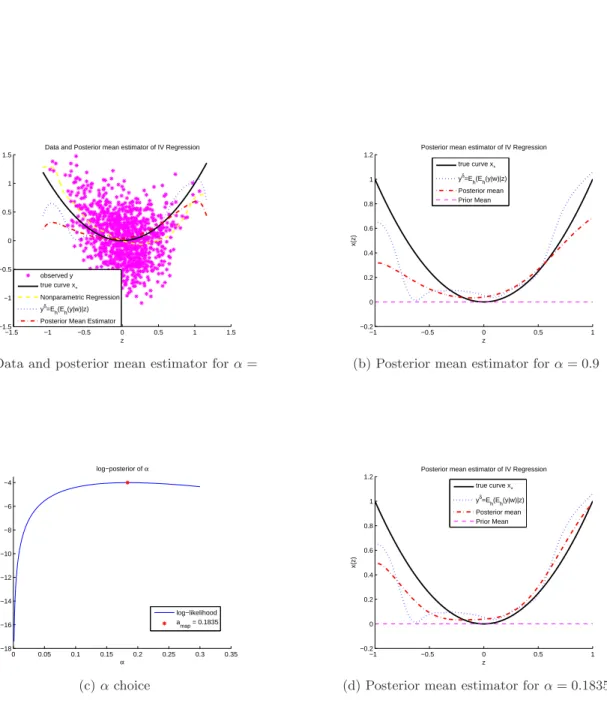
Example 1(Instrumental variable (IV) regression estimation). Let (Y, Z, W) be an observable real random vector and x(Z) be the IV regression defined through the moment condition E(Y|W) = E(x|W). Suppose that the distribution of (Z, W) is confined to the unit square [0,1]2 and admits
a densityfZW. The moment restriction implies thatx is a solution to
EW[E(Y|w)a(w, v)] (v) = Z 1 0 Z 1 0 x(z)a(w, v)fZW(z, w)dwdz where a(w, v) ∈ L2[0,1]2 is a known and symmetric function, E
W denotes the expectation with respect to the marginal density fW of W and L2[0,1]2 denotes the space of square integrable functions on [0,1]2. This transformation of the original moment condition is appealing because
in this way its empirical counterpart is asymptotically Gaussian (as required by our Bayesian approach). Assume that x∈ X ≡ L2[0,1]. By replacing the true distribution of (Y, Z, W) with a
nonparametric estimator we obtain (1) with
yδ= ˆEW h ˆ E(Y|w)a(w, v) i and Kx= Z 1 0 Z 1 0 x(z)a(w, v) ˆfZW(z, w)dwdz. (2) ¤
Example 2 (Functional Linear Regression Estimation). The model is the following:
ξ=
Z 1
0
x(s)Z(s)ds+ε, E(εZ(s)) = 0, Z, x∈L2([0,1]), E< Z, Z ><∞ (3)
and ε|Z, τ2∼ N(0, τ2), with <·,·>denotes the inner product inL2[0,1]. We want to recover the
functional regression x. Assuming that Z is a centered random function with covariance operator of trace-class, the most popular approach consists in multiply both sides of the first equation in (3) by Z(s) and then take the expectation: E(ξZ(t)) =R01x(s)Cov(Z(s), Z(t))ds, for t∈[0,1]. If we dispose of independent and identically distributed data (ξ1, Z1), . . . ,(ξn, Zn) we can estimate the unknown moments in the previous equation. Thus, x is solution of (1) with yδ := 1
n
P
U = 1nPiεiZi(t) and ∀ϕ∈L2([0,1])7→Kϕ:= 1n
P
i < Zi, ϕ > Zi(t). ¤
A Bayesian approach to stochastic inverse problems allows to answer two important questions. A first question concerns the way to incorporate in the estimation procedure the prior information about the functional parameter which is often provided by economic theory or beliefs of experts. This prior information may be particularly valuable in functional estimation since often the data available are concentrated only in a region of the graph of the functional parameter so that some parts of the function can not be recovered from the data. Therefore, the prior information allows to “identify” the parts of the curve for which we have no data.
A second question concerns the selection in practice of the tuning parameter that is necessary in order to compute the nonparametric estimator. In estimation based on inverse problem techniques this parameter is known as the regularization parameter. The value of such a parameter affects considerably the estimation result and it is very important to have an accurate way to choose it.
The Bayesian approach combines the prior and sampling information and proposes the poste-rior distribution as solution to the inverse problem. It allows to incorporate pposte-rior information in a natural way through the prior distribution as well as to select a value for the tuning parameter from its posterior distribution by using a hierarchical structure. Unfortunately, many of the Bayesian approaches to stochastic inverse problems proposed so far can not be applied to functional estima-tion in econometrics. This is due to two main reasons. First, the majority of Bayesian approaches do not work for functional observations and parameters because they consider a finite dimensional projection of (1) and recover x only on a grid of points, see Chapter 5 in Kaipio and Somersalo (2004) and Helin (2009), Lassas et al. (2009), Hofinger and Pikkarainen (2007), Hofinger and Pikkarainen (2007), Neubauer and Pikkarainen (2008). Second, the existing Bayesian approaches to inverse problems that consider models for functional estimation do not allow to accommodate the econometric model of interest because of the different definition of the model’s error term U, see Knapiket al. (2011).
Since the econometric model (1) differs from the stochastic inverse problems addressed by the existing Bayesian inverse problems literature a specific Bayesian procedure must be developed. In particular, we have to deal with the problem that the exact posterior mean of x in (1) (when a conjugate-Gaussian setting is used) can be defined only in a complicated way as a measurable linear transformation (see the explanation below) and it is not possible to compute it in practice. To over-come this problem Florens and Simoni (2012b) construct a regularized posterior distribution for the solution of an inverse problem. The mean of this distribution is easy to implement and works well in practice but lacks a pure Bayesian interpretation. In fact, the regularization of the posterior distribution is introducedad hoc and cannot be justified by any prior-to-posterior transformation. Therefore, it is not possible to construct a data-driven method based on a Bayes procedure for selecting theregularization parameter and the regularized posterior mean differs from a frequentist
Tikhonov-type estimator. The current paper proposes a pure Bayesian solution to this problem as we explain in the next section.
1.1 Our contribution
Our estimation procedure is based on a conjugate-Gaussian setting which is suggested by the linearity of problem (1). On one hand, such a setting is appealing because the corresponding pos-terior distribution can be computed analytically without using any MCMC algorithm which, even if very powerful, slows down the estimate computation. On the other hand, a conjugate-Gaussian Bayesian inverse problem has the drawback that the exact mean of the posterior distribution is, in general, not defined as a linear estimator but as a measurable linear transformation (mlt) which is a weaker notion, see Mandelbaum (1984). In particular, there is no explicit form for the mlt
estimator and so it is unclear how we can construct the Bayes estimator ofxin practice. Moreover, whether consistency of the mlt estimator holds or not is still an open question.
The first contribution of our paper is to provide a sufficient condition under which the exact posterior mean, in a conjugate-Gaussian setting, has a closed-form and thus can be easily computed and used as an estimator for x (as it is justified for a broad class of loss functions). We assume a Gaussian prior distribution forx, with mean functionx0 ∈ X and covariance operator Ω0 :X → X.
Then, in the case when X and Y are finite-dimensional and x and yδ are jointly Gaussian, the posterior mean of x is the linear estimator [x0 + Ω0K∗V ar(yδ)−1(yδ−Kx0)] provided V ar(yδ)
is invertible, where V ar(yδ) denotes the marginal covariance operator of yδ. However, when the dimension of X and Y is infinite, the linear operator Ω0K∗V ar(yδ)−1 is only defined on a dense
subspace ofY of measure zero and is typically non-continuous (i.e. unbounded). This paper gives a sufficient condition that guarantees that V ar(yδ)−1 is continuous (and defined) on the whole
Y and shows that this condition is in general satisfied in many econometric models. Hence, we provide a closed-form for the posterior mean ofx that is implementable in practice and prove that it is a continuous and linear (thus consistent) estimator defined on Y. Under this condition, the prior-to-posterior transformation can be interpreted as a regularization scheme and we do not need to introduce an ad hoc regularization scheme as in Florens and Simoni (2012b).
Our second contribution consists in the study of frequentist asymptotic properties of the conjugate-Gaussian Bayesian estimation of (1). For that, we admit the existence of a true x
that generates the data. We establish that the posterior mean estimator and posterior distribution have good frequentist asymptotic properties forδ →0. Frequentist posterior consistency is defined as the convergence of the posterior distribution towards a Dirac mass at the true value ofx almost surely with respect to the sampling distribution, see e.g. Diaconis and Freedman (1986, 1998). This property provides the frequentist validation of our Bayesian procedure.
Besides proving frequentist consistency we also recover the rate of contraction of the risk as-sociated with the posterior mean and of the posterior distribution. This rate depends on the smoothness and scale of the prior as well as on the smoothness of the true x. Depending on the specification of the prior this rate may beminimax over a Sobolev ellipsoid. In particular,(i) when the regularity of the prior matches the regularity of the true x, the minimax rate of convergence is obtained with a fixed prior covariance; (ii) when the prior is rougher or smoother at any degree than the truth, the minimax rate can still be obtained if the prior is scaled at an appropriate rate depending on the unknown regularity of the true x.
Our third contribution consists in proposing a new method for optimally selecting the regu-larization parameter α. This parameter enters the prior distribution as a scaling hyperparameter of the prior covariance and we construct an adaptive data-driven method for selecting it which is based on an empirical Bayes (EB) approach. Because the posterior mean is, under our assumptions, equal to a Tikhonov-type estimator for problem (1), our EB approach for selecting the regulariza-tion parameter is valid and can be used also for frequentist estimators based on inverse problems techniques.1 Finally, the EB-selected regularization parameter is plugged into the prior distribution
ofxand for the corresponding EB-posterior distribution we prove frequentist posterior consistency. In the following, the Bayesian approach and the asymptotic results are presented for general models of the form (1); then, we develop further results that apply to the specific examples 1 and 2. In Section 2 we set the Bayesian model associated with (1) and the main assumptions. In Section 3 the posterior distribution of xis computed and its frequentist asymptotic properties are analyzed. Section 4 focuses on the mildly ill-posed case. The EB method is developed in Section 5. Section 6 shows numerical implementations and Section 7 concludes. All the proofs are in the Appendix.
2
Model
Let X and Y be infinite dimensional separable Hilbert spaces over Rwith norm || · || induced by the inner product<·,·>. LetB(X) andB(Y) be the Borelσ-fields generated by the open sets ofX andY, respectively. We consider the inverse problem of estimating the functionx∈ X which is linked to the datayδ through the linear relation
yδ=Kx+U, x∈ X, yδ∈ Y (4)
whereyδ is an observable function andK :X → Y is a known, bounded, linear operator (we refer to Carrascoet al. (2007) for definition of terminology from functional analysis). The elements yδ
1Notice that in general the posterior mean in a conjugate-Gaussian problem stated in infinite-dimensional Hilbert spaces cannot be equal to the Tikhonov solution of (1). This is due to the particular structure of the covariance operator of the error termU and it will be detailed later.
andU are Hilbert space-valued random variables (H-r.v.), that is, for a complete probability space (S,S,P), U (resp. yδ) defines a measurable map U : (S,S,P)→ (Y,B(Y)), see e.g. Kuo (1975). Realizations of yδ are functional transformations of the observed data. The true value of x that generates the data is denoted byx∗.
We assume a mean-zero Gaussian distribution on B(Y) for U: U ∼ N(0, δΣ) where δ > 0 is the noise level and Σ : Y → Y is a covariance operator, that is, Σ is such that < δΣφ1, φ2 >=
E(< U, φ1 >< U, φ2>) for all φ1, φ2 ∈ Y. Therefore, Σ is a one-to-one, linear, positive definite,
self-adjoint and trace-class operator. Because Σ is one-to-one the support of U is all Y, see Kuo (1975) and Ito (1970). A trace-class operator is a compact operator with eigenvalues that are summable. This property rules out a covariance Σ proportional to the identity operatorI and this is a key difference between our model and the model used in a large part of the statistical inverse problem literature, seee.g. Cavalier and Tsybakov (2002), Bissantzet al. (2007) and Knapiket al.
(2011). On the other side, a covariance Σ different fromI naturally arises in econometric problems since the structure of the estimating equation (1) does not allow for an identity (or proportional to identity) covariance operator, see examples 1 and 2.
Under model (1) and the assumption thatU ∼ N(0, δΣ) the sampling distributionPx,i.e. the conditional distribution ofyδ given x, is a Gaussian distribution on B(Y):
yδ|x∼Px=N(Kx, δΣ). (5) withδ >0 such thatδ↓0. Hereafter, Ex(·) will denote the expectation taken with respect toPx.
Remark 2.1. The assumption of Gaussianity of the error term U in the econometric model (1) is not necessary and only made in order to construct (and give a Bayesian interpretation to) the estimator. The proofs of our results of frequency consistency do not rely on the normality ofU. In particular, asymptotic normality ofyδ|x– as in example 1 – is enough for our estimation procedure and also for our EB data-driven method for choosing the regularization parameter. ¤
Remark 2.2. All the results in the paper are given for the general case where K and Σ are fixed and known. This choice is made in order to keep our presentation as simple as possible. We discuss how our results apply to the case with unknownK and Σ through examples 1 and 2. ¤
2.1 Notation
We set up some notational convention used in the paper. For positive quantities Mδ and Nδ
depending on a discrete or continuous indexδ, we writeMδ³Nδ to mean that the ratioMδ/Nδ is bounded away from zero and infinity. We writeMδ=O(Nδ) if Mδ is at most of the same order as
Nδ. For an H-r.v. W we write W ∼ N for denoting that W is a Gaussian process. We denote by R(·) the range of an operator and byD(·) its domain. For an operator B :X → Y,R(B) denotes
the closure in Y of the range of B. For a bounded operator A : Y → X, we denote by A∗ its adjoint,i.e. A∗ :X → Y is such that< Aψ, ϕ >=< ψ, A∗ϕ >,∀ϕ∈ X,ψ∈ Y. The operator norm
is defined as ||A|| := sup||φ||=1||Aφ|| = min{C ≥ 0 ; ||Aφ|| ≤ C||φ||for all φ ∈ Y}. For a subset Y1 ⊂ Y,A|Y1 :Y1→ X denotes the restriction ofA to the domainY1. The operatorI denotes the
identity operator on both spacesX andY,i.e. ∀ψ∈ X, ϕ∈ Y,Iψ=ψ and Iϕ=ϕ.
Let{ϕj}j denote an orthonormal basis ofX. The trace of a bounded linear operatorA:Y → X is defined as tr(A) :=P∞j=1 <(A∗A)12ϕ
j, ϕj > independently of the basis{ϕj}j. IfA is compact then its trace writes tr(A) = P∞j=1λj, where {λj} are the singular values of A. The Hilbert-Schmidt norm of a bounded linear operator A : Y → X is denoted by ||A||HS and defined as
||A||2
HS =tr(A∗A), see Kato (1995).
2.2 Prior measure and main assumptions
In this section we introduce the prior distribution and two sets of assumptions. (i)The first set of assumptions (A.2 and B below) will be used for establishing the rate of contraction of the posterior distribution and concerns the smoothness of the operator Σ−1/2K and of the true value x
∗. (ii)
The assumptions in the second set (A.1 and A.3 below) are new in the literature and are sufficient for having a posterior mean that is a continuous linear operator defined on Y. The detection of the latter assumptions is an important contribution because, as remarked in Luschgy (1995) and Mandelbaum (1984), in the Gaussian infinite-dimensional model the posterior mean is in general only defined as a mlt which is a weaker notion than that one of a continuous linear operator. Therefore, in general the posterior mean has not an explicit form and may be an inconsistent estimator in the frequentist sense while our assumptions A.1 and A.3 guarantee a closed-form (easy to compute) and consistency for the posterior mean.
Assumption A.1. R(K)⊂ D(Σ−1/2).
Since K and Σ are integral operators, Σ−1/2 is a differential operator and Assumption A.1 demands that the functions in R(K) are at least as smooth as the functions in R(Σ1/2). A.1
ensures that Σ−1/2 is defined on R(K) so that Σ−1/2K, which is used in Assumption A.2 below,
exists.
Assumption A.2. There exists an unbounded, self-adjoint, densely defined operator L in the Hilbert spaceX for which ∃η >0 such that< Lψ, ψ >≥ η||ψ||2, ∀ψ∈ D(L), and that satisfies
m||L−ax|| ≤ ||Σ−1/2Kx|| ≤m||L−ax|| (6)
onX for some a >0 and 0< m≤m <∞. Moreover, L−2s is trace-class for somes > a.
Assumption A.2 means that Σ−1/2K regularizes at least as much as L−a. Because Σ−1/2K
We turn now to the construction of the prior distribution of x. Our proposal is to use the operatorL−2sto construct the prior covariance operator. We assume a Gaussianprior distribution
µon B(X): x|α, s∼µ=N ³ x0, δ αΩ0 ´ , x0∈ X, Ω0 :=L−2s, s > a (7) withα >0 such thatα→0. The parameterαdescribes a class of prior distributions and it may be viewed as an hyperparameter. We provide in Section 5 an Empirical Bayes approach for selecting it.
By definition of L, the operator Ω0 :X → X is linear, bounded, positive-definite, self-adjoint,
compact and trace-class. It results evident from Assumption A.2 that such a choice for the prior covariance is aimed at linking the prior distribution to the sampling model. A similar idea was proposed by Zellner (1986) for linear regression models for which he constructed a class of prior called g-prior. Our prior (7) is an extension of the Zellner’s g-prior and we call itextended g-prior. The distribution µ (resp. Px) is realizable as a proper random element in X (resp. Y) if and only if Ω0 (resp. Σ) is trace-class. Thus, neither Σ nor Ω0 can be proportional to I so that,
in general, in infinite-dimensional inverse problems, the posterior mean cannot be equal to the Tikhonov regularized estimator xT
α := (αI+K∗K)−1K∗yδ. However, we show in this paper that under A.1, A.2 and A.3, the posterior mean equates the Tikhonov regularized solution in theHilbert Scale generated byL. We give later the definition of Hilbert Scale.
The following assumption ties further the prior to the sampling distribution by linking the smoothing properties of Σ,K and Ω12
0.
Assumption A.3. R(KΩ12
0)⊂ D(Σ−1).
Hereafter, we denoteB = Σ−1/2KΩ12
0. Assumption A.3 guarantees thatB and Σ−1/2B exist.
We now discuss the link existing between Assumption A.2, which quantifies the smoothness of Σ−1/2K, and Assumption B below, which quantifies the smoothness of the true valuex
∗. In order
to explain these assumptions and their link we will: (i)introduce the definition ofHilbert scale,(ii)
explain the meaning of the parameter a in (6), (iii) discuss the regularity conditions of Σ−1/2K
and of the true value ofx.
(i) The operator L in Assumption A.2 is a generating operator of the Hilbert scale (Xt)t∈R where∀t∈R, Xt is the completion of
T
k∈RD(Lk) with respect to the norm||x||t:=||Ltx||and is a Hilbert space, see Definition 8.18 in Engl et al. (2000), Goldenshluger and Pereverzev (2003) or Krein and Petunin (1966). For t > 0 the space Xt ⊂ X is the domain of definition of Lt:
Xt=D(Lt). Typical examples ofX
t are Sobolev spaces of various kinds.
(ii) We refer to the parameter a in A.2 as the “degree of ill-posedness” of the econometric model under study andais determined by the rate of decreasing of the spectrum of Σ−1/2K (and
not only by that one ofK as it would be in a classical inverse problems framework for (1)). Since the spectrum of Σ−1/2K is decreasing slower than that one of K we have to control for less
ill-posedness than if we used the classical approach.
(iii) In inverse problems theory it is natural to impose conditions on the regularity of x∗ by
relating it to the regularity of the operator that characterizes the inverse problem (that is, the operator Σ−1/2K in our case). A possible implementation of this consists in introducing a Hilbert
Scale and expressing the regularity of both x∗ and Σ−1/2K with respect to this common Hilbert
Scale. This is the meaning of - and the link between - Assumptions A.2 and B where we use the Hilbert Scale (Xt)t∈R generated by L. We refer to Chen and Reiss (2011) and Johannes et al. (2011) for an explanation of the relationship between Hilbert Scale and regularity conditions. The following assumption expresses the regularity ofx∗ according toXt.
Assumption B. For some 0 ≤ β, (x∗ −x0) ∈ Xβ, that is, there exists a ρ∗ ∈ X such that
(x∗−x0) =L−βρ∗ (≡Ω β
2s
0 ρ∗).
The parameter β characterizes the “regularity” of the centered true function (x∗−x0) and is
generally unknown. Assumption B is satisfied by regular functions x∗. In principle, it could be
satisfied also by irregularx∗ if we were able to decompose x∗ in the sum of a regular part plus an
irregular part and to choosex0 such that it takes all the irregularity ofx∗. This is clearly infeasible in practice asx∗ is unknown. On the contrary, we could take x0 very smooth so that Assumption
B would be less demanding about the regularity of x∗. When Xβ is the scale of Sobolev spaces, Assumption B is equivalent to assume that (x∗−x0) has at leastβ square integrable derivatives.
Remark 2.3. Assumption B is classical in inverse problems literature, see e.g. Chen and Reiss (2011) and Nair et al. (2005), and is closely related to the so-called source condition which expresses the regularity of the function x∗ according to the spectral representation of the operator
K∗K defining the inverse problem, see Englet al. (2000) and Carrascoet al. (2007). In our case,
the regularity of (x∗−x0) is expressed according to the spectral representation ofL. ¤
Remark 2.4. Assumption A.2 covers not only the mildly ill-posed but also the severely ill-posed case if (x∗ −x0) in assumption B is infinitely smooth. In the mildly ill-posed case the singular
values of Σ−1/2K decay slowly to zero (typically at a geometric rate) which means that the kernel
of Σ−1/2K is finitely smooth. In this case the operator L is generally some differential operator
so that L−1 is finitely smooth. In theseverely ill-posed case the singular values of Σ−1/2K decay
very rapidly (typically at an exponential rate). Assumption A.2 covers also this case if (x∗−x0) is
very smooth. This is because when the singular values of Σ−1/2K decay exponentially, Assumption
A.2 is satisfied if L−1 has an exponentially decreasing spectrum too. On the other hand, L−1
is used to describe the regularity of (x∗−x0), so that in the severely ill-posed case, Assumption
B can be satisfied only if (x∗ −x0) is infinitely smooth. In this case we could for instance take
L= (K∗Σ−1K)−1
and Reiss (2011), in order to cover theseverely ill-posed case even when (x∗−x0) is not infinitely
smooth. Since computations to find the rate would become more cumbersome (even if still possible) we do not pursue this direction here. ¤
Remark 2.5. The specification of the prior covariance operator can be generalized as δ αΩ0 = δ
αQL−2sQ∗, for some bounded operator Q not necessarily compact. Then, the previous case is a particular case of this one forQ=I. In this setting, Assumptions A.1 and A.3 are replaced by the weaker assumptions R(KQ) ⊂ D(Σ−1/2) and R(KQL−s) ⊂ D(Σ−1), respectively. In Assumption
A.2 the operator Σ−1/2K must be replaced by Σ−1/2KQand Assumption B becomes: there exists
˜
ρ∗ ∈ X such that (x∗−x0) =QL−βρ˜ ∗. ¤
Example 1 (Instrumental variable (IV) regression estimation (continued)). Let us consider the integral equation (4), with yδ and K defined as in (2), that characterizes the IV regression x. Suppose to use the kernel smoothing approach to estimate fY W and fZW, where fY W denotes the density of the distribution of (Y, W) with respect to the Lebesgue measure. For simplicity we assume that (Z, W) is a bivariate random vector. Let KZ,handKW,h denote two univariate kernel functions inL2[0,1], h be the bandwidth and let (y
i, wi, zi)ni=1 be the n-observed random sample.
Denote Λ :L2[0,1]→L2[0,1] the operator Λϕ=R a(w, v)ϕ(w)dw, with a(w, v) a known function,
and ˜K :L2[0,1]→L2[0,1] the operator ˜Kφ= 1
n Pn i=1 KW,h(wi−w) h < φ(z), KZ,h(zi−z) h >. Therefore,
K = Λ ˜K so that the quantities in (2) can be rewritten as
yδ= Λ h ˆ E(Y|W =w) ˆfW i (v) = Z a(w, v) 1 nh n X i=1 yiKW,h(wi−w)dw and Kx= Z a(w, v)1 n n X i=1 KW,h(wi−w) h Z x(z)KZ,h(zi−z) h dzdw (8)
Remark that limn→∞Kφ˜ =fW(w)E(φ|w) =MfE(φ|w) whereMf denotes the multiplication oper-ator byfW. Ifa=fW Z then Λ limn→∞K˜ is the same as the integral operator in Hall and Horowitz
(2005).
In this example, the assumption thatU ∼ N(0, δΣ) (whereU =yδ−Kx) holds asymptotically and the transformation of the model through Λ is necessary in order to guarantee such a convergence ofU towards a zero-mean Gaussian process. We explain this fact by extending Ruymgaart (1998). It is possible to show that the covariance operator ˜Σhof
√ n n Pn i=1 ³ yi−< x,KZ,h(hzi−z) > ´ KW,h(wi−w) h satisfies < φ1,Σ˜hφ2> −→ < φ1,Σ˜φ2 >, ash→0, ∀φ1, φ2 ∈L2[0,1]
where ˜Σφ2 =σ2fW(v)φ2(v) =σ2Mfφ2(v) under the assumptionE[(Y−x(Z))2|W] =σ2 <∞.
Un-fortunately, because ˜Σ has not finite trace, it is incompatible with the covariance structure of a Gaus-sian limiting probability measure. The result is even worst, since Ruymgaart (1998) shows that
there are no scaling factors, withh=n−r, for 0< r <1, such thatn−rPn i=1 ³ yi−< x,KZ,h(hzi−z) > ´ × KW,h(wi−w)
h converges weakly in L2[0,1] to a Gaussian distribution (unless this distribution is de-generate at the zero function). However, if we choosea(w, v) appropriately so that Λ is a compact operator and Λ∗Λ has finite trace, then√n¡yδ−Kx¢⇒ N(0,Λ ˜ΣΛ∗), inL2[0,1] asn→ ∞, where
‘⇒’ denotes weak convergence and Λ ˜ΣΛ∗ =: Σ. The adjoint operator Λ∗ : L2[0,1] → L2[0,1] is
defined as: ∀ϕ∈L2[0,1], Λ∗ϕ= Ra(w, v)ϕ(v)dv and Λ = Λ∗ ifa(w, v) is symmetric in w and v. The operator Σ is unknown and can be estimated by ˆΣ = Λˆσn2 Pni=1KW,h(hwi−w)Λ∗.
We now discuss Assumptions A.1, A.2 and A.3. While A.1 and A.3 need to hold both in finite sample and for n→ ∞, A.2 only has to hold forn→ ∞. We start by checking assumption A.1. In large sample, the operator K converges to ΛMfE(φ|w) and it is trivial to verify that D(Σ−1/2) =R(ΛM12
f)⊃ R(ΛMf)⊃ R(ΛMfE(·|w)). In finite sample, the same holds withMf and
E(·|w) replaced by their empirical counterparts. Next, we check the validity of assumption A.2 for
n → ∞. Remark that the operator Σ1/2 may be equivalently defined in two ways. It may be a self-adjoint operator, that is Σ1/2 = (Σ1/2)∗ = (ΛM
fΛ∗)1/2, such that Σ = Σ1/2Σ1/2 or it may be defined as Σ1/2 = ΛM1/2
f so that Σ = Σ1/2(Σ1/2)∗ where (Σ1/2)∗ = M
1 2
f Λ∗. Thus, by using the second definition, we obtain that Σ−1/2K = (ΛM12
f )−1Λ ˜K = f −1 2 W Λ−1Λ ˜K = f −1 2 W K˜ and ∀x ∈ X,
||limn→∞Σ−1/2Kx|| = ||E(x|w)||2W, where ||φ||2W :=
R
[φ(w)]2f
W(w)dw. This shows that, in the IV case, assumption A.2 is a particular case of assumptions 2.2 and 4.2 in Chen and Reiss (2011). Finally, we check assumption A.3 for both n → ∞ and finite sample. In finite sample this assumption holds trivially since R( ˆΣ) (=D( ˆΣ−1)) and R(KΩ12
0) have finite ranks. Suppose that
the conditions for the application of the Dominated Convergence Theorem hold, then Assumption A.3 is satisfied asymptotically if and only if ||Σ−1Λ lim
n→∞K˜Ω
1 2
0||2 <∞. This holds if Ω0 is
ap-propriately chosen. One possibility could be to set Ω0 =T∗Λ∗ΛT, where T :L2[0,1]→L2[0,1] is
a trace-class integral operator T φ=R ω(w, z)φ(z)dz for a known functionω and T∗ is its adjoint.
Define Ω12 0 =T∗Λ∗. Then,2 ||Σ−1Λ lim n→∞ ˜ KΩ12
0||2 = ||Σ−1Λ limn→∞KT˜ ∗Λ∗||2≤ ||Σ−1Λ limn→∞KT˜ ∗Λ∗||2HS ≤tr(Σ−1Λ limn→∞KT˜ ∗Λ∗) = tr(Λ∗Σ−1Λ lim
n→∞
˜
KT∗) =tr(E(T∗· |w))≤tr(T∗)||E(·|W)||<∞.
¤
2.2.1 Covariance operators proportional to K
A particular situation often encountered in applications is the case where the sampling covari-ance operator has the form Σ = (KK∗)r, for some r∈R
+, and is related to the classical example
of g-priors given in Zellner (1986). In this situation it is convenient to chooseL = (K∗K)−12 so
2This is because for a compact operator A : L2[0,1] → L2[0,1] and by denoting |A| = (A∗A)1/2, we have: ||A||2≤ ||A||2
that Ω0= (K∗K)s, fors∈R+. Because (KK∗)r and (K∗K)sare proper covariance operators only
if they are trace-class thenK is necessarily compact. Assumptions A.1 and A.2 hold for r≤1 and
a= 1−r, respectively. Assumption A.3 holds for s≥2r−1.
Example 2(Functional Linear Regression Estimation(continued)). Let us consider model (3) and the associated integral equation E(ξZ(t)) =R01x(s)Cov(Z(s), Z(t))ds, for t∈[0,1]. If we dispose ofi.i.d. data (ξ1, Z1), . . . ,(ξn, Zn) the unknown moments in this equation can be estimated. Thus,
x is solution of (4) with yδ := 1 n P iξiZi(t), U = 1n P iεiZi(t) and ∀ϕ ∈ L2([0,1]) 7→ Kϕ := 1 n P
i < Zi, ϕ > Zi(t). The operator K : L2([0,1]) → L2([0,1]) is self-adjoint, i.e. K = K∗. Moreover, conditional onZ, the error termU is exactly a Gaussian process with covariance operator
δΣ =δτ2Kwithδ= 1
n which is trace-class since its range has finite dimension. Thus, we can write
δΣ = n1τ2(KK∗)r with r = 1
2. Assumption A.1 is trivially satisfied in finite sample as well as for
n→ ∞. We discuss later on how to chooseL in order to satisfy assumptions A.2 and A.3. ¤
3
Main results
The posterior distribution of x, denoted byµY
δ, is the Bayesian solution of the inverse problem (1). Because a separable Hilbert space is Polish, there exists a regular version of the posterior distributionµY
δ, that is, a conditional probability characterizing µYδ. In many applications X and
Y are L2 spaces and L2 spaces are Polish if they are defined on a separable metric space. In the
next Theorem we characterize the joint distribution of (x, yδ) and the posterior distribution µYδ of
x. The notation B(X)⊗B(Y) means the Borelσ-field generated by the product topology.
Theorem 1. Consider two separable infinite dimensional Hilbert spaces X and Y. Let x|α, s and yδ|x be two Gaussian H-r.v. on X and Y as in (7) and (5), respectively. Then,
(i) (x, yδ) is a measurable map from (S,S,P) to (X × Y,B(X)⊗B(Y)) and has a Gaussian
distribution: (x, yδ)|α, s ∼ N((x0, Kx0),Υ), where Υ is a trace-class covariance operator
defined as Υ(ϕ, ψ) = ¡αδΩ0ϕ+αδΩ0K∗ψ,αδKΩ0ϕ+ (δΣ +αδKΩ0K∗)ψ
¢
for all (ϕ, ψ)∈ X × Y. The marginal sampling distribution of yδ|α, s isP
α∼ N(Kx0,(δΣ + αδKΩ0K∗)).
Moreover, let A :Y → X be aPα-measurable linear transformation (Pα-mlt), that is, ∀φ∈ Y, Aφ
is aPα-almost sure limit, in the norm topology, ofAkφask→ ∞, whereAk:Y → X is a sequence
of continuous linear operators. Then, (ii) the conditional distribution µY
δ of x given yδ exists, is regular and almost surely unique. It
is Gaussian with mean E(x|yδ, α, s) =A(yδ−Kx
0) +x0 and trace-class covariance operator
V ar(x|yδ, α, s) = δ α[Ω0−AKΩ0] : X → X. Furthermore, A = Ω0K∗(αΣ +KΩ0K∗)−1 on R((δΣ + δ αKΩ0K∗) 1 2).
(iii) Under Assumptions A.1 and A.3, the operator A characterizing µYδ is a continuous linear operator on Y and can be written as
A= Ω12
0(αI+B∗B)−1(Σ−1/2B)∗ :Y → X (9)
withB = Σ−1/2KΩ12
0.
Point (ii)in the theorem is an immediate application of the results of Mandelbaum (1984), we refer to this paper for the proof and for a rigorous definition ofPα-mlt. As stated above, the quantity
Ayδ is defined as aP
α-mlt, which is a weaker notion than that of a linear and continuous operator andAis in general not continuous. In fact, sinceAyδ is aP
α-almost sure limit ofAkyδ, fork→ ∞, the null set where this convergence is not satisfied depends onyδand we do not have an almost sure convergence ofAk toA. Moreover, in general, Atakes the form A= Ω0K∗(αΣ +KΩ0K∗)−1 only
on a dense subspace ofY ofPα-probability measure 0. Outside of this subspace,Ais defined as the unique extension of Ω0K∗(αΣ +KΩ
0K∗)−1 to Y for which we do not have an explicit expression.
This means that in general it is not possible to construct a feasible estimator forx.
On the contrary, point (iii) of the theorem shows that, under A.1 and A.3, A is defined as a continuous linear operator on the whole Y. This is the first important contribution of our paper since A.1 and A.3 permit to construct a point estimator forx– equal to the posterior mean – that is implementable in practice. Thus, our result(iii) make operational the Bayesian approach for linear statistical inverse problems in econometrics. When assumptions A.1 and A.3 do not hold then we can use a quasi Bayesian approach as proposed in Florens and Simoni (2012a,b). Summarizing, under a quadratic loss function, the Bayes estimator for a functional parameterxcharacterized by (1) is ˆ xα = Ω 1 2 0(αI+B∗B)−1(Σ−1/2B)∗(yδ−Kx0), with B = Σ−1/2KΩ1/2.
Remark 3.1. Under our assumptions it is possible to show the existence of a close relationship between Bayesian and frequentist approach to statistical inverse problems. In fact, the posterior mean ˆxα is equal to the Tikhonov regularized solution in the Hilbert scale (Xs)s∈R generated by
L of the equation Σ−1/2yδ = Σ−1/2Kx+ Σ−1/2U. The existence of Σ−1/2K is guaranteed by A.1.
Since E(x|yδ, α, s) =A(yδ−Kx
0) +x0, we have, under A.1 and A.3:
E(x|yδ, α, s) = L−s(αI+L−sK∗Σ−1KL−s)−1L−sK∗Σ−1/2Σ−1/2(yδ−Kx0) +x0
= (αL2s+T∗T)−1T∗(˜yδ−T x0) +x0, T =T = Σ−1/2K, y˜δ = Σ−1/2yδ
and it is equal to the minimizer, with respect tox, of the Tikhonov functional ||y˜δ−T x||2+α||x−x0||2s.
The model Σ−1/2yδ =T x+ Σ−1/2U is the transformation of (1) through the operator Σ−1/2. The quantities Σ−1/2yδ and Σ−1/2U can not be interpreted as H-r.v. but have to be interpreted in
process form (as in Bissantzet al. (2007)),i.e. in the sense of weak distributions, see Kuo (1975). More precisely,Z := Σ−1/2U is a Hilbert space process inY ifZ(ϕ) :=< Z, ϕ >:Y →L2(S,S,P) is
a random variable with zero mean and CovZ =I, whereCovZ :Y → Y is the covariance operator characterized by< CovZϕ, ψ >=E(Z(ϕ)Z(ψ)), ∀ϕ, ψ∈ Y.
In the IV regression estimation, the equation Σ−1/2yδ = T x+ Σ−1/2U writes ˆE(Y|W) ˆf12
W =
ˆ
E(x|W) ˆf12
W +error and the posterior mean estimator writes
ˆ xα = µ αL2s+ ˜K∗ 1 ˆ fW ˜ K ¶−1 ˜ K∗ ³ ˆ E(Y −x0|W) ´ = ³ αL2s+ ˆE h ˆ E(·|W)|Z i´−1 ˆ E h ˆ E(Y −x0|W)|Z i .
Forx0= 0 this is, in the framework of Darolleset al. (2011) or Florenset al. (2011), the Tikhonov estimator in the Hilbert scale generated by fZ1 L2s. ¤
3.1 Asymptotic analysis
We analyze now frequentist asymptotic properties of the posterior distribution µY
δ of x. The asymptotic analysis is for δ → 0. Let Px∗ denote the sampling distribution (5) with x = x
∗, we
remind the definition of posterior consistency, see Diaconis and Freedman (1986) or Ghosh and Ramamoorthi (2003):
Definition 1. The posterior distribution is consistent at x∗ with respect to Px∗ if it weakly
con-verges towards the Dirac measure δx∗ at the point x∗, i.e. if, for every neighborhood U of x∗,
µYδ(U|yδ, α, s)→1 in Px∗-probability or Px∗-a.s. asδ →0.
Posterior consistency provides the basic frequentist validation of our Bayesian procedure be-cause it ensures that with a sufficiently large amount of data, it is almost possible to recover the truth accurately. Lack of consistency is extremely undesirable, and one should not use a Bayesian procedure if the corresponding posterior distribution is inconsistent. Our asymptotic analysis is organized as follows. First, we take the posterior mean ˆxα as an estimator for the solution of (1) and study the rate of convergence of the associated risk. Second, we state posterior consistency and recover the rate of contraction of the posterior distribution. We denote the risk (MISE) associated with ˆxαbyEx∗||xˆα−x∗||2 whereE
x∗ denotes the expectation taken with respect toPx∗. Let{λjL}
denote the eigenvalues ofL−1, we define:
γ := inf{˜γ∈(0,1] ;
∞
X
j=1
λ2˜jLγ(a+s)<∞} ≡inf{˜γ ∈(0,1] ; tr(L−2˜γ(a+s))<∞}. (10)
We point out thatγ is known since it depends onL. For instance,γ = 2(a1+s) means that eitherL−1
is trace-class butL−(1−ω)is not trace-class for everyω∈R
+or thattr
¡
L−(1+ω)¢<∞ ∀ω∈R +but
L−1 is not trace-class. Since under A.2 the operator L−2s is trace-class, the parameter γ cannot be larger than a+ss. Thus, if γ = 2(a1+s) this implies that s ≥ 12 since 2(a1+s) must be less than or equal to s
(a+s). Remark that the smaller the γ is and the smaller the eigenvalues of L−1 are.
Furthermore, we denote byXβ(Γ) the ellipsoid of the type
Xβ(Γ) :={ϕ∈ X ; ||ϕ||β2 ≤Γ}, 0<Γ<∞ (11) where ||ϕ||β := ||Lβϕ||. Our asymptotic results will be valid uniformly on X
β(Γ). The following theorem gives the asymptotic behavior of ˆxα.
Theorem 2. Let us consider the observational model (4) with x∗ being the true value of x that
generates the data. Under Assumptions A.1-A.3 and B, we have
sup (x∗−x0)∈Xβ(Γ) Ex∗||xˆα−x∗||2 =O µ αaβ+˜s +δα− a+γ(a+s) a+s ¶ with β˜= min(β, a+ 2s).
The value a+ 2splays the role of aqualification in a classical regularization scheme, that is, it limits to a+ 2s the regularity ofx∗ that can be exploited in order to improve the rate. It is equal
to the qualification of a Tikhonov regularization in the Hilbert scale (Xs)s∈R, see e.g. Engl et al. (2000) Section 8.5.
The value ofαthat minimizes the rate given in theorem 2 is: αmin :=κδβ˜+a+a+γ(sa+s), for some
con-stantκ >0. Whenαis set equal toαmin(i.e. the prior is scaling), then sup
(x∗−x0)∈Xβ(Γ)Ex∗||xˆαmin− x∗||2 = O µ δ ˜ β ˜ β+a+γ(a+s) ¶
and this rate is equal to the minimax rate δ
β
β+a+ 12 if β ≤ a+ 2s and
γ = 1
2(a+s) (which is possible only ifs≥ 12). If the regularity of the prior matches the regularity of
the truth through the relation s=β+ 12 then a prior with α =αmin =κδ is non-scaling and still
provides the minimax rate of convergence ifγ = 2(a1+s) (in this case ˜β =βsinceβ=s−12 < a+2s). When s6=β+12 (and γ = 2(a1+s)) the prior must be scaled in order to achieve a minimax rate of convergence: if s > β+12 the prior has to spread out (to become rougher) while if s < β+12 the prior must shrink (to become smoother).3
In all the other cases where α6=αmin the rate is slower than δ
β
β+a+ 12 but we still have
consis-tency provided that we setα³δ²for 0< ² < a+s
a+γ(a+s). Remark that sincetr(L−2s)<∞under A.2
thenγ ≤ s
a+s so that a+γa+(as+s) ≥1. Thus, 1 is a possible value for ²which implies that consistency
is always obtained with a non-scaling prior even if the minimax rate is obtained only in particular cases.
3Remark that a γ smaller than 1
2(a+s) implies that tr(L
−1)< tr(L1/g) <∞for some g >1. This means that
L−1is very smooth and its spectrum is decreasing fast. Thus, if (x
∗−x0) is not very smooth then assumption B will be satisfied only with aβvery small. A smallβ will decrease the rate of convergence.
The same discussion can be made concerning the rate of contraction of the posterior distribution which is given in the next theorem.
Theorem 3. Let the assumptions of Theorem 2 be satisfied. For any sequence Mδ → ∞ the
posterior distribution satisfies
µYδ{x∈ X :||x−x∗||> εδMδ} →0 in Px∗-probability as δ→0, where ε δ= µ α ˜ β 2(a+s) +δ12α− a+γ(a+s) 2(a+s) ¶ and β˜= min(β, a+ 2s).
We refer to εδ as the rate of contraction of the posterior distribution. If the prior is fixed, that is, α ³δ, thenεδ =δ
β∧(s−γ(a+s))
2(a+s) . If α is chosen such that the two terms in ε
δ are balanced, that is, α ³αmin, then ε
δ =δ
˜
β
2 ˜β+2a+2γ(a+s). The minimax rate δ
β
2β+2a+1 is obtained when β ≤ a+ 2s,
γ = 2(a1+s) and we setα=αmin. In this case, the prior is either fixed or scaling depending whether
sequates β+1
2 or not.
3.2 Example 1: Instrumental variable (IV) regression estimation (continued)
In this section we explicit the rate of theorem 2 for the IV regression estimation. Remark that B∗B = Ω12 0K˜∗[σ2fˆW]−1K˜Ω 1 2 0 where ˆfW = n1 Pn i=1 KW,h(wi−w)
h , ˜K has been defined before display (8) and ˜K∗ :L2[0,1]→ L2[0,1], is the adjoint operator of ˜K that takes the form: ˜K∗φ=
1
n
Pn
i=1KZ,h(hzi−z) < φ,
KW,h(wi−w)
h >, ∀φ ∈ L2[0,1]. The Bayesian estimator of the IV regression is ˆxα = Ω
1 2
0(αI+B∗B)−1(Σ−1/2B)∗(yδ−Λ ˜Kx0). We assume that the true IV regression x∗ that
generates the data satisfies Assumption B. In order to determine the rate of the MISE associated with ˆxα the proof of theorem 2 must be slightly modified. This is because the covariance operator ofU andK in the inverse problem associated with the IV regression estimation are changing with
n. Therefore, the rate of the MISE must incorporate the rate of convergence of these operators towards their limits. The crucial issue in order to establish the rate of the MISE associated with ˆ
xα is the rate of convergence of B∗B towards Ω12
0K∗σ21fWKΩ 1 2
0 where K= limn→∞K˜ =fWE(·|W) and K∗ = lim
n→∞K˜∗ =fZE(·|Z). This rate is specified by Assumption (HS) below and we refer to Darolleset al. (2011, Appendix B) for a set of sufficient conditions that justify this assumption.
Assumption HS. There exists ρ≥2 such that: (i). E||B∗B−Ω12 0K∗σ21fWKΩ 1 2 0||2 =O ¡ n−1+h2ρ¢; (ii). E||Ω12 0( ˆT∗− T∗)||2 =O ¡1 n+h2ρ ¢ , where T∗=E(·|Z) and Tˆ∗ = ˆE(·|Z).
To get rid of σ2 it is sufficient to specify Ω
0 as Ω0σ2 so that B∗B does not depend on σ2
anymore and we do not need to estimate it to get the estimate ofx. The next corollary to theorem 2 gives the rate of the MISE of ˆxα under this assumption.
Corollary 1. Let us consider the observational modelyδ=Kx∗+U, with yδ andK defined as in
(8) andx∗ being the true value of x. Under Assumptions A.1-A.3, B and HS:
sup (x∗−x0)∈Xβ(Γ) Ex∗||xˆα−x∗||2=O ³ µ α ˜ β a+s +n−1α− a+γ(a+s) a+s ¶ (1 +α−2 µ 1 n+h 2ρ ¶ ) +α−2 µ 1 n+h 2ρ ¶ µ 1 nh +h 2ρ¶ ´ with β˜= min(β, a+ 2s).
In this example we have to set two tuning parameters: the bandwidth h and α. We can set h such that h2ρ goes to 0 at least as fast as n−1 and α = αmin ∝ n−β˜+a+a+γ(sa+s). With this
choice, the rate of convergence ofB∗B towards Ω12
0K∗fW1 KΩ 1 2 0 and of Ω 1 2 0Tˆ∗ towards Ω 1 2 0T∗ will not
affect the rate in the MISE (that is, the rate will be the same as the rate given in theorem 2) if ˜
β ≥2s+a−2γ(a+s) andρ > ˜β˜+a+γ(a+s)
β+2γ(a+s)−2s. We remark that when the prior is not scaling,i.e.
α³n−1, the condition [α2n]−1 =O(1) is not satisfied. The rate of corollary 1, with α=αmin and
h=O(n−1/(2ρ)), is minimax whena+ 2s≥β≥a+ 2s−1
2 and γ = 2(a1+s).
4
Operators with geometric spectra
We analyze now the important case where the inverse problem (1) is mildly ill-posed. We denote with λjK the singular values of K and with λjΣ and λjL the eigenvalues of Σ and L−1, respectively. Assumption C states that the operators Σ−1/2 and KK∗ (resp. K∗Σ−1K and L−1)
are diagonalizable in the same eigenbasis and have polynomially decreasing spectra.
Assumption C. The operatorΣ−1/2 (resp. K∗Σ−1K) has the same eigenfunctions{ϕj} as KK∗
(resp. {ψj} as L−1). Moreover, the eigenvalues of KK∗, Σ andL−1 satisfy
aj−2a0 ≤λ2
jK≤aj−2a0, cj−c0 ≤λjΣ ≤cj−c0 and lj−1 ≤λjL≤¯lj−1, j= 1,2, . . .
with a0 ≥0, c0>1 anda, a, c, c, l,¯l >0.
This assumption implies that KK∗ and K∗K are strictly positive definite. For the setting
described by Assumption C we give in this section the exact rate attained by ˆxα.
Assumption C is standard in statistical inverse problems literature (see e.g. assumption A.3 in Hall and Horowitz (2005) or assumption B3 in Cavalier and Tsybakov (2002)) and, by using the notation defined in 2.1, it may be rewritten as λjK ³j−a0,λ
jΣ ³j−c0 and λjL ³j−1. Under Assumption C we may rewrite Xβ(Γ) as Xβ(Γ) :={ϕ ∈ X ;
P
jj2β < ϕ, ψj >2≤Γ} and we may explicitly compute γ: it is equal to 1
2(a+s) so that this value, and not γ, will appear in the rate.
The following proposition provides necessary and sufficient conditions for A.1, A.2 and A.3, when C is satisfied.