DATA DETECTION IN
MASSIVE MU-MIMO SYSTEMS
A Dissertation
Presented to the Faculty of the Graduate School of Cornell University
in Partial Fulfillment of the Requirements for the Degree of Doctor of Philosophy
by Charles Jeon
© 2019 Charles Jeon ALL RIGHTS RESERVED
DATA DETECTION IN MASSIVE MU-MIMO SYSTEMS Charles Jeon, Ph.D.
Cornell University 2019
Massive multi-user (MU) multiple-input multiple-output (MIMO) will be a core technology in next-generation wireless systems. By equipping the infrastructure base-stations (BSs) with hundreds of antenna elements and serving tens of user equipments (UEs) in the same time-frequency resource, massive MU-MIMO enables orders-of-magnitude higher spectral efficiency than existing wireless systems. The presence of large number of antenna elements at the BS, how-ever, causes significant implementation challenges. In particular, optimal data detection at the BS that maximizes the spectral efficiency (i.e., the number of bits that can be transmitted reliably over a given bandwidth) entails prohibitive complexity. As a result, the majority of existing data detection algorithms for mas-sive MU-MIMO and corresponding hardware designs are sub-optimal, thereby sacrificing spectral efficiency.
In this thesis, we will provide a positive answer to the question “Is optimal data detection in massive MU-MIMO systems feasible?” by considering a multi-disciplinary research approach that spans theory, algorithm development, and application-specific integrated circuit (ASIC) design. Concretely, we will propose a range of solutions on theory, algorithm, and hardware level that enable optimal data detection in practice. In addition, we will present new methods that reduce the complexity of channel-matrix preprocessing, as well as novel architectures and algorithms that enable parallel processing of the most critical tasks in mas-sive MU-MIMO BSs. In order to demonstrate the effectiveness of all our solutions in practically-relevant communication scenarios, we will support our findings via theoretical results, numerical simulations, and ASIC implementations.
BIOGRAPHICAL SKETCH
Charles Jeon obtained his BS with a dual major in Electrical Engineering and Mathematics graduating magna cum laude, and MS in Electrical Engineering from the University of Pennsylvania in 2013. During the same year, he also received a BS in Economics with concentrations in Finance and Statistics from The Wharton School. Since finishing his undergraduate studies, Charles has been pursuing a PhD at Cornell University in School of Electrical and Computer Engineering, where he worked on novel data detection methods and digital circuit implementations for next-generation wireless systems. During his PhD work, Charles has held internships at Xilinx, FutureWei Technologies, and Intel Labs; prior coming to Cornell, he has held internships at MIT Lincoln Laboratory, Deutsche Bank, and Hanwha Securities. Charles was the recipient of John McMullen Dean’s Fellowship, ECE Hewlett Packard Fellowship, and Cornell ECE Outstanding PhD TA award.
ACKNOWLEDGEMENTS
This dissertation was a culmination of many years of work across multi-ple disciplines–ranging from mathematical proofs, computer simulations, and circuit-level descriptions. Learning and performing research across these disci-plines would not have been possible without the help of Professor Christoph Studer. I would like to thank him for taking me as his first student without any knowledge in digital circuits. Coming from a half-finance and half-engineering background, I asked Christoph many questions on how wireless systems work, and how even the most simplistic arithmetic operations were implemented in hardware. Christoph was always patient with me, and never hesitated to describe other methods for describing the same functionality. Throughout my journey in graduate school, Christoph has instilled me the importance of cross-layer optimization and the importance of building devices that actually work. His passion for signal processing was present anywhere and anytime, whether it be when eating chicken nuggets at McDonalds on a Sunday lunchtime, or drinking Sangrias at CollegeTown Bagels on Fridays past midnight. I will never forget the research discussions we had, and your teachings will resonate throughput my career. Thanks again Christoph!
My graduate school career would not have been successful without the teach-ings of my undergraduate academic advisors at the University of Pennsylvania. Professor Santosh Venkatesh has taught me the importance of intuitive thinking and the beauty of mathematical analysis. The Fourier analysis and probability courses were difficult, but I would not be here without solving his elegant math-ematical puzzles. I would like to thank Professor Saleem Kassam for teaching me both analog to digital communications. Whenever I dropped by, he would provide me with wisdom not only about signal processing, but also about life in
general. I will never forget his teachings for using mathematics as a tool. I would also like to thank Professor Jan Van der Spiegel for always giving me research feedback when I visited him. Everytime I visited his office after graduating Penn, he provided me with directions on how I should think as a circuit designer for my next research in signal processing.
I am indebted to my colleagues and friends for not only teaching me about research, but also providing me wisdom on life directions after graduate school. Ramina Ghods, it was a pleasure to discuss research problems with you; you helped me to actually sit and think about problems that I would have glanced over if I did not discuss it with you. Nirmal Shende, it was unfortunate that we did not have a chance to write a paper together in graduate school. I had a great time with you at ISIT in Barcelona, whether it be practicing together or attending each other’s conference talks. Shih-Hao Tseng, we had a great time touring each other’s hometown in Taipei and Seoul. Next time, I will take you to the best Taiwanese restaurant in Korea! Ecenur Ustun, you always greeted me with a huge smile anytime. Even though I would be having a bad day, you would always come by and say “Hi∼” to cheer me up. I wish you carry the positive vibe anywhere you go, and hope that you continue to listen to KPop. Ryan O’Hern, you have introduced me to serious lifting, and helped me become stronger both physically and mentally. I will never forget the knowledge that you have taught me over coffee (which includes lifting supplements), and to become a better man. Ritchie Zhao, thanks for being a great housemate, and more importantly, a great friend. I initially did not understand why kitchen top spaces are important, but now I believe it because you introduced me how to cook systematically. I will never forget our great times making (spicy) Korean food at Zhao’s kitchen. Khalid Al-Hawaj, we had a blast during graduate school. I would like to thank
you for providing me with wisdom on both work and non-work related things, and how to have a colorful and fulfilling life. I will never forget the numerous discussions we had, whether it be while eating Oreo McFlurries at a parking lot at 11:59pm, or drinking coffee until dawn outside during cold Ithaca winters. I would like to thank again all my friends in Computer Systems Laboratory at Cornell. I will never forget all the memories that I had, and the countless number of cups of coffee I shared with all of you.
Most importantly, I would like to thank my family for their unconditional love and support. Their sacrifices for my education is the reason why I was able to study and learn in the US. Thanks for staying with me in both good and bad times. I cannot express my gratefulness to my family in words.
TABLE OF CONTENTS
Biographical Sketch . . . iii
Dedication . . . iv
Acknowledgements . . . v
Table of Contents . . . viii
List of Tables . . . xiii
List of Figures . . . xiv
1 Introduction 1 1.1 Abstract . . . 1
1.2 Contributions in Massive MU-MIMO . . . 4
1.2.1 Individually-Optimal Data Detection . . . 4
1.2.2 Mismatched Data Detection . . . 7
1.2.3 Decentralized Data Detection . . . 10
1.2.4 Efficient Preprocessing . . . 13
1.2.5 ASIC Design of Optimal Data Detection . . . 15
1.2.6 ASIC Design of a Nonparametric Equalizer . . . 17
1.3 Notation . . . 19
1.4 Full Publication List . . . 20
2 Massive MU-MIMO: Basics and State-of-the-Art 23 2.1 Motivation for Massive MU-MIMO . . . 23
2.2 MIMO and Massive MU-MIMO Wireless Technology . . . 24
2.2.1 Massive MU-MIMO . . . 26
2.3 Introduction to Wireless Systems . . . 29
2.4 System Model . . . 31
2.5 The Basics of MIMO Data Detection . . . 33
2.5.1 Optimal Data Detection . . . 33
2.5.2 Linear Data Detection . . . 36
3 Individually-Optimal Data Detection in Massive MU-MIMO 42 3.1 Introduction . . . 42
3.1.1 Application Examples . . . 43
3.1.2 Relevant Prior Art . . . 45
3.2 Complex Bayesian Approximate Message Passing (cB-AMP) . . . 46
3.2.1 System Model and Assumptions . . . 47
3.2.2 cSE: Complex State Evolution (with Mismatch) . . . 51
3.3 LAMA: Large MIMO Approximate Message Passing . . . 54
3.3.1 Large MIMO and Optimal Data Detection . . . 54
3.3.2 Derivation of the LAMA Algorithm . . . 56
3.3.3 LAMA Decouples Large-MIMO Systems . . . 58
3.3.4 LAMA and MF Data Detection . . . 62
3.4 Optimality of LAMA . . . 64
3.4.1 Existing Results of IO and Multiuser Detection . . . 65
3.4.2 Fixed Points of LAMA . . . 67
3.4.3 When Does LAMA Achieve IO Data Detector Performance? 68 3.4.4 Optimality Conditions for LAMA with No Noise . . . 71
3.4.5 Optimality Conditions for LAMA With Noise . . . 73
3.4.6 Decomposing Complex-Valued Systems . . . 81
3.4.7 ERT, MRT, and Critical Noise Levels . . . 84
3.5 Numerical Asymptotic Results . . . 85
3.5.1 Achievable Rates and Error-Rate Performance . . . 86
3.5.2 Performance and Complexity Trade-offs . . . 88
3.5.3 Performance in Finite-Dimensional Systems . . . 91
3.5.4 Extension to General Channel MatricesH . . . 92
3.5.5 Simulation Results . . . 93
3.6 LAMA and Prior Art . . . 97
3.6.1 BPSK Signaling in Randomly Spread CDMA systems . . . 97
3.6.2 Recovery of Antipodal Solutions via Convex Optimization 100 3.7 Conclusions . . . 101
4 Mismatched Data Detection in Massive MU-MIMO 102 4.1 Introduction . . . 102
4.1.1 Why Should One Use a Mismatched Prior? . . . 103
4.1.2 Relevant Prior Art . . . 104
4.2 Mismatched Complex Bayesian AMP . . . 105
4.2.1 The mcB-AMP Algorithm . . . 105
4.2.2 Mismatched State Evolution Framework . . . 106
4.2.3 Optimal Tuning of the Variance Parameterτ . . . 109
4.2.4 Fixed-point Analysis . . . 110
4.3 Mismatched Data Detection with Optimal Tuning: General Case 111 4.3.1 Optimally-Tuned Data Detection with a Gaussian Prior . . 111
4.3.2 Suboptimal Data Detection with a Gaussian Prior . . . 113
4.4 Mismatched Data Detection with Optimal Tuning: QAM/PAM . 114 4.4.1 Optimally-Tuned Data Detection with a Hypercube Prior . 115 4.4.2 Suboptimal Data Detection with a Hypercube Prior . . . . 116
4.4.3 Optimally-Tuned Data Detection with Gray Coding . . . . 119
4.4.4 Suboptimal Data Detection with Gray Coding . . . 123
4.5 Numerical Results . . . 124
4.6 Conclusions . . . 127
5 Decentralized Data Detection in Massive MU-MIMO 128 5.1 Introduction . . . 128
5.1.1 Decentralized Baseband Processing . . . 129
5.1.2 Relevant Prior Art . . . 130
5.2.1 Uplink System Model and Equalization . . . 133
5.2.2 Basics of Decentralized Equalization . . . 134
5.2.3 Partially Decentralized (PD) Equalization Architecture . . 134
5.2.4 Fully Decentralized (FD) Equalization Architecture . . . . 135
5.2.5 Signal-to-Interference-and-Noise-Ratio (SINR) Analysis . 136 5.3 Partially Decentralized (PD) Equalization . . . 137
5.3.1 Linear Equalization Algorithms for the PD Architecture . 137 5.3.2 LAMA for the PD Architecture . . . 141
5.4 Fully Decentralized (FD) Equalization . . . 142
5.4.1 Optimal Fusion for the FD Architecture . . . 142
5.4.2 SINR Analysis of Optimal Fusion in the FD Architecture . 144 5.4.3 Antenna Partitioning Strategies for Linear Equalizers . . . 145
5.5 Numerical Results . . . 147
5.5.1 Achievable Rate Analysis . . . 148
5.5.2 Asymptotic vs. Finite-Dimensional Systems . . . 153
5.5.3 Coded Error-rate Performance in Realistic Systems . . . . 153
5.6 Conclusions . . . 155
6 Efficient Preprocessing For Massive MU-MIMO 156 6.1 Introduction . . . 156
6.1.1 Interpolation-Based Matrix Computations . . . 157
6.1.2 Relevant Prior Art . . . 158
6.2 Prerequisites . . . 159
6.2.1 System Model . . . 159
6.2.2 Wideband Channel Model . . . 160
6.2.3 Linear and Non-linear Data Detection and Precoding . . . 162
6.3 Interpolation-based Gram Matrix Computation . . . 163
6.3.1 Exact Gram-Matrix Interpolation . . . 163
6.3.2 Approximate Gram-Matrix Interpolation . . . 165
6.4 Approximation Error Analysis . . . 167
6.4.1 Mean-Square-Error of Approximate Interpolation . . . 167
6.4.2 Mean-Square-Error of 0th Order Interpolation . . . 168
6.4.3 Mean-Square-Error of 1st Order Interpolation . . . 170
6.5 Complexity Analysis . . . 172 6.5.1 Brute-Force Computation . . . 173 6.5.2 Exact Interpolation . . . 173 6.5.3 0th Order Interpolation . . . 174 6.5.4 1st Order Interpolation . . . 175 6.6 Numerical Results . . . 175 6.6.1 Complexity Comparison . . . 176
6.6.2 MSE of Approximate Interpolation . . . 177
6.6.3 Error-rate Performance . . . 178
6.6.4 Performance and Complexity Trade-offs . . . 182
7 ASIC Design of Optimal Data Detection for Massive MU-MIMO 185
7.1 Introduction . . . 185
7.1.1 Relevant Prior Art . . . 186
7.2 Massive MIMO Detection . . . 188
7.2.1 System Model . . . 188
7.2.2 Iterative MIMO Detection and Decoding . . . 188
7.3 Robust Algorithm Optimizations for LAMA . . . 189
7.3.1 Algorithmic Improvements For General Channels . . . 191
7.3.2 Efficient Posterior Mean and Variance Computation . . . . 192
7.3.3 Preprocessing . . . 196
7.3.4 Architecture Overview . . . 198
7.3.5 Posterior Function and Onsager Computation . . . 202
7.3.6 Matrix-vector Multiplier Unit . . . 205
7.3.7 SINR Computation: Newton-Raphson Based Reciprocal . 206 7.3.8 LLR Computation Unit . . . 208
7.4 Implementation Results . . . 208
7.4.1 Post-placement Layout Results . . . 209
7.4.2 Fixed-point Error Rate Performance . . . 211
7.4.3 Comparisons to Other Detector Implementations . . . 216
7.5 Conclusions . . . 218
8 ASIC Design of a Nonparametric Equalizer for Massive MU-MIMO 220 8.1 Introduction . . . 220
8.1.1 The Case for Nonparametric Equalization . . . 220
8.2 A Primer on L-MMSE Equalization . . . 221
8.2.1 System Model . . . 222
8.2.2 Basics of L-MMSE Equalization . . . 222
8.2.3 L-MMSE Equalization via mcB-AMP . . . 223
8.3 Nonparametric Equalizer (NOPE) . . . 224
8.3.1 The NOPE Algorithm . . . 225
8.3.2 Robust Version of NOPE . . . 225
8.3.3 Numerical Results . . . 228
8.4 VLSI Architecture and Synthesis Results . . . 229
8.4.1 Architecture Overview . . . 230
8.4.2 Architecture Details . . . 231
8.4.3 Implementation Results and Conclusions . . . 235
9 Conclusions and Outlook 236 A Proofs 239 A.1 Proofs for Chapter 3 . . . 239
A.1.1 Proof of [1, Lem. 5.56] for complex-valued systems . . . . 239
A.1.2 Derivation of Algorithm 1 . . . 240
A.1.4 Intuitive derivation of Theorem 2 . . . 245
A.1.5 Proof of Lemma 4 . . . 247
A.1.6 Proof of Lemma 5 . . . 248
A.1.7 Proof of Lemma 6 . . . 249
A.1.8 Proof of Lemma 9 . . . 250
A.1.9 Proof of Theorem 10 . . . 251
A.1.10 Proof of Lemma 11 . . . 251
A.1.11 Proof of Lemma 12 . . . 251
A.1.12 Proof of Theorem 13 . . . 252
A.1.13 Proof of Lemma 14 . . . 254
A.1.14 Proof of Lemma 15 . . . 255
A.2 Proofs for Chapter 4 . . . 256
A.2.1 Proof of Lemma 17 . . . 256
A.2.2 Proof of Lemma 20 . . . 256
A.2.3 Proof of Lemma 21 . . . 256
A.2.4 Proof of Lemma 23 . . . 258
A.2.5 Proof of Lemma 25 . . . 258
A.3 Proofs for Chapter 5 . . . 261
A.3.1 Derivation of Algorithm 4 . . . 261
A.3.2 Proof of Lemma 28 . . . 261
A.3.3 Proof of Lemma 29 . . . 262
A.3.4 Proof of Theorem 30 . . . 262
A.3.5 Proof of Lemma 31 . . . 263
A.3.6 Proof of Lemma 32 . . . 264
A.3.7 Proof of Lemma 33 . . . 264
A.3.8 Proof of Lemma 34 . . . 264
A.3.9 Proof of Lemma 35 . . . 265
A.4 Proof of Chapter 6 . . . 266
A.4.1 Proof of Lemma 36 . . . 266
A.4.2 Proof of Lemma 37 . . . 266
A.4.3 Proof of Theorem 38 . . . 267
A.4.4 Proof of Corollary 40 . . . 269
A.4.5 Proof of Theorem 41 . . . 270
A.4.6 Proof of Corollary 42 . . . 270
A.5 Proofs of Chapter 7 . . . 272
A.5.1 Proof of Theorem 43 . . . 272
LIST OF TABLES
3.1 Summary of (Sub-)Optimality Regimes of LAMA . . . 73 3.2 ERTs βmaxO , MRTs βOmin and the critical noise levels N0min(βminO )
and Nmax
0 (βmaxO )for LAMA with common PSK, PAM, and QAM constellations . . . 83 7.1 Detailed area and power breakdown of the post-placement layout
of LAMA . . . 210 7.2 Post-layout results of LAMA and comparison to existing massive
MU-MIMO data detectors . . . 219 8.1 Synthesis results of NOPE for a 64 BS antenna, 16 UE system and
LIST OF FIGURES 1.1 Contributions overview . . . 4 1.2 Contributions of Chapter 3 . . . 5 1.3 Contributions of Chapter 4 . . . 8 1.4 Contributions of Chapter 5 . . . 11 1.5 Contributions of Chapter 6 . . . 15 1.6 Contributions of Chapter 7 . . . 16 1.7 Contributions of Chapter 8 . . . 18
2.1 Measured global monthly cellular traffic data/voice . . . 24
2.2 Example of a MIMO wireless device: Samsung Galaxy S8 . . . . 25
2.3 Trends and data rates of modern wired and wireless technology 25 2.4 Illustration of conventional MIMO and massive MIMO . . . 27
2.5 Illustration of single-user and multi-user massive MIMO . . . 29
2.6 Illustration of fading in a wireless system . . . 30
2.7 LoS and NLoS propagation effects . . . 30
2.8 Input-output system model for the MU-MIMO uplink . . . 32
3.1 LAMA decouples large-MIMO systems . . . 58
3.2 MIMO system with LAMA and its equivalent decoupled system 61 3.3 Function (3.34) forβ< βminQPSK . . . 77
3.4 Function (3.34) forβ∈ [βminQPSK,βmaxQPSK] . . . 78
3.5 Function (3.34) forβ> βmaxQPSK . . . 79
3.6 Function (3.34) for 16-PSK and β=1.73 ∈ [βmin16-PSK,βmax16-PSK]. . . . 80
3.7 Achievable rate of LAMA for different system ratios with QPSK 87 3.8 Symbol error rate of LAMA for different system ratios with QPSK 88 3.9 Performance/complexity trade-offs of LAMA for different system ratios with QPSK . . . 89
3.10 Symbol error rate (SER) of LAMA in the large-system limit com-pared to the optimal SER and the SER of an AWGN channel . . . 94
3.11 Performance/complexity trade-off of LAMA in the analytical large-system limit and simulated finite dimension . . . 95
3.12 Symbol error rate of LAMA for a 128×64 system with 16-QAM 96 3.13 Symbol error rate of LAMA for a 128×128 system with 16-QAM 97 3.14 Symbol error rate of LAMA for a 128×128 system with QPSK and channel estimation errors . . . 98
4.1 Symbol error rate for M-LAMA algorithms for 128×64 MIMO system with QPSK and 10 algorithm iterations . . . 125
4.2 Symbol error rate for M-LAMA algorithms for 128×64 MIMO system with 16-QAM and 5 algorithm iterations . . . 126
5.1 Partially and fully decentralized feedforward equalization archi-tectures for the massive MU-MIMO uplink . . . 132
5.2 Achievable rate analysis of feedforward decentralized baseband processing for QPSK: fixed target rate ofR=1.99 . . . 148 5.3 Achievable rate analysis of feedforward decentralized baseband
processing for QPSK: fixed SNR loss of 1 dB . . . 149 5.4 Achievable rate analysis of feedforward decentralized baseband
processing for 16-QAM: fixed target rate ofR=3 . . . 150 5.5 Achievable rate analysis of feedforward decentralized baseband
processing for 16-QAM: fixed SNR loss 1 dB . . . 151 5.6 SER of decentralized equalization in the large-system limit and
256×16 Rayleigh-fading massive MU-MIMO system . . . 152 5.7 Packet error-rate of an LTE-like 64×16 massive
MU-MIMO-OFDM system in WINNER II channel model . . . 154 6.1 Illustration of 0th and 1st order interpolation across subcarriers . 166 6.2 Comparison of Gram matrix computational complexity . . . 177 6.3 MSE of 0th and 1st order interpolation . . . 179 6.4 Bit error rate for 128×8 massive MU-MIMO-OFDM system for
16-QAM with brute-force and approximate Gram matrix interpo-lation for i.i.d. Rayleigh fading with perfect CSI . . . 180 6.5 Bit error rate for 128×8 massive MU-MIMO-OFDM system for
16-QAM with brute-force, exact, and approximate Gram matrix interpolation for i.i.d. Rayleigh fading with channel estimation . 181 6.6 Bit error rate for 128×8 massive MU-MIMO-OFDM system for
16-QAM with brute-force, exact, and approximate Gram matrix interpolation for QuaDRiGa channel with channel estimation . . 182 6.7 Trade-off between SNR performance and computational
complex-ity for 0th and 1st order interpolation in an i.i.d. Rayleigh fading channel with channel estimation errors . . . 183 7.1 Coarse-grained pipeline architecture for LAMA . . . 198 7.2 Top-level diagram of LAMA for Algorithm 5 . . . 200 7.3 Log-likelihood Ratio unit forbth bit in posterior function unit . . 202 7.4 Post-placement layout of the LAMA chip . . . 209 7.5 256×32 MU-MIMO-OFDM system with i.i.d. Rayleigh fading . 212 7.6 256×32 MU-MIMO-OFDM system with Urban Micro channel . 213 7.7 32×32 MU-MIMO-OFDM system with i.i.d. Rayleigh fading . . 214 7.8 32×32 MU-MIMO-OFDM system with Urban Micro channel . . 215 8.1 Bit error rate of NOPE algorithm in a 64×16 massive MU-MIMO
system with i.i.d. Rayleigh fading . . . 228 8.2 Top level block diagram of NOPE algorithm . . . 229 8.3 Illustration of the matrix-vector unit (MVU) that computes
com-putesHsˆandHHrin a 3×3 system via Cannon’s algorithm . . . 230 8.4 Post-placement layout of the NOPE chip . . . 233
CHAPTER 1
INTRODUCTION
1.1 Abstract
Wireless technology has transformed the way people connect, work, and play. For example, high-definition video calls can be done over a smartphone nearly anytime and anywhere—gamers can enjoy real-time high-fidelity worldwide gaming in a portable setup, whether it is on a smartphone or a laptop. The transformative impact of wireless technology on society is expected to continue with the introduction of novel applications, including virtual and augmented reality, autonomous driving, industry 4.0, and the Internet of things (IoT).
In order to enable these applications while supporting the exponential growth in the number of connected devices, without sacrificing data rates, energy effi-ciency, and quality-of-service, novel wireless technologies are necessary. Massive multi-user (MU) multiple-input multiple-output (MIMO) is a promising tech-nology as it enables the communication between an infrastructure base-station (BS) and tens to hundreds of user equipments (UEs) in the same time-frequency resource. The idea of this technology is to equip the BS with an antenna array consisting of hundreds to thousands of antenna elements, which enables fine-grained beam-forming (i.e., focusing the transmitted energy towards the UEs), mitigates MU interference, and improves energy efficiency. Although massive MU-MIMO is a candidate technology for fifth-generation (5G) wireless systems, the presence of a large number of antenna elements and the need to sustain high data rates results in significant implementation challenges. One critical challenge is the computational complexity of optimal data detection, which
in-creases exponentially in the number of transmitting UEs. As a result, the majority data detection algorithms proposed for massive MU-MIMO and corresponding hardware design are sub-optimal in terms of the spectral efficiency.
Sub-optimal linear data detection algorithms are known to achieve optimal performance in massive MU-MIMO limit, i.e., where one fixes the number of UEs and increases the number of BS antennas to infinity. However, in realistic, finite-dimensional systems where the number of UEs is comparable to the num-ber of BS antennas, linear methods perform only poorly. In fact, only optimal data detection maximizes the spectral efficiency and is able to fully exploit the capabilities of the large antenna array at the BS. This maximization in spectral efficiency is crucial for BS operators as more UEs can be served simultaneously by the same equipment, which leads to reduced operating cost per UE and an increase in revenue. In addition, optimal data detection enables one to operate at lower signal-to-noise-ratio (SNR) levels while maintaining highest spectral efficiency, which improves throughput, coverage, range, and quality-of-service. Moreover, UEs can communicate at lower transmit power, which has the poten-tial to increase battery life—a critical aspect of devices for the IoT. Despite all these advantages, the design of optimal data detectors for massive MU-MIMO was, until now, an elusive goal.
This thesis boldly addresses the question: “Is optimal data detection in mas-sive MU-MIMO systems feasible?” This thesis provides a positive answer to this question by considering a multidisciplinary research approach that spans theory, algorithm development, and hardware design. Such a holistic approach is necessary as the problem of optimal data detection is multifaceted: (i) optimal data detection entails prohibitive complexity, (ii) robust yet scalable algorithms
that perform well in a range of application scenarios are required, and (iii) corre-sponding algorithm solutions must be hardware friendly in order to enable an efficient integration in digital integrated circuits. Unfortunately, simply optimiz-ing and tunoptimiz-ing existoptimiz-ing algorithm solutions and their correspondoptimiz-ing hardware implementations is not a viable solution. As a result, this thesis approaches this problem by proposing a completely novel solution via the joint consideration of theory, algorithms, and hardware design.
This thesis develops optimal data detection algorithms for massive MU-MIMO and provides corresponding theoretical performance guarantees. In order to assess the real-world benefits of the proposed solutions (in terms of silicon area, throughput, and power consumption), prototype hardware designs in application-specific integrated circuits (ASICs) will be presented. In addition, the trade-offs between optimality and complexity are investigated by system-atically analyzing suboptimal data detection methods that are able to achieve near-optimal performance while reducing hardware complexity. We also present new methods that reduce the preprocessing complexity of data detection and novel architectures and algorithms that enable parallel processing on multiple computing fabrics, which facilitates practical BS designs. For all of the pro-posed methods, a thorough theoretical analysis in combination with extensive numerical simulations and comparisons with existing algorithms for a range of practically-relevant communication scenarios are provided.
proof of concep t perfor mance ga in theory algorithm development ASIC design system design
Figure 1.1: This thesis takes a holistic approach spanning theory, algorithm development, system design, and digital VLSI design to propose a solution for optimal data detection in practical massive MU-MIMO systems.
1.2 Contributions in Massive MU-MIMO
This thesis jointly investigates theory, algorithm development, system design, and application-specific integrated circuit (ASIC) design to enable optimal data detection in practical massive MU-MIMO systems. Fig. 1.1 illustrates the re-search approach pursued throughout this work: we develop novel algorithms and analyze their theoretical performance, present algorithm-level solutions to address implementation challenges, and design very-large scale integration (VLSI) architectures, and demonstrate the efficacy of the developed algorithms via real-world ASIC prototypes. Each of the following sections will detail the key contributions this thesis and list the associated publications.
1.2.1 Individually-Optimal Data Detection
Data detection in the massive MU-MIMO uplink (UEs transmit data to the BS) is among the most critical tasks from a spectral efficiency, hardware
com-theory algorithm development ASIC design system design
(a) Contributions of Chapter 3
0 4 8 12 16 20 24 10−4 10−3 10−2 10−1 100 SNR gain>12 dB average receive SNR [dB] symbol err or rate (SER) AWGN channel individually optimal LAMA (asymptotic) LAMA (128×128) linear MMSE (128×128)
(b) Performance of LAMA in 128×128 i.i.d. Rayleigh mas-sive MU-MIMO system and QPSK constellation
Figure 1.2: Contributions of Chapter 3: We develop a computationally efficient al-gorithm, referred to as LAMA which is able to achieve the error-rate performance of the so-called individually-optimal data-detector under certain assumptions on the MIMO channel matrix and the constellation alphabet.
plexity, and energy-efficiency perspective. However, solving the optimal data detection problem in MU-MIMO wireless systems with a large number of UEs entails prohibitive computational complexity. Although computationally effi-cient optimal data detection methods exist for small-scale MIMO systems, such as sphere-decoding (SD) based methods [2–4], their average complexity stills scales exponentially in the number of UEs. Consequently, such methods cannot be used. In order to reduce complexity of optimal data detection, a variety of sub-optimal detection algorithms have been proposed in the literature [5–8].
In this chapter of the thesis, we develop a novel, computationally efficient algorithm, referred to as LAMA, which is short for large MIMO approximate message passing). LAMA is able to achieve the error-rate performance of the individually-optimal (IO) data-detector under certain assumptions on the MIMO channel matrix and the constellation alphabet. The proposed method builds upon complex-valued AMP [9] and (real-valued) Bayesian AMP [1], initially proposed for sparse signal recovery. This thesis first develops the complex
Bayesian AMP (cB-AMP) framework along with its complex state evolution (cSE) framework. Then, cB-AMP is specialized to data detection in massive MU-MIMO systems, resulting in the LAMA algorithm. Fig. 1.2 shows that LAMA approaches the IO symbol error-rate (SER) performance by less than 0.2 dB SNR, whereas the reference linear minimum-mean squared error (MMSE) detector suffers a substantial SNR performance loss for a 128 BS antenna, 128 UE massive MU-MIMO system. The key contributions are summarized as follows:
• We propose the LAMA algorithm for data detection in massive MU-MIMO systems.
• We study the theoretical properties of LAMA in the massive MU-MIMO limit, i.e., when β → 0 and the channel matrix is distributed i.i.d. Gaus-sian, and show that for such a scenario, simple low-complexity algorithms achieve IO performance.
• We demonstrate that the SE recursions of LAMA are identical to the fixed-point equations that predict the optimal multiuser efficiency developed in [10–12].
• We develop conditions for which LAMA achieves the same error-rate performance as the IO data detector.
• We derive exact recovery thresholds (ERTs), for which LAMA perfectly recovers signals from PAM, PSK, and QAM alphabets in noiseless scenarios. • We investigate the achievable rates and error-rate performance of LAMA
for PAM, PSK, and QAM constellations, and analyze the impact of the UE-to-BS ratioβ=U/B.
that only a few algorithm iterations are sufficient to achieve near-IO perfor-mance.
• We discuss the efficacy and limits of the proposed LAMA algorithms in practical (finite-dimensional) large-MIMO systems and provide correspond-ing numerical results.
The publications describing parts of the results in this chapter:
1. C. Jeon, R. Ghods, A. Maleki, and C. Studer, “Optimal data detection in large MIMO,”submitted to IEEE Transactions on Information Theory, 2018 2. C. Jeon, R. Ghods, A. Maleki, and C. Studer, “Optimality of large MIMO
detection via approximate message passing,”Proc. IEEE International Sym-posium on Information Theory (ISIT), Jun. 2015, pp. 1227-1231
3. R. Ghods,C. Jeon, A. Maleki, and C. Studer, “Optimal large-MIMO data detection with transmit impairments,”Proc. Allerton Conference on Commu-nication, Control, and Computing, Sept. 2015, pp. 1211-1218
1.2.2 Mismatched Data Detection
For practical, finite-dimensional massive MU-MIMO systems, LAMA enables near-IO performance at low computational complexity. Despite these advan-tages, LAMA requires repeated computations of transcendental functions that exhibit a high numerical precision. These computations render the design of corresponding high-throughput hardware designs that deploy finite precision (fixed-point) arithmetic a challenging task. Therefore, one often resorts to
nu-theory algorithm development ASIC design system design
(a) Contributions of Chapter 4
12 14 16 18 20 10−4 10−3 10−2 10−1 100 SNR gain>3 dB average receive SNR [dB] symbol err or rate (SER) LAMA SM-LAMA-GrayMaxLog SM-LAMA-hypercube linear MMSE
(b) Performance of M-LAMA in 128×64 i.i.d. Rayleigh massive MU-MIMO system and 16-QAM constellation
Figure 1.3: Contributions of Chapter 4: We show that by carefully selecting a mismatched signal prior, we can not only prevent the need for transcendental functions and reduce the dynamic range, but also reduce the computational complexity.
merical approximations, which reduce the precision requirements and improve hardware efficiency.
In this chapter of the thesis, we present a theoretical framework to analyze and benchmark such approximate solutions that yield hardware friendly algo-rithms. To do so, we use the framework of mismatched data detection, when the prior used for detection differs from the true prior distribution. We show that by carefully selecting a mismatched signal prior, one can not only prevent the need for transcendental functions and reduce the dynamic range, but also reduce the computational complexity of data detection. We develop a mismatched version of the complex Bayesian approximate message passing (cB-AMP) presented in the thesis that includes a tuning stage to minimize the performance loss caused by a mismatch in the signal prior. To enable a precise performance analysis in the large-system limit, we propose the associated mismatched state-evolution (SE) framework. We then propose a mismatched version of the LAMA algorithm (short M-LAMA) and apply our framework to mismatched data detection in
large MIMO systems for two cases: (i) general case and (ii) PAM/QAM constella-tions. Fig. 1.3 shows that suboptimal mismatched LAMA (SM-LAMA) achieves identical SER performance as LAMA for a 128 BS antenna, 64 UE massive MU-MIMO system for 16-QAM constellation in a hardware-friendly way. The key contributions are summarized as follows:
• We present mismatched LAMA (M-LAMA) with a Gaussian prior for the general case in massive MU-MIMO. We present the corresponding SE analysis for M-LAMA which coincides exactly to the classical results from linear data detectors [13].
• We present M-LAMA with a uniform prior for PAM/QAM constellation. We show that the asymptotic performance of M-LAMA coincides exactly to that given by convex methods in [14, 15]. In addition, our analysis is constructive in a sense that M-LAMA achieves identical performance to that given by convex-based methods in a computationally efficient manner. • We also present M-LAMA with a Gray-coding based approximation for
PAM/QAM constellation. We show that M-LAMA achieves minimal loss in performance compared to the optimal LAMA algorithm, but in a hardware-friendly and low-complexity way.
• We present optimal and suboptimal tuning strategies and the associated computational complexity trade-offs for all the proposed mismatched prior distributions.
• We analyze the performance of the resulting algorithms in the large-system limit and support our findings via numerical simulations in finite-dimensional systems. These results demonstrate that carefully-selected
mismatched priors enable near-IO performance in finite-dimensional sys-tems and in a hardware-friendly way.
The publications describing parts of the results in this chapter:
1. C. Jeon, A. Maleki, and C. Studer, “Mismatched data detection in large MIMO systems,” in preparation for IEEE Transactions on Signal Processing, 2018
2. C. Jeon, A. Maleki, and C. Studer, “On the performance of mismatched data detection in large MIMO systems,”Proc. IEEE International Symposium on Information Theory (ISIT), Jul. 2016, pp. 180-184
1.2.3 Decentralized Data Detection
Although massive MU-MIMO promises orders-of-magnitude improvements in terms of spectral and energy efficiency, the large number of antennas at the BS causes significant challenges when implementing this technology. One of the most prominent challenges is the excessively high amount of fronthaul data that must be transferred from the radio-frequency (RF) antenna units at the BS antenna array to the baseband processing unit (BBU) [16–19]. Such high data rates not only exceed the bandwidth of existing high-speed interconnect standards, such as the common public radio interface (CPRI) [20], but also approach the limits of existing chip input/output (I/O) interfaces in terms of bandwidth and power dissipation [21]. Furthermore, traditional data-detection algorithms that achieve near-optimal spectral efficiency in the MU-MIMO uplink [6], such as zero-forcing (ZF) and linear minimum mean-square error (L-MMSE)-based
theory algorithm development ASIC design system design
(a) Contributions of Chapter 5
. . . CHEST preprocessing . . . RF RF . . . . . . CHEST RF RF . . . . . . preprocessing equalization +
(b) Partially decentralized equalization architecture
. . . CHEST equalization . . . RF RF . . . . . . CHEST RF RF . . . . . . equalization fushion . . .
(c) Fully decentralized equalization architecture
Figure 1.4: Contributions of Chapter 5: We propose two distinct feedforward ar-chitectures for partially decentralized (PD) and fully decentralized (FD) equaliza-tion, which mitigate the interconnect, I/O, latency, and computation bottlenecks in massive MU-MIMO.
equalization, rely on centralized processing in a single computing fabric, which results in excessively high complexity for large antenna arrays [17, 22].
In this chapter of the thesis, we propose two distinct feedforward architec-tures for partially decentralized (PD) and fully decentralized (FD) equalization, which mitigate the interconnect, I/O, latency, and computation bottlenecks, shown in Fig. 1.4. For both of these architectures, we investigate the efficacy of matched filter (MF), ZF, L-MMSE, and LAMA for equalization for the massive MU-MIMO uplink. We present asymptotic analysis that discuss the performance and interconnect trade-offs between the proposed two architectures. Our re-sults demonstrate that feedforward equalization enables scalable decentralized solutions for massive MU-MIMO systems with hundreds of antenna elements,
and incurs no or only a small loss in post-equalization SINR and error-rate per-formance compared to that of centralized solutions. The key contributions are summarized as follows:
• We develop a framework that enables a precise analysis of the post-equalization signal-to-noise-and-interference-ratio (SINR) of decentralized equalization with feedforward architectures in the large-system limit. • We show that the partially-decentralized feedforward architecture achieves
the same SINR performance as centralized solutions for equalization with MF, ZF, L-MMSE, and LAMA-PD.
• We show that the FD feedforward architecture is able to provide near-optimal SINR performance, but further reduces the interconnect and I/O bandwidths.
• We analyze optimal antenna partitioning strategies that maximize the SINR for the FD architecture.
• We conduct error-rate simulations for a realistic 3GPP long-term evolution (LTE)-like massive MU-MIMO system that support our theoretical findings.
The publications describing parts of the results in this chapter:
1. C. Jeon, K. Li, J. R. Cavallaro, and C. Studer, “Decentralized equalization with feedforward architectures for massive MU-MIMO,”submitted to IEEE Transactions on Signal Processing, 2018
2. C. Jeon, K. Li, J. R. Cavallaro, and C. Studer, “On the achievable rates of decentralized equalization in massive MU-MIMO systems,”Proc. IEEE International Symposium on Information Theory (ISIT), Jun. 2017, pp. 1102-1106
3. K. Li,C. Jeon, J. R. Cavallaro, and C. Studer, “Decentralized equalization for massive MU-MIMO on FPGA,”Proc. Asilomar Conference on Signals, Systems, and Computers, Oct. 2017, pp. 1532-1536
4. K. Li,C. Jeon, J. R. Cavallaro, and C. Studer, “Feedforward architectures for decentralized precoding in massive MU-MIMO systems,”Proc. Asilomar Conference on Signals, Systems, and Computers, 2018 (2nd Place at the Student Paper Contest)
1.2.4 Efficient Preprocessing
The computational complexity of most existing linear and non-linear data-detection algorithms in massive MU-MIMO systems is often dominated by the computation of the Gram matrix [22,23]. The complexity of Gram matrix compu-tation is orders-of-magnitude higher in wideband systems that use orthogonal frequency-division multiplexing (OFDM) or single-carrier frequency-division multiple access (SC-FDMA), in which this matrix must be computed for each active subcarrier (i.e., subcarriers used for pilots and data transmission) [22].
In this chapter of the thesis, inspired by exact, interpolation-based matrix computation algorithms in [24–27] for small-scale wideband MIMO systems, we propose novel algorithms forapproximateGram matrix computation in massive MU-MIMO systems. Instead of performing a brute-force (BF) computation of the Gram matrix for all subcarriers or using exact interpolation schemes, we propose two simple, yet efficient approximate interpolation methods that perform close to that of an exact BF computation at only a fraction of the computational complexity. In addition, the proposed approximate interpolation methods are more robust
to channel-estimation errors and receive-side antenna correlation than exact interpolation methods. Fig. 1.5 shows the trade-off between minimum SNR required to achieve 10−3bit-error rate (BER) in a 128×8 i.i.d. Rayleigh massive MU-MIMO system and 16-QAM constellation with channel estimation errors. We see that the 1st order interpolation method approaches the SNR performance of the brute-force method by 1dB with only 45% of the complexity. The key contributions are summarized as follows:
• We study exact methods and establish the minimum number of Gram matrix base-points that are required for exact interpolation.
• We show that channel-hardening in massive MU-MIMO enables approxi-mate interpolation schemes that achieve near-exact error-rate performance, even with strong undersampling in the frequency domain.
• We provide analytical results that characterize the approximation errors of the proposed interpolation methods depending on the channel’s delay spread and the antenna configuration.
• We also derive exact mean-squared error (MSE) expressions of our approxi-mate interpolation algorithms for imperfect channel-state information (CSI) and BS-antenna correlation.
• We characterize the trade-offs between computational complexity and error-rate performance in realistic massive MU-MIMO-OFDM systems, and we demonstrate the robustness of our approximate interpolation methods for realistic scenarios with imperfect CSI and BS-antenna correlation.
theory algorithm development ASIC design system design
(a) Contributions of Chapter 6
9 10 11 12 13 14 15 0 0.2 0.4 0.6 0.8 1 1 dB SNR=9.51 dB SNR=32.56 dB
minimum SNR [dB] for 10−3bit-error rate (BER)
fraction of br ute-for ce complexity brute-force 0th order interpolation 1st order interpolation
(b) 1st order interpolation method approaches the SNR performance of the brute-force method by 1 dB with only 45% of the complexity
Figure 1.5: Contributions of Chapter 6: We propose two simple, yet efficient approximate interpolation methods for computing the Gram matrix that perform close to that of an exact computation at only a fraction of the computational complexity.
1. C. Jeon, Z. Li, and C. Studer, “Approximate Gram-matrix interpolation for wideband massive MU-MIMO systems,”submitted to IEEE Transactions on Wireless Communications, 2018
1.2.5 ASIC Design of Optimal Data Detection
To enable high-throughput data detection performance for massive MU-MIMO systems, a variety of low-complexity algorithms (see [7, 28–30] and references therein) as well as the corresponding hardware designs in field-programmable gate array (FPGA) [8, 22, 31–34] and application-specific integrated circuit (ASIC) [35–37] designs have been proposed in the existing literature. Majority of these algorithms, and their hardware designs rely on (approximate) linear data detec-tion, which are known to scale poorly in massive MU-MIMO uplink when the number of transmit antennas is similar to that of receive antennas at the BS [22]. Moreover, these algorithms are designed to operate on channels that have i.i.d.
theory algorithm development ASIC design system design
(a) Contributions of Chapter 7
softout LLR out LLR in posterior function unrelated designs onsg. post-eq SNR matrix-vector multiplier 32x32 complex
(b) ASIC Design of a LAMA
Figure 1.6: Contributions of Chapter 7: We provide the first, to the best of our knowledge, 32-user soft-input and soft-output near-optimal data detector for massive MU-MIMO. We prototype the LAMA algorithm and show that near-optimal data detection is possible in practical massive MU-MIMO systems by a joint optimization of theory, algorithm, system, and ASIC design.
Rayleigh fading, which in general, does not hold in practical massive MU-MIMO systems.
In this chapter of the thesis, we propose an ASIC implementation of a massive MU-MIMO data detector that is capable of soft-input soft-output (SISO) capa-bilities for iterative MIMO data detection and decoding. Our implementation is based on the LAMA (short for large MIMO approximate message passing (AMP)) algorithm [38, 39] that was shown achieve optimal error-rate perfor-mance in the asymptotic regime, and under i.i.d. Rayleigh fading. Since these two assumptions are not satisfied in general, we extend the LAMA algorithm, and present numerous algorithmic- and hardware-level optimizations to arrive at a high-throughput and low-area ASIC design, while maintaining a robust near-optimal error-rate performance in practical massive MU-MIMO systems. Our key contribution is as follows:
can provably achieve optimal error-rate performance in the asymptotic regime.
• We present algorithmic-, architecture-level, and hardware-level optimiza-tions that leads to an efficient ASIC implementation.
• We compare our LAMA results to existing data-detection algorithms and showcase the significant gains in spectral efficiency under realistic channel models.
The publication describing parts of the results in this chapter:
1. C. Jeon, O. Casta ˜neda, and C. Studer, “ASIC implementation of a 32-user soft-input soft-output massive MU-MIMO detector,”in preparation for sub-mission, 2018
1.2.6 ASIC Design of a Nonparametric Equalizer
Low-complexity, but near-optimal data detection algorithms are a key to achieve high spectral efficiency in the fifth-generation wireless systems. However, practi-cal massive MU-MIMO systems suffer—as do traditional MIMO systems—from real-world hardware impairments and model mismatches, e.g., amplifier nonlin-earities, phase noise, quantization artifacts, and channel-estimation errors. Such system nonidealities are known to substantially reduce the performance of opti-mal data-detection algorithms unless one explicitly models these impairments and estimates the associated parameters [40].
In this chapter of the thesis, we develop a hardware architecture of the NOPE (short for nonparametric equalizer) algorithm proposed in [41] that requires low
theory algorithm development ASIC design system design
(a) Contributions of Chapter 8
unrelated designs matrix-vector multiplier 64x16 complex R-norm Z-norm PM
(b) ASIC Design of a NOPE
Figure 1.7: Contributions of Chapter 8: We provide the first VLSI design of NOPE algorithm [41]. Our results demonstrate that massive MU-MIMO has the unique potential to design parameter-free algorithms, such as NOPE, that perform on par with solutions that require accurate knowledge of critical system and model parameters.
complexity and is robust to system impairments and model mismatches. We generalize NOPE to practical channels and provide, to the best of our knowledge, its first VLSI design. Our results demonstrate that massive MU-MIMO has the unique potential to design parameter-free algorithms, such as NOPE, that perform on par with solutions that require accurate knowledge of critical system and model parameters. The key contributions of this chapter are summarized as follows:
• We propose a set of algorithm-level modifications that enable NOPE to operate on more realistic MU channels.
• We develop a VLSI architecture that relies on Cannon’s algorithm [42] to achieve high throughput at low area.
• We show reference VLSI synthesis results in 28 nm CMOS for a 64 BS antenna, 16 UE massive MU-MIMO system.
knowledge of the signal and noise powers.
The publication describing parts of the results in this chapter:
1. C. Jeon, G. Mirza, R. Ghods, A. Maleki, and C. Studer, “VLSI design of a nonparametric equalizer for massive MU-MIMO,”Proc. Asilomar Conference on Signals, Systems, and Computers, Oct. 2017, pp. 1504-1508
2. R. Ghods,C. Jeon, G. Mirza, A. Maleki, and C. Studer, “Optimally-tuned nonparametric linear equalization for massive MU-MIMO systems,”Proc. IEEE International Symposium on Information Theory (ISIT), Jun. 2017, pp. 2118-2122
1.3 Notation
Lowercase and uppercase boldface letters represent column vectors and matrices, respectively. For a matrix H, we define its transpose and Hermitian to be HT andHH, respectively. Thebth row vector and uth column of the matrixHare denoted byhrow
b andhcolu respectively, the entry on thebth row anduth column
is Hb,u, and theuth entry of a vectorxisxu. For a N-dimensional vectorx, we
define its complex conjugate byx∗ and itsuth entry byxu. TheU×U identity matrix is denoted byIU and the B×U all-zeros matrix by0B×U. The real and
imaginary parts of scalars, vectors, and matrices are denoted by Re(·)and Im(·), respectively. We useh · ito represent the averaging operatorhxi = N1 ∑Nk=1xk.
Multivariate real-valued and complex-valued Gaussian probability density (pdf) functions are denoted by N(m,K) and CN(m,K), respectively, where m is
the mean vector andKthe covariance matrix;EX[·] denotes expectation and
VarX[·]denotes variance with respect to the pdf of the random variableX.
1.4 Full Publication List
• C. Jeon, R. Ghods, A. Maleki, and C. Studer, “Optimal data detection in large MIMO,”submitted to IEEE Transactions on Information Theory, 2018 • C. Jeon, K. Li, J. R. Cavallaro, and C. Studer, “Decentralized equalization
with feedforward architectures for massive MU-MIMO,”submitted to IEEE Transactions on Signal Processing, 2018
• C. Jeon, Z. Li, and C. Studer, “Approximate Gram-matrix interpolation for wideband massive MU-MIMO systems,”submitted to IEEE Transactions on Wireless Communications, 2018
• C. Jeon, O. Casta ˜neda, and C. Studer, “ASIC implementation of a 32-user soft-input soft-output massive MU-MIMO detector,”in preparation for IEEE Journal of Solid-State Circuits, 2018
• C. Jeon, A. Maleki, and C. Studer, “Mismatched data detection in large MIMO systems,” in preparation for IEEE Transactions on Signal Processing, 2018
• R. Ghods,C. Jeon, A. Maleki, and C. Studer, “Optimal data detection and signal estimation with input noise,”in preparation for IEEE Transactions on Signal Processing, 2018
• S. Jacobsson, O. Casta ˜neda,C. Jeon, G. Durisi, and C. Studer, “Nonlinear precoding for phase-quantized constant-envelope massive
MU-MIMO-OFDM,”Proc. IEEE International Conference on Telecommunications (ICT), Jun. 2018, pp. 367-372
• K. Li,C. Jeon, J. R. Cavallaro, and C. Studer, “Feedforward architectures for decentralized precoding in massive MU-MIMO systems,”Proc. Asilo-mar Conference on Signals, Systems, and Computers, 2018 (2nd Place in the Student Paper Contest)
• C. Jeon, C. Studer, M. Wu, and C. Dick, “System and method for downlink processing in communication systems,”United States Patent and Trademark Office (USPTO), 9876657, 2017
• C. Jeon, G. Mirza, R. Ghods, A. Maleki, and C. Studer, “VLSI design of a nonparametric equalizer for massive MU-MIMO,”Proc. Asilomar Conference on Signals, Systems, and Computers, Oct. 2017, pp. 1504-1508
• K. Li,C. Jeon, J. R. Cavallaro, and C. Studer, “Decentralized equalization for massive MU-MIMO on FPGA,”Proc. Asilomar Conference on Signals, Systems, and Computers, Oct. 2017, pp. 1532-1536
• R. Ghods,C. Jeon, G. Mirza, A. Maleki, and C. Studer, “Optimally-tuned nonparametric linear equalization for massive MU-MIMO systems,”Proc. IEEE International Symposium on Information Theory (ISIT), Jun. 2017, pp. 2118-2122
• C. Jeon, K. Li, J. R. Cavallaro, and C. Studer, “On the achievable rates of decentralized equalization in massive MU-MIMO systems,”Proc. IEEE International Symposium on Information Theory (ISIT), Jun. 2017, pp. 1102-1106
• C. Jeon, A. Maleki, and C. Studer, “On the performance of mismatched data detection in large MIMO systems,”Proc. IEEE International Symposium on Information Theory (ISIT), Jul. 2016, pp. 180-184
• R. Ghods,C. Jeon, A. Maleki, and C. Studer, “Optimal large-MIMO data detection with transmit impairments,”Proc. Allerton Conference on Commu-nication, Control, and Computing, Sept. 2015, pp. 1211-1218
• C. Jeon, R. Ghods, A. Maleki, and C. Studer, “Optimality of large MIMO detection via approximate message passing,”Proc. IEEE International Sym-posium on Information Theory (ISIT), Jun. 2015, pp. 1227-1231
CHAPTER 2
MASSIVE MU-MIMO: BASICS AND STATE-OF-THE-ART
We will first motivate the need for massive MU-MIMO by discussing the exponential growth of data consumption in mobile traffic. We will then discuss the existing state-of-the-art MIMO, as well as massive MU-MIMO technology. In addition, we detail the system model and the wireless system that we will assume throughout this thesis.
2.1 Motivation for Massive MU-MIMO: Explosive Growth of
Data Consumption
Fig. 2.1 shows the global monthly cellular traffic trend, which shows the ex-ponential growth of data which dwarfs traffic incurred by voice, which stays constant [43]. This paradigm shift of voice-based mobile communication to data-based mobile communication is also fueled by an exponential increase number of wireless-capable devices, ranging from portable computers to Internet-of-Things (IoT) [44]. The driving force behind data consumption is more users streaming high-resolution video content in their mobile platform, and the trend of moving to 720p or 1080p resolution from standard video resolution of 480p [43]. The exponential growth of cellular data from video traffic is forecasted to continue to grow at 45 percent annually through 2023 [43] to account for 73 percent of all mobile data traffic. Moreover, new trends of new video technology is expected to significantly impact data traffic consumption. One example is YouTube 360-degree video, which consumes more than 4×bandwidth compared to standard video at the same resolution [43].
2013 2014 2015 2016 2017 2018 10−1 100 101 102 total traf fic [exabytes (10 18)/month] data voice
Figure 2.1: Measured global monthly cellular traffic data/voice [43]: Data growth is increasing exponentially whereas voice stays relatively constant.
Unfortunately, however, state-of-the-art systems are already at its limits in terms of throughput and therefore, unable to cope with the increase in data consumption [43]. As a result, to provide a good quality-of-service for all UE while simultaneously connecting all devices, new wireless communication stan-dards are required to provide higher spectral efficiency. One viable solution to improve spectral efficiency for multiple UEs is massive MU-MIMO, which we will describe next.
2.2 MIMO and Massive MU-MIMO Wireless Technology
Multiple-input multiple-output (MIMO) is a physical layer technique that pro-vides an increase in spectral efficiency without additional increase in transmit power and/or bandwidth. First proposed for consumer technology in IEEE 802.11n-2009 [47], MIMO technology has been incorporated to virtually all cur-rently utilized wireless systems, which include LTE and LTE advanced [48–50], WiMAX, and IEEE 802.11ac and 802.11ax [51]. The key idea is to utilize multiple
Up to 9 Unique Radio
Paths
Primary Antenna 2 (Mid Band) Primary Antenna 1 (Low/Mid Band)
Diversity Antennas (Rx only) MU-MIMO (Wi-Fi) Primary Antenna 3 (CA) 5 GHz LTE-U
Figure 2.2: Samsung Galaxy S8 utilizes multiple antennas to achieve downlink speeds of 1 Gigabit per second [45, 46].
1995 2000 2005 2010 2015 2020 1 Kbps 1 Mbps 1 Gbps 100 Gbps 100BASE 1000BASE 10GBASE 100GBASE 200GBASE HDMI 1.0
HDMI 1.4a HDMI 2.0
HDMI 2.1
USB 1.0
USB 2.0
USB 3.0 USB 3.1 USB 3.2
802.11b 802.11g 802.11n 802.11ac802.11ax IS-95 W-CDMA HSDPA 802.16e HSPA+LTE LTE advanced
wired
wireless
data rate Ethernet HDMI USB Wi-Fi CellularFigure 2.3: Trends and data rates of modern wired and wireless technology: Slope of the date rate of wireless is higher than that given by wired technology. antennas at the transmitter and/or receiver simultaneously to achieve higher throughput and/or improving reliability. Since these additional antennas allow multiple data streams to be utilized independently, in general, MIMO offers sig-nificantly increased throughput compared to single-input single-output system. Fig. 2.2 shows an example of a Samsung Galaxy S8 smartphone, which utilizes multiple antenna simultaneously to achieve maximum speed of 1 Gigabit per second. In addition, the smartphone has two diversity antennas which help to improve reliability.
Fig. 2.3 shows data rates for commonly used wired and wireless systems for consumer technology. We observe that the gap between wired and wireless communications is diminishing, and it is predicted that wireless will eventu-ally provide higher throughput than wired technology [52]. The trend is also reflected in Edholm’s law [52], which states that telecommunications data rates are doubling every 18 months, which is exactly identical to the transistor scaling in Moore’s law.
2.2.1 Massive MU-MIMO
To address the exponential increase in data without simply increasing the power nor allocating more bandwidth, Marzetta proposed a “massive” or large-scale MIMO system where the number of antennas are scaled up even at a greater magnitude [53]. An analysis of scaling the BS antennas to infinity, while keeping the number of user antennas constant, showed that the effect of fading disappears completely. This effect was also known as “wires-in-the-air” [54]. Moreover, in the asymptotic regime simple matched-filter equalization was proved to be optimal (see Section 3.3.4 for a detailed discussion).
The largest difference between massive MIMO and current MIMO is the number of antennas at the BS. Current state-of-the art MIMO standards such as LTE-Advanced [48] and/or IEEE 802.11ax [51] supports up to 8 BS and 8 user equipment (UE), whereas massive MIMO envisions the usage of hundreds or even thousands of antennas while only increasing the UE to the order of tens. Due to the order-of-magnitude increase in the antennas at the BS, massive MIMO is also commonly referred as large-scale MIMO or very-large MIMO [5]. We
time 1 time 2 time 3 (a) Conventional MIMO
time 1 time 2 time 3 (b) Massive MIMO
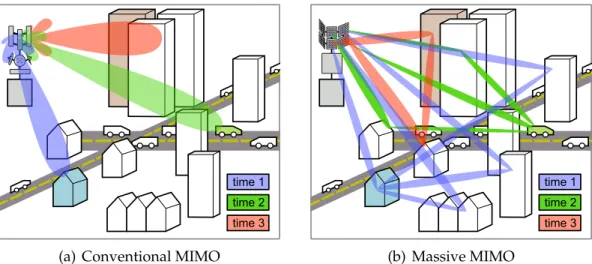
Figure 2.4: Illustration of conventional MIMO and massive MIMO: Unlike con-ventional MIMO, massive MIMO allows fine-grained beamforming that simpli-fies the UE equalization and data detection procedure.
highlight some of the advantages of massive MIMO:
1. Uplink–Fading is significantly reduced in Massive MIMO:In the uplink (UL), where UE is communicating to the BS, the BS performs equalization and detection on the signals sent by the UE. Although the wireless fading is random due to the propagation environment, combining the received signals coherently significantly reduce fading, and virtually eliminate fad-ing in the asymptotic limit [6]. This phenomena is also known as “channel hardening” [5, 55, 56]. Since fading is reduced significantly, equalization processing can be made simpler at the BS.
2. Downlink–Fine-grained beamforming: In the downlink (DL), where BS is communicating to the UEs, the BS can utilize the additional antennas to perform preprocessing the UE’s data signal. The additional antennas can be used to constructively add the signal directed to each UE increasing the received signal strength, while destructively removing the UE inter-ference. This procedure, known as precoding, can be done in the digital
domain without additional analog circuitry. Precoding couples well with massive MIMO as larger number of antennas provide a greater spatial reso-lution. As a result, precoding provides the UE with its corresponding data at a significantly lower interference compared to existing MIMO systems. Fig. 2.4 shows a the prime difference between conventional MIMO and massive MIMO. The BS can utilize the wireless channel knowledge to per-form much finer beamper-forming Fig. 2.4(b) compared to that of conventional MIMO Fig. 2.4(a).
3. Reduced power consumption at UE:In the uplink, fading is reduced by fine-grained beamforming at the BS, utilizing the large number of arrays to perform coherent combining. Therefore, the UE can operate at a lower signal-to-noise ratio and hence, reducing transmit signal power. In the downlink, precoding pushes the computational complexity to the BS so that UE only has to perform simple equalization and data detection. This shift of computational burden decreases the hardware cost at the UE due to simpler communication hardware and reduced power consumption.
On top of providing higher link reliability and reduced power consumption at the UE, massive MIMO can provide significantly higher spectral efficiency compared to existing MIMO systems by serving multiple users simultaneously at the same time-frequency resource.
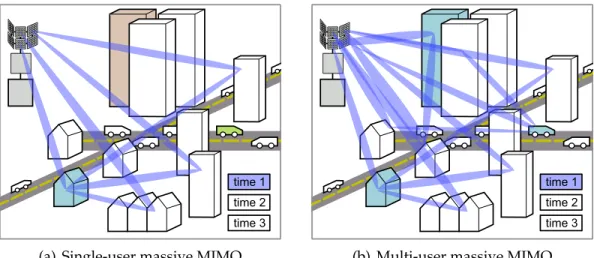
Fig. 2.5 shows how multi-user MIMO can bring significantly improved spec-tral efficiency. In single-user MIMO shown in Fig. 2.5(a), a total of three users are communicating from the BS over three time slots, where we show only for time slot 1. While each UE can have multiple antennas, each UE occupies the whole time slot (blue, green, red) for communication. However, in MU-MIMO
time 1 time 2 time 3 (a) Single-user massive MIMO
time 1 time 2 time 3 (b) Multi-user massive MIMO
Figure 2.5: Illustration of single-user and multi-user massive MIMO: Multi-user massive MIMO can bring significantly increased spectral efficiency over conventional state-of-the-art MIMO technology by serving multiple UEs in the same time-frequency resource.
shown in Fig. 2.5(b), multiple UEs (each with possibly multiple antennas) can be served simultaneously in a same time slot. In the uplink, the BS performs coherent equalization for the UE’s transmit signals; in the downlink, the BS performs precoding for beamforming to remove inter-user interference. Since this procedure can be done on a per-time-slot basis, the MU-MIMO can serve multiple users over multiple time-slots. As shown in Fig. 2.5(b), the three UEs are served in a single time slot, which provides much greater spectral efficiency compared to one UE served for a single-user MIMO.
2.3 Introduction to Wireless Systems
In this section, we provide a brief overview of a wireless system and the associ-ated challenges compared to wired communications. Unlike in wired communi-cations, in which the medium of communication is done by a physical cable such as Ethernet or HDMI, the medium of communications in wireless is carried out
Tx
Rx
LoS
NLoS1
NLoS2
Figure 2.6: Illustration of fading in a wireless system: Wireless system may have both Line-of-Sight and Non-Line-of-Sight components
0 500 1000 1500 0 0.2 0.4 0.6 0.8 1 time [µs] multipath gain Line-of-Sight (LoS) Non Line-of-Sight (LoS)
(a) time-domain impulse response
0 4 8 12 16 20 0.01 0.02 0.03 frequency [MHz] channel response magnitude Line-of-Sight (LoS) Non Line-of-Sight (LoS)
(b) frequency-domain response
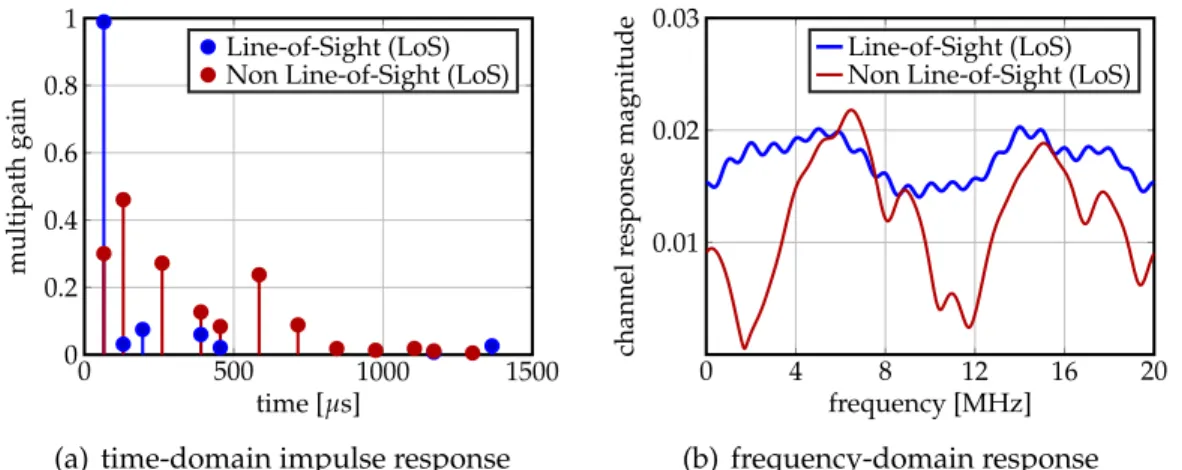
Figure 2.7: LoS and NLoS propagation effects and its impact on frequency-selective fading.
through electromagnetic waves generated by the radio-frequency (RF) chain. The transmitter generates the electromagnetic waves and propagates it through the air from its transmit antenna. The transmitted wave experiences different scatter-ing and diffraction in paths between the transmitter and receiver, which results in a superposition of delayed and attenuated versions of the original waveform with different magnitude scaling arriving at the receiver antenna. Such effects are referred to as multi-path fading [57]. In general, we refer Line-of-Sight (LoS) path as the direct path, and Non-Line-of-Sight (NLoS) as all the diffracted paths
from the transmitter to receiver; we refer to all these multi-path effects as the channel between the transmitter and the receiver. An illustration of a wireless system is shown in Fig. 2.6. The transmitter (Tx) sends a wave to the receiver
(Rx). The wave experiences three different paths comprising one LoS path and
two NLoS paths.
The multi-path fading in the wireless channel in time domain brings effects in the frequency domain for both LoS and NLoS. Fig. 2.7(a) shows the impulse response for both LoS and NLoS scenario in a typical urban environment for Long-Term Evolution (LTE). We can observe that the LoS scenario has most of the energy concentrated in the first time step, whereas for NLoS scenario has energy scattered around multiple time steps. The differences in the delays for these two scenarios bring forth effects in the frequency domain, shown in Fig. 2.7(b). We observe that LoS has a slower varying magnitude compared to that given by NLoS. In addition of these fading scenarios, there are additional effects that affect the wireless channel, which include mobility of both transmitter and receiver. All of the aforementioned fading effects make wireless communications very challenging, and thus makes equalization and data detection an essential task to ensure reliable and robust communication.
2.4 System Model
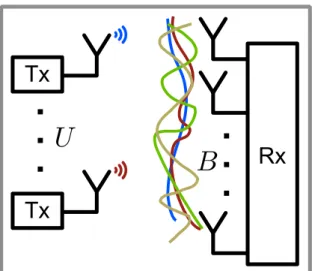
We now describe the system model that we will use throughout the thesis. We consider an uplink MU-MIMO system where we haveUusers each with a single antenna, andBreceive antennas at the base-station. A visual representation of the system is shown in Fig. 2.8. Contrary to the existing literature on classic
. . .
Tx
Tx
Rx
. . .
Figure 2.8: Input-output system model for the MU-MIMO uplink
MIMO, we do not place any restrictions on the relationship between the number of user and BS antennas; we will discuss regimes when we have more users than BS antennas, i.e., overloaded systems.
The input-output relation of the MIMO channel is modeled as:
y=Hs0+n, (2.1)
where s0 is the U-dimensional symbol sent from the transmitter, y is the B -dimensional vector received at the BS, andHis the complex-valuedB×Bchannel matrix that represents the wireless fading characteristics, which includes the different transmit powers for each individual UE. We model theB-dimensional thermal noisenat the receiver i.i.d. zero mean circularly symmetric complex Gaussian distribution with variance N0, i.e., n ∼ CN(0×1,N0IB). Throughout
the thesis, we assume the BS has perfect knowledge of the channel1where as the UE does not have any knowledge of the channel. Since the transmitted symbol
s0comes from a discrete constellation setOU, e.g., phase shift keying (PSK) or pulse amplitude modulation (PAM), we model the prior distribution for each
uth UE as p(su) =
∑
au∈O pauδ(su−au),∑
au∈O pau =1,where δ(·,) is the Dirac delta function. For the case of uniform priors, we have p(su) = |O|1 ∑a∈Oδ(su−a). The signal-to-noise ratio (SNR) that we use throughout the thesis is the average SNR per receive antenna defined by
SNR= EH,s
kHsk2
Enknk2
.
2.5 The Basics of MIMO Data Detection
We will start by reviewing data detection methods in MIMO. We will first formu-late the optimal data detection problem and discuss why it becomes intractable in large or massive MIMO systems. We will then present heuristic linear data detection algorithms that are commonly used in MIMO, as well as massive MIMO.
2.5.1 Optimal Data Detection
For the system model presented in Fig. 2.8, we will first define two data-detection problems, which are jointly optimal (JO) and individually optimal (IO). We will formulate the optimization problem and discuss why solving them are a non-trivial task.
![Figure 2.1: Measured global monthly cellular traffic data/voice [43]: Data growth is increasing exponentially whereas voice stays relatively constant.](https://thumb-us.123doks.com/thumbv2/123dok_us/11106657.2998343/40.918.300.669.117.375/figure-measured-monthly-cellular-increasing-exponentially-relatively-constant.webp)