Procedia Environmental Sciences 11 (2011) 55 – 62
doi:10.1016/j.proenv.2011.12.010
Environmental
Sciences
Procedia Environmental Sciences 00 (2011) 000–000
www.elsevier.com/locate/procedia
PSO-FNN-based Vertical Handoff Decision Algorithm in
Heterogeneous Wireless Networks
Wang Nan, Shi Wenxiao
, Fan Shaoshuai, Liu Shuxiang
College of Communication Engineering Jilin University Changchun, ChinaAbstract
Aiming at working out the problem that fuzzy logic and neural network based vertical handoff algorithm didn’t consider the load state reasonably in heterogeneous wireless networks, a PSO-FNN-based vertical handoff decision algorithm is proposed. The algorithm executes factors reinforcement learning for the fuzzy neural network (FNN) with the objective of the equal blocking probability to adapt for load state dynamically, and combined with particle swarm optimization (PSO) algorithm with global optimization capability to set initial parameters in order to improve the precision of parameter learning. The simulation results show that the PSO-FNN algorithm can balance the load of heterogeneous wireless networks effectively and decrease the blocking probability as well as handoff call blocking probability compared to sum-received signal strength (S-RSS) algorithm.
Keywords: Heterogeneous wireless networks; vertical handoff; fuzzy neural network; load balance; particle swarm optimization 1. Introduction
The next-generation wireless networks will be consisted of various mobile and wireless technologies. Given the complementary characteristics of different networks, it is necessary to combine them to provide ubiquitous wireless access for users. The integration of heterogeneous wireless networks requires the design of intelligent vertical handoff decision algorithm to ensure seamless coverage, and provide high quality of service for different applications [1].
Many vertical handoff decision algorithms have been proposed. Fuzzy logic systems and neural network classifiers are good candidates for pattern classifiers due to their non-linearity and generalization capability. In [2], the algorithm uses a neural network to forecast the number of users, and adopts a fuzzy inference system to make a handoff decision. The algorithm achieves better performance in guaranteeing the Quality of Service (QoS). In [3], the fuzzy neural network (FNN) is used to make a vertical handoff decision and the learning target value is set to a constant user satisfaction.
1878-0296 © 2011 Published by Elsevier Ltd.
Selection and/or peer-review under responsibility of the Intelligent Information Technology Application Research Association.
Open access under CC BY-NC-ND license.
© 2011 Published by Elsevier Ltd.
Selection and/or peer-review under responsibility of the Intelligent Information Technology Application Research Association.
The vertical handoff strategies mentioned above had their own advantages, but they did not put attention on the load conditions of the networks, and the allocation of resources is unreasonable.
In this paper, we adopt a Particle Swarm Optimization (PSO) algorithm to train the FNN. The proposed PSO-FNN-based vertical handoff decision algorithm can make reasonable handoff decision intelligently according to the study of network status. This algorithm can reduce the number of unnecessary handoff, avoid Ping-Pong effect, balance the load of networks effectively and decrease the access blocking probability as well as the handoff call blocking probability.
2. PSO-FNN-based Vertial Handoff Algorithm
This paper proposes a PSO-FNN-based vertical handoff decision algorithm, which can adjust the parameters according to the study of network status, so as to achieve the expected performance.
The equal blocking probability of networks indicates that the load conditions of networks are close. So the proposed algorithm executes factors reinforcement learning with the objective of the equal blocking probability of networks, which can make the access blocking probability of the candidate networks close and balance the load of networks effectively.
2.1Flowchart of Vertical Handoff Decision Algorithm
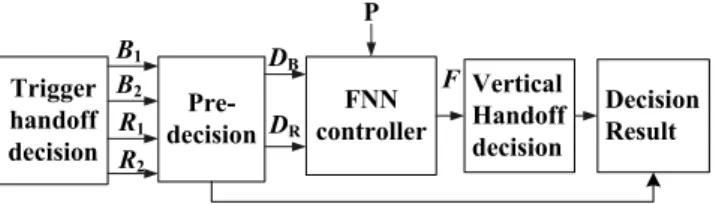
In this paper, we consider a heterogeneous wireless environment with the coexistence of UMTS and WLAN networks. When the average received signal strength reaches the threshold, it triggers a handoff decision. The proposed algorithm is mainly composed of three parts: pre-decision, FNN controller and handoff decision.
As shown in Fig.1, we import the parameters into the pre-decision module. If a handoff decision can be made in the pre-decision module directly, then the FNN control module and the handoff decision module can be skipped. Otherwise, the parameters are imported into the FNN control module. Finally, handoff decision module is used to select the most appropriate network according to the parameter F.
Figure 1 Components of the proposed vertical handoff decision algorithm
Where Bi (i=1,2) and Ri (i=1,2) are, respectively, the available bandwidth (B) and received signal strength
(R) of the candidate networks; DB is the difference of available bandwidth between networks; DR is the difference of received signal strength between networks; P is the periodical statistics of the access blocking probability.
2.2Handoff Triggering
In order to avoid “ping-pong” effect, we decide whether to execute a handoff or not according to the sum S of the received signal strength in WLAN in a time period T (T=LTs)
P F DR DB R2 R1 Vertical Handoff decision Pre-decision B1 B2 FNN controller Trigger handoff decision Decision Result
∑
= = K k k r S 1 (1) Where K is the times that the received signal strength is higher than the trigger threshold of the handoff R in a time period; 1≤K≤L; rk (k=1,2,⋯,K) represent the received signal strength in WLAN at time k; L is thetimes of sampling; Ts is the time interval of sampling. The handoff triggering has two cases:
1) handoff to UMTS: If the received signal strength is lower than R, then start sampling. If S<RL/2, then trigger the handoff decision, otherwise reset S.
2) handoff to WLAN: If the received signal strength is higher than R, then start sampling. If S>RL/2, then trigger the handoff decision, otherwise reset S.
2.3Pre-decision Method
The pre-decision method is used to filter the users before importing into FNN controller. We use B and R of the candidate networks to make a pre-decision.
If Bi of the target network is less than the threshold BT, no handoff happens; if Bi of the target network
is larger than the threshold BT, calculate DB and DR, and import the parameters into the FNN controller module. The flowchart of the pre-decision is shown in Fig. 2.
Figure 2 Flowchart of the pre-decision
DR is calculated as 2 1 R R DR = − (2) DB is calculated as DB =B1−B2 (3)
2.4FNN Vertical Handoff Controller
In this paper, we propose a FNN-based vertical handoff algorithm. This algorithm adopts PSO algorithm to set initial parameters value and executes factors reinforcement learning with the objective of the equal blocking probability of networks.
3) The structure of FNN
A four-layer FNN [4], as shown in Fig. 3, comprises the input (Layer1), membership (Layer2), rule (Layer3) and output layers (Layer4). This type of FNN is good at acquiring rules, recognizing patterns and tuning the membership function shapes [3].
Parameters
Bi>BT Y
N No
handoff PSO-FNN module
Pre-decision
Calculate
Figure 3 Structure of the four-layer FNN Layer1: Input Layer
No computation is required in this layer. xi represents the inputs. x1=DB and x2=DR.
Layer 2: Membership Layer
Each node in this layer transforms the value from Layer1 into the linguistic level using the membership function. The Gaussian function is adopted as the membership function. The membership function μij of
the nodeis represented as
( )
(
(
(
)
2)
2)
exp i ij ij
i
ij x x c σ
μ = − − (4) Where cij andσij (i=1,2; j=1,2,3) are, respectively, the mean and the standard deviation of the Gaussian
function. The total number of the nodes is six. Layer3: Rule Layer
The nodes in Layer3 are the rule nodes, and the links in this layer perform the precondition matching of the fuzzy rules. Each node represents a single fuzzy rule. This layer performs a fuzzy “AND” operation that sends out the node value according to the incoming membership values from Layer2. Similar to Layers1 and 2, there is no weight to be adjusted in this layer. The value amn(m=1,2,3;n=1,2,3) of the node
is calculated as follows
n m mn
a =μ1 ×μ2 (5) Layer4: Output Layer
Each fuzzy rule from Layer3 is given a weight. wmn is the weight of the fuzzy rule amn.
By the method of weighted mean defuzzification, we convert the vector into a single value F
⎟⎟ ⎠ ⎞ ⎜⎜ ⎝ ⎛ ⎟⎟ ⎠ ⎞ ⎜⎜ ⎝ ⎛ =
∑∑
∑∑
= = = = 3 1 3 1 3 1 3 1 i j mn i j mn mn a a w F (6) 4) Ascertainment of the initial parametersThis paper adopts a hybrid training algorithm by combining the PSO and the back-propagation algorithm. The PSO is used to optimize the initial parameters of the FNN, and the back-propagation algorithm is used to implement the self-adaption modulation for the parameters.
Layer3 F x1 x2 w11 w12 w13 w21 w22 w23w31 w32 w33 Layer1 Layer2 Layer4
In PSO, a group of particles, without quality and volume, fly through a N-dimensional space adjusting their positions in search space according to their own experience. The position of the particle is represented with a position vector pi=(pi1,pi2,…piN), i=1,2,…,m and a velocity vector vi=(vi1,vi2,…viN). In every time
step t, particle i changes its velocity and position according to the following equations [5]
( )
t v( )
t cr( ) ( ) ( )
t(
p t x t)
cr( ) ( ) ( )
t(
p t x t)
vij +1=ϕij + 1ij ij − ij + 22j gj − ij (7)
( )
t+1 =x( )
t +v( )
t+1xij ij ij (8)
Where i represents the i-th particle; j represents the j-th dimension of speed or location; virepresents the
speed of the i-th particle; c1 and c2 represent the study factors; r1jand r2j represent the random numbers
among 0 and 1; xi represents the current location of the i-th particle; φ is the inertial weight;
pi=(pi1,pi2,…piN) is the best personal position of particle i which has been visited during the lifetime of the
particle; pg=(pg1,pg2,…pgN) is the global best position that is the best position of all particles in the swarm.
The concrete steps of the PSO algorithm are shown [3]:
Step1: Initialize the positions and velocities of a group of particles randomly.
Step2: Compute every particle’s fitness value. The fitness function is defined as f=M|di-oi|, di
represent the realistic value; oi represent the expect value; M is a positive constant. The di and oi are set as
di=y, oi=y*. The position with lower fitness value is better.
Step3: Set pi as the current position of the particle i. And set pg as the best position of the initialized
particles.
Step4: The positions and velocities of all particles are updated according to (7) and (8). Evaluate each new particle’s fitness value. If thecurrent fitness value is better than pi fitness value, replace pi with the
current position. If the best position of all new particles is better than pg, then pg is updated.
Step5: Judge the pause conditions. If the conditions are met, stop the iteration, and the positions of particles represented by pg is the optimal best value. Otherwise, the process is repeated from step4.
Step6: Algorithm ends. Take the coordinates of pgas the initial parameters of the FNN.
5) Reinforcement Learning Algorithm
To describe the learning algorithm of the FNN using the supervised gradient decent method [6], firstly the error function E is defined as
( )
(
( )
)
2 * 2 1 y yt t E = − (9) Then, the mean cij, the standard deviation σij of the Gaussian function and the weight wmn of the fuzzyrule are updated according to the following equation )) 1 ( ) ( ( ) ( ) 1 ( + − − ∂ ∂ − = + Z t Z t Z E t Z t Z ij ij ij ij ij η α (10)
Where η is the learning rate; α is the momentum rate; Zij is an universal variable. We can update the parameters by using this method.
2.5Vertical Handoff Decision
In this phase, we make a vertical handoff decision according to the output parameter F of the FNN. The decision method is defined as:
If F<0.5, handoff to UMTS; If F>0.5, handoff to WLAN;
3. Simulation and Analysis
In order to evaluate the performance of the proposed PSO-FNN-based vertical handoff decision algorithm, we compare the performance of PSO-FNN algorithm to sum-received signal strength (S-RSS) algorithm proposed in [7].
3.1Simulation scenario
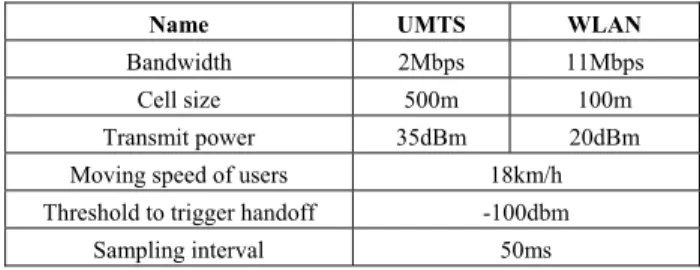
In our simulation, each UMTS cell overlaps two WLAN cells. Parameter setting is shown in Table 1 . Table 1 Simulation Parameter Setting
Name UMTS WLAN
Bandwidth 2Mbps 11Mbps
Cell size 500m 100m
Transmit power 35dBm 20dBm
Moving speed of users 18km/h
Threshold to trigger handoff -100dbm
Sampling interval 50ms
3.2Simulation results and discussion
The results of simulation are shown in Fig. 4-Fig. 6.
Figure 4 Average load
Figure 6 Handoff call blocking probability
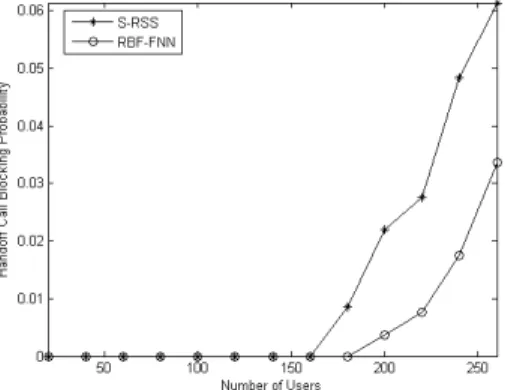
Fig. 4-Fig. 6 are the comparisons of PSO-FNN and S-RSS algorithm in one UMTS cell and two WLAN cells repeating coverage area. Fig. 4 is the statistics of the normalized load. We can see that the PSO-FNN algorithm which executes factors reinforcement learning with the objective of the equal blocking probability of networks can balance the load of networks effectively. As the load balancing of networks can increase the usage of the whole network resource and make the overload of a network less possible. Therefore the access blocking probability and handoff call blocking probability will decrease accordingly.
Fig. 5 shows user blocking probability caused by full network load when users initially get access. We can see that the access blocking probability of PSO-FNN algorithm is lower than that of S-RSS algorithm, and when the number of users is greater than 180, the access blocking probability decreases 6.37% in average. Fig. 6 shows handoff call probability caused by full network load when users switch among networks. We can see that the handoff call blocking probability of PSO-FNN algorithm is lower than that of S-RSS algorithm, and when the number of users is greater than 180, the handoff call blocking probability decreases 2.11% in average.
4. Conclusions
This paper proposes a PSO-FNN-based vertical handoff decision algorithm which can make a reasonable handoff decision intelligently according to the study of network status. The proposed algorithm adopts PSO algorithm to set initial parameters value and executes factors reinforcement learning with the objective of the equal blocking probability of networks. Simulation results indicate that the PSO-FNN algorithm can balance the load of heterogeneous wireless networks effectively and decrease the blocking probability as well as handoff call blocking probability.
Acknowledgment
References
[1]C. Çeken, S. Yarkan, and H. Arslan, “Interference aware vertical handoff decision algorithm for quality of service support in wireless heterogeneous networks,” Computer Networks, vol. 54(5), pp. 726-740, April 8, 2010.
[2]Q. Guo, X. H. Xu, and Y. L. Wang, “Intelligent handoff decision in radio heterogeneous network,” Journal of Harbin Institute of Technology, vol. 4(6), pp. 741-746, December, 2008.
[3]L. Giupponi, R. Agusti, J. Perez-Romero, and O. Sallent, “A fuzzy neural JRRM in a heterogeneous scenario supported by prediction strategies for horizontal and vertical handovers,” IEEE International Conference on Fuzzy Systems, pp. 655–662, 2006.
[4]W. X. Shi, S. S. Fan, N. Wang, and C. J. Xia, “Fuzzy neural network based access selection algorithm in heterogeneous wireless networks,” Journal on Communications, vol. 31(9), pp. 151-156, 2010.
[5]A. B. Hashem and M. R. Meybodi, “A note on the learning automata based algorithms for adaptive parameter selection in PSO,” Applied Soft Computing Journal, vol. 11(1), pp. 689–705, 2011.
[6]R. Ballini and F. Gomide, “Recurrent fuzzy neural computation: Modeling, learning and application,” 2010 6th IEEE World Congress on Computational Intelligence, WCCI 2010, 2010.
[7]X. Liu, L. G. Jiang, and C. He, “An algorithm of vertical handoff for heterogeneous networks,” Journal of Shanghai Jiaotong University, vol. 40(5), pp. 742-746, 2006.