UNDERSTANDING AND OPTIMIZING PYTHON-BASED APPLICATIONS - A CASE STUDY ON PYPY
YANGGUANG LI
A THESIS SUBMITTED TO THE FACULTY OF GRADUATE STUDIES IN PARTIAL FULFILMENT OF THE REQUIREMENTS
FOR THE DEGREE OF
MASTER OF APPLIED SCIENCE
GRADUATE PROGRAM IN ELECTRICAL ENGINEERING AND COMPUTER SCIENCE
YORK UNIVERSITY TORONTO, ONTARIO
JULY 2019
Abstract
Python is nowadays one of the most popular programming languages. It has been used extensively for rapid prototyping as well as developing real-world applications. Unfortunately, very few empirical studies were conducted on Python-based appli-cations. There are various Python implementations (e.g., CPython, IronPython, Jython, and PyPy). Each has its own unique characteristics. Among them, PyPy, which is also implemented using Python, is generally the fastest due to PyPy’s efficient tracing-based Just-in-Time (JIT) compiler. Understanding how PyPy has been evolved and the rationale behind its high performance would be very useful for Python application developers and researchers.
This thesis is divided into two parts. In the first part of the thesis, we conducted a replication study on mining the historical code changes’ of PyPy and compared our findings against Python-based applications from five other application domains: Web, Data processing, Scientific computing, Natural Language Processing, and Media. In the second part of the thesis, we conducted a detailed empirical study
on the performance impact of the JIT configuration settings of PyPy. The findings and the techniques in this thesis will be useful for Python application developers as well as researchers.
Table of Contents
Abstract ii
Table of Contents iv
List of Tables viii
List of Figures xi
1 Introduction 1
2 Related Work 5
2.1 Code Diffing . . . 5
2.2 Code Change Analysis . . . 6
2.3 JIT Compiler . . . 7
2.4 Understanding and Tuning the Configuration Settings . . . 8
3.1 Introduction . . . 11
3.1.1 Chapter Organization. . . 13
3.2 Python Source Code Diffing . . . 14
3.2.1 Code Parser . . . 14
3.2.2 GumTree Differencing . . . 19
3.2.3 Action Parser . . . 20
3.2.4 Output. . . 24
3.2.5 Tool Evaluation . . . 26
3.3 Summary of original study . . . 28
3.4 Replication Results . . . 34 3.4.1 (RQ1) Across Projects . . . 34 3.4.2 (RQ2) Across Versions . . . 37 3.4.3 (RQ3) Maintenance Activities . . . 38 3.4.4 (RQ4) Dynamic feature . . . 41 3.5 Threats to Validity . . . 44 3.5.1 Construct Validity . . . 44 3.5.2 Internal Validity . . . 44 3.5.3 External Validity . . . 45 3.6 Conclusion . . . 45
4 Assessing and Optimizing the Performance Impact of the
Just-in-time Configuration Parameters 47
4.1 Introduction . . . 47
4.1.1 Chapter Organization. . . 50
4.2 Background . . . 51
4.2.1 An Overview of the JIT Compilation Process . . . 51
4.2.2 PyPy’s JIT Configuration . . . 54
4.3 Exploratory Study . . . 55
4.4 Automatically Tuning the JIT Configuration Parameters . . . 77
4.4.1 Tailoring MOGA for JIT Configuration Tuning . . . 79
4.4.2 Our Performance Testing Framework . . . 90
4.4.3 Implementation . . . 91
4.5 Case Study . . . 92
4.5.1 Case Study Setup . . . 93
4.5.2 Case Study Results . . . 97
4.6 Discussions . . . 100
4.6.1 Optimal Configurations across Different Systems . . . 101
4.6.2 Top Configurations across Different Workloads . . . 105
4.6.3 Code Jitting vs. Performance . . . 108
4.6.5 Termination criteria . . . 117 4.7 Threats to Validity . . . 119 4.7.1 Construct Validity . . . 119 4.7.2 Internal Validity . . . 121 4.7.3 External Validity . . . 122 4.8 Conclusion . . . 123
5 Conclusions and Future work 125
List of Tables
3.1 Identified changes in 10 sampled commits of PyPy. . . 28
3.2 Comparisons between the original study and the current study . . . 31
3.3 Comparisons between the original study and the current study (con-tinued) . . . 32
3.4 Comparisons between the original study and the current study (con-tinued) . . . 33
4.1 PyPy benchmark programs description. . . 59
4.2 Comparing the response time between the warmup phase (A) and the warmed up phase (B). . . 65
4.3 List of relevant PyPy’s JIT configuration parameters and their in-formation. . . 67
4.4 The JIT configurations chosen for performance evaluation. . . 68
4.5 Number of best performing programs/scenarios under each JIT con-figuration setting. . . 71
4.6 Comparing the jitting performance against the configuration under JIT off. The number of programs/scenarios whose performance un-der jitted configuration is worse or no different than JIT off setting is highlighted in bold.. . . 73
4.7 Comparison between the configuration settings yielded the best per-formance and the configuration settings resulted in the most jitted code. . . 76
4.8 Dominance relations among the four configuration settings in our running example. “” means the the left configuration setting dom-inates the right configuration setting, “≺” means the right config-uration setting dominates, and “≈” means there is no dominance relation. . . 86
4.9 An overview of the three Python-based systems under study. . . 92
4.10 Workload description for the three systems. . . 94
4.11 Statistics after running the MOGA approach on the three case study systems. . . 97
4.12 Comparing the performance between the optimal configuration set-tings and the default configuration setting for the three systems. The optimal configurations are labelled as OA, OB, and OC. WS stands
for the web server, and DB stands for the database. “-” means the ESM-MOGA suggested optimal configuration setting outperforms the default setting and “+” means otherwise. . . 98
4.13 Top three optimal configuration settings for the three studied system.102
4.14 Spearman correlation between configuration and response time. The large and very large correlation measures are shown in bold. . . 102
4.15 Comparing the performance among the optimal configuration set-tings under different workloads for Wagtail. . . 106
4.16 Top three optimal configuration settings for Wagtail under different workloads. . . 107
4.17 Configuration A and the default configuration. . . 114
4.18 Spearman correlation between number of jitted line and memory usage for each system. . . 115
4.19 Runtime statistics for ESM-MOGA under different termination cri-teria. . . 116
List of Figures
3.1 Overall process of PyDiff. . . 15
3.2 An example of converting Python source code to Python AST . . . 16
3.3 An sample converting Python AST to JSON AST . . . 17
3.4 An example of converting JSON AST to LAT . . . 18
3.5 Two sample statement with their corresponding ASTs and mappings 19
3.6 Two sample statement with their corresponding ASTs and mappings 21
3.7 Fluri’s Taxonomy of Change Type . . . 25
3.8 The distribution of change type frequency across projects. . . 35
3.9 The frequency comparison between different versions of PyPy. . . . 38
3.10 The frequency comparison between bug-fix commits and non-bugfix commits of PyPy. . . 40
3.11 The change frequency of each dynamic feature.. . . 42
3.12 The change frequency of each dynamic feature.. . . 43
4.2 Number of jitted lines and response time over 50 iterations for the
html5lib program from the PyPy benchmark suite.. . . 60
4.3 Overall process of PyPyJITTuner. . . 78
4.4 The workflow for our tailored version of the MOGA method. . . 80
4.5 Visualizing the response time distributions of different scenarios un-der different configuration settings for Wagtail.. . . 98
4.6 Number of jitted lines and overall average response time among all evaluated JIT configuration settings in Saleor. The red dotted line shows the overall average response time with JIT turned off. . . 109
4.7 Two code snippets showing the executed code and the jitted code under the two configuration settings: A vs. B. Configuration A is a jit-enabed configuration shown in Figure 4.6. It has worse perfor-mance than configuration B, which is JIT off. The colour scheme is defined as follows: grey coloured code is for not executed code; bolded black coloured code is for executed but not jitted code; and highlighted bold coloured code is for jitted code under configuration A. . . 112
1
Introduction
Python is nowadays one of the most popular programming languages [51]. Due to its dynamic features, rich set of library and framework, and large community, Python is also used quite often during rapid prototyping [77], especially in the fields of web (e.g., [4, 6]), data analysis (e.g., [11, 9]), and machine learning (e.g., [20,18]) as well as developing many real-world business systems in many large scale and mission-critical systems inside companies like Facebook [66], Google [26], and PayPal [55].
There are many empirical studies done for other programming languages, like Java [79, 45, 42, 38, 59] and JavaScript [53]. However, very few works focused on Python, except the works of [69] and [71]. Studying Python applications have been increasing important, as many popular applications and libraries were writ-ten in Python. There are various Python implementations (e.g., CPython, Iron-Python, Jython, and PyPy). Each implementation has its own unique characteris-tics. For example, Jython is a Python interpreter implemented in Java and it can be
fully integrated into Java applications, IronPython is tightly integrated with .NET Framework. Among those implementations, PyPy is generally the fastest [14] due to PyPy’s efficient tracing-based Just-in-Time (JIT) compiler [31] and it is imple-mented with Python. Understanding how PyPy has been evolved and the rationale behind its high performance would be very useful for Python application developers and researchers.
There have been very few studies on the evolution of Python-based applications, except the work of Lin et al. [69], the authors conducted an empirical study about fine-grained source code changes on ten Python application across five domains (Web, Data processing, Science computing, NLP, Media). However, the study did not included any applications from the domain of compiler, whose evolution patterns may or may not be the same as other application domains. For example, dynamic features bring great flexibility during development, but are generally slower to execute. PyPy, which is focused on high performance, would its JIT compiler use many dynamic features compared to other application domains? The first part of this thesis will be focused on replicating the above study on the PyPy development history.
PyPy mainly gains its performance via its JIT complier [14]. For dynamic languages, JIT compiler is being used to improve the efficiency of compiling and executing the source code. For example, Java’s HotSpot JVM [10] can compile
methods based on its execution frequency. JIT compiling is also used in Chrome’s V8 engine [2], which can compile JavaScript code into machine code during run-time. Existing works on the JIT compilation focus on the jitting strategies (e.g., method [38] vs. trace-level based code jitting [31]), speeding up the process of the JIT compilations [63,47, 70], optimizing the performance of the underlying virtual machines [88,89,90], and detecting JIT unfriendly code [53]. Unfortunately, there are very few existing studies which investigate the impact of the JIT configurations on the system performance. Software configuration is one of the main sources of software errors [92]. The configuration settings of a software system can signifi-cantly impact its performance. Optimizing the configuration settings may result in great performance gain. Hence, the second part of the thesis will be focused on investigating the performance impact of PyPy’s JIT configurations.
The contributions of this thesis are:
1. We have developed a change extraction tool, PyDiff, which can extract fine-grained historical changes from the Python source code.
2. We have replicated the empirical study in [69] by comparing our results from PyPy (a language interpreter written in Python) against 10 Python-based applications from five other domains (Web, Data processing, Science comput-ing, NLP, Media) and found that 6 out of 9 findings are different from the
original study.
3. This is the first empirical study on assessing and optimizing the impact of the tracing-based JIT configuration settings on system performance.
4. In this thesis, we have detailed our search-based configuration tuning ap-proach, (ESM-MOGA) for tuning applications running PyPy.
5. Our experiments on JIT configurations are carried out on both the synthetic benchmarks as well as real systems. The empirical findings can be useful for both software engineering and programming language researchers as well as practitioners.
Thesis Organization:
The thesis is organized as follows: Chapter2introduces the related work. Chap-ter 3 presents our empirical studies on the historical code changes in PyPy and compared our findings to the findings in the original study. Chapter 4studied and optimized PyPy performance by tuning its JIT configuration settings. Chapter 5
2
Related Work
In this chapter, we discuss prior research works that are related to this thesis.
2.1
Code Diffing
Software projects are changed rapidly to meet the constantly evolving customer requirements and deployment environments. To help developers better understand the changes in different code commits, many tools have been developed to extract the find-grained code changes by comparing the historical versions of the source code.
J-REX [79] is an evolutionary extractor which can analyze Java-based projects. It uses the token-based technique to compare the changes between each consecutive file revisions and outputs the code revisions in terms of function additions, function deletions and function updates. Fluri and Gall presented a taxonomy of source code changes to be used for change coupling analysis in his work [43]. Fluri et al. [45] also presented the original Abstract Syntax Trees (AST) differencing algorithm,
ChangeDistiller, and described inadequacies concerning the extraction of source code changes. The work of Falleri et al. [42] mainly described their novel tree differencing algorithm, the GumTree differencing algorithm, which is more efficient and accurate. However, neither GumTree nor ChangeDistller provided a mechanism for diffing among Python-based source code. Lin et al. [69] implemented an automatic tool to extract fine-grained source code changes in Python code, named PyCT, based on ChangeDistiller. However, the implementation of PyCT is not available for download. In this thesis, we have developed a fine-grained code diffing tool, called PyDiff. Our tool extracts the ASTs from different versions of the Python-based applications and leverages the GumTree’s differencing algorithms to output the fine-grained code changes between two commits.
2.2
Code Change Analysis
In the work of Lin et al. [69], the authors conducted an empirical study on 10 Python projects across 5 domains. They tried to investigate the pattern of change types across project, revisions and maintenance activities. And they provided in-sights about the change of Python dynamic features. Similar as the work of Lin et al. [69], Romano et al. [75] developed the tool WSDLDiff to extract fine-grained source code changes between different versions of WSDL interfaces and they analyzed the evolution of WSDL interface based on the fine-grained source
code changes in four real world web services. [44] used ChangeDistiller to extract change types from each version of the software and formed a matrix with which they can group changes between versions into different clusters and explore the patterns in each cluster. Thung et al. [86] combined code analysis and machine learning approaches to analyze the bug fix changes. Their approach can predict the code line that caused the bug and the result out-performed the state-of-art. However, there is no existing evolutionary study on Python-based compilers, which is the focus of Chapter 3 of the thesis.
2.3
JIT Compiler
JIT is introduced as a technique to improve the system behavior during runtime by compiling the frequently executed (a.k.a., “hot”) code snippets into binaries [31,73]. Currently, there are two general approaches on recognizing and compiling hot code: (1) the method-based jitting approach [38], which compiles the whole hot method; and (2) the trace-based jitting approach [31], which only compiles the frequently ex-ecuted code path(s) within one method. Both techniques have their pros and cons and are adopted by different programming languages. The code jitting process takes a while to recognize and compile the hot code snippets [30]. Hence, various techniques have been proposed to speed up the JIT compilations [63,47,70]. Since only portions of the source code are jitted, during runtime, depending on the
ac-tual execution path(es), the system may switch between the native mode (a.k.a., executing the compiled binaries) and the interpreter mode. Gong et al. [53] de-veloped a technique to detect performance anti-patterns that prohibit the system to execute certain portions of the code natively. Our paper differs from the above works, as it focuses on the configuration settings of the JIT compiler. The closest work was done by Hoste et al. [59], which proposed a search-based technique to automatically tune the Java compiler. Although the two programming languages differ in their jitting techniques (method-based JIT for Java and tracing-based JIT for PyPy), both [59] and this paper reported the need to automatically tune JIT configurations, as the optimal JIT configurations are system and workload depen-dent. [59] even found that the JIT configuration tuning is hardware dependent. In this paper, we further studied the characteristics of the PyPy jitting behavior and tried to derive general patterns/guidelines on tuning the JIT configurations. For example, we have found a high correlation between the amount of jitted code and memory utilization. Generally, the configuration parameter decay should be set with a small value and a large value in the trace limit.
2.4
Understanding and Tuning the Configuration Settings
Software configuration settings play an important role in the performance of a software system. However, there can be many configuration parameters, each of
which has various possible settings. Hence, the overall configuration space for one system can be huge. In this subsection, we will discuss the related works in the area of assessing and optimizing the configuration settings for one system. We have divided the existing techniques into the following three categories:
Understanding the Performance Impact of Various Configuration Parameters Through Experimentation: Not all configuration parame-ters can impact the system performance. Hence, researchers have devised a set of experiments with various combinations of the configuration settings to assess the impact of the configuration parameters [33, 84]. Various experi-mental design techniques (e.g., screening design [93], and covering array [58]) have been applied to assess the performance impact of various configuration parameters. These techniques require a much smaller set of experiments than exhaustively enumerating all the possible combinations of the configuration settings, while still able to identify the high performance impacting configu-ration parameters.
Modeling System Performance Under Different Configuration Set-tings: Instead of isolating the impact of various configuration parameters, another approach to assess the performance impact of configuration settings is through performance modeling. Siegmund et al. [81] predicted the system
performance by detecting performance-relevant feature interactions. In their later work [80], Siegmund et al. leveraged machine learning and sampling heuristics to build performance models, which can describe the performance influences among different configuration options and their interactions, from a small set of experiments. Libiˇc et al. [68] used queuing theory to model the performance of the JVM garbage collectors (GCs). Singer et al. [82] built machine learning models using the data from the existing configurations of the GCs. Recently, Jamshidi et al. [61] proposed to use the transfer learning technique to model and infer the system performance under different config-uration settings.
Automated Tuning of the Configuration Settings: There are two gen-eral approaches to automatically tuning the configuration settings of a soft-ware system: (1) through reduction of the possible candidates of optimal con-figurations (e.g., based on the similarities among configuration settings [74] or through iterative experimentations [85]); (2) through the use of the search-based algorithms (e.g., hill-climbing [91,87], ParamILS [67], or multi-objective genetic algorithms [59,83]).
However, there is no existing works focusing on assessing and tuning the per-formance of PyPy. This is the foucs of Chapter 4of the thesis.
3
The Replication Study
In this study, we have performed an evolutionary study on the PyPy project. In particular, we compared our findings against one existing evolutionary study on Python-based appications [69].
3.1
Introduction
It has been well understood that software has to be adapted to changing require-ments and environrequire-ments. The source code changes between different versions can provide developers insight into how a software project evolves. Researches in mining software repositories are becoming more and more popular.
There are many works which studied the evolution in source code changes in projects. Romano et al. [75] analyzed the evolution of the WSDL interface based on the fine-grained source code changes in four real-world web services. [44] extract change types from each version of the software and formed a matrix with which they can group changes between versions into different clusters and explore the patterns
in each cluster. However, few of these work studied the evolution of Python-based applications, except the work of Lin et al. [69], the authors conducted an empirical study about fine-grained source code changes on ten Python application across five domains (Web, Data processing, Science computing, NLP, Media). However, the study did not include any applications from the domain of compilers, whose evolution patterns may or may not be the same as other application domains. For example, dynamic features bring great flexibility during development but are generally slower to execute. PyPy, which is focused on high performance, it would be interesting to verify if the JIT compiler use as many dynamic features as other application domains.
In order to study the evolution of the Python-based applications, tools to extract the fine-grained differences between different commits are needed. For example, J-REX [79], ChangeDistiller [44], and GumTree [42] can extract fine-grained Java source code changes. Unfortunately, they do not support Python. PyCT [69] can be used to extract fine-grained changes from Python source code and is based on ChangeDistiller’s AST differencing algorithm. But its implementation is not available publically. In this project, we leveraged the framework from PyCT and the GumTree differencing algorithm and developed PyDiff, which can extract fine-grained historical changes from python source code. We conducted a replication study which analyzes the source code evolution for PyPy, which is a Python-based
application in the domain of interpreter. The contributions of this chapter are:
1. We have developed a change extraction tool, PyDiff, which can extract fine-grained historical changes from the Python source code. This tool is publicly available for use [13].
2. We have replicated the empirical study in [69] by comparing our results from PyPy (a language interpreter written in Python) against Python applications from five other domains (Web, Data processing, Science computing, NLP, Media) and we found that 6 out of 9 findings are different from the original study.
3.1.1 Chapter Organization
The rest of the chapter is organized as follows: we introduced the implementation of our Python source code diffing tool, PyDiff, in detail in section 3.2. Section3.3
gives a summary of the original study and an overview of the findings. Section3.4
describes the findings in our replication study and discusses the implications. Sec-tion discusses the threats and validity and SecSec-tion 3.6 concludes the chapter.
3.2
Python Source Code Diffing
PyDiff analyzes two consecutive revisions of source code and provides fine-grained change information between these two revisions. The source code changes are cate-gorized into many change types to help software engineer understand how the code got changed. Fig3.1 gives us an overview of PyDiff. The input of PyDiff is histor-ical revisions of a project, which is usually stored in the Code Repositories (e.g., CVS, SVN, and git.). Within PyDiff, there are three components: the Code Parser (Section III-A) parses Python source code into abstract syntax tree (AST) that can be processed by GumTree; the GumTree Differencing (Section III-B) performs the GumTree differencing algorithm on two ASTs and generates an edit script which contains Actions must be performed on the first AST to obtain the second one; and, the Action Parser (Section III-C) groups these Actions according to their line number and identifies the change type for each group by analyzing the Actions in that group. The output of PyDiff is a CSV file which contains change types for each changed line between two consecutive revisions.
3.2.1 Code Parser
The Code Parser is responsible for converting the Python source code to AST that could be analyzed by GumTree. GumTree has the functionality to directly convert
Figure 3.1: Overall process of PyDiff.
Java, C, and C++ source code into a Tree that it can process. However, no such a function has been developed for Python source code. Fortunately, GumTree can accept JSON data as input and can convert JSON data into a Language-Agnostic Tree (LAT) format which it can also analyze. Therefore, we can bring the gap between Python source code and LAT by converting Python AST into JSON AST and use the JSON AST as input for GumTree. The Code Parser takes the following four steps to convert Python source code to LAT that can be analyzed efficiently by GumTree:
3.2.1.1 Python Source Code to Python AST
Python has a module, named ”ast”, which can generate an AST from python source code. We can use it to parse the Python source code to Python AST easily. The result will be a tree of objects whose classes all inherit from AST. Figure3.2 gives
Figure 3.2: An example of converting Python source code to Python AST
an example about how to convert a Python statement ”a = 1” to Python AST.
3.2.1.2 Python AST to JSON AST
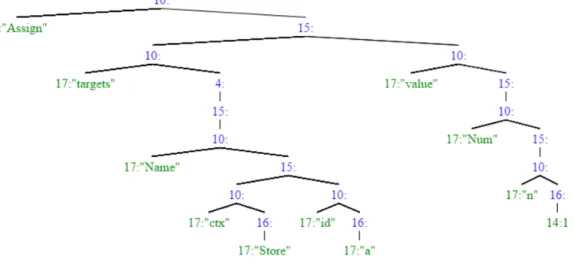
JSON data structure is similar to XML. In JSON, each node is constructed by a name/value pair, in which name is a string and value could be number, string, list or another node. For each node in Python AST, we can get its class name as well as its child nodes. This structure is very similar to JSON data structure. Therefore, when we covert Python AST to JSON AST, we use the class name of the node as name and use its child nodes as value to construct a field in JSON data structure. By converting all nodes in Python AST, we can obtain a JSON AST that keeps the original structure of Python AST. Figure 3.3 shows the JSON AST for statement ”a=1”.
Figure 3.3: An sample converting Python AST to JSON AST
3.2.1.3 JSON AST to LAT
As we mentioned above, GumTree provides an API called TreeGenerator which can take JSON data as input and convert JSON data into a LAT. We can use TreeGenerator from GumTree to generate LAT from JSON AST. Figure3.4 shows a LAT generated by TreeGenerator from JSON AST of statement ‘a = 1’. In the LAT, each node has two fields: node type and label. Node type 4, 10, 15 16 do not have a label because they donate array, field, object, and number in JSON data separately. And node type 17 means string and node type 14 means numbers in JSON.
Figure 3.4: An example of converting JSON AST to LAT
3.2.1.4 Simplify LAT
As shown in Figure 3.4, the above parsing steps could introduce many uninforma-tive nodes. For example, a field node will be added to LAT for each field in JSON AST, an object node will be added to LAT for each object in JSON AST. These uninformative trivial nodes make our LAT redundant. They can also introduce misclassification in the GumTree algorithm and bring a large number of uninfor-mative Actions in GumTree’s differencing results which are hard to interpret. To address this issue, we simplify the LAT by eliminating the uninformative nodes, like field nodes, object nodes, array nodes, number nodes, string nodes, etc. The simplified LAT of statement ‘a = 1’ can be seen in Figure 3.5. In the simplified LAT, each node has two fields: node id and label.
a = 1
Figure 3.5: Two sample statement with their corresponding ASTs and mappings
3.2.2 GumTree Differencing
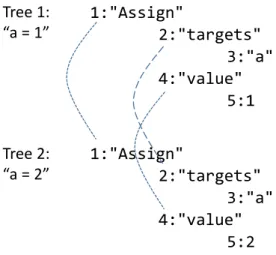
The GumTree Differencing component takes two LATs as input and applies the GumTree differencing algorithm to these two LATs. It can compute a sequence of tree edit actions that transform a LAT into another. GumTree Differencing works in two steps: establishing mappings and deducing an edit script. The mapping between two LATs will be computed by two successive phases. 1. A greedy top-down algorithm to find isomorphic subtrees of decreasing height. Mappings are established between the nodes of these isomorphic subtrees. They are called anchors mappings. On the sample trees of Fig3.6, this step finds the mappings shown with dashed lines. 2. A bottom-up algorithm where two nodes match (called a container mapping) if their descendants (children of the nodes, and their children, and so on) include a large number of common anchors. When two nodes match, it finally applies an optimal algorithm to search for additional mappings (called recovery mappings) among their descendants. On the sample trees of Fig3.6, this step finds the container mappings shown using short-dotted lines. And there are no recovery
mappings in this example. Then the mapping results can be used by the RTED algorithm [36] to compute the actual edit script. It will generate a tree edit script which contains Actions that must be performed on the first LAT to obtain the second LAT. And those Actions can be used to identify fine-grained source code change types. There are four types of tree edit actions: Insert, Delete, Update and Move. In the example of Fig3.6, the edit script generated contains only one Action, which is “update label ’1’ to label ’2’ in node 5”.
Then the mapping results can be used by the RTED algorithm [36] to compute the actual edit script. It will generate a tree edit script which contains Actions that must be performed on the first LAT to obtain the second LAT. And those Actions can be used to identify fine-grained source code change types. There are four types of tree edit actions: Insert, Delete, Update and Move. In the example of Figure 3.6, the edit script generated contains only one Action, which is “update label ‘1’ to label ‘2’ in node 5”.
3.2.3 Action Parser
GumTree differencing can only give us changes between two ASTs, because GumTree ignores the semantic meanings of each node in the LAT when it’s performing the differencing. Therefore, those changes cannot tell us anything about the source code changes, which is useless in software analysis. To gather source code level
1:"Assign" 2:"targets" 3:"a" 4:"value" 5:1 1:"Assign" 2:"targets" 3:"a" 4:"value" 5:2 Tree 1: “a = 1” Tree 2: “a = 2” {"Assign": {"targets": [ {"Name": {"ctx": "Store", "id": "a"} }], "value": {"Num": {"n": 1} } } }
Figure 3.6: Two sample statement with their corresponding ASTs and mappings
change types, we introduced Action Parser to interpret Actions from the GumTree differencing result and obtain source code level change types for all changed lines. This can be done in two steps:
3.2.3.1 Map source code line with Actions
Edit script contains a sequence of Actions from different code lines. With just one Action, we cannot identify the change type for a code line correctly. Therefore, we need to aggregate Actions that are taken in each code line by its line number. For each Action in the edit script, it contains node information of the node that has been changed. And the line number of that node can help us identify which statement that action belongs to.
change and it can also represent the line in the source code after a change. There-fore, we cannot simply map the line number back to the before source code line number. In GumTree differencing, the source of the line number is determined by the type of action. The line numbers of changed nodes in Update, Delete and Move Actions represent line number in before source code. The line numbers of changed nodes in Insert Actions represent line number in after source code. In order to deal with the difference, Action Parser processes Insert Actions and other Actions sep-arately by dividing them into before Actions and after Actions. Therefore, it has two groups of Actions which represent the changes made to before and after AST. And it aggregates those two groups of Actions by their line number and builds a map of the source code line and the Actions.
3.2.3.2 Identify change type
In Fluri’s work [43], they presented a taxonomy of source code changes that can be used for change coupling analysis. The source code change types are defined according to tree edit operations in the AST. And this classification allows one to assess error-proneness of source code entities, qualify change couplings, or identify programming patterns. The defined change types are shown in Table3.7. Although the change types are mainly defined for Java programming language and there are many change types not applicable for Python, we took it as a guideline and defined
our change type taxonomy base on the characteristic of Python. The third column in the Table 3.7 indicates whether a change type is applicable for Python or not.
As shown in Table 3.7, ’Additional Object State’ and ’Removed Object State’ are not applicable because Python doesn’t have attribute declaration. Since Python don’t have attribute declaration in Python, change types, like ’Decreasing Acces-sibility Change’, ’Increasing AccesAcces-sibility Change’, ’Attribute Type Change’, ’At-tribute Renaming’, ’Final Modifier Insert’ and ’Final Modifier Delete’ are also not applicable. In method declaration of Python, we cannot define the return type of a method, thus ’Return Type Insert’, ’Return Type Delete’ and ’Return Type Update’ are also not applicable. Base on Fluri’s taxonomy of change types, we defined our own fine-grained change types according to our needs. For example, in Fluri’s work, he identifies a class declaration statement as a normal statement and inserting or deleting the class declaration will be regarded as ’statement insert’ or ’statement delete’ action. Therefore, we defined two additional actions ’Additional Class’ and ’Removed Class’ to help me understand insert and delete changes made to class declaration statements. And we grouped defined fine-grained change types into eight groups: Class Change, Function Change, Statement Change, Selection Structure Change, Loop Structure Change, Exception Handling Change, Import
Change, andOthers Change.
changed statement by analyzing Actions taken under the statement. For each changed statement, it can analyze its aggregated Actions by two steps. It firstly identifies if there is any Action made to the root node of that statement. If the root node of the statement is changed, the change type of the statement would be statement level Insert, Delete or Move, which is determined by Action type. If it’s not a statement level change, it will identify a detailed change type according to the type of statement and the action type. If these Actions do not contain changes to the statement’s root node, the change type would be statement Update. And a more detailed change type can be determined by doing an analysis of the Actions. From the example in Fig3.6, Action Parser can obtain an action “update ’1’ to ’2’ in node 5”. According to the strategy, node 5 is not a root node for the variable assignment statement. Therefore, it can roughly infer that the change type for the statement is statement update. Then, it does further analysis on the change type by combining the statement type, which is assigned statement in our case, and the action made to the statement. And it can determine the change type for that statement is ’statement update’.
3.2.4 Output
In order to help researchers understand the changes in the software, PyDiff will output all changes made to a file throughout the software’s life circle into a CSV
a = 1
Figure 3.7: Fluri’s Taxonomy of Change Type
file. For each change, it will contain information about change type, file path, before revisionID, after revisionID, changed line number, changed location.
3.2.5 Tool Evaluation
In this section, we will explain how our experiment was designed to evaluate PyDiff. In order to test the robustness of PyDiff, we need to choose well-maintained, long history project to evaluate PyDiff. Thus we chose the Python project PyPy to evaluate PyDiff. PyPy has more than 17 years of development history. And it’s open-source on Bitbucket, so we can easily obtain all the historical revisions. Based on SVN logs, PyPy was first committed on Feb 24, 2003. With more than 17 years’ development history, PyPy contains 97,000 committed revisions and about 4000 python source files. And the evaluation process is as follows:
1. Extracting PyPy history source code from SVM: In order to extract all changed files in each commit, we implemented a small tool to extract changed source files in the current commit and its parent commit by three steps: a. Ex-tract the change log, which contains information about changed files, change type of the file, commit id, revision id, etc., for each commit. b. Recursively extract changed file’s source code for each commit and its parent commit. c. Create a JSON file for each commit in PyPy and store changed source code in the JSON file. In this way, we can extract the changed source code for all
commits, on which we can apply PyDiff.
2. Applying PyDiff on PyPy source code: After we obtained the historical source code, we used them as input for PyDiff. PyDiff will run the differencing algorithm on two consecutive source code and generate the change type for each changed line between these two source code files. Then, PyDiff will store all changes in that commits into a CSV file.
3. Manual Examine: After obtaining the output for all commits in PyPy, we evaluated the differencing results by conducting a manual examination. Be-cause there are more than 97,000 commits in PyPy, it is not practical to examine the output of all commits. Therefore, we conducted a manual exam-ine on 10 sample commits. For each selected commit, we manually checked if the identified change type matches the source code change or not and record the number of correctly identified changes.
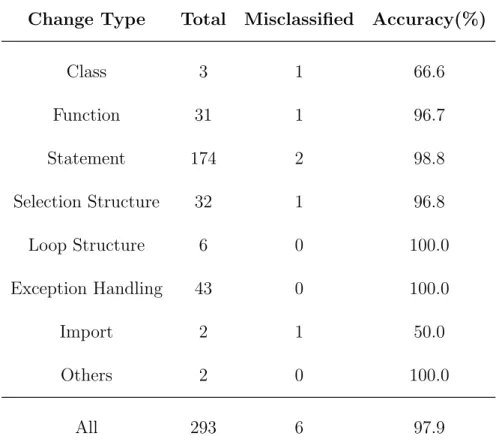
After manually checking the source code change result from 10 randomly se-lected commits, we measured the number of changes correctly identified and mis-classified in each change type. Table3.1shows us the result of the examination. As we can see, PyDiff identified 293 lines of changes among the 10 randomly selected commits. Statement change is the most common change type which takes up 59 percent of all source line changes and achieved 98.8 percentage of accuracy. And
Table 3.1: Identified changes in 10 sampled commits of PyPy. Change Type Total Misclassified Accuracy(%)
Class 3 1 66.6 Function 31 1 96.7 Statement 174 2 98.8 Selection Structure 32 1 96.8 Loop Structure 6 0 100.0 Exception Handling 43 0 100.0 Import 2 1 50.0 Others 2 0 100.0 All 293 6 97.9
Import change and Other changes occurred the least in the examined commits. Overall, the PyDiff can achieve a precision of 97.9 percent for all changes types.
3.3
Summary of original study
In the work of Lin et al., the authors conducted an empirical study about fine-grained source code changes in Python applications (Django, Tornado, Pandas, Pylearn2, Numpy, Scipy, Sympy, Nltk, Beets, Mopidy) from different domains
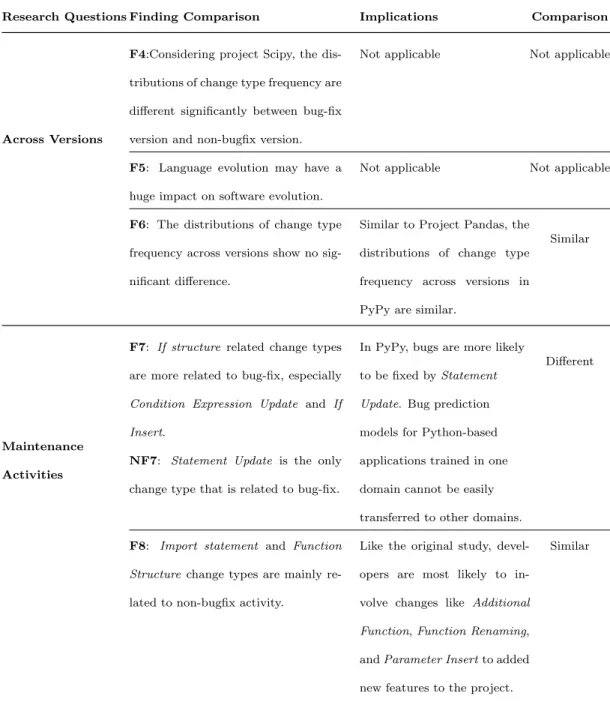
(Web, Data processing, Science computing, NLP, Media). In their study, they first defined 77 kinds of fine-grained changes types and then they developed an au-tomatic tool - PyCT, which can quickly compare Python source code and extract fine-grained source code changes. The author proposed four research questions cov-ered different aspects of the source code change behavior throughout the project’s history. Then, the authors applied PyCT on ten open source Python projects from five different domains and answered the proposed research questions. Based on the source code diffing result, the author reported 11 major findings, as shown in the Table 3.4, summarised below (Note: Original Fining is denoted as F and New finding is denoted as NF).
First, they compared the change type frequency between projects and domains. They found that Function and Statement changes are the most frequent change types and Loop Structure changes is the least frequent (Finding 1). Also, the distribution of change types shares similar trends between projects (Finding 2) and domains (Finding 3).
Second, they use Scipy and Pandas as case study and compared the change type frequency between different versions of a project. In project Scipy, they found that the change type frequency distribution is significantly different between bug-fix and non-bugfix versions (Finding 4) and language evolution may have a big impact on software evolution (Finding 5). In project Pandas, they found the change type
frequency distribution are similar across different versions (Finding 6).
Then, they conducted a detailed comparison for change type frequency be-tween bug-fix and non-bugfix commits, in which they found thatif structure related change types are more related to bug-fix activities (Finding 7). And the non-bugfix activity related change types areimport statement and function structure changes (Finding 8).
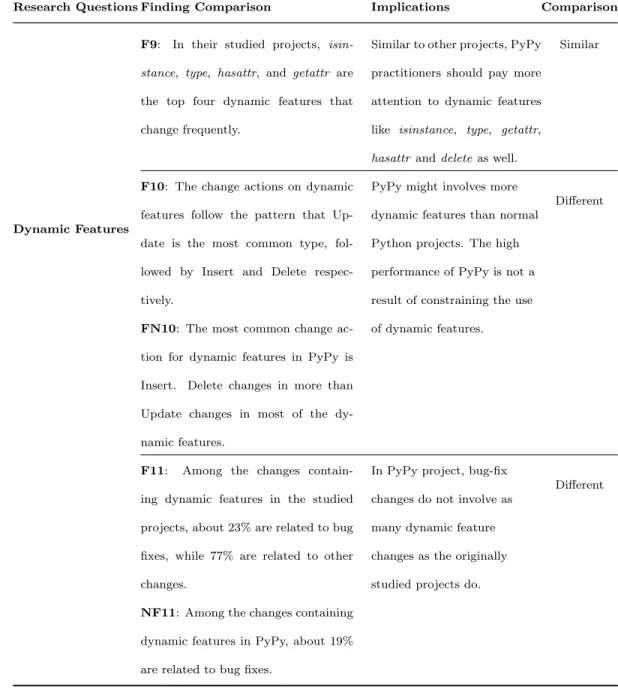
Finally, they investigated the dynamic feature changes. The result shows that
isinstance, type, hasattr, and getattr are the most frequently changed dynamic features (Finding 9). The most common change action on dynamic features is Update (Finding 10). 23% dynamic feature changes are related to bug-fix activities and 77% dynamic feature changes are related to non-bugfix activities (Finding 11). We applied the PyDiff tool on PyPy to get the answer for each research question. And we compared our findings against the findings in the original study and report whether they are similar or different (as shown in Table3.4). In summary, we found that PyPy, as a compiler, has very different code change behavior compared to the applications from other domains and 6 out of 9 findings are different compared with the original study. In the following sections, we detailed our approach for replication and results for each research question. And we summarised our findings and discussed the implications.
Table 3.2: Comparisons between the original study and the current study
Research QuestionsFinding Comparison Implications Comparison
Across Projects
F1:Function Change and Statement Change are the most common change types, whereasLoop StructureChange is the least common change type.
PyPy as an implementation of a language rarely uses third party dependencies.
Therefore, the Import change is the least common change type.
Different
NF1: Statement Change and Func-tion Change are the most common change types, whereasImportChange is the least common change type. F2: The distributions of change type frequency share similar trends across studied projects.
PyPy, as a Python written compiler, is different from other Python projects in change behavior. More replication studies are needed to generalize the evolutionary behavior of Python
applications.
Different
NF2: The distribution of change type frequency is significant different be-tween PyPy and the projects in the original study.
F3: There are no significant dif-ferences among the distributions of change type frequency across studied domains.
The domain of compiler does not share similar change type frequency distribution with the projects from the other application domains. It is worthwhile to study other Python-based compilers to see whether our findings would generalize in this domain.
Different
NF3: PyPy is significantly different from the studied Python-based appli-cations in other application domains in terms of the distribution of change type frequency.
Table 3.3: Comparisons between the original study and the current study (continued)
Research Questions Finding Comparison Implications Comparison
Across Versions
F4:Considering project Scipy, the dis-tributions of change type frequency are different significantly between bug-fix version and non-bugfix version.
Not applicable Not applicable
F5: Language evolution may have a huge impact on software evolution.
Not applicable Not applicable
F6: The distributions of change type frequency across versions show no sig-nificant difference.
Similar to Project Pandas, the distributions of change type frequency across versions in PyPy are similar.
Similar
Maintenance Activities
F7: If structure related change types are more related to bug-fix, especially Condition Expression Update and If Insert.
In PyPy, bugs are more likely to be fixed byStatement Update. Bug prediction models for Python-based applications trained in one domain cannot be easily transferred to other domains.
Different
NF7: Statement Update is the only change type that is related to bug-fix.
F8: Import statement and Function Structure change types are mainly re-lated to non-bugfix activity.
Like the original study, devel-opers are most likely to in-volve changes like Additional Function,Function Renaming, andParameter Insertto added new features to the project.
Table 3.4: Comparisons between the original study and the current study (continued)
Research Questions Finding Comparison Implications Comparison
Dynamic Features
F9: In their studied projects, isin-stance, type, hasattr, and getattr are the top four dynamic features that change frequently.
Similar to other projects, PyPy practitioners should pay more attention to dynamic features like isinstance, type, getattr, hasattranddeleteas well.
Similar
F10: The change actions on dynamic features follow the pattern that Up-date is the most common type, fol-lowed by Insert and Delete respec-tively.
PyPy might involves more dynamic features than normal Python projects. The high performance of PyPy is not a result of constraining the use of dynamic features.
Different
FN10: The most common change ac-tion for dynamic features in PyPy is Insert. Delete changes in more than Update changes in most of the dy-namic features.
F11: Among the changes contain-ing dynamic features in the studied projects, about 23% are related to bug fixes, while 77% are related to other changes.
In PyPy project, bug-fix changes do not involve as many dynamic feature changes as the originally studied projects do.
Different
NF11: Among the changes containing dynamic features in PyPy, about 19% are related to bug fixes.
3.4
Replication Results
In our replication study, we selected PyPy as our subject, because PyPy, as a compiler written in Python, is from a domain that was not studied in the original study. Since the first commit on Feb 24, 2003, there are about 97,000 commits submitted to the project after 16 years of development. About 44 releases published. And the earliest release (pypy-2.1-beta1-arm) was published on June 12th, 2013 with 4180 Python files and 1,393,401 lines of code. The latest release (release-pypy3.6-v7.1.1) was published on Apr 14th, 2019 with 3930 Python files and 987,939 lines of code. The size of the project has been expended for about 10% over the past years. We applied PyDiff on PyPy for source code change extraction. And we answered each of the research questions proposed by the original study in the subsections below. For each RQ in the original study, we described the approach that we conducted the experiment and compared our findings with the findings in the original study and discussed the implications.
3.4.1 (RQ1) Across Projects
In order to get the diffing result for all PyPy commits, we first extracted the changed source code files for each commit and its parent commit. Then we applied the PyDiff in each commits to extract the source code changes within each commit. For each
0% 10% 20% 30% 40% 50% 60% 70% 80% 90% 100%
PyPy Django Tornado Pandas Pylean2 Numpy Scipy Sympy Nltk Beets Mopidy Class Function Statement Selection Structure
Loop Structure Exception Handling Import Others
0% 10% 20% 30% 40% 50% 60% 70% 80% 90% 100%
PyPy Django Tornado Pandas Pylean2 Numpy Scipy Sympy Nltk Beets Mopidy Class Function Statement Selection Structure
Loop Structure Exception Handling Import Others
Figure 3.8: The distribution of change type frequency across projects.
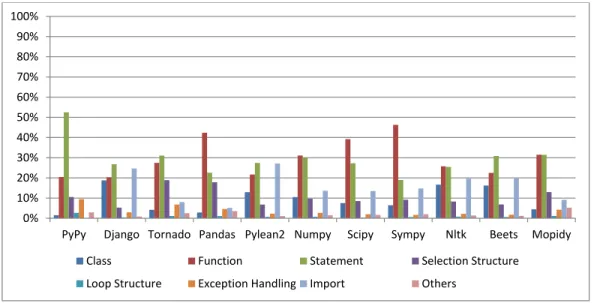
change type, we first counted the number of changes of the type in the history, and then we divided it by the total number of changes and got the change type frequency. Figure 3.8 shows the change type frequency for all studied projects.
As shown in Figure 3.8, theStatement change has the highest frequency (75%) and the frequency for Function change and Selection Structure change ranked at the second and third place with a frequency of 52% and 44% respectively. On the other hand, the most uncommon change type in PyPy isImport changes.
New Finding 1: Statement Change and Function Change are the most com-mon change types, whereas Import Change is the least common change type. Implications: PyPy as an implementation of a language rarely uses third party dependencies. Therefore, the Import change is the least common change type.
Based on the measured change type frequency, we applied Wilcoxon rank sum (WRS) test [27] to statistically compare the change type frequency distribution between PyPy and the originally studied projects. A p-value larger than 0.05 indicates there is no significant difference in change type frequency distribution between PyPy and the originally studied projects. In addition, we group the change type frequency based on the application domains. And we applied the WRS test to statistically compare the change type frequency distribution between the domain of compiler with five other domains in the original study.
The statistical result indicates that the change type frequency distribution in PyPy is significant different from the projects in the original study. And the change type frequency in the domain of compiler is significantly different from all the five domains in the original study.
New Finding 2: The distribution of change type frequency is significant differ-ent between PyPy and the originally studied projects.
Implications: PyPy, which is a compiler written in Python, is different from other Python projects in terms of change behavior. More replication studies are needed in order to generalize the evolutionary behavior of Python-based applications.
New Finding 3: PyPy is significantly different from the studied Python-based applications in other application domains in terms of the distribution of change type frequency.
Implications: The domain of compiler does not share similar change type fre-quency distribution with the projects from the other application domains in the original study. It is worthwhile to study other Python-based compilers to see whether our findings would generalize in this domain.
3.4.2 (RQ2) Across Versions
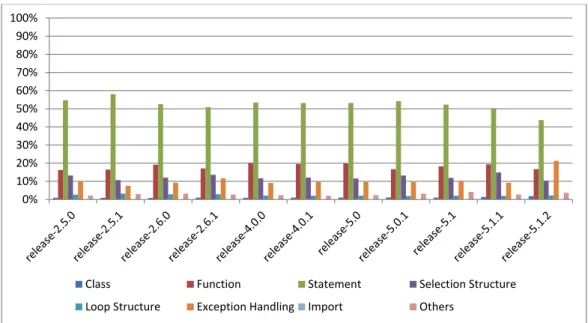
Base on the source code diffing result for each commit in RQ1, we grouped the commits into releases. For all commits in each release, we measured the change type frequency. Figure 3.9 shows the change type frequency for the 11 PyPy releases.
As we can see from Figure3.9, the change type frequency distribution across dif-ferent versions show a similar trend. To further examine the finding, we conducted the WRS test between the change type frequency distribution between different PyPy releases. The statistic result shows that there is no significant difference in change type frequency distribution across different PyPy releases.
In addition, we looked into the release logs and check if any of the releases is purely a bug-fix release. But the release log shows that all the 11 release are mixed with changes about bug-fix, new features, and improved test coverage. Therefore,
0% 10% 20% 30% 40% 50% 60% 70% 80% 90% 100%
Class Function Statement Selection Structure
Loop Structure Exception Handling Import Others
Figure 3.9: The frequency comparison between different versions of PyPy.
Finding 4 and Finding 5 in the original study do not hold in the PyPy project. Finding 6: The distributions of change type frequency across versions show no significant difference.
Implications: Similar to Project Pandas, the distributions of change type fre-quency across versions in PyPy are similar.
3.4.3 (RQ3) Maintenance Activities
In the original study, they found that the distribution of change type frequency in pure bug-fix versions are different from others. In order to understand the code changes, they conducted a study comparing changes types frequency in bug-fix ac-tivities and non-bugfix activity. First of all, we divided the commits into bug-fix
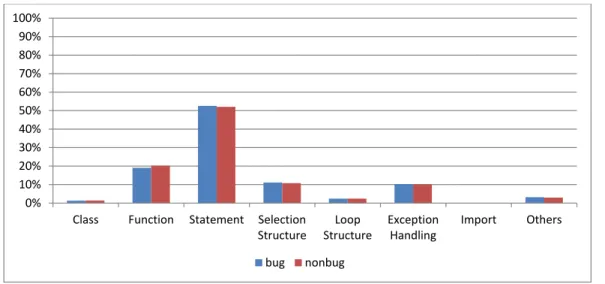
and non-bugfix by mining the commit messages. For each commit, we got the commit message and convert the words into word stems. Then, we checked if the word stems contain the bug-fix related keywords. In particular, we identified a commit as a bug-fix commit if the commit message contains word stems for the following bug-fix related keywords: ‘error’, ‘bug’, ‘fix’, ‘issue’, ‘mistake’, ‘incorrect’, ‘fault’, ‘defect’ and ‘flaw’. Figure 3.10 provides an overview of the change type frequency among bug-fix and non-bugfix commits. And then, for each change type, the bug-fix and non-bugfix commits are divided into four groups (1) bug-fix com-mits containing this change type; (2) bug-fix comcom-mits not containing this change type; (3) non-bugfix commits containing this change type; (4) non-bugfix commits not containing this change type. At last, we applied Fisher’s exact test on the four groups which can measure the significance of the association between two classifica-tions. In our case, a p-value smaller than 0.05 indicates that the change type differs between bug-fix and non-bugfix behavior. And the Odds Ratio from Fisher’s exact test can quantify the strength of the association between two events. An Odds Ratio equals one means the change type behave the same in bug-fix and non-bugfix commits. If the odd ratio is larger than 1, the change type is more related to bug-fix commits and vice versa.
In the result of Fisher’s exact test, only Statement Update is is related to bug fixes with a p-value equals 3.54e-48 and an Odds Ratio of 1.27. However, there are in
0% 10% 20% 30% 40% 50% 60% 70% 80% 90% 100%
Class Function Statement Selection
Structure StructureLoop ExceptionHandling Import Others bug nonbug
Figure 3.10: The frequency comparison between bug-fix commits and non-bugfix commits of PyPy.
total 62 fine-grained changes types which is not related to bug fixes. In particular, many function level changes, e.g. Additional Function, Function Renaming, and
Parameter Insert are non-bugfix related.
New Finding 7: Statement Update is the only change type that is related to bug-fix.
Implications: In PyPy project, bugs are more likely to be fixed by Statement Update. Bug prediction models for Python-based applications trained in one domain cannot be easily transferred to other domains (e.g., compilers).
Finding 8: Import statement and Function Structure change types are mainly related to non-bugfix activity.
Implications: Like the originally studied projects, developers are most likely to involve changes likeAdditional Function, Function Renaming, andParameter Insert to added new features to the project.
3.4.4 (RQ4) Dynamic feature
To study the pattern of dynamic feature changes in PyPy project, we further imple-mented the PyDiff tool and included the functionality to identify dynamic feature changes in the source code files. And then, we re-applied the PyDiff in all com-mits with the dynamic feature change function turned on and got the dynamic feature changes in each commit. Based on the dynamic change results in PyPy, we measured the dynamic feature change type frequency by dividing the number of commits containing this dynamic feature change with the total number of commits containing dynamic feature changes.
Figure 3.11 shows the distribution of the frequency of various change types related to the dynamic features in PyPy and the originally studied projects. Among all dynamic feature changes, more than 60% commits contain isinstance change. The second most frequently changed dynamic feature in PyPy is getattr, with a percentage of 22%. In addition, dynamic features type, hasattr, and del are also
0% 10% 20% 30% 40% 50% 60% 70% PyPy Others 0% 10% 20% 30% 40% 50% 60% 70% 80% 90% 100% PyPy Others
Figure 3.11: The change frequency of each dynamic feature.
commonly changed in PyPy.
Finding 9: In their studied projects, isinstance, type, hasattr, and getattr are the top four dynamic features that change frequently.
Implications: Similar to other projects, PyPy practitioners should pay more attention to dynamic features like ininstance,type,getattr, hasattr and delete as well.
We grouped the dynamic feature changes into three categories based on the change type: Insert, Delete, and Update. Figure3.12shows the percentage of each change actions within a dynamic feature change for the most commonly changed five dynamic features. As shown in Figure3.12, Insert is the most common change action for all the five dynamic feature changes, with a percentage from 48% to 54%. And the second common change action is Delete for most of the dynamic features
0 0.1 0.2 0.3 0.4 0.5 0.6
getattr isinstance type hasattr del
Insert Delete Update
0% 10% 20% 30% 40% 50% 60% 70% 80% 90% 100%
getattr isinstance type hasattr del Insert Delete Update
Figure 3.12: The change frequency of each dynamic feature.
changes except getattr.
New Finding 10: The most common change action for dynamic features in PyPy is Insert. Delete changes in more than Update changes in most of the dynamic features.
Implications: PyPy might involves more dynamic features than normal Python projects. The high performance of PyPy is not a result of constraining the use of dynamic features.
In order to understand the how the dynamic features changed under different maintenance activities, we leveraged the identified bug-fix commits and non-bugfix commits in RQ3 and divide the commits that contain dynamic features into two
groups: commits containing dynamic feature change that are bug-fix related and commits containing dynamic feature change that are non-bugfix related.
New Finding 11: Among the changes containing dynamic features in PyPy, about 19% are related to bug fixes.
Implications: In PyPy project, bug-fix changes do not involve as many dynamic feature changes as the originally studied projects do.
3.5
Threats to Validity
In this section, we will discuss the threats to validity.
3.5.1 Construct Validity
Since the source code change can be very complicated, correctly identifying code changes between two commits can be hard. To make sure that our source code diffing tool work properly, we manually examined 10 commits which contains more than 10 changes. The results show that all the code changes that we identified have more than 98% confidence level.
3.5.2 Internal Validity
The taxonomy of Python source code is defined by ourselves. In order to make a proper comparison with the original study, we must make sure the change types we defined are the same as the original study. Therefore, we defined our classification
scheme based on the Fluri’s [43] taxonomy for source code change in object-oriented language, which is also used by the original study.
3.5.3 External Validity
The study is conducted in Python-based applications, the findings may not be generalizable to applications in other programming languages (e.g. Java, C). The findings we got from the source code change result of PyPy project from the domain of compiler is very different from the other Python applications and domains. We plan to extend our study to the applications in other domains as well as other programming languages in the future.
3.6
Conclusion
Lin et al. [69] conducted the first work in studying the evolution of Python-based projects by studying 10 Python applications from 5 different application domains. They studied the Python source code change behavior from four different angles: across projects, across versions, maintenances, and dynamic features and got 11 interesting findings. We performed a replication study on the PyPy project which belongs to the domain of compiler that has never been studied. We found that 6 out of 9 findings are different which indicates the evolution of projects from the domain of compiler is very different from the project. In the next chapter, we will dig more
into the reason for PyPy’s fast speed and find ways to optimize the performance of Python-based applications running under PyPy.
4
Assessing and Optimizing the Performance
Impact of the Just-in-time Configuration
Parameters
In the previous chapters, we have studied the evolution of PyPy. In this chapter, we assess and optimize the performance of applications running under PyPy by tuning its JIT configuration parameters.
4.1
Introduction
Software performance is one of the crucial factors related to the success and the sustainability of large scale software systems, which serve hundreds or even millions of customers’ requests every day. Failure to provide satisfactory performance would result in customers’ abandonment and loss of revenue. For example, Amazon re-ported that one second delay in loading their webpages could result in $1.6 billion loss in their sales revenue annually [41]. BBC has also recently found that 10% of
the users will leave their website even if there is merely one additional second of performance delay [37]. Various strategies (e.g., asynchronous requests [60], data compression [54], just-in-time (JIT) compilation [10], load balancing [25], and re-sult caching [34]) have been developed to further enhance the performance of these systems.
In general, there are three types of system executions depending on the pro-gramming languages: (1) executing natively on top of the operating systems (e.g., C and C++), (2) executing the source code by the interpreters (e.g., Python, PHP, and JavaScript), and (3) executing compiled intermediate artifacts on the virtual machines (e.g., Java and C#). Compared to the native execution mode, systems executed under the interpreted mode (a.k.a., by interpreters or virtual machines) are generally slower due to their additional layers. To cope with this challenge, the JIT compilation is introduced so that frequently executed code snippets are compiled into binaries, which can be executed natively.
Existing works on the JIT compilation focus on the jitting strategies (e.g., method [38] vs. trace-level based code jitting [31]), speeding up the process of the JIT compilations [63,47, 70], optimizing the performance of the underlying virtual machines [88,89,90], and detecting JIT unfriendly code [53]. Unfortunately, there are very few existing studies which investigate the impact of the JIT configurations on the system performance. Software configuration is one of the main sources of
software errors [92]. The configuration settings of a software system can significantly impact its performance. Most of the existing configuration tuning and debugging studies are focused on the configurations of the studied systems [40,93,84,61]. For tuning the configuration settings of interpreters or virtual machines, the focus is mainly on optimizing the performance of the garbage collectors [82, 67,33], except the work by Hoste et al. [59]. In [59], Hoste et al. provided an automated approach to tuning the JIT compiler for Java, which is a method-based JIT. Hence, in this paper, we seek to investigate the impact of the tracing-based JIT configurations on the system performance by using PyPy as our case study subject.
Python is nowadays one of the most popular programming languages [51]. Python has been used extensively to develop real-world business systems, including many large scale and mission-critical systems inside companies like Facebook [66], Google [26], and PayPal [55]. Among various implementations of the Python pro-gramming language (e.g., CPython, IronPython, Jython, and PyPy), PyPy is gen-erally the fastest [14] mainly due to PyPy’s efficient tracing-based JIT compiler [31]. Hence, in this paper, we focus on assessing and optimizing the performance impact of PyPy’s JIT configuration settings. The contributions of this chapter are:
1. This is the first empirical study on assessing and optimizing the impact of the tracing-based JIT configuration settings on system performance.
2. Our experiments are carried out on both the synthetic benchmarks as well as real systems. The empirical findings in this paper can be useful for both software engineering and programming language researchers as well as prac-titioners.
3. Compared to [59] which also used a search-based approach to automatically tuning the JIT configuration settings, many of the details (e.g., the initial setup, the configuration settings, and the evaluation details) are not clear. It is not easy to reapply the approach to other Java-based systems or other JIT compilers. In this paper, we have detailed our search-based configuration tuning approach, (ESM-MOGA) to ease replication.
4. To enable replication and further research on this topic, we have provided a replication package [16] which includes the implementation for our configu-ration tuning framework, PyPyJITTuner, as well as the experimental data.
4.1.1 Chapter Organization
The organization of this chapter is as follows: Section4.3describes the exploratory study that we have conducted to understand the relationship between JIT configu-ration settings and its performance. Section4.4proposes our approach to automat-ically tuning the JIT configuration parameters. Section 4.5 shows the result from
6 def test(): 7 even = 0 8 oddLarge = 0 9 oddSmall = 0 10 c = 0 (*) 11 for i in range(1000000): (*) 12 if i%2 == 1: (*) 13 even += 1 (*) 14 elif i * i <= 100: 15 oddSmall += 1 (*) 16 elif i * i > 100 and i < 1000000: (*) 17 oddLarge += 1 18 else: 19 c += 3 20 return c
Figure 4.1: A sample PyPy code snippet with the jitted code marked as “(*)”.
the case study conducted on three real word systems and evaluate the effective-ness of our approach. Threats and validity is discussed in Section 4.7. Section 4.8
concludes this chapter.
4.2
Background
In this section, we will first give an overview of the JIT compilation process in Sec-tion 4.2.1. Then we will explain PyPy’s JIT configuration setting in Section4.2.2.
4.2.1 An Overview of the JIT Compilation Process
JIT compilers are introduced for systems executed by interpreters (e.g., Python, PHP, and Ruby) or virtual machines (e.g., Java and C#) to further speed up the system performance during runtime. By default, there are no JIT compilations
upon the initial system startup and these systems are executed under the inter-preted mode by their interpreters or virtual machines. Hence, their performance is usually slower than natively executed systems (e.g., systems programmed in C or C++), whose binaries are executed directly on top of the operating systems. To cope with this limitation, the JIT compiler is introduced so that, during runtime, various parts of the systems are converted into machine executable code (a.k.a., code jitting). However, the code jitting process is usually slow, as it takes time to load and compile the corresponding code snippets. Hence, only the commonly used (a.k.a., “hot”) code snippets are usually jitted [31, 73]. For such systems, there is usually a warmup period after the initial system startup before these systems reach the peak performance [30]. During the warmup period, the frequently executed code will be profiled to locate the “hot” spots and various code snippets are being jitted [70]. In general, there are two approaches for code jitting depending on their granularity:
Method-based JIT Compiling: if one method has been used many times (a.k.a., “hot method”), the method-based JIT will compile this entire method into the binary executable format. Hotspot (Oracle’s implementation of the Java Virtual Machine) and Chakra (Microsoft’s JavaScript engine) use the method-based JIT Compiling.