PERCEPTRON LEARNING IN CACHE MANAGEMENT AND PREDICTION TECHNIQUES
A Thesis by
ESHAN BHATIA
Submitted to the Office of Graduate and Professional Studies of Texas A&M University
in partial fulfillment of the requirements for the degree of MASTER OF SCIENCE
Co-Chairs of Committee, Paul V. Gratz Daniel A. Jiménez Committee Members, Sunil P. Khatri Head of Department, Miroslav M. Begovic
May 2019
Major Subject: Computer Engineering
ABSTRACT
Hardware prefetching is an effective technique for hiding cache miss latencies in modern processor designs. An efficient prefetcher should identify complex memory access patterns during program execution. This ability enables the prefetcher to read a block ahead of its demand access, potentially preventing a cache miss. Accurately identifying the right blocks to prefetch is essential to achieving high performance from the prefetcher.
Prefetcher performance can be characterized by two main metrics that are generally at odds with one another: coverage, the fraction of baseline cache misses which the prefetcher brings into the cache; and accuracy, the fraction of prefetches which are ultimately used. An overly aggressive prefetcher may improve coverage at the cost of reduced accuracy. Thus, performance may be harmed by this over-aggressiveness because many resources are wasted, including cache capacity and bandwidth. An ideal prefetcher would have both high coverage and accuracy.
In this thesis, I propose Perceptron-based Prefetch Filtering (PPF) as a way to increase the coverage of the prefetches generated by a baseline prefetcher without negatively impacting accuracy. PPF enables more aggressive tuning of a given baseline prefetcher, leading to increased coverage by filtering out the growing numbers of inaccurate prefetches such an aggressive tuning implies. I also explore a range of features to use to train PPF’s perceptron layer to identify inaccurate prefetches. PPF improves performance on a memory-intensive subset of the SPEC CPU 2017 benchmarks by 3.78% for a single-core configuration, and by 11.4% for a 4-core configuration, compared to the baseline prefetcher alone.
DEDICATION
ACKNOWLEDGMENTS
I would like to extend my deepest gratitude to my advisors – Prof. Daniel Jiménez and Prof. Paul Gratz. I was really lucky to have two of the best minds in the field of computer sciences working with me. Prof. Jimémez’s guidance in the early stages of the project and his strong intuition about the working of caches and perceptrons helped in giving the correct direction to my thesis. Prof. Gratz’s experience with prefetching was really instrumental in helping me understand finer nuances about the field. His never ending patience helped me remain motivated even when the results would be far from promising. Prof. Sunil Khatri, also on my thesis committee, strongly motivated me to think about possible constraints in a real hardware implementation of my research. I can’t be more thankful to Gino Chacon, a fellow graduate student at Texas A&M. He made sure he was always available to help me out - be it solving any simulator issues or be it documenting the work. I would also like to thank my collaborators, Dr. Seth Pugsley and Dr. Elvira Teran. Their insighful discussions during the course of the thesis really helped me make this work more novel.
On a more personal note, I would like thank my close friends at Texas A&M – Fazia, Swati, Nalin, and Saumil for being with me through thick and thin of the life as a graduate student. Lastly and most importantly, I am eternally grateful to my family – my parents and my sister, for always being there as pillars of moral support.
CONTRIBUTORS AND FUNDING SOURCES
Contributors
This work was supported by a thesis committee consisting of Prof. Paul V. Gratz (ECEN Department) and Prof. Daniel A. Jiménez (CSCE Department) as the co-advisors and Prof. Sunil P. Khatri (ECEN Department) as the committee member.
Some contributions in finalizing the overall architecture of the algorithm described in this work were made by the collaborators – Gino Cachon, Dr. Seth Pugsley and Dr. Elvira Teran.
All other work conducted for the thesis was completed by the student independently. Funding Sources
Graduate study was partly supported by the merit based scholarship from the ECEN Department at Texas A&M University.
TABLE OF CONTENTS
Page
ABSTRACT . . . ii
DEDICATION . . . iii
ACKNOWLEDGMENTS . . . iv
CONTRIBUTORS AND FUNDING SOURCES . . . v
TABLE OF CONTENTS . . . vi
LIST OF FIGURES . . . viii
LIST OF TABLES. . . ix
1. INTRODUCTION AND MOTIVATION . . . 1
2. BACKGROUND AND RELATED WORK . . . 5
2.1 Background . . . 5
2.1.1 Spatial Prefetchers . . . 5
2.1.2 Lookahead Prefetchers . . . 6
2.1.3 Managing Prefetched Data . . . 6
2.1.4 Machine Learning for Prefetching . . . 7
2.2 Perceptron Learning in Computer Architecture . . . 7
2.2.1 Perceptron Training . . . 8
2.2.2 Hashed Perceptrons for Branch Prediction . . . 8
2.2.3 Perceptrons in Cache Management . . . 9
2.3 Baseline Prefetcher: SPP . . . 9
2.4 Case for an On-line Filter . . . 12
3. PERCEPTRON BASED PREFETCH FILTERING . . . 13
3.1 PPF Design and Architecture . . . 13
3.1.1 The Perceptron Filter . . . 14
3.1.2 Optimizing PPF for a Given Prefetcher . . . 17
3.2 PPF Implementation Using SPP . . . 19
3.2.1 Changes Made to SPP . . . 19
3.2.2 Features used by Perceptron . . . 19
4.1 Methodology . . . 22
4.1.1 Performance Model . . . 22
4.1.2 Testing Under Additional Memory Constraints . . . 22
4.1.3 Workloads. . . 22
4.1.4 Prefetchers Simulated . . . 24
4.1.5 Developing Features for PPF . . . 24
4.1.6 Overhead for PPF. . . 29
4.2 Results . . . 31
4.2.1 Single-core Results . . . 31
4.2.2 Multi-core Results . . . 34
4.2.3 Additional Memory Constraints . . . 34
4.2.4 Cross Validation . . . 35
5. CONCLUSION. . . 37
5.1 Conclusion. . . 37
LIST OF FIGURES
FIGURE Page
1.1 Performance vs Prefetch Aggressiveness . . . 2
2.1 The Basic Perceptron Model . . . 7
2.2 SPP Data-path Flow . . . 10
2.3 SPP Architecture . . . 11
3.1 PPF Architecture in the Memory Hierarchy . . . 13
3.2 PPF Data Path and Operation . . . 15
4.1 Distribution of Trained Weights . . . 25
4.2 P-Values for all Features . . . 26
4.3 P-value Variation across Traces for selected Features . . . 27
4.4 SPEC CPU 2017 Single-Core IPC Speedup . . . 31
4.5 Fraction of Cache Misses Covered . . . 32
4.6 Speedup for 4-core SPEC CPU 2017 . . . 33
4.7 Speedup for 8-core SPEC CPU 2017 . . . 35
LIST OF TABLES
TABLE Page
4.1 Simulation Parameters . . . 23 4.2 Metadata Stored in Prefetch Table . . . 28 4.3 SPP-Perc Storage Overhead . . . 29
1. INTRODUCTION AND MOTIVATION
Processor and memory technologies have been developed with different goals in mind. While processor scaling has focused on speed improvements, memory scaling has primarily focused on increasing capacity. The difference in each technology’s scaling has led to the Memory Wall [1] – the increasing gap between processor and memory performance. Data prefetching is one important technique that has been developed to minimize the effects of this trend. Data prefetching exploits the fact that in most applications, memory accesses have a repeating and predictable pattern. This presents an opportunity to speculatively fetch useful data from the DRAM into the cache hierarcy. An ideal prefetching scheme would perfectly capture a program’s memory access pattern, and then predict and pre-load the needed data into the processor’s caches in a timely manner. Memory access patterns may be simple, such as accessing every item in an array with a for-loop, or very complex, such as chasing pointers through dynamically-allocated memory. Practical prefetchers face challenges not only in predicting what data will be useful in the future, but also in timing when that data should be prefetched, deciding which level of the cache hierarchy the data should be stored in, and deciding what data should be evicted from the caches to accommodate the prefetched data. All prefetchers are designed around a fundamental trade-off between two important metrics: coverage and accuracy. Prefetcher coverage refers to the fraction of baseline cache misses that the prefetcher pulls into the cache prior to their reference. For example, if an application experiences 1,000 cache misses without a prefetcher, while 800 of those cache misses become hits with a prefetcher, then the prefetcher has 80% coverage for that application. Prefetcher accuracy refers to the fraction of prefetched cache lines that end up being used by the application. So if a prefetcher prefetches 1,200 cache lines, but only 800 of them are used by the application, then that prefetcher’s accuracy is 66.7%.
Coverage and accuracy are generally at odds with one another, and as one metric improves, the other usually gets worse. For example, when an application accesses a new region of memory
0.90
0.95
1.00
1.05
1.10
1.15
1.20
1.25
8
10
12
14
SPP Lookahead Depth
Normalized Scale
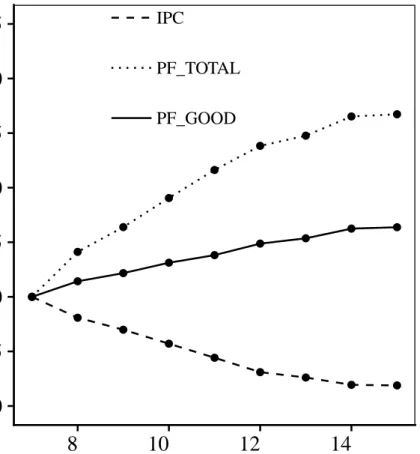
IPC PF_TOTAL PF_GOOD(a) The impact of aggressive prefetching on performance for 603.bwaves_s. The number of useful prefetches increases with aggressiveness slower than total prefetches, which wastes bandwidth and harms performance.
Figure 1.1: Performance vs Prefetch Aggressiveness
for the first time, a naïve prefetcher may predict that all data in that region will be used by the application. This will clearly result in 100% coverage for that region, but with possibly a very low accuracy. In fact, so much cache capacity and bandwidth may be wasted prefetching unused data that performance can ultimately be harmed by this strategy. At the other extreme, another prefetcher may be overly conservative and never prefetch anything, wasting no capacity or bandwidth, and achieving 0% prefetch coverage.
Figure 1.1 illustrates the above scenario. Here, I consider a state-of-the-art lookahead prefetcher – SPP [2]. Lookahead prefetchers such as SPP provide a mechanism to speculate an arbitrary number
of references ahead of the initial triggering access. In SPP, a throttling confidence threshold is then used to ensure that the lookahead stops when confidence falls too low to ensure that prefetches are accurate. In the figure, I iteratively re-tuned this threshold to allow the prefetcher to lookahead with depths varying from 7 to 15. The figure depicts the behavior of the603.bwaves_sSPEC CPU 2017 benchmark. The IPC, the total number of prefetches issued by the prefetcher (TOTAL_PF), and the actual useful predictions (GOOD_PF), all have been normalized to the lookahead depth of 7. As the lookahead depth increases, so do useful prefetches, and hence coverage. This coverage, however, comes at the cost of total prefetches increasing at an even higher rate. This leads to cache pollution and bandwidth contention, and leads to a reduction in IPC.
Therefore, a delicate balance between coverage and accuracy is required for a prefetcher to maximize its performance impact. Prefetchers are generally designed with internal mechanisms to monitor their accuracy, and throttling mechanisms that can be tuned for either coverage or accuracy. The more irregular an application’s memory access pattern is, the more difficult it is to accurately predict every access, so a prefetcher will have to be tuned more toward coverage (and away from accuracy) in order to gain any benefit. This may be especially dangerous to do in the context of a multi-core processor, where overly aggressive prefetching in one core can waste shared resources, such as last-level cache (LLC) capacity, and off-chip bandwidth, impacting the performance of other cores [3].
From the preceeding discussuion, we can see that the core of prefetching lies in idenfying the memory access patterns and predicting the next access that a given pattern of accesses can lead to. Thus prefetching is a pattern recognition problem. We would also like to study the predictions and classify them as potentilly useful vs useless. This makes prefetching a classification problem too. Lastly, all the learning has to be on-line – happening in hardware in real-time, to make the prefetcher robust and diverse. This shows that prefetching has all the elements of utilizing a machine learing based aprroach.
Thesis Statement: In this thesis, I propose that machine learning based prefetch filtering can significantly improve performance and efficiency of existing prefetching schemes.
Proposed Solution: Here, I introduce Perceptron-based Prefetch Filtering (PPF) as an en-hancement to existing state-of-the-art prefetchers, allowing them to speculate deeply to achieve high coverage while PPF filters out the inaccurate prefetches this deep speculation implies. PPF works by observing the stream of candidate prefetches generated by a prefetcher, and then rejects those that are predicted by the online-trained neural model to be inaccurate. The state-of-the-art prefetcher that I use to evaluate PPF in this work is the Signature Path Prefetcher (SPP) [2], however as described, PPF can be designed to benefit any prefetcher. In this design, PPF replaces SPP’s existing confidence-based throttling mechanism, which itself was a highly tuned feature of that prefetcher. Because PPF is so much more effective at rejecting inaccurate prefetches than SPP’s baseline mechanism, we are free to re-tune the rest of SPP’s design around maximizing coverage. The result is an increase in both accuracy and coverage, and a notable increase in performance.
This work describes Perceptron-based Prefetch Filtering, explains its merits, offers analysis, and outlines the scope for future research. Its contributions are:
• An on-line neural model used for hardware data prefetching. Previous work in this area either relied on program semantics [4] or were application specific [5].
• Implementing PPF as a state-of-the-art prefetcher, giving a significant performance improve-ment compared to previous work. PPF adapts itself to shared resource constraints, leading to further increased performance in multi-core and bandwidth-constrained environments. • A methodology for determining an appropriate set of features for prediction, regardless of the
underlying prefetcher used. More details are explained in Section 4.1.5.
In a single core configuration, PPF increases performance by 3.78% compared to the underlying prefetcher, SPP. In a multi-core system running a mixes of memory intensive SPEC CPU 2017 traces, PPF sees an improvement of 11.4% over SPP for a 4-core system, and 9.65% for an 8-core system.
2. BACKGROUND AND RELATED WORK
In this chapter, I discuss the most closely related work to this proposed technique. A major portion of this chapter discusses prior work in the domain of hardware prefetching, including the Signature Path Prefetcher, which acts as the underlying prefetcher in the implementation done in this work. The remaining part gives a conext on application of machine learning for hardware predictions.
2.1 Background
The idea of prefetching begins with Jouppi’sInstruction Stream Buffers[6]. Two of the most fundamental prefetchers are the Next-nLines [7] and the Stride based [8, 9, 10] prefetchers. Both capture regular memory access patterns with low overhead. The Next-nLines prefetcher queues prefetches for the nextnblocks after any given miss, expecting that the principle of spatial locality will hold and those cache blocks after a missed block are likely to be used in the future. The stride prefetcher identifies strided reference patterns in programs based on past behavior of missing loads. When a load misses, cache blocks ahead of that miss are fetched in the pattern following the previous behavior in the hope of avoiding future misses. Without further knowledge about temporal locality and application characteristics, these prefetchers cannot do more than detecting and prefetching regular memory access patterns with limited spatial locality.
Modern prefetching mechanisms are more sophisticated as they look into past memory behav-ior [11, 12], locality [13, 14, 15, 16, 17, 18], control-flow speculation [19, 20], and other other aspects to detect complex memory access patterns.
2.1.1 Spatial Prefetchers
Spatial prefetchers include such well-understood examples as the next-line (or next-n-line) prefetcher, and the stream prefetcher, and are distinguished by prefetching data without regard for the order in which the data will be accessed. In addition to these simpler examples, Somogyiet al.propose Spatial Memory Streaming (SMS) [14]. SMS works by learning the spatial footprint
of all data used by a program within a region of memory around a given missing load, and when the load that causes an new miss elsewhere, the same spatial footprint is prefetched. Ishiiet al.
propose the Access Map Pattern Matching prefetcher (AMPM) [12], which creates a map of all accessed lines within a region of memory, and then analyzes this map on every access to see if any fixed-stride pattern can be identified and prefetched that is centered on the current access. DRAM-Aware AMPM (DA-AMPM) [21] is a variant of AMPM that delays some prefetches so they can be issued together with others in the same DRAM row, increasing bandwidth utilization. Pugsley
et al. propose the Sandbox Prefetcher [22], which analyzes candidate fixed-offset prefetchers in a sandboxed environment to determine which is most suitable for the current program phase. Michaud proposes the Best-Offset Prefetcher [23], which determines the optimal offset to prefetch while considering memory latency and prefetch timeliness.
2.1.2 Lookahead Prefetchers
Unlike spatial prefetchers, lookahead prefetchers take program order into account when they make predictions. Shevgooret al. propose the Variable Length Delta Prefetcher (VLDP) [24], which correlates histories of deltas between cache line accesses within memory pages with the next delta within that page. SPP [2] and KPC’s prefetching component [25] are more recent examples of lookahead prefetchers. They try to predict not only what data will be used in the future, but also the precise order in which the data will be used, within a given page. Predictions made by lookahead prefetchers can be fed back into their prediction mechanisms to predict even further down a speculative path of memory acesses. These prefetchers can also generalize their learned patterns from one page, and use those patterns to make predictions in other pages.
2.1.3 Managing Prefetched Data
A low-accuracy aggressive prefetcher can significantly harm performance. To minimize inter-ference from prefetching, Wuet al.propose PACMan [26], a prefetch-aware cache management policy. PACMan dedicates some LLC sets to each of three competing policies that treat demand and prefetch requests differently, using the policy in the rest of the cache that shows the fewest
misses. Seshadriet al. propose ICP [27], which demotes a prefetch to the lowest reuse priority on a demand hit, based on the observation that most prefetches are dead after their first hit. To address prefetcher-caused cache pollution, it also uses a variation of EAF [28] to track prefetching accuracy, and inserts only accurate prefetches to the higher priority position in the LRU stack. Jain
et al. propose Harmony [29] to accomodate prefetches in their MIN algorithm-inspired Hawkeye cache management system.
2.1.4 Machine Learning for Prefetching
Peledet al. introduce interesting ideas for on-line Reinforcement Learning and dynamically scaling the magnitude of feedback given to the baseline prefetcher [4]. The prefetcher relies on compiler support to receive features and build the context. Liaoet al.focus on prefetching for data center applications [5]. They use offline machine learning algorithms such as SVMs and logistic regression to do a parametric search for an optimal prefetcher configuration.
2.2 Perceptron Learning in Computer Architecture
X1
X2
X3
W1
W2
W3
Inputs
Weights
...
...
Weighted Sum
Step Function
2.2.1 Perceptron Training
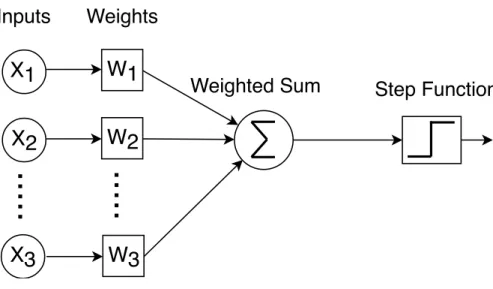
Perceptron learning is the most basic form of a machine learning based prediction mechanism. As shown in the figure 2.1, a perceptron is a light weight structure that can add contributions from disparate pieces of information, called as a feature or an attribute, into a meaningful sum.
Mathematically, a perceptron is modeled as a dot product of the signed weights with the vector of input features. These weights are learned through online training. The sum obtained from the dot product depicts the extent of confidence in predicting the final decision. In a way, training the perceptron weights helps capture the correlation of the decision prediction with the input features.
There are two components to the abstract perceptron learning algorithm:
• To predict true or false, a vector of signed weights is chosen according to some criteria. The dot product of the weights and input vectors, calledyout, is computed. Ifyoutexceeds some threshold, the prediction is true, otherwise it is false.
• To update the weights after the true outcome of the predicted event is known, we first consider the value ofyout. If the prediction was correct and |yout|exceeds a threshold θ, then the weights remain unchanged. Otherwise, the inputs are used to update the corresponding weights. If there is positive correlation between the input and the outcome of the event, the corresponding weight is incremented; otherwise, it is decremented. Over time, the weights are proportional to the probability that the outcome of the event is true in the context of the input and the criterion for choosing that weight. The weights saturate at maximum and minimum values so they will fit in a fixed bit width.
2.2.2 Hashed Perceptrons for Branch Prediction
Perceptron learning for microarchitectural prediction was introduced for branch prediction [30]. This predictor uses a version of microarchitectural perceptron prediction known as the “hashed perceptron” organization [31]. As an abstract idea, a hashed perceptron predictor hashes several different features into values that index several distinct tables. Small integer weights are read out from the tables and summed. If the sum exceeds some threshold, a positive prediction is made,e.g.
“predict branch taken” or “allow the prefetch.” Otherwise, a negative prediction is made. Once the ground truth is known, the weights corredponding to the prediction are incremented if the outcome was positive, or decremented if it was negative. This update only occurs if the prediction was incorrect or if the magnitude of the sum failed to exceed a threshold. Beyond branch prediction, perceptron learning has been applied to last-level cache reuse prediction [32, 33]. In this work, I apply it for the first time to prefetch filtering.
2.2.3 Perceptrons in Cache Management
In addition to branch prediction [30], perceptron-based learning has been applied to the area of cache management. Teranet al. propose using perceptrons to predict cache line resuse, bypass, and replacement [32]. Perceptron Learning trains weights selected by hashes of multiple features, including the PC of the memory access instruction, some other recent PCs, and two different shifts of the tag of the referenced block. These features are used to index into weight tables, and the weights are then thresholded to generate a prediction. When a block from one of a few sampled sets [34] is reused or evicted, the corresponding weights are decremented or incremented, according to the perceptron learning rule. Multiperspective Reuse Prediction [33] improves on Perceptron Learning by contributing many new features.
2.3 Baseline Prefetcher: SPP
Kim et. al. proposed Signature Path Prefetcher (SPP) [2], a confidence-based lookahead prefetcher. SPP creates a signature associated with a page address by compressing the history of accesses. By correlating the signature with future likely delta patterns, SPP learns both simple and complicated memory access patterns quickly. While the basic idea of perceptron based prefetch filtering is applicable to any lookahead prefetcher, this work develops a practical implementation of the proposed perceptron prefetch filter using SPP as the baseline. Here I describe the basic architecture of SPP.
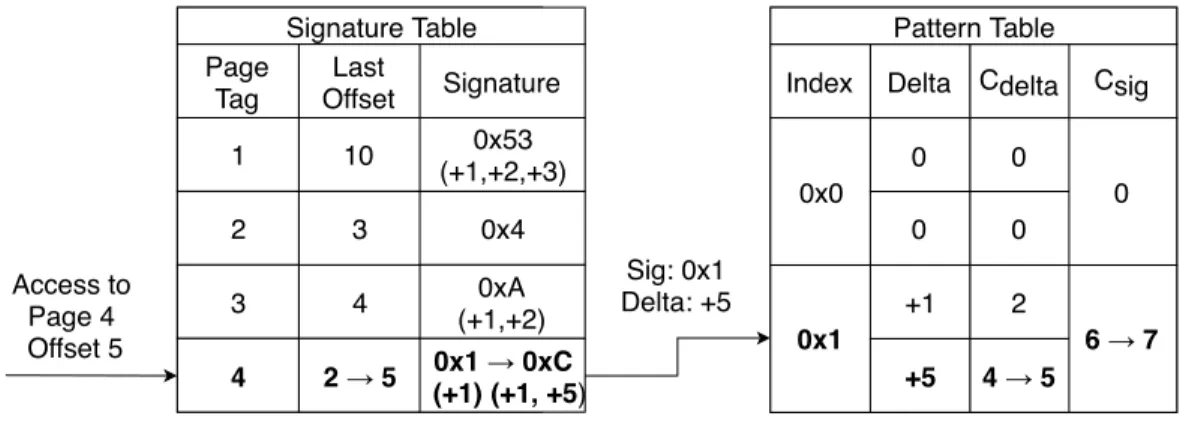
Signature Table: As shown on the left side of Figure 2.2, the Signature Table keeps track of 256 most recently accessed pages. It is meant to capture memory access patterns within a page
Index 0x0 0x1 Delta 0 0 +1 +5 Cdelta 0 0 2 4 → 5 Csig 0 6 → 7 Pattern Table Access to Page 4 Offset 5 Signature Table Page Tag Last Offset Signature 1 2 3 4 10 4 3 2 → 5 0x53 (+1,+2,+3) 0x4 0xA (+1,+2) 0x1 → 0xC (+1) (+1, +5) Sig: 0x1 Delta: +5
Figure 2.2: SPP Data-path Flow
boundary. SPP indexes into an entry of the Signature Table using the page number. For each entry corresponding to a page, the table stores a ‘last block offset’ and an ‘old signature’. Last block offset is the block offset of the last memory access of that given page. The block offset is calculated with respect to the page boundary. The signature is a 12-bit compressed representation of the past few memory accesses for that page. The signature is calculated as:
N ewSignature= (OldSignature << 3bits) XOR (Delta)
Delta is the numerical difference between the block offset of the current and the previous memory access. In case a matching page entry is found, the stored signature retrieved and used to index into the Pattern Table. This process is illustrated in Figure 2.2.
Pattern Table: The Pattern Table, shown on the right side in Figure 2.2 is indexed by the signature generated from the Signature Table. Pattern Table holds predicted delta patterns and their confidence estimates. Each entry indexed by the signature holds up to 4 unique delta predictions.
Lookahead Prefetching: On each trigger, SPP goes down the program speculation path using its own prefetch suggestion. Using the current prefetch as a starting point, it re-accesses the Pattern Table to generate further prefetches. As illustrated in Figure 2.3, it repeats the cycle of accessing Pattern Table and updating the signature based on highest confidence prefetch from the last iteration.
The iteration counter on which SPP manages to predict prefetch entries in the lookahead manner is characterized as its ‘depth’. While doing so, SPP also keeps compounding the confidence in each depth. Thus as depth increases, overall confidence keeps decreasing.
Signature: 0xC Confidence (P0)=Cdelta/Csig = 0.8 Lookahead Signature Pd > Tp Prefetch (Baseα +3) Confidence (Pd)=α * Cdelta/Csig * Pd-1 Index 0xC 0xD Delta -1 3 -2 +2 Cdelta 1 4 2 2 Csig 5 4 Pattern Table (0xC << 3) XOR (+3) = 0x63 Figure 2.3: SPP Architecture
Confidence Tracking: As shown in Figure 2.3, the Pattern Table keeps a count of hits to each signature through a counter Csig. The number of hits for a given delta per signature are tracked using a counter Cdelta. The confidence for a given delta is approximated through Cd = Cdelta/ Csig. When SPP enters into a lookahead mode, the path confidence Pdis given as: Pd = α . Cd . Pd-1 Hereαrepresents the global accuracy, the ratio of number of prefetches which led to a demand hit to the total number of prefetches recommended. The range ofαis [0,1].dis the lookahead depth. Ford= 1SPP is in non-speculative mode and P0= 1. The final Pd is thresholded against prefetch threshold (Tp) to reject the low confidence suggestions and then against a numerically bigger fill threshold (Tf) to decide whether to send the prefetch to L2 Cache (high confidence prefetch) or Last Level Cache (low confidence prefetch). The two thresholds were empirically set to 25 and 90 respectively, on the scale of 0 to 100.
2.4 Case for an On-line Filter
As was noted in Figure 1.1, aggressive lookahead prefetching, if done without any accuracy check, can harm the performance of the system. As the figure shows, aggressive lookahead and its accompanied loss of accuracy degrades performance by almost 9%. This is despite a growing number of useful prefetches generated by the prefetcher. Thus, we need a mechanism that is orthogonal to the underlying prefetching scheme and can be used to prune out the useful prefetches from the useless ones.
Moreover, the on-line confidence mechanism used by most prefetchers is very rudimentary. For example, SPP’s internal confidence mechanism is based on taking the ratio Cd= Cdelta/ Csig. This confidence was used to make the decision of whether to prefetch or not to prefetch and which level to prefetch. While this approximation was shown to work in the original implementation, I believe that a better form of generalized on-line decision making was possible. Hence, it was necessary to build a robust and adaptable learning mechanism to accept / reject the prefetch suggestions and to decide the fill level (L2 Cache vs Last Level Cache). Thus, in this thesis, I introduce an independent on-line perceptron based filtering mechanism.
3. PERCEPTRON BASED PREFETCH FILTERING
This chapter describes the details of the proposed idea - Perceptron Based Prefetch Filtering (PPF). The first section talks about the general architecture of the prefetch filter and how it can be developed for any underlying prefetcher. The second section consists of the practical implementation of PPF, using SPP as the baseline prefetcher. It also describes how PPF can be tweaked to work in a tightly knit manner with the underlying prefetcher.
L2 Cache L3 Cache Core Baseline Prefetcher Off-Chip DRAM PPF Reject Table Prefetch Table Perceptron Weight Tables Prefetch Suggestion Training and
feature data from L2 demand access
Prefetch (insert into either L2 or L3) L1D L1I Prefetches Metadata Prefetcher specific metadata
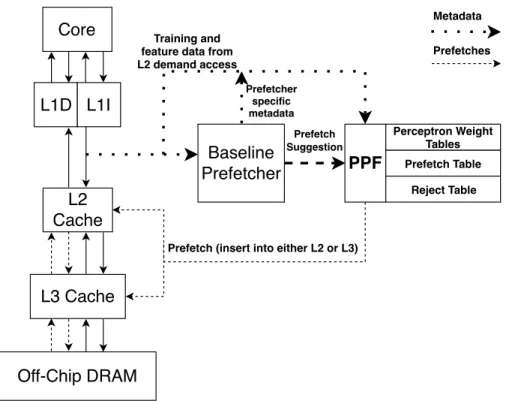
Figure 3.1: PPF Architecture in the Memory Hierarchy
3.1 PPF Design and Architecture
It can be beneficial to allow a prefetcher to speculate as deeply as possible. Often, some useful prefetches are generated long after the confidence of the prefetcher has fallen below the point at which performance degrades due to the increase of inaccurate prefetches. In order to allow deep
speculation in the prefetcher, however, inaccurate prefetches must be filtered out. I propose to leverage perceptron-based learning as a mechanism to differentiate between potentially useful deeply speculated prefetches and likely not-useful ones. The Perceptron Prefetch Filter (PPF) is placed between the prefetcher and the prefetch insertion queue, as illustrated in Figure 3.1, to prevent not-useful prefetches from polluting the higher levels of the memory hierarchy.
Perceptron learning is a light-weight mechanism to pull together disparate forms of information and synthesize a decision from them. This work considers a number of features corresponding to a prefetch, such as speculation depth, page address and offset, and uses this information as the inputs to the perceptron-based filter in order to predict the usefulness of a prefetch. Here, I discuss the design of my proposed perceptron prefetch filter (PPF). PPF enhances a base prefetcher by filtering out predicted unused prefetches. PPF is a generalized prefetch filtering mechanism that may be adapted to any prefetcher with appropriate feature selection and modifications described below. 3.1.1 The Perceptron Filter
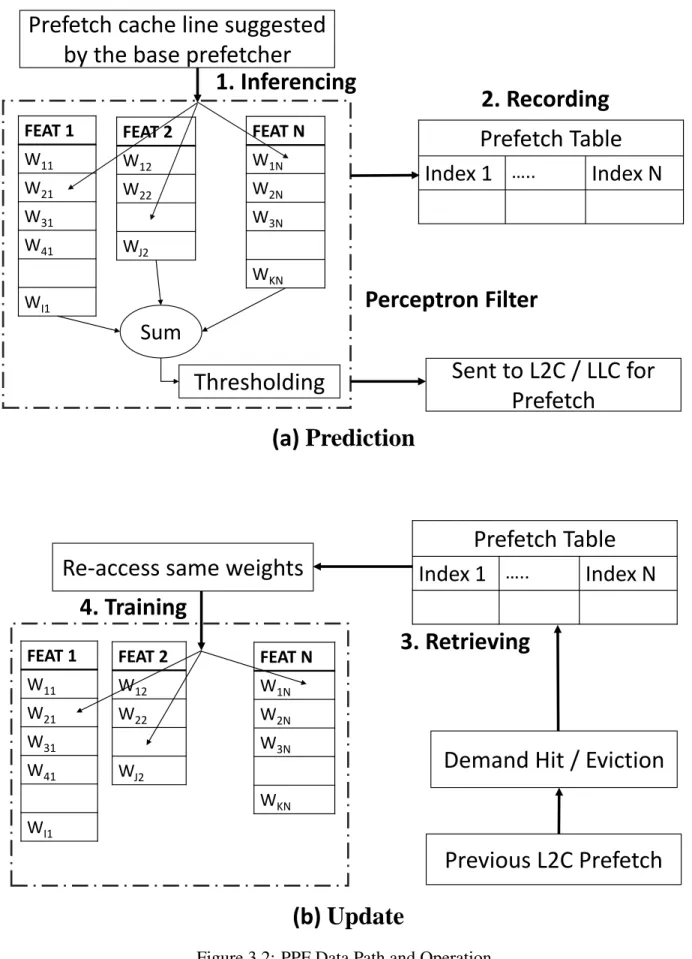
Figure 3.2 shows the microarchitecture of PPF, as well as the steps required to filter out not-useful prefetches. The perceptron filter is organized as a set of tables, where each entry in the tables holds aweight. For a configuration of PPF usingN number of features,N different tables of weights are needed. Each feature is used to index into a distinct table. The number of entries of each table varies according to the corresponding feature, hence, different number of bits are needed to index different tables. Each weight is a 5-bit saturating counter ranging from -16 to +15. I found that having 5-bit weights provides a good trade-off between accuracy and area. A detailed explanation of the storage overhead of PPF can be found in Section 4.1.6.
Inferencing
The base prefetcher is triggered on every demand access to the L2 Cache, as seen in Figure 3.1. At this point, it has the opportunity to trigger a prefetch. If it does so, it will also need to decide how many cache blocks to prefetch. These blocks can be either placed in the L2 or L3 cache according to the confidence of the prefetching mechanism. Once the base prefetcher is triggered, the suggested prefetch candidates are fed to the perceptron filter to determine the usefulness of these prefetches.
Sum
Thresholding
Prefetch cache line suggested
by the base prefetcher
Sent to L2C / LLC for
Prefetch
Prefetch Table
Index 1
…..
Index N
1. Inferencing
2. Recording
Perceptron Filter
FEAT 1 W11 W21 W31 W41 WI1 FEAT 2 W12 W22 WJ2 FEAT N W1N W2N W3N WKNPrevious L2C Prefetch
Demand Hit / Eviction
3. Retrieving
4. Training
FEAT 1 W11 W21 W31 W41 WI1 FEAT 2 W12 W22 WJ2 FEAT N W1N W2N W3N WKNRe-access same weights
(a)
Prediction
(b)
Update
Prefetch Table
Index 1
…..
Index N
The filter ultimately decides whether to issue the prefetch suggestions of the base prefetcher. As shown in step 1 of Figure 3.2(a), to make the decision, each feature corresponding to a suggested prefetch is used to index a table and all the corresponding weights are summed. The sum denotes the confidence value for the suggested prefetch, and is thresholded against two different values: τhi
andτlo.
Prefetches whose sum exceedsτhiare placed into the L2 cache. The higher confidence value
hints the prefetch would be useful and should be prioritized. A prefetch for which the features result in a confidence value betweenτloandτhiis allocated in the larger LLC, as the filter is moderately
confident of the future reuse of the cache block, but not enough to possible pollute a significantly smaller L2. Suggested prefetches for which the features lead to a confidence value lower thanτlo
are not prefetched, as the low confidence value represents that the perceptron learned that a similar set of features are associated with non-useful prefetches.
Recording
As shown in step 2 of Figure 3.2(a) the prefetches that make it through the inference stage are recorded in the “Prefetch Table”. The prefetch table is a 1,024-entry, direct mapped structure that contains all metadata required to re-index the perceptron entries for training.
In addition to the prefetch table mentioned above, PPF also maintains a 1,024-entry direct-mapped “Reject Table.” If a prefetch suggestion is rejected by the perceptron layer, it is logged into the reject table. The table is used to train the perceptron to avoid false negativesi.e., cases where the prediction suggested to reject the prefetch but the prefetch could have proven to be useful based on the observed demand accesses to the L2.
Feedback and Data Retrieval
As depicted in step 3, when there is an eviction or a demand access to the L2, training for both the base prefetcher and the filter mechanism is triggered. The address of the cache block that triggered training is used to index both the Prefetch and Reject tables. 10 bits of the address are used to index tables, and another 6 bits to perform tag matching. Once the contents of the matching entry have been retrieved, the corresponding features are used to index into the tables of weights again.
Training
As can be seen in step 4, the address from the demand request triggering the training is looked up in both tables. If the address is in the prefetch table and marked as valid, this hints the previous prediction was correct and this is a useful prefetch. The prefetcher computes the sum of the corresponding weights. If the sum falls below a specific threshold, training occurs and the corresponding weights are adjusted accordingly. These thresholds are introduced in order to avoid over-training, helping the filter adapt quickly to changes in memory behavior. These thresholds are referred to asθp andθn, respectively for the positive and negative values of training saturation.
On a cache block eviction, the prefetching logic looks up the corresponding address in the prefetch table. If there is a valid entry with this address, the filter made a misprediction. The block was allocated in the L2 with a prefetch request that the filter should have categorized as a useless prefetch. Thus, the corresponding features of the prefetch request are used to re-index the tables of weights, and those weights are adjusted accordingly.
Parallel to accessing the prefetch table, on a demand access, the reject table is accessed. Before the demand access triggers the next set of prefetches, the reject table is checked for a valid entry. A hit means that the corresponding cache block was initially suggested by the base prefetcher, but wrongly rejected by the perceptron filter. The perceptron filter learns from this and makes use of the corresponding features associated to the original prefetch request, which are stored in the reject table, to index the weights tables and adjust the weights accordingly. The implementation of the reject table, allows the prefetcher to capture the information of prefetches that were rejected, and that can be used to further optimize the overall prefetching mechanism.
3.1.2 Optimizing PPF for a Given Prefetcher
The above discussion of PPF shows that it is highly modular and can be adapted to be used over any base prefetcher for increased prefetch accuracy. As a first step, all the prefetch candidates of the prefetcher have to pass through the perceptron filter. If qualified, the metadata for perceptron indexing has to be stored. Next, when the feedback of a prior prefetch is available in form of a subsequent demand hit or cache eviction, the stored metadata needs to be retrieved to update the
state of the perceptrons.
In general, PPF can be adapted to a new base prefetcher with only a few modifications:
Making Base Prefetcher More Aggressive: By tuning down any internal thresholds or throttling mechanisms to increase its aggressiveness.
Inferencing and Storing:All prefetch recommendations are tested using the perceptron inferencing algorithm. The perceptron’s output,true or false, should be saved appropriately, along with all metadata required for perceptron indexing.
Retrieving and Training:When feedback for a prefetch becomes available, the previously stored metadata can be used to re-index into the perceptron entries and increment or decrement the weights. Feature Selection: Perceptrons essentially integrate contributions from different features to get a single sum representing the final confidence. Thus, perceptron learning can only be as good as the set of features chosen. Interestingly, this is what makes perceptron learning scalable, as it can easily learn to incorporate newer information in the form of new features. Some of the features developed here use information derived directly from program execution, agnostic to the baseline prefetcher. Beyond that, the feature set can be expanded to convey any useful information or metadata available in the baseline prefetcher.
Using Metadata from the Prefetcher: Some of the internal counters specific to the underlying prefetcher can be suitable candidates for the perceptron features. To make sure that the perceptron layer sees that, the relevant metadata must be exported from the prefetcher to PPF. This way, PPF can be optimized to work tightly-knit with the base prefetcher.
3.2 PPF Implementation Using SPP
This section describes a case study implementation of PPF and the range of features that are used to determine the usefulness of prefetches. Here, I have selected SPP as the base engine prefetcher. 3.2.1 Changes Made to SPP
To modify the SPP design to suit my scheme, the following changes were made:
Exporting Features from SPP: PPF uses the metadata specific to SPP to build some of the perceptron features. These include the lookahead depth, signature and the confidence counter. These features were made visible to PPF.
Original Thresholds Discarded:In PPF, the perceptron sum is used to decide whether to prefetch or not, and the fill-level in case of prefetch. Thus, the confidence thresholds used by SPP – Tfand Tp are no longer needed to throttle the prefetcher and can be discarded.
3.2.2 Features used by Perceptron
All the features used by PPF can be derived from the information available in the L2 Cache access stream or are taken as metadata derived from the baseline prefetcher. My feature selection involved searching over a large space of relevant perceptron features. Note that part of the process of tuning PPF to a specific prefetcher involves examining the available metadata in the prefetcher itself, and thus PPF is attuned to the baseline prefetcher’s design. Using the statistical methodology outlined in Section 4.1.5, I pruned the feature set to a minimal yet relevant set of features. When implemented with SPP as the baseline prefetcher, the following nine features were used by PPF:
• Physical Address: Here I use the lower bits of the physical address of the demand access that triggers the prefetch. This address corresponds to a stream of accesses that SPP and the PPF have seen before. Therefore, PPF will correlate the past behavior of this address to the prefetch outcome.
• Cache Line and Page Address: These two separate features are derived from the base address that triggered the prefetch, as follows:base_addr >> LOG2_BLOCK_SIZE and
base_addr >> LOG2_P AGE_SIZE respectively. The idea behind using three different shifted versions of the same feature is that it allows the filter to focus its examination in more detail on different aspects of the address than with a single version. It also helps give more importance to the overlapping bits and lesser importance to most and least significance bits. This approach can also eliminate destructive interference that can be caused by directly folding the address bits into half.
• Program Counter XOR Depth: The PC is for the instruction that triggered the prefetch chain. Depth refers to the iteration count of the lookahead stages. It was seen that by itself, the PC is not a good basis for filtering a lookahead prefetcher, as all the prefetches with depth >= 1 are aliased into the same PC, which will not be the PC of the eventual actual demand access. This feature, on the other hand, resolves a PC into a different value for each lookahead depth of prefetch speculation, giving a more accurate correlation in lookahead cases. This is akin to the concept of Virtual Program Counters [35] introduced by Kimet. al. for indirect branch prediction.
• PC1XOR PC2»1 XOR PC3»2: HereP Cirefers to the lastithPC before the instruction that
triggered the current prefetch. Hashing together the last three PCs informs PPF about the path that led to the current demand access and helps capture and branching information of the current basic block. PCs are shifted in the increasing order of history before being hashed together. This is done to avoid the resultant value of zero when 2 or more PCs are the same. Additionally, blurring the information as it gets older allows us to get a wider and yet more approximate look into the program’s history.
• Program Counter XOR Delta: This feature tells us if a given PC favors particular value(s) of delta. As noted earlier, while the PC alone does not convey useful information, this hash resolves the PC into different values based on the tendency of that PC to favor a certain delta. Thus, the dynamic nature of different instances of the same memory access instruction is captured here.
• Confidence: The confidence, on a scale of 0 to 100, used to throttle lookahead depth in the original SPP design. While the original confidence does not directly make the decision to prefetch, PPF correlates it to the correctness of a proposed prefetch. While the original SPP may have dismissed a prefetch due to running further into speculation, PPF can use the original confidence as indicator of not only when prefetches become less confident, but also how likely a low confident speculation is correct in the context of other features.
• Page Address XOR Confidence: This feature scores the tendency of each page to be prefetch friendly or prefetch averse. It helps resolve a page into different entries depending on its confidence for prefetching, which can vary during phases of a program execution.
• Current Signature XOR Delta: Recall from the discussion of SPP in Section 2.3 that the new signature is generated using the old signature and the current block delta. The result of this feature is the next signature that is predicted to be accessed based on the delta predicted by SPP. While “Current Signature XOR Delta” is not the exact formula for generating the future signature, it gives an approximate idea of the path that the combination of these two values can lead to.
As can be noted above, some composite features are derived from simple hashing (XOR) of two primary features. There is always a question of usefulness of such composite features and the new information added. I justify the choice of each feature by quantifying the contribution made towards predicting prefetch behavior, in Section 4.1.5. Finally, as noted above, each feature indexes into its independent entry of perceptron weights.
4. METHODOLOGY AND RESULTS
4.1 Methodology
4.1.1 Performance Model
I use the ChampSim [36] simulator for the evaluation of PPF against prior techniques. Champ-Sim is an enhanced version of the framework that was used for the 2nd Data Prefetch Championship (DPC-2) [37], also used in the 2nd Cache Replacement Competition (CRC2) [38]. I model 1-core, 4-core, and 8-core out-of-order machines. The details of the configuration parameters are summarized in Table 4.1.
The block size is fixed at 64 bytes. Prefetching is only triggered upon L2 cache demand accesses but could be directed to the L2 or last-level cache. No L1 data level prefetching is done. The LRU replacement policy is used on all levels of cache hierarchies. Branch prediction is done using the perceptron branch predictor [30]. The page size is 4KB. ChampSim operates all the prefetchers strictly in the physical address space.
4.1.2 Testing Under Additional Memory Constraints
The default single-core configuration simulates a 2MB LLC and a single channel DRAM with 12.8GB/s bandwidth. I extend the simulations to include memory constraints introduced in DPC-2. Specifically I look at the following two variations: Low Bandwidth DRAM, where DRAM bandwidth is limited to 3.2 GB/s, and small LLC, where the LLC size is reduced to 512 KB. All the multi-core simulations are only done in the default configuration.
4.1.3 Workloads
I use all the 20 workloads available in the SPEC CPU 2017 suite [39]. Using the SimPoint [40] methodology, I identified 95 different program segments of 1 Billion instructions each.
Single-core performance: For single-core simulations, I use the first 200 million instructions to warm-up the microarchitectural structures and the next 1 billion instructions to do detailed
Block Configuration
CPU 1-8 Cores, 4 GHz
Core 256 entry ROB, 4-wide Private 32 KB, 8-way, 4 cycles
L1 DCache 8 MSHRs, LRU
Private 256 KB, 8-way, 8 cycles L2 Cache 16 MSHRs, LRU, Non-inclusive
Shared 2MB/core, 16-way, 12 cycles LLC 32 MSHRs, LRU, Non-inclusive
4 GB 1-Channel (single-core) DRAM 8 GB 2-Channels (multi-core)
64-bit channel, 1600MT/s Table 4.1: Simulation Parameters
simulations and collect run-time statistics. I report the IPC speedup over the baseline of no prefetching. The final numbers reported are the geometric mean of the weighted mean speedup achieved per application using the SimPoint methodology.
Multi-core performance: For multi-application workloads, I generate 100 random mixes and another 100 mixes from the memory intensive subset of SPEC CPU 2017. For 4-core workloads, 200 Million instructions are used for warm-up and additional 1 Billion instruction simulated for collecting statistics. Each CPU keeps executing its workload till the last CPU completes one billion instructions after warm-up. For collecting IPC and other data, only the first billion instructions are considered as the region of interest.
Here I report the weighted speedup normalized to baselinei.e., no prefetching. For each of the workloads running on a particular core of the 4-core 8 MB LLC system, I compute IPCi. I then find the IPC_isolatedi of the same workload running in isolated 1-core 8 MB LLC environment. Then I calculate the total weighted-IPC for a given workload mix asΣ(IPCi / IPC_isolatedi). For each of the 100 workload-mix, the sum obtained is normalized to the weighted-IPC calculated similarly for baseline casei.e., no prefetching, to get the weighted-IPC-speedup. Finally the geometric mean of these 100 weighted-IPC-speedup is reported as the effective speedup obtained by the prefetching scheme.
I repeat the same process for 8-core workloads, correspondingly with 16MB LLC. The only difference is that 20 million warm-up instructions and 100 million full instructions are executed. This is done so as to keep the simulation run-time within reasonable limits as a single 8-core mix takes up to 3 days to simulate one billion instructions.
Validation: I cross-validated the PPF model using SPEC CPU 2006 [41] and CloudSuite [42] benchmarks. For single-core SPEC CPU 2006, I developed 94 simpoints spread across all the 29 applications. For multi-core, I followed the same methodology as SPEC CPU 2017. For CloudSuite, I used the traces made available for the 2nd Cache Replacement Competition (CRC-2) [38]. The traces include four 4-core applications with six distinct phases per application.
In total, I used 285 traces representing workloads across 53 applications. Throughout the thesis, I consider memory intensive subset as the applications with SimPoint weighted LLC MPKI > 1. This includes 11 out of 20 SPEC CPU 2017 applications. For SPEC CPU 2006, this includes 16 out of 29 applications.
4.1.4 Prefetchers Simulated
I compare PPF against three of the latest, state of the art hardware-only prefetchers: Best Offset Prefetcher (BOP), DRAM Aware - Access Map Pattern Matching (DA-AMPM) [21] and Signature Path Prefetcher (SPP). BOP was the winner of 2nd Data Prefetching Championship. DA-AMPM is the enhanced version of AMPM, modified to account for DRAM row buffer locality. SPP has been shown to outperform BOP on SPEC CPU 2006 traces [2]. For each of these, I compare their speedups taking the no prefetching case as the baseline.
4.1.5 Developing Features for PPF
This section describes the intuition and analysis that went behind developing the perceptron features. As noted earlier, I developed a set of nine features that allow the perceptron layer to correlate prefetching decision with the program behavior. To study the correlation across each feature, I statistically examine the perceptron weights and try to interpret their distribution.
execution by which time the weights have settled to steady values. The weights obtained from running all the SPEC CPU 2017 traces are concatenated. Features with a bulk of their perceptron weights concentrated around 0 or small magnitude numbers show a weak correlation with the prefetching outcome. On the other hand, features with most of the weights saturated around highest value (+15) show a high positive correlation and the features with weights close to the lowest value (-16) show a strong negative correlation.
-16 -15 -14 -13 -12 -11 -10 -9 -8 -7 -6 -5 -4 -3 -2 -1 0 1 2 3 4 5 6 7 8 9 10 11 12 13 14 15
Frequ
ency
Perceptron Weight Values
(a) Confidence ^ Page address
P = 0.904
-16 -15 -14 -13 -12 -11 -10 -9 -8 -7 -6 -5 -4 -3 -2 -1 0 1 2 3 4 5 6 7 8 9 10 11 12 13 14 15
Fr
equency
Perceptron Weight Values
(b) Last Signature
P = 0.073
Figure 4.1: Distribution of Trained Weights
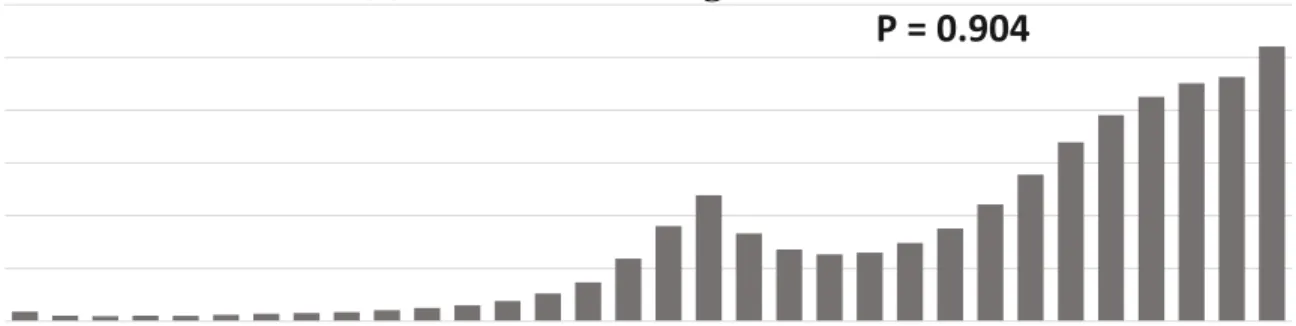
I plot a histogram for each feature depicting weights distribution from -16 to +15 and generate the Pearson’s correlation factor for that feature. Pearson’s factor is a numerical measure ranging from -1 to 1 of the degree of linear correlation between two variables. The magnitude of Pearson’s
factor gives the extent of correlation and the sign indicates whether it is a positive correlation or a negative correlation. Values close to 0 suggest a low correlation while a value of +1/-1 suggests a perfectly linear positive / negative correlation respectively.
As a part of the perceptron feature selection methodology, I explored a wide variety of features to begin with. Features with a low Pearson’s coefficient were rejected as they didn’t provide much useful correlation. Figure 4.1 depicts the histogram distribution of trained weights for two features. The first feature, Confidence XOR Page address has the highest observed P-value, hence was retained. On the other hand, the second feature, Last Signaturedid not provide any meaningful correlation and hence was rejected. This is visible from the bulk of its trained weights settling to near zero values.
0.104 0.43 0.48 0.51 0.59 0.64 0.8 0.88 0.9 0 0.1 0.2 0.3 0.4 0.5 0.6 0.7 0.8 0.9 1
Pearso
n's
Coe
fficient
Perceptron Feature
Figure 4.2: P-Values for all Features
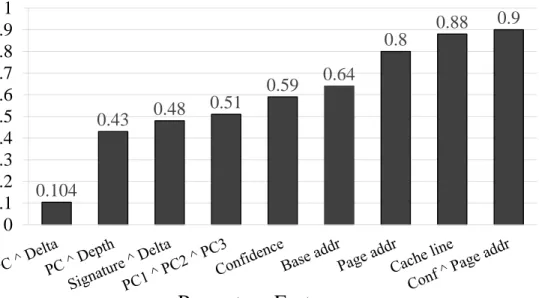
Figure 4.2 shows all the features which are finally used, arranged in the increasing order of their Pearson’s factor. As can be seen 5 out of the 9 features provide a moderate to high correlation, with
the magnitude of P-value > 0.6. The single most important feature,Confidence XOR Page address
helps provide a correlation to prefetch outcome with a factor of 0.90.
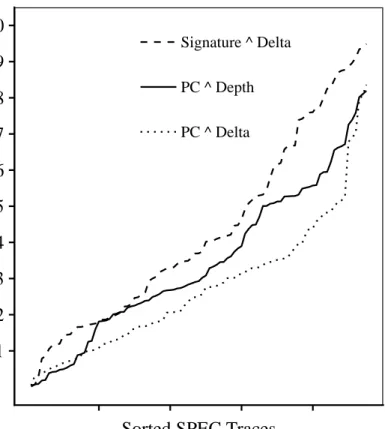
Per Trace Correlation: Another important way to look at the perceptron features is to see how much their contribution varies across the traces. Here I give special attention to features with low overall P-values. Figure 4.3 shows the variation of P-values for three features : PC XOR Delta,
Signature XOR DeltaandPC XOR Depth; across all the SPEC CPU 2017 traces. For simplicity, the traces are arranged in an increasing order of contribution made by the feature. It can be seen that even features with a low overall correlation provide useful correlation (magnitude > 0.5) for a significant number of traces. This study motivated me to choose PC XOR DELTA overLast Signatureas it provided useful correlation in at least some of the traces.
0.1
0.2
0.3
0.4
0.5
0.6
0.7
0.8
0.9
1.0
Sorted SPEC Traces
Pearson'
s Coef
ficient
Signature ^ Delta PC ^ Depth PC ^ DeltaTrimming Features Using Cross-correlation: Beside providing interesting insights into prefetch-ing behavior, P-value can also be used for feature selection and prefetcher tunprefetch-ing.
As I examined correlation of each feature with the final outcome, I also studied correlation between the features. I used the above methodology to eliminate features providing little information that has already been captured in other features.
I initially came up a with set of 23 features. By studying cross correlation of each of these features against others in a 23×23 matrix, I identified pairs of features with correlation factor > 0.9 in magnitude and eliminated redundant features, using guidance from Global and per-trace Pearson’s factor of those features. By doing this, I reduced the feature count to 9. Thus, in the final implementation of PPF, no two features have a high correlation between them. This way we can be sure that each feature makes a contribution that cannot be captured using other features.
Secondly, studying the relative importance of each feature enabled me to vary the number of entries dedicated for each feature. Features with higher correlation,cache lineandpage address
were given most importance and allowed full 12-bits of indexing. Features likePC XOR deltaand
PC XOR depthwith a low overall P-value were allocated fewer entries in the feature table.
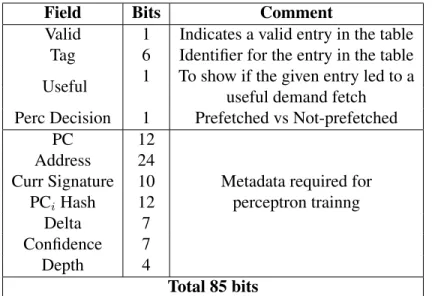
Field Bits Comment
Valid 1 Indicates a valid entry in the table Tag 6 Identifier for the entry in the table Useful 1 To show if the given entry led to a
useful demand fetch Perc Decision 1 Prefetched vs Not-prefetched
PC 12
Address 24
Curr Signature 10 Metadata required for PCiHash 12 perceptron trainng
Delta 7
Confidence 7
Depth 4
Total 85 bits
Structure Entry Components Total
256
Valid (1 bit) Tag (16 bits)
11008 Signature Table Last Offset (6 bits)
bits Signature (12 bits) LRU (6 bits) 512 Csig(4bits) 24576 Pattern Table Cdelta(4*4 bits)
bits Delta (4*7 bits) Perceptron 4096*4 5 bits Weights 2048*2 113280 1024*2 bits 128*1 Prefetch 1024 85 bits 87040 Table1 bits Reject 1024 84 bits 86016 Table2 bits Global 8 Signature (12 bits)
History Confidence (8 bits) 264
Register Last Offset (6 bits) bits Delta (7 bits)
Accuracy 1 Ctotal 10 bits
Counters 1 Cusef ul 10 bits
Global PC P C1(12 bits)
Trackers 3 P C2(12 bits) 36 bits
P C3(12 bits)
Total: 3,222,940 bits = 39.34 KB Table 4.3: SPP-Perc Storage Overhead
4.1.6 Overhead for PPF
In this section, I analyze the hardware overhead required to implement PPF. The Prefetch Table was enhanced to accommodate storing of metadata for perceptron training. Table 4.2 depicts the metadata stored for each entry in the Prefetch Table. Table 4.3 shows the total storage overhead of PPF implementation. The hardware budget for 2nd Data Prefetching championship was 32 KB. Keeping that in mind the considerable speedup PPF obtained over the winner, the extra hardware budget can be accounted for. The extra hardware also makes the overall scheme more scalable than SPP. In the original SPP paper, it was demonstrated that adding extra hardware brings little
advantage in terms of performance gain. The newly added perceptron tables can be scaled to increase / decrease features depending on the permitted budget.
In terms of computations, the perceptron mechanism only introduces an extra adder tree. The hash perceptron mechanism makes sure than there is no actual vector multiplication happening in the hardware. Obtaining the perceptron sum requires addition of nine 5-bit numbers. Using an adder tree of four 5-bit adders, this can be done in ceil(log29) = 4 steps. Perceptron update only requires
weight update by +1 or -1. Thus, all the operations required for perceptron inferencing or updating the states of the perceptrons can be easily done in the time constraints of L2 Cache Accesses.
1Components of Prefetch Table can be found in Table 4.2.
2The Reject Table does not need to maintain the useful bit as that only applies for prefetches that ultimately made through.
4.2 Results
This section discusses the results obtained from running PPF in terms of speedup and prefetch cache, for the SPEC CPU 2017 benchmarks. First, I present the results for single-threaded workloads then for multi-core workloads.
1 1.2 1.4 1.6 1.8 2 perlbe nch gcc bwa ves mcf cact uBSSN lb m o mnet p p w rf x ala ncb mk x 264 cam4 pop2 deep sjeng imag ick leela nab exch ange2 fot o n ik3 d rom s xz Mem Int G eoMean
Speedup
BOP
DAAMPM
SPP
PPF
Figure 4.4: SPEC CPU 2017 Single-Core IPC Speedup4.2.1 Single-core Results
Figure 4.4 shows the single core speedup obtained by BOP, DA-AMPM, SPP and PPF for each of the individual SPEC CPU 2017 applications, followed by the geomean of the memory intensive subset and finally the geomean across the full suite. All the results have been normalized to the baseline of no prefetching.
PPF yields a geometric mean speedup of 26.95% over the baseline. This is equivalent to 4.63%over DA-AMPM,4.61%over BOP and3.78%over SPP. Out of the 20 SPEC CPU 2017 applications, PPF nearly matches or outperforms all the other prefetchers on 19 applications.
Benchmarks 603.bwaves_s,605.mcf_s,623.xalancbmk_s and 649.fotonik3d_s benefit the most from PPF, with the speedup over SPP ranging from10% to 25%.
One interesting case here is623.xalancbmk. Despite SPP under performing on that applica-tion, PPF manages to considerably outperform all prefetchers. Since this benchmark has varying prefetch deltas, SPP’s conservative throttling mechanism catches that and quickly halts prefetching at an average depth of 2.1. On the other hand, PPF’s more efficient accuracy check enables it to prefetch upto a lookahead depth of 3.3. Doing this, PPF suggests 1.61 times more total prefetches and 2.53 times more useful prefetches than SPP.
The only benchmark where PPF fails to match the improvement offered by other prefetchers is607.cactuBSSN_s. Based on the observations of prefetching behavior, I gather that BOP’s aggressive and localized nature fits this workload very well; as opposed to SPPs lookahead nature. As a result, SPP, and hence PPF, underperform on this benchmark.
On the full SPEC CPU 2017 suite, PPF improves the geometric mean IPC of the baseline by 15.24%, which is2.27%better than the next best prefetcher – SPP.
0
0.2
0.4
0.6
0.8
1
L2C
LLC
Fraction
Misses Cove
red
SPP
BOP
DA-AMPM
PPF
Coverage: Prefetcher coverage is defined as the ratio of the number of misses avoided through prefetching over the number of misses with no prefetching. Figure 4.5 shows the fraction of misses in the L2 and LLC avoided by the various prefetchers. PPF has the highest coverage of all the prefetchers simulated. On the SPEC CPU 2017 benchmarks, PPF reduces misses by75.5% and 86.9%in the L2 and LLC respectively. For the same benchmarks, the next best prefetcher, DA-AMPM, covers54.3%and78.5%of the misses respectively.
This superior coverage of PPF can be attributed to aggressive re-tuning of the underlying SPP, enabled by the Perceptron Filter making sure the high coverage does not lead to increased cache pollution.
1.0
1.2
1.4
1.6
1.8
2.0
2.2
1.0
1.2
1.4
1.6
1.8
2.0
2.2
20
40
60
80
100
Workloads Sorted by Speedup
W
eighted IPC Speedup
W
eighted IPC Speedup
SPP BOP DAAMPM PPF
4.2.2 Multi-core Results
In this section, I demonstrate the improvement achieved by PPF for a mix of multi-programmed workloads.
4-Core: Figure 4.6 shows a comparison of speedups obtained on 4-core mixes of a memory intensive subset of SPEC CPU 2017. I plot all 4 prefetchers, normalized to the baseline. The workloads have been sorted in increasing order of the speedup. PPF offers a speedup of51.2%on these traces, an improvement of11.4%over the underlying SPP,9.7%over the next DA-AMPM, and16.9%over BOP. On a different set of fully random SPEC CPU 2017 4-core mixes (not illustrated for space reasons), PPF provides an IPC speedup of26.07% over the baseline, which is an improvement of 5.6% over SPP.
8-Core: The sorted comparison of speedups on the memory intensive 8-core mixes is shown in Figure 4.7. PPF improves baseline performance by37.6%, an improvement of9.65%over SPP. For a random set of SPEC CPU 2017 mixes (not illustrated for space reasons), PPF improves perfor-mance by23.4%over the baseline, corresponding to4.6%over SPP. This increased improvement achieved by PPF over the base engine SPP in a multi-core environment is expected as PPF is a very accurate filter. Thus, it eliminates useless prefetches before they can cause pollution in the shared LLC. BOP offers a better improvement than SPP for the memory intensive mixes. This superiority can be attributed to BOP’s inherent aggressive nature. DA-AMPM is also ahead of SPP in both the mixes. Interestingly, in all these cases, PPF consistently outperforms the best performing prefetcher. 4.2.3 Additional Memory Constraints
I also model PPF with reduced LLC and with low bandwidth constraints, respectively (not illustrated for space reasons). Benchmark605.mcf_sin low bandwidth conditions is prefetch averse. In general, any prefetcher yields a negative speedup on that trace. On654.roms_sand 607.cactuBSSN_s, PPF is unable to match the performance achieved by the best prefetcher. On the other hand, PPF outperforms all the other prefetchers on 623.xalancbmk_s and 638.imagick_sbenchmarks. Overall, PPF provides a greater improvement under small LLC
1.0
1.1
1.2
1.3
1.4
1.5
1.6
1.7
1.0
1.1
1.2
1.3
1.4
1.5
1.6
1.7
20
40
60
80
100
Workloads Sorted by Speedup
W
eighted IPC Speedup
W
eighted IPC Speedup
SPP BOP DAAMPM PPF
Figure 4.7: Speedup for 8-core SPEC CPU 2017
condition and matches the best prefetcher, BOP, under low DRAM bandwidth conditions. 4.2.4 Cross Validation
Figure 4.8(a) shows the performance benefit comparison of all the prefetch schemes on 4 different applications in the CloudSuite benchmark. In general, these applications are prefetch agnostic. Even so, PPF manages a3.78%improvement over no prefetching, putting it ahead of the next best prefetcher, SPP, which provides a 3.08% speedup.
Figure 4.8(b) shows the speed-up achieved on the memory intensive subset and the full SPEC CPU 2006 suite for a single-processor machine. PPF provides a speedup of36.3%over the baseline on the memory intensive subset of SPEC CPU 2006 benchmark, giving an improvement of6.1%
1 1.1 1.2 1.3 1.4
Mem Intensive All
DA-AMPM BOP SPP PPF 1 1.01 1.02 1.03 1.04 1.05 1.06 1.07
Cassandra Cloud9 Nutch Streaming GeoMean
IPC S
peedup
BOP DA-AMPM SPP PPF
(a) CloudSuite (b) SPEC CPU 2006
Figure 4.8: IPC Speedup for Unseen Workloads
over SPP and8.44%over DA-AMPM and9.93%over BOP. On the whole of the SPEC CPU 2006 suite, the speedup is19.6%, an improvement of3.33%over SPP.
For 4-core memory intensive mixes, PPF improves the baseline by59.1%,8.6%ahead of SPP. For 8-core memory intensive mixes, the speedup over the baseline is47.8%,11.3%ahead of SPP. I developed PPF to yield good performance on the SPEC CPU 2017 benchmarks. Nevertheless, the performance is consistently good on other benchmark suites. I attribute this fact to the inherent adaptability of the perceptron model. In general, perceptron weights are able to adjust in real-time so as to find the best possible correlation between the output and the given set of features.
5. CONCLUSION
5.1 Conclusion
In this thesis, I introduce Perceptron-Based Prefetch Filtering (PPF). PPF is an on-line perceptron learning based classifier. It classifies the prefetch suggestions coming from the underlying prefetch engine as useless prefetches vs useful prefetches. Furthermore, it classifies the useful prefetches as high-confidence vs low-confidence useful, to decide the fill level of the prefetches. Thus, PPF acts as an independent check on the quality of predictions made by the baseline prefetcher. This two-step approach helps overcome the inherent trade-off between the aggressiveness and the accuracy of a prefetcher and increase performance of the overall prefetchig scheme. I also created a case study implementation of PPF using SPP as the baseline prefetch engine, while in principle other prefetchers could be used.
Some of the merits of using PPF based approach are:
• Performance Boost: By effectively filtering out bad prefetches, PPF helps increase the overall performace (measured in terms of IPC) of the system by up to 11.4%, as compared to just using the baseline prefetcher. This makes PPF perform even better on constrained environments like a multi-core system.
• Quick On-line Learning: The huge advantage of using the perceptron-based learning ap-proach is that it can easily learn the memory access patterns of any application and even quickly adapt to dynamically changing program behaviour. This makes the prefetching scheme highly robust and versatile.
• Modular Approach: A large part of the perceptron learning remains hidden from the underlying prefetcher. PPF can be as loosely or as tightly coupled with the baseline prefetcher, depending on the availability of the metadata to be conveyed between the two. This makes PPF an attractive add-on to any future prefetching schemes.
• Scalable Design:The feature-set of PPF can be scaled up / down, depending on the available hardware budget. Controlling the bit-width of each perceptron and independent depth of each perceptron table gives further control over achieving the performance vs hardware trade-off for PPF.
I show that PPF effectively filters bad prefetches, so that the given underlying prefetcher can be highly aggressively tuned to achieve increasing coverage. PPF is a robust and adaptable technique that can be used to enhance any existing prefetcher and can be a valuable tool in the design of future memory latency constrained systems.
REFERENCES
[1] W. A. Wulf and S. A. McKee, “Hitting the memory wall: Implications of the obvious,”
SIGARCH Comput. Archit. News, vol. 23, pp. 20–24, Mar. 1995.
[2] J. Kim, S. H. Pugsley, P. V. Gratz, A. L. N. Reddy, C. Wilkerson, and Z. Chishti, “Path confidence based lookahead prefetching,” in 2016 49th Annual IEEE/ACM International Symposium on Microarchitecture (MICRO), pp. 1–12, Oct 2016.
[3] N. D. E. Jerger, E. L. Hill, and M. H. Lipasti, “Friendly fire: understanding the effects of multiprocessor prefetches,” in2006 IEEE International Symposium on Performance Analysis of Systems and Software, pp. 177–188, March 2006.
[4] L. Peled, S. Mannor, U. Weiser, and Y. Etsion, “Semantic locality and context-based prefetch-ing usprefetch-ing reinforcement learnprefetch-ing,” in2015 ACM/IEEE 42nd Annual International Symposium on Computer Architecture (ISCA), pp. 285–297, June 2015.
[5] S. Liao, T. Hung, D. Nguyen, C. Chou, C. Tu, and H. Zhou, “Machine learning-based prefetch optimization for data center applications,” inProceedings of the Conference on High Performance Computing Networking, Storage and Analysis, pp. 1–10, Nov 2009.
[6] N. P. Jouppi, “Improving direct-mapped cache performance by the addition of a small fully-associative cache and prefetch buffers,” in Proceedings of the 17th Annual International Symposium on Computer Architecture, ISCA ’90, (New York, NY, USA), pp. 364–373, ACM, 1990.
[7] A. J. Smith, “Sequential program prefetching in memory hierarchies,” Computer, vol. 11, pp. 7–21, Dec 1978.
[8] A. J. Smith, “Sequential program prefetching in memory hierarchies,” Computer, vol. 11, pp. 7–21, Dec. 1978.