Procedia Economics and Finance 32 ( 2015 ) 1289 – 1304
2212-5671 © 2015 The Authors. Published by Elsevier B.V. This is an open access article under the CC BY-NC-ND license (http://creativecommons.org/licenses/by-nc-nd/4.0/).
Selection and peer-review under responsibility of Asociatia Grupul Roman de Cercetari in Finante Corporatiste doi: 10.1016/S2212-5671(15)01506-3
ScienceDirect
Emerging Markets Queries in Finance and Business
The second wave of restructuring in Romania.
A change of paradigm
Dumitru Dan Popescu
a,*, Costin Ciora
aaThe Bucharest University of Economic Studies, 5-7, Mihail Moxa Street, District 1, Bucharest, Romania
Abstract
In the last decade of the past century, the Romanian economy had registered suboptimal economic performances characterized by severe declines in the GDP, huge losses of the state-owned companies and gigantic inter-enterprise arrears that accounted for over 35% of Romania’s GDP. The restructuring process of state-owned enterprises (SOE) in Romania started in 1993 with a massive exercise that included more than 400 SOE (state-owned-companies) amid on the following patterns: "top-down" approach and a „pre-privatization restructuring” preceded and joined by a substantial specific legislative framework .This first wave has been followed by a second wave starting from 2001 that included a limited number of companies but of higher value and impact on the economy (biggest banks, big industrial and energy companies, former regies autonomes etc.) The second wave of restructuring meant a change of paradigm for companies in need of restructuring, developed in two important stages, when SOE were listed at the stock exchange, privatized or placed in a „stand-by” process in order to be restructured. Thus, the methodology of restructuring in the second wave has been retooled and correlated with the evolution of the macroeconomic conditions and agreements with IFI's. The EBRD index of privatization show a direct relation between the two waves, as Romania received a higher value for this index as it moved to next level of restructuring and privatization. © 2015 Published by Elsevier Ltd. Selection and peer review under responsibility of Emerging Markets Queries in Finance and Business local organization.
Keywords: restructuring; liquidation; corporate governance; privatization; economic crisis
* Corresponding author. Tel.: +40 213-119-790. E-mail address: [email protected].
© 2015 The Authors. Published by Elsevier B.V. This is an open access article under the CC BY-NC-ND license (http://creativecommons.org/licenses/by-nc-nd/4.0/).
1.Introduction
The purpose of this paper is to underpin the correlation between the restructuring results, followed by privatization and the impact on macroeconomic figures. Moreover, in this research we developed the foundation of analyzing the evolution of the restructuring process of the most important companies in Romania. We studied the effects on a limited and representative number of companies from the first wave and selective cases of companies from the second wave, and measured the impact of restructuring actions as well as methodological aspects incurred. A key result is that the effects of restructuring in both waves are positive, which provides evidence in support of the structure-conduct-performance hypothesis, while at the same time some relevance of the efficient-structure hypothesis cannot be rejected. The paper concludes with some remarks on the practicality and implementation of the findings. The purpose of this paper was three-fold:
• to improve the Restructuring Process Analysis by a better segregation of the last twenty years of continuous Restructuring Programs of Romanian economy;
• to underpin the correlation between the restructuring results, followed by privatization and the impact on macroeconomic figures that will allow to have a better and more accurate picture of the effectiveness of numerous restructuring programs that have been developed over the last twenty years;
• and last but not least, in this research we developed the foundation of analyzing the evolution of the restructuring process of the most important companies in Romania. We studied the effects on a limited and representative number of companies from the first wave and selective cases of companies from the second wave, and measured the impact of restructuring actions as well as methodological aspects incurred.
2.Literature review
Frydman, Rapaczynski et all (1993) – discussed about legal and ownership structure, institutions for state regulation, overview of privatization process and the initial transformation of enterprises. Some authors refer to transition economies in the early stages of transformation as a “weakly structured market economy” (Dobrescu 1996) or a “previously centrally planned economy” ( Calvo and Fenkel 1991). Grosfeld and Senik (1996) They were thinking that the change of ownership was a necessary and a sufficient condition of capitalism. The literature on financial repression and financial reform provides a thorough macroeconomic link between the development of financial markets and economic growth (Fry 1982, 1993, 1995, Roubini and Sala-i-Martin 1992, Rayon 1994, Chang 1994). The need for a closer analysis of the microeconomic roots of financial repression, however, is a new approach in the studies of financial markets in developing and transition economies (Amrit-Poser 1996, Popa 1998). Nicolescu et all (1996) – developed the” efficiency-based” restructuring concept and Crum and Goldberg (1998) – analyzed restructuring as a complex set of decisive measures in order to increase competitiveness. The inter-enterprise arrears, as well as the bank, tax and wage arrears phenomena provide a good example of a microeconomic problem in the financial markets of Romania . The accumulation of inter-enterprise arrears can also cause inflation. Monetary control can be defeated by firms that circumvent a tight credit market by creating their own liquidity through trade credits (e.g. Daianu,1994) .Credit and liquidity constraints affect indiscriminately viable and non-viable businesses, or, even worse, create adverse selection effects – artificially sustaining large loss-makers and preventing new private firms from developing profitable investment projects (see Berglöf and Roland 1997 and 1998).
As shown in Croitoru and Schaffer (2000) for the case of tax arrears, an increasing real gross arrears aggregate would be a sign that more and more firms are running into arrears. In Romania’s case, the commitment of the government to economic reforms by liquidating inefficient firms Stiglitz (1994, p. 238) would have extended mainly to state-run utility companies because they were the biggest actors in accumulating enterprise arrears (Santarossa, 2001; OECD, 2002). Bowman and Singh (1999) classified restructuring activities into three categories namely portfolio restructuring, financial restructuring and organizational restructuring. Kornai (2000)
considers that the pre-privatization restructuring serves as a useful screening device in order to interest private investors, who buy the firms. Debande and Friebel (2004) advocates for the firmly reestablishing of the State control of SOE cause it avoids that (unproductive) managers abuse and divert capital or funds which are for restructuring. Djankov (1998) - selected a sample of Romanian companies from the period 1992-1996. He concludes that isolating programs have delayed restructuring imposing budget constraints on loss-making enterprises. On the other hand Djankov (1999) – studies the relation between ownership structure and enterprise performance in newly independent states: Georgia, Kazakstan, Kyrgyz Republic, Moldova and Russia. He concluded that non-linear analysis showed some significant relation between different types of ownership and enterprise restructuring. Fidrmucova (2000) made an analysis on channels of restructuring on a panel of Czech companies and found that investment is not a significant determinant of enterprise performance. Koh, Dai & Chang (2010) – examined the impact of lifecycles on restructuring strategies. Distress firm’s access to different types of restructuring strategies is limited by the lifecycle stage they are in. Frydman, Hessel & Rapaczynski (2001) – followed the entrepreneurship and restructuring of enterprises in Central Europe (Czech Republic, Hungary and Poland) and explained the market impact of ownership on firm performance.Sterman (2002) analyzed restructuring as diverse activities such as divestiture of under-performing business, spin-offs, acquisitions, stock repurchases and debt swaps. Gibbs P.A. (2007) considers that restructuring means changes in the operational structure, investment structure, financing structure and governance structure of a company. 3.A view of restructuring
In the last decade of the past century, the Romanian economy had registered suboptimal economic performances characterized by severe declines in the GDP, huge losses of the state-owned companies and gigantic inter-enterprise arrears that accounted for over 35% of Romania’s GDP. In this circumstances Romania started the Restructuring Process that dominated the transformation of Romanian economy in the last twenty years.
Fig. 2. Production process – stage 1
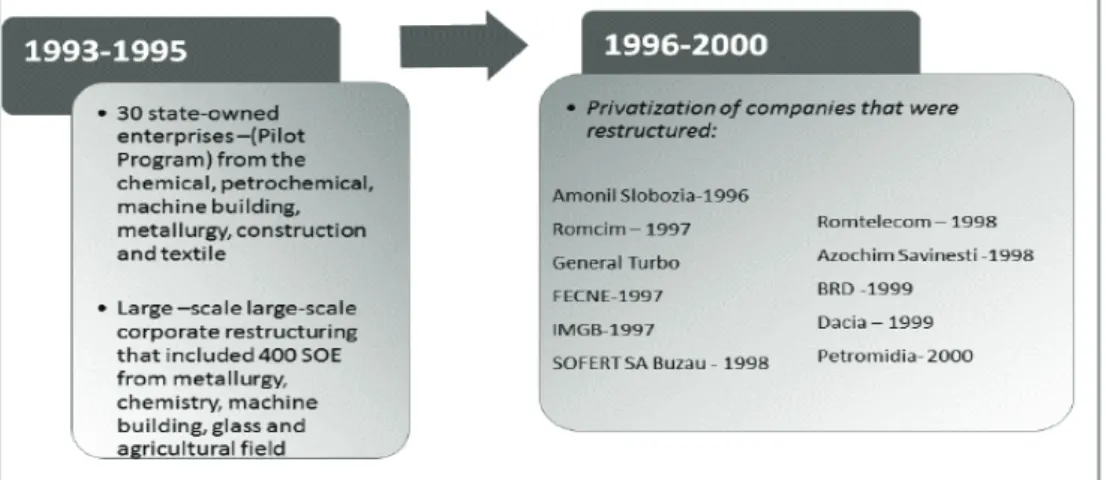
This process can be structured in two waves with two stages each as follows. The FIRST WAVE (FW) started in 1993 known as the “Large-scale corporate and financial restructuring process” and consisted in two stages:
• a first stage of two exercises: a pilot program of 30 companies followed by a more systematic exercise that included in excess of 400 companies and regies autonomes focused on a “top-down” model of restructuring that was finalized with notable results 1993-1995.
• second stage (for accurate quantification of restructuring results purposes) known as “LARGE-SCALE PRIVATIZATION”(OWNERSHIP RESTRUCTURING” 1996-2000;
The SECOND WAVE (SW) started in 2001 and consisted in two stages as well:
• first stage 2001-2009 dedicated exclusively to the ownership restructuring (privatization) of SME’s and few large-sized companies through direct sale and initiated sale through IPO on the Bucharest Stock Exchange. • second stage 2010-2013 that included three main categories : SOE for Stock Exchange listing (Nuclearelectrica, Romgaz, Transelectrica, Fondul Proprietatea, Transgaz etc., SOE for privatization and Special cases (Hidroelectrica, Oltchim, CFR Marfa etc).
It has to be mentioned that the First Stage of the FW “Large-scale corporate and financial restructuring process” has been developed on the “pre-privatization-”principle with the aim at turning around viable corporations, liquidate nonviable ones, restore the health of the financial sector and create the conditions for long-term economic growth and involved changes in corporate governance, organizational structure, management, labor, capital, technology, output, and sales for better positioning the companies for the last component of restructuring process-ownership restructuring (privatization). A comprehensive strategy and methodology for restructuring, encompassing both the corporate and financial sectors, was put in place once the economic crisis in Romania of mid-nineties was judged to be systemic in scope.
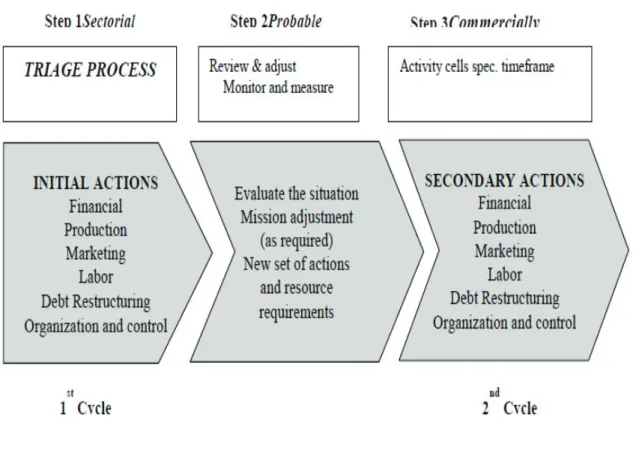
Fig. 3. Short-term action plan (STAP’s) Cycles
The results of the FW are structured in two main categories:
• Immediate ones as results of the implementation of Short Term Action Plans (STAP’s) within a 30-90 days timeframe
• The shutting down of production capacities in value of 600 million dollars; • The sale of assets of approximately 50 millions $;
• Staff reduction of approximately 35.000 people;
• Funds worth 170 million $ from SOF for modernization and technology upgrading; • Bank credits worth 300 million $;
• Cost reductions (400 million $); • Cash-in improvements (600 million $);
The results of the conciliation process of the commercial companies that signed the conciliation agreements are as follows:
• Of the total debts of 1 billion $ 71% were recon ciliated ;
• Of the total conciliated debts of 710 million $ , 71.8% represent rescheduled debts to the suppliers, banks and the state budget. 0.5% represents the reduced payment of the debts to the suppliers, banks and the
state budget and 27.7% represent cancellation of penalties granted by the suppliers, banks and the state budget.
As a result of the „ shock policies” from that time, the state budget had been cleaned of a series of hidden or quasi-fiscal elements such as credits for the agricultural sector, indirect subsidies for the heavy industry obtained from the foreign exchange restrictions, and subsidies for consumers through regulated prices for energy and agricultural sectors. As a consequence, the increasing trend of public deficits from 1993-1996 had been stopped. Long-term ones as result of the finalization of the restructuring process through ownership restructuring in the second stage of the FW - “LARGE-SCALE PRIVATIZATION”(OWNERSHIP RESTRUCTURING” 1996-2000;
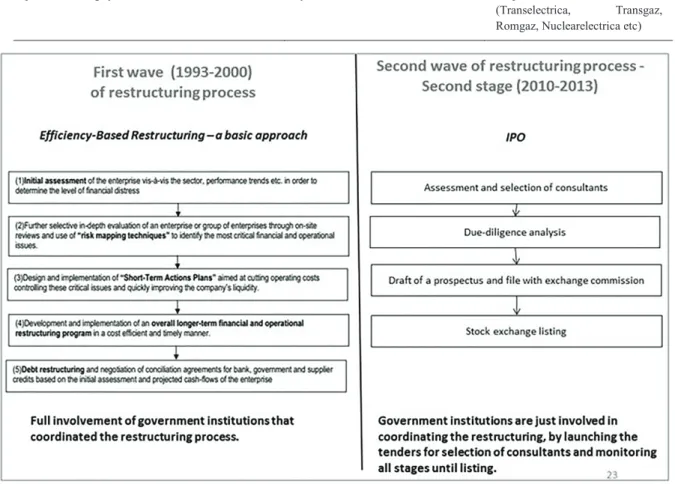
Fig. 4. Implementation of comprehensive restructuring programs
Naturally, starting even with the second stage of the FW and in both stages of SW the restructuring process was based on a new paradigm, that ignored the involvement of the state institutions in the micromanagement of the process and focused on a unique element of a standard restructuring = the ownership restructuring.
Fig. 5. The first wave of restructuring
This segregation in waves and stages on the one hand and of the results of restructuring (in immediate-short-term and long-immediate-short-term) as result of the finalization of the restructuring process through ownership restructuring in the second stage of the FW, on the other hand gives us the possibility to better commensurate the effects of the restructuring process in Romania.
Fig. 7. Timeline of restructuring in Romania
Table 1. Differences between the two waves of restructuring
First wave (1993-2000) of restructuring process
Second wave (2001-2012) of restructuring process
First stage (2001-2009) Second stage (2010-2013)
CONTENT : 400 joint stock companies Residual stock of mid and big-sized companies (privatization)
National companies (former Regies autonomes )
PRINCIPLES: “pre-privatization “restructuring followed by privatization through MEBO until 1997 and direct sales (1997-2004)
Ownership restructuring (privatization)
Through direct sales and IPO’s on Stock exchange
Ownership restructuring (privatization)
Through IPO’s on Stock exchange
APPROACH: ” top-down “ for general restructuring MANAGEMENT: Who was running the restructuring process?
State management through the Government institutions: Restructuring Agency and State Ownership Fund
“Top-down” as for ownership restructuring and partial elements of the standard restructuring
State management through the Government institutions:
OPSPI and line ministries
Top-down” as for ownership restructuring and partial elements of the standard restructuring State management through the Government institutions: OPSPI and line ministries First wave (1993-2000)
of restructuring process
Second wave (2001-2012) of restructuring process
TYPES of restructuring: STANDARD:
legal, ownership, operational, financial, technological, management. Preparing the company for the ownership restructuring through privatization
Ownership restructuring standard restructuring through mergers and spin-offs
Ownership restructuring towards standard restructuring
Special cases: Mergers (Energetic complexes)
LEGAL: lack of legal framework for insolvency Legal framework for insolvency completed
Legal framework for insolvency improved
TYPE of management of CC’s: state management
State management changed to private management through privatization
Change to private management in most of cases
The principles were agreed with IFI and included in the matrix of conditionality’s of “stand-by” loans
The principles were agreed by IFI. In the second stage, since 2007, joined by EU Commission
The principles were agreed by troika: IMF, WB, and EU Commission
The absence of the structured capital markets institutions. i.e. the Bucharest Stock Exchange and private banking system
Development of Bucharest Stock Exchange and private banking system
New stage in Bucharest Stock Exchange : listed Fondul Proprietatea and several IPO’s (Transelectrica, Transgaz, Romgaz, Nuclearelectrica etc)
Fig. 10. Second stage types of restructuring
4.The impact of restructuring on macro and micro aggregates
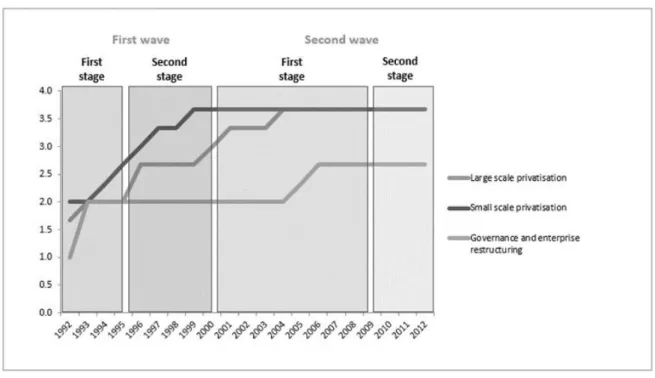
Based on the segregation that we stated, we have set up and computed correlations with: Real GDP, FDI and exports, BET index and EBRD: large scale privatization index, small scale privatization index, government and enterprise restructuring index.
Fig. 12. Evolution of BET index, exports and FDI during the waves of restructuring
Fig. 13. EBRD indexes during the two waves
5.Correlations for restructuring
In order to study the direct correlation between and privatization we used the data provided by EBRD for Romania since 1992, which calculates two important indexes: Privatization index and Government and enterprise Restructuring Index. Thus, we applied the Pearson correlation coefficient according to the model.
ݎ= ݊(σݔݕ)െ(σݔ)(σݕ )
ඥ[݊σݔଶെ(σݔ)ଶ][݊σݕଶെ(σݕ)ଶ]
As starting form a function: y=mx + b, we calculated the slope and independent variable. Slope means that a unit change in x, the independent variable will result in a change in y by the amount of b.
Our findings are:
EBRD Priv index= 1.349 * Gov and entr. Restr. + 0.097 Pearson Correlation coefficient ( r )= 0.8537
There is a high positive correlation between the increase of the privatization index provided by EBRD and the Government & Enterprise restructuring index. A unit increase in Government & enterprise restructuring index
will mean a 1.349 increase in Privatization index. There is an amplification of the actual restructuring towards ownership restructuring.
Fig. 14. Evolution of revenues and profit of selected companies
Further, we assessed the case of three important Romanian companies that had an ownership restructuring: one through privatization and the others two through IPO. We followed the evolution of three indicators: net revenues, gross profit and net profit. After the change in ownership (whether this was the result of an IPO of
stock listing or the result of privatization), the company trend was positive. In the same time, we analyzed profit margin of this three companies and we noticed increasing values after privatization or IPO.
Fig. 15. Comparison of profit margin for selected companies
Furthermore, we increased our sample with 17 companies that were privatized during 1997 till 2008, at a total value of 7.7 bln.euro. We calculated the weight of value of privatization to the GDP volume (*%Val of priv/GDP), which was correlated with the real GDP growth rate.
Table 2. Selection of companies privatized between 1997 and 2008
Year GDP - bln. Euro
Real GDP
variation Ownership restructuring (Privatization) companies
Val of privatization (bln. Euro) % Val of priv/GDP* 1997 31.3 -6.00% Romcim 0.165 0.528% 1998 37.4 -4.80% Romtelecom 0.558 1.492% 1999 33.5 -1.10% BRD, Dacia 0.206 0.616% 2000 40.3 2.90% Rompetrol Rafinare 0.049 0.122% 2001 44.9 5.50% Sidex 0.074 0.165% 2002 48.5 5.00% Alro, Rafo 0.020 0.042%
2004 60.8 8.50% Petrom, Distrigaz Sud 1.610 2.648%
2005 79.5 4.20% Distrigaz Nord, Electrica Oltenia, Electrica
Moldova 0.866 1.089%
2006 97.7 7.90% BCR 3.750 3.838%
2007 123.7 6.30% Electroputere, Automobile Craiova 0.059 0.048% 2008 139.7 7.30% Electrica Muntenia Sud 0.395 0.283% *%Val of priv/GDP = value of privatization/GDP volume
By using the Pearson Correlation coefficient we wanted to see the influence of weight of value of privatization to the GDP volume on the Real GDP growth rate.
The findings are presented below
Real GDP variation = 0.694 * %Val of priv/GDP + 0.0553 Pearson Correlation coefficient = 0.66
There is a moderate correlation, as a unit increase of %val of priv/GDP will mean a 0.694 increase in Real GDP variation. Thus, this validates our idea that restructuring effects are more accurate on a long-term basis 6.Conclusions
A change of restructuring paradigm: switching from “pre-privatization restructuring” to “ownership restructuring” starting with the second stage of FW
This segregation in waves and stages on the one hand and of the results of restructuring( in immediate -short-term and long--short-term as result of the finalization of the restructuring process through ownership restructuring in
the second stage of the FW, on the other hand gives us the possibility to better quantify the effects of the restructuring process in Romania.
A key result is that the effects of restructuring in both waves are positive, which provides evidence in support of the structure-conduct-performance hypothesis, while at the same time some relevance of the efficient-structure hypothesis cannot be rejected. Large-scale restructuring was a process both useful and efficient. Djankov conclusion (that the large scale restructuring process had no results) was made on a methodological error, because the first FRP were set up in 1995-1996, and the results of the implementation of an FRP is measurable and relevant on a short –term basis (30-90 days) cumulated with medium and long term (2-5 years) that escaped from his calculation (his data base was consisting in 1992-1996 period, and cumulated effects were not yet visible). Delayed results of privatization that crystallized by the end of first wave did not deny the principles that governed the first wave of restructuring process. Residual stock of mid and big companies that entered the restructuring process in the first wave where privatized in the second wave (first stage). Significant improvement of macroeconomic results (GDP, FDI and exports) and stock exchange (BET index) in the second wave of restructuring.
The correlations showed us high correlation in terms of impact of government and enterprise restructuring on privatization and also moderate correlation in terms of effects. The restructuring process must be seen on long term basis, as its effects are correlated with the macroeconomic results.
References
Amrit-Poser, J., (1996) A Microeconomic Explanation for the Macroeconomic Effects of Inter-Enterprise Arrears in Post-Soviet Economies, IfO Discussion Papers, No. 32, Munich: IfO Institute for Economic Research, November
Berglöf E. and Roland G. (1998), Soft Budget Constraints and Banking in Transition, Journal of Comparative Economics, 26 Berglöf E. and Roland G. (1997), Soft Budget Constraints and Credit Crunch in Financial Transition, European Economic Review, 41 Bowman, E.H., & Singh, H. (1999). When Does Restructuring Improve Performance?, California Management Review, Winter, 34 – 54. Calvo G.A., Frenkel J.A. (1991), From Centrally-Planned to Market Economies: The Road from CPE to PCPE, Staff Papers, IMF, 38, No.
2, June
Chang, G. (1994), Savings, Investment and Economic Growth in Developing Countries:Financial Repression Theory Re-evaluated, Ph.D. Thesis, University of Texas at Dallas,May 1994.
Croitoru L., Schaffer M.E., (2000) Soft Budget Constraints in Romania: Measurement, Assessment, Policy Crum R.L, Goldberg I. (1998) Restructuring and Managing the Enterprise in Transition, World Bank Publications
'ăLDQX ' ,QWHU-Enterprise Arrears in a Post-Command Economy: Thoughts from a Romanian Perspective, IMF Working Paper
94/94, May 1994
Debande O, Friebel G. (2004) A positive theory of Give-away Privatization, International Journal of Industrial Organization, Vol. 22, Pages 1209 – 1325
Dinu, E., Curea, C. (2007) Key success factors in knowledge economy, Amfiteatru Economic, vol. 9, issues 22, pg. 163-166
Djankov, S. (1998) Enterprise isolation programs in transition economies: evidence from Romania, Policy Research Working Paper Series 1952, The World Bank.
Djankov, S. (1999) Ownership Structure and Enterprise Restructuring in Six Newly Independent States, Comparative Economic Studies, Palgrave Macmillan, vol. 41(1), pages 75-95, April.
Dobrescu E. (1996), Transition Economy – a Weakly Structured System, Romanian Economic Revue, Tome 41, No.2, pp.111-120 Fidrmucova J. (1997) Channels of Restructuring in Privatized Czech Companies. Paper provided by Econometric Society in its series
Econometric Society World Congress 2000 Contributed Papers with number 1358.under European Union’s Phare ACE Program Frydman, R., Rapaczynski A., Earle J. at all.(1993). The privatization process in Central Europe. New York: Central European University
Press
Frydman, R, Marek H., Rapaczynski A., (2000), ‘Why Ownership Matters?: Entrepreneurship and the Restructuring of Enterprises in Central Europe,’ C.V. Starr Center for Applied Economics Research Report
Frydman R., Phelps E.S., Rapaczynski A., Shleifer A., (1993), Needed Mechanisms of Corporate Governance and Finance in the Economic Reform of Eastern Europe, Economics of Transition, 1, 171-207
Fry, M. (1982), Models of Financially Repressed Developing Economies, in World Development Vol. 10 (9), pp. 731–750.
Fry, M. (1993), Financial Repression and Economic Growth, International Finance Group Working Paper 93-07, University of Birmingham. Fry, M. (1995), Money, Interest, and Banking in Economic Development (2nd edition) Baltimore, London, The John Hopkins University
Gibbs, P. A. (1993), Determinants of corporate restructuring: The relative importance of corporate governance, takeover threat, and free cash flow. Strat. Mgmt. J., 14: 51–68. doi: 10.1002/smj.4250140906 Article first published online: 16 FEB 2007
Grosfeld I., Senik-Leygonie C., (1996), Trois enjeux des privatisations à l'Est, DELTA Working Papers, 96-16
Kornai J. (2000), Ten Years After `The Road to a Free Economy': The Author's Self Evaluation", Paper for the World Bank 'Annual Bank Conference on Development Economics.
Munteanu S., Tudor, E. (2009) The influence of international economic crisis to Romanian foreign direct investments, Economia. Seria Management, v. 12, pg. 240-245
Nicolescu, O6WUDWHJLLPDQDJHULDOHGHILUPă- (GLWXUD(FRQRPLFă%XFXUHúWL OECD (2002), OECD Economic Surveys: Romania - Economic Assessment,OECD, Paris.
Popa, C. (1998) Nominal-Real Trade-offs and the Effects of Monetary Policy: The Romanian Experiences, paper presented at the 46th International Atlantic Economic Conference, Boston, MA, October
Roubini N., Sala-i-Martin X. (1995), A growth model of inflation, tax evasion, and financial repression, Journal of Monetary Economics, Elsevier, vol. 35(2), pp 275-301
Rayon, E. (1994), When Financial Repression Causes Financial Market Development.The Case of Mexico, Ph.D. Thesis, University of Southern California, Dec. 1994.
Robu, V., Anghel, I. Serban, C., Tutui, D. (2003) Evaluarea intreprinderii, Editura ASE, Bucuresti
Santarossa, L.D. (2001), Arrears as a Sign of Financial Repression in Transition Economies: The Case of Romania, CERT Discussion Paper 2001/04, Heriot-Watt University, Edinburgh.
Sterman, I.A. (2002), Mergers and Acquisition, Oxford University Press, New York Stiglitz, J.E. (1994), Wither Socialism? MIT Press, Cambridge, Mass.
SzeKee Koh, Lele Dai and Millicent Chang Financial Distress: Lifecycle and Corporate Restructuring University of Western Australia Business School with the support provided by the UWA Business School Research Development Grant