Le, Khoi Nguyen (2011) A study of evolutionary
multiobjective algorithms and their application to
knapsack and nurse scheduling problems. PhD thesis,
University of Nottingham.
Access from the University of Nottingham repository: http://eprints.nottingham.ac.uk/13116/1/546703.pdf
Copyright and reuse:
The Nottingham ePrints service makes this work by researchers of the University of Nottingham available open access under the following conditions.
· Copyright and all moral rights to the version of the paper presented here belong to
the individual author(s) and/or other copyright owners.
· To the extent reasonable and practicable the material made available in Nottingham
ePrints has been checked for eligibility before being made available.
· Copies of full items can be used for personal research or study, educational, or
not-for-profit purposes without prior permission or charge provided that the authors, title and full bibliographic details are credited, a hyperlink and/or URL is given for the original metadata page and the content is not changed in any way.
· Quotations or similar reproductions must be sufficiently acknowledged.
Please see our full end user licence at:
http://eprints.nottingham.ac.uk/end_user_agreement.pdf
A note on versions:
The version presented here may differ from the published version or from the version of record. If you wish to cite this item you are advised to consult the publisher’s version. Please see the repository url above for details on accessing the published version and note that access may require a subscription.
A STUDY OF EVOLUTIONARY
MULTIOBJECTIVE
ALGORITHMS
AND THEIR APPLICATION TO KNAPSACK
AND NURSE SCHEDULING
PROBLEMS
by Khoi Nguyen Le, BSc, MRes
GEORGE GREEN LIBRARY OF
SCIENCE AND ENGINEERING
Thesis submitted to the University of Nottingham for the degree of Doctor in Philosophy
School of Computer Science March 2011
Contents
List of Figures vi List of Tables ix Abstract xi Acknowledgements xii 1 Introduction 1 1.1 Motivation ... ... 1 1.2 Structure of this Thesis ... ... 3 1.3 Contribution of this Thesis ... ... 4 2 Nurse Scheduling Problems 5 2.1 Nurse Scheduling Problems ... 6 2.1.1 Basic Terminologies ... ... 72.1.2 Constraints in Nurse Scheduling
... ... 9
2.1.3 Objective Functions ... ... 11
2.1.4 Generic Models
... ... 11 2.2 Nurse Scheduling Approaches
... ... 12 2.2.1 Simulated Annealing ... ... ... 13 2.2.2 Tabu Search ... ... 14 2.2.3 Evolutionary Algorithms ... ... 15
2.2.4 Other Approaches
... 18
2.3 Summary ... ... .... ... 19
3 Evolutionary Multiobjective Optimisation 21 3.1 Multiobjective Optimisation ... ... 23
3.2 Evolutionary Algorithms ... ... 27
3.2.1 Overview of Evolutionary Algorithms .... ... 28
3.2.2 Multiobjective EAs in the Literature .... ... 38
3.3 Performance Assessment ... ... 46
3.3.1 The 0/1 Multiple Knapsack Problem .... ... .... 46
3.3.2 Performance Metrics ... ... 52
4 Restricted Assortative Mating in EMO algorithms 57 4.1 Introduction ... 57
4.2 Mating Schemes for EMOAs ... 59
4.3 The Assortative Mating Scheme ... 61
4.3.1 The Experimental Setting ... 62
4.3.2 Similarity Measurement ... 62
4.3.3 Static Setting of the Mating Pressure ... 63
4.3.4 Dynamic Setting of the Mating Pressure ... 67
4.4 Summary ... ... 72
5 Volume Dominance in EMO 73 5.1 Introduction ... 74 5.2 Literature Review ... 75 5.3 Volume Dominance ... 79 5.3.1 Experimental Design ... 82
5.3.3 Summary ... ... 94
5.4 Improved Volume Dominance ... ... . 94
5.4.1 Improved Volume Dominance ... .... 96
5.4.2 Experimental Design ... 100
5.4.3 Results and Discussion ... 101
5.5 Summary ... 107
6 Hyper Volume Evolutionary Algorithm 108 6.1 Hyper Volume Evolutionary Algorithm ... . ... 109
6.1.1 Fitness Assignment ... ... ... 111
6.1.2 Ranking Assignment ... ... 113
6.1.3 Environmental Selection ... ... .... ... 114
6.1.4 Crowding Assignment ... ... 115
6.1.5 Generating Offspring ... ... 117
6.1.6 Comparison With SMS-EMOA ... ... 117
6.2 Comparative Case Study ... ... 118
6.2.1 Evolutionary Multiobjective Algorithms . ... 118
6.2.2 Experimental Design ... ... 118
6.3 Results and Discussion ... ... 121
6.3.1 Comparison to EMO algorithms ... ... 121
6.3.2 Comparison to MOEA/D ... ... .... 129
6.3.3 Further Discussion ... ... 135
6.4 Summary ... ... 136
7 Theoretical Model To Real-world Nurse Scheduling Problems 138 7.1 Introduction ... 138
7.2 Queens Medical Centre Problem ... 141
7.2.2 Problem Modelling ... .... 144 7.2.3 Self-Adaptive Heuristic Decoder
... . 147 7.2.4 Preliminary Investigations
... 150 7.3 A New Model for QMC Problem
... 153
7.3.1 Hard Constraint Violation Repaired Heuristics
... 154 7.3.2 A More Deterministic Heuristic Approach
... 156 7.4 A More General Approach to Nurse Scheduling Problems -A Proposal159 7.5 Summary ... 161
8 Conclusions and Future Work 162 8.1 Conclusions ... 162 8.2 Future Work ... ... .... 165 Bibliography
Appendix - List of Publications
167 183
List of Figures
3.1 One Point Crossover
... 33 3.2 Two Point Crossover
... 33 3.3 Uniform Crossover
... 33 3.4 Cycle Crossover
... 34 3.5 Uniform Order-Based Crossover
... 34 3.6 The choices of the reference point re fl (close to Pareto sets) and re f2
(at the origin) impose different performance assessment of Pareto
sets X and X" regarding the S-metric ... 52 3.7 X' is better than X" but X' and X" are similar under the C-metric. 53
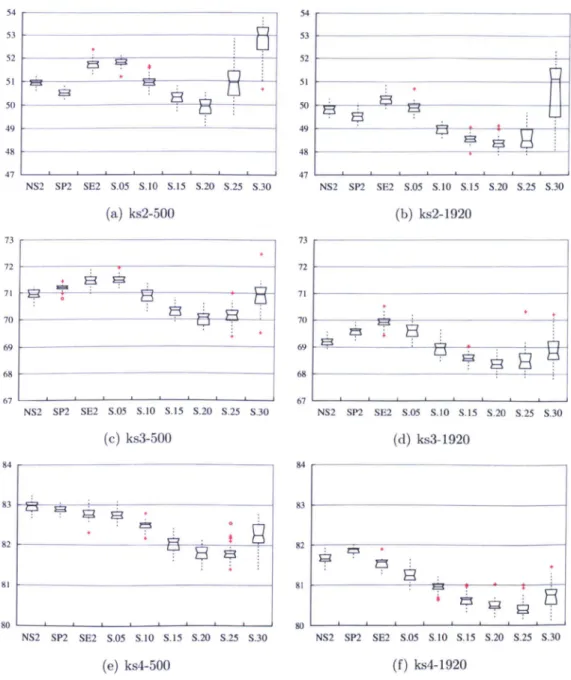
4.1 Performance of various EMO algorithms on the multiple 0/1 knap- sack problem with respect to percentage of the complement of the
S metric ... 65
4.2 Results of SEAMO2(RM) on the 2-knapsack and 750 items problem for six values of Q,,,, Qting ... 66 4.3 Performance of various EMO algorithms on the multiple 0/1 knap-
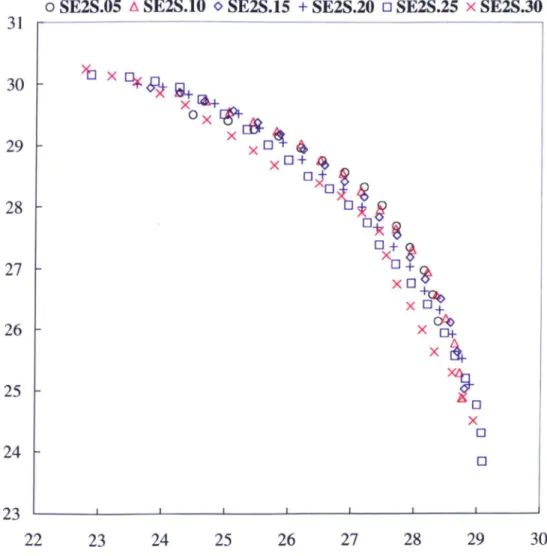
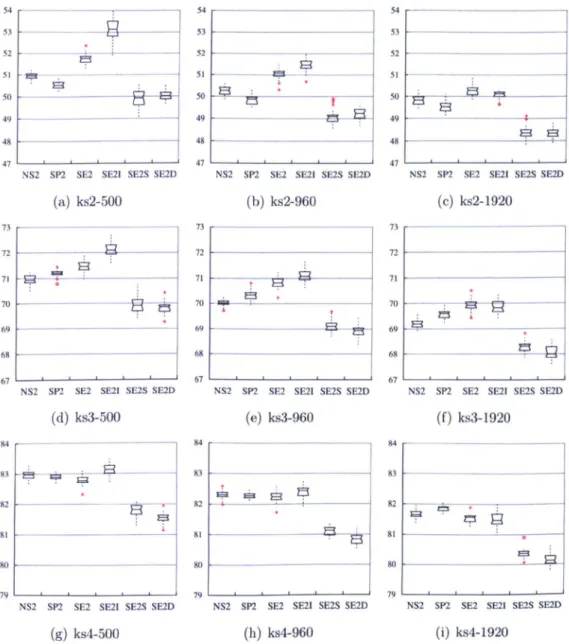
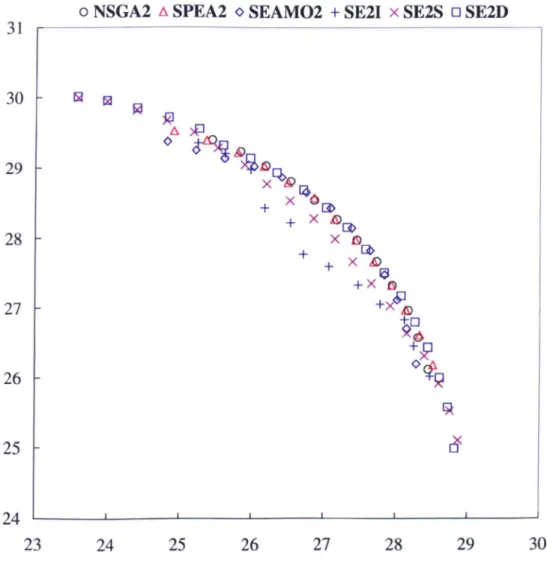
sack problem with respect to percentage of the complement of the S metric ... 68 4.4 Results comparing NSGA2, SPEA2, SEAMO2, SE2I, SE2S and
SE2D on the 2-knapsack problem with 750 items. ... 70
4.5 Results comparing SE2S and SE2D on the 2-knapsack problem with
750 items
. ... ... ... 71 5.1 Volume Dominance -A Form of Relaxed Dominance ... 80
5.2 The performance of Pareto dominance and volume dominance on SEAMO2 for 4-objective knapsack problem on the reciprocal of the S-metric
5.3 The distribution of objective values obtained when using conven- tional Pareto dominance and volume dominance on SEAMO2 for 4-
objective knapsack problem. ... . ... 88
5.4 The performance of Pareto dominance and volume dominance on SPEA2 for 4-objective knapsack problem on the reciprocal of the S-metric ... 90
5.5 The performance of Pareto dominance and volume dominance on NSGA2 for 4-objective knapsack problem on the reciprocal of the S-metric ... 91
5.6 The distribution of objective values obtained when using conven- tional Pareto dominance and volume dominance on SPEA2 for 4- objective knapsack problem ... ... ... . 92
5.7 The distribution of objective values obtained when using conven- tional Pareto dominance and volume dominance on NSGA2 for 4- objective knapsack problem ... 93
5.8 Volume dominance. In the case of the convex front, both points should be regarded as equally good instead of X being evaluated as better than X* ... 95
5.9 Volume Dominance - Reference Point ... 97
5.10 The fairly representative Pareto front of the population with respect to the individual x... 98
5.11 Performance of Pareto dominance, previous volume dominance and new improved volume dominance on SEAMO2, SPEA2, NSGA2 for 2-, 3-, and 4- objective knapsack problems with 750 items on the reciprocal of the S-metric ... 102
5.12 The combined non-dominated front obtained from 30 independent runs for 2-objective knapsack problem with 750 items.. ... 106
6.1 The current representative Pareto front of the population with re- spect to the individual x... ... 109
6.2 The hypervolume S-metric (permutation encoding) ... .... 124
6.3 The hypervolume S-metric (binary encoding) . ... .... 124
6.4 The hypervolume S-metric (te binary encoding) ... .... 125
6.5 The hypervolume S-metric (ws binary encoding) ... .... 125
6.7 The hypervolume S-metric (binary encoding) ... 130 6.8 The hypervolume S-metric (te binary encoding) ... 131 6.9 The hypervolume S-metric (ws binary encoding) ... .... 131 7.1 Constructed Schedule, Preference Schedule and Permutation List. . 145 7.2 The decoding process ... ... .... 148
7.3 Repair the violation of the Succession constraint. ... 149
7.4 Repair the violation of the MinDaysOn constraint. ... 149 7.5 Performance, based on the S-metric, of EMO algorithms incorpo-
rated the heuristic decoder on the QMC model proposed in [81]. .. 152 7.6 Performance, based on the S-metric, of EMO algorithms incorpo-
rated the heuristic decoder without repairing MinDaysOn hard con-
straint on the QMC model proposed in [81] using objective function
replacement ... 155 7.7 The decoding process using single permutation list of shifts. .... 157 7.8 Performance, based on the S-metric, of EMO algorithms on the
new QMC model using single permutation and a more deterministic
List of Tables
4.1 Average values (standard deviation) of coverage of two sets C(A >-
B) ... _. 70 5.1 The performance of Pareto dominance and volume dominance on
SEAMO2 for 4-objective knapsack problem on the C(A r B) metric. 87 5.2 The performance of Pareto dominance and volume dominance on
SPEA2 for 4-objective knapsack problem on the C(A >- B) metric. . 90
5.3 The performance of Pareto dominance and volume dominance on NSGA2 for 4-objective knapsack problem on the C(A >- B) metric.. 91
5.4 Average size (standard deviation) of the nondominated set.. .... 103
5.5 Average size (standard deviation) of the cluster metrics CL,... ... 104
5.6 Average distance (standard deviation) from the nondominated set to the approximation of the true Pareto Front ... 105
6.1 Parameter Setting for The Multiple 0/1 Knapsack Problem ... .. 119
6.2 Generational Distance (permutation encoding) ... .. 126
6.3 Generational Distance (binary encoding) ... .. 126
6.4 Generational Distance (te binary encoding) ... .. 126
6.5 Generational Distance (ws binary encoding) ... .. 126
6.6 Inverted Generational Distance (permutation encoding) ... .. 127
6.7 Inverted Generational Distance (binary encoding) ... .. .. 127
6.8 Inverted Generational Distance (te binary encoding) ... .. 127
6.9 Inverted Generational Distance (ws binary encoding) ... .. 127
6.11 Computational Time in seconds (binary encoding) ... 128
6.12 Computational Time in seconds (te binary encoding) .... .... 128
6.13 Computational Time in seconds (ws binary encoding) ... 128
6.14 Generational Distance (permutation encoding) ... 132
6.15 Generational Distance (binary encoding) ... 132
6.16 Generational Distance (te binary encoding) ... 132
6.17 Generational Distance (ws binary encoding) ... 132
6.18 Inverted Generational Distance (permutation encoding) ... 133
6.19 Inverted Generational Distance (binary encoding) ... 133
6.20 Inverted Generational Distance (te binary encoding) ... 133
6.21 Inverted Generational Distance (ws binary encoding) ... 133
6.22 Computational Time in seconds (permutation encoding) ... 134
6.23 Computational Time in seconds (binary encoding) ... 134
6.24 Computational Time in seconds (te binary encoding) ... 134
6.25 Computational Time in seconds (ws binary encoding) ... 134
6.26 Computational Time (in seconds) for The Multiple 0/1 Knapsack Problem ... 136
7.1 Coverage demand of nurses in each shift ... 144
Abstract
Evolutionary algorithms (EAs) based on the concept of Pareto dominance seem the most suitable technique for multiobjective optimisation. In multiobjective op- timisation, several criteria (usually conflicting) need to be taken into consideration simultaneously to assess a quality of a solution. Instead of finding a single solution, a set of trade-off or compromise solutions that represents a good approximation to the Pareto optimal set is often required. This thesis presents an investigation on evolutionary algorithms within the framework of multiobjective optimisation. This addresses a number of key issues in evolutionary multiobjective optimisation. Also, a new evolutionary multiobjective (EMO) algorithm is proposed. Firstly, this new EMO algorithm is applied to solve the multiple 0/1 knapsack problem (a well- known benchmark multiobjective combinatorial optimisation problem) producing competitive results when compared to other state-of-the-art MOEAs.
Secondly, this thesis also investigates the application of general EMO algorithms to solve real-world nurse scheduling problems. One of the challenges in solving real-world nurse scheduling problems is that these problems are highly constrained and specific-problem heuristics are normally required to handle these constraints. These heuristics have considerable influence on the search which could override the effect that general EMO algorithms could have in the solution process when applied to this type of problems. This thesis outlines a proposal for a general approach to model the nurse scheduling problems without the requirement of problem-specific heuristics so that general EMO algorithms could be applied. This would also help to assess the problems and the performance of general EMO algorithms more fairly.
Acknowledgements
I would like to thank my supervisor Dr. Dario Landa-Silva for all the support and guidance which he had given me throughout my doctoral study. Also, thanks to Dr. Rong Qu who gave me valuable comment and advice during the second year review of my doctoral degree. I also thank the School of Computer Science, University of Nottingham for providing excellent facilities for my research and the Graduate School of the University of Nottingham for their research training programme.
This doctoral programme would have not been possible without the financial support of the Overseas Research Students Awards Scheme (ORSAS) and the School of Computer Science, University of Nottingham.
I would like to thank my family and friends for their encouragement.
Finally, thanks to all members of ASAP group, School of Computer Science for
Chapter 1
Introduction
1.1 Motivation
Many real-world optimisation problems are multiobjective by nature due to several criteria associated with them. Solving multiobjective optimisation problems by confronting these possibly conflicting criteria is one of the main challenges to a decision-maker. A suitable solution, which represents a good compromise between these criteria, is required. However, it is quite difficult to find such a solution due to the several criteria that need to be taken into consideration simultaneously. There are three approaches for selecting this good compromise solution which are categorised based on the process of handling the search and the decision making. These three approaches are a-priori preference articulation (decision making before search), a-posteriori preference articulation (search before decision making) and interactive preference articulation (interactive search and decision making) [33]. Within the scope of this thesis, the a-posteriori approach, which constructs a set of alternative solutions for the decision maker to select a suitable solution, will be discussed in detail. The challenge to this approach is that, without any preference to criteria, this set of solutions should be both well-converged and well-distributed.
This set is known as the Pareto front in Pareto-based multiobjective optimisation. Solutions in this set are said to be non-dominated, i. e. none of the solutions is better than others in the set.
Evolutionary algorithms (EAs) are capable of generating multiple promising
solutions in a single run and evolving a population of solutions towards the Pareto front. These properties make EAs especially adequate to deal with Pareto-based multiobjective optimisation problems (MOPs). In EAs, a population is maintained and evolved throughout the search process. Solutions in the population could survive and pass their characteristics to the next generations. This process is an analogy to biological evolution [37].
Over recent years, multiobjective optimisation problems and the application of evolutionary approaches to deal with these problems have received increasing attention from the research community. Some of the most interesting and difficult MOPs are real-world nurse scheduling problems in the field of personnel scheduling. There are a large number of constraints associated to real-world nurse scheduling problems. It is non-trivial to satisfy these constraints. It normally requires a par- ticular heuristic or metaheuristic to handle constraints of a given problem. Then, evolutionary approaches could be applied to optimise these solutions. A conven- tional approach to solve nurse scheduling problems using evolutionary algorithms is to employ a simple evolutionary algorithm incorporating problem-specific heuris- tics/metaheuristics. This approach could generate high quality solutions. How- ever, it is difficult to employ these heuristics/metaheuristics for other problems. There is interest in developing more general heuristics/metaheuristics which could be incorporated into general, strong performing EAs to solve nurse scheduling problems.
The work reported in this thesis presents an investigation on general evolution- ary multiobjective optimisation (EMO) algorithms and the application of EMO algorithms in solving nurse scheduling problems.
1.2 Structure of this Thesis
The remainder of this thesis is organised as follows.
Chapter 2 provides the basic terminology for nurse scheduling problems. It also
discusses common constraints and generic models related to nurse scheduling prob-
lems. A brief review on different approaches to solve nurse scheduling problems, which concentrates on evolutionary approaches, is presented.
Chapter 3 provides the basic concepts of multiobjective optimisation prob-
lems and evolutionary multiobjective optimisation. Key issues in designing EMO algorithms are discussed in this chapter. Some of important and recent EMO al- gorithms are described. Chapter 3 also presents a set of performance metrics to assess EMO algorithms. A benchmark problem for evolutionary multiobjective optimisation, the multiple 0/1 knapsack problem, is presented and reviewed.
Chapter 4 proposes an adaptive assortative mating scheme in the decision space which could be incorporated into EMO algorithms. This mating scheme adapts the mating pressure as the search progresses.
Chapter 5 provides a brief review on relaxed Pareto dominance. It proposes a new form of relaxed Pareto dominance which is based on the concept of the hypervolume of individuals in the objective space.
Chapter 6 further explores the ideas of volume dominance proposed in chap- ter 5. A new population-based EMO algorithm, called hyper volume evolutionary algorithm (HVEA), is proposed and compared to other state-of-the-art EMO al- gorithms.
Chapter 7 reviews a real-world nurse scheduling problem, the QMC prob-
lern [81]. This chapter investigates and proposes a new model for the QMC prob- lem which could be solved by general EMO algorithms. Based on this study of the
new model for the QMC problem, a more general approach to nurse scheduling problems is outlined.
Chapter 8 briefly summarises the work investigated in this thesis. It also sug- gests future work which was drawn up based on the study of this thesis.
1.3 Contribution of this Thesis
The contributions of this thesis are as follows:
"A review of common solution representation and constraint handling tech- niques for the multiple 0/1 knapsack problem, a well-known benchmark prob- lem in multiobjective optimisation.
"A new form of relaxed Pareto dominance, named volume dominance is pro- posed. The concept of volume dominance is based on comparing the domi- nated volume of individuals to establish superiority between solutions in the population. It is shown that this new form of relaxed Pareto dominance in- corporated in different EMO algorithms is more robust than the conventional Pareto dominance which allows EMO algorithms to obtain more consistent performance.
"A new EMO algorithm, hyper volume evolutionary algorithm (HVEA), which is based on the concept of volume dominance, is presented. HVEA exploits the principle of volume dominance to estimate individual fitness, rank and crowding around an individual. Results show that HVEA outperforms or remains competitive to other state-of-the-art EMO algorithms.
"A more general EMO approach to solve nurse rostering problems based on exploiting constraint handling techniques for the multiple 0/1 knapsack prob-
Chapter 2
Nurse Scheduling Problems
Personnel scheduling or personnel rostering refers to the construction of rosters for personnel (or staff) in an organisation over a scheduling period in such a way that the organisation fulfils the demand for its goods or services [51] while also adher- ing to existing certain work regulations. Personnel scheduling problems exist in almost all working environments. It is particularly a difficult and interesting prob- lem for organisations which have a large pool of personnel with multiple skills and work around the clock [7], such as fire brigade and rescue and health care services. High quality schedules help to provide better services, improve overall job satis- faction and better utilise the available workforce [81]. The process of constructing personnel rosters consists of two parts [51]. The first part is to determine the number of personnel, the set of personnel skills (or qualifications), personnel pref- erences, workplace regulations, service demand, the layout of the work timetable, constraints and other criteria (which vary amongst organisations). This first step could be referred to as the problem construction process. Then, the second step is to allocate suitable staff members to shifts in order to meet the demand of services a different times while attempting to satisfy workplace regulations and personnel preferences [11,14,50,511. Another possible need within the allocation step is to assign specific job requirements (or duties) to individual personnel members
in each shift. It is often difficult to find feasible schedules that satisfy all hard constraints, such as work regulations, employee preferences and job requirements. It is extremely difficult to find good-quality feasible schedules to these type of highly constrained and complex problems and even more difficult to find optimal solutions [51]. Within the personnel scheduling field, nurse scheduling and airline crew scheduling are the two sub-fields which have attracted much attention from researchers [51]. This chapter pays attention to the process of allocating staff mem- bers to shifts in nurse scheduling. The chapter will provide the basic terminologies and discuss the main approaches to tackle nurse scheduling problems proposed in the literature.
2.1 Nurse Scheduling Problems
Nurse scheduling is particularly difficult because of its nature that demands work- ing around the clock in hospitals. Nurses' well being and job satisfaction are af- fected by irregular shift work [24]. It is usually desired to meet nurse requests while confronting work regulation and other constraints during the personnel schedul- ing process. Producing good quality nurse schedules has a great impact on the quality of healthcare service, improving overall job satisfaction and making more efficient use of the workforce [30,81]. Many healthcare institutions use software to support the construction of nurse schedules but in many other cases this is still done manually [24]. For problems of considerable size, the non-automated con- struction of nurse schedules is time consuming, difficult and prone to errors. As Burke et al. note, "the automatic generation of high quality nurse schedules can lead to improvements in hospital resource efficiency, staff and patient safety, staff and patient satisfaction and administrative workload" [24]. This section provides basic terminology in nurse scheduling. It also discusses work regulations and other constraints in nurse scheduling which are mostly found in the literature.
2.1.1 Basic Terminologies
2.1.1.1 Personnel
Within the hospital environment staff members are organised into teams of nurses,
also known as wards. Usually, each ward performs a set of fixed activities at a
settled location [23]. Each nurse has some certain attributes as follows:
Work regulations. This is the agreement and job description such as full-
time/part-time basis, permanent/temporary employee, working shifts etc. It is
common to have a personalised agreement for each nurse [23].
Qualifications and Skills. Personnel can be categorised based on a number of
factors such as qualifications, skills, experience and responsibility [7,23,24]. In some cases, gender, nationality and personality are also of concern [7]. Based on their characteristics as well as particular nurse scheduling problems, qualifications and skills could be further classified such as disjoint, hierarchical, alternative. Disjoint skills set represents skills defined by a single criterion. Hierarchical skills sets means that nurses with higher qualifications could substitute those with lower. Alternative skills sets means that nurses with more experience could substitute higher skill nurses.
2.1.1.2 Planning Period, Shifts and Scheduling
Planning Period. The planning period defines the time horizon over which person-
nel is scheduled. The typical planning period in nurse scheduling is 4 weeks (28 days).
Shift Type. Shift types (or shifts for short) are periods of work which are usually well defined by starting and ending times within a 24 hour period. Burke et at. [24] pointed out that many nurse scheduling problems employ three common shifts:
early, late and night. There are also other shift types such as day, short early, short late [22] an "unusual" shift [81]. The starting and ending times usually define the length of the shift which will have implication of certain work regulations. These shift types are also referred to as working shifts.
Day-on and Day-of. A day, for which a nurse is allocated one of the above shift types, is known as a working day or day-on. While a day-off is a day in which the nurse is not allocated a working shift.
Individual preferences. It is often the case that a nurse requests a day-off, annual leave or specific working shifts for some days of the planning period.
Shift sequence/Shift pattern. A shift sequence (17] is a set of shift types on consecutive days, one shift a day. Shift sequences often have different lengths. A shift pattern [3] is often a fixed length set consisting of working shifts and non- working shifts. It is noted that in this case, a day-off is considered as a non-working shift.
Schedule. The definition of a schedule (or a nurse schedule) is mainly given by the shift structures employed by nurse scheduling problems. A schedule is an ordered list of working shifts and days-off, or an ordered list of shift sequences and day-off periods, or an ordered list of one or more shift patterns. Then, the length of the schedule is the length of this ordered list which must be the same as the planning period. Nurse scheduling is often described as a non-cyclical approach. Non-cyclical approaches in nurse scheduling provide a greater degree of flexibility and ability to handle individual preferences, unpredicted demand and disruption due to nurse absences [24].
Ward schedule. The ward schedule consists of all nurse schedules combined for the same planning period.
required number of nurses with specific qualification for each shift on a particular day during the planning period.
2.1.2 Constraints in Nurse Scheduling
Nurse scheduling problems are very difficult because many constraints are imposed on the problems. Different problems often possess different sets of constraints. Even if employing the same set of constraints, the type assigned to the constraint (hard or soft) could be different. Constraints are broadly classified into two types: hard constraints and soft constraints. Hard constraints are those that must be satisfied in order to make schedules feasible. Soft constraints are desirable but do not have to be satisfied. Cheang et al. [30] presented a good summary of nurse scheduling constraints. The most common nurse scheduling constraints in the literature are described below. These constraints are related to and categorised accordingly to coverage demand, work regulations and individual preferences.
2.1.2.1 Work Regulation Constraints
Most constraints in nurse scheduling fall into this sub-category because work reg- ulations define many rules which should be obeyed during the scheduling process. The main types of work regulation constraints are below:
" Working hours define the maximum/minimum hours that a nurse works over a period of time (a week or a fortnight).
9 Consecutive working shifts/days define the maximum/minimum number of shifts/days that a nurse works in a row. Maximum consecutive working
shifts/days allow regular breaks in the schedule of a nurse.
" Shift Assignments define the maximum/minimum number of shifts that a nurse works in the planning period.
" Working Weekends define constraints related to weekend work. For exam- ple maximum/minimum number of weekends that nurses work during the planning period or the requirement that nurses should work both days of a weekend.
" Break periods define maximum/minimum amounts of time breaks between
consecutive working shift patterns. 2.1.2.2 Coverage Demand Constraints
Coverage demand constraints impose an adequate level of staff to meet the patient demands which usually define the required number of nurses during the planning period. In more detail, coverage demand constraints indicate the number of nurses with certain qualifications and skills for any shift on any day over the whole plan- ning period. The required number of nurses could be a maximum, minimum or exact number.
2.1.2.3 Individual Preference Constraints
According to Ernst et al., the tendency in the modern workplace is to focus on individuals rather than on teams and hence, personnel schedules should cater to individual preferences [50]. This is particularly true in nurse scheduling because it is common that each nurse indicates his/her preference schedule. This allows nurses to get involved in the scheduling process. This might help to increase the nurse satisfaction level by attempting to meet the individual preference constraints. This could then lead to an increase in the quality of service offered to patient.
2.1.3
Objective
Functions
Objective functions are designed to assess the quality of schedules. Depending on the model used to represent schedules, different approaches could be employed to evaluate objective functions. It is common that objective functions are related to constraints in the model and hence objective functions could measure the violations on constraints or the cost of constraint violation.
2.1.4 Generic Models
Cheang et al. [30] pointed out that there are three common models for the nurse scheduling problem: a nurse-day view, a nurse-time slot view and a nurse-shift
pattern view.
1. A nurse-day view usually represents a ward schedule as a two-dimensional schedule. One dimension represents the set of days over the planning period and the other dimension represents the nurse schedule. Each variable in the structure represents a shift type (or a day-off) that a nurse works on a particular day. The two-dimensional structure could be extended to consider the shift types as the third dimension. These are known as binary models, where each variable takes a value or either 0 or 1 (with 1 indicating that a nurse works a shift on a day).
2. A nurse-time slot view is a variant of the nurse-day day. Each decision vari- able represents the assignment of a nurse to a time period over the planning period. A nurse either receives an assignment or not.
3. A nurse-shift pattern view pre-defines a set of shift patterns which are allo- cated to nurses. Each decision variable represents a shift pattern assigned to a nurse. Usually shift patterns, which are constructed and evaluated be- fore the search, often satisfy certain constraint types. An extension of the
nurse-shift pattern view is the nurse-shift sequence view. In the nurse-shift sequence view, high quality sequences of shifts are constructed during the search then assigned to nurses.
2.2 Nurse Scheduling Approaches
This section discusses recent and important approaches to nurse scheduling prob- lems in the literature. It pays attention to metaheuristic approaches, especially evolutionary approaches. More comprehensive reviews of nurse scheduling ap- proaches could be found in [24,30] and more general personnel scheduling ap- proaches in [50,51].
One of the first methods used for solving nurse scheduling problems (dated back to the 1970s) is mathematical programming [1,92,114,116,117]. These approaches usually attempt to optimise an objective function defined by the eval- uation of violations of certain constraints. It is possible that mathematical pro- gramming could find optimal solutions but only to small size problems. However, practical nurse scheduling problems are far more complex and difficult, and math- ematical programming maybe inappropriate and impractical to apply. There are only a few papers describing mathematical programming approaches for practical nurse scheduling problems [24].
During the 1980s, goal programming approaches to solve nurse scheduling at- tracted some attention from researchers. In goal programming, a desired level is defined for each criterion to be achieved. The priorities between criteria are also determined before search. Goal programming then attempts to find the closest solution to each of the criterion targets following their priorities. Mathematical programming is deployed using the principle of goal programming to find solu- tions [6,54,100]. The latest research investigates metaheuristics within a multi-
objective framework [11,21,70].
During the 1980s, artificial intelligence techniques were introduced for nurse scheduling problems and until today this area still attracts considerable attention from researchers. These techniques include constraint programming [87,89,97] and case-based reasoning [9,8,10,103,109]. In constraint programming, variables are assigned values in finite domains in order to satisfy all constraints imposed on those variables. Case-based reasoning attempt to solve new problems by exploiting information of solutions to previous similar problems. Case-based reasoning has the ability to learn new knowledge by judging new experience containing information that might help to solve new problems [7].
Over the last two decades, metaheuristic approaches to solve nurse schedul- ing problems have drawn great attention from researchers. Those metaheuristics include simulated annealing, tabu search, evolutionary algorithm, etc..
2.2.1
Simulated
Annealing
Simulated annealing approaches mimic the physical process of annealing in which the quality of solid material is improved by heating up the material then letting it cool down. The simulated annealing algorithm exploits this principle to help the search to escape local optimum and continue searching for the global opti- mum. A function, which controls the cooling process, indicates the probability that low quality solutions are accepted during the search. This probability is set to high value at the start of the search which allows poor quality solutions to be accepted and hence to easily escape from local optimum. Throughout the search, the probability is gradually reduced, hence it is more difficult to escape from the local optimum. The main purpose is to search in the neighbourhood of current local optimum rather than jump to a new local optimum as it is expected that the global optimum or near global optimum is eventually reached towards the end of
the search.
Burke et al. [28] presented a simulated annealing approach for a multiobjec-
tive nurse scheduling problem. They investigated two options to satisfy soft con- straints: a weighted-sum evaluation function emphasizing individual preferences, and a domination-based evaluation function encouraging the diversification of the population. Legal shift patterns are assigned to each nurse schedule to satisfy shift- related hard constraints. Then, an adaptive heurictic is used to find a solution by assigning one of the available shift patterns to each nurse. Finally, violations of coverage demands are repaired by modifying under-/over-covered shifts to make solutions feasible.
2.2.2 Tabu Search
Tabu search approaches use a list to hold solutions (or their attributes) that have been visited recently. It is preferred that solutions in this list are not visited again to avoid getting stuck in local optima.
Burke et al. [25] presented tabu search as the drive-force within a hyper-heuristic to solve nurse scheduling problems. Typically, a hyper-heuristic chooses which heuristics and meta-heuristics are attempted to solve the problem based on the current performance of each heuristic.
Burke et al. [221 presented an efficient and effective hybrid tabu search approach for nurse scheduling. An initial feasible solution is generated that satisfy all hard constraints. The hybrid tabu search never violates hard constraints while searching solutions that satisfy as many soft constraint as possible. The hybrid tabu search tries to solve complete weekend constraints first. It then improves the worst nurse schedule by switching part of this schedule with another nurse schedule. The best possible switch is chosen but there is no guarantee on the overall improvement for
every nurse schedule. Finally, their algorithm performs a major step, greedy shuf- fling, which searches all possible switches between parts of two nurses schedules. This step is very time-consuming. The model employs a time interval representa- tion, rather than a shift type representation, which enables shifts to be split and combined. This approach provides greater choice of shift work and part time work which could be closer to real-world nurse scheduling problems.
2.2.3 Evolutionary
Algorithms
Evolutionary algorithms are based on the analogy to biological evolution. They maintain a population of solutions. Solutions in the populations are recombined and mutated to form new solutions. The population is evolved by selecting the best solutions from the current population of solutions and also selecting newly generated solutions for the next generation. It is common that in solving nurse scheduling problems, evolutionary algorithms employ some local search techniques such as a mutation process of solutions. The purpose is to not only improve the solution quality but also to maintain the solution feasibility which is one of the main challenges in nurse scheduling.
Aickelin and Dowsland [3] pointed out that the classical generic algorithm is not
suitable to handle the conflicts between objectives and constraints which usually occur in nurse scheduling problems. They suggest that problem-specific knowledge should be incorporated to overcome this issue. They proposed three types of prob- lem specific knowledge: co-operating subproblems, incentives, local search/repair. Co-operating subproblems involves decomposing the problem into easier problems based on grades of nurses. The population of the problem and the subpopula- tions of the subproblems are co-evolved. Incentives are used to penalise solutions with unbalanced shift coverage. In local search/repair, a simple hill-climber cycles through and accepts nurses' shift patterns that improve fitness. The hill-climber is
also there to improve the preferences of feasible solutions. One problem with this approach is that the shift patterns are pre-defined and limited.
Aickelin and Dowsland [4] later proposed an indirect genetic algorithm using an indirect coding and heuristic decoder to the same problem. The heuristic decoder constructs feasible solutions from good quality permutations of nurses which are identified by GA operators. This approach avoids the issue in dealing with problem specific constraints and infeasibility.
Jan et al. [69] proposed a population-less cooperative genetic algorithm ap- proach for a multiobjective nurse scheduling problem. A new solution is produced by applying two-point crossover on two nurse schedules of the same solution. This could be referred to as a mutation on a single solution, hence there is no crossover between solutions. Two objectives in the problem which are subject to minimisa- tion are: minimise the soft constraint violation penalty and minimise the variance on the nurse schedule penalties.
Cai and Li [29] proposed a genetic algorithm for a nurse scheduling problem with three objectives: minimise personnel cost in satisfying coverage requirements, maximise staff surplus, and minimise the variation of the staff surplus. Individual preference is not considered. A crossover operator aims to maintain the diversity and attempts to maximise feasibility of offspring. The most violated constraint is repeatedly repaired by assigning an additional shift.
Kawanaka et al. [74] proposed a genetic algorithm approach for nurse scheduling with various constraints. Crossover operators are applied to create new solutions. Infeasible solutions are then repaired by swapping shifts but trying to maintain parents' characteristic. Hard constraints employed by this model are minimum qualification coverage and other work regulations. Individual preferences, shift patterns and the balance of shifts are soft constraints.
rithm for nurse scheduling. In their approach, users can modify solutions in the population to improve the quality of solutions regarding user's preference. The fit- ness of a solution measures the violations of coverage demands, illegal shift patterns and individual preferences.
Ozcan [99] proposed a memetic approach for a nurse scheduling problem by exploiting a number of mutation, crossover and hill-climbing operators. There are a limited number of constraints. The problem has two types of shifts being assigned over a two week period. The hill-climbing operator changes shift assignments to repair violations on constraints one at a time.
Moz and Pato [94] investigated a genetic algorithm approach for their nurse rescheduling problem which occurs when nurses cannot work in shifts that were previously assigned. The current schedule must be rebuilt if there is no provision for nurse absence. The challenge is that besides satisfying constraints, the new schedule must be as similar as possible to the current one. The approach studied several specific encodings and operators and constructive heuristics for sequencing problems applied to the nurse rescheduling problem. The fitness of individuals is defined based on the similarity between the rebuilt schedule and the current schedule.
Puente et al. [104] present a genetic algorithm for the medical staff scheduling problem. The initial population of feasible solutions is produced by an ad-hoc heuristic schedule builder that satisfies hard constraints. Solutions are generated by a specific crossover operator, which exchanges whole work weeks. Infeasible so- lutions are then repaired. Individual fitness is based on the weighted sum approach based on satisfying soft constraints.
Landa-Silva and Le [81] proposed a simple evolutionary algorithm with self adaptation for a multiobjective nurse scheduling problem. The problem tackled covers a quite balanced set of hard constraints and soft constraints. New solu-
tions are produced based on crossover of a pair of nurse schedules for the same nurse from two different solutions. Instead of using mutation, Landa-Silva and Le designed a self adaptive decoder which iteratively repairs violations of hard constraints during the construction of nurse schedules. A regeneration strategy, which introduces newly generated solutions to the population to prevent stagna- tion, is also employed. They set a target of individual preference to be satisfied and other three objectives are: the nurse qualification coverage demand, the variance of coverage demand amongst shifts and work regulations.
Burke et al. [19] proposed a scatter search approach. The idea behind scatter
search is to replace stochastic reproduction operators by systematic and strategi- cally designed rules (19]. In scatter search, a new solution is selected for the next generation depending not only on the solution quality but also its contribution to population's diversity. Their approach aims to maintain the highest quality and also a diverse population. In this approach, solution similarity is measured by looking at the number of days in which identical shifts are assigned for each nurse schedule. Then, to obtain a diverse population of solutions, solutions are constructed by assigning a shift to a nurse who has been assigned that shift on a particular day the least number of times in all other solutions in the population. Neighbourhood searches further improve the solution by moving and swapping shifts between nurses.
2.2.4 Other Approaches
Burke et al. [18] proposed a hybrid algorithm which combines a memetic algorithm and tabu search for the nurse scheduling problem [20]. The memetic algorithm em- ploys a steepest decent improvement heuristic as local search. Burke et al. reported that the hybrid approach is better than both tabu search and their memetic al- gorithms alone. They also report that memetic approaches are more robust than
tabu search but slower.
Aickelin et al. [2] proposed an evolutionary squeaky wheel optimization that in-
corporates evolutionary selection and mutation operators. This approach is a cycle of analysis, selection, mutation, prioritisation and construction. The analysis step identifies underperforming solution components which are discarded by the selec- tion step based on the fitness of these components. The mutation step continues randomly discarding some components. Incomplete solutions are then repaired by the prioritisation and construction steps. It is argued that improvements in this approach are obtained by selective solution disruption, iterative improvement and constructive repair.
Brucker et al. [17] proposed an adaptive constructive method which is based on a decomposition approach. In this method, high quality shift sequences are constructed during the search, different from [3,4] where shift patterns are pre- defined. In the next step, nurse schedules and ward schedules are built based on the shift sequences. During this step constraint violations are considered. To improve the quality of nurse schedules, a greedy local search is also employed during and after the construction of nurse schedules.
2.3 Summary
This chapter presented the basic terminology, concepts and models for the nurse scheduling problem. The chapter also presented a brief description of constraints which are found most often in the literature as well as in real-world nurse scheduling scenarios. However, the chapter does not suggest how to handle constraints. The reason for this is that different models using different solution approaches are likely to use different constraint handlers. It is quite difficult to develop a generic approach for constraint satisfaction.
This chapter also summarised some approaches to nurse scheduling in the litera- ture, but paid more attention to evolutionary approaches. Evolutionary approaches are very powerful, but one of the main challenges is to maintain the feasibility of solutions. Evolutionary approaches for nurse scheduling problems usually deploy some kind of local search as mutation and/or repair methods to generate feasible solutions or even improve the quality of solutions.
Even though, there were many models and approaches proposed for the nurse scheduling problems in the literature, there is still a big gap between nurse schedul- ing in research and the challenging requirements in real hospital environment [24]. The reason behind this is that models in research are often a much simplification of real-world nurse scheduling problems. The current trend is to address the re- quirement of the real world [24] and try to bridge the gap between research models and real-world models which could be pursed by including as many constraints in the research models but still allowing flexibility of models.
It is noted that it is difficult to compare different approaches for nurse schedul- ing problems due to a wide range of nurse scheduling models deployed by re- searchers. Each approach is normally designed to solve only a few or even one spe- cific model. There is a trend of deploying the hybridisation of different approaches to solve nurse scheduling problems. Burke et al. [24] pointed out that interactive approaches, which incorporate problem specific methods and heuristics, are the current state-of-the-art in solving complex real-world nurse scheduling problems.
Chapter 3
Evolutionary
Multiobjective
Optimisation
Many real-world optimisation problems are multiobjective and the application of heuristic and evolutionary techniques to solve these kind of problems is a very active research area and has increased considerably over the last decade or so. The main challenge in solving multiobjective optimisation problems is that several criteria (usually conflicting) need to be taken into consideration simultaneously to assess the quality of a solution. Confronted with a multiobjective optimisation problem, a decision-maker should find an appropriate solution that represents a good compromise between the several possibly conflicting objectives. As aforemen- tioned in chapter 1, there are three approaches to find such a solution, a-priori, in- teractive and a-posteriori preference articulations. The a-priori approach requests the preference amongst objectives before the search. However this is a non-trivial task in real-world optimisation problems. The techniques deployed by the a-priori approach include lexicographic ordering, linear aggregating function and nonlinear aggregating function [33]. The lexicographic ordering technique ranks objectives in order of importance then the optimum solution is obtained by optimising ob- jective functions in a sequential manner, starting with the most important one.
The linear aggregating function technique uses weighting coefficients to compute solution's fitness which is then optimised. This coefficient vector represent the relative importance of objectives. The nonlinear aggregating function technique defines a suitable probability of acceptance (or goal) to be achieved for objectives. The main advantage of the a-priori approach is its simplicity and computational efficiency. However, this approach tends to prefer certain objectives in the prob- lem. It could lead the population to converge to a particular part in the search space. This approach is most suitable when the importance (or the goal) of each objective is clearly defined. However, if the goal of the objectives is not clearly defined by the decision makers, the interactive approach could be appropriate. The interactive preference articulation could be referred to as the process of finding an intermediate solution then obtaining response from the decision maker regarding this solution to alter the preferences of the objectives accordingly. This process is repeated until the decision maker is satisfied or no further improvement is possi- ble [33]. The interactive approach could be also ideal if only a certain region of the search domain is of interest. The last approach, the a-posteriori preference articulation, does not require any preference over the objectives. Regarding this approach, it is not easy to select just one solution because there are usually more than one good tradeoff solutions. Instead of find a single solution, it is required to generate a set of solutions known as a "front" or "trade-off" [32]. In Pareto based multiobjective optimisation, a set of non-dominated solutions, also known as a Pareto set, is sought so that the decision-maker can select the most appropri- ate solution. Using Pareto dominance, a solution x is said to be non-dominated if there is no other solution that is better than x for at least one objective and as good as x in the other objectives.
Evolutionary algorithms seem especially suitable to deal with Pareto based multiobjective optimisation problems because they can produce multiple promising solutions in a single run. The term evolutionary algorithm (EA) is derived from Darwin's concept of natural evolution in biological organisms [37]. Every individual
in the population has a chance of surviving and reproducing its genetic material into future generations. Following the analogy to biological evolution, an EA evolves a population of solutions or individuals to find a good set of solutions to the optimisation problem at hand. The evolution in an EA is based on the recombination and mutation of selected parents to produce offspring. High quality offspring could replace parents and compete for survival and reproduction in next generations.
This chapter provides the basic concepts of multiobjective optimisation prob-
lems (MOPs) and evolutionary multiobjective optimisation (EMO). It reviews some of important and recent evolutionary multiobjective algorithms. Key is- sues in EMO algorithms are also discussed. This chapter suggests some direction in designing a good evolutionary multiobjective algorithm which should be able to obtain Pareto fronts that are both well-distributed and well-converged. Finally, a set of performance metrics to assess EMO algorithms is presented.
3.1 Multiobjective
Optimisation
The MOP requires to find a n-decision variable vector Y that optimises the m- objective vector f (x). Without the loss of generality, let us assume that the MOP is a maximisation problem.
Definition 1. (Multiobjective Optimisation Problem): given the decision vector x= (x1 7 x2, .... xn)T which belongs to the feasible region S formed by con- straint conditions, maximise the objective vector x:
maximise f (Y) = (fl x), f2(x), ... , fn(s))
In order to find solutions to the MOP, the optimiser requires mechanisms to com- pare solutions to identify superior solutions. One of the classical methods is the weighted-sum approach which scalarises the m-objectives into a single objective represented by a scalar value:
m
F(x) _ wa. fi(x) (3.2)
i=1
where wi is the weight of the ith objective function. It is common that w is chosen as a normalised weight vector wi = 1). This is the simplest and probably the most widely accepted method [45]. However, it is controversial to choose an appropriate normalised weight vector w because the m-objectives could be non-commensurable. Additionally, choosing w is equivalent to defining a priori preferences over the m-objectives before the search which is also not an easy task. Recent multiobjective optimisation algorithms deploy a different approach, the use of a domination concept, which was proposed by Vilfredo Pareto in 1896 [101]. In the last two decades or so, Pareto dominance has been widely adopted as the technique to establish the superiority between solutions in multiobjective optimi- sation.
In Pareto dominance, a solution x is considered to be better than a solution i if and only if the objective vector of x dominates the objective vector of ? ':
Definition 2. (Pareto Dominance): A solution x" in the search space S dom- inates a solution x* in the search space S (x r x*) if and only if x is not worse than x* in all objectives (fi(x) > fi (? ) Vi = 1, ..., m) and Y is strictly better than x* in at least one objective i=1, ... ,m (f; (x) > fj(x*)).
In the context of Pareto dominance, we can further distinguish between weak dominance and strong dominance [271 or loose dominance and strict dominance [38] respectively.
Weak dominance. Pareto dominance is sometimes simply referred to as a weak dominance. A solution x weakly dominates a solution x* (x" }- i*) if x is better than x* in at least one objective and is as good as x* in all other objectives.
Strong dominance. A solution x strongly dominates a solution ?* (x >- x*) if x is strictly better than ? in all objectives.
Non-dominance. If neither x dominates x* nor x* dominates x, then both solutions are said to be incomparable or non-dominated. In this case, no solution is clearly preferred over the other, at least under the Pareto dominance criterion.
The set P* consisting of all non-dominated solutions for a given set of solutions P is called the non-dominated set of P. Solutions in P* are not dominated by any solutions in P. The non-dominated set P* is also termed as the Pareto set of P which refers to the decision variable space. In the literature, there is also another term known as the Pareto front of P which refers to the objective functions space. Definition 3. (Pareto Set): For a given MOP and its set of solutions P, the Pareto set P' is defined as follows:
P'={xEPI-3x*EP: x*>-x} (3.3)
When the set P is the entire search space (P = S), the Pareto set P* of the
set P is called the Pareto-optimal set.
Definition 4. (Pareto-Optimal Set): For a given MOP and its search space S, the Pareto-optimal set PF is defined as follows:
PF={x"ESI-13?
ES: i >-x"}
(3.4)
The procedure to find the Pareto set P' for the set of solutions P is as fol-
Step 1 Initialise P* = {xl}. Set counter i=2 for solutions in P. Step 2 Set xý is the first non-dominated solution in P*
Step 3 Perform domination check for solution xi in P and non-dominated solu- tion x in P.
Step 4 If x1 dominates x;, delete non-dominated solution xý from P*, set xj as the next non-dominated solution in P* then go to Step 3. If xý dominates xi, increase i by one then go to Step 2. If xi and xj* are non-dominated, set xj as the next non-dominated solution in P* then go to Step 3. For all three cases, if the last non-dominated solution in P* is reached, hence there is no more xj' solution to perform Step 3, then go to Step 5.
Step 5 Insert x; into P* (P* = P* U {xi}). If i< JPJ, increase i by one then go to Step 2. Otherwise terminate and declare P* as the Pareto set.
Although the conventional Pareto dominance has been extensively used in the literature as the criterion to compare the fitness of solutions in multiobjective opti- misation, there are proposals for alternative forms of Pareto dominance, known as relaxed Pareto dominance [84,86] also called `extended' dominance. These varia- tions of Pareto dominance aim to find solutions in difficult areas (like the extremes of the tradeoff surface) or attempt to combine convergence and diversity in or- der to improve the performance of multiobjective optimisers and achieve a better Pareto set in difficult problems. Usually in these relaxed or extended dominance relationships, some transferring functions are applied to the rn-objective values of the objective vector f (i) before comparing the solutions. In general, relaxed Pareto dominance allows a solution x to dominate another solution i for which 1 and x* are Pareto non-dominated solutions or even x is Pareto-dominated by x*. It has been shown that relaxed Pareto dominance helps to obtain better quality Pareto fronts in some problems (e. g. [82,79,27]). More details on relaxed Pareto dominance will be discussed in chapter 5.
3.2 Evolutionary Algorithms
The evolutionary algorithm stands for a class of stochastic optimisation technique inspired by the principles of natural selection and natural genetics [52,106]. EMO is the technique using EAs to solve MOPs [122,44,33]. Colleo Coello [33] pointed out that the potential of EAs for solving MOPs was suggested by Rosenberg in his PhD thesis [105]. Since then, there has been an enormous amount of work dedicated to this field. The first acknowledged EMO algorithm, by Schaffer [107], is the Vector Evaluation Genetic Algorithm (VEGA) which attempted to solve machine learning problems. During the 1990s, there were several EMO algorithms proposed in the field such as MOGA by Foncesca and Flemming [53], NPGA by Horn et al. [61], NSGA by Srinivas and Deb [110], SPEA by Zitzler and Thiele [125]. In the early 2000s, there was a surge of publications describing EMO algorithms including, but not limited to, PAES by Knowles and Corne [77], PESA2 by Coyne et al. [36], NSGA2 by Deb et al. [47], SPEA2 by Zitzler et al. [124], MOGLS by Jaszkiewicz [71], e-MOEA by Deb et al. [46], SEAM02 by Mumford [96] and IBEA by Zitzler and Künzli [123]. The contribution to the EMO field continues to grow with recent publications such as MOEA/D by Zhang and Li [121], and other hypervolume-based approaches such as SMS-EMOA by Beume et al. [12], SIBEA by Brochhoff and Zitzler [16] among many others.
According to Deb [41], the EMO field was judged as one of the three fastest growing field of research and application among all computational intelligence top- ics in recent years. Despite the fact that EMO research and application has grown considerably [41], there is still strong interest in further improving the performance of EMO and exploring new challenging methodologies to attempt to find optimal solutions to multiobjective problems [91]. Perhaps the most noticeable research direction nowadays is to enhance EMO methods by incorporating concepts from different fields which results in sub-fields of research within the EMO framework. Examples of these sub-field are memetic algorithms and preference-based EMO
algorithms. Some important and recent EMO algorithms in the literature are re- viewed below. Other earlier EMO algorithms could be found in several review papers [31,32,34].
3.2.1 Overview of Evolutionary Algorithms
Within the EA framework, individuals (solutions to the optimisation problem) are encoded as chromosomes, a collection of genes, which represents the characteristics of that individual. The chromosome is also known as the genenotype. The phe- notype, which represents the quality of the individual, is defined by decoding the chromosome. The evolutionary process starts by evaluating the quality of individ- uals in the population. Individuals in the current population, known as parents, then go through selection for the recombination process. Selected parents are re- combined to create offspring. The replacement process then chooses high quality individuals (i. e. parents and offspring) for the population of the next generation. These steps repeat until the stopping criteria is met. The conceptual evolutionary algorithm is as follows:
ConConceptual Evolutionary Algorithm Initialisation: create an initial population
Evaluation: evaluate fitness values of individuals in the population.
while stopping criteria not met do
Selection: choose high fitness value parents to fill the mating pool. Variation: apply variation operators on parents to create offspring. Evaluation: evaluate fitness values of parents and offspring.
Replacement: replace parents with higher quality offspring.
end while
3.2.1.1 Individual Representation
Within the EA framework, individuals are considered at two levels: the genotypic level and the phenotypic level [52]. The genotype of an individual, also referred to as the chromosome, is a string of genes of finite length. The chromosomes could be in any form such as binary, integer/alphabet, real-valued. The most common forms are binary (binary representation) and integer/alphabet (e. g. permutation representation). In the binary representation, each gene in encoded individuals takes a value of either 0 or 1 and the value of genes is important. In the permu- tation representation, each gene in encoded individuals take a distinguished value and the position of genes is important. The choice of chromosome representation, which depends on the problem as well as the EA itself, is important. An un- suitable representation could lead to unnecessary computational overhead and low performance of the EA.
The genenotype represents the characteristics (decision variables) of individuals
but not the quality of individuals. The quality of individuals, the phenotype, is obtained by decoding the chromosome. The phenotype is also known as the objective value of individuals. It is crucial to understand the differences between genotype and phenotype representations because of their different purposes and association to different stages during the evolutionary process.
3.2.1.2 Evaluation of Individual Fitness
The evaluation of an individual is the process which obtains the objective values, the phenotype, of the individual by decoding its genotype. The phenotype of indi- viduals could be used to directly compare individuals based on Pareto dominance and at different stages of the algorithm such as in SEAMO/SEAMO2 [115,96]. However, it is very common that the algorithm takes one step further in assessing individuals' quality by assigning a fitness to each individual. This process is re-