Vol.8 (2018) No. 3
ISSN: 2088-5334
Methods to Characterize Fly Ash Quality in the Field
Triwulan
#, Khorin Agus Priadana
#, Januarti Jaya Ekaputri
##
Civil Engineering Department, Faculty of Civil Engineering and Planning, Institut Teknologi Sepuluh Nopember (ITS), Surabaya, Indonesia E-mail: [email protected]
Abstract— Fly ash is applied widely in concrete. Therefore, the quality of fly ash plays a critical role in altering the compressive
strength of concrete. As the fact, it is necessary to provide better insight on the characterization of fly ash based on their correlation index against the strength. This is regarded as the prior studies were merely focused on the relationship of fly ash percentage and compressive strength due to high demand and time-consuming. On the other hand, this paper offers more advanced analysis on the utilization of several methods to determine the effect of different fly ashes on the quality of mortar. In this study, 12 types of fly ash and six methods were involved. The differences between the methods consisted of how the samples were prepared and cured. In the mixture, 20% of fly ash and 80% of OPC (Ordinary Portland Cement) were used as a binder. The specimens were cured in two different methods (normal curing and steam curing). After 28-day of curing, specimens were tested under compression load to obtain the strength. The test results indicated that the method, where the fly ash was sieved in the preparation phase and was cured at a high temperature increased gradually, was found to be the fastest to analyze.
Keywords— quality of fly ash; binder; steam curing; characterization
I. INTRODUCTION
The quality of fly ash depends on the quality of coal and also the method of calcination process [1]. There are many types of coals in the field, resulting in the extent variations of the quality of fly ash. Fly ash as a binder of concrete affects the performance of concrete or mortar. Many ready-mix concrete industries use fly ashes as its ready-mixed material. Therefore, it is necessary to determine the correlation of fly ash quality to the compressive strength of mortar. It is not simple to determine this correlation; it depends on the quality of fly ash as mineral content, oxide content, and phases amorphous of fly ash. Since of limitations of existing equipment, it is not easy and not inexpensive to determine the content of fly ash. The condition causes that to determine the correlation between the quality of fly ash and its influence on the compressive strength of the mortar is not simple, expensive and takes a long time.
Therefore, this study was used several approaches to determine the effect of different quality fly ash on the compressive strength of mortar. The research was used 12 types of fly ashes from several diverse sources. Specimens were in the form of paste and mortar, the mixture of binders was formed by OPC and fly ash by the weight ratio 20% of fly ash and 80% of OPC. To determine the correlation of fly ash content to the compressive strength of the mortar or
paste, 6 different methods were used in this study. Each of methods differed in the preparation procedure and curing process. Test results that provide the fastest response to the compressive strength that was chosen as the reference.
II. MATERIAL AND METHOD A. Materials
The basic material of this research is fly ash.
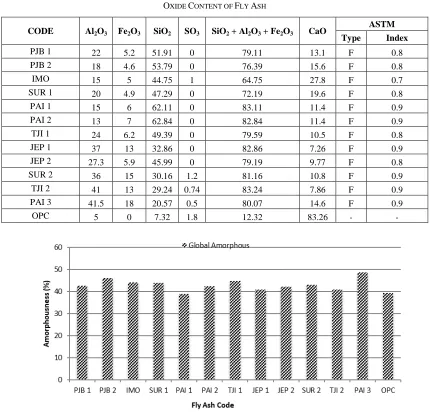
1) Oxide Content of Fly Ash: The oxide content of fly
2) Percentage Amorphous of Fly Ash: The percentage
amorphous of fly ash is displayed in Fig. 1. From the figure, it is shown that almost all of the fly ash has the percentage of amorphous content more than 40%.
B. Approach Method
There were 6 approach methods shown in below.
1) Method 1: The weight of fly ash was 20% by weight
of the cementitious material, without sieving condition of fly ash. The form of specimens was mortar. Immediately after casting, the specimens were cured with immersion treatment. The compressive strength of specimens was determined after 7-day of the curing process.
2) Method 2: The weight of fly ash was 20% by weight
of the cementitious material with no sieving condition of fly ash. The form of specimens was mortar. Immediately after casting, the specimens were cured with immersion treatment. The compressive strength of specimens was determined after 28-day of the curing process.
3) Method 3: The weight of fly ash was 20% by weight
of the cementitious material with sieving condition of fly ash. The form of specimens was mortar. Immediately after casting, the specimens were cured with immersion treatment. The compressive strength of specimens was determined after 7-day of the curing process.
4) Method 4: The weight of fly ash was 10% by weight
of the cementitious material, without sieving condition of fly ash. The form of specimens was mortar. Immediately after casting, the specimens were cured with moist treatment. The compressive strength of specimens was determined after 7-day of the curing process.
5) Method 5: The weight of fly ash was 20% by weight
of the cementitious material, with sieving condition of fly ash. The form of specimens was a paste, and the specimens were moist cured at 60 degrees Celcius for three hours. The compression tests of specimens were conducted after one day of casting.
6) Method 6: The weight of fly ash was 20% by weight
of the cementitious material, without sieving condition of fly
TABLEI
OXIDE CONTENT OF FLY ASH
CODE Al2O3 Fe2O3 SiO2 SO3 SiO2 + Al2O3 + Fe2O3 CaO
ASTM Type Index
PJB 1 22 5.2 51.91 0 79.11 13.1 F 0.8
PJB 2 18 4.6 53.79 0 76.39 15.6 F 0.8
IMO 15 5 44.75 1 64.75 27.8 F 0.7
SUR 1 20 4.9 47.29 0 72.19 19.6 F 0.8
PAI 1 15 6 62.11 0 83.11 11.4 F 0.9
PAI 2 13 7 62.84 0 82.84 11.4 F 0.9
TJI 1 24 6.2 49.39 0 79.59 10.5 F 0.8
JEP 1 37 13 32.86 0 82.86 7.26 F 0.9
JEP 2 27.3 5.9 45.99 0 79.19 9.77 F 0.8
SUR 2 36 15 30.16 1.2 81.16 10.8 F 0.9
TJI 2 41 13 29.24 0.74 83.24 7.86 F 0.9
PAI 3 41.5 18 20.57 0.5 80.07 14.6 F 0.9
OPC 5 0 7.32 1.8 12.32 83.26 - -
ash. The form of specimens was a paste, and the specimens were moist cured at 60 degrees Celcius for three hours. The compression tests of specimens were conducted after one day of casting.
III.RESULTS AND DISCUSSION
A. The Compressive Strength Results
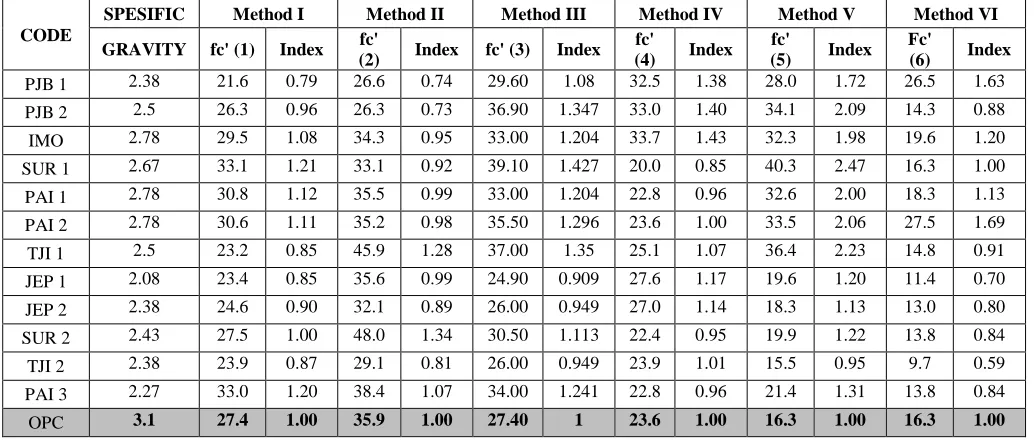
The correlation of specific gravity, compressive strength, and index for each method are summarized in Table 2 and depicted in Fig. 2.
The numeral on the index column represents the compressive strength ratio of each mixture to the
compressive strength of mixture with the paste of 100% OPC. The majority of the results as seen in Fig. 2 indicates that the Method 5 has the highest index, which was the method used steam curing high temperature and sieving condition of fly ash. It was due to differences in specimens curing temperature, and the difference in the level of material fineness will accelerate the cement hydration process, [3]. Moreover, enhancement the material fineness even increases the compressive strength of the specimen [4]. The same as Method 5 and 6, the difference is at the level of fineness, fly ash on the method of 5 has a higher fineness level than that of the method 6. Karim et al [5] said that fineness of ground disposed of fly ash plays a crucial role in the compressive strength of mortar.
TABLEII
SPECIFIC GRAVITY,COMPRESSIVE STRENGTH AND INDEX FOR EACH METHOD
CODE
SPESIFIC Method I Method II Method III Method IV Method V Method VI GRAVITY fc' (1) Index fc'
(2) Index fc' (3) Index fc'
(4) Index fc'
(5) Index Fc'
(6) Index PJB 1 2.38 21.6 0.79 26.6 0.74 29.60 1.08 32.5 1.38 28.0 1.72 26.5 1.63 PJB 2 2.5 26.3 0.96 26.3 0.73 36.90 1.347 33.0 1.40 34.1 2.09 14.3 0.88 IMO 2.78 29.5 1.08 34.3 0.95 33.00 1.204 33.7 1.43 32.3 1.98 19.6 1.20 SUR 1 2.67 33.1 1.21 33.1 0.92 39.10 1.427 20.0 0.85 40.3 2.47 16.3 1.00 PAI 1 2.78 30.8 1.12 35.5 0.99 33.00 1.204 22.8 0.96 32.6 2.00 18.3 1.13 PAI 2 2.78 30.6 1.11 35.2 0.98 35.50 1.296 23.6 1.00 33.5 2.06 27.5 1.69 TJI 1 2.5 23.2 0.85 45.9 1.28 37.00 1.35 25.1 1.07 36.4 2.23 14.8 0.91 JEP 1 2.08 23.4 0.85 35.6 0.99 24.90 0.909 27.6 1.17 19.6 1.20 11.4 0.70 JEP 2 2.38 24.6 0.90 32.1 0.89 26.00 0.949 27.0 1.14 18.3 1.13 13.0 0.80 SUR 2 2.43 27.5 1.00 48.0 1.34 30.50 1.113 22.4 0.95 19.9 1.22 13.8 0.84 TJI 2 2.38 23.9 0.87 29.1 0.81 26.00 0.949 23.9 1.01 15.5 0.95 9.7 0.59 PAI 3 2.27 33.0 1.20 38.4 1.07 34.00 1.241 22.8 0.96 21.4 1.31 13.8 0.84 OPC 3.1 27.4 1.00 35.9 1.00 27.40 1 23.6 1.00 16.3 1.00 16.3 1.00
B. Influence of Carbon Content in Fly Ash
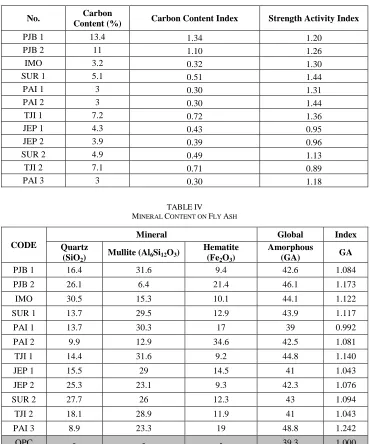
The influence of carbon content in fly ash to the compressive strength is shown in Table 3. The carbon content was calculated based on the weight of fly ash retained on the 200 mesh. Furthermore, the determination of carbon index according to ASTM standard, for carbon content 5% given index 0.5, while the compressive strength index was derived from the average value of the compressive strength index per each method. From the data Table 3. it can be mentioned that it is not easy to find the correlation between carbon content and compressive strength. McCarter et al. [6] search for pozzolan reactivity of four kinds of material that were metakaolin, micro-silica, PFA (pulverized fuel ashes) and GGBS (ground granulated blast furnace slag). GGBS which has the highest carbon content has the lowest pozzolanic reactivity, but from the other three materials, the relationship between carbon content and
pozzolan reactivity were not comparable. Hardjito [7] stated that fly ash with low carbon content provides high compressive strength to geopolymer concrete. Malvar [8] revealed that high levels of carbon content increase expansion. However, the last two authors did not mention how the direct relation between carbon content in fly ash and compressive strength was. The reality is not simple to find a direct connection between carbon content in fly ash and compressive strength of mortar.
C. Mineral Content in Fly Ash
The minerals content of fly ash is shown in Table 4. The majority of minerals contained in fly ash were quartz (SiO2), mullite (Al6Si12O3) and hematite (Fe2O3). Similar to Fernandez's [10] research that the majority of minerals are quartz, mullite, hematite. The numeral on the index global amorphous (GA) column represents the number of the ratio
TABLEIII
CARBON CONTENT OF FLY ASH
No. Carbon
Content (%) Carbon Content Index Strength Activity Index
PJB 1 13.4 1.34 1.20
PJB 2 11 1.10 1.26
IMO 3.2 0.32 1.30
SUR 1 5.1 0.51 1.44
PAI 1 3 0.30 1.31
PAI 2 3 0.30 1.44
TJI 1 7.2 0.72 1.36
JEP 1 4.3 0.43 0.95
JEP 2 3.9 0.39 0.96
SUR 2 4.9 0.49 1.13
TJI 2 7.1 0.71 0.89
PAI 3 3 0.30 1.18
TABLEIV
MINERAL CONTENT ON FLY ASH
CODE
Mineral Global Index
Quartz (SiO2)
Mullite (Al6Si12O3) Hematite (Fe2O3)
Amorphous
(GA) GA
PJB 1 16.4 31.6 9.4 42.6 1.084
PJB 2 26.1 6.4 21.4 46.1 1.173
IMO 30.5 15.3 10.1 44.1 1.122
SUR 1 13.7 29.5 12.9 43.9 1.117
PAI 1 13.7 30.3 17 39 0.992
PAI 2 9.9 12.9 34.6 42.5 1.081
TJI 1 14.4 31.6 9.2 44.8 1.140
JEP 1 15.5 29 14.5 41 1.043
JEP 2 25.3 23.1 9.3 42.3 1.076
SUR 2 27.7 26 12.3 43 1.094
TJI 2 18.1 28.9 11.9 41 1.043
PAI 3 8.9 23.3 19 48.8 1.242
among GA percentage of each fly ash to the GA of OPC (Ordinary Portland Cement), by setting index 1 in the GA index for OPC. Table 4 indicates that mineral content in fly ash is uncertain.
In the case of Tables 3 and 4, it appears that fly ash containing the highest percentage of global amorphous did not indicate the highest compressive strength index. This is also in accordance with the research of Skavarla [9] which resulted that the chemical composition not being used to predict compressive strength. Fernandez [10] and Nurwidayati [10] stated that oxides do not form a part of the main reaction products, and consequently, they do not significantly contribute to the mechanical strength
development. As shown in Table 4 there is no relation between the mineral content and compressive strength.
D. Different Results of Methods 1 and 3
The different results of compressive strength of Methods 1 and 3 are displayed in Fig. 3. The figure emphasizes that the increase of material fineness will increase the compressive strength. In Fig. 3 although the same level of fly ash fineness but the increasing of percentage in the compressive strength were not equal, this argument applies to Fig. 4 as well. The images confirmed that the compressive strength and mineral content were not related directly too. Fernandez [11], [12] stated that from the chemical point of view the most important factor is the reactive silica content.
Fig. 3 The compressive strength comparison of Method 1 and Method 3
Silica is the main constituent of the structural skeleton of the reaction product formed in the alkaline activation of the ashes.
E. Different Results of Methods 5 and 6
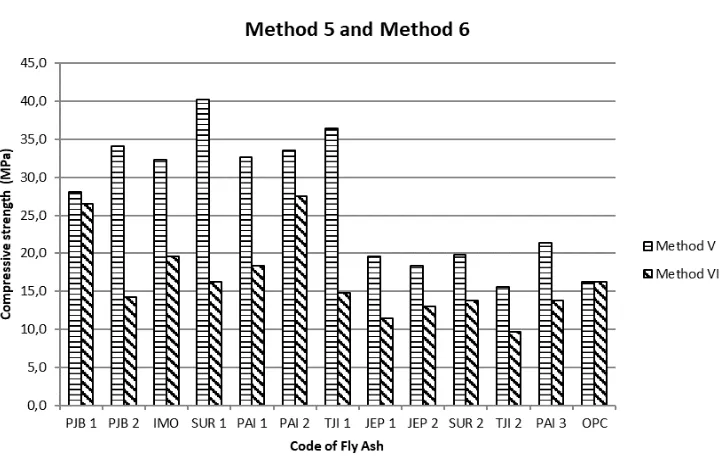
The results of compressive strength Methods 5 and 6 are displayed in Fig. 4. The different method 5 and 6 were the degree of fly ash fineness and the duration of the curing process. The argument of the increase in fly ash fineness is similar to an explanation in Fig. 3. When comparing Fig. 3 and 4, the difference is the curing method and the age of the compressive strength test. In Fig. 4 the specimens were cured at high temperature, and the compressive strength tests were performed at the age of 1 day, while in Fig. 3 the specimens were cured at ambient temperature, and compressive strength tests carried out at the age of 7 days. Meanwhile, the compression rate is not much different. The maximum compressive strength of Method 3 in Fig. 3 is about 38.5 MPa, while on Method 5 in Fig. 4 is about 40 MPa. In terms of time, in Fig. 4 the compressive strength tests were done at the age of 1-day, while in Fig. 3, the compressive strength tests performed at the age of 7-day.
F. General Discussion.
It is already known that there are numbers of variations of fly ash in the field, including the physical properties and chemical content. In the current situation, the use of fly ash is very significant, either as a normal concrete mix or as the basic material of geopolymer concrete [13]. However, so far, a direct relationship between the physical and chemical properties of fly ash to the compressive strength of concrete is not easy to predict. As well as the existing results of this study, it is relatively not simple to relate the relationship between the total amorphous, the mineral content, the oxide content to the compressive strength directly. Moreover, to analyze the oxide content with XRF (X-Ray Fluorescence) and to analyze the mineral content by XRD (X-Ray Diffractometer) requires a budget that is costly. For that reason, it needs to find another alternative method to connect fly ash with compressive strength directly.
The main purpose of the study was to determine the relationship between fly ash to the compressive strength of the mortar test specimen. From the description of the study results show the most appropriate is method 5, relatively fast and cheap enough.
IV. CONCLUSION
Results in this paper have shown that it is not easy to find a direct relationship between the total amorphous, the mineral content, the oxide content to the compressive strength of mortar.
To characterize fly ash to the compressive strength of the mortar, Method 5 is found to be relatively cheap and fast
whereby the method employs the use of paste mixture with the weight of fly ash is 20% by weight of the cementitious material, with sieving condition of fly ash. A special condition in this method is moist curing at a temperature of 60 degrees Celcius for three hours and compressive strength test conducted at one day after casting.
ACKNOWLEDGMENTS
The authors gratefully wish to acknowledge the Ministry of Research, Technology, and Higher Education of the Republic of Indonesia for the financial support throughout the course of this research.
REFERENCES
[1] Januarti Jaya Ekaputri, Triwulan, Khorin Agus Priadana, Tri Eddy Susanto and Subaer Junaedi. "Physico-Chemical Characterization of Fly Ash" The 2013 World Congress On Advances in Structural Engineering and Mechanics (ASEM 13) Jeju, Korea, September 8-12, 2013
[2] ASTM C618-03, 2003, "Standard Specification for Coal Fly Ash and Raw or Calcined Natural Pozzolan for Use as a Mineral Admixture in Concrete", Annual Book of ASTM Standard.
[3] Triwulan, Luvi Yusepa Dwijayanti, Januarti Jaya Ekaputri ,Ridho Bayuaji, "Lightweight Geopolymer Binder With Abaca Fiber In Different Curing". Materials Science Forum Issn: 1662-9752, Vol. 841, Pp 140-147.2016.
[4] Hongzhu Quan "The Effects of Change in Fineness of Fly Ash On Air-Entraining Concrete", The Open Civil Engineering Journal, 2011, 5, 124-131,2011.
[5] M. R. Karim, M. F. M. Zain, M. Jamil, F. C. Lai and M. N. Islam "Strength Development of Mortar and Concrete Containing Fly Ash: A Review" International Journal of The Physical Sciences Vol. 6(17), Pp. 4137-4153. 2011.
[6] W. J. Mccarter and D. Tran "Monitoring Pozzolanic Activity by Direct Activation with Calcium Hydroxide" Construction and Building Materials, Vol. 10, No. 3, Pp. 179-184,1996.
[7] D. Hardjito and B. V. Rangan "Development and Properties of Low-Calcium Fly Ash-Based Geopolymer Concrete "Research Report Gc 1 Faculty of Engineering Curtin University of Technology, Perth, Australia, 2005.
[8] L. J. Malvar 1, L. R. Lenke 2 "Efficiency of Fly Ash in Mitigating Alkali Silica Reaction Based on Chemical Composition "Aci Materials Journal, Vol. 103, No. 5, Pp. 319-326, 2006.
[9] Skavarla, J., Sisol, M., Botula, J., Kolesarova., M., Dan Krinicka, I. "The Potential Use of Fly Ash with a High Content of Unburned Carbon in Geopolimers." Science Direct. Acta Geodyn. Geomater., Vol. 8, No. 2 (162), 123-132, 2011.
[10] Nurwidayati, R., J.J. Ekaputri, M. Bahrul Ulum, Triwulan and P. Suprobo, "Characterization of Fly Ash on Geopolymer Paste", Materials Science Forum Vol. 841, 118-125, 2016.
[11] A. Fernandez -Jimenez, A.Palomo "Characterization Of Fly Ashes. Potential Reactivity as Alkaline Cements "Elsevier Fuel 82 (2003) 2259-2265, 2003.
[12] Ekaputri Januarti Jaya ,Ulum Muhammad Bahrul , Triwulan ,Ridho Bayuaji , Susanto Tri Eddy and Mohd Mustafa Al Bakri Abdullah . “A Comprehensive Characterization and Determination of Fly Ashes In Indonesia using Different Methods” Applied Mechanics and Materials Vols. 754-755 pp 320-325 ,2016.