
Available Online At www.ijpret.com
INTERNATIONAL JOURNAL OF PURE AND
APPLIED RESEARCH IN ENGINEERING AND
TECHNOLOGY
A PATH FOR HORIZING YOUR INNOVATIVE WORK
“CLOUD SECURITY: CONTROLS AND ISSUES”
CHAITANYA N. GADGE, PROF. S. T. KHANDARE
1. ME (appeared), BNCOE, PUSAD 2. Associate Professor, BNCOE, PUSAD
Accepted Date:
27/02/2013 Publish Date:
01/04/2013
Keywords
Cloud Security
Corrective Controls
Virtualizing Security
Auditability
No Security Perimeter
Community
Corresponding Author Mr. Chaitanya N. Gadge
Abstract
In this paper we mostly concentrated on different security issues and security controls in cloud. Cloud security basically not any application software that can be offered or given as cloud based. We can say that it is one of important service provided by “The Cloud”. Hence We can argue that “Security as a service” usually refers to security services provided by a third party using the other service model, but there’s a compelling set of capabilities that enables companies large and small to be both effective, efficient and cost-manageable as we embrace the “new” world of highly distributed applications, content and communications .[1] As with virtualization, when we discuss “security” and “cloud computing,” any of the three services often are conflated such as Software as a service (SaaS). Platform as a service (PaaS). Infrastructure as a service (IaaS).There are a lot of securities issues/concerns associated with cloud computing. Security issues are mostly divided into two groups. Security issues faced by cloud providers that provide different services to the customer and security issues faced by their customers. In most cases, the provider must ensure that their infrastructure is secure and that their client’s data and applications are protected while the customer must ensure that the provider has taken the proper security measures to protect their information.
[2]
Available Online At www.ijpret.com INTRODUCTION
Cloud computing security (sometimes
referred to simply as "cloud security") is
an evolving sub-domain of computer
security, network security, and, more
broadly, information security. It refers to a
broad set of policies, technologies, and
controls deployed to protect data,
applications, and the associated
infrastructure of cloud computing.
"Cloud computing" as "the logical
computational resources (data, software)
accessible via a computer network
(through WAN or Internet etc.), rather
than from a local computer. Managing
local computers is hard: there are security
issues, computer lifecycle issues,
accessibility issues. Cloud computing,
ideally is easy: use it and leave it, access
your data from anywhere over world. To
end users, whether individuals or
companies, "the cloud" is an abstraction,
a computing environment that can
expand to suit users' needs.
Basically, Cloud computing is a model for enabling convenient, on-demand network
access to a shared pool of configurable
computing resources (e.g., networks,
servers, storage, applications, services)
that can be rapidly provisioned and
released with minimal management effort
or service provider interaction. There is
different cloud models, deployment
models used for security purpose.
Cloud computing deployment models
1 Cloud computing service models
Software as a Service (SaaS) provides a number of ways to control access to the
Web portal, such as the management of
user identities, application level
configuration, and the ability to restrict
access to specific IP address ranges or
geographies.
Platform as a Service (PaaS) allow clients
to assume more responsibilities for
managing the configuration and security
for the middleware, database software,
and application runtime environments. Infrastructure as a Service (IaaS) model transfers even more control, and
responsibility for security, from the Cloud
provider to the client; access is available
to the operating system that supports
virtual images, networking, and storage
[3].
1. Public Cloud - A public cloud can be
Available Online At www.ijpret.com
internet connection and access to the
cloud space.
2. Private Cloud - A private cloud is
established for a specific group or
organization and limits access to just that
group.
3. Community Cloud - A community cloud
is shared among two or more
organizations that have similar cloud
requirements.
4. Hybrid Cloud - A hybrid cloud is
essentially a combination of at least two
clouds, where the clouds included are a
mixture of public, private, or community.
[4]
Available Online At www.ijpret.com CONTROLS
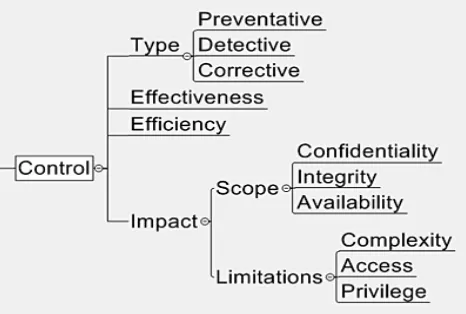
There are different types included in cloud
controls that are classified as follows:
• Preventative controls exist to prevent the
threat from coming in contact with the
weakness
• Detective controls exist to identify that
the threat has landed in our systems.
• Corrective controls exist to mitigate or
lessen the effects of the threat being
manifested.
• Deterrent Control is to reduce the
likelihood of a Vulnerability being
exploited without actually reducing the
exposure.
• Corrective controls
As a result, Corrective Controls are all
about reducing the Impact of the exploited
Vulnerability rather than preventing them
from happening in the first place. The key
point here is that the attack has already
begun and all we can do is limit the severity
of it.
Looking at the Impact assessment, it is
entirely dependent on the number of
Information Assets that are exposed. The
goal of the Corrective Control, therefore,
should be to reduce the quantity of
Information Assets that are exposed. This
will be entirely dependent on the nature of
the Vulnerability, however something as
simple as terminating the associated users
session may be enough to limit the number
of records they were able to steal or
modify.
• Deterrent Controls
Deterrent Controls are that they do not
attempt to fix the associated Vulnerability;
they just attempt to make it occur less
frequently. The goal of a Deterrent Control
is to reduce the likelihood of a Vulnerability
being exploited without actually reducing
the exposure.
Deterrent controls are used in phishing
attack, which is completely outside of the
control of the target company, is successful
by increasing the awareness of its
customers. Similarly, for internal facing
threats, including black lists of known
malware sites and so forth can reduce the
likelihood of staff being exposed to these
kinds of threats. There are many tips on
Available Online At www.ijpret.com
address phishing type threats, where your
only options are deterrent controls.[5]
• Detective controls
Detective controls are measures a company
uses to identify irregularities so they can be
corrected, ideally as promptly as possible.
Laws like the Sarbanes-Oxley Act of 2002
mandate the use of internal controls to
address common accounting and ethics
problems, and companies also want to use
controls to avoid waste, fraud, and other
issues they may encounter in the course of
doing business. The counter to detective
controls are corrective controls, which are
measures to prevent problems from
occurring in the first place.
There are a lot of detective controls can
include triggers for certain types of activity,
such as warning alerts that will show up
when people engage in financial
transactions that appear irregular. If a
department always issues a check to the
same vendor for the same amount, a
sudden change might be a cause for
concern, and a detective control could be
set up to notify the accounting department
when variations like this occur so they can
find out what happened
• Preventative controls
Preventative security controls are put into
place to prevent intentional or
unintentional disclosure, alteration, or
destruction (D.A.D.) of sensitive
information. Some example preventative
controls follow:
• Policy – It will restrict the unauthorized
network connections.
• Firewall – In the firewall, unauthorized
Connections are blocked.
• Locked wiring closet – It is used to
prevent unauthorized equipment from
being physically plugged into a network
switch.[6]
Available Online At www.ijpret.com NEW SECURITY ISSUES
• Lack of Auditability
One of the most negative aspects of cloud
computing is its ability, or lack thereof, to
allow for adequate auditability and to
ensure regulatory compliance issues are
being addressed. It might surprise some
unbelieves that a significant portion of the
SaaS community is comfortable with what
their service providers offer in that regard.
Audit and compliance issues can vary
depending on the type of cloud computing
you're considering or implementing. For
example, infrastructure-as-a-service
generally allows for more control on the
part of the customer. On the other hand,
software-as-a-service locks down
processing on the vendor's site, application
features are mostly standard, and
customization is generally limited.
• Regulatory Compliance
Cloud computing makes it harder for
enterprises to be sure they're complying
with industry and government regulations.
IT and legal experts offer CIOs advice on
how to stay in compliance even when their
applications reside in the cloud.
Compliance covers a lot of ground, from
government regulations such as
Sarbanes-Oxley and the European Union Data
Protection Act, to industry regulations such
as PCI DSS for payment cards and HIPAA for
health data. You may have internal controls
in place, but moving to a public-cloud
infrastructure platform, a cloud-based
application suite or something in between
will mean giving up some controls to the
cloud vendor.[8]
• No Security Perimeter
Today's managed security service providers
(MSSPs) essentially offer perimeter security
management outsourcing. Customers still
have to buy and deploy in-premise security
equipment such as firewalls, IPD, IDS and
the rest. The tedious day to day
management and continuous policy process
is delegated to the cloud, but the security
boxes remain. From that standpoint,
today’s managed security services fall short
from moving the infrastructure cost and
complexity of perimeter security to the
Available Online At www.ijpret.com
Another model would be for the PAAS to
think as a true platform provider and enable
specialized security vendors to start
building such services on top of their
platform. In that model, MSSPs would start
building virtualized, multi-tenant perimeter
infrastructure on top of their favorite PAAS,
and then, sell perimeter security as a
service within these environments to their
customer base. Obviously, this would
require a different platform than the
current MSS infrastructures. Moreover,
MSS providers would have to adapt to each
specific PAAS, forcing them to make
strategic choices and restrict them to a few
partners, who may not fit what their
customers want in the first pla
• Larger Attack Surface
Available Online At www.ijpret.com
Another model would be for the PAAS to
think as a true platform provider and enable
specialized security vendors to start
building such services on top of their
In that model, MSSPs would start
tenant perimeter
infrastructure on top of their favorite PAAS,
and then, sell perimeter security as a
service within these environments to their
customer base. Obviously, this would
fferent platform than the
current MSS infrastructures. Moreover,
MSS providers would have to adapt to each
specific PAAS, forcing them to make
strategic choices and restrict them to a few
partners, who may not fit what their
customers want in the first place.
Attack Surface is a measure of how
potentially vulnerable a piece of software
is. It enumerates the entry points and
associated code a malicious user could
employ to exploit the software.
would be open sockets, RPC
and even the number of web applications
hosted inside a web server more programs
that are running, the more program code is
exposed to malicious users finding
vulnerabilities. Also, larger programs will
tend to provide more opportunities for
exploitation. For example, a web
application with 1000 lines of code is
generally less likely than a web application
with 10000 lines of code to have
vulnerability. disabling unneeded features is
a good step. In fact, software vendors like
Citrix are tending to disable more features
by default to improve security.
can also disable services and features not
used – the smaller the number of features,
the less attack surface is effectively
available. The principle of least privilege
also applies to all deployments.
Attack Surface is a measure of how
potentially vulnerable a piece of software
It enumerates the entry points and
associated code a malicious user could
employ to exploit the software. Examples
would be open sockets, RPC entry points,
and even the number of web applications
hosted inside a web server more programs
that are running, the more program code is
exposed to malicious users finding
vulnerabilities. Also, larger programs will
tend to provide more opportunities for
For example, a web
application with 1000 lines of code is
generally less likely than a web application
with 10000 lines of code to have
disabling unneeded features is
In fact, software vendors like
ding to disable more features
by default to improve security. Customers
can also disable services and features not
the smaller the number of features,
the less attack surface is effectively
available. The principle of least privilege
Available Online At www.ijpret.com • Accountability
Research has shown that accountability, the
ability to reliably monitor the state of a
system and faithfully trace its operation,
can foster trust in a system by increasing
transparency. System transparency enables
early detection of faults and malicious
behaviors, provides assurances for the
compliance to legal and regulatory
requirements, and assists in dispute
resolution by attributing blame when things
go wrong.
The key challenges lay in the diverse needs
of cloud users, the highly dynamic nature of
CCS, and the operation over a largely
untrusted infrastructure. [9]
Cloud computing introduces a paradigm
shift in providing and supporting software
services. With this shift come new
questions of responsibility and
accountability that are highlighted
particularly when there is a service outage.
Accountability has clearly undergone some
shifts in the cloud, and standards bodies are
working to establish outage measurement
rules that address the new paradigm. But
Available Online At www.ijpret.com
Research has shown that accountability, the
ability to reliably monitor the state of a
system and faithfully trace its operation,
can foster trust in a system by increasing
transparency. System transparency enables
early detection of faults and malicious
behaviors, provides assurances for the
compliance to legal and regulatory
requirements, and assists in dispute
resolution by attributing blame when things
The key challenges lay in the diverse needs
d users, the highly dynamic nature of
CCS, and the operation over a largely
Cloud computing introduces a paradigm
shift in providing and supporting software
services. With this shift come new
questions of responsibility and
countability that are highlighted
particularly when there is a service outage.
Accountability has clearly undergone some
shifts in the cloud, and standards bodies are
working to establish outage measurement
rules that address the new paradigm. But
the rules are not yet in place. For now,
some existing distribution of service
accountability can be adapted to this new
environment.
• Data Security
There is also one important security issue
“data security” in the data security; we used
different techniques to pro
costumer from the corruption. Following
table shows techniques:[9]
Table 1.Security Techniques for Service
Provider
CONCLUSION
This paper has presented the work
published by the academic community
advancing the technology of cloud s are not yet in place. For now,
some existing distribution of service
accountability can be adapted to this new
There is also one important security issue
“data security” in the data security; we used
different techniques to protect data of
costumer from the corruption. Following
table shows techniques:[9]
Table 1.Security Techniques for Service
This paper has presented the work
published by the academic community
Available Online At www.ijpret.com
computing. Much of the work has focused
on different security controls and issues in
cloud. This papers firstly working on to
prevent customers issues according to
security and their control standards..
Various definitions of cloud computing
were discussed and the NIST working
definition by Mell and Grance [9] was found
to be the most useful as it described cloud
computing using a number of
characteristics, service models and
deployment models. The different security
technique aspects of cloud computing that
were reviewed included the using
percentage for privacy to customer. There is
a lot of new security issues discussed that
are used to focus to protect customers
privacy.
You also must be aware of the security risks
of having data stored on the cloud. The
cloud is a big target for malicious individuals
and may have disadvantages because it can
be accessed through an unsecured internet
connection.
REFERENCES
1. "Swamp computing a.k.a. Cloud
Computing". Web Security
Journal.2009-12-28. http://security.syscon.com/node/12317
25. Retrieved
2010-01-2. "Thunderclouds: Managing SOA-Cloud
Risk". Service Technology
Magazine. http://www.servicetechmag.com
/I55/1011-1. Retrieved 2011-21-21
3. Gartner (2012) Cloud Computing.
Retrieved April15,2012from
http://www.gartner.com/technology/it-glossary/cloud-computing.jsp
4. Jansen, Wayne & Grance, Timothy. Guidelines on Security and Privacy in Public
Cloud Computing. National Institute of
Standards and Technology, 2011.
5. J Brodkin. (2008). Gartner Seven
cloud-computing security risks.
http://www.networkworld.com/news/200S
!07020Scloud.
6. Hickey, Kathleen. "Dark Cloud: Study finds security risks in virtualization".
Government Security
Available Online At www.ijpret.com
dark-cloud-security.aspx. Retrieved 12
February 2012.
7. Winkler, Vic (2011). Securing the Cloud:
Cloud Computer Security Techniques and
Tactics. Waltham, MA USA: Elsevier.
pp. 59. ISBN Securing the Cloud Cloud
Computer Security Techniques and
Tactics. http://www.elsevier.com/wps/find/
bookdescription.cws_home/723529/descrip
tion#description
8. YanpeiChen, Vern Paxsonand Randy H.
Katz, ―What’s New about Cloud CompuSng
Security Technical Report No.
UCB/EECS-2010-5,
http://www.eecs.berkeley.edu/Pubs/TechR
pts/2010/EECS-2010-5.html, Jan. 20, 2010.
9. NIST, DRAFT Guidelines on Security and
Privacy in Public Cloud Computing,
http://csrc.nist.gov/publications/drafts/800
![table shows techniques:[9] table shows techniques:[9]](https://thumb-us.123doks.com/thumbv2/123dok_us/8758053.1750486/8.595.313.529.359.554/table-shows-techniques-table-shows-techniques.webp)
