Available Online at www.ijpret.com
138
INTERNATIONAL JOURNAL OF PURE AND
APPLIED RESEARCH IN ENGINEERING AND
TECHNOLOGY
A PATH FOR HORIZING YOUR INNOVATIVE WORK
SURVEY ON LOAD BALANCING AND IMPROVING CAPACITY OF A NODE WITH
BOUNDED STRETCH IN WIRELESS NETWORK
ROSHNI GOLHAR1, PROF. SADANAND PATIL2, PROF. RAVINDRA KALE3
1. Dept. of Computer Science &Engineering G.H. Raisoni College of Engineering, women
Nagpur,
2. Dept. of Computer Technology Priyadarshani Institute of Engg. & Tech., Nagpur.
3. Dept. of CSE/IT G. H. Raisoni College of Engineering women Nagpur,
Accepted Date: 15/02/2014 ; Published Date: 01/04/2014
\
Abstract: Routing in wireless networks has been heavily studied in the last decade. In a dense wireless network, a route travelled by a packet from the source to the destination usually consists of multiple hops where intermediate nodes act as relays. The packets usually follow the shortest path between source and destination in routing protocols to achieve smallest travelled distance. However, this leads to the uneven distribution of traffic load in a network. The wireless nodes in the center of the network will have heavier traffic. Since most of the shortest routes go through them. There are many algorithms available in the load balancing and improving capacity technique. In this paper, describe a novel routing algorithm called Circular Sailing Routing (CSR), which we can distribute the traffic more evenly in the network. Based on our study, found to reduced traffic distribution and capacity of a node in the wireless network compared to any other algorithm. This is because they proposed maps in the network onto a sphere via a simple stereographic projection and then the route decision is made by the distance on the sphere instead of Euclidean distance in the plane.
Keywords: Capacity, Load balancing, Circular Sailing Routing, Routing, Mobile ad-hoc networks (MANETs).
Corresponding Author: Ms. ROSHNI GOLHAR
Access Online On:
www.ijpret.com
How to Cite This Article:
Available Online at www.ijpret.com
139 INTRODUCTION
Available Online at www.ijpret.com
140 geographical localized routing protocols, such as greedy routing, the packets usually follow the shortest paths when the network is dense and uniformly distributed. In this paper, we proposed in algorithm which will provide traffic load is uniformly distributed with high capacity of a node in network. So that, multi-hop wireless network is proposed by us. This paper is organized as follows. In section II, we have related work on the paper is placed. In section III, the classification of the algorithm is taken place. In section 4, we have the various applications for the algorithms are given. In section 5, we have conclusion areas placed. Finally, in section V we concluded the overall system.
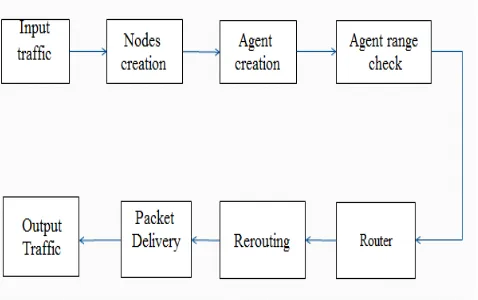
Fig 1. System Model
Here, the above diagram shows that, first take input of all nodes in input traffic block then create nodes and transfer to the agent creation block with the help of transfer agents (T.A), then check range of agents and forward nodes to router. while routing packet from source to destination in which any node will drop in that case transfer agent(T.A) will reroute that node again and forward to the packet delivery block and finally send it to the output traffic of destination node in the network . CSR can be easily implemented based on either shortest path routing or greedy routing. The only modification is a simple mapping calculation of the position information and the computational overhead is negligible. There are no changes to the communication protocol and no any additional communication overhead.
II] RELATED WORK
Available Online at www.ijpret.com
Available Online at www.ijpret.com
142 In [11] for two nodes whose projections are on the equator, there are infinite number of spherical shortest paths on the surface of the sphere also studied how to avoid the crowded center problem by analyzing the load probability in a dense network. In [18] proposed a randomized choice between shortest path and routing on inner/outer radii to level the loads in the network. we proposed in algorithms which will provide traffic load is uniformly distributed with high capacity of a nodes in network. So that, multi-hop wireless network is proposed by us.
III] MODELLING METHOD
Circular Sailing Routing Algorithm: In Circular Sailing Routing (CSR) based on stereographic projection maps an infinite plane onto a sphere. The basic idea of circular sailing routing is letting packet follow the circular shortest paths on the sphere instead of the Euclidean shortest path in 2D plane because there is no hot spot on the sphere where most of the circular shortest paths must go through. In CSR surface is symmetric path will follow because to communicate nodes on the surface and traffic load is uniformly distributed in network. Since the surface of the sphere is symmetric, if nodes only communicate on the surface and traffic demand is uniformly distributed in the network, there will be no crowded center effect on the spherical surface. A stereographic projection can map an infinite plane onto a sphere and vice versa. The mapping method used by CSR, which is a stereographic projection. For a wireless network. we expect circular sailing routing can achieve better load balancing than shortest path routing. The detailed routing algorithm is given as follows: The CSR will follow some parameters are as follows: The I/P parameter to first maps the network onto a sphere via a simple stereographic projection and then the route decision is made by the distance on the sphere instead of the Euclidean distance in the plane. O/P parameter to the distance travelled by the packets using CSR is no more than a small constant factor of the minimum shortest path to improving capacity, packet redundancy and traffic distribution in per node or multiple nodes using CSR protocols for 3D networks where nodes are distributed in a 3D space instead of a 2D plane.First take user input data from the network then arrange all the nodes in circular fashion. then to create transfer agents(T.A.) of a node with range (R) .To move that transfer agents(T.A.) in network then they will take a decision if range(R) >T.A. then deliver data to the node create in new T.A. unless move T.A. in the network. When the data is delivered to network then stop otherwise move to T.A. in network. Now again check range of data and data deliver to the node create in new T.A. otherwise move to T.A. in wireless network.
IV] APPLICATION
Available Online at www.ijpret.com
143
V] CONCLUSION
We therefore conclude that our proposed (CSR) algorithm for wireless networks to avoid the uneven load distribution caused by shortest path routing or greedy routing. By spreading the traffic across a virtual 3D sphere which is mapped from the network, CSR can reduce hot spots in the networks and increase the energy lifetime of the network. CSR can be easily implemented using any existing position-based routing protocols without any major changes or additional overhead. CSR can achieve the best load balancing in a large scale dense multi hop network.
VI] REFERENCES
1. Jiajia Liu,Xiaohong ,Jiang, Hiroki Nishiyama,” Throughput Capacity of MANETs with Power
Control and Packet Redundancy”,IEEE,transactionon WirelessCommunications,Vol.12,NO.6, JUNE2013.
2. E. Hyyti¨a and J. Virtamo, “On traffic load distribution and load balancing in dense wireless
multihop networks,” EURASIP Journal on Wireless Communications and Networking, Article ID 16932, 2007.
3. J. Liu, J. Gao, X. Jiang, H. Nishiyama, and N. Kato, “Capacity and delay of probing-based
two-hop relay in MANETs,” IEEE Trans. Wireless Commun., Vol. 11, NO. 11, Dec.2012.
4. “On throughput capacity of MANETs with power control and packet redundancy,” Graduate
school of information sciences, Tohoku University, 2013, technical report blogspot.com2012.
5. I. Cidon, R. Rom, and Y. Shavitt, “Analysis of multi-path routing,” IEEE/ACM Transactions on
Networking, Vol.7,NO. 6, Dec 2011.
6. Sung-Ju Lee and Mario Gerla, “Dynamic load-aware routing in ad hoc networks,” in Proc.
of IEEE ICC, 2010.
7. S. R. Kulkarni and P. Viswanath, “A deterministic approach to throughput scaling in wireless
networks,” IEEE Trans. Inf. Theory, Vol. 50, NO.16. June 2008.
8. P.P. Pham and S. Perreau, “Performance analysis of reactive shortest path and multipath
routing mechanism with load balance,” IEEE Trans., wireless network, Vol.10,NO.6, Sep 2008.
9. F. Li and Y. Wang, “Stretch Factor of Curveball Routing in Wireless Network: Cost of Load
Available Online at www.ijpret.com
144
10.Y. Ganjali and A. Keshavarzian, “Load balancing in ad hoc networks:single-path routing vs.
multi-path routing,” in Proc. of IEEE INFOCOM,2007.
11.P. Gupta and P. Kumar, “The capacity of wireless networks,” IEEE Tran. Inf. Theory, Vol.
46, NO.2, Mar. 2005.
12.J. Gao and L. Zhang, “Tradeoffs between stretch factor and load balancing ratio in routing
on growth restricted graphs,” in Proceedings of the 23rd Annual ACM Symposium on Principles
of Distributed Computing (PODC ’04), pp. 189–196, ACM, 2004.
13.D. B. Johnson and D. A. Maltz, “Dynamic source routing in ad hoc wireless networks,” in
Mobile Computing, T. Imielinski and H. Korth, Eds., vol. 353, chapter 5, pp. 153–181, Kluwer
Academic Publishers, Dordrecht, The Netherlands, 2003
14.K. Wu and J. Harms, “Performance study of a multipath routing method for wireless mobile
Ad hoc networks,” in Proceedings of the IEEE International Workshop on Modeling, Analysis,
and Simulation of Computer and elecommunication Systems (MASCOTS ’01), pp. 99–107, 2002.
15.I. Cidon, R. Rom, and Y. Shavitt, “Analysis of multi-path routing,” IEEE/ACM Transactions on
Networking, vol. 7, no. 6, pp. 885–896, 2002.
16.S.-B. Lee, J. Cho, and A. T. Campbell, “A hotspot mitigation protocol for ad hoc networks,”
Ad Hoc Networks, vol. 1, no. 1, pp. 87–106, 2001.
17.L. Popa, A. Rostamizadeh, R. Karp, C. Papadimitriou, and Stoica, “Balancing traffic load in
wireless networks with curveball routing,” in Proceedings of the 8th ACM International
Symposium on Mobile Ad Hoc Networking and Computing (MobiHoc ’07)), pp. 170–179,
September 2001.
18.Y. Yoo and S. Ahn, “A simple load-balancing approach in cheat-proof ad hoc networks,” in
Proceedings of the IEEE Global Telecommunications Conference (GLOBECOM ’04), vol. 6, pp.
3573–3577, Dallas, Tex, USA, November-December 2000.
19.Y. Yi, T. J. Kwon, and M. Gerla, “A load aware routing (LWR) based on local information,” in
Proceedings of the 12th IEEE International Symposium on Personal, Indoor andMobile Radio Communications (PIMRC ’01), vol. 2, pp. 65–69, 2000.
20.H. Hassanein and A. Zhou, “Routing with load balancing in wireless ad hoc networks,” in