V R Charan Teja*
Sree Vidyanikethan College of Pharmacy, Tirupati, Andhra Pradesh, India. Tel: +91 97006 52559,
E-mail:[email protected]
Address for correspondence
V.R. Charan Teja et al. / Journal of Global Trends in Pharmaceutical Sciences 5(2)-(2014) 1649–57
A GLIMPSE ON SOLID LIPID NANOPARTICLES AS DRUG DELIVERY SYSTEMS
INTRODUCTION:
In the recent past solid lipid nanoparticles (SLN) are escalating at a faster rate. Solid lipid nanoparticles introduced in 1991, signify an alternative carrier system to traditional colloidal carriers, such as emulsions, liposomes and polymeric micro- and nanoparticles. SLN are sub-micron colloidal carriers ranging from 10 to 1000 nm, composed of physiological lipid dispersed in water or in aqueous surfactant solution. SLN offer unique properties such as small size, large surface area, high drug loading, and interaction of phases at the interface and are attractive for their potential to improve performance of pharmaceuticals. Nanoparticles are attracting major attention as novel colloidal drug carrier for intravenous applications as they have been proposed as an alternative particulate carrier system. Development of solid lipid nanoparticles is one of the emerging fields of lipid nanotechnology with numerous potential applications in drug delivery, clinical medicine and research, as well as in varied discipline. Particulate drug carriers investigated for many years include oil-in-water (O/W) emulsions, liposomes, microparticles and nanoparticles based on synthetic polymers or natural macromolecules. Solid lipid nanoparticles are one of the novel potential colloidal carrier systems as alternative materials to polymers which is identical to oil in water emulsion for parenteral nutrition, but the liquid lipid of the emulsion has been
replaced by a solid lipid shown on Fig. 1. They have many advantages such as good biocompatibility, low toxicity and lipophilic drugs are better delivered by solid lipid nanoparticles and the system is physically stable.1, 2
Fig. 1: Structure of solid lipid nanoparticle (SLN)
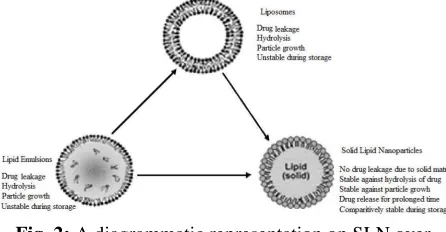
Fig. 2: A diagrammatic representation on SLN over
emulsions and liposomes advantages of SLN3
♦ Control and / or target (site specific) drug release. ♦ Excellent biocompatibility.
♦ Improve stability of pharmaceuticals. ♦ High and enhanced drug content. ♦ Easy to scale up and sterilize.
Solid lipid nanoparticles are at the vanguard of the rapidly budding field of nanotechnology with numerous prospective applications in drug delivery, clinical research, in addition to other diverse sciences. A solid lipid nanoparticle (SLN) is a typically colloidal spherical with an average diameter between 10 to 1000 nm. Solid lipid nanoparticles hold a solid lipid core matrix that can solubilize lipophilic molecules. The lipid core of SLNs is stabilized by the surfactants (emulsifiers). Due to their inimitable size-dependent properties, lipid nanoparticles proffer the possibility to develop new therapeutics. The potential to incorporate drugs into nanocarriers offers a new archetype in drug delivery that could hold an immense promise in accomplishing the bioavailability enhancement accompanied by controlled and site specific drug delivery. This review presents a discussion on the aims, advantages, limitations, production procedures, factors affecting the formulation, characterization studies and promising remedies of SLNs.
Keywords: Controlled and site specific drug delivery, nanotechnology, solvent
evaporation, super critical fluid technique, ultrasonication.
ABSTRACT
V R Charan Teja*
V. Harini Chowdary
Y. Prasanna Raju
N. Surendra
R. Vishnu Vardhan
B. Kiran Kumar Reddy
*
Department of Pharmaceutics,
Sree Vidyanikethan College of
Pharmacy, Tirupati, Andhra
Pradesh, India.
Journal of Global Trends in Pharmaceutical Sciences
Journal home page: www.jgtps.com
ISSN: 2230-7346
♦ Better control over release kinetics of encapsulated compounds.
♦ Enhanced bioavailability of entrapped bioactive compounds.
♦ Chemical protection of labile incorporated compounds.
♦ Much easier to manufacture than biopolymeric nanoparticles.
♦ No special solvent required.
♦ Conventional emulsion manufacturing methods applicable.
♦ Very high long-term stability. ♦ Application versatility.
♦ Can be subjected to commercial sterilization procedures.
Disadvantages of SLN 3 ♦ Particle growth.
♦ Unpredictable gelation tendency.
♦ Unexpected dynamics of polymeric transitions.
Aims of solid lipid nanoparticles 1, 3, 4 ♦ Possibility of controlled drug release. ♦ Increased drug stability.
♦ High drug pay load.
♦ No bio-toxicity of the carrier. ♦ Avoidance of organic solvents.
♦ Incorporation of lipophilic and hydrophilic drugs.
Methods of preparation of solid lipid nanoparticles SLNs are prepared from lipid, emulsifier and water/solvent by using different methods and are discussed below.
1. High pressure homogenization A. Hot homogenization B. Cold homogenization
2. Ultrasonication/high speed homogenization A. Probe ultrasonication
B. Bath ultrasonication 3. Solvent evaporation method
4. Solvent emulsification-diffusion method 5. Supercritical fluid method
6. Microemulsion based method 7. Spray drying method
8. Double emulsion method 9. Precipitation technique 10. Film-ultrasound dispersion
1. High pressure homogenization (HPH)
It is a reliable and powerful technique, which is used for the fabrication of SLNs. High pressure homogenizers push a liquid with high pressure (100–2000 bar) through a narrow gap (in the range of a few microns). The fluid accelerates on a very short distance at a very high velocity (over 1000 Km/h). Very high shear stress and cavitation forces disrupt the particles down to the submicron range. Generally 5-10% lipid content is used but up to 40% lipid content has also been investigated. Two general approaches of HPH are hot homogenization and cold homogenization; which work
on the same concept of mixing the drug in bulk of lipid melt.
A. Hot homogenization:
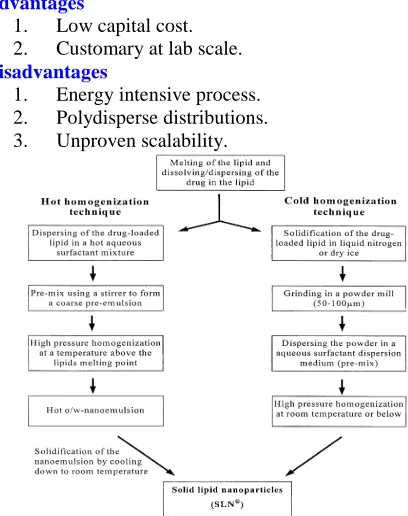
Hot homogenization is carried out at temperatures above the melting point of the lipid and therefore regarded as the homogenization of an emulsion. A pre-emulsion of the drug loaded lipid melt and the aqueous emulsifier phase (same temperature) is obtained by high-shear mixing device. HPH of the pre-emulsion is carried out at temperatures above the melting point of the lipid. In general, higher temperatures result in lower particle sizes due to the decreased viscosity of the inner phase.
However, high temperatures increase the degradation rate of the drug and the carrier. Increasing the homogenization pressure or the number of cycles often results in an increase of the particle size due to high kinetic energy of the particles.5, 6, 7
B. Cold homogenization
Cold homogenization has been developed to overcome various problems associated with hot homogenization such as: Temperature-induced drug degradation, drug distribution into the aqueous phase during homogenization, Complexity of the crystallization step of the nanoemulsion leading to several modifications and/or super cooled melts. In this technique the drug containing lipid melt is cooled, the solid lipid ground to lipid microparticles and these lipid microparticles are dispersed in a cold surfactant solution yielding a pre-suspension. Then this pre-suspension is homogenized at or below room temperature, the gravitation force is strong enough to break the lipid microparticles directly to solid lipid nanoparticles. 5, 6, 7, 8
Advantages
1. Low capital cost. 2. Customary at lab scale. Disadvantages
1. Energy intensive process. 2. Polydisperse distributions. 3. Unproven scalability.
Fig. 4: Schematic procedure of hot and cold
2. Ultrasonication / high speed homogenization SLNs are also prepared by ultrasonication or high speed homogenization techniques. To achieve smaller particle size, combination of both ultrasonication and high speed homogenization is required.9, 10
Advantages
1. Reduced shear stress.
Disadvantages
1. Potential metal contamination.
2. Physical instability like particle growth upon storage.
3. Solvent evaporation
SLNs can be prepared by solvent evaporation method. The lipophilic material is dissolved in a water-immiscible organic solvent (e.g. cyclohexane) that is emulsified in an aqueous phase. Upon evaporation of the solvent, nanoparticles dispersion is formed by precipitation of the lipid in the aqueous medium by giving the nanoparticles of 25 nm mean size. The solution was emulsified in an aqueous phase by high pressure homogenization. The organic solvent was removed from the emulsion by evaporation under reduced pressure (40– 60 mbar).5
Advantages 1. Scalable.
2. Mature technology. 3. Continuous process.
4. Commercially demonstrated. Disadvantages
1. Extremely energy intensive process. 2. Polydisperse distributions.
3. Biomolecule damage.
4. Solvent emulsification-diffusion method
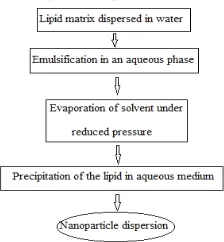
SLNs can also be produced by solvent emulsification-diffusion technique. The mean particle size depends upon lipid concentration in the organic phase and the emulsifier used. Particles with average diameters of 30-100 nm can be obtained by this technique. Avoidance of heat during the preparation is the most important advantage of this technique. Here, the lipid matrix is dissolved in water-immiscible organic solvent followed by emulsification in an aqueous phase. The solvent is evaporated under reduced pressure resulting in nanoparticles dispersion formed by precipitation of the lipid in aqueous medium.11, 12
Fig. 5: Systematic representation for
emulsification-diffusion method
5. Supercritical fluid method
This is a novel technique recently applied for the production of SLNs. A fluid is termed supercritical when its pressure and temperature exceed their respective critical value. The ability of the fluid to dissolve compounds increases. This technology comprises of several processes for nanoparticle production such as rapid expansion of supercritical solution (RESS), particles from gas saturated solution (PGSS), aerosol solvent extraction solvent (ASES), supercritical fluid extraction of emulsions (SFEE). The advantages of this technique includes avoidance of the use of solvents, particles obtained as a dry powder, instead of suspensions, requires mild pressure and temperature conditions. Carbon dioxide solution is the good choice as a solvent for this method. 5, 13, 14
Advantages
1. Avoid the use of solvents.
2. Particles are obtained as a dry powder, instead of suspensions.
3. Mild pressure and temperature conditions. 4. Carbon dioxide solution is the good choice as a
solvent for this method.
6. Microemulsion based method
This method is based on the dilution of microemulsions. Micro-emulsions are two-phase systems composed of an inner and outer phase (e.g. o/w microemulsions). They are made by stirring an optically transparent mixture at 65-70°C, which typically composed of a low melting fatty acid (e.g. stearic acid), an emulsifier (e.g. polysorbate 20), co-emulsifiers (e.g. butanol) and water. The hot microemulsion is dispersed in cold water (2-3°C) under stirring. SLN dispersion can be used as granulation fluid for transferring in to solid product (tablets, pellets) by granulation process, but in case of low particle content too much of water needs to be removed. High-temperature gradients facilitate rapid lipid crystallization and prevent aggregation. Due to the dilution step; achievable lipid contents are considerably lower compared with the HPH based formulations. 15, 16
Fig. 6: Microemulsion method
Advantages
1. Low mechanical energy input. 2. Theoretical stability.
Disadvantages
7. Spray drying method
It is an alternative technique to the lyophilization process. This recommends the use of lipid with melting point more than 70oC. The best results were obtained with SLN concentration of 1% in a solution of trehalose in water or 20% trehalose in ethanol-water mixture.5, 17
8. Double emulsion method
Here the drug is encapsulated with a stabilizer to prevent the partitioning of drug in to external water phase during solvent evaporation in the external water phase of w/o/w double emulsion.5, 18
9. Precipitation method
The glycerides are dissolved in an organic solvent (e.g. chloroform) and the solution will be emulsified in an aqueous phase. After evaporation of the organic solvent the lipid will be precipitated forming nanoparticles.5
10. Film-ultrasound dispersion
The lipid and the drug were put into suitable organic solutions, after decompression, rotation and evaporation of the organic solutions, a lipid film is formed, then the aqueous solution which includes the emulsions was added. Using the ultrasound with the probe to diffuser at last, the SLN with the little and uniform particle size is formed.5
Formulation variables in the product quality 2, 18, 19 Particle size
Alteration of the size significantly affects the physical stability, biofate of the lipid particles, and release rate of the loaded drug. Hence the size of the SLNs has to be controlled within reasonable range. Well formulated systems (liposomes, nanospheres and nanoparticles) should display a narrow particle size distribution in the submicron size range (as having size below 1µm), according to the definition of colloidal particles.
Influence of the ingredients on product quality
The particle size of lipid nanoparticles is affected by various parameters such as composition of the formulation (such as surfactant/ surfactant mixture, properties of the lipid and the drug incorporated), production methods and conditions (such as time, temperature, pressure, cycle number, equipment, sterilization and lyophilization). Large particle size is obtained at lower processing temperature. The hot homogenization technique gives a smaller particle size, generally below 500 nm, and a narrow particle size distribution as compared to cold homogenization. Mean particle size as well as polydispersity index (PI) values are reported to be reduced at increasing homogenization pressure up to 1500 bar and number of cycles (3-7 cycles).
Influence of the lipids
Using the hot homogenization, it has been found that the average particle size of SLN dispersions is
increasing with higher melting lipids. However, other critical parameters for nanoparticle formation will be different for the different lipids. The examples include the velocity of lipid crystallization, the lipid hydrophilicity (influence on self-emulsifying properties and the shape of the lipid crystals (and therefore the surface area). Further, increasing the lipid content over 5-10% resulted in larger particles (including microparticles) and broader particle size distribution in most cases.
Influence of the emulsifiers
The concentration of the surfactant/surfactant mixture strongly affects the particle size of the lipid nanoparticles. In general, smaller particle sizes were observed when a higher surfactant/lipid ratio was chosen. The decrease in surfactant concentration resulted in increase of particle size during storage. Surfactants decrease the surface tension between the interface of the particles causing portioning of the particles and thereby increasing the surface area.
Characterization of solid lipid nanoparticles Analytical characterization of SLN
Adequate and proper characterization of the SLNs is necessary for its quality control. However, characterization of SLN is a serious challenge due to the colloidal size of the particles and the complexity and dynamic nature of the delivery system. The important parameters which need to be evaluated for the SLNs are particle size, size distribution kinetics (zeta potential), degree of crystallinity and lipid modification (polymorphism), coexistence of additional colloidal structures (micelles, liposome, super cooled, melts, drug nanoparticles), time scale of distribution processes, drug content, in vitro drug release and surface morphology.
Determination of particle size:
Particle size and size distribution are the essential characteristics of nanoparticle systems. They decide the in vivo distribution, biological fate and the targeting capability of nanoparticle drug delivery systems. In addition, they can also control the drug loading, drug release and stability of nanoparticles. Many studies have confirmed that nanoparticles of sub-micron size have a numerous advantages over microparticles as a drug delivery system.1, 20
Electron microscopy:
properties . Lipidic nanoparticles containing cyclosporine were prepared by the emulsification-diffusion method and their physicochemical stability was characterized by evaluating particle size. It was observed that SLNs, variations in size were greater and particle size also increased over time in all batches; this effect may have been caused by a probable expulsion of the drug due to the lipid's partial rearrangement.1, 21
Dynamic Light Scattering (DLS):
DLS or quasi-elastic light scattering records the variation in the intensity of scattered light on the microsecond time scale. This variation results from interference of light scattered by individual particles under the influence of brownian motion and is quantified by compilation of an autocorrelation function. This function is fit to an exponential, or some combination or modification thereof, with the corresponding decay constant(s) being related to the diffusion coefficient. The advantages of the process are the speed of analysis, lack of requisite calibration, and sensitivity to submicrometer particles. 1, 22, 23
Photon correlation spectroscopy (PCS) and laser diffraction (LD) are the most powerful techniques for routine measurements of particle size. The Coulter method is rarely used to measure SLN particle size because of difficulties in the assessment of small nanoparticle and the need of electrolytes which may destabilize colloidal dispersions. PCS (also known dynamic light scattering) measures the fluctuation of the intensity of the scattered light which is caused by the particle movement. This method covers a size range from a few nanometers to about 3 microns. This means that PCS is a good tool to characterize nanoparticles, but it is not able to detect larger microparticles. They can be visualized by means of LD measurements. This method is based on the dependence of the diffraction angle on the particle radius (Fraunhofer spectra). Smaller particles cause more intense scattering at high angles compared to the larger ones. A clear advantage of LD is the coverage of a broad size range from the nanometer to the lower millimeter range. 1, 22, 23
Degree of crystallinity
It can be measured by X-ray diffraction (powder X-ray diffraction) .The geometric scattering of radiation from crystal planes within a solid allow the presence or absence of the former to be determined thus permitting the degree of crystallinity to be assessed. Another method that is a little different from its implementation with bulk materials, DSC can be used to determine the nature and speciation of crystallinity within nanoparticles through the measurement of glass and melting point temperatures and their associated enthalpies.1, 24, 25
Drug incorporation and loading capacity3, 26
The particle size, loading capacity and the size distribution of SLN’s is found to vary with lipid (triglycerides, fatty acids, steroids, waxes etc), emulsifier (anionic, cationic, non - ionic) and the method of preparation etc.
Factors determining the loading capacity of the drug in the lipid are 1, 3, 26, 27
− Solubility of the melted lipid.
− Miscibility of the drug melt in the lipid melt. − Chemical and physical structure of solid lipid
matrix.
− Polymorphic state of lipid material.
The pre – requisite to obtain a sufficient loading capacity is a sufficiently high solubility of the drug in the lipid melt. Typically the solubility should be higher than required because, it decreases when cooling down the melt and might be even lower in the solid lipid. To enhance the solubility in the lipid melt one can add solubilizers. In addition, the presence of mono and diglycerides in the lipid used matrix material promotes drug solubilization. The chemical nature of the lipid is also important because lipids which form highly crystalline particles with a perfect lattice lead drug expulsion.
Estimation of incorporated drug Entrapment efficiency
This is the prime importance in SLN, since it influences the release characteristics of drug molecule. The amount of drug encapsulated per unit weight of nanoparticles is determined after separation of the entrapped drug from the SLN formulation. This separation can be carried out using the techniques such as ultracentrifugation, centrifugation filtration and or gel permeation chromatography. 22,28, 29
Centrifugation filtration
Filters such as ultra free – mc or ultra sort – 10 are used along with classical centrifugation techniques. The degree of encapsulation can be assessed indirectly by determining the amount of drug remaining in supernatant after centrifugation filtration/ultra-centrifugation of SLN suspension or alternatively by dissolution of the sediment in an appropriate solvent and subsequent analysis. 1, 30
Principles of drug release 1, 3, 26
The general drug principles of drug release from lipid nanoparticles are as follows:
− There is an inverse relationship between drug release and the partition co-efficient of the drug. − Higher surface area owing to smaller particle size in
the nanometer size range gives higher drug release. − Slow drug release can be achieved when drug is
homogenously dispersed in the lipid matrix. It depends on the type and the drug entrapment model of SLN.
− Crystallinity behavior of the lipid and high mobility of the drug lead to fast drug release. There is an inverse relationship between crystallization degree and mobility of drug.
in the velocity with decreasing particle size was reported.
Storage stability of SLN 1, 31, 32
The physical properties of SLN’s during prolonged storage can be determined by monitoring changes in zeta potential, particle size, drug content, appearance and viscosity as the function of time. External parameters such as temperature and light appear to be of primary importance for long – term stability. The zeta potential should be in general, remain higher than -60mV for a dispersion to remain physically stable.
4oC - Most favorable storage temperature.
20oC - Long term storage did not result in drug loaded SLN aggregation or loss of drug.
50oC - A rapid growth of particle size was observed.
In vitro and ex vivo methods for the assessment of drug release from SLN 1, 22, 33
A large number of drugs including very hydrophilic molecules have been postulated to be
incorporated into SLN. Various methods used to study the in vitro release of the drug are:
− Side by side diffusion cells with artificial or biological membrane.
− Dialysis bag diffusion technique. − Reverse dialysis bag technique.
− Agitation followed by ultracentrifugation or centrifugal ultra filtration.
In vitro drug release 1, 34 Dialysis tubing
In vitro drug release could be achieved using
dialysis tubing. The solid lipid nanoparticle dispersion is placed in pre - washed dialysis tubing which can be hermetically sealed. The dialysis sac then dialyzed against a suitable dissolution medium at room temperature; the samples are withdrawn from the dissolution medium at suitable intervals, centrifuged and analyzed for the drug content using a suitable analytical method. 1, 34
Reverse dialysis
In this technique a number of small dialysis sacs containing 1 ml of dissolution medium are placed in SLN dispersion. The SLN’s are then displaced into the medium. 1, 34
Administration routes of SLNs: 1. Oral administration 2. Parenteral administration 3. Rectal administration 4. Nasal administration 5. Respiratory delivery 6. Topical application 7. Ocular administration
Oral administration
Controlled release behaviour of SLNs enables the bypass of gastric and intestinal degradation of the encapsulated drug, and their possible uptake and transport
through the intestinal mucosa. However, the assessment of the stability of colloidal carriers in GI fluids is essential in order to predict their suitability for oral administration. 1, 3, 35
Parenteral administration
Peptide and protein drugs are usually available for parenteral use in the market. Their conventional oral administration is not possible due to enzymatic degradation in GI tract. Parenteral application of SLN reduces the possible side effects of drug incorporated with the increased bioavailability. These systems are very suitable for drug targeting. 1, 3, 36
Rectal administration
When rapid pharmacological effect is required, in some circumstances, parenteral or rectal administration is preferred. This route is used for pediatric patients due to easy application. 1, 3, 37
Nasal administration
Nasal route is preferred due to its fast absorption and rapid onset of drug action, avoiding degradation of labile drugs in the GIT and insufficient transport across epithelial cell layers. 1, 3, 36
Respiratory delivery
Nebulisation of solid lipid particles carrying anti-tubercular drugs, anti-asthmatic drugs and antipassive cancer was observed to be successful in improving drug bioavailability and reducing the dosing frequency for better management of pulmonary action. 1, 3, 38
Topical administration
SLN are very attractive colloidal carrier systems for skin applications due to their various desirable effects on skin besides the characteristics of a colloidal carrier system. They are well suited for use on damaged or inflamed skin because they are based on non-irritant and non-toxic lipids. 1, 3, 39, 40
Ocular administration
Biocompatibility and muco-adhesive properties of SLN improve their interaction with ocular mucosa and prolong corneal residence time of the drug, with the aim of ocular drug targeting. 1, 3, 40, 41
APPLICATION: 27, 40, 41, 42, 43, 44 SLNs as gene vector carrier:
to transfer it in neuroblastoma cells were investigated. The lipid nucliec acid nanoparticles were prepared from a liquid nanophase containing water and a water miscible organic solvent where both lipid and DNA are separately dissolved by removing the organic solvent, stable and homogeneously sized lipid-nuclic acid nanoparticle (70-100 nm) were formed. It's called genospheres. Mannan-modified DNA-loaded vehicles have great potential for targeted gene delivery.
SLNs as a targeted carrier for solid tumors:
One of the most important challenges in drug delivery is to get the drug at the place it is needed in the body thereby avoiding possible side effects to non diseased organs. The non restricted toxicity of chemotherapeutics thus limits the full use of their therapeutic potential. Local drug delivery or drug targeting results in increased local drug concentrations and provides strategies for more specific therapy. Nanoparticles have specific particles as tools to enable these strategies. SLNs have been reported to be useful as drug carriers to treat neoplasms. Tumour targeting has been achieved with SLNs loaded with drugs like methotrexate, paclitaxel and camptothecin.
SLNs in anti tubercular chemotherapy:
Another prominent example of SLNs-based drug delivery is pulmonary delivery of antimicrobials to treat tuberculosis, a serious lung infection caused by
Mycobacterium tuberculosis. Antitubercular drugs such
as rifampicin, isoniazide, pyrazinamide-loaded SLN systems, were able to decrease the dosing frequency and improve patient compliance. This antitubercular drug loaded solid lipid nanoparticles were prepared by using the emulsion solvent diffusion technique.
SLNs in breast cancer:
Photodegradation and low bioavailability are chief hurdles for the therapeutic use of curcumin. Transferrin mediated SLNs were formulated to increase photostability and enhance its anticancer activity against MCF-7 breast cancer cells. The anticancer activity of curcumin is enhanced with transferrin-mediated SLNs compared to curcumin solubilized surfactant solution and apoptosis is the mechanism underlying the cytotoxicity. Mitoxantrone-loaded SLNs local injections were formulated to reduce the toxicity and improve the safety and bioavailability of drug. Efficacy of doxorubicin has been reported to be enhanced by incorporation in SLNs. Doxorubicin was complexed with soybean-oil-based anionic polymer and dispersed collectively with a lipid in water to form doxorubicin loaded solid lipid nanoparticles. The system has improved its efficacy and reduced breast cancer cells.
SLNs for topical use:
Corticosteroids are therapeutic agents generally used in the treatment of skin diseases such as eczema or psoriasis. Topical SLN products show enormous prospective for treating dermatological conditions by targeting corticosteroids to dermal disease sites while
decreasing systemic drug absorption. Topical application of the drugs at the pathological sites offers possible advantages of delivering the drug directly to the site of action. SLNs are used for topical application of various drugs such as vitamin-A, isotretinoin, flurbiprofen. The isotretinoin-loaded lipid nanoparticles were formulated for topical delivery of drug. Production of the flurbiprofen-loaded SLN gel for topical application offer a potential advantage of delivering the drug directly to the site of action, which will produce higher tissue concentrations. Miconazole nitrate loaded SLN were prepared by modified solvent injection method and characterized for surface morphology, particle size and drug entrapment.
SLNs as cosmeceuticals:
Cosmeceuticals is rising as the major application target of these carriers. Carrier systems like SLNs and NLC were formulated with a point of view to meet manufacturing needs like scale up, qualification and validation, simple technology, low cost etc. The SLNs have been functional in the preparation of sunscreens and as an active carrier agent for molecular sunscreens and UV blockers. Many features of SLNs are advantageous for dermal application of cosmetic products have been reported, e.g. occlusive properties, increase in skin hydration, modified release, increase of skin penetration and avoidance of systemic uptake. The first two cosmetic products containing lipid nanoparticles were introduced to the market in 2005. Within 3 years after the introduction, of about 30 cosmetic products containing lipid nanoarticles are in the market these days.
Solid lipid nanoparticles for delivering peptides and proteins
Solid lipid particulate systems such as solid lipid nanoparticles (SLN), lipid microparticles (LM) and lipospheres have been sought as alternative carriers for therapeutic peptides, proteins and antigens. The research work developed in the area confirms that under optimized conditions they can be produced to incorporate hydrophobic or hydrophilic proteins and seem to fulfill the requirements for an optimum particulate carrier system. Proteins and antigens intended for therapeutic purposes may be incorporated or adsorbed onto SLN, and further administered by parenteral routes or by alternative routes such as oral, nasal and pulmonary. Formulation in SLN confers improved protein stability, avoids proteolytic degradation, as well as sustained release of the incorporated molecules. Important peptides such as cyclosporine A, insulin, calcitonin and somatostatin have been incorporated into solid lipid particles and are currently under investigation. Several local or systemic therapeutic applications may be foreseen, such as immunisation with protein antigens, infectious disease treatment, chronic diseases and cancer therapy.
SLN as potential new adjuvant for vaccines
adjuvants are required. New developments in the adjuvant area are the emulsion systems. These are oil-in-water emulsions that degrade rapidly in the body. Being in the solid state, the lipid components of SLNs will be degraded more slowly providing a longer lasting exposure to the immune system.
Stealth nanoparticles
These provide a novel and unique drug-delivery system they evade quick clearance by the immune system. Theoretically, such nanoparticles can target specific cells. Studies with antibody labelled stealth lipobodies have shown increased delivery to the target tissue in accessible sites. Stealth SLNs have been successfully tested in animal models with marker molecules and drugs.
Conclusion
SLN as colloidal drug carrier combines the advantage of polymeric nanoparticles, fat emulsions and liposomes. A lot of research on SLN as carrier system has rationalized the approach that SLN are the non trivial systems with complex lipid compositional matrix and internal particle microstructure which could be a potential colloidal drug carrier system to administer active compounds or pharmacologically difficult molecules such as proteins, peptides, hormones, genes, DNA, RNA or viral vectors for targeting to exert their related benefits. The appropriate characterization of the complex surfactant/lipid dispersions requires several analytical methods in addition to the determination of the particle size. In summary, SLN are very complex systems with clear advantages and disadvantages to other colloidal carriers. Still various new dimensions and implications are being pooled by the scientific community especially in nanoscalar systems to utilize these systems as industrially viable and commercially robust technology in the field of SLN technology. Further work needs to be done to understand the structure and dynamics of SLN on molecular level in vitro and in vivo studies.
REFERENCES
1. Ekambaram P, Abdul hasan sathali A, Priyanka K. solid lipid nanoparticles: a review. Sci. Revs. Chem. Commun., 2012, 2(1), 80-102.
2. Rainer H. Muller, Karsten Mader and Sven Gohla, Solid lipid nanoparticles (SLN) for controlled drug delivery -a review of the state of the art. Eur. J. Pharm. Biopharm. 2000, 50(1), 161-177.
3. Melike Uner, Gulgun Yener. Importance of solid lipid nanoparticles (SLN) in various administration routes and future perspectives Int J Nanomedicine. 2007, 2(3), 289-300.
4. Indu Pal Kaur, Rohit Bhandari, Swati Bhandari and Kakkur. Potential of solid lipid nanoparticles in brain targeting. J. Cont. Rel. 2008, 127, 97-109.
5. Krishna Sailaja A, Amareshwar P, Chakravarty P. Formulation of solid lipid nanoparticles and their applications. CPR 2011, 1(2), 197-203.
6. Ahlin P, Kristl J, Kobar S. Optimization of procedure parameters and physical stability of solid lipid nanoparticles in dispersion. Acta Pharm. 1998, 48, 257-67.
7. Jahnke S. The theory of high pressure homogenization, in: Muller RH, Benita S, Bohm B. editors. Emulsions and nanosuspensions for the formulation of poorly soluble drugs, Stuttgart Medpharm Scientific Publishers. 1998, 77-2005. 8. Siekmann B, Westesen K. Investigations on solid
lipid nanoparticles prepared by precipitation in o/w emulsions. Eur J Pharm Biopharm. 1996, 43, 104-9.
9. Gasco MR. Method for producing solid lipid microspheres having narrow size distribution. United State Patent. USS 188837; 1993.
10. Elldem T, Speiser P, Hineal A. Optimization of spray-dried and congealed lipid microparticles and characterization of their surface morphology by scanning electron microscopy. Pharm Res. 1991, 8, 47-54.
11. Muller, R.H., Mader, K., Gohla, S.H. Solid Lipid Nanoparticles for Controlled Drug Delivery- A Review of the State of the art. Eur J Pharm Bio Pharm. 2000, 50(1), 161-177.
12. Trotta, M., Debernardi, F., Caputo, O. Preparation of Solid Lipid Nanoparticles by a solvent emulsification-diffusion technique. Int J Pharm. 2003, 257, 153-160.
13. Cavalli R, Marengo E, Rodriguez L, Gasco MR. Effects of some experimental factors on the production process of solid lipid nanoparticles. Eur J Pharm Biopharm. 1996, 43, 110-5.
14. Chen YJ, Jin RX, Zhou YQ, Zeng J, Zhang H, Feng QR. Preparation of solid lipid nanoparticles loaded with Xionggui powder-supercritical carbon dioxide fluid extraction and their evaluation in vitro release. 2006, 31, 376-9.
15. Mueller B.W, Mikroemulsionen als neue Wirkstoff-Traegersysteme, in: R.H. Mueller, G.E. Hildebrand (Eds.), Pharmazeutische Technologie., 1998; pp. 161-168.
16. Waghmare AS, Grampurohit ND, Gadhave MV, Gaikwad DD, Jadhav S. Solid lipid nanopar-ticles: A promising drug delivery System IRJP. 2012, 3(4), 100-107.
17. De Labouret A, Thioune O, Fesii H, Devissaguet JP, Puiseieux F. Application of an original process for obtaining colloidal dispersion of some coating polymers. Preparation, Characterization, industrial scaling up. Drug Develop Ind Pharm. 1995, 21, 229-4.
18. Ghada Abdelbary and Rania H. Fahmy, Diazepam-Loaded Solid Lipid Nanoparticles: Design and Characterization AAPS Pharm. Sci. Tech. 2009, 10(1).
19. Chien Y. W, Novel Drug Delivery, 2nd Edition, 2005; pp. 1-5.
Library of MedicineNational Institutes of Health, Tuberculosis (Edinb). 2005; 85: 415-20.
21. Nagi A. Alhaj, Rasedee Abdullah, Siddig Ibrahim. Tamoxifen Drug Loading Solid Lipid Nanoparticles Prepared by Hot High Pressure Homogenization Techniques Pharmacology and Toxicology. 2008, 3(3), 219 – 224.
22. Yung-Chih Kuo and Hung-Hao Chen, Int. J. Pharm. 2009, 365, 206-213.
23. Robhash Kusam Subedia, Keon Wook Kanga and Hoo-Kyun Choi. Preparation and characterization of solid lipid nanoparticles loaded with doxorubicin Eur. J. Pharm. Sci. 2009, 37(3-4), 508-513.
24. Westesen K, Siekmann B, Koch MHJ. Investigations on the physical state of lipid nanoparticles by synchrotron radiation X-ray diffraction. Int. J. Pharm. 1993, 189–199.
25. Westesen, H. Bunjes, Do nanoparticles prepared from lipids solid at room temperature always possess a solid lipid matrix? Int. J. Pharm.1995, 115, 129–131
26. Annette Zur Mehlen, Cora Schwarz and Wolfgang Mehnart. Solid lipid nanoparticles (SLN) for controlled drug delivery– Drug release and release mechanism Eur. J. Pharm. Biopharm. 45, 149-155. 27. Wolfgang Mehnart and Karsten Mader. Solid lipid nanoparticles Production, characterization and applications. Adv. Drug. Deliv. Rev. 2001, 47, 165-196.
28. Mukherjee S, Ray S and Thakur R. S. Solid lipid nanoparticles: A modern formulation approach in drug delivery system Ind. J. Pharm. Sci. 2009, 71(4),349-58.
29. Milan Stuchlik, stanislav Zak. Lipid- based vehicle for oral drug delivery. Biomed. Papers, 2001, 145(2), 17-26.
30. Alessandro Bargoni, Roberto Cavalla, Otto Caputo and M. R Gasco. A review on solid lipid nanoparticles. Pharm. Res. 1998, 15(5), 745-750. 31. Qing Zhi Lu, Aihua Yu, Yanwei Xi and Houli Li,
Zhimei Song, Jing Cui and Fengliang Cao, Guangxi Zhai. Development and evaluation of penciclovir-loaded solid lipid nanoparticles for topical delivery. Int. J. Pharm. 2009, 372, 191 – 198.
32. Rishi Paliwal, Shivani Rai, Bhuvaneshwar Vaidya, Kapil Khatri, Amit K. Goyal, Neeraj Mishra, Abhinav Mehta and Suresh P. Vyas, PhD.
Nanomedicine, Nanotechnology, Biology and Medicine. 2009, 5(2), 184-191.
33. Yi Fan Luo, DaWei Chen, Li Xiang Ren and Xiu Li Zhao, Jing Qin. Solid lipid nanoparticles for enhancing vinpocetine's oral bioavailability. J. Cont. Release. 2006, 114, 53–59.
34. Lippacher A, Fluessigund halbfeste SLN-Dispersionen zur topischen Applikation, Ph.D. thesis, Free University of Berlin (2001).
35. Zara G.P, Cavalli R, Fundaro A`, Bargoni A, Caputo O, Gasco MR, Pharmacokinetics of doxorubicin incorporated in solid lipid nanospheres (SLN). Pharm. Res. 1999, 281-286. 36. Lippacher A, Fluessigund halbfeste
SLN-Dispersionen zur topischen Applikation, Ph.D. thesis, Free University of Berlin (2001).
37. Santos MC, Mehnert W, Schaller M. Drug targeting by solid lipid nanoparticles for dermal use. J Drug Target. 2002, 10, 489-95.
38. Maia C.S, Mehnert W, Schafer M Solid lipid nanoparticles as drug carriers for topical glucocorticoids, Int. J. Pharm. 2000, 196, 165– 167.
39. Vyas SP and Khar RK. Controlled Drug Delivery - Concepts and Advances, First Edition, Vallabh Prakashan. 2002; pp. 38-50.
40. Praveen Kumar Gupta, Pandit JK, Ajay Kumar and Pallavi Swaroop, Sanjiv Gupta. Pharmaceutical nanotechnology novel nanoemulsion –High energy emulsification preparation, evaluation and application. T. Ph. Res. 2010, 117-138
41. Sven Gohla. Solid lipid nanoparticles (SLN) for controlled drug delivery – a review of the state of the art Eur. J. Pharm. Biopharm. 2000, 50, 161-177.
42. Ruckmani K, Sivakumar M, Ganeshkumar PA. Methotrexate loaded solid lipid nanoparticles (SLN) for effective treatment of carcinoma. J Nanosci Nanotechnol. 2006, 6, 2991-5.
43. Lu B, Xiong SB, Yang H., Yin XD, Chao RB. Solid lipid nanoparticles of mitoxantrone for local injection against breast cancer and its lymphnode metastases. Eur J Pharm Sci. 2006, 28, 86-95. 44. Antonio J. Almeida and Eliana Souto. Solid lipid
nanoparticles as a drug delivery system for peptides and proteins. Adv. Drug Delivery Rev. 2007, 59, 478-490.
How to cite this article:
V R Charan Teja*, V. Harini Chowdary, Y. Prasanna Raju, N. Surendra, R. Vishnu Vardhan, B. Kiran Kumar Reddy: A Glimpse on solid lipid nanoparticles as drug delivery systems, Journal of Global Trends in Pharmaceutical Sciences, 5(2): 1649-57. (2014)