Organized by C.O.E.T, Akola, ISTE, New Delhi & IWWA. Available Online at www.ijpret.com606
INTERNATIONAL JOURNAL OF PURE AND
APPLIED RESEARCH IN ENGINEERING AND
TECHNOLOGY
A PATH FOR HORIZING YOUR INNOVATIVE WORK
TESTING AND PERFORMANCE EVALUATION OF BATTERY OPERATED COTTON
PICKER
M. D. NIKAM, V. P. KHAMBALKAR
College of Agricultural Engineering and Technology, Dr. P.D.K.V. Akola, (M.S.), India-444 104
Accepted Date: 07/09/2016; Published Date: 24/09/2016
Abstract: The present work was carried out to find out the feasibility of the small battery operated cotton picker. The cotton picker was procured from the M/s Padson Industries, Nagpur. The machine was tested in the famer field during the karif season of 2011. The agro-technical parameters of the crop have been recorded before the test. The seed cotton crop was sown in row spacing of 100 cm. The plant to plant distance was 65 cm. The crop was sown in 3 ha area. The machine was tested for determining the effective field capacity, field efficiency by comparing it with the hand picking operation. The picking efficiency of the cotton picker was also evaluated with the handpicked operation. The seed cotton samples were subjected to the laboratory analysis for identifying the trash in the seed cotton. The cost of operation per hour and per kilogram of the seed cotton picked was determined with the comparing the hand picking.
Keywords: Cotton picker, field capacity, Field efficiency.
Corresponding Author:MR. A. M. MAHULIKAR
Co Author: MR. V. P. PANDAGALE
Access Online On:
www.ijpret.com
How to Cite This Article:
M. D. Nikam, IJPRET, 2016; Volume 5 (2): 606-612
PAPER-QR CODE
SPECIAL ISSUE FOR
INTERNATIONAL CONFERENCE ON
“INNOVATIONS IN SCIENCE & TECHNOLOGY:
Organized by C.O.E.T, Akola, ISTE, New Delhi & IWWA. Available Online at www.ijpret.com607
INTRODUCTION
Cotton, (Gossypium hisutum L.) the ‘white gold’ is India’s principle commercial crop play a key role in national economy in terms of both employment generation and farming exchange. Cotton is a soft, fluffy staple fibre that grows in a ball around the seeds of the cotton plant. Cotton, the most important commercial crop playing a key role in economic and social affairs of the world continues to be acclaimed as 'King fiber’. Besides, by-products of cotton viz., the cotton seed oil, seed protein, hulls, linters and woody stems add further commercial value to the crop. Cotton is one of the principal commercial crop in India, with 9.53 million ha area (largest in the world). India is the second largest producer of cotton in the world with a mean yield of 526 kg ha (Anon, 2005) as against the world average of 715 kg ha(Cotton Corporation of India, 2009). Cotton plays an important role in the national economy by providing large employment in the farm marketing and processing sectors. All textiles including cotton contribute mainly about 33 per cent of Indian exports. Cotton is cultivated in three distinct agro-climatic zones, namely North zone comprising of Punjab, Haryana and Rajasthan; Central zone comprising of Maharashtra, Gujarat and Madhya Pradesh and South zone comprising of Tamil Nadu, Karnataka and Andhra Pradesh.
Mechanization of cotton picking
At present there are two types of cotton harvesters available, i.e. pickers and strippers. Mechanical pickers are selective in that the seed cotton is removed from the open bolls, where as green and unopened bolls are left on the plant to mature for later pickings. Strippers, on the other hand, are once-over machines. All bolls, whether open or closed, are removed from the plant in a single pass. Chemical defoliants and desiccants are usually applied to facilitate harvesting.
. In India, Normally a farmer goes for 2 to 5 pickings of cotton till the final stage of harvesting of crop. It is expected that 85 per cent of the seed cotton is picked during the initial three pickings and the subsequent picking sometimes may not be economical even by manual labour. Manual picking is not only drudgery prone and tedious but also it is costlier and time consuming. Cotton picker helps to reduce the picking time.
Organized by C.O.E.T, Akola, ISTE, New Delhi & IWWA. Available Online at www.ijpret.com608
Thus to overcome the above problems, first time in India a battery operated hand cotton picking machine is introducing by M/s Padgilwar Corporation, Nagpur, Maharashtra State, India (ISO – 9001 :2008). It consists of chain belt type spindle arrangement. To operate this machine is not required very skilled labour. This machine is easily operated in the field. Loss of cotton during operation is very less as compared to mechanical cotton picker & stripper but more than hand picking. This machine is most suitable for small land holding former.
MATERIALS AND METHODS
Picking unit of battery operated hand cotton picker
It consists of a chain belt whose length is 26.25cm. The chain belt has a 21 teeth &
distance between two teeth is 1.25cm. There are two chain belt rotate at same speed and direction. The width of every chain is 0.60 cm. The distance between two chains is 1.2cm. There is a fixed shaft made of plastic over which chain is rotate at one side and other side has a sprocket fit on the shaft which rotates the sprocket.
There are four finger placed below the chain belt & prevent the machine from shucking of threshed cotton inside the machine.
Field test:
The performance of battery operated cotton picker was carried out in the field of farmers. Following observation were noted in field trials of air assisted boom sprayer.
1. Actual field capacity 2. Theoretical field capacity 3. Field efficiency
4. Travelling speed 5. Cost of operation
Organized by C.O.E.T, Akola, ISTE, New Delhi & IWWA. Available Online at www.ijpret.com609
Table 3.1 – Specification of cotton plant
Sr. No. Height (cm) No of bolls No of open bolls % Open bolls No of close bolls % close balls
No of bolls picked
1 130 41 13 31.70 25 60.97 03
2 110 38 18 47.36 14 36.84 06
3 100 28 09 32.14 15 53.57 04
4 115 40 16 40.00 18 45.00 06
5 120 42 19 45.23 18 42.85 05
6 120 50 05 10.00 45 90.00 Nil
7 107 24 03 12.50 21 87.50 Nil
8 127 48 16 33.33 29 60.41 03
9 121 28 08 28.57 19 67.85 01
10 93 18 03 16.67 15 83.33 Nil
RESULTS AND DISCUSSION
A battery operated cotton picker has been evaluated for its field performance in cotton crops. The different parameters of performance are expressed bellow.
Picking Efficiency of Machine
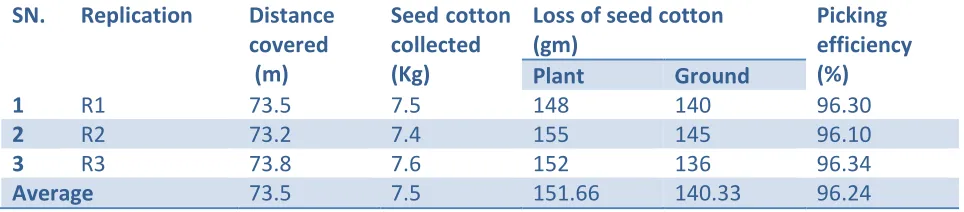
For calculating the picking efficiency of machine a test were carried out. For this total cotton collected by machine, plant loss, ground losses were observed & depicted in the table 2.
Table 2: Picking efficiency of machine
SN. Replication Distance
covered (m)
Seed cotton collected (Kg)
Loss of seed cotton (gm)
Picking efficiency (%)
Plant Ground
1 R1 73.5 7.5 148 140 96.30
2 R2 73.2 7.4 155 145 96.10
3 R3 73.8 7.6 152 136 96.34
Average 73.5 7.5 151.66 140.33 96.24
Organized by C.O.E.T, Akola, ISTE, New Delhi & IWWA. Available Online at www.ijpret.com610
Table 3: Picking efficiency of hand picking method
SN Replication Distance
covered (m)
Cotton collected (Kg)
Loss of cotton (gm)
Picking efficiency (%)
Plant Ground
1 R1 120 11.5 22 5 99.76
2 R2 122 11.8 25 10 99.70
3 R3 118 11.2 29 8 99.67
Average 120 11.5 25.33 7.66 99.71
The machine picking has been compared with the manual picking operation. The manual picking efficiency was observed to be 99.71 per cent.
Field capacity of the picking operation
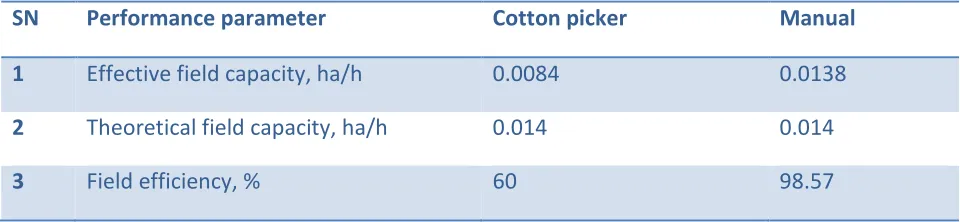
The performance parameters like effective field capacity, and field efficiency of the cotton picker were determined over the manual operation. The working speed of the manual picking operation was observed in the field during the test found to be 0.140 km/h. The effective field capacity of the picker was observed to be 0.0084 ha/h at which labour picking effective field capacity was 0.0138 ha/h. The field efficiency of the cotton picker was observed to be 60 per cent. The results are depicted in Table 4.
Table 4: Performance parameters of cotton picker
SN Performance parameter Cotton picker Manual
1 Effective field capacity, ha/h 0.0084 0.0138
2 Theoretical field capacity, ha/h 0.014 0.014
3 Field efficiency, % 60 98.57
Cost of operation
Organized by C.O.E.T, Akola, ISTE, New Delhi & IWWA. Available Online at www.ijpret.com611
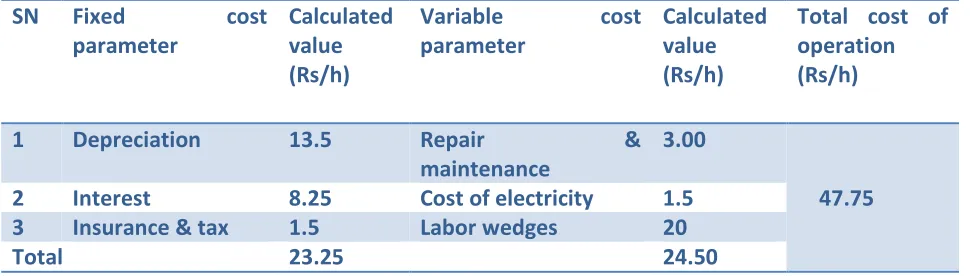
Table 6: Cost of operation by machine
SN Fixed cost
parameter
Calculated value (Rs/h)
Variable cost
parameter
Calculated value (Rs/h)
Total cost of operation (Rs/h)
1 Depreciation 13.5 Repair &
maintenance
3.00
47.75
2 Interest 8.25 Cost of electricity 1.5
3 Insurance & tax 1.5 Labor wedges 20
Total 23.25 24.50
For determining the cost of operation of the machine we have considered the eight picking
of the crop. Accordingly the number of hours of operation in the one years was comes to be 60 hours. The labour wages was considered as the actual paid by the farmers in the study. It was Rs. 150 per day. The cost of operation of the machine per hour was observed to be Rs. 47.75. During the test machine averagely collected the seed cotton near about 8.62 kg per hour. The cost of cotton picking per kilogram was observed to be Rs. 5.54.
The cost of operation per hour for the hand picking operation was calculated to be Rs. 20. During the test handpicked collect seed cotton was 13.22 kg. The cost of seed cotton picked by hand per kilogram was found to be Rs. 1.51.
SUMMARY AND CONCLUSIONS
1. The effective field capacity of the machine was observed to be 0.0084 ha/h. 2. The field efficiency of the machine was observed to be 60 per cent.
3. The seed cotton picking efficiency of the machine was found to be 96.24 per cent. 4. The handpicked efficiency during the operation was observed to be 99.71 per cent.
5. The trash contents observed in the seed cotton picked by the machine was observed to be 8.55 per cent.
6. The trash contests observed in the seed cotton picked by the hand was observed to be 7.30 per cent.
Organized by C.O.E.T, Akola, ISTE, New Delhi & IWWA. Available Online at www.ijpret.com612
8. The cost of operation for the hand picking operation per hour was determined to be Rs. 20. 9. The cost of seed cotton picked by the machine per kilogram was observed to be Rs. 5.54. 10. The cost of seed cotton picked by hand per kilogram was found to be Rs. 1.51.
REFERENCES
1. Goyal, M.R., D.M. Byg and K. Singh. 1979. Appropriate technology for cotton production in India. Agricultural mechanization in Asia, Africa and Latin America. Spring: 73-78.
2. Hettiaratchi K., S.R. Woodhead., and A.R. Reed. 1998. Comparison between pressure drop in horizontal and vertical pneumatic conveying pipelines. Powder Technology 95 (1998 ) 67-73. 3. Hudspeth, E.B.1971. Field storage of burr cotton on Texas High Plains, 1951 - 52. Texas agriculture Express PR 1728
4. Kilickan, A.M. and S.Z. Guner. 2006. Pneumatic Conveying Characteristics of Cotton Seeds, Biosystems Engineering, www.Sciencedirect.com
5. Lazzari, M.R. Marai and E. Natalicchio. 1992. Prototype simplified tractor mounted cotton picker: result of the first two years of experiment test. Rivista-di-Agriculture-Subtropicale-e-tropicale.86:4,615-634.
6. Lindsey, M.M. and M.N. Arthur. 1967. Cotton harvesting in the Yazoo- Mississippi Delta. delta Branch, Mississippi Agr.Exo.Sta. Bul,739.
7. Prasad, J.K., N.S. Sandhar, G.J. Majumdar, P.G.Patil, S.K.Shukla, B.N. Jaiswal and A.B.Patil. (2004). Performance evaluation of spindle type cotton picker. Journal of Agricultural Engineering, Vol.44(1), pp:38-42.
8. Ruixiu, S.J., A.N. Thomasson and S.D. Filip. 2010. Developed Cotton-harvester-flow simulator for testing cotton yield monitors, International Journal of Agric & Biol Engg. Open Access at http://www.ijabe.org Vol. 3 No.1