Integrating Behavioral-Motive and Experiential-Requirement Perspectives
on Psychological Needs: A Two Process Model
Kennon M. Sheldon
University of MissouriPsychological need theories offer much explanatory potential for behavioral scientists, but there is considerable disagreement and confusion about what needs are and how they work. A 2-process model of psychological needs is outlined, viewing needs as evolved functional systems that provide both (a) innate psychosocial motives that tend to impel adaptive behavior and (b) innate experiential requirements that when met reinforce adaptive behavior and promote mental health. The literature is reviewed to find support for 8 hypotheses derived from this model: that certain basic psychosocial motives are present at birth; that successful enactment of these motives supports the functioning and wellness of all humans; that individual differences in these motives develop in childhood; that these strong motive dispositions tend to produce the satisfying experiences they seek; that motive dispositions do not moderate the effect of motive-corresponding need satisfaction on well-being but do moderate the effect of assigned goal-type on rated self-concordance for those goals; that need dissatisfaction and need satisfaction correspond to the separable behavioral-motive and experiential-reward aspects of needs; and that motives and needs can become decoupled when chronic dissatisfaction of particular requirements warps or depresses the corresponding motives, such that the adaptive process fails in its function. Implications for self-determination theory and motive disposition theory are considered.
Keywords: psychological needs, self-determination theory, motive disposition theory
In order to thoroughly understand human behavior, psycholo-gists need to understand what it is that people want and need. In other words, even a complete knowledge of the mind’s lower level neural and cognitive machinery may do us limited good if we do not know what people are striving to do as they employ this machinery (Emmons, 1989; Carver & Scheier, 1998); emergent personality processes and their effects are likely irreducible to component biological or cognitive processes (Carver & Scheier, 1998; McAdams, 1996; Sheldon, 2004b; Sheldon, Cheng, & Hil-pert, 2011). Psychological need constructs have long held great promise in addressing these essential questions because they con-cern the basic motivations and desires that move people through life (Maslow, 1954). Correctly conceived, need theories can pro-vide a powerful theoretical lens with which to consider both the ultimate functions of lower level processes and how successfully those processes fulfill their functions (Sheldon, 2004b).
Unfortunately, psychological need theories have long been plagued by definitional problems and theoretical disagreements. Should basic psychological needs be conceptualized as noncon-scious motives that orient people automatically toward the pursuit of varying incentives in the world (Schultheiss, 2008), or should psychological needs be conceptualized as requirements for partic-ular types of conscious experience that bring happiness and growth (Deci & Ryan, 2000)? Do psychological needs energize and acti-vate behavior, or do they reward and reinforce it? Are needs
acquired through development and learning, or are they inherent within the human genome (White, 1959)? Also, are there many domain-specific psychological needs, corresponding to the many specific adaptive problems faced by humans (Buss, 2008), or might there also be a few higher order or domain-general needs, which allow flexible solutions to a wide range of unpredictable adaptive problems (MacDonald, 1991)? Of course, it is possible that the answer is “yes” to all of these questions (i.e., all of the propositions are true); however, ways to link these superficially diverging perspectives on needs are not currently apparent. This article proposes an integrative process model of psychological needs that addresses these issues. Notably, the “two processes” referenced in this model are not automatic versus controlled pro-cesses or nonconscious versus conscious propro-cesses, as in many currently popular models of social cognition; instead, as will become clear, the coupled processes refer to separable behavioral energization and experiential reward facets of a more or less integrated functional system.
The two process model (TPM) of psychological needs rests on this general proposition: Psychological needs are evolved
tenden-cies to seek out certain basic types of psychosocial experiences and to feel good and thrive when those basic experiences are obtained. This perspective defines psychological needs as both
behavioral motives that are inborn within everyone (although people may develop variations in the strengths of these motives) and as experiential nutriments (Ryan, 1995) that everyone requires in order to thrive and experience wellness (although people may vary in how well these needs are satisfied). The two aspects of psychological needs serve as part of a coupled motivational system that functions by prompting people to pursue (typically) adaptive behavioral motives and also reinforces them when successful This article was published Online First July 25, 2011.
Correspondence concerning this article should be addressed to Kennon M. Sheldon, 112 McAlester Hall, Psychological Sciences, University of Missouri, Columbia, MO 65211. E-mail: [email protected]
552
This
document
is
copyrighted
by
the
American
Psychological
Association
or
one
of
its
allied
publishers.
This
article
is
intended
solely
for
the
personal
use
of
the
individual
user
and
is
not
to
be
disseminated
need-relevant behavior occurs. Eight specific hypotheses are de-rived from this general proposition, which is evaluated via a selective but integrative review of the relevant literatures.
Before turning to these eight hypotheses, however, it is first necessary to consider the abstract nature of need-based motiva-tional systems. In the next section, I first discuss the behavioral-motive and experiential-requirement aspects of psychological needs separately, aspects best represented by motive disposition theory (MDT; McClelland, 1985) and self-determination theory (SDT; Deci & Ryan, 1985), respectively. I then argue that behav-ioral motives and experiential requirements should not simply be conflated; they represent separate processes that can become de-coupled. I then consider how the two aspects of the system typically work together to peoples’ benefit. Next, I consider why such psychological need systems might exist, using evolutionary reasoning. Then, I discuss the criteria we might use in order to identify which psychosocial qualities function as basic psycholog-ical needs and to weed out nonneeds. Next, I compare the TPM to some other existing psychological need theories. Finally, the eight hypotheses are considered, as a test of the core ideas of the TPM. These core ideas are presented below.
Defining Psychological Needs
Needs-as-Requirements
The notion that people need certain elements in order to be healthy is an ancient one, and the list of what these elements might be is long. Drive and biologically based theories of healthy func-tioning (Hull, 1943) provide prominent examples: People need the elements of food, water, air, sleep, and so on in order to survive and/or be healthy. However, the perennial issue for philosophers, psychologists, and social theorists involves more than mere phys-ical needs such as these; instead, the question is whether people need certain psychological elements, that is, specific virtues, val-ues, attitudes, beliefs, or activities, in order to thrive. For these psychological theories, the question is not whether life is being maintained but rather whether optimal performance, happiness, growth, and health are being promoted via the functioning of the personality/contextual system (Maslow, 1954; Sheldon, Cheng, & Hilpert, 2011).
Psychological need theories in particular focus on certain
psy-chosocial experiences (or sets of experiences) that people are
presumed to need—for example, experiences of belongingness (Baumeister & Leary, 1995), power (Adler, 1917), self-actualization (Rogers, 1961), self-esteem (Greenberg, Pyszczyn-ski, & Solomon, 1986), self-consistency (Heider, 1958), or auton-omy, competence, and relatedness (Deci & Ryan, 2000). Regardless of their disagreements concerning which needs belong within the basic set (considered later), these theories all assume that a need is a certain type, content, or character of psychosocial experience that people need to feel, presumably consciously, if they are to grow, develop, and be happy and well adjusted. We might term this the needs-as-requirements perspective, in which needs are akin to psychological vitamins that people must experi-ence to be healthy. The exact dosage or optimal timing of these experiences might vary across different psychological needs, peo-ple, or theories, but one way or another, all people are said to need
some significant amount or intensity of the designated experiences in order to thrive.
Requirement theories typically claim to be identifying univer-sally needed experiences, relatively unqualified by individual or cultural differences. A typical research strategy for validating a candidate need is to show that its experiential presence predicts unique variance in expected outcomes, such as performance, health, well-being, or personal growth, approximately equivalently for all people (Deci & Ryan, 2000; Ryan & Deci, 2008; Sheldon, Elliot, Kim, & Kasser, 2001). For example, Baumeister and Leary (1995) reviewed a large literature on the positive mental health and well-being effects that result when belongingness requirements are met, and the health and well-being decrements that result when belongingness requirements are not met, effects found in all cul-tures and personality types. Thus, belongingness seems to be a psychological “vitamin” whose experiential absence universally causes psychological and even physical suffering (Maslow, 1954). Self-determination theory (SDT; Deci & Ryan, 1985, 2000; Ryan & Deci, 2008) provides the best current exemplar of a needs-as-requirements theory, with its assumption that human beings have evolved three basic psychological need requirements: for autonomy (feelings of volition and self-ownership), compe-tence (feelings of effectance and mastery), and relatedness (feel-ings of social connectedness, similar to Baumeister and Leary’s posited need for belongingness). As reviewed in more detail be-low, SDT research has focused on showing that these three expe-riences uniquely predict a wide variety of positive outcomes in a wide variety of contexts and cultures (Ryan & Deci, 2008). Much of the current article’s exposition of the proffered TPM cites recent research concerning SDT’s proposed three universal need require-ments because this research is highly relevant. However, the TPM is expected to apply regardless of which psychosocial experiences are ultimately identified as belonging to the basic set. That is, acceptance of SDT is not necessary for accepting the TPM.
Needs-as-Motives
The above discussion addressed the needs-as-requirements the-ories, the notion that people need certain “experiential vitamins” to thrive. However, further consideration of the literature shows that psychological needs are also frequently conceptualized as motives that people have, that is, as urges to go out and do certain things or pursue certain incentives. We might call this the needs as
behavioral motives perspective. Examples of theories employing
the needs-as-motives perspective go back at least to Murray (1938), with his conception of needs as internal presses that influence behavior, an idea that was further developed by the motive disposition tradition of McClelland, Atkinson, Winter, McAdams, and others (Atkinson & Burch, 1970; McClelland, 1985). Maslow’s (1954) theory of personality and motivation also employed a needs-as-motives perspective, stating that unmet needs at a particular level of a need hierarchy prompt ameliorative behavioral efforts at that level.
Although both Murray and Maslow attempted to specify sets of universal behavioral motives (27 for Murray and five for Maslow), they also acknowledged that people could vary on the strength or these impulses, as a function of learning, current state, or life stage. And indeed, motive disposition theories (McClelland, 1985; Win-ter, 1992) rely on the assertion that there are prominent individual
This
document
is
copyrighted
by
the
American
Psychological
Association
or
one
of
its
allied
publishers.
This
article
is
intended
solely
for
the
personal
use
of
the
individual
user
and
is
not
to
be
disseminated
differences in certain basic need motives, typically the needs for achievement (nAch), affiliation (nAff), and power (nPow). A typical research strategy in the needs-as-motives area is to show that individual differences in particular need motives (e.g., for achievement), as measured by content coding of relevant psycho-social themes appearing in spontaneous text, predict a wide variety of corresponding purposive behaviors and perceptual orientations. For example, people high in nAch tend to persist longer in achieve-ment tasks, tend to notice achieveachieve-ment-relevant perceptual cues, tend to choose moderately difficult and thus maximally diagnostic achievement goals, and so on (McClelland, 1985).
Distinguishing Between Needs-as-Motives and
Needs-as-Requirements
One might simply conflate the requirement and motive perspec-tives on psychological needs, assuming that they are simply two different ways of talking about the same phenomenon. For exam-ple, in their theoretical writings, motive disposition theorists use the terms “need for X” and “the motive disposition toward X” essentially interchangeably (McClelland, 1985). However, conflat-ing needs and motives implies that unmet needs invariably arouse relevant motives and that aroused motives invariably satisfy unmet needs. For example, a person’s unmet belongingness need (feel-ings of loneliness) would automatically produce a relevant belong-ingness motive (i.e., “find somebody to talk to”), which would automatically produce a belongingness experience (talking would produce felt belongingness). Obviously, such sequences can and do happen, but they do not necessarily happen.
In short, I suggest it is crucial to distinguish between psycho-logical needs as behavioral motives and psychopsycho-logical needs as experiential requirements. This is for three primary reasons:
1. First, motives are salient at the inception of an action se-quence, influencing what is attempted during the action sese-quence, whereas experiences are more salient at the conclusion of the action sequence, presumably influencing the likelihood of repeat-ing the action sequence (Gollwitzer, 1990). In other words, insti-gating motives and resulting experiences occur at different phases of a dynamic temporal process. Of course, these phases are not absolutely distinct; for example, anticipated or expected experi-ences might influence the decision to initiate action and initial motives might influence how the consequences of an action se-quence are experienced and evaluated (Gollwitzer, 1990). Still, theories of motives and theories of needs-as-requirements may ultimately explain different parts of a behavioral sequence, and both types of theory may be required for the most comprehensive understanding of the entire sequence. This cannot happen if motives and needs are not distinguished, which this article accomplishes by defining them as two different aspects of a loosely coupled sequence.
2. Second, what people are motivated to do may not provide them with what they need. Consider a stereotypical status- or wealth-seeking financier who suffers continuing malaise because he is callous and has few friends; he is not getting his interpersonal need requirements met. He copes by putting in even more hours at work, trying to fill the void with luxuries and accomplishments, but the problem only gets worse (Kasser, 2002). Examples such as these suggest that a person’s behavioral choices can be “out of touch” or nonconcordant with his or her evolved needs or deeper
organism (Sheldon, 2004b), such that even if the person success-fully achieves his personal strivings (Emmons, 1989), he or she may fail to thrive (Sheldon & Elliot, 1999). In terms of the vitamin metaphor, one’s chosen food may not actually be nutritious. Ac-knowledging that motives can be distinct from needs and may not meet needs opens up important questions concerning the adequacy of peoples’ motives and behavioral choices, the means by which contexts can facilitate better and more need-sensitive choices (Kuhl & Kazen, 1994), and the means by which people cope with acute and/or chronic dissatisfaction due to contextual thwarting or due to their own inadequate choices.
3. A third reason to distinguish between needs as motives versus experiential requirements is that people may not be motivated to get what they do need; for example, a lonely recluse with an unmet belongingness need may withdraw further from others rather than reach out to others, or a person’s need-relevant motives may be of a degraded type: The man described above may engage in many casual sexual encounters with young office workers, but these experiences do not provide deeper interpersonal need-satisfaction. As these two examples illustrate, and as is discussed further below, even presumed universal need requirements (e.g., for belonging-ness) do not necessarily evoke action, or appropriate action, to meet themselves. Because the TPM being proposed here facilitates separate consideration and testing of needs as motives and needs as requirements, it is well poised to address the dynamic reasons why, as Mick Jagger (Jagger & Richards, 1965) observed, some people “can’t get no satisfaction.”
Before turning to the model, however, further consideration of the MDT perspective on the motives versus requirements issue is warranted. MDT researchers might suggest that the callous young man’s malaise results from conflict between his strong need for achievement or power and his strong need for affiliation. In this view, if he were not high on the need for affiliation (as well as the need for achievement), he would experience no conflict and no malaise. However, a universal requirements theory would reply that all people have a need to feel relatedness, whether or not they orient particularly toward getting affiliation, and thus would hold that the young man would suffer even if he were not disposition-ally (or especidisposition-ally) high on affiliation motivation (Baumeister & Leary, 1995).
As another consideration, MDT researchers emphasize the dis-tinction between implicit or nonconscious motives and explicit or self-attributed motives; the former are thought to represent affec-tive learning and to influence spontaneous behavioral choices, whereas the latter are thought to represent the self-concept and to influence self-reports (McClelland, Koestner, & Weinberger, 1989; Schultheiss, 2008). The TPM outlined here does not distin-guish between implicit and explicit motives, simply viewing them as different ways that motives (on the behavioral side) can be expressed. Indeed, data presented under Hypothesis 4, below, suggest that implicit and explicit motives are equally predictive of corresponding need satisfaction. This does not mean that the explicit/implicit distinction is immaterial to the TPM, just that there is little relevant data as yet. Finally, it is noteworthy that MDT theorists have typically not focused as much attention on the issue of whether motivated behavior succeeds in its aims, thereby providing the desired experiences; again, MDT has considered primarily the inception phase of need-striving processes and has given less attention to the outcome phase of those processes (but
This
document
is
copyrighted
by
the
American
Psychological
Association
or
one
of
its
allied
publishers.
This
article
is
intended
solely
for
the
personal
use
of
the
individual
user
and
is
not
to
be
disseminated
see Jemmott, 1987, who showed that inhibited power motive syndrome may be a risk factor for a variety of negative health outcomes).
The Two Process Dynamic
How do motives and requirements work to peoples’ benefit, and how can requirements and motives become decoupled? Let us further consider the basic biological drives, for food, water, air, and so on. Consistent with the TPM, these physical needs appear to have two aspects: People are innately motivated to pursue the physical needs for air, food, and water (after sufficient time has passed), and successful attainment of these needs is rewarded by specific positive experiences, of relief, satiety, and quenching, which doubtless influence future behavior. For example, a student with an aroused hunger drive seeks a source of food, finds a snack machine just down the hall, sates his hunger, and returns to that machine the next day. In this case the coupled adaptive system is evident in the fact that unmet needs spawn drives that energize behavior, and the particular directed behaviors that successfully reduce those drives are presumably reinforced and strengthened (i.e., the behaviors become habits; Hull, 1943).
Still, it is important to note that even in the case of physical drives and requirements, motives and requirements can become decoupled. Hungry people may fail to eat available food, to the point of starvation (e.g., anorexics). Thus, missing physical re-quirements do not necessarily spur motivation. Also, the behaviors undertaken to get nutrition (eating too much snack machine food) may not succeed in providing much actual nutrition. Thus, moti-vated behavior does not necessarily supply missing requirements. This is likely even more true in the domain of psychological needs, which are presumably not as pressing (or as required) as physical needs. Again, the two processes need to be kept distinct and not conflated because at times, missing requirements might not spur relevant motives, and at times, aroused motives might not provide missing requirements.
There is of course much more that could be said about drive and biological perspectives on needs, which I l forgo because my focus is on psychological, not physical needs. Instead, I merely pose the question: How do psychological needs differ from physical needs? In some ways, and consistent with reinforcement and learning perspectives, they may not differ much (McClelland, 1985). Both types of need presumably give rise to urges to seek out particular experiences or incentives, perhaps particularly when the need is saliently lacking, and for both type of need, the behaviors that provide the desired experiences are presumably reinforced. Paral-leling the example of the hungry student above, a lonely student (missing belongingness) is on average more likely to reach out to another person than a nonlonely student, and if the result is good (belongingness is experienced), she may call that same person again the next time she is lonely.
Still, there are obviously important differences between the “lonely” and the “hungry” student. First, psychological needs (as requirements) are not associated with objectively measurable bodily conditions and deficiencies, as are drives for food, air, and water. Second, psychological needs (as motives) presumably do not arise as a simple linear function of time of deprivation or time since last satiation. The temporal dynamics affecting the waxing and waning of psychological motives are likely complex, and
unfortunately this topic has received little attention since Atkinson and Birch’s (1970) pioneering research. Third, biological drives are primarily about absences or deficiencies (the individual acts to reduce tension or discomfort), whereas psychological need mo-tives might involve proactively seeking stimulation or positive states, as well as reacting to prior negative states (Deci & Ryan, 1985; White, 1959). Another important difference between phys-ical and psychologphys-ical needs is that people appear to be able to tolerate much more thwarting of psychological need requirements than thwarting of physical need requirements. A person deprived of food will either solve the problem or become sick and die. A person deprived of a psychological need will merely feel unhappy, perhaps in time becoming helpless with respect to obtaining the need.
Although psychological needs-as-motives are not physical drives, in at least one important further respect they may function like drives: namely, via their regulation by negative feedback or discrepancy-reduction processes (Carver & Scheier, 1998). Psy-chological need motives may supply implicit reference standards or set points regarding the level of positive psychosocial experi-ence that people want and expect. When the absexperi-ence of the required experience becomes highly salient (i.e., discrepancies from these reference standards are detected; Carver & Scheier, 1998; Emmons, 1989), then motives to ameliorate the situation may subsequently result (Atkinson & Birch, 1970), in a test– operate–test– exit sequence (TOTE; Miller, Galanter, & Pribram, 1960). For example, a student who expects and is satisfied with a “B” average may become motivated to study harder after receiving a “D” on the first test; his effectance or competence need (White, 1959) has been thwarted, so he takes action to remedy the discrep-ancy. It is hoped that his renewed studying is rewarded with a “B” or even an “A” grade on the next test, thereby meeting his competence need and also reinforcing the studying behavior.
Figure 1 represents such a process. Salient need-relevant nega-tive events (“felt rejected,” “got a D,” “felt manipulated”) produce negative affect and also arouse implicit standards for how the person wants and expects things to be. These activated standards energize behavioral efforts to remedy and improve the situation, in a TOTE sequence that is often characterized by conscious process-ing. The connections in the model are of course only probabilistic, such that negative events do not necessarily arouse motivation, aroused motivation does not necessarily produce behavior, and behavior does not necessarily produce new satisfaction of the particular need. Also, motives may arise at times from positive and not just negative precursor events or may arise from endogenous sources without a particular prompt or precursor. Figure 1 merely aims to illuminate one particular motivational sequence that more often than not, is beneficial for people. The implications of this view, and the emerging data supporting the view, are discussed further throughout this article.
Figure 1. A regulatory process linking as-requirements and needs-as-motives. TOTE⫽test– operate–test– exit sequence.
This
document
is
copyrighted
by
the
American
Psychological
Association
or
one
of
its
allied
publishers.
This
article
is
intended
solely
for
the
personal
use
of
the
individual
user
and
is
not
to
be
disseminated
The Origin of Psychological Needs
The TPM is meant to describe a basic personality process common to all human beings. This universalist assumption re-quires consideration of the ultimate function of psychological needs. Evolutionary reasoning suggests that innate psychological need systems, if they exist, evolved because they produced more adaptive behavior on average, compared with those without those needs. Obviously, human behavior is not completely hard-wired and thus is not tied automatically to specific stimuli or social configurations. Instead, motivated internal processing lets one cope, often very creatively, with the infinite variations and unpre-dictable twists that emerge within the shared social world of individuals. Because of such internal processing, most people manage to maintain a fairly steady course toward their own agen-das and needs, despite the many potential deflections. In line with this idea, Baumeister and Leary (1995) suggested that in order to adapt on the fly to the emergent complexities of social life, individuals need a few general guides and rules; things they are trying to do, regardless of the particular situational variations they encounter. These general motives, if evolved, should correspond to general categories of adaptive behavior; that is, they should make subjective agents “want” to have the experiences associated with adaptive behavior and make the feelings that result from such behavior innately rewarding and desirable (MacDonald, 1991).
Consider the evolved need for belongingness or relatedness, proposed and well supported by Baumeister and Leary (1995). Random mutations presumably produced individuals who wanted to feel much positive affect and communion, compared with their conspecifics. Assuming that these motivated efforts succeeded (i.e., these especially social individuals formed more stable and favorable relationships and alliances, elicited more cooperation from others, and raised more socially adept children) and assuming that these outcomes are more adaptive on average (i.e., they enhance survival and/or reproduction), then the frequency of the genes or gene-complexes supporting the relatedness need system would have increased in the population until everyone had them. As a result, a need for belongingness or relatedness would over time become a universal or species-typical feature of human nature (Tooby & Cosmides, 1990). Indeed, such a universal motive for interpersonal connectedness appears to be evident almost imme-diately, in the operation of early attachment security processes, and the motive continues to powerfully affect almost every area of human life thereafter (Baumeister & Leary, 1995). This very general motivational predisposition appears to help humans solve the lifelong adaptive problem of securing cooperation and benefits from others.
A somewhat contrasting perspective was put forth by Buss (1995, 2008), who argued that evolved human personality should contain many domain-specific orientations and capabilities, each designed to solve a specific adaptive problem and each of which takes in only a narrow slice of information and applies a very particular set of decision rules (Buss, 2008, p. 38). Buss also suggested that general or global psychological mechanisms should not evolve because there is no such thing as a general adaptive problem (Symons, 1992). The mind is said to be like a Swiss Army knife, with specific tools evolved to handle the specificity of the many different problems faced, and general mechanisms would fail to guide individuals to correct adaptive solutions (p. 39). In
this context, Buss (2008) discussed several domain-specific dis-positions including fears of snakes or spiders, tendencies to be-come jealous when one’s spouse talks to others, tendencies to prefer certain landscapes, tendencies to prefer fatty or salty foods, and tendencies to seek social status.
Although domain-specific predispositions and mechanisms doubtless exist, the current argument rests on the notion that
general psychosocial motives also evolved, such as a need for
belongingness, to help individuals navigate a reasonably coherent and steady course through the bewildering complexities of human life (Baumeister & Leary, 1995; Deci & Ryan, 2000). The problem of connecting and cooperating with others may be of such a broad, complex, and diverse nature that it cannot be reduced to a set of specific decision rules and if–then contingencies. Indeed, it seems fair to question whether humans are really run by hundreds of encapsulated modules, evolved in the Pleistocene to solve hun-dreds of different specific social problems, or rather whether they might also have a few general motives that provide them a basis for making online strategic calculations and innovations (MacDon-ald, 1991). A small suite of broad social motives, given some ability to control and regulate the activation of the more specific social mechanisms discussed by Buss (2008), might explain how people can continue to function effectively in the social world even as that social world changes from a local tribe of Pleistocene hunter-gathers to an international network of Facebook users and cell phone users. Humans may still be trying to get the same basic experiences, just by different means.
As mentioned above, Buss (2008) made a case for an adaptive mechanism for status and status seeking, along with specific mo-tives to prefer certain landscapes, to guard one’s mate, to avoid spiders and snakes, and so on. However, status seeking seems of a different category than the others: status seeking is a domain-general motivation which cross-cuts all areas of social and group life, cuing a potentially infinite variety of strategic behaviors including Machiavellian submission or deference at times (Wilson, Near, & Miller, 1996); indeed, status may sometimes be achieved by refusing to play “status games” and by instead hewing to a personal or moral code immune to such considerations (Erikson, 1963). In other words, it is difficult to construe status seeking as a domain-specific adaption sensitive to a very narrow range of information with very specific if–then decision rules used to solve a very specific problem. It is also difficult to imagine what incred-ibly complex suite of preexistent stimulus–response sequences would have to reside within the evolved mind in order to mecha-nistically facilitate the endlessly nuanced negotiations that deter-mine status.
Fortunately, such all-encompassing preexistent programs are not necessary, given the presence of an action system or executive function that is moved by motives and needs. Action systems function best when there is top-down regulation, typically by more abstract principles and purposes, which provide standards for the negative feedback and discrepancy reduction processes that move people forward (Austin & Vancouver, 1996; Carver & Scheier, 1981, 1998). In other words, broader motives can provide criteria with which to assess the current situation and can thus inform the flexible choice of how more specific evolved adaptations and learned skills should be deployed (Sheldon, 2004b). Evolutionary perspectives have been somewhat slow to incorporate flexible executive functioning into their theoretical armamentarium (but
This
document
is
copyrighted
by
the
American
Psychological
Association
or
one
of
its
allied
publishers.
This
article
is
intended
solely
for
the
personal
use
of
the
individual
user
and
is
not
to
be
disseminated
see Geary & Huffman, 2002; MacDonald, 1991), sometimes pre-ferring instead to stick to a stimulus–response or cognitive auto-maticity model (Bargh & Ferguson, 2000) that precludes having to deal with notions of subjective agency. Incidentally, in a later section of this article I suggest that there may not be a psycholog-ical need requirement for status, at least not as defined by the current theory. Very strong status seeking may be a compensatory, not a basic, motivation.
One final general observation is worth making about psycho-logical needs: Although they are evolved adaptations, they can also make people vulnerable. Organisms (such as plants) have needs that evolved (for water, sunlight, and carbon dioxide and for species-typical nutrients) because provision of those nutrients af-forded optimal growth and thriving within the organism’s niche. However, each new need also produces a new vulnerability; if something is actually needed (not merely wanted), then suffering results when the need is thwarted. Furthermore, people’s attempts to cope with this suffering may produce even further suffering, as discussed under Hypothesis 8.
Criteria for Identifying Basic Needs
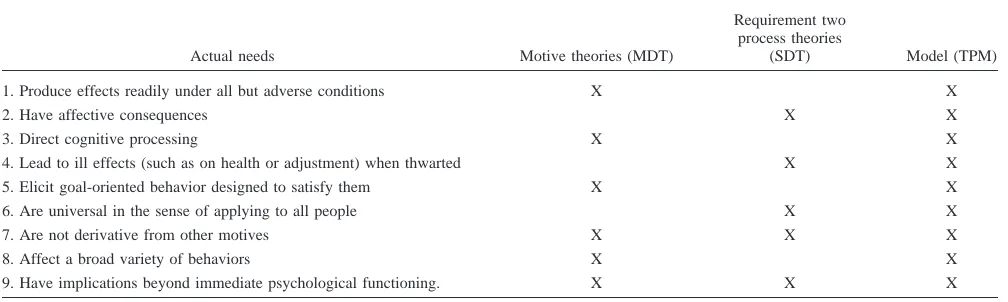
The above consideration of status seeking raises an important question: How do we tell what is, or is not, a basic psychological need? Obviously, there should be stringent criteria for identifying basic needs, in order to rigorously test hypothesized needs and to prevent the undue multiplication of unwarranted needs. Baumeis-ter and Leary (1995) provided the most comprehensive analysis of the criterion question, in a preliminary section prior to developing their argument that there is a fundamental need for belongingness or relatedness. Specifically, they proposed that a “true” need should (a) produce effects readily under all but adverse conditions, (b) have affective consequences, (c) direct cognitive processing, (d) lead to ill effects (such as on health or adjustment) when thwarted, (e) elicit goal-oriented behavior designed to satisfy it (subject to motivational patterns such as object substitutability and satiation), (f) be universal in the sense of applying to all people, (g) not be derivative of other motives, (h) affect a broad variety of behaviors, and (i) have implications that go beyond immediate psychological functioning. A “true” universal need should meet all
of these criteria, and Baumeister and Leary’s (1995) review of the literature showed that the proposed need for belongingness indeed passed this stringent test.
The TPM proposed in this article addresses all nine of these criteria (see Table 1, which is discussed further in the next sec-tion). Again, the model proposes that psychosocial needs both are universal motives that tend to produce adaptive behavior (needs-as-motives perspective) and are universally required experiences that tend to promote thriving (needs-as-requirements perspective). The needs-as-motives perspective covers Criteria 1, 3, 5, 8, and 9 by specifying that actual needs produce behavioral effects, direct processing, elicit goal-oriented behavior, affect a broad variety of behavior, and have implications beyond immediate functioning (i.e., successful adaptation). The needs-as-requirements perspec-tive covers Criteria 2, 4, 6, 7, and 9 by specifying that actual needs have affective consequences, lead to ill effects when thwarted, are required by all people, are not derivable from other experiences (just as vitamin C is not derivable from other vitamins), and have broad implications.
Comparing the TPM to Other Need Models
Most extant psychological need theory research tends to focus on either the motive aspect or the requirement aspect of needs, rarely giving empirical consideration to the other aspect. Thus, these theories do not provide full support for their proposed needs, according to Baumeister and Leary’s (1995) nine criteria. For example, despite using both need and motive terms, MDT re-searchers focus primarily on motives by using individual differ-ences in motive-strengths to predict behavior and typically take no position on whether the sought experiences are actually “required” in some way (McClelland, 1985). However, such consideration seems important if one wants to say people really need something. Epstein (2003) and Fiske (2003) also employed both motive and need terminology in describing their theories of basic psycholog-ical needs, but careful reading reveals that their posited needs (self-esteem, relatedness, pleasure, and self-coherence, for Ep-stein; belongingness, control, self-enhancement, shared social un-derstanding, and trust, for Fiske) also are primarily conceived of as internal motives influencing social cognition and social behavior
Table 1
Baumeister and Leary’s (1995) Nine Criteria for Identifying Basic Psychological Needs
Actual needs Motive theories (MDT)
Requirement two process theories
(SDT) Model (TPM)
1. Produce effects readily under all but adverse conditions X X
2. Have affective consequences X X
3. Direct cognitive processing X X
4. Lead to ill effects (such as on health or adjustment) when thwarted X X
5. Elicit goal-oriented behavior designed to satisfy them X X
6. Are universal in the sense of applying to all people X X
7. Are not derivative from other motives X X X
8. Affect a broad variety of behaviors X X
9. Have implications beyond immediate psychological functioning. X X X
Note. SDT⫽self-determination theory; MDT⫽motive disposition theory; TPM⫽two process model; X⫽criteria addressed by a theory.
This
document
is
copyrighted
by
the
American
Psychological
Association
or
one
of
its
allied
publishers.
This
article
is
intended
solely
for
the
personal
use
of
the
individual
user
and
is
not
to
be
disseminated
rather than as required nutrimental experiences influencing further outcomes such as growth and happiness.
On the opposite side, although SDT researchers occasionally allude to unmet needs as motivating behavior (i.e., Deci & Ryan, 2000, p. 230), Ryan and Deci (2008) explicitly identified SDT as primarily an experiential requirements-type theory rather than a motive disposition-type theory. Also, empirical SDT needs re-search has focused almost without exception on needs-as-requirements that mediate between external contextual variables and downstream outcomes, such that unmet needs are found to have exclusively negative effects. Little research has been done to examine whether unmet SDT needs can potentially motivate need-relevant and adaptive behavior, such that people can take action to meet their own needs even when contexts do not support needs (but see Sheldon & Gunz, 2009, discussed further under Hypoth-esis 7).
Table 1 compares MDT, SDT, and the current TPM regarding which criteria for identifying actual needs are primarily addressed, showing that the TPM, by combining aspects of SDT and MDT, addresses all of the Baumeister and Leary (1995) criteria. Notably, Maslow’s (1954) need theory also addresses both facets of needs, defining needs both as motives that prompt behavior and as experi-ential requirements that promote mental health. For example, a person who does not have their belongingness need met, in Maslow’s theory, is motivated to go out and meet that need; once that need is met, mental health is facilitated and a new, “higher” need emerges (in this case, self-esteem). However, Maslow’s hierarchical conception of needs, in which satisfaction of need X results in activation of subsequent motive Y at a higher level of a hierarchy, has received little empirical support (Wahba & Bridwell, 1976), and the basic set of five needs he proposed may be in need of some revision (as is considered in a later section).
Eight Hypotheses Concerning Psychological Needs
The reasoning in the first half of this article suggests eight hypotheses regarding lines of theory or patterns of findings that should already be present in the literature. These eight hypotheses are presented summarily below and subsequently discussed one at a time.
Hypothesis 1: Basic psychosocial motives are evident at or
soon after birth, presumably because of their importance for learning and adaptation. The basic set may include SDT’s postulated three needs for relatedness, competence, and au-tonomy (Deci & Ryan, 1985, 2000; Ryan & Deci, 2008).
Hypothesis 2: Certain psychosocial experiences (such as
re-latedness, competence, and autonomy) positively impact the well-being of all humans; this supports their designation as needs by the requirements criteria.
Hypothesis 3: In adults, there will be variability or individual
differences in motives to get these basic psychosocial expe-riences, based on variable learning and reinforcement during childhood and/or based on genetic dispositions. MDT ad-dresses such variability, focusing primarily on motives to-ward affiliation, achievement, and power or personal causa-tion, dispositions that correspond to the SDT need
requirements for relatedness, competence, and autonomy. This correspondence is no accident.
Hypothesis 4: Strong dispositional motives (and the behaviors
they evoke) tend to bring about corresponding need satisfac-tion; for example, need for achievement should be associated with competence need-satisfaction and need for affiliation should be associated with relatedness need-satisfaction. Mo-tive dispositions developed because they were reinforced, creating dominant approaches to need satisfaction that are still being employed.
Hypothesis 5: However, those high in a motive should benefit
no more or less than those low in that motive from actually receiving a motive-relevant experience; the individual differ-ences in Hypothesis 4 concern the behavioral-motive facet of needs, not the experiential requirements facet of needs. More generally, need satisfaction (met requirement) effects on well-being should have very few moderators; all people are af-fected much the same way by basic need satisfaction because needs are part of basic human nature.
Hypothesis 6: Still, those high in a motive disposition should
report more self-concordant goal motivation when their goals match their motive disposition. Whereas Hypothesis 5 says that people high in motive X do not get extra happiness benefits from experiences of X (a nonmatching hypothesis), Hypothesis 6 specifies that when goals match one’s motive disposition, one gains extra motivational resources for goal pursuit. Hypothesis 6 links MDT, SDT, and relevant goal constructs within a single dynamic framework.
Hypothesis 7: Measures of need satisfaction and need
dissat-isfaction (i.e., of met and unmet requirements) are not just psychometric opposites; positive and negative satisfaction should be empirically distinguished because they may be salient at different phases of the behavioral sequence and may predict or be predicted by different things.
Hypothesis 8: Chronic dissatisfaction might warp or
extin-guish needs-as-motives, inducing maladaptive compensatory strivings or even helplessness. As in the financier and recluse examples, people may not know what they need or what to do to meet their needs, or they may have lost the motivation to take action to meet their needs.
Below, I consider each hypothesis in turn.
Hypothesis 1: Basic psychosocial motives are evident at or
soon after birth, presumably because of their importance for learning and adaptation. The basic set may include SDT’s postulated three needs for relatedness, competence, and au-tonomy (Deci & Ryan, 1985, 2000; Ryan & Deci, 2008).
Although human infants were once said to have few innate behavioral propensities beyond a few simple reflexes, it is now apparent that babies are not blank slates; they come pre-equipped with cognitive and motivational systems to help them do the massive amount of learning that is required (Buss, 2008; Pinker, 2002). These propensities may not manifest immediately at birth,
This
document
is
copyrighted
by
the
American
Psychological
Association
or
one
of
its
allied
publishers.
This
article
is
intended
solely
for
the
personal
use
of
the
individual
user
and
is
not
to
be
disseminated
but they initiate rapidly once the infant becomes oriented. In this section, I consider the questions of which basic psychosocial motives might exist and how early they might exist. For this purpose, I focus on the three basic psychological needs proposed by SDT—relatedness, competence, and autonomy (Ryan & Deci, 2008)—as these needs both receive much current research atten-tion and are reflected in many other theories besides SDT. Again, however, acceptance of the basic propositions of the TPM does not require acceptance of SDT or SDT’s specific proposed three needs.
Relatedness Motives
One very early propensity involves the attachment system (Bowlby, 1969), which ideally evokes a secure interpersonal bond (i.e., a feeling of psychological relatedness) between the infant and his and/or her caregivers. Babies smile at faces, coo when touched, and giggle when played with. They also quickly come to rely on the presence of the caregiver(s), manifesting loneliness and dis-tress when the caregiver is absent. Similarly, parents have an intense desire to relate to and guide their children. It seems apparent that an evolved need for interpersonal connection, as manifested in both the infant and caregiver, goes a long way in helping vulnerable, immature humans to navigate their long child-hoods and in helping parents to retain their sanity (Bigelow, MacLean, Proctor, Myatt, Gillis, & Power, 2010). Later, the at-tachment system becomes the model for a wide variety of inter-personal relationship styles and processes (Shaver & Mikulincer, 2010), as humans negotiate with each other for the feelings of connection and belongingness that they need (Baumeister & Leary, 1995).
Of course, infant and caregiver are typically genetically related, and later on in life, people do not want to become psychologically connected with just anyone; they may prefer family or people with similar interests and values. This illustrates that the predominant targets of the relatedness need might be influenced by domain-specific selection processes, perhaps accounting for, among other things, nepotism and ethnocentric biases as well as infant care giving and many more specific phenomena. Still, those who can develop the general capacity to seek and find interpersonal con-nections with nonrelatives may also be those who benefit most from group-level cooperation and from reciprocal altruism pro-cesses (Wilson, 2002).
Competence Motives
Besides a motive for relatedness, it seems that humans also come equipped with a strong motive for learning and mastery. An infant will focus attention for many minutes on something as simple as controlling the movement of an arm or hand, a toddler will focus for many hours on building a tower of blocks, and a teenager may obsess for many days over a sonata or a tennis serving motion. Piaget’s (1971) organismic perspective suggested that such self-initiated mastery attempts are the foundation of cognitive development, a perspective echoed in White’s (1959) discussion of effectance motivation and elsewhere in the classical developmental literature (Bandura, 1997; Csikszentmihalyi, 1993; Vygotsky, 1967). These classic perspectives share in common the notion that cognitive development does not occur by itself; it requires an active agent or agent function, striving to expand the
current limits and boundaries of the system. Such effectance mo-tivation (Elliot, Conroy, Barron, & Murayama, 2010) is termed the need for competence by self-determination theory (Deci & Ryan, 2000), and it would be difficult to argue that effectance and mastery motives are merely learned or acquired by children rather than being present and stimulating effort and development from birth (Seifer & Vaughn, 1995). Of course, such efforts may be rewarded to a greater or less extent during development, perhaps affecting a person’s later score on the need for achievement (discussed under Hypothesis 3).
Autonomy Motives
The case for an inborn motive or need for autonomy is also good, although the case involves further subtleties. To be auton-omous or self-determined, as defined by SDT, involves “endorsing one’s actions at the highest level of reflection” (http://
www.psych.rochester.edu/SDT/)—to feel subjective ownership
and control over one’s behavior. This definition obviously best suits adults, but the general principle is the same for children; they are trying to become more self-directing and self-regulating, trying to differentiate themselves from others and then reintegrate with them on the basis of personal volition and mutual respect (Ryan & Deci, 2008). This basic developmental trend manifests in one way as infants learn about intentionality, both within themselves and within others (Tomasello & Carpenter, 2007). It manifests in another way as children begin to develop a theory of mind, concerning both their own and other’s minds, and begin to develop more advanced executive functioning (Benson & Sabbagh, 2010) in service of their personal and private desires. Indeed, the roots of the growth and exploratory urge (White, 1959) are likely to be found just as much in the need for autonomy (desire to enhance self-regulation) as in the need for competence (desire to master challenges). A baby trying to learn how to work its fingers desires both competence and regulation, both mastery and self-ownership. deCharms (1968) discussed the basic autonomy need in terms of the need for “personal causation,” that is, the feeling that one’s own will is the source of one’s actions, as opposed to the feeling that one’s actions are caused by nonintegrated internal or external forces. It seems likely that such desires influence human behavior from soon after birth (Warneken & Tomasello, 2008).
Interestingly, the notion that relatedness, competence, and au-tonomy might be central to human nature and development can also be founded in Erikson’s (1963) stage model of development, as these capabilities are featured in each of the four earliest developmental stages: Trust versus mistrust (relatedness), auton-omy versus shame/doubt (autonauton-omy), initiative versus guilt (au-tonomy and competence), and industry versus inferiority (compe-tence). Whether these motives are all active at birth, as SDT would argue, or whether they become active only at particular develop-mental stages, as Erikson would argue, the point of relevance here is that relatedness, competence, and autonomy indeed seem to be core psychosocial motives that help to drive the development of human personality.
Other Possible Basic Psychosocial Motives
What other inborn psychosocial motives may exist, with impor-tant effects at a very early age? The possibilities are actually
This
document
is
copyrighted
by
the
American
Psychological
Association
or
one
of
its
allied
publishers.
This
article
is
intended
solely
for
the
personal
use
of
the
individual
user
and
is
not
to
be
disseminated
surprisingly few, perhaps including motives for safety, physical pleasure, status, meaning, control, or self-esteem. Although felt safety is likely to be important indeed, and though physical plea-sure may also be important, safety and physical pleaplea-sure do not directly concern psychosocial experiences, the primary focus of TPM. Also, data discussed under Hypothesis 2 shows that these two experiences may not be as “required” for well-being as au-tonomy, competence, and relatedness experiences, at least when conditions are reasonably stable and sustaining. Self-esteem, meaning, and status are psychosocial, but they may not emerge until later, being based on more advanced self-cognition and social functioning. Also, meaning and status may be less important for well-being (also discussed below under Hypothesis 2). Self-esteem appears to be an important predictor of well-being but may not meet other criteria for identifying actual needs, in that motives to get esteem may backfire and fail to produce lasting self-esteem and may also tend to undermine the satisfaction of auton-omy, competence, and relatedness needs (Crocker & Park, 2004). Regarding a potential need for control, it is possible that there is such a master need, due to the relevance of control for a wide variety of survival and reproductive outcomes (Geary, 1998). However, I suggest that it may be fruitful to conceptually differ-entiate such a single master need into more specific but still very broad components, such as SDT’s relatedness, competence, and autonomy.
Hypothesis 2: Certain psychosocial experiences (such as
re-latedness, competence, and autonomy) positively impact the well-being of all humans; this supports their designation as needs by the requirements criteria.
The above discussion of basic psychosocial motives already present at birth primarily concerned the needs-as-motives perspec-tive: What are children trying to do, even early on, which promotes adaptive behavior and learning? I suggested that the SDT needs for relatedness, competence, and autonomy may provide a relatively parsimonious but also comprehensive set of the earliest and most basic psychosocial motives, according to behavioral-motive crite-ria (although again, accepting SDT’s particular set as basic is not critical to accepting the TPM itself). However, to support that a basic need is a basic need it is also necessary to find evidence for experiential-requirement criteria; essentially, that the presence of the need evokes wellness and the absence evokes distress to about the same extent for all people. Babies with thwarted psychological needs are likely to suffer, but they cannot report this directly. For experiential-requirement type evidence concerning the basic needs, I turn to research with adults.
Considerable evidence in the SDT research tradition supports the notion that autonomy, competence, and relatedness are funda-mental experiences that people require in order to be well. Asking “what makes for a good day,” Sheldon, Ryan, and Reis (1996) found that autonomy and competence are separable experiences that influence subjective well-being (SWB; high positive affect and low negative affect) when measured at both trait and fluctu-ating state levels; Reis, Sheldon, Gable, Roscoe, and Ryan (2000) extended this study to include relatedness experiences as well. Autonomy, competence, and relatedness have also been found to help explain what’s secure about secure attachment relationships (LaGuardia, Ryan, Couchman, & Deci, 2000), what’s good about
good college teaching (Filak & Sheldon, 2003), and even what’s good about good sex (Smith, 2007). In addition, the three experi-ences have been found to contribute unique variance in predicting positive outcomes within an increasingly wide range of cultures (Ryan & Deci, 2008), including a recent study of 3,755 partici-pants in 21 different cultures (Sheldon, Cheng, & Hilpert, 2011). Furthermore, the three experiences have been found to explain or mediate the positive effects of constructs at many different levels of conceptual analysis, including the effects of cultural member-ship, group membermember-ship, and relationship status, and the effects of personality traits, self, and motive variables (Sheldon, Cheng, & Hilpert, 2011; Sheldon & Tan, 2007). As universal experiential requirements for human beings, autonomy, competence, and relat-edness experiences seem to have essentially the same effects on everyone’s thriving (Hypothesis 5 discusses specific evidence of this).
One limitation in the SDT needs-as-requirements literature has been a lack of examination of comparison or alternative needs, in addition to autonomy, competence, and relatedness. Perhaps there are many different types of positive experience that feel good, and perhaps autonomy, competence, and relatedness are an arbitrary or incomplete subset of those many different types? Sheldon et al. (2001) provided some of the only data relevant to this discriminant validity issue, asking what’s satisfying about satisfying events and comparing 10 different candidate needs as predictors of event-related satisfaction. These 10 candidate needs included self-esteem, security, meaning, luxury/money, popularity/status, phys-ical thriving, and pleasure/stimulation, as well as relatedness, competence, and autonomy. Cross-sectional, longitudinal, and cross-cultural studies consistently located autonomy, competence, and relatedness in the set of “true” needs, according to two different criteria: they had significantly higher mean ratings than the other candidate needs, as rated descriptors of the “most satis-fying event” just described by the participant, and they each uniquely predicted the level of positive affect and satisfaction associated with the most satisfying event, whereas the other can-didate needs dropped out of the simultaneous regression equation. There were two exceptions to this pattern worth mentioning. First, it appeared that self-esteem should also be located in the set of need requirements, according to the study criteria, as self-esteem aligned with autonomy, competence, and relatedness in having a higher event mean rating than other candidate needs and in uniquely predicting event-related well-being. However, Ryan and Deci (2008) have argued that self-esteem should not be in-cluded in the set of basic need requirements because it is derivative of the satisfaction of more basic requirements and bespeaks an excessive concern for positive evaluation. It seems safest to say that self-esteem feels very good and influences well-being, sug-gesting it may be a need by the “requirements” criteria. However, the evidence is more mixed on the “needs-as-motives” criteria, as striving for self-esteem is not something that everybody does (Crocker & Park, 2004), and furthermore, those who directly pursue self-esteem often find it is a corrosive activity that ulti-mately detracts from rather than enhances their well-being (Crocker & Park, 2004; Ryan & Deci, 2008; Sheldon, 2004a).
The second exception to the general pattern (Sheldon et al., 2001) was that “security” also emerged as a possible basic need, but only when the prompt was to “describe the most dissatisfying event of the last X weeks.” When focusing on a negative scenario,
This
document
is
copyrighted
by
the
American
Psychological
Association
or
one
of
its
allied
publishers.
This
article
is
intended
solely
for
the
personal
use
of
the
individual
user
and
is
not
to
be
disseminated
the extent people felt secure in that situation also emerged in the top set of need requirements, according to both the mean-level and correlational criteria. This suggests that satisfaction and dissatis-faction may sometimes have different correlates or effects, an issue considered further under Hypothesis 7.
One final feature of the Sheldon et al. (2001) research was that in no study did popularity/status emerge as “what’s most satisfy-ing” about the satisfying events reported, and in no study did this experience predict the amount of well-being associated with the event. Thus, by Baumeister and Leary’s (1995) experiential-requirement Criteria 2, 4, 6, and 7, “status/popularity” is not a psychological need, although status may still be basic in some way as a behavioral motive. Again, however, in considering Hypothesis 8 below, I suggest that direct status seeking is actually a compen-satory motive, not a basic motive, just as directly seeking esteem may reflect a compensatory but ultimately self-undermining restorative attempt (Crocker & Park, 2004).
Hypothesis 3: In adults, there will be variability or individual
differences in motives to get these basic psychosocial expe-riences, based on variable learning and reinforcement during childhood and/or based on genetic dispositions. MDT ad-dresses such variability, focusing primarily on motives to-ward affiliation, achievement, and power or personal causa-tion, dispositions that correspond to the SDT need requirements for relatedness, competence, and autonomy. This correspondence is no accident.
This hypothesis relies on the extensive motive disposition liter-ature to make the case that people develop varying motive dispo-sitions to acquire the universal needs, based on varying learning histories (e.g., early toilet training is associated with later need for achievement, and early parental permissiveness is associated with later need for power; McClelland, Koestner, & Weinberger, 1989). Such differential motivational orientations persist and influence behavior throughout the lifespan. Of course, it is likely that some aspects of individual differences in motive dispositions are genet-ically based or are based on complex gene-environment interac-tions (Knafo & Israel, 2010); the sources of the differences are not crucial for the TPM. Hypothesis 3 also relies on the assumption that important motive dispositions within the research literature correspond in near one-to-one fashion with the three SDT needs. As intimated before, people high in the need for achievement may be especially motivated to satisfy their competence needs; people high in the need for affiliation (or intimacy; McAdams, 1982) may be especially motivated to satisfy their relatedness needs; and people high in the need for power (Winter, 1992) or personal causation (deCharms, 1976, 1992) may be especially motivated to satisfy their autonomy needs. Hypothesis 6 discusses these inter-action hypotheses in detail.
Notably, the need for personal causation has received less re-search attention in the motive disposition literature than other motives, although personal causation had prominent weight in Heider’s (1958) and Kelly’s (1955) theories of basic motivations (deCharms, 1992). Still, its existence as a construct within the motive disposition literature, with a refined and validated scoring protocol (deCharms, 1976, 1992), supports the parallelism across the motive disposition theory (MDT) and SDT literatures and also supports SDT’s claim that autonomy is a basic need. Instead of
focusing on a need for personal causation, motive disposition researchers have instead focused on a need for social power as a third basic motive disposition (Winter, 1992). Although there is a parallel between power and autonomy, power, like status, may not be a basic need after all, at least not by the experiential-requirement criterion (Emmons, 1997). Indeed, power does not map as cleanly onto autonomy as achievement maps onto compe-tence and affiliation maps onto relatedness; power motivation is construed primarily as a desire for control or influence over others, whereas the autonomy need is construed primarily as a need for control and regulation of the self (Schu¨ler, Sheldon, & Fröhlich, 2010). Those overly concerned with controlling others may ulti-mately fail to meet their own relatedness or belongingness need requirements (Kasser, 2002).
The uneasy parallel between SDT’s need for autonomy and MDT’s need for power illustrates a possible limitation of the MDT approach: that not all of the motive dispositions historically stud-ied by MDT may be actual “basic” motives, from the SDT per-spective. The affective consequences and ill effects criteria (see Table 1) require that if a need (i.e., for power) is an actual need, then deprivation of that need should have negative effects on everyone (i.e., like scurvy); again, the data suggest that power does not function in this way. I suggest that the SDT approach can perhaps help MDT identify the most important set of psychosocial experiences on which to conduct its individual difference studies.
Hypothesis 4: Strong dispositional motives (and the behaviors
they evoke) tend to bring about corresponding need satisfac-tion; for example, need for achievement should be associated with competence need-satisfaction and need for affiliation should be associated with relatedness need-satisfaction. Mo-tive dispositions developed because they were reinforced, creating dominant approaches to need satisfaction that are still being employed.
Do people with strong motive dispositions typically get the experiences they seek? More generally, what reinforces and re-wards motive disposition-relevant behavior? McClelland (1985) argued that motive dispositions are oriented toward various “nat-ural incentives” in the environment, such as achievement or rela-tionship cues, and that the positive emotions experienced when approaching these natural incentives reinforced the motive dispo-sitions. The ultimate emotional reinforcers behind natural incen-tives were said to be excitement–interest–flow in the case of achievement behavior and joy– happiness–pleasure in the case of affiliation behavior (McClelland, 1985). However, reflection sug-gests that either type of emotion set could accompany either type of satisfaction; one might experience joy and pleasure during competence episodes (i.e., flow experiences) or interest and ex-citement during relatedness episodes (i.e., infatuation experi-ences). Thus, I propose that feelings of relatedness and compe-tence may offer a more precise way of considering the specific positive feelings or natural incentives that reinforce the expression of affiliation and achievement motives, respectively. Furthermore, feelings of autonomy may be the natural reinforcers of the motive disposition toward enhanced personal causation (deCharms, 1992) and may be part of what reinforces the motive disposition for power.
This
document
is
copyrighted
by
the
American
Psychological
Association
or
one
of
its
allied
publishers.
This
article
is
intended
solely
for
the
personal
use
of
the
individual
user
and
is
not
to
be
disseminated