Mathematical modelling of thin layer solar drying of Ighu
M.O. Iwe
1*, C. Okoro
1, A.B. Eke
2, A.N. Agiriga
3(1. Department of Food Science and Technology, Michael Okpara University of Agriculture, Umuahia, P.M.B. 7267, Abia State;
2. Department of Agricultural and Bioresources Engineering, Michael Okpara University of Agriculture, Umuahia, P.M.B. 7267, Abia State;
3. Department of Food Science and Technology, Federal University Oye-Ekiti, Oye-Are Road, Ekiti State, Nigeria)
Abstract: A solar cabinet dryer was fabricated and used in evaluating thin layer drying of Ighu. Three air-plenums (40, 60,
80 mm), three loading densities (330, 530, 730 g mm-2) and three moisture contents (57.8%, 67.3%, 75.6%) were applied to the
process of drying to determine their effects on drying time. Fresh Ighu samples were prepared and dried by a natural open sun drying method. The experimental moisture ratios of the samples were fitted to nine drying models. The mathematical models were tested with the drying behaviour of Ighu in the solar dryer and open sun. The Page model and modified Page
model were the best model based on statistical parameters of coefficient of determination, root mean square error and reduced mean square errors. They are applicable to predict moisture content of Ighu samples during solar and open sun drying.
Keywords:Ighu, solar drying, mathematical modeling, thin layer drying, moisture ratio
Citation: M.O. Iwe, C. Okoro, A.B. Eke and A.N. Agiriga 2018. Mathematical modelling of thin layer solar drying of Ighu.
Agricultural Engineering International: CIGR Journal, 20(4): 149–156.
1 Introduction
Cassava (Manihot esculenta Crantz) a tuberous
starchy root crop of the family Euphorbiaceae is popular
worldwide (Kordylas, 2002; Agodzo and Owusu, 2002). They are broadly classified into the sweet and the bitter varieties based on the level of the poisonous hydrogen cyanide (HCN) present in the tuber (Iwe, 2008; Agodzo and Owusu, 2002). The main products derived from processing the bitter varieties are Ighu, garri, lafun, fufu,
abacha, akpu, kokonte and agbelima (Quaye et al., 2009)
while the sweet varieties are boiled, pounded into dough and consumed with vegetable soup. Culturally, Ighu is the
bread of the poor in those localities where it is processed. It is a popular food of the Isuochi people in Abia State, several towns in Oji River Local Government Area of Enugu State and various towns in the former Aguata Local Government Area of Anambra State (Iwe, 2008). In the preparation of Ighu, fresh cassava tuber is washed and
Received date: 2018-01-21 Accepted date: 2018-03-27
* Corresponding author: M.O. Iwe, Ph.D., Professor of Food
Science and Technology, Michael Okpara University of Agriculture, Umudike, Umuahia, P.M.B. 7267, Abia State, Nigeria. Email: [email protected]. Tel: +2348035487198.
steamed for 20 to 30 minutes and allowed to cool. The cooled tubers are peeled and manually shredded with a metallic shredder composed of sharp openings. The thinly sliced shreds are then soaked in water overnight during which time the water is changed once or twice, washed and dried on wooden trays or traditional baskets on elevated platforms (Enwere, 1998). However, this processing method differs with communities (Njoku and Banigo, 2006).
for the construction (Mumba, 1995). The use of solar drying systems for grains, fruits, and vegetables is feasible, economical and ideal for farmers in many developing countries (Mustayen et al., 2014; El-Sebaii and Shalaby, 2012; Sharma et al., 2009). Most solar dryers are black inside, either painted or with black polythene inserts to absorb as much solar radiation as possible (Bala and Woods, 1994; Sharma et al., 1995). Arinze et al. (1992) used polythene as top cover to construct cheap solar dryers, affordable and adaptable to farmers. Several direct type solar dryers are fabricated, tested, and analyzed in many countries (El-Sebaii and Shalaby, 2012; Arinze et al., 1992). The simplest direct type solar dryer is solar cabinet dryer (Al-Juamily et al., 2007). This dryer has given encouraging results and reduced the drying time by one third compared to open sun drying (Maiaet al., 2009; Al-Juamily et al., 2007).
Many researches have been conducted on the mathematical modeling and experimental studies on thin layer solar drying processes of various vegetables and fruits, such as green bean (Doymaz, 2005), pistachio (Midilli and Kucuk, 2003), red pepper (Akpinar et al., 2003), mint leaves (Akpinar, 2010), tarragon (Arabhosseini et al., 2008), potato (Aghbashlo et al., 2009), chilli pepper (Tunde-Akintunde, 2011), carrot (Berruti et al., 2009) and citrus aurantium leaves (Mohamed et al., 2005). However, the drying characteristics of Ighu and their mathematical drying
model have not been developed. Thin layer drying equations are used to estimate drying time of several products and also to generalize drying curves (Erbay and Icier, 2010). The main objectives of this study are: a) construct a solar cabinet dryer with cheap, workable and readily available materials for drying of Ighu, b)
determine the effect of different air-plenums, loading densities and moisture contents on the drying kinetics of
Ighu; c) evaluate the fitting of the drying experimental
data to nine mathematical models.
2 Materials and methods
2.1 Sample preparation
Fresh cassava (TME 419) tubers were obtained from the National Root Crops Research Institute (NRCRI) Umudike, Abia State, Nigeria. They were washed to
remove adhering dirt and mud, steamed for 20 to 30 minutes at 100°C and cooled. After cooling, they were peeled and manually shredded with a metallic shredder composed of sharp openings to form threadlike strands. The shredded product was then washed gently four times with portable water and rinsed thoroughly, drained and thinly spread on wooden trays (mmimi) to dry in the open
sun. A convective oven (Venticell, MMM, Medcener, Germany) was used to determine the initial and final moisture content at 105°C (Ruiz, 2005).
2.2 Sample collection
Dried Ighu was purchased from a local market at
Isiochi, Umuneche LGA Abia State. Black-Afara wood,
Zinc, Polythene, Nails, Plywood, Saw dust, Nylon net and Black oil paint were purchased from a local market at Umuahia, Abia State.
2.3 Fabrication of solar dryer
Batch type direct mode natural convection solar dryers were fabricated using cheap, locally available materials. The dryer consists of two major components: collector section and drying chamber. Black-Afara wood
was used for the dryer frame-work. Five star brand zinc painted black served as the collector flat plate material and for covering the sides of the drying chamber. Glass polythene was framed with wood to form the top cover of the collector and drying chamber sections. Nails of various sizes were used as fasteners. Plywood was used to cover the base and the outer parts of the dryers. Sawdust was used as back collector insulation. Nylon net was framed with wood to form the crop tray and black oil paint was used to paint the whole dryer black except the polythene that was used as the dryer top cover.
2.4 Drying experiments
Dried Ighu was rehydrated by soaking in water for 10,
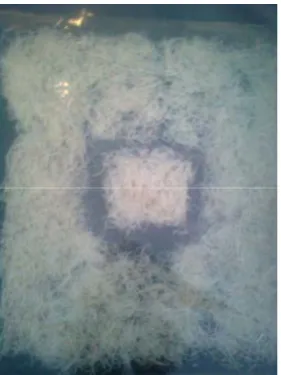
manually at 120 minutes intervals. A convective oven (Venticell, MMM, Medcener, Germany) was used to determine the initial and final moisture content at 105°C (Ruiz, 2005). During the drying process, experiments continued until the mass change between two weightings was less than 0.05 g (Bagheri et al., 2013). All the experiments were conducted in triplicate. The temperature and relative humidity of the drying air were recorded every five minutes during the drying process. The diagram of Ighu on the solar dryer is shown in Figure 1.
Figure 1 Diagram of the drying Ighu on the fabricated solar dryer 2.5 Drying procedures
Drying curves were drawn for the samples taken from the three sample trays in the dryer. Ambient air temperature was monitored with an omega thermometer, model RH. 610 with digital readout and a probe for the temperature sensor, which ranges from –10oC to 60oC. The relative humidity of the ambient air every five minutes was tested using a digital probe Bioblock thermohygrometer (precision: ±3% for RH≤80% and ±4% for RH>80%). A vane anemometer, which has a graduated scale and a pointer that indicates wind speed, was mounted and used to measure atmospheric wind speed in the drying zone. Haeni solar 118 Delta instrument, a digital radiometer with sensor output in W m-2, which is highly sensitive, was used to measure the total solar radiation.
2.6 Mathematical modelling of drying curves
The moisture content was expressed in percentage wet basis (%, w.b) and then converted to kilogram water per kilogram dry matter. The drying curves were fitted to nine different moisture ratio models to select a suitable
model for describing the drying process of Ighu. The
samples from open sun drying were also included, for comparison. Mathematical models applied to the drying curves are shown in Table 1.
Table 1 Mathematical models applied to the drying curves
Model Name Equation References Newton MR=exp(–kt)) (Ayensu, 1997) Page MR=exp(–ktn) (Doymaz, 2004a) Henderson and Pabis MR=aexp(–kt) (Rahman et al., 1998) Logarithmic MR=aexp(–kt)+c (Lahsasni et al., 2004b) Two-term MR=aexp(–k0t)+cexp(–k1t) (Dandamrongrak et al2002) ., Modified Page MR=exp[–(kt)n] (Hayaloglu et al.,2007)
Two-term exponential MR=aexp(–kt)+(1–a)cexp(–kat) (Hayaloglu et al., 2007
Wang and Singh MR=1+at+ct2 (Hayaloglu et al.,2007)
Midilli et al. MR=aexp(–kt)+ct (Hayaloglu et al.,2007)
Note: a, c, k, k0, k1 and n are drying constants and t is the drying time measured
in seconds.
Moisture ratio of the samples during drying was expressed by Equation (1):
1
d
o M MR
M
= − (1)
where, Md, Mo and Meare moisture content at any time,
initial and equilibrium moisture content (Kg water/Kg dry matter), respectively. The values of Me are usually little
compared to those of M or Mo, the error that is usually
involved in the simplification is negligible (Aghbashlo et al., 2008), thus moisture ratio was calculated using Equation (2) below (Shanmugam and Natarajan, 2006):
d
o M MR
M
= (2)
The moisture content data at each drying process, obtained at different loading densities and air-plenum were converted to the moisture ratio values and fitted versus the drying time. Then the selected thin layer drying models were compared according to the statistical results of coefficient of determination (R2), root mean
square error (RMSE) and reduced mean square errors
(MSE) (Hossain and Bala, 2002; Bagheri et al., 2013).
The model with the highest value for R2 was selected to
describe the drying curves. As well, the lowest values of
RMSE and MSE described how good the fit is (Doymaz,
2004a; Saeed et al., 2006; Kingsly and Singh, 2007). The statistical values were calculated from Equations (3), (4) and (5):
2 2
, 1
1 N ( )
per exp i
i
2
, ,
1( )
n
exp i pre i
i MR MR
MSE
N
= −
=
∑
(4)RMSE = MSE1/2 (5)
In the above equations, MRpre,i is the ith prediction
moisture ratio, MRexp,i is the experimental moisture ratio,
N is number of observations and n is number of constants.
3 Results and discussion
3.1 Drying procedures
During the drying experiments, the daily mean values of ambient air temperature and solar radiation ranged from 25°C to 45°C, 165.3-835 W m-2, respectively. The ambient air temperature and solar radiation reached the highest figures between 12:10 h and 14:10 h.
3.2 Drying characteristics of Ighu
Rehydrated Ighu samples were dried from the initial
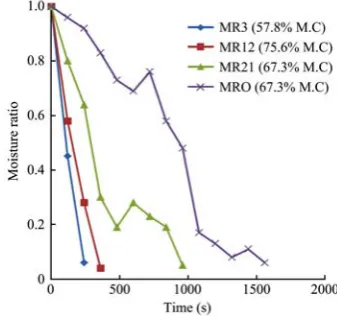
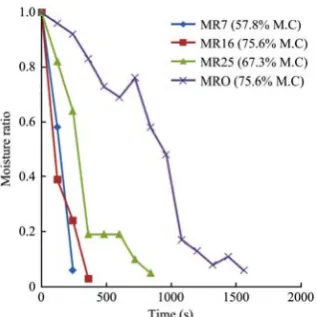
moisture content of 57.8%, 67.3%, and 75.6% to an average final moisture content of 11.4% using natural convection solar dryers of air-plenum 40, 60 and 80 mm and loading density of 330, 530 and 730 g mm-2 in a thin-layer. Moisture ratio decreased with increase in drying time (Bagheri et al., 2013). The moisture content rapidly dropped at the initial stage and then it gradually decreased till it reached an equilibrium point. The effect of initial moisture content on drying time showed that increase in moisture content resulted in increase in drying time. Ighu samples with the loading density of 730, 530
and 330 g mm-2 that were dried in the dryers took the average of 1,000, 653 and 507 min respectively to reach the safe final moisture content of 11.4% and the same sample of 730 g mm-2 loading density required an average of 1,320 min in an open sun to reach the same moisture value. Therefore, from the obtained result it could be concluded that drying rate decreased continuously with increased loading density. All the drying processes occurred in the falling rate period. This indicates that diffusion is most likely the dominant physical mechanism governing moisture movement within the Ighu samples. Similar results have been
reported by various researchers in potato slices (Akpinar et al., 2003), ripe banana (Nguyen and Price, 2007), pomegranate arils (Motevali et al., 2010), Mulberry (Doymaz, 2004a), eggplant (Erketin and Yaldiz, 2004), peach slices (Kingsly et al., 2007) and cassava chips
(Tunde-Akintunde and Afon, 2010).
The moisture ratio profile of Ighu with respect to
drying time is shown in Figures 2 to 10. From the Figures, it was observed that moisture ratio decreased with increase in drying time. The moisture content rapidly dropped at the initial stage and then it gradually decreased till it reached an equilibrium point. The effect of initial moisture content on drying time showed that increase in moisture content resulted in increase in drying time.
Figure 1 Moisture ratio of Ighu at 730 g mm-2 loading density and
80 mm Air-Plenum
Figure 2 Moisture ratio of Ighu at 730 g mm-2 loading density and
60 mm Air-Plenum
Figure 3 Moisture ratio of Ighu at 730 g mm-2 loading density and
Figure 4 Moisture ratio of Ighu at 530 g mm-2 loading density and
80 mm Air-Plenum
Figure 5 Graph of moisture ratio of Ighu at 530 g mm-2 loading
density and 60 mm Air-Plenum
Figure 6 Moisture ratio of Ighu at 530 g mm-2 loading density and
40 mm Air-Plenum
Figure 7 Moisture ratio of Ighu at 330 g mm-2 loading density and
80 mm Air-Plenum
Figure 8 Moisture ratio of Ighu at 330 g mm-2 loading density and
60 mm Air-Plenum
Figure 9 Moisture ratio of Ighu at 330 g mm-2 loading density and
40 mm Air-Plenum
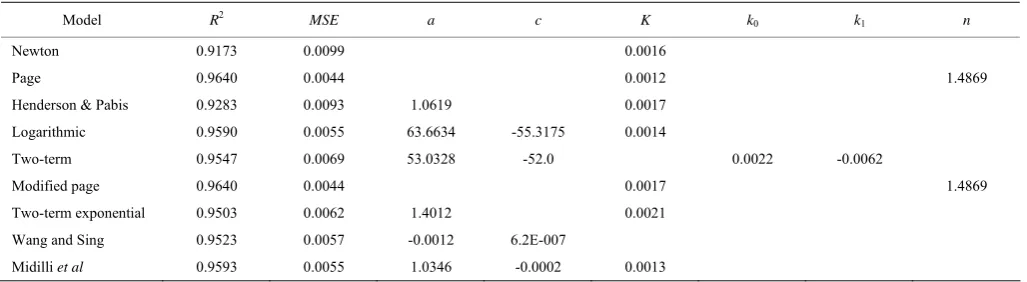
Average statistical result of the nine selected thin layer drying models resulting from fitting of the nine drying models to the experimental data from solar cabinet and open sun drying, are presented in Tables 2 and 3 respectively. The Page model and modified Page model represented the experimental values of moisture ratio satisfactorily having the lowest values of RMSE, MSE and the highest value of R2. Thus, the Page model and Modified Page model represented the experimental values of moisture ratio satisfactorily and can be assumed to represent the drying behaviour of Ighu. Tuncay et al.
modelling of thin layer solar drying of whole okra
(Abelmoschus esculentus (L.) Moench) pods (Ismail and
Ibn Idriss, 2013). On the other hand, Koua et al. (2009) reported that the Henderson and Pabis drying model were the most suitable for describing the solar drying curves of plantain banana, mango and cassava. Yaldiz et al. (2001) reported that a two-term drying model satisfactorily described the solar drying curve of Sultana grapes.
The values of R2, RMSE and MSE were better
compared with the findings of several previous works in fitting the model to the experimental data. Akpinar (2006) reported R2 of 0.99869 and
MSE, 2.31×10⁻³ in drying of
apples. In the drying of green table olives, R2 values
ranging from 0.9890-0.9987 were reported (Demir et al.,
2007). For Figures, R2, MSE and RMSE values of 0.9912,
7.06×10 3 and 0.074918 were reported (Doymaz, 2005b).
Table 2 Average statistical result of the nine selected thin layer drying models
Model R2 RMSE MSE a c K k0 k1 n
Newton 0.9546 0.0711 0.0067 0.0040
Page 0.9740 0.0511 0.0037 0.0023 1.3337 Henderson & Pabis 0.9566 0.0842 0.0086 1.0227 0.0041
Logarithmic 0.9679 0.0710 0.0074 -24.0083 25.1139 0.0023 Two-term 0.9726 0.0704 0.0066 1.5804 -0.8180 7.41E-05 1.0742
Modified page 0.97404 0.0511 0.0037 0.0037 1.3337 Two-term exponential 0.9655 0.0624 0.0061 1.3672 0.0055
Wang and Sing 0.9693 0.0557 0.0048 -0.0029 2.154-06
Midilli etal 0.9735 0.0609 0.0052 1.0114 -0.0004 0.0030
Note: a, c, k, k0, k1 and n are drying constants.
Table 3 Statistical result of the nine selected thin layer drying models for natural sun drying
Model R2 MSE a c K k0 k1 n
Newton 0.9173 0.0099 0.0016
Page 0.9640 0.0044 0.0012 1.4869
Henderson & Pabis 0.9283 0.0093 1.0619 0.0017
Logarithmic 0.9590 0.0055 63.6634 -55.3175 0.0014 Two-term 0.9547 0.0069 53.0328 -52.0 0.0022 -0.0062
Modified page 0.9640 0.0044 0.0017 1.4869 Two-term exponential 0.9503 0.0062 1.4012 0.0021
Wang and Sing 0.9523 0.0057 -0.0012 6.2E-007
Midilli etal 0.9593 0.0055 1.0346 -0.0002 0.0013 Note: a, c, k, k0, k1 and n are drying constants.
4 Conclusion
In order to explain the drying behavior of Ighu, nine
different thin layer drying model were fitted to experimental data and compared according to their R2, RMSE and MSE. Page model and modified Page model
were found as the best model which could be used to predict the moisture content of Ighu during solar and
open sun drying processes. Since constant rate period was not noticed during the drying processes which could be as a result of time lag for data collection, it is recommended that the same variables be tested again based on reduced time intervals and the effect of microbes on the samples should be determined.
Disclosure Statement
The authors declare no actual or potential conflict of interest including any financial, personal, or other relationships with other people or organizations.
References
Aghbashlo, M., M. H. Kianmehr, and A. Arabhosseini. 2009. Modeling of thin-layer drying of potato slices in length of continuous band dryer. Energy Conversion and Management, 50(5): 1348–1355.
2865–2871.
Agodzo, S. K., and A. Owusu. 2002. Crop coefficient determination of a six-month variety cassava. Journal of Agricultural Engineering and Technology, 10: 1–6.
Akpinar, E. K. 2010. Drying of mint leaves in a solar dryer and under open sun: Modelling, performance analyses. Energy Conversion and Management, 51(12): 2407–2418.
Akpinar, E. K. 2006. Determination of suitable thin layer drying curve model for some vegetables and fruits. Journal of Food Engineering, 73: 75–84.
Akpinar, E. K., A. Midilli, and Y. Bicer. 2003. Experimental investigation of drying behavior and conditions of pumpkin slices via a cyclone-type dryer. Journal of the Science of Food and Agriculture, 83(14): 1480–1486.
Al-Juamily, K. E. J., A. J. N. Khalifa, and T. A. Yassen. 2007. Testing of the performance of a fruit and vegetable solar drying system in Iraq. Desalination, 209(1-3): 163–170.
Arabhosseini, A., W. Huisman, A. van Boxtel, and J. Müller. 2008. Modeling of thin layer drying of tarragon (Artemisia dracunculus L.). Industrial Crops and Products, 28(2): 53–59.
Arinze, E. A., M. W. Bassey, J. O. Olukosi, A. B. Eke, and G. J. Schoenau. 1992. Field experimental performance evaluation of free convective solar crop dryers in Nigeria. World Renewable Energy Congress, 2: 647–652.
Bagheri, H., A. Arabhosseini, M. H. Kianmehr, and G. R. Chegini. 2013. Mathematical modeling of thin layer solar drying of tomato slices. Agricultural Engineering International: CIGR Journal, (15)1: 146–153.
Bala, B., and J. Woods. 1994. Simulation of the indirect natural convection solar drying of rough rice. Solar Energy, 53(2):
259–266.
Berruti, F. M., M. Klaas, C. Briens, and F. Berruti. 2009. Model for convective drying of carrots for pyrolysis. Journal of Food Engineering, 92(2): 196–201.
Can, A. 2000. Drying kinetics of pumpkin seeds. International Journal of Energy Reserve, 24(11): 965–975.
Demir, V., T. Gunhan, and A. K. Yagcioglu. 2007. Mathematical modeling of convection drying of green table olives.
Biosystems Engineering, 98(1): 47–53.
Doymaz, I. 2004a. Convective air drying characteristics of thin layer carrots. Journal of Food Engineering, 61(3): 359 – 364.
Doymaz, I. 2005. Drying behaviour of green beans. Journal of Food Engineering, 69(2): 161–165.
Doymaz, I. 2005b. Sun drying of Figs: an experimental study.
Journal of Food Engineering, 71(4): 403–407.
El-Sebaii, A., and S. Shalaby. 2012. Solar drying of agricultural products: a review. Renewable and Sustainable Energy Reviews, 16(1): 37–43.
Enwere, N. C. 1998. Food of Plant Origins. Nsukka, Nigeria:
Afro-Orbic Pub. Ltd.
Erbay, Z., and E. Icier. 2010. A review of thin layer drying of foods: theory, modeling, and experimental results. Critical Reviews in Food Science and Nutrition, 50(5): 441–464.
Ertekin, C., and O. Yaldiz. 2004. Drying of eggplant and selection of a suitable thin layer drying model. Journal of Food Engineering, 63(3): 349–359.
Hossain, M. A., and B. K. Bala. 2002. Thin layer drying characteristics for green chilli. Drying Technology, 20(2):
489–505.
Ismail, M. A., and E. M. Ibn Idriss. 2013. Mathematical modelling of thin layer solar drying of whole okra (Abelmoschus esculentus (L.) Moench) pods. International Food Research Journal, 20(4): 1983–1989.
Iwe, M. O. 2008. Food Processing as a Hub of National Food Security. An R and D in Extrusion cooking and other Techniques for Handling Tropical Crops for Food Use. In
Seventh Inaugural Lecture, 10. Michael Okpara University of
Agriculture, Umudike, 11th April, 2008.
Kingsly, A. R. P., and D. B. Singh. 2007. Drying kinetics of pomegranate arils. Journal of Food Engineering, 79(2): 741–744.
Kingsly, R. P., R. K. Goyal, M. R. Manikantam, and S. M. Ilyas. 2007. Effects of pretreatments and drying air temperature on drying behavior of peach slice. International Journal of Food Science and Technology, 42(1): 65–69.
Kordylas, J. M. 2002. Processing and Preservation of Tropical and Sub-Tropical Foods. London: Macmillan Education Ltd.
Koua, K. B., W. F. Fassinou, P. Gbaha, and S. Toure. 2009. Mathematical modelling of the thin layer solar drying of banana, mango and cassava. Energy, 34(10): 1594–1602.
Maia, C. B., A. G. Ferreira, R. M. Valle, and M. F. Cortez. 2009. Analysis of the airflow in a prototype of a solar chimney dryer.
Heat Transfer Engineering, 30(5): 393–399.
Midilli, A., and H. Kucuk. 2003. Mathematical modeling of thin layer drying of pistachio by using solar energy. Energy Conversion and Management, 44(7): 1111–1122.
Mohamed, A., M. Kouhila, A. Jamali, S. Lahsasni, N. Kechaou, and M. Mahrouz. 2005. Single layer solar drying behaviour of Citrus aurantium leaves under forced convection. Energy Conversion and Management, 46(9-10): 1473–1483.
Motevali, A., S. Minaei, M. H. Khoshtaghaza, M. Kazemi and A. M. Nikbakht. 2010. Drying of pomegranate arils: Comparison of predictions from mathematical models and neural networks.
International Journal of Food Engineering, 6(3): 1–19.
Mumba, J. 1995. Development of a photovoltaic powered forced circulation grain dryer for use in the tropics. Renewable Energy,
6(7): 855–862.
Mustayen, A. G. M. B., S. Mekhilef, and R. Saidur. 2014. Performance study of different solar dryers: A review.
Nguyen, M. H., and W. E. Price. 2007. Air-drying of banana: Influence of experimental parameters, slab thickness, banana maturity and harvesting season. Journal of Food Engineering, 79(1): 200–207.
Njoku, B. A., and E. O. I. Banigo. 2006. Physico-chemical properties of precooked cassava (Manihot esculentaCrantz) flour prepared by adaptation of a traditional process. Nigerian FoodJournal, 24(1): 98–106.
Oosthuizen, P. 1995. The design of indirect solar rice dryers.
Journal of Engineering forInternational. Development, 2(1): 20–27.
Quaye, W., J. Gayin, I. Yawson, and W. A. Plahar. 2009. Characteristics of various cassava processing methods and the adoption requirements in Ghana. Journal of Root Crops, 35(1): 59–68.
Ruiz, R. P. 2005. Gravimetric measurements of water. In Handbook of Food Analytical Chemistry, Edited by: Wrolstad et al.,John
Wiley and Sons, NJ, USA: 5–12.
Saeed, I. E., K. Sopian, and A. Z. Zainol. 2006.Drying kinetics of Roselle (Hibiscus sabdariffa L.): dried in constant temperature and humidity chamber. In Proc. SPS 2006, 143–148. Malaysia, Bangi, 29-30 August, 2006.
Sharma, V. K., A. Colangelo, and G. Spagna. 1995. Experimental
investigation of different solar dryers suitable for fruit and vegetable drying. Renewable Energy, 6(4): 413–424.
Sharma, A., C. Chen, and N. Vu Lan. 2009. Solar-energy drying systems: a review. Renewable and Sustainable EnergyReviews,
13(6-7): 1185–1210.
Shanmugam, V., and E. Natarajan. 2006. Experimental investigation of forced convection and desiccant integrated solar dryer.
Renewable Energy, 31(8): 1239–1251.
Tiwari, G., P. Bhatia, A. Singh, and R. Goyal. 1997. Analytical studies of crop drying cum water heating system. Energy Conversion and Management, 38(8): 751–759.
Tuncay, G., D. Vedat, H. Ebru, and H. Arif. 2005. Mathematical modeling of drying of bay leaves. Energy Conversion and Management, 46(11-12): 1667–1679.
Tunde-Akintunde, T. Y. 2011. Mathematical modeling of sun and solar drying of chilli pepper. Renewable Energy, 36(8):
2139–2145.
Tunde-Akintunde, T. Y., and A. A. Afon. 2010. Modeling of hot air drying of preheated cassava chips. Agricultural Engineering International: CIGR Journal, 12(2): 34–41.
Yaldiz, O., C. Ertekin, and H. I. Uzun. 2001. Mathematical Modeling of thin layer solar drying of Sultana grapes. Energy,