Fall 2018
Existence of Dependency-Based Attacks in NodeJS Environment
Existence of Dependency-Based Attacks in NodeJS Environment
Prachi R. Patel
Iowa State University, [email protected]
Follow this and additional works at: https://lib.dr.iastate.edu/creativecomponents
Part of the Other Computer Engineering Commons
Recommended Citation Recommended Citation
Patel, Prachi R., "Existence of Dependency-Based Attacks in NodeJS Environment" (2018). Creative Components. 91.
https://lib.dr.iastate.edu/creativecomponents/91
by
Prachi Patel
A creative component submitted to the graduate faculty
in partial fulfillment of the requirements for the degree of
MASTER OF SCIENCE
Major: Computer Engineering
Program of Study Committee: Lotfi Ben Othmane, Co-major Professor
Doug Jacobson, Co-major Professor
The student author, whose presentation of the scholarship herein was approved by the program of study committee, is solely responsible for the content of this dissertation/thesis. The Graduate College will ensure this dissertation/thesis is globally accessible and will not permit alterations
after a degree is conferred.
Iowa State University
Ames, Iowa
TABLE OF CONTENTS
Page
LIST OF TABLES . . . iv
LIST OF FIGURES . . . v
ACKNOWLEDGMENTS . . . vi
ABSTRACT . . . vii
CHAPTER 1. INTRODUCTION . . . 1
1.1 Problem . . . 1
1.2 Approach . . . 2
1.3 Contribution . . . 2
1.4 Organization . . . 3
CHAPTER 2. BACKGROUND . . . 4
2.1 Node.js . . . 4
2.2 NPM . . . 4
2.3 Third-party dependencies in Node.js . . . 4
2.4 Server-less Cloud Computing . . . 5
2.5 Injection of Malicious Dependency . . . 5
2.6 T. J. Watson Libraries for Analysis (WALA) . . . 5
CHAPTER 3. SURVEY OF VULNERABILITIES AND ATTACKS FOUND IN JAVASCRIPT APPLICATIONS . . . 7
CHAPTER 4. DEPENDENCY-BASED ATTACKS . . . 11
4.1 Global Leakage . . . 11
4.3 Service Interruption . . . 13
4.4 Local Manipulation . . . 13
4.5 Dependency Tree Manipulation . . . 14
CHAPTER 5. STATIC CODE ANALYSIS . . . 16
5.1 Context-sensitivity . . . 16
5.2 Analysis Steps . . . 16
5.2.1 Intermediate Representation . . . 16
5.2.2 Basic Block . . . 18
5.2.3 Control Flow Graph (CFG) . . . 18
5.2.4 Dataflow Analysis and facts . . . 18
5.2.5 Interprocedural Finite Distributive Subset Framework . . . 19
5.2.6 Analysis Framework Overview . . . 19
CHAPTER 6. ANALYSIS OF NPM PACKAGES . . . 21
6.1 Analyzed Packages . . . 21
6.2 Analysis Results . . . 22
6.3 Analysis of Vulnerability . . . 22
6.3.1 Vulnerability Description . . . 23
6.3.2 Extending WALA to Detect the Found Vulnerability . . . 23
6.3.3 Challenges Faced During Analysis . . . 24
LIST OF TABLES
Page
3.1 The 36 categories of vulnerabilities. . . 9
3.2 Description of the top 10 vulnerability/attack categories. . . 10
3.3 Total vulnerabilities divided into client-side and server-side depending on
where they occurred. . . 10
6.1 Description of analyzed modules. . . 21
LIST OF FIGURES
Page
2.1 Attack vectors for dependency-based attacks. . . 6
3.1 Number of vulnerabilities by category. . . 8
ACKNOWLEDGMENTS
I would like to thank Dr. Lotfi Ben-Othmane for his guidance throughout the course of this
research and Prof. Doug Jacobson for his support. I would also like to thank Ameerah-Muhsinah
Jamil for helping out with surveys and observations and Brian Pfretzschner for his guidance.
I would like to thank the department faculty and staff for making my time at Iowa State
ABSTRACT
Node.js is an open source server-side run-time platform for JavaScript applications. Node.js
applications are dependent on several, even hundreds, packages, which in turn have many
depen-dencies. Node.js supports monkey-patching, global variables, shared cache of loaded modules and
functions as function parameters, which can be exploited through dependent packages. There is
always a risk of malicious code hidden in one of these dependencies.
This work analyzes vulnerabilities found in Node.js based applications, discusses five basic types
of attacks: data manipulation on global and local level, leakage of sensitive data to malicious server,
interruption of service provided by the host application and dependency cache manipulation, and
reports about the assessment of five frequently-used Node.js packages with respect to
dependency-based vulnerabilities. The assessment revealed a vulnerability in file bson.js in an NPM package
name ‘bson,’ which is the default Binary JSON (BSON) parser. This package is used by 375
CHAPTER 1. INTRODUCTION
JavaScript plays a significant role in modern web development. It allows for rapid development
and high performance since it is dynamic and asynchronous. It was intended as a front-end language
to be used in browser environments. Due to advent of Node.js, JavaScript can also be used on
back-end.
Node.js applications use same programming concepts as Javascript. However, Node.js
appli-cations are based on a large number of third-party dependencies. These dependencies can have a
huge impact on the security of the application.
One of the security risks could be the presence of malicious code in third-party dependencies.
This problem becomes even more severe in server-less cloud computing environments where
appli-cations are automatically deployed and invoked. Cloud service providers resolve and provision the
required dependencies for a given application. The result of this is that the application owner has
to give up control over the exact folder structure or dependency source code since it is opaquely
downloaded by the cloud service.
1.1 Problem
Dependency-based attacks can be launched by third-party dependencies on a host Node.js
application. This report studies the existence of dependency-based attacks in Node.js environment.
The malicious dependency is assumed to contain code that performs actions that the host
application developer did not expect. Such actions could modify JavaScript core features, interrupt
the Node.js execution environment or leak sensitive data. The malicious code might spread and
duplicate itself such that it hides in unexpected and unpredictable locations.
Performing attacks discussed in this report requires that the attacker successfully manages
Manager (NPM) or modifying an existing dependency in NPM. Threat model is focused around
the attack vectors such as - overtaking the host application, manipulating or leaking data processed
in the application and interrupting services provided by the application. Whether the dependency
is loaded directly by the host application or indirectly as part of another dependency does not
matter.
1.2 Approach
Reported Node.js vulnerabilities were analyzed with the goal to identify the relation to
depen-dency between packages.
Static code analysis is performed using the open source analysis framework - T.J. Watson
Libraries for Analysis (WALA). Attacks are classified into five different categories. Using WALA,
analysis is designed and implemented for each of the identified attack categories. Control Flow
Graphs are extracted from the input source code and dataflow analysis is performed using dataflow
functions provided by WALA. These concepts are explained in detail in chapter 5 of this report.
A set of NPM packages were analyzed using the detection framework. Manual analysis was
performed to verify the results of automation. In this thesis, we only focus on Node.js applications
written in JavaScript.
1.3 Contribution
Main contributions of this thesis are
-• Analysis of existing vulnerabilities to understand their relationship to dependency concept.
• Application of static code analysis on a set of packages and manual analysis of source code
for verification of automation results.
• Recognition of vulnerability in one of the dependencies of the analyzed packages during
1.4 Organization
Basic details about Node.js, Node Package Manager (NPM), third-party dependencies in Node.js
and T. J. Watson Libraries for Analysis (WALA) are discussed in chapter 2 of this report.
Knowl-edge of these concepts is required for better understanding of the presented work.
Chapter 3 provides analysis of vulnerabilities or attacks that have been recorded in Node.js. It
provides an overview of different categories of vulnerabilities.
In chapter 4, the five categories of dependency-based attacks are explained in detail. These
categories are: Global Manipulation, Global Leakage, Local Manipulation, Service Interruption
and Dependency Tree Manipulation. Examples are provided by including code snippets containing
malicious code which can be detected by our framework.
Next chapter provides details about the static code analysis built on top of WALA APIs.
Topics of context-sensitivity, intermediate representation and basic blocks, control flow graphs and
dataflow analysis are explained in detail in this chapter. Also, an overview of the analysis framework
is provided.
The attack detection framework was applied to a set of packages in NPM. Results of this
analyses are discussed in chapter 6 along with the discovered vulnerability. Finally, conclusion and
CHAPTER 2. BACKGROUND
This chapter provides background information on the following topics - Node.js, Node Package
Manager (NPM), third-party dependencies in Node.js and T. J. Watson Libraries for Analysis
(WALA). Knowledge of these concepts is required for better understanding of the presented work.
2.1 Node.js
Node.js [1] is a server-side language built on top of Google Chrome’s v8 engine. It uses
event-driven non-blocking I/O which makes it a perfect candidate for data-intensive applications. The
core of Node is JavaScript. Node inherits weaknesses of JavaScript. JavaScript runs in browser
environment whereas Node.js is executed using v8 engine on a server. This impacts the attack
surface of applications in Node.js.
2.2 NPM
NPM stands for Node Package Manager. It is the online repository through which Node.js
packages are uploaded and shared. It is currently the largest software repository consisting of total
742,509 packages with approximately 3 billion downloads per week [2].
2.3 Third-party dependencies in Node.js
Third-party dependencies are very common in Node.js applications. Primary dependencies can
also have their own dependencies (indirect dependencies). Hence, the total number of dependencies
for a Node.js application can easily exceed several hundred.
These dependencies are critical for application security since they have the same access level
security and third-party dependencies. According to a recent survey by NPM, 77% of respondents
were concerned with the security of Open Source Software (OSS) and third-party code [3].
2.4 Server-less Cloud Computing
In server-less cloud environments, dependencies are provided to the host application at run-time.
The advantage of this approach is that only application-specific source code has to be uploaded
to the cloud and the amount of data on the cloud server is minimized. However, the application
owner does not have control over the dependency source code since its opaquely downloaded by the
cloud service.
2.5 Injection of Malicious Dependency
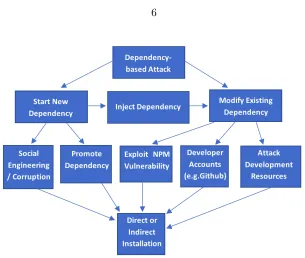
Figure 2.1 depicts various attack vectors for injection of dependency. An attacker can upload
a new dependency on NPM or modify an existing dependency. The aim of the attacker is to
enter the dependency tree of an application. The dependencies can either be bundled by the
cloud user and uploaded as a package, or automatically resolved by the cloud platform based on
the package.json file. In either cases, the malicious dependency gets downloaded from a public
repository, for instance NPM or GitHub. If the attacker decides to start a new dependency, he can
promote it publicly using social engineering techniques. The application developer needs to review
any newly installed dependency and its dependencies to make sure none of the code introduced to
the application bundle performs undesired actions. However, this approach can be time-consuming
if a large number of dependencies need to be reviewed [4].
2.6 T. J. Watson Libraries for Analysis (WALA)
WALA is an open-source library written in Java for static and dynamic program analysis of
Java and JavaScript code. It is initially developed by IBMs T.J. Watson Research Center and was
Figure 2.1 Attack vectors for dependency-based attacks.
WALA is built around the following key design goals : robustness, efficiency and extensibility.
Main features provided by WALA include pointer analysis, call-graph construction,
interprocedu-ral dataflow analysis framework, multiple language front-ends and generic analysis utilities/data
CHAPTER 3. SURVEY OF VULNERABILITIES AND ATTACKS FOUND
IN JAVASCRIPT APPLICATIONS
We conducted an extensive survey to analyze the different types of vulnerabilities that have
been reported in Node.js applications.
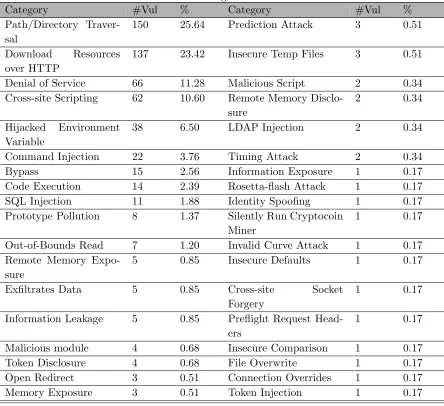
Total 36 types of vulnerability/attack categories have been recognized with 585 total number
of vulnerabilities/attacks found in Node Security Platform [8]. This data is collected as of 8th Aug
2018. Table3.1shows the list of categories in the descending order of number of
vulnerabilities/at-tacks found for each category. (Note - This work is ongoing and more categories may be added in
the future to this survey).
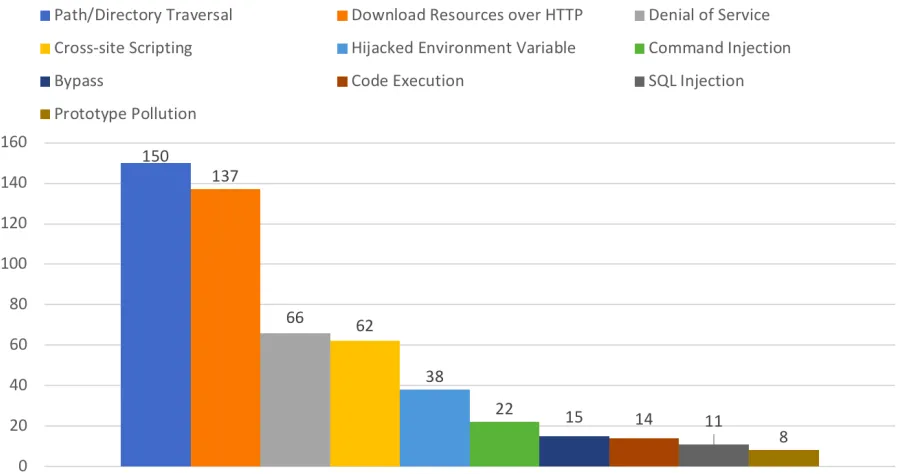
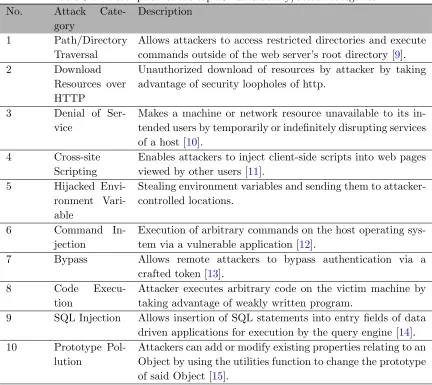
Top 10 of the 36 categories listed in Table 3.1 consist of around 90% of the total reported
vulnerabilities. Figure 3.1 compares the number of vulnerabilities of these top 10 categories and
table 3.2contains the descriptions for these attack categories.
Amongst the top 10 categories of vulnerabilities/attacks shown in table 3.2, four categories
: cross-site scripting, command injection, code execution and SQL injection occur due to weakly
written code. But the following three categories of attacks: Denial of Service, hijacked environment
variable and prototype pollution can be executed by malicious code in third-party dependencies.
Our detection framework aims to detect these types of attacks.
The total 585 vulnerabilities were also classified into client-side and server-side depending on
where they occurred. These are shown in Table 3.3.
JavaScript is used to write client-side scripts and Node.js is used for server-side programming.
As seen from Table 3.3, most of the vulnerabilities occurred on the server-side. This points to
the fact that server-side code written in Node.js is more vulnerable to attacks as compared to
Table 3.1 The 36 categories of vulnerabilities.
Category #Vul % Category #Vul %
Path/Directory Traver-sal
150 25.64 Prediction Attack 3 0.51
Download Resources over HTTP
137 23.42 Insecure Temp Files 3 0.51
Denial of Service 66 11.28 Malicious Script 2 0.34 Cross-site Scripting 62 10.60 Remote Memory
Disclo-sure
2 0.34
Hijacked Environment Variable
38 6.50 LDAP Injection 2 0.34
Command Injection 22 3.76 Timing Attack 2 0.34 Bypass 15 2.56 Information Exposure 1 0.17 Code Execution 14 2.39 Rosetta-flash Attack 1 0.17 SQL Injection 11 1.88 Identity Spoofing 1 0.17 Prototype Pollution 8 1.37 Silently Run Cryptocoin
Miner
1 0.17
Out-of-Bounds Read 7 1.20 Invalid Curve Attack 1 0.17 Remote Memory
Expo-sure
5 0.85 Insecure Defaults 1 0.17
Exfiltrates Data 5 0.85 Cross-site Socket Forgery
1 0.17
Information Leakage 5 0.85 Preflight Request Head-ers
1 0.17
Malicious module 4 0.68 Insecure Comparison 1 0.17 Token Disclosure 4 0.68 File Overwrite 1 0.17 Open Redirect 3 0.51 Connection Overrides 1 0.17 Memory Exposure 3 0.51 Token Injection 1 0.17
Table 3.2 Description of the top 10 vulnerability/attack categories. No. Attack
Cate-gory
Description
1 Path/Directory Traversal
Allows attackers to access restricted directories and execute commands outside of the web server’s root directory [9]. 2 Download
Resources over HTTP
Unauthorized download of resources by attacker by taking advantage of security loopholes of http.
3 Denial of Ser-vice
Makes a machine or network resource unavailable to its in-tended users by temporarily or indefinitely disrupting services of a host [10].
4 Cross-site Scripting
Enables attackers to inject client-side scripts into web pages viewed by other users [11].
5 Hijacked Envi-ronment Vari-able
Stealing environment variables and sending them to attacker-controlled locations.
6 Command In-jection
Execution of arbitrary commands on the host operating sys-tem via a vulnerable application [12].
7 Bypass Allows remote attackers to bypass authentication via a crafted token [13].
8 Code Execu-tion
Attacker executes arbitrary code on the victim machine by taking advantage of weakly written program.
9 SQL Injection Allows insertion of SQL statements into entry fields of data driven applications for execution by the query engine [14]. 10 Prototype
Pol-lution
Attackers can add or modify existing properties relating to an Object by using the utilities function to change the prototype of said Object [15].
Table 3.3 Total vulnerabilities divided into client-side and server-side depending on where they occurred.
Category Number Percentage
Client 250 42.74 %
Server 334 57.09 %
[image:18.612.91.521.631.696.2]CHAPTER 4. DEPENDENCY-BASED ATTACKS
This report focuses of five different categories of dependency-based attacks. This chapter
ex-plains them in detail. The five categories are - Global Manipulation, Global Leakage, Local
Ma-nipulation, Service Interruption and Dependency Tree Manipulation. Code snippets containing
malicious code are included to provide examples of how these attacks can be launched.
4.1 Global Leakage
This attack is performed by the malicious dependency by accessing the global name-space and
public data structures of the execution environment in order to leak them to an attacker-controlled
server. As an example, a dependency can access and modify the security credentials provided by
cloud systems through global variables. Although it is fairly simple to leak data to malicious server,
it is difficult for automated systems to detect this type of attack. Listing 4.1shows an example of
global leakage attack. [4]
4.2 Global Manipulation
The goal of this type of attack is to manipulate a globally accessible value or function to alter the
application behavior. This type of attack is also known as Global Namespace Pollution. JavaScript
by design makes heavy use of global variables. This property makes the attack highly probable.
One example of manipulation of functions is monkey-patching, where original implementation
of a function is overridden by the malicious version provided by attacker. The original function no
longer behaves as expected and this can be used to execute unwanted code. An example of global
Listing 4.1 Demonstration of the global leakage attack where data is sent through http request.
f u n c t i o n l e a k ( p a y l o a d ) {
v a r URL = r e q u i r e ( ’ u r l ’ ) ;
v a r u r l = URL. p a r s e ( p r o c e s s . env . POC LEAK URL | | ’ ’ ) ; i f ( ! u r l | | ! u r l . p r o t o c o l ) {
c o n s o l e . l o g ( ’ G l o b a l Leakage PoC : I n v a l i d POC LEAK URL, c a n n o t l e a k : ’ , p a y l o a d ) ;
r e t u r n ;
}
v a r r e q u e s t = u r l . p r o t o c o l === ’ h t t p : ’ ? r e q u i r e ( ’ http ’ ) . r e q u e s t : r e q u i r e ( ’ h t t p s ’ ) . r e q u e s t ;
v a r p o s t D a t a = JSON . s t r i n g i f y ( p a y l o a d ) ;
v a r o p t i o n s = {
hostname : u r l . hostname , p o r t : u r l . p o r t ,
path : u r l . path , method : ’POST’ , h e a d e r s : {
’ Content−Type ’ : ’ a p p l i c a t i o n / j s o n ’ ,
’ Content−Length ’ : B u f f e r . b y t e L e n g t h ( p o s t D a t a )
} };
v a r r e q = r e q u e s t ( o p t i o n s ) ; r e q . w r i t e ( p o s t D a t a ) ;
r e q . end ( ) ;
}
Listing 4.2 Example of Global Manipulation attack where original function is overridden by monkey-patched implementation.
{
f u n c t i o n MyClass ( ) { };
MyClass . p r o t o t y p e . someFunction = f u n c t i o n ( ) {
// I n i t i a l i m p l e m e n t a t i o n
};
f u n c t i o n performMonkeyPatch ( ) {
v a r o r i g i n a l F u n c t i o n
= MyClass . p r o t o t y p e . someFunction ;
MyClass . p r o t o t y p e . someFunction = f u n c t i o n ( ) {
// New monkey−p a t c h e d i m p l e m e n t a t i o n // o r i g i n a l F u n c t i o n can be i n v o k e d h e r e
}; }
v a r c = new MyClass ( ) ;
c . someFunction ( ) ; // I n i t i a l i m p l e m e n t a t i o n performMonkeyPatch ( ) ; c . someFunction ( ) ; // Monkey−p a t c h e d i m p l e m e n t a t i o n
}
4.3 Service Interruption
This attack aims at congesting the event loop of the JavaScript engine by asynchronous function
invocations and can also be achieved using monkey-patching.
This is a type of Denial of Service (DoS) attack. Initially, the application will run at expected
speed, but after a given point of time, the event loop is polluted enough to noticeably slow down
the application execution. In a short amount of time, the event loop gets flooded and finally gets
suspended. To recover, the application it has to be restarted completely. Listing 4.3 shows an
example of global leakage attack [4].
4.4 Local Manipulation
This attack targets local properties that are only accessible from the context of the caller.
Node.js scoping is based on standard JavaScript scoping and hence is not flawed. However, Node.js
Listing 4.3 Example of Service Interruption attack where delay grows quadratically with time, finally resulting in suspension of event loop.
( f u n c t i o n i n t e r r u p t ( ) {
v a r f = s e t T i m e o u t ; f ( i n t e r r u p t ) ;
f ( i n t e r r u p t ) ;
}) ( ) ;
Modules are cached after being loaded for the first time. If any file from the package calls the
module, same object is returned from cache. This is referred to as loaded module cache. This
feature is a security weakness.
As an example of this type of an attack, consider a main file that requires dependencies A and
B. When dependency B gets loaded, it can also require dependency A and gets the exact same
object returned as the main file. In this situation, the main file and dependency B both have a
object in their local scope which is shared between both files. Unfortunately, this object is writable.
Any modification is reflected to any file that also requires that dependency.
To conduct a local manipulation attack, the order in which dependencies are loaded does not
matter. In any case, all files that require a certain dependency get the same reference to an
object returned. Whether a victim file or the malicious dependency requires the file first, is not
relevant. [4].
4.5 Dependency Tree Manipulation
This type of attack takes advantage of the fact that in Node.js, all dependencies are loaded into
cache. It focuses on manipulating the cache so that the malicious dependency prevents the benign
dependency from being loaded. First, the required cache is artificially populated with a forged
value. From that point on, any file that requires original dependency gets the forged value from
spoiled cache. Hence, the order in which dependencies load into cache is very important for this
Listing 4.4 Example of Dependency Tree Manipulation attack.
{
r e q u i r e ( ‘ . / m a l i c i o u s−l i b ’ ) ;
r e q u i r e . c a c h e [ r e q u i r e . r e s o l v e ( ‘ v i c t i m−l i b ’ ) ] = r e q u i r e . c a c h e [ r e q u i r e . r e s o l v e ( ‘ . / m a l i c i o u s−l i b ’ ) ] ;
}
CHAPTER 5. STATIC CODE ANALYSIS
This chapter provides details about the static code analysis built on top of WALA APIs. Some
of the concepts used for analysis such as context-sensitivity, intermediate representation and basic
blocks, control flow graphs and dataflow analysis are explained in detail. In the end, overview of
the analysis framework is provided.
5.1 Context-sensitivity
Context-sensitive interprocedural analysis can be used to study data propagation throughout
the code. When information is propagated through procedure boundaries while respecting the
actual control flow of the application, it is known as interprocedural analysis. Context-sensitive
interprocedural analysis keeps information gathered on different paths separated. For each
invoca-tion site of a funcinvoca-tion, funcinvoca-tion internal details are kept separate from other invocainvoca-tion sites. As an
example, if a function returning a value is invoked at two different call sites, and if the first
invoca-tion returns a tracked value and the second invocainvoca-tion returns an irrelevant value, context-sensitive
analysis would separate these invocations and infer that the returned value from first invocation
also needs to be tracked, while the return value from second invocation can be discarded.
5.2 Analysis Steps
5.2.1 Intermediate Representation
The program being analyzed is converted to Intermediate Representation (IR) form which
reduces the complexity of the source code into a low level form. A type of IR is the
Three-address code representation of source code where more complex statements can be represented
by a combination of multiple three-address code instructions. Listing 5.1 shows an example of
Listing 5.1 Example of three-address form of Intermediate Representation (IR).
For eg : Three−a d d r e s s c o d e r e p r e s e n t a t i o n o f t h e s t a t e m e n t −
v a r r = a + f ( b , c ) + d param b
param c
t 1 = i n v o k e f , 2 r = a + t 1
r = r + d
Listing 5.2 Example of SSA form of IR.
For eg : SSA t r a n s f o r m e d c o d e o f t h e s t a t e m e n t s v a r r = a + f ( b , c ) + d ; r e t u r n r == 0 ? 1 : 0 ;
v27 = i n v o k e f b , c
v26 = b i n a r y o p ( add ) a , v27 r = b i n a r y o p ( add ) v26 , d v32 = b i n a r y o p ( eq ) r , 0
c o n d i t i o n a l branch ( eq , t o i i n d e x =8) v32 , 0 v33 = 1
g o t o ( t o i i n d e x =9) v35 = 0
v11 = p h i v35 , v33 r e t u r n v11
This thesis implements another form of IR known as Single Static Assignment (SSA) which
does not have a restriction on the number of variables per instruction.
Listing 5.2 shows an example of SSA form for statements “var r = a + f(b, c) + d; return r
== 0 ? 1 : 0;”. Advantage of using SSA form for analysis, is that each modification of a variable
creates a new version of the variable and the old version remains unchanged. This ensures that
value of a specific version of a variable is constant in a given context after definition. This makes it
easier for static analysis and to track a given value which is held by some variable at a particular
5.2.2 Basic Block
Basic block (BB) is a sequence of consecutive instructions that are always executed successively
and do not include any jumps, neither in nor out of the sequence.
Instructions inside a BB can be treated similar and can be grouped and handled as one single
basic block instead of dealing with each instruction separately. This can lead to significant
improve-ment in performance. However, for convenience and accuracy, this analysis treats every instruction
as a BB. Hence, every BB only contains a single SSA instruction.
5.2.3 Control Flow Graph (CFG)
A Control Flow Graph (CFG) is a directed graph G= (V, E) with vertexesV and edges E .
Each basic block of a procedure is represented as exactly one vertex. Each vertex is represented in
the form of Call Graph Node (CGNode). Any edge from vertex V1 to vertexV2 denotes a jump
in the basic block represented byV1 to the basic block represented by V2.
For each vertexv, there are set of predecessors and successors depending on whether the edge is
ending at, or originating formv. Hence, jumps between basic blocks are encoded in this CFG.
Ver-texes that don’t have predecessors are classified as entry points and those that dont have successors
are classified as exit points.
A CFG denotes one individual procedure. All CFGs together create the supergraph which
represents an entire application and is the foundation of an interprocedural analysis.
5.2.4 Dataflow Analysis and facts
Dataflow analysis is used to propagate values of interest through the program and use the result
to identify potential violations. Dataflow analysis uses the concept of facts - information attached
to instructions of the program. Depending on already existing facts, new facts are computed and
attached to other instructions on the path. Initial seeds are facts that are attached to certain
initial facts are an essential element of a data flow analysis, since a missed fact can result in an
false negative.
5.2.5 Interprocedural Finite Distributive Subset Framework
Interprocedural Finite Distributive Subset Framework (IFDS) algorithm invokes dataflow
func-tions on facts and uses resulting value for subsequent steps. It maintains a worklist of facts on
which dataflow functions are yet to be invoked. First initial seeds are identified, which act as
starting points for the actual analysis. Next, dataflow functions are used to propagate dataflow
facts through control flow graph (CFG). New facts can be generated during the analysis which are
inserted in worklist and acted upon later. Dataflow analysis can be intraprocedural or
interpro-cedural, based on whether it is derived from CFG of individual function or the supergraph which
consists of all CFGs.
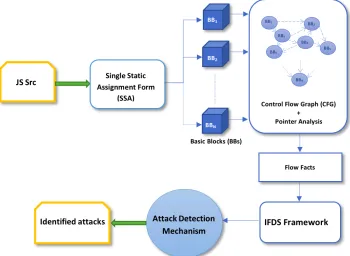
5.2.6 Analysis Framework Overview
Analysis steps are summarized below
-• Source code is converted to Single Static Assignment (SSA) form.
• Every instruction in SSA form is stored as one Basic Block (BB).
• Basic Blocks are used to create Control Flow Graphs (CFGs) and supergraph.
• Pointer analysis is performed using Basic Blocks.
• Flowfacts are derived from Control Flow Graphs and supergraph.
• Dataflow analysis is performed by propagating facts through CFGs using dataflow functions
from IFDS algorithm.
• Results of dataflow analysis are used by the five attack detection algorithms to identify attacks.
CHAPTER 6. ANALYSIS OF NPM PACKAGES
We applied out static code analysis on a set of packages in NPM to check the existence of
dependency-based attack in Node.js environment. This chapter discusses the results. These are
followed by the description of the vulnerability that was discovered in one of the packages.
6.1 Analyzed Packages
We selected five packages for analysis. Some of the packages (for example mongoose) have large
number of dependent applications and some packages like cross-env have similar functionality as
that of the attack categories targeted in this report. Both of these are security critical modules. For
example, cross-env package runs scripts that set and use environment variables across platforms.
This points to the fact that this package uses global environment variables and is highly useful for
our analysis.
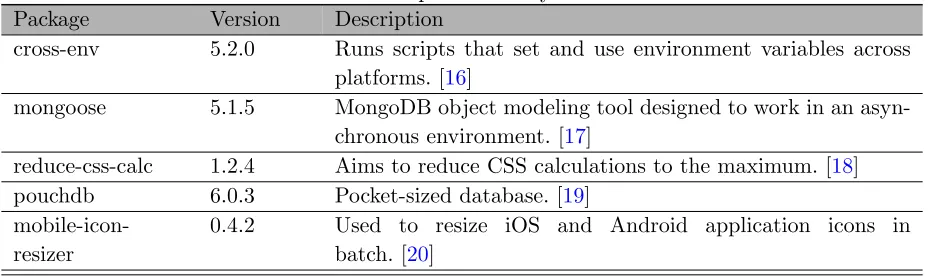
[image:29.612.75.549.498.636.2]Table6.1 contains version and a brief description of the five modules that were analyzed.
Table 6.1 Description of analyzed modules. Package Version Description
cross-env 5.2.0 Runs scripts that set and use environment variables across platforms. [16]
mongoose 5.1.5 MongoDB object modeling tool designed to work in an asyn-chronous environment. [17]
reduce-css-calc 1.2.4 Aims to reduce CSS calculations to the maximum. [18] pouchdb 6.0.3 Pocket-sized database. [19]
mobile-icon-resizer
Listing 6.1 Code snippet containing the vulnerability.
1 v a r i s o l a t e E v a l = f u n c t i o n ( f u n c t i o n S t r i n g ) {
2 // C o n t a i n s t h e v a l u e we a r e g o i n g t o s e t 3 v a r v a l u e = n u l l ;
4 // Eval t h e f u n c t i o n
5 e v a l ( ‘ v a l u e = ’ + f u n c t i o n S t r i n g ) ; 6 r e t u r n v a l u e ; };
6.2 Analysis Results
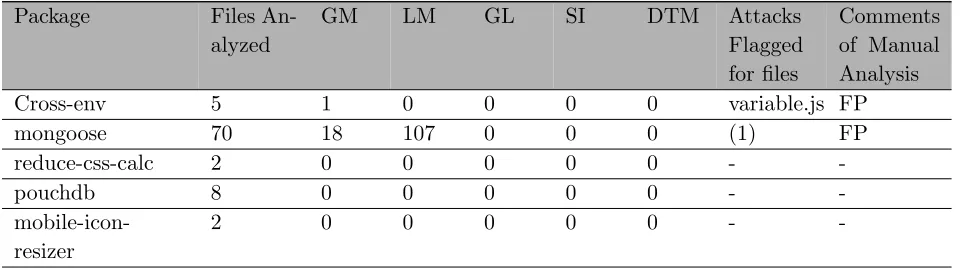
We analyzed 5 packages containing total 87 files. Our analysis detection framework signalled
global manipulation attacks for one file in cross-env package and 8 files in mongoose package. As an
example, following lines of code in the file map.js (Location : mongoose/bson/lib/bson) contribute
to one of the detections - module.exports = global.Map; module.exports.Map = global.Map; This
is detected due to a read/write on a global entity.
Local Manipulation attacks were flagged for 6 files in mongoose package. As an example, inside
file index.js (Location : mongoose/bson), we have : ‘var BSON = require(’./lib/bson/bson’);’ Here,
BSON variable references required file bson under the location lib/bson/bson. This is a local entity
which is tracked for manipulations. The line of code : ‘BSON.BSON-INT32-MAX = 0x7fffffff;’ is
considered as manipulation of local entity BSON. There are total 21 such assignments in the file
resulting in 21 detections.
Table6.2provides the overview of these results. Manual analysis confirmed that the alerts were
false positives.
6.3 Analysis of Vulnerability
Manual Analysis was conducted for packages analyzed by WALA to verify absence of false
negatives. Package bson - a dependency of primary package ‘mongoose’ was also manually analyzed
and a vulnerability was observed in files bson.js and deserializer.js. Code snippet containing the
Table 6.2 Description of Analysis Results. Package Files
An-alyzed
GM LM GL SI DTM Attacks Flagged for files
Comments of Manual Analysis Cross-env 5 1 0 0 0 0 variable.js FP
mongoose 70 18 107 0 0 0 (1) FP
reduce-css-calc 2 0 0 0 0 0 -
-pouchdb 8 0 0 0 0 0 -
- mobile-icon-resizer
2 0 0 0 0 0 -
-(1) - index.web.js, objectId.js, binary.js, index.js, decimal128.js, connectionstate.js, cast.js, mongooseError.js
FP - False Positive
GM - Global Manipulation LM - Local Manipulation GL - Global Leakage SI - Service Interruption
DTM - Dependency Tree Manipulation
6.3.1 Vulnerability Description
As seen in listing 6.1, function isolateEvaltakes a string as an input parameter and evaluates
it using the eval()function. If unwanted input is passed to the function isolateEval,eval() will
directly execute the input string f unctionString with host applications privileges (refer to line
6 in figure 3.1). This is highly vulnerable to arbitary code execution and use of eval needs to
be avoided to enable greater protection. This can also result in global leakage attack if an https
request is executed through theeval function.
6.3.2 Extending WALA to Detect the Found Vulnerability
Attack detection mechanism can be extended to observe if global variables or data structures
are being overwritten or read by eval(). This might result in false positives for certain cases, but
6.3.3 Challenges Faced During Analysis
We faced two main challenges during the analysis. They are:
• If Source code contains a named function, WALA models function definition like global
vari-able creation. Hence, even if a function is defined locally and is only accessible within current
scope or children scopes, by WALAs approach, it will be listed under global variables. When
these functions are invoked, WALA models it as a read of a global variable. This might create
some false positives.
• Occurrence of large number of False Positives due to over-approximation during static code
CHAPTER 7. CONCLUSION AND FUTURE WORK
Node.js and JavaScript support global variables, monkey-patching and loaded modules cache by
design. These features could be used to perform dependency-based attacks - global leakage, global
manipulation, local manipulation, service interruption and dependency tree manipulation. Number
of dependencies for a Node.js application can easily exceed several hundred as a dependency could
use several other dependencies. This makes it extremely difficult for developers to review the
dependencies they use for malicious behavior.
In this report, static code analysis implemented in WALA is used to detect the above mentioned
attacks. Total 6 packages containing 87 files were analyzed. These are heavily relied-upon by other
Node.js applications and together have more than 6000 dependent applications [2]. Automated
analysis is performed followed by manual analysis of source code to make sure there are no false
negatives. A vulnerability was found in files bson.js and deserializer.js with the help of manual
Bibliography
[1] : Node.js v8.11.3 documentation. https://nodejs.org/dist/latest-v8.x/docs/api/
[2] : npm. https://www.npmjs.com/
[3] : Dangers of malicious modules in node.js. https://medium.com/intrinsic/
common-node-js-attack-vectors-the-dangers-of-malicious-modules-863ae949e7e8
[4] Pfretzschner, B., ben Othmane, L.: Identification of dependency-based attacks on node.js.
In: Proceedings of the 12th International Conference on Availability, Reliability and Security.
ARES ’17 (2017) 68:1–68:6
[5] : T.j. watson libraries for analysis. http://wala.sourceforge.net/wiki/index.php/Main_
Page
[6] : Wala javascript tutorial.http://wala.sourceforge.net/files/PLDI_WALA_Tutorial.pdf
[7] : Wala github. https://github.com/wala/WALA
[8] : Node security platform. NodeSecurityPlatformhttps://nodesecurity.io/advisories
[9] : Directory traversal attacks. https://www.acunetix.com/websitesecurity/
directory-traversal/
[10] : Denial-of-service attack. https://en.wikipedia.org/wiki/Denial-of-service_attack
[11] : Cross-site scripting. https://en.wikipedia.org/wiki/Cross-site_scripting
[12] : Command injection. https://www.owasp.org/index.php/Command_Injection
[13] : Authentication bypass. https://nodesecurity.io/advisories/151
[15] : Prototype pollution vulnerability. https://www.sourceclear.com/
vulnerability-database/security/prototype-pollution/javascript/sid-5834
[16] : cross-env. https://www.npmjs.com/package/cross-env
[17] : mongoose. https://www.npmjs.com/package/mongoose
[18] : reduce-css-calc package. https://www.npmjs.com/package/reduce-css-calc
[19] : pouchdb package. https://www.npmjs.com/package/pouchdb