I N S I G H T S F R O M P S Y C H O L O G I C A L S C I E N C E
BE AWARE OF STEREOTYPES
MAKE PEOPLE MATTER
SPEAK UP
ENGAGE WITH RESPECTFUL MAJORITY
ACKNOWLEDGE FEELINGS
DEFINE PROBLEM GROUPS NARROWLY
DEAL WITH CONFLICT POSITIVELY
ADVOCATE FOR CHANGE
Australia generally prides itself on being a safe, peaceful, multicultural society and for decades, people’s support for multiculturalism in
Australia has been very high. Despite this, people from non-English speaking backgrounds report quite high levels of discrimination, indicating that racism and prejudice are still a large problem in Australia. Recently, too, people’s fears of community violence, and even violent extremism and terrorism have risen, despite the relatively low level of threat of these forms of violence in Australia.
How we deal with these fears, at all levels of society, is hugely
important. When people are anxious about threats of violent extremism this is usually followed by an increase in calls for surveillance and greater police powers. However, there is little evidence to support the effectiveness of such approaches. Worse, these approaches risk
undermining Australia’s multicultural ethos and national identity. They also risk violating our civil liberties, invade privacy, discriminate
against whole classes of citizens, and paradoxically increase the risk of radicalisation and the threat of violence and terrorism.
In response to these rising levels of fear, this resource offers some strategies which may help to create happy and safe communities. Using insights from psychological science, we show how all of us can play a part in building social cohesion in our communities. Social cohesion is the bond or ‘glue’ that binds people together in positive relationships. The more that people feel connected and that they
belong and matter in our communities, the happier and safer (and even healthier!) we all become.
TALK ABOUT YOUR FEARS
Talk about your fears with other people you trust to offer comfort and perspective.
Think about what underlies your fears, which is often a set of important needs and wants like wishing to be safe, secure and happy. Most likely you share these needs with many others around you. Keep your eye on these important shared values, and look for positive ways of making them happen.
THINK ABOUT WHAT UNDERLIES YOU FEARS
A C K N O W L E D G E
F E E L I N G S
It is understandable for people to have strong feelings when they think about violent extremism, particularly after a recent event that has received a lot of media attention. It is frightening to imagine random acts of violence or
destruction that might hurt ourselves or our families, or our communities or other innocent people.
Yet, whilst these fears are understandable, when we are fearful we often react in unhelpful ways. Often, fear leads to overreaction, and increased calls for law and order solutions that unfortunately create more divisions in our society.
A more useful response to the feelings that can arise in relation to terrorism is to acknowledge and manage these feelings so that we can respond in constructive ways and build resilient communities, rather than fearful communities.
RECOGNISE FEAR FOR WHAT IT IS
Fear is a normal and natural response, which in appropriate and
It can help to remind yourself that the threat of violent extremism in Australia is very low. As a population we are much more likely to be harmed through overeating highly processed foods, drinking alcohol, rising inequality, or from ongoing reliance on coal for electricity, than we are from an attack from a terrorist.
ASSESS THREATS REALISTICALLY
Use problem-focused coping strategies which aim to do something about the problem which is causing the distressing feelings. This could include strategies that help create a more peaceful world like learning conflict resolution, or supporting multicultural events. Or take a break from media stories about violence around the world. Remember that repeatedly reading and hearing stories about violent extremism in the media can raise your fears even if these fears are not justified.
USE PROBLEM-FOCUSED COPING STRATEGIES
A C K N O W L E D G E
F E E L I N G S
Sometimes politicians and the media can report issues and events so as to generate more fear. Ask whose interests are being served by reporting in a certain way and you may realise there is less need to be so fearful!
Stereotypes are mental pictures we hold about members of particular groups, like about their race or religion. From an early age, we learn to place people and objects into categories to make a complex world simpler. As we grow older and are influenced by parents, peers, and the media, our tendency to label people in different racial groups as superior/good or inferior/bad increases significantly.
When we stereotype people based on race or religion, we don’t take into account individual differences that don’t fit the stereotype. We ignore the full humanity and uniqueness of all people. Also, the less contact we have with a particular group, the more likely we are to have negative feelings about that group. Then, any negative experiences that we have with a member of a particular group will strengthen our stereotypes and create fears about the whole group.
B E A W A R E
O F S T E R E O T Y P E S
When our perceptions of different races are negatively stereotyped, it’s demeaning,
devaluing, limiting, and hurtful to others.
When someone tells you that you’ve said or done something that offends or hurts them, try not to be defensive, even if the statement’s impact was unintentional. Ask clarifying questions, if need be, e.g., “Please help me understand. How have I offended you?” Thank the person for pointing it out, and ask for continued
feedback (but make sure you’re not always putting the responsibility on the marginalised person to educate the rest of the community!).
BE OPEN TO FEEDBACK
Educate yourself about other cultures when you meet new people from a different culture (but don’t assume you know everything after your google search!).
EDUCATE YOURSELF
B E A W A R E
O F S T E R E O T Y P E S
Notice your own automatic thoughts arising in your mind when you think about people from different backgrounds. These thoughts are normal and mostly beyond our control, at least initially. However, we are responsible for our subsequent thoughts and actions. Be curious about why these thoughts have arisen and question their logic.
NOTICE YOUR OWN AUTOMATIC THOUGHTS
Do they seem 'acceptable' only because the targeted group is not present?
HELP PEOPLE TO EMBRACE THEIR OWN CULTURAL
GROUP
Maintaining culture and identity helps migrants, refugees and other members of cultural or linguistic minority groups fit into new society as immigrants.
Talk to other people about your own upbringing, and your annual rituals and celebrations.
Share your own culture with others
M A K E P E O P L E
M A T T E R
The feeling that you count and that you are important, that you are
acknowledged and recognised, and that what you do makes a difference in the world, is a very human need. Psychologists sometimes describe this as ‘mattering’. Mattering is an important part of how human beings make
meaning in their lives, and even more, of what makes life worth living.
People also have an inherent desire to belong and be an important part of something greater than themselves. Belonging to a group helps us to feel valued, understood, needed, accepted and safe. People feel better about themselves when they have a sense of belonging, and that they matter.
Read books (and also to children) written by and about people from diverse cultures.
Read books
Join and participate in a range of cultural activities
Make friends from diverse backgrounds
Make friends from diverse backgrounds and encourage children to do so. Talk positively about your friendships with people from different cultural
backgrounds.
In workplaces, provide a dedicated, comfortable space like a ‘Quiet Room’ for individual or communal worship, or simple reflection during the workday. This is meaningful to employees who practice a religion requiring prayer at
specific times (e.g. Muslims and Orthodox Jews) as well as to non-religious employees who simply seek time to meditate or reflect.
Provide a dedicated, comfortable space
Bring people in the community together by running community events,
activities and programs around food, sport, music and art. Make sure these events are seen as inclusive and affordable (or free), accessible and
include childcare.
Bring people in the community together
HELP PEOPLE TO FEEL THAT THEY BELONG TO THE
BROADER COMMUNITY
Help people to feel that they also belong to the broader community by creating a sense of inclusion and belonging for people.
Show warmth and openness
Show warmth and openness to the diverse people you meet as you go about your daily routines, like smiling at strangers (if it feels appropriate!) on public transport, in shops, and on the streets.
Consider inviting your work colleagues from another culture to your party. Even though they might not be your closest friends, invite them because you like them and because you think they might enjoy it.
Be proactive and welcoming
Don't make assumptions about people based on appearance. Asking "Where are you from?" or saying "Gee, your English is good" to people whose
physical appearance, accent or name suggest they are 'foreign' can lead to the person feeling different to and set apart from other Australians.
Don't make assumptions
M A K E P E O P L E
M A T T E R
Ask for their input and give them opportunities to talk and share their ideas at school or council meetings, sports clubs and community projects. Provide interpreters if needed. Include and encourage someone to be on the board or committee of a local sports team, school, community group or organisation.
Speaking up when you see racism and prejudiced behaviour is a very effective way to combat racism. This is sometimes called ‘bystander anti-racism’, or ‘bystander action’. One of the most effective things you can do when confronting someone about racism is to simply disagree. This of course can be taken even further by letting people know that anti-racist views are widely supported in the community. Bystander action also benefits the victim in the immediate situation. They end up feeling supported and included in the larger group of people who don’t tolerate racist behaviour and who value diversity and acceptance.
SPEAK UP OR ACT WHEN YOU HEAR RACIST COMMENTS
Speak up or act when you hear racist comments (if it is safe or productive to do so). Speaking up doesn’t need to be getting embroiled in an argument – a short, warmly delivered, direct contradiction followed by a positive comment is likely to be effective. Getting angry can be misinterpreted as aggression and may provoke hostility. Try to remain warm, but clear that you don’t like what they are saying: “What you said is really offensive and rude”, or “You know, I see this differently”.
Don’t label people as racists as this can put them on the defensive. It is more useful to separate out the ‘what they are’ conversation from the ‘what they did’ (i.e. their behaviour) conversation. Focus on the person’s words and actions and why what they did and said was unacceptable: “I don’t care about what you are, I care about what you did”.
DON’T LABEL PEOPLE AS RACISTS
S P E A K
U P
Laughing at racist jokes and off-handed comments that are racist can also be seen to be allowing racism to seem normal. Instead, try some of the following:
CHALLENGE RACIST JOKES
Don’t laugh. Meet a racist 'joke' with silence, or use displeased body language.
Try saying things like: “I don’t think that is really funny”, or “I know you’re just having fun, but that can be very unkind to some people”.
Tell the people listening why the 'joke' offends you, that it feels like it’s based on stereotypes or ignorance.
Participate in or begin social media campaigns that offer support for victims of racist attacks and challenge the narrative like the #Illridewithyou campaign.
CAMPAIGN VIA SOCIAL MEDIA
Remember that people are complex. What they say in one moment is not necessarily an indication of everything they think. If you hear someone saying something racist, try saying: “That surprises me to hear you say that, because I’ve always thought of you as someone who is very open-minded” or “I know you treat all people well, no matter their background, but do you think you might be generalising a little when you say..?”
SUPPORT THE VICTIM OF THE STEREOTYPING OR RACIST
COMMENT
Stand or sit alongside them in a supportive gesture, or ask them if they are ok. You could also help them report it to the police or a person in charge, or even support them to make a complaint to the Australian Human Rights
Commission, if they wish.
If someone makes a comment that implies that a whole group has a particular attribute, broaden it to universal human behaviour. Try saying: “I don’t think that’s an African thing, I think anyone can be lazy, no matter their
background”.
EXPLAIN THAT BEHAVIOURS CAN BE UNIVERSAL
If someone tries to generalise an action by one person to a whole community, challenge the assumption and individualise the behaviour, e.g. “Are you sure that’s something all Indians do, or are you just talking about one or two people you know?”
INDIVIDUALISE BEHAVIOUR
When you show others that you are a part of the larger group of respectful people, to which they also most likely belong, you then have a greater possibility of being able to talk with them in a way that they will be able to hear and accept. This is because, when we pass information to one another we can only do that if we have trust and openness between us. Boundaries between groups can stop these messages getting through.
By showing that you are a part of the group that you are trying to talk to, it is much easier to communicate your message to that group. People are
therefore much more likely to take on board a message from someone that they see as ‘like them’, a part of their ‘in-group’, than they ever will from someone they perceive as in the ‘out-group’.
E N G A G E W I T H
R E S P E C T F U L M A J O R I T Y
Start with something positive about the group you are talking with. Try saying something like: “People living in Epping, like me, are really interested in
supporting their vibrant, multicultural community”.
START WITH SOMETHING POSITIVE
Show how you are part of the in-group by using language and values that belong to the in-group.
SHOW HOW YOU ARE PART OF THE IN-GROUP BY
USING LANGUAGE
Highlight shared values. Show them that you share many of the same values that they have, and that you are basically ‘like them’. Show them that together you are part of a large group of people who share concerns about a safe society and are searching for solutions to the problems that shock and disgust you.
Finding someone who is a trusted member of the group you want to talk with, who can communicate the message you want them to hear, raises the
likelihood of your message being heard and accepted and responded to. This is particularly important when talking to groups where there is typically a divide or a gap between them, like for example left wing or right wing supporters.
CHANGE THE MESSENGER IF YOU NEED TO
E N G A G E W I T H
R E S P E C T F U L M A J O R I T Y
This can backfire on you and inadvertently support people’s views and make them believe that they are with the majority in being prejudiced, or that racism is “normal”. We know from research that most Australians support
multiculturalism and that we live in a harmonious society. This is the story that we need to be sharing.
BE CAREFUL NOT TO TALK ABOUT HOW WIDESPREAD
RACISM IS
Another way in which we can help to promote open-minded, accepting and inclusive values in society is to show how this is the majority view. Indeed, more than 75% of Australians have always shown strong community support for multiculturalism and even larger numbers of people agree that something more should be done to minimise or address racism in Australia.
The dangerous influence of individuals and groups that promote hatred and violence can all too easily escalate when the ‘problem’ group is too widely defined by the community.
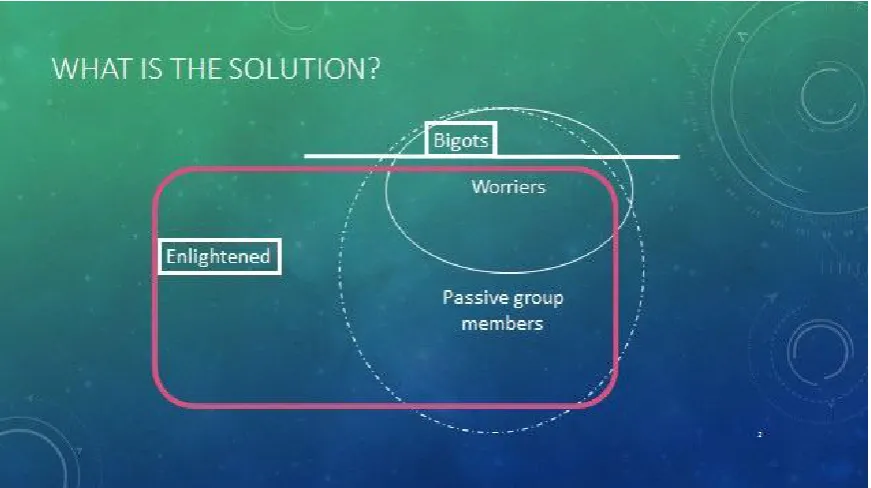
There is a tendency for we - the enlightened - to group not only the 'worriers' but also the passive group members into the same category as the 'bigots', resulting in drawing a line between ‘us’ and the rest of mainstream society. When people say “anyone who disagrees with me is a bigot” or ‘‘If you’re not for us you’re against us”, and so on, the group of people who are now
perceived as the problem becomes bigger. It also then becomes more difficult to talk to members of that group because you have now created a boundary between yourself and the others, which means trust and openness is reduced.
It is actually more useful socially to define the problem group narrowly. You can then identify yourself as part of the much larger group of respectful people who oppose the problem group, and your communications are then directed towards this majority, to which you belong.
D E F I N E P R O B L E M G R O U P S
N A R R O W L Y
Define the problem group (e.g. bigots, haters, violent activists) very narrowly e.g., describe the group as ‘a few young angry men’ rather than broadly (e.g. ‘all people from _________ background’).
DEFINE THE PROBLEM GROUP NARROWLY
DISTINGUISH BETWEEN GROUPS
Distinguish between groups, e.g., terrorists from non-terrorist political opponents.
DISTINGUISH BIGOTS FROM WORRIERS
Distinguish bigots from worriers, political opponents, and passive group members.
D E F I N E P R O B L E M G R O U P S
N A R R O W L Y
[image:17.595.82.517.197.446.2]Add a little bit of body text
Figure 1. Defining problem groups broadly reduces social cohesion
Figure 2. Defining problem groups narrowly increases social cohesion
[image:17.595.82.518.486.730.2]Talk from your own personal experience about how you’ve come to your views about inclusion and respect for diversity.
TALK FROM YOUR OWN PERSONAL EXPERIENCE
D E A L W I T H C O N F L I C T
P O S I T I V E L Y
Different cultures and people see the world differently. Diversity and radicalism are natural and healthy aspects of any society as they allow
complexity and creativity in problem-solving. Diversity has allowed the human species to survive and is vital to our future on the planet. Problems arise, however, when violence is used in response to, or to promote diverse and radical ideas.
Social cohesion is not just about emphasising mutual respect and positivity, but about providing a safe way to express and negotiate conflict. Conflict is not always negative. On the contrary, differences of opinion are essential to a healthy society. However, problems occur when conflict is not managed well or when violence is used.
Communicate that you understand what someone is saying, and that you can see the positive values that motivate them to have these views, even if you do not agree.
RESPECT DIFFERENCES IN OPINION
Listen to and understand the other person's point of view. Try to be open and curious about everyone's perspective.
D E A L W I T H C O N F L I C T
P O S I T I V E L Y
Respond calmly when you are challenged and people misunderstand you, by reasserting your positive values and beliefs
RESPOND CALMLY
When people are taught to resolve conflict by first listening to each other’s underlying needs, wants, fears and concerns, they usually find that there are key interests that they hold in common with the other person. These shared concerns and needs then become a valuable point of connection, and help in brainstorming a range of options for resolving the original conflict that can meet everyone’s needs.
LEARN AND APPLY CONFLICT RESOLUTION SKILLS
DISCUSS A COMMON CONCERN
ATTEND PUBLIC EVENTS
Show up in support and solidarity at public actions, marches, and rallies.
Read, watch and share books, comics, and films that feature heroes who combat racism and spread acceptance. Promote film and book
competitions that invite authors and artists to develop works that promote respectfulness and diversity e.g., the Psychologists for Peace children’s book award and Youth peace prize.
PROMOTE ROLE MODELS
People with status and influence (parents, teachers, managers in
organisations, politicians, sportspeople, musicians and actors) can use their influence to spread the anti-racism message among those who
support and follow them. Do it yourself, or find trusted community leaders.
USE STATUS TO SPREAD THE MESSAGE
A D V O C A T E
F O R C H A N G E
Letting the decision-makers, including MPs, governments, corporations and businesses, know about your concerns (like reducing discrimination and racism, or removing laws that invades people’s privacy) is crucial. If enough people do this, and keep doing it, in time government policies can be
changed.
USE SOCIAL MEDIA
Show up in supportInform and activate your networks: blog, share, tweet, comment, and post prolifically about social issues and actions. Support
social media campaigns such as #NotInMyName which are leading the way in helping to promote positive messages. (And conversely, complain to the
PROMOTE WORKPLACE ANTI-RACISM POLICIES
Ask your workplace to promote (or develop if they don’t already have one!) their anti-racism policies so that everyone in the organisation is aware of it.
PARTICIPATE IN PUBLIC INQUIRIES
Participate in public inquiries by the Human Rights and Equal Opportunity Commission (HREOC) or the Government, to have your say about the human rights impacts of policies and laws.
Support the idea of a Bill of Rights which does not exist yet in Australia, but which many people argue should be a part of our Constitution. A Bill of Rights would state the essential human rights of all people living in Australia, and ensure that these rights are better considered in all subsequent law and policy making.
SUPPORT THE IDEA OF A BILL OF RIGHTS
Advocate for the preservation of section 18c of the Racial Discrimination Act to stop the watering down of our anti-discrimination laws. Although this has not been passed by the Senate it is likely to continue as a divisive issue for some time.
ADVOCATE FOR THE PRESERVATION OF SECTION 18C
Racism. It stops with me campaign
https://itstopswithme.humanrights.gov.au/
Be an active bystander against discrimination
https://www.vichealth.vic.gov.au/be-healthy/be-healthy-mental-health
Four bystander anti-racism campaign videos have been produced. These videos educate the public on action they can take as witnesses of racism.
https://www.westernsydney.edu.au/challengingracism/challenging_racism_proje ct/our_research/bystander_anti-racism.
Bystander anti-racism project, Western Sydney
This booklet is adapted from a longer document which includes more
information about the rationale for developing this resource, as well as the psychological evidence supporting each strategy. You can find it and more information here:
U S E F U L
R E S O U R C E S
Responding to Everyday Bigotry: Speak Up! - published by Southern Policy Law Centre. The six steps are: be ready; identify the behaviour; appeal to principles; set limits; find an ally; be vigilant.
https://www.tolerance.org/magazine/publications/speak-up/six-steps-to-speak-up