The Thirty-Third AAAI Conference on Artificial Intelligence (AAAI-19)
Unknown Agents in Friends Oriented
Hedonic Games: Stability and Complexity
Nathana¨el Barrot,
1,2Kazunori Ota,
2Yuko Sakurai,
3Makoto Yokoo
2,1 1RIKEN, Center for Advanced Intelligence Project (AIP),2Kyushu University,3National Institute of Advanced Industrial Science and Technology (AIST)
[email protected], [email protected] [email protected], [email protected]
Abstract
We study hedonic games under friends appreciation, where each agent considers other agentsfriends, enemies, or un-known agents. Although existing work assumed that un-known agents have no impact on an agent’s preference, it may be that her preference depends on the number of unknown agents in her coalition. We extend the existing preference,
friends appreciation, by proposing two alternative attitudes toward unknown agents,extraversionand introversion, de-pending on whether unknown agents have a slightly positive or negative impact on preference. When each agent prefers coalitions with more unknown agents, we show that both core stable outcomes and individually stable outcomes may not ex-ist. We also prove that deciding the existence of the core and the existence of an individual stable coalition structure are respectively NPNP-complete and NP-complete.
Introduction
In many real-life examples, ranging from sports clubs to political parties, individuals (agents) carry out activities in groups (coalitions) to achieve common goals. Coalition for-mation with hedonic preferences, orhedonic games, is con-cerned with settings where each agent’s payoff depends only on the coalition that she joins. A natural question in hedo-nic games is the existence of stable partitions of the set of agents (coalition structures). Various stability concepts have been studied; among the most prominent arecoreand indi-vidual stability(see handbook Aziz and Savani (2016)).
In hedonic games, each agent’s preference is a weak or-der over the exponentially many coalitions that she can join. Therefore, several compact preference representations have been proposed in the literature. Dimitrov et al. (2006) pro-posed a notably simple preference representation, where each agent partitions the set of agents intofriendsand en-emies. They studied a preference extension called friends appreciationwhere each agent prefers coalitions with more friends and, in case of a tie, with fewer enemies. Recently Ohta et al. (2017) slightly extended this model by introduc-ing agents who do not impact preferences (neutral agents).
We propose to extend this analysis by generalizing friends appreciation. Indeed it is quite natural to assume that only a subset of agents significatively affects our preferences,
Copyright c2019, Association for the Advancement of Artificial Intelligence (www.aaai.org). All rights reserved.
i.e. our friends and our enemies. Agents that we don’t know enough to identify as friends or enemies, i.e.unknown agents, have a minor impact on our preferences. However, we argue that the attitude toward unknown agents is not re-stricted toneutrality. In personality theory, the broadly rec-ognized five-factor model presents extraversion as one of the five core personality traits (see introduction (McCrae and John 1992) and handbook (John and Srivastava 1999)). Roughly speaking, individuals with high extraversion tend to be sociable and to enjoy meeting new people, while those with low extraversion tend to be reserved and to avoid large social gatherings. In our setting, neutrality toward unknown agents would lie in the middle of this continuous scale. In this paper, we consider two alternative preferences which take into account this personality trait:friends appreciation with extraverted agentsandfriends appreciation with intro-verted agents, modelling agents who prefer coalitions with respectively more or fewer unknown agents.
From a theoretical viewpoint, analyzing how unknown agents affect stability concepts more precisely is meaning-ful. Indeed, under friends appreciation without unknown agents, an individually stable coalition structure always ex-ists (Dimitrov and Sung 2004), while when considering un-known agents with no impact on preferences, the question has still to be addressed. In both models, there always ex-ists a core stable coalition structure, which can be found in polynomial time. Since in the more general model of addi-tively separable preferences a core/individually stable out-come may not exist, we hope to clarify a boundary case where core/individual stability is guaranteed.
and individually stable outcomes always exist and can be computed in polynomial time.
Related work In hedonic games, initiated by Banerjee, Konishi, and S¨onmez (2001) and Bogomolnaia and Jack-son (2002), a fundamental question is to identify condi-tions which guarantee the existence of stable coalition struc-tures. Aziz and Brandl (2012) clarified the relations between well-studied stability concepts. In fractional hedonic games, Aziz, Brandt, and Harrenstein (2014) described sufficient conditions for the existence of the core, Brandl, Brandt, and Strobel (2015) showed that an individually stable outcome may not exist, and Monaco, Moscardelli, and Velaj (2018) studied Nash and core stability in a slightly modified setting. The idea of neutral agents was introduced by Lang et al. (2015), using the generalized Bossong-Schweigert exten-sion principle. They characterized coalition structures that are necessarily/possibly stable. Furthermore, Peters (2016) proposed a graphical representation of hedonic games, where an agent’s preference only depends on her neighbors. Regarding computational complexity, Ballester (2004) showed that the existence problem is NP-complete for core and individual stability under individually rational coali-tion lists. In additively separable hedonic games, Woeg-inger (2013) showed that existence of the core is NPNP -complete, result later extended to symmetric preferences in Peters (2017). Peters and Elkind (2015) identified sufficient conditions on expressivity for proving the NP-hardness of existence problems, which apply to various hedonic games such as hedonic coalition nets (Elkind and Wooldridge 2009). Bil`o et al. (2018) showed NP-hardness of comput-ing a best Nash stable outcome in fractional hedonic games.
Outline Preliminaries introduce the model and relevant no-tions. In the next section, with extraverted agents, we show that the core may be empty and we examine the complexity of deciding its existence. The following section focuses on individual stability; we provide counter-examples and, with extraverted agents, we study the complexity of the existence problem. Finally, we discuss stability in presence of intro-verted agents and stability when preferences are symmetric.
Preliminaries
LetN = {1, . . . , n} denote theset of agents. Acoalition C ⊆ N is a subset of agents. Acoalition structureπis a partition ofN. Letπ(i)denote the coalition to which agent
ibelongs inπ. LetCN denote the set of all coalition
struc-tures. A hedonic game (N, P) is defined by set of agents
Nand apreference profileP = (%i)i∈N. For every agenti,
herpreference%iis based on the coalitions to which she
be-longs; letiand∼irespectively denote the strict preference
and the indifference relation derived from%i.
Additively separablehedonic games form a natural class of hedonic game where each agent has a value for any other agent and the utility that an agent derives from a coalition is the sum of the values of its members.
Definition 1 (Additively Separable). A hedonic game (N,%)isadditively separableif for each agenti∈N there exists a utility functionvi:N 7→Rsuch thatvi(i) = 0and
for any two coalitionsS, T ⊆Nsuch thati∈S, T,
S %iT ⇔
X
j∈S
vi(j)≥
X
j∈T
vi(j).
Hedonic games under friends appreciation and its exten-sions proposed in this paper are additively separable. More-over, an additively separable hedonic game issymmetricif any two agents associate the same value to each other.
Definition 2(Symmetry). An additively separable hedonic game satisfiessymmetryif for alli, j∈N,vi(j) =vj(i).
We focus on two prominent stability concepts,coreand
individual stability. These stability concepts are among the least restrictive -afterindividual rationality- which concern respectively coalition and individual deviations. Individual rationality is a minimal requirement which guarantees that each player weakly prefers her coalition over being alone.
Definition 3(Individual Rationality). A coalition structure
π∈CN is individually rational if there exists no agent that
prefers to deviate alone, i.e., for alli∈N,π(i)%i{i}.
Definition 4(Core Stability). A coalition structureπ∈CN
admits a blocking coalitionX ⊆N(X 6=∅) if for alli∈X,
X i π(i)holds. The core is the set of coalition structures
that do not admit any blocking coalition.
Definition 5(Individual Stability). A coalition structureπ∈ CN is individually stable if there exists no agenti∈Nand coalitionC∈π∪ {∅}such thatC∪ {i} iπ(i), and for all
j∈C,C∪ {i}%jC.
Intuitively, a coalition structure is core stable if no group of agents benefits from forming a deviating coalition, and it is individually stable if no individual agent benefits from joining an existing coalition without harming any agent in this coalition. Furthermore, a coalitionC isacceptable
to agent i if and only ifC %i {i} holds. Thus, ifπ(i)is
unacceptable to agenti,πcannot be a member of the core or individually stable.
We consider a simple and compact preference called
friends appreciation, first proposed by Dimitrov et al. (2006) and extended with neutral agents by Ohta et al. (2017).1 For each agent i, the set of other agentsN \ {i} is parti-tioned into friends, enemies, and unknown agents, and we denote the respective sets of agents byFi,Ei, and⊥i.
Un-der friends appreciation, when comparing two coalitions, an agent first compares the number of her friends in each coalition, and then the number of her enemies. Unknown agents have no impact on preferences, they are considered neutral agents. For two coalitionsS andT such that agent
i ∈ S, T, agent iprefers the coalition with more friends, and in case of a tie, she prefers the one with fewer enemies:
S i T ⇔ (1)|S ∩Fi| > |T ∩Fi|, or (2)|S ∩Fi| =
|T ∩Fi|and|S∩Ei|<|T∩Ei|.
Notice that S ∼i T holds iff |S ∩Fi| = |T ∩ Fi| and
|S ∩Ei| = |T ∩Ei|. The set of preference profiles under
1
friends appreciation is denoted byPF. A preference inPF
is additively separable on weightsnfor a friend, 0 for an unknown agent, and−1for an enemy.
We propose two alternative preferences,friends appreci-ation with extraverted agentsandfriends appreciation with introverted agents, illustrated in Example 1, by allowing agents to take into account in their preferences the num-ber of unknown agents. Anextravertedagent considers that unknown agents have a positive impact, whereas an intro-vertedagent considers that unknown agents have a negative impact. Under friends appreciation with extraverted agents, in the case of a tie for both the number of friends and enemies, agent iprefers the coalition with more unknown agents, i.e., for two coalitions,S andT such thati ∈S, T:
S i T ⇔ (1)|S ∩Fi| > |T ∩Fi|, or (2)|S ∩Fi| =
|T ∩ Fi|and|S ∩ Ei| < |T ∩ Ei|, or (3)|S ∩ Fi| =
|T∩Fi|and|S∩Ei|=|T∩Ei|and|S∩ ⊥i |>|T∩ ⊥i|.
Under friends appreciation with introverted agents, agenti
prefers the coalition with fewer unknown agents.
For both preferences,S∼iTholds iff|S∩Fi|=|T∩Fi|,
|S ∩Ei| = |T ∩Ei|, and |S∩ ⊥i | = |T∩ ⊥i |. The
set of preference profiles under friends appreciation with ex-traverted (resp. introverted) agents is denoted byPF+(resp.
PF−). A preference inPF+(resp.PF−) is additively sepa-rable with weightsnfor a friend,1/nfor an unknown agent, and−1for an enemy (resp.n,−1/n, and−1).
Definition 6(HG/F, HG/F+, and HG/F-). AnHG/F(resp.
HG/F+,HG/F-) is a hedonic game(N,(%i)i∈N)such that
each%ilies inPF (resp.PF+,PF−).
The preferencesPF,PF+, andPF−are strictly more ex-pressive than the original model, i.e.PF with only friends
and enemies (PF
o), and moreover, their pairwise
intersec-tions correspond exactly toPF o :
1) Consider an agent whose preference lies inPF. When she
has an unknown agent, her preference is not representable by
PF
o ,PF+, orPF−. Indeed, these preferences do not allow
for similarity between coalitions of different sizes.
2) Now consider an agent whose preference lies inPF+. If she has an unknown agent and another relation (friend or en-emy), then her preference is not representable byPF
o,PF,
orPF−. Indeed an unknown agent and a friend both have a positive impact but not an interchangeable one.
3) Finally consider an agent whose preference lies inPF−. If she has an unknown agent and an enemy, then her pref-erence is not representable byPF
o ,PF, orPF+. Indeed an
unknown agent and an enemy have both a negative impact on preference but not interchangeable. Notice however that if this agent has only unknown agents and friends, then her preference is representable byPF
o and thus byPF, orPF+.
In other words,PF,PF+, andPF−generalise the origi-nal friends appreciationPF
o in three distinct directions.
Furthermore HG/F, HG/F+, and HG/F- are related to
anonymoushedonic games, which are games where agents’ preferences depend only on the size of the coalitions they be-long to. Indeed, these games are anonymouswithinthe sets of friends, enemies, and unknown agents, e.g., two friends of an agent have interchangeable impacts on her preference. Hedonic games HG/F, HG/F+, or HG/F- can be
repre-sented by a labeled directed graph,GEF⊥= (N, AE∪AF∪
A⊥), where each vertex corresponds to an agent, and arc (i, j)in setAE(resp.AF, A⊥) represents that agenti con-siders agentjan enemy (resp. a friend, an unknown agent).
Example1. Consider four agents{1,2,3,4}and the game which relations are described in the graph below:
1 2
3 4
F
E
⊥ ⊥
⊥ ⊥
⊥
Agent1has one friend, one enemy, and one neutral. When the game is HG/F, HG/F+, or HG/F-, it leads re-spectively to preference a, b, or c (restricted to acceptable coalitions):
a:{1,2,4} ∼1{1,2} 1{1,2,3,4} ∼1{1,2,3} 1{1,4} ∼1{1} b:{1,2,4} 1{1,2} 1{1,2,3,4} 1{1,2,3} 1{1,4} 1{1}
c:{1,2} 1{1,2,4} 1{1,2,3} 1{1,2,3,4} 1{1} In the context of hedonic games, two well-studied de-cision problems are Existence and Verification. Given a stability concept and a hedonic game, the former decides whether there exists a stable coalition structure, and the latter verifies whether a given coalition structure is stable. We define HG/F+/IS/EXIST and HG/F+/C/EXIST as the existence problems related to individual and core stability of an HG/F+. Similarly, we define HG/F+/IS/VERIF and HG/F+/C/VERIFas the verification problems.
We assume that the reader is familiar with concepts from complexity theory, particularly with time complexity classes NP, NPNP, and their complements (Garey and Johnson 2002). In our complexity proofs, we utilize the NP-complete problem MAXCLIQUEand the coNPNP-complete problem MINMAXCLIQUE(Ko and Lin 1995), defined below. First, a cliqueis a graphG = (V,A)such that for any pair of nodesx, yinV, edge(x, y)belongs toA.
Definition 7 (Problem MAXCLIQUE). Consider a graph
G= (V,A)and a thresholdk∈N. Does there exist a subset
ofkverticesW ⊆ Vsuch that subgraphG[W]is a clique?
Definition 8 (Problem MINMAXCLIQUE). Consider a graph G = (V,A), two sets I, J that partition V into
{Vi,j | i ∈ I, j ∈ J}, and a thresholdk ∈ N. For every
functiont : I → J, does the subgraphG[∪i∈IVi,t(i)] con-tain a clique of sizek?
In other words, V is partitioned into |I|·|J| subsets
Vi,j. Then, for each function t : I → J, we
con-sider a MAXCLIQUEproblem for the subgraph induced by
G[∪i∈IVi,t(i)]. Notice that the proof in Ko and Lin (1995) showing coNPNP-completeness of MINMAXCLIQUE, holds even whenJ ={0,1}and|Vi,0|=|Vi,1|for alli∈I.
Core Stability with Extraverted Agents
First, we discuss the existence of a core stable coalition structure under friends appreciation with extraverted agents, as well as the complexity of the existence problem.The core may be empty
always exists and that it can be computed in polynomial time as the strongly connected components of graphGF. These
results also hold in the original friends and enemies model with no unknown agents (Dimitrov et al. 2006). However, when agents prefer coalitions with more unknown agents, the existence of the core is no longer guaranteed.
Theorem 1. In an HG/F+, the core may be empty.
To prove this theorem, we utilize the following example:
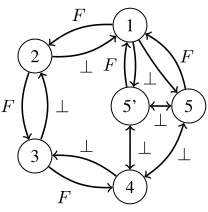
Example 2. Consider six agents{1,2,3,4,5,50} with the following preferences. Fori ∈ {1,2,3}, agenticonsiders agenti+ 1a friend, whereasi+ 1 regardsias unknown. Agents 4, 5, and 50 view each other as unknown agents. Agents5 and50 see1as a friend, but 1considers them as unknown agents. Other relations are enemy relations. Pref-erences are illustrated with graphGF⊥in Figure 1.
1
2
3
4 5 5’
F
F
F
F F
⊥
⊥
⊥ ⊥
⊥ ⊥
⊥
Figure 1: Example of an HG/F+ with an empty core.
Proof. By contradiction, assume that a core stable outcome
πexists in Example 2.
First, assume that agents5and50belong to different coali-tions inπ. If agent1 does not belong toπ(2), then coali-tion {1,5,50} is a deviation; thus π(1) = π(2). If5 be-longs toπ(1)(= π(2)), then 3 belongs toπ(1) (otherwise 2 deviates alone), which implies that 4 also belongs toπ(1) (otherwise 3 deviates alone). However,4has enemies but no friend in this coalition, thus4 deviates alone. Therefore5 does not belong to π(1), and by symmetry between5and 50,{5,50} ∩π(1) =∅. Now, if agent4does not belong to
π(3), coalition{4,5,50}is a deviation, but when4belongs toπ(3), coalition{5,50}is a deviation. Therefore,5and50 belong to the same coalition. Since they have similar prefer-ences, we consider them as one agent5-50in the following. Now, assume that there exists a coalition with three agents or more from{1,2,3,4,5-50}. This coalition must include an agent with no friend and at least one enemy, who then prefers to deviate in a singleton coalition. Therefore, each coalition consists of at most two agents, which implies that at least one agent is in a singleton coalition. However, if agent 1 (resp.2,3,4) is in a singleton coalition, then coalition{1,5 -50}(resp.{1,2},{2,3},{3,4}) is a deviation, since agent 5-50 (resp.1,2,3) gains one friend. Similarly, if agent5-50 is in a singleton coalition, then{4,5-50}is a deviation since 4gains one unknown agent. Thus, the core is empty.
Even if the impact of unknown agents on preferences is negligible compared to the impact of friends or enemies,
Theorem 1 shows that they can greatly affects core stability. An interesting question is then how difficult it is to decide if a given HG/F+ has an empty core.
Computational Complexity
In this subsection, we study the complexity of the existence of a core stable outcome under friends appreciation with traverted agents. First, notice that an HG/F+ where there ex-ists no friend relation is equivalent to a hedonic game under
enemies aversion (HG/E, see Footnote 1) where unknown arcs from the original graph become friend arcs in the new one. Since under enemies aversion, verifying that a given coalition structure is in the core is coNP-complete (Sung and Dimitrov 2007), it extends to our setting:
Theorem 2. ProblemHG/F+/C/VERIFis coNP-complete.
This result implies that the corresponding existence prob-lem is in NPNP. Moreover, we show the following:
Theorem 3. ProblemHG/F+/C/EXISTis NPNP-complete.
The main argument of the proof resembles to the one of Theorem 4 in (Ohta et al. 2017) concerning HG/E, however we have to adapt it to our setting. Indeed, while in an HG/E, coalitions in a core stable partition are necessarily cliques (in the graphGF⊥), this does not hold in an HG/F+. We adapt it by introducing cliques where only single nodes were nec-essary in their proof and by utilizing the following remarks.
Remark 1. Consider an HG/F+ where there exists a clique of friends,K, which agents have no friends outside ofK. Then a coalition structure that divides the agents ofKinto different coalitions is not core stable (sinceKis a deviation).
Remark 2. Consider an HG/F+ composed ofb cliques of friends {K1, . . . , Kb} and assume that 1) agents have no
friends outside of their clique, 2) agents in the same clique have the same set of unknown agents, which is a union of cliques in {K1, . . . , Kb}, and 3) the game is symmetric.
Then, a core stable coalition structure exists.
Proof of Theorem 3. First, by Theorem 2, HG/F+/C/EXIST is in NPNP. We prove NPNP-hardness by reducing the coNPNP-complete MINMAXCLIQUEto the complement of HG/F+/C/EXIST. Let an undirected graph G = (V,A), a setIpartitioning setVinto{Vi,0,Vi,1|i∈I}, and an inte-gerk∈N, define a restricted instance of MINMAXCLIQUE, where∀i∈I,|Vi,0|=|Vi,1|. We construct the correspond-ing instance of coHG/F+/C/EXISTas follows, illustrated by a partial representation of graphGF⊥in Figure 2:
(1) For eachxinV, we createvertex-cliqueKxthat contains
k0mutual friends (k0is specified at the end of the proof), and thenV =S
i∈IVi,0∪Vi,1, whereVi,j =
S
x∈Vi,jK
x. For
each edge(x, y)in graphG = (V,A), we introduce mutu-ally unknown arcs between eachx0 ∈Kxandy0∈Ky. (2) We introduce ageneralization of Example 2where agents 5and50are replaced by a clique ofk00−1mutually unknown agents,Kµ. We setk00such that a clique of sizekin the orig-inal graphGinduces a clique of sizek00in graphGF⊥. (3) We introduce afulcrum-cliqueKϕof2mutual friends. Agents inKϕconsider agents inKµand inV as unknown
V1,0 V2,0 V3,0
V1,1 V2,1 V3,1
L1,0
L1,1
L2,0
L2,1
L3,0
L3,1
×××
×××
×××
Kϕ
1
2
3 4
Kµ
⊥
⊥ F
⊥
⊥ F
⊥ F
⊥
F ⊥
⊥ F
Model of MinMaxClique Fulcrum-Clique Generalized Example 2
Figure 2: Corresponding instance of coHG/F+/C/EXIST.
(4) Between each pairVi,0andVi,1, we introduce|Vi,0|
in-hibitors(marked by×in Figure 2). EachKxinV
i,0is paired to oneKyinV
i,1through an inhibitor which makes exactly one of them available for a core stable coalition withKϕ.
(5) We connect to eachVi,j alogic gameLi,j which
con-tains a blocking coalition iff condition ‘all agents inVi,jare
inhibited, or none is inhibited’ is not satisfied. (6) All others relations are enemies relations.
Before the main argument, notice that all the vertex-cliquesKx, x ∈ V, the fulcrum-cliqueKϕ, the inhibitors, and the cliques from the logic games (described below) satisfy Remark 1. Therefore we do not discuss the stability of coalition structures that divide the agents of those cliques.
Main argument
First, observe that no core stable coalition structure con-tains a coalition with agents from the left and the right of
Kϕ (w.r.t. Figure 2). Thus, in a core stable coalition,Kϕ
is either grouped withKµ of sizek00−1 or with a clique which size is at leastk00inV. If cliqueKϕgoes to the left,
the game from the generalization of Example 2 is isolated and thus has an empty core. However, if cliqueKϕgoes to the right, the core of gameKϕ∪Example 2 is non-empty:
{{Kϕ, Kµ},{1,2},{3,4}}is core stable.
Assume that there exists a function t∗ : I → {0,1}
such that subgraph G[∪i∈IVi,t∗(i)] contains no clique of
size k. We claim that a core stable coalition structure ex-ists. For each i ∈ I, we set the inhibitors to Vi,1−t∗(i).
Thus no logic game generates a blocking coalition and only agents in∪i∈IVi,t∗(i)are available toKϕ. Thus, if we group
cliques Kϕ andKµ together,Kϕ has no interest to devi-ate left, which implies that the partial coalition structure
{{Kϕ, Kµ},{1,2},{3,4}}admits no blocking coalition (in
the whole game). Furthermore, the subgraph composed of vertex-cliquesKxin∪
i∈IVi,t∗(i)represents a game that
sat-isfies Remark 2, and thus, a core stable partition exists. Conversely, assume that for every functiont:I→ {0,1}, subgraphG[∪i∈IVi,t(i)]contains a clique of sizek. By con-tradiction, assume that a core stable coalition structure π
exists. Then there exists function tπ such that, for each
i ∈ I, all inhibitors between Vi,0 and Vi,1 are set to 1 −tπ(i), otherwise at least one logic game is not core
stable. ThusKϕ is grouped with a clique which size is at
leastk00inGF⊥[∪i∈IVi,tπ(i)], which exists for any function
t : I → {0,1} by assumption. Thus, the game from Example 2 is isolated and contains a blocking coalition.
Inhibitors and logic games (sketch)
Inhibitors and logic games help us model the MIN-MAXCLIQUE problem; the former make vertex-cliques (un)available for a deviation withKϕ, and the later impose
that the set of available vertex-cliques models a function
t:I→ {0,1}. Due to space limit, we only sketch them. An inhibitor is a clique that containsk∗ mutual friends (k∗ is specified below) and is mutually unknown with one vertex-cliqueKxinV
i,0 and with one vertex-cliqueKy in
Vi,1. We enforce that an inhibitor either joinsKxorKyin a core stable outcome by properly fixing the sizek∗.
Each logic game Li,j relies on a combination of
gad-get games, presented in Figure 3, that model logical gates with the understanding that an available agent amounts to Boolean True. AllK∗ in Figure 3 are cliques of friends. In gate NOT, we assume thatKxandKy have identical sizes;
in gate OR, we assume thatKx1 andKx2 have sizes≥2, and thatKαandKyhave sizes−1; in gate DUPLIC, we
assume that the size ofKxiss≥ 3, the size of eachKβ1 andKβ2iss−2, and the size of eachKy1andKy2iss−1.
Ky Kx
⊥
Ky Kα
Kx1 Kx2
⊥ ⊥
⊥
Ky1 Ky2
Kβ1 Kβ2
Kx
⊥ ⊥
⊥
⊥ ⊥
Figure 3: Gates NOT, OR and DUPLIC (In:Kx, Out:Ky).
By combining these logic gates and taking the vertex-cliquesKx ∈ V
i,j as input, eachLi,j is constructed to
ob-tain formulaV
Kx∈Vi,jKx
WV
Kx∈Vi,j¬Kx
, i.e. “all vertex-cliquesKx∈Vi,jare available or none is”. The
out-put of eachLi,j is then connected to a specific instance of
Example 2, such that the core of the gameLi,j∪Example 2
exists if and only if the formula is valid.
Finally, we briefly explain the values of k0, k00, and k∗. The construction of the logic games leads us to set the size of each vertex-clique Kx to 7, i.e., k0 = 7. Further-more, each vertex-cliqueKxis associated with a separating-clique of size k0 (not described here), which separates it from the logic game. It implies that a clique of size k in the original MinMaxClique instance leads to a core sta-ble coalition with (2×k0)×k unknown agents for Kϕ. Thus, we setk00= 14×k. Lastly, excluding inhibitors, the maximal number of unknown agents for agent xinVi,j is
7 + 14×(|V| −1) + 2, that is,7unknown agents fromx’s separating-clique,14×(|V| −1)unknown agents from the (|V| −1)other vertex-cliques and their separating-cliques, and2unknown agents from the fulcrum-clique. So we set
Hence, although HG/F+ are notably simple (additive on three values), they encompass the highest computational complexity reachable by any class of hedonic game (with polynomially computable preference) w.r.t. core stability.
Individual Stability
Now we investigate the existence of an individually stable coalition structure first under friends appreciation and then under friends appreciation with extraverted agents.
Friends Appreciation under Neutrality
Dimitrov and Sung (2004) proved that, in an HG/F with no unknown agents, individually stable outcomes always exist. When adding unknown agents with no impact on prefer-ences, although Ohta et al. (2017) argued that the core al-ways exists, they did not address individual stability. Theo-rem 4 proves that individual stability is not guaranteed.
Theorem 4. In an HG/F, an individually stable coalition structure may not exist.
To prove this theorem, we utilize the following example.
Example 3. Consider 12agents {0, . . . ,11}, divided into four groups:{0,1,2},C0 ={3,4,5},C1 ={6,7,8}, and
C2={9,10,11}, and the following preferences, illustrated in Figure 4, a partial representation of graphGEF⊥. In this example and the following proof, when we write[3], we mean (mod 3). First, fori ∈ {0,1,2}, preferences of agents in groupCiare defined as follows:
•agents3(i+1)+1and3(i+1)+2consider agent3(i+1)a friend, and other relations withinCiare unknown relations;
•all agents inCiconsider agentsiandi+ 1 [3]unknowns,
agenti+2 [3]an enemy, and agents fromCj, j6=i, enemies.
Fori∈ {0,1,2}, agenti’s preferences are such that:
•agenticonsiders agenti+1 [3]as friend, but agenti+1 [3] regards agentias an unknown agent;
•forCi, agenticonsiders agent3(i+ 1)as an enemy and
agents3(i+ 1) + 1and3(i+ 1) + 2as friends;
• for Ci+2[3], agent i regards agent 3((i+ 2 [3]) + 1) as an unknown agent and agents 3((i+ 2 [3]) + 1) + 1 and 3((i+ 2 [3]) + 1) + 2as friends;
•Finally, agentiis mutually enemy with agents inCi+1[3].
Proof. Assume that an individually stable coalition struc-ture π exists in Example 3. We first focus on C0. Notice that agent3has no friend, which implies thatπ(3)does not contain any enemy of 3; otherwise3deviates alone. Notice also that agents3,4, and5have identical preferences toward agents outside ofC0, and that4and5share a unique friend, that is agent3. This implies that agents inC0are in the same coalition, which does not contain any enemy of3.
By symmetry, fori ∈ {0,1,2}, agents inCi belong to the
same coalition, which does not contain any enemy of agent 3(i+ 1). Furthermore, fori ∈ {0,1,2}, agentibelongs to the coalition ofCi or of Ci+2[3], whereihas at least two friends. Thus, fori ∈ {0,1,2},Ciis either alone, grouped
with agenti, with agenti+ 1 [3], or with both.
Then, there are two cases to consider: (1) agents0,1, and 2 join three different coalitions, or (2) two agents from
0
1 2
0
⊥ ⊥ 3
4 5
0
⊥
⊥
6 7 8
0
⊥ ⊥
9 10
11
⊥
F
F F F
F
F F
F
F
2F,1⊥
2F,1E 2F,1⊥
2F,1E 2F,1E 2F,1⊥
C0
C1
C2
Figure 4: An HG/F with no individually stable outcome.
{0,1,2}join the same coalition.
Case (1): If agent0joinsC0, then0deviates toward coalition
{2} ∪C2, where she has two friends and no enemy. How-ever if0joinsC2, then0deviates toward coalition{1} ∪C0, where she has three friends.
Case (2): Without loss of generality, assume that agents 0 and1join the same coalition, i.e.,π(0) =π(1) ={0,1} ∪ C0. If agent2joinsC2, then2deviates towardC1, where she has no enemy. However, if agent2joinsC1, then1deviates toward coalition{2} ∪C1, where she has three friends. As a result, no individually stable outcome exists.
Friends Appreciation with Extraverted Agents
Back to our model in the presence of extraverted agents, we prove now that an individually stable coalition structure may not exist and that deciding its existence is NP-complete.
Theorem 5. In anHG/F+, an individually stable coalition structure may not exist.
Proof. The proof is based on the same example as in the proof of Theorem 1. Assume that an individual stable coali-tion structureπexists in Example 2. Furthermore, assume that agents5and50belong to different coalitions.
Notice first thatπ(4)∩ {1,2}=∅, since otherwise agent4 deviates in a singleton coalition. It implies that agent3does not belong toπ(1), since otherwise3deviates in a singleton coalition. Then, assume that agent1does not belong toπ(2). Ifπ(1)∩ {5,50}=∅, then5deviates toward{1}. However, if π(1) = {1,5} (resp.{1,50}), then 50 (resp.5) deviates toward{1,5}(resp.{1,50}).
Thus,1belongs toπ(2), which implies thatπ(1)∩ {5,50}=
∅, since otherwise agent2deviates in a singleton coalition. Then,3does not belong toπ(5)orπ(50), since otherwise5 or50 deviates in singleton coalition. In other words, agents 5and50are either both in singleton coalitions or just one of them is and the other belongs toπ(4). If5 and50 are both in singleton coalitions, then 5deviates toward {50}. Thus,
π(4)∩ {5,50} 6= ∅, but then5 (resp. 50) deviates toward
coalition and a similar argument as in Theorem 1 applies, showing that no individually stable outcome exists.
Similarly to Theorem 1, this result shows that adding un-known agents in the presence of extraverts impacts individ-ual stability. Hence, we turn to the complexity of deciding the existence of an individually stable outcome. Notice first that the verification problem for individual stability is triv-ially polynomial for any class of hedonic game, and thus, the existence problem is in NP. Moreover, we show:
Theorem 6. ProblemHG/F+/IS/EXISTis NP-complete.
Proof. To prove NP-hardness, we reduce the NP-complete problem MAXCLIQUEto problem HG/F+/IS/EXIST.
Let graphG = (V,A)and thresholdk∈Ndefine an
stance of MAXCLIQUE. We construct the corresponding in-stance of HG/F+/IS/EXISTwithnvertex-agents inV ≡ V
(modeling graphG),ncliques of unknown agents(Ki)i∈V,
each of sizek, and three agents10,20,30; therefore the set of agents isN =V ∪(Ki)i∈V ∪ {10,20,30}. The preferences
are define as follows, illustrated in Figure 5.
In setV, for each edge(i, j)in graphG = (V,A), we con-struct unknown arcs(i, j) and(j, i). Moreover, all agents inV consider agent30 unknown, whereas agent30 consid-ers each of them friends. For i ∈ V, all the k agents in
Kiare mutually unknown toward each other, mutually
un-known with agenti∈V, and they consider agent10a friend, whereas agent10 considers them unknown agents. Further-more, agent 10 (resp. 20) considers agent 20 (resp. 30) as friend, whereas agent20 (resp.30) considers agent10 (resp. 20) as unknown. Finally, all other arcs are enemies; in partic-ular agents from different cliques in(Ki)i∈V are enemies.
First, notice that the structure of the whole game is based
1’
2’
3’
K1 Kn
Model of
G= (V,A)
F
F
F F
F
⊥
⊥
⊥
⊥
E
⊥ ⊥
Figure 5: Instance of HG/F+/IS/EXISTfrom MAXCLIQUE.
on Example 2, with cliques (Ki)i∈N in place of agents 5
and50, and agents inV (model ofG)embedded in place of agent4. Thus, with a similar argument, we see that if there is no clique of sizekinV, then no individually stable coali-tion structure exists. However, when a clique C of size k
exists, the following coalition structure is individually sta-ble:{C∪ {30},{10,20},(Ki∪ {i})i /∈C,(Ki)i∈C}. Indeed,
no agenti∈V in coalitionC∪ {30}has an incentive to de-viate towardKisince the number of unknown agents is the
same. Thus agent20cannot join30and the deviation cycle in Example 2 is interrupted.
Hence HG/F+ contain some of the most difficult problems in hedonic games related to individual stability.
Discussion
Friends appreciation with introverted agents When all agents are introverted, i.e. they value unknown agents nega-tively, enemies and unknown agents have similar (but not equivalent) impact on preferences. Thus, we obtain simi-lar results as under friends appreciation with no unknown agents, that is, core and individually stable coalition struc-tures always exist. We prove this result by showing that the strict core always exists, with the same argument developed under friends appreciation with no unknown agents in (Dim-itrov et al. 2006). By definition, a strict core stable coalition structure is also core and individually stable.
Theorem 7. Under friends appreciation with introverted agents (1) a strict core outcome always exists and (2) it can be computed in polynomial time as the strongly connected components of graphGF.
Symmetric hedonic games Previous sections focused on non-existence results for core/individually stable outcomes. An interesting question is then what restrictions on prefer-ence can guarantee the existprefer-ence of stable outcomes. We ad-dress it for a natural restriction, namelysymmetry.
Proposition 1. In symmetric HG/F+, the core always exists. Moreover, in both symmetric HG/F and HG/F+, an individ-ually stable outcome always exists.
Proof. First, an HG/F+ with symmetric preferences satisfies the top-coalition property which is a sufficient condition for the existence of the core (Banerjee, Konishi, and S¨onmez 2001). Moreover, Bogomolnaia and Jackson (2002) proved that an individually stable coalition structure always exists in a symmetric additively separable hedonic game.
Conclusion
We studied the impact of different attitudes toward un-known agents on stability in friends oriented hedonic games. We proved that three distinct extensions of the existing preference lead to a diverse stability and complexity land-scape. With extraverted agents, we provided counterexam-ples showing that both core and individually stable coali-tion structures may not exist, whereas the strict core is guaranteed in the presence of introverted agents. Then we proved that deciding the existence of such outcomes is NPNP-complete for core stability and NP-complete for in-dividual stability. We also proved that an inin-dividually stable coalition structure may not exist under friends appreciation with neutrality. An open question is to prove the complex-ity of deciding the existence of individual stable outcomes under friends appreciation with neutrality.
Acknowledgments
References
Aziz, H., and Brandl, F. 2012. Existence of stability in hedonic coalition formation games. InProceedings of the 11th International Conference on Autonomous Agents and Multiagent Systems (AAMAS-2012), 763–770.
Aziz, H., and Savani, R. 2016. Hedonic games. In Brandt, F.; Conitzer, V.; Endriss, U.; Lang, J.; and Procac-cia, A. D., eds.,Handbook of Computational Social Choice. Cambridge University Press. 356–376.
Aziz, H.; Brandt, F.; and Harrenstein, P. 2014. Fractional hedonic games. In Proceedings of the 13th International Conference on Autonomous Agents and Multi-agent Systems (AAMAS-2014), 5–12.
Ballester, C. 2004. NP-completeness in hedonic games.
Games and Economic Behavior49(1):1–30.
Banerjee, S.; Konishi, H.; and S¨onmez, T. 2001. Core in a simple coalition formation game.Social Choice and Welfare
18(1):135–153.
Bil`o, V.; Fanelli, A.; Flammini, M.; Monaco, G.; and Moscardelli, L. 2018. Nash stable outcomes in fractional he-donic games: Existence, efficiency and computation. Jour-nal of Artificial Intelligence Research62:315–371.
Bogomolnaia, A., and Jackson, M. O. 2002. The stability of hedonic coalition structures.Games and Economic Behavior
38(2):201–230.
Brandl, F.; Brandt, F.; and Strobel, M. 2015. Fractional he-donic games: Individual and group stability. InProceedings of the 14th International Conference on Autonomous Agents and Multiagent Systems (AAMAS-2015), 1219–1227.
Dimitrov, D., and Sung, S. C. 2004. Enemies and friends in hedonic games: individual deviations, stability and manipu-lation.
Dimitrov, D.; Borm, P.; Hendrickx, R.; and Sung, S. C. 2006. Simple priorities and core stability in hedonic games.Social Choice and Welfare26(2):421–433.
Elkind, E., and Wooldridge, M. 2009. Hedonic coalition nets. In Proceedings of the 8th International Conference on Autonomous Agents and Multi-agent Systems (AAMAS-2009), 417–424.
Garey, M. R., and Johnson, D. S. 2002. Computers and intractability, volume 29. wh freeman New York.
John, O. P., and Srivastava, S. 1999. The big five trait taxonomy: History, measurement, and theoretical per-spectives. Handbook of personality: Theory and research
2(1999):102–138.
Ko, K.-I., and Lin, C.-L. 1995. On the complexity of min-max optimization problems and their approximation. Non-convex optimization and its applications4:219–240. Lang, J.; Rey, A.; Rothe, J.; Schadrack, H.; and Schend, L. 2015. Representing and solving hedonic games with ordinal preferences and thresholds. InProceedings of the 14th Inter-national Conference on Autonomous Agents and Multiagent Systems (AAMAS-2015), 1229–1237.
McCrae, R. R., and John, O. P. 1992. An introduction to the
five-factor model and its applications.Journal of personality
60(2):175–215.
Monaco, G.; Moscardelli, L.; and Velaj, Y. 2018. Stable out-comes in modified fractional hedonic games. arXiv preprint arXiv:1804.05040.
Ohta, K.; Barrot, N.; Ismaili, A.; Sakurai, Y.; and Yokoo, M. 2017. Core stability in hedonic games among friends and en-emies: Impact of neutrals. InProceedings of the 26th Inter-national Joint Conference on Artificial Intelligence (IJCAI-2017), 359–365.
Peters, D., and Elkind, E. 2015. Simple causes of com-plexity in hedonic games. InProceedings of the 24th Inter-national Joint Conference on Artificial Intelligence (IJCAI-2015), 617–623.
Peters, D. 2016. Graphical hedonic games of bounded treewidth. InProceedings of the 30th AAAI Conference on Artificial Intelligence (AAAI-2016), 586–593.
Peters, D. 2017. Precise complexity of the core in dichoto-mous and additive hedonic games. InInternational Confer-ence on Algorithmic DecisionTheory, 214–227. Springer. Sung, S. C., and Dimitrov, D. 2007. On core membership testing for hedonic coalition formation games. Operations Research Letters35(2):155–158.
Woeginger, G. J. 2013. A hardness result for core stability in additive hedonic games. Mathematical Social Sciences