The Thirty-Third AAAI Conference on Artificial Intelligence (AAAI-19)
Discrete Social Recommendation
Chenghao Liu,
1,2∗Xin Wang,
3∗Tao Lu,
2,4Wenwu Zhu,
3Jianling Sun,
2,4Steven C.H. Hoi
11School of Information Systems, Singapore Management University, Singapore 2School of Computer Science and Technology, Zhejiang University, China 3Department of Computer Science and Technology, Tsinghua University, China
4Alibaba-Zhejiang University Joint Institute of Frontier Technologies, China
{twinsken, 3140102441, sunjl}@zju.edu.cn,{xin wang,wwzhu}@tsinghua.edu.cn, [email protected],
Abstract
Social recommendation, which aims at improving the per-formance of traditional recommender systems by consider-ing social information, has attracted broad range of interests. As one of the most widely used methods, matrix factoriza-tion typically uses continuous vectors to represent user/item latent features. However, the large volume of user/item latent features results in expensive storage and computation cost, particularly on terminal user devices where the computation resource to operate model is very limited. Thus when taking extra social information into account, precisely extractingK
most relevant items for a given user from massive candidates tends to consume even more time and memory, which im-poses formidable challenges for efficient and accurate recom-mendations. A promising way is to simply binarize the latent features (obtained in the training phase) and then compute the relevance score through Hamming distance. However, such a two-stage hashing based learning procedure is not capable of preserving the original data geometry in the real-value space and may result in a severe quantization loss. To address these issues, this work proposes a novel discrete social recommen-dation (DSR) method which learns binary codes in a unified framework for users and items, considering social informa-tion. We further put the balanced and uncorrelated constraints on the objective to ensure the learned binary codes can be informative yet compact, and finally develop an efficient op-timization algorithm to estimate the model parameters. Ex-tensive experiments on three real-world datasets demonstrate that DSR runs nearly5times faster and consumes only with 1/37of its real-value competitor’s memory usage at the cost of almost no loss in accuracy.
Introduction
Online social networks have become an important source to provide a huge amount of timely and valuable information for understanding social behaviors and inferring personal preferences. Recommender systems, though are designed to help users discover interesting products or services, always suffer from the lack of useful information for understanding user preferences. Therefore, when recommender systems (which urge for data) meet online social networks (which offer useful data), their combination naturally gives birth
∗
equal contribution
Copyright c⃝2019, Association for the Advancement of Artificial Intelligence (www.aaai.org). All rights reserved.
tosocial recommendation(Ma et al. 2011; Ma et al. 2008; Tang, Hu, and Liu 2013; Wang et al. 2016) that aims at im-proving the accuracy of traditional recommendation meth-ods through mitigating the data sparsity issue.
However, the ever-growing scales of various web ser-vices bring social recommendation a serious concern on the computational efficiency in terms of time and space. More concretely, matrix factorization based collaborative filtering (CF), one of the most widely adopted techniques in real-world applications, factorizes ann×muser-item rating ma-trix and maps both users and items into a r-dimensional (r ≪ min(n, m)) real-value latent space. A user’s prefer-ence for an item can be approximated by the inner prod-uct of their real-valued latent vectors. As a result, the ber of parameters to be stored grows linearly with the num-ber of users or items. This becomes very challenging when the recommender systems have millions or even billions of users/items, which prevents the model from being deployed to mobile devices. Moreover, to further generate the top-K preferred items for each user, it’s necessary to first compute users’ preferences for all items, and then sort the preference scores by a descending order, whose computation complex-ity, i.e.,O(mnr+mnlogK), becomes a critical bottleneck in terms of efficiency especially whenmornis quite large. Both issues become even more severe on social recommen-dation tasks which need extra storage and computation to aggregate social information from social ties.
through ignoring the discrete constraints and then binarizes the results by thresholding, becomes a compromising solu-tion. Nevertheless, as pointed out by Zhang et al. (Zhang et al. 2016), this solution suffers from a large quantization loss for failing to preserve the original data geometry (user-item relevance and user-user relationship) in the continuous real-valued vector space. To this end, the proposed DSR adopts a unified framework which optimizes the user/item binary codes in a way that can preserve the intrinsic user-item rel-evance and user-user relationship. Moreover, DSR is able to obtain informative yet compact binary codes in a lim-ited size through satisfying additional balanced and uncor-related constraints. To solve the discrete optimization with balanced and uncorrelated bits in a tractable way, we de-velop an efficient alternative optimization algorithm which solves several mixed-integer programming subproblems in an iterative process. Extensive experiments are carried out on real-world datasets to validate the recommendation accu-racy and retrieval time of our proposed DSR method.
As a summary, we make the following contributions:
• We propose a novel discrete social recommendation (DSR) for compact representations. DSR is able to learn informative yet compact user/item binary codes for effi-cient user-item relevance and user-user relationship cal-culation and significantly reduce the storage cost in the scenario of large-scale social recommendation.
• We develop an efficient learning algorithm to solve the discrete optimization problem in a tractable way, with bal-anced and uncorrelated constraints being considered si-multaneously.
• We conduct extensive experiments on three real-world datasets to demonstrate that DSR runs roughly 5 times faster and consumes down to1/37of its real-value com-petitor’s memory usage at the cost of almost no loss in accuracy.
To the best of our knowledge, DSR is the first work that learns binary representations in social recommendation. The proposed method is potentially applicable to a wide range of other social recommendation tasks.
Related Work
In this section, we briefly review related work on social rec-ommendation and binary code collaborative filtering.
Social Recommendation. The data sparsity and cold start problem are two important reasons deteriorating the perfor-mance of traditional recommender systems (Liu et al. 2017). With the booming of data in social media, a large amount of valuable social information can be utilized for effectively solving these problems through modeling the mutual influ-ences between users (Wang et al. 2017b), which motivates the advent of social recommendation that aims to improve conventional recommender systems through utilizing social information. Specifically, Ma et al. (2008) combines collab-orative filtering with social information by proposing a prob-abilistic matrix factorization model which factorizes user-item rating matrix and user-user linkage matrix simultane-ously. They later present another probabilistic matrix
fac-torization model which aggregates a user’s own rating and her friends’ ratings to predict the target user’s final rating on an item. Jamali and Ester in their work (Jamali and Es-ter 2010) introduce a novel probabilistic matrix factoriza-tion model based on the assumpfactoriza-tion that users’ latent fea-ture vectors are dependent on their social ties’. Last but not least, Wang et al. (2016; 2017a) propose to distinguish dif-ferent tie types in social recommendation through present-ing a method which can simultaneously classify strong and weak ties in a social network with respect to optimal rec-ommendation accuracy as well as learn the latent vectors for users and items. We remark that all these models are learned in a continuous space, which in practice imposes se-vere challenges in the storage and computation cost when the number of users or items becomes large enough. The proposed discrete representation method could be easily ap-plied for the above model.
Binary Code Collaborative Filtering. As the scale of so-cial media data becomes larger and larger, the efficiency and scalability of recommendation methods are gradually draw-ing more attention. Collaborative filterdraw-ing can essentially be treated as a similarity search process, the methodology of learning the binary codes (Salakhutdinov and Hinton 2009; Grauman and Fergus 2013) can serve as a promising way to enhance the efficiency and scalability of recommenda-tion. Existing works on binary code collaborative filtering can be categorized into two groups: two-stage method and single-stage (i.e., unified framework) method. In general, two-stage method first obtains the user/item real-valued rep-resentations in a separate procedure, then performs the pro-cess of binarization on the learned representation to get the binary codes for users/items. This method may run the risk of ignoring the original data geometry and produc-ing large quantization loss. Typical models include utiliz-ing Locality-Sensitive Hashutiliz-ing (Gionis, Indyk, and Mot-wani 1999) to generate binary codes (Das et al. 2007), ran-domly projecting (Karatzoglou, Smola, and Weimer 2011) or rotating (Zhou and Zha 2012) features to obtain binary codes and imposing uncorrelated bit constraints to get bi-nary codes (Liu et al. 2014) etc. Single-stage method (Zhang et al. 2016; Zhang, Lian, and Yang 2017; Lian et al. 2017; Zhang et al. 2018; Liu et al. ), demonstrates its superiority over two-stage method by learning the binary codes for users and items in a unified framework so that the intrinsic geom-etry in real-valued vector space can be maintained and the quantization error can be dramatically reduced. However, all existing single-stage models do not take the important social information into account and thus fail to handle our problem in this work.
Discrete Social Recommendation
Preliminaries
Given a user-item rating matrixRof sizen×m, matrix fac-torization based collaborative filtering aims to decompose
Rinto two matrices, i.e.,Pr×n andQr×mwhich represent
the user preferences and the item preferences respectively, such thatR ≈P|Q. Theithcolumn ofP, denoted asP
i,
represents the latent feature vector of useri. Similarly, the jthcolumn ofQ, denoted asQ
j, represents the latent
fea-ture vector of itemj. As such, the rating of userifor item j is approximated by the dot product of Pi and Qj, i.e., Rij ≈P|iQj.
When considering social relationships among users (Ma et al. 2008), there comes an additional social relation ma-trixS of sizen×nwhose entry for rowiand column k, i.e.,Sik, measures the relationships (e.g., degree of trust)
be-tween useriand userk. The approximation ofSis similar to that ofRthrough introducing a third latent feature matrix
Tr×n, i.e., social factor matrix, satisfyingSik≈P|iTk:
min
n ∑
i=1
∑
Tk∈Ni
(Sik−P|iTk)
2,
whereNiis the set of neighbors (direct connections) latent
vectors of useri. Thus the overall objective is to minimize the squared loss for observed ratingsΩand social relation-shipsΨ:
argmin P,Q,T
∑
(i,j)∈Ω
(Rij−P|iQj)2+α0
∑
(i,k)∈Ψ
(Sik−P|iTk)2
+α1∥P∥2F+α2∥Q∥2F+α3∥T∥2F, (1)
where ∥ · ∥F denotes the Frobenius norm of a matrix,
α0 is the hyperparameter that controls the relative
impor-tance of the rating matrix and the social relation matrix and α1, α2, α3>0are hyperparameters which control the
trade-off between low loss and low model complexity. In this work, we follow Ma et al. (2008) and factorize user-item rat-ing matrix and user-user relationship matrix simultaneously, assuming that user rating information and user social infor-mation should share the same user latent feature vectors.
Discrete Social Recommendation (DSR)
When the dot product of those learned real-valued latent vectors is used for the purpose of similarity search, the to-tal computation complexity isO(mnr+mnlogk), which may result in a crucial efficiency issue when the number of usersnor the number of itemsmbecomes quite large. Thus we propose discrete social recommendation (DSR) model to replace real-valued latent feature vectors with binary codes such that the computation efficiency of dot product between user and item binary codes can be improved through the Hamming distance. Formally, the dot product between the user and item binary codes,bi ∈ {±1}randdj ∈ {±1}r,
can be formulated as
bidj= 2H(bi,dj)−r,
whereH(·,·) = ∑rk=1I(bik = djk)is the Hamming
dis-tance between two binary codes andI(·)denotes the
indica-tor function that returns1if the element is true and0 other-wise. Specifically,H(bi,dj) = 0if all the bits betweenbi
anddjare different andH(bi,dj) =rif all the bits are the same. Thanks to the high efficiency of bit operations, sim-ilarity search through computing Hamming simsim-ilarity can be accelerated up to logarithmic or even constant time com-plexity (Muja and Lowe 2009; Wang, Kumar, and Chang 2012).
Similar to the problem of conventional social recommen-dation in Equation (1), we can use the above similarity score to reconstruct the observed user-item ratings and user-user links. In order to maximize the information each bit car-ries and to assure the compactness of the learned binary codes, we impose the de-correlated constraint on the binary codes to guarantee the independence among different bits and place balance constraint on the learning process to en-sure that the each bit carries as much information as possi-ble. Given the observed user-item ratings indexΩand user-user links index Φ, the objective function of DSR model could be formulated as:
argmin B,D,F
∑
(i,j)∈Ω
(Rij−b|idj)
2+α 0
∑
(i,k)∈Ψ
(Sik−b|ifk)
2
(2)
s.t.B∈ {±1}r×n,D∈ {±1}r×m,F∈ {±1}r×n
B1n= 0,D1m= 0,F1n = 0 (3)
BB|=nIr,DD|=mIr,FF|=nIr, (4)
wherebi ∈ {±1}r,dj ∈ {±1}randfk ∈ {±1}r
repre-sent user binary codes, item binary codes and social binary codes respectively. We further stack the binary codes by col-umn to form matrices, i.e.,B∈ {±1}r×n,D∈ {±1}r×m,
F ∈ {±1}r×n. Due to the binary constraint, the
regulariza-tion ∥B∥2
F +∥D∥2F +∥F∥2F in Equation (1) becomes an
constant and hence is canceled. Equation (3) and (4) guar-antees the informativeness and compactness of the learned binary codes. It is obvious that the proposed DSR model follows the same assumption that rating matrixRand social relation matrixSshare the same user binary codes.
Optimizing DSR is essentially a challenging discrete op-timization problem, since it is generally NP-hard. Specif-ically, finding the global optimum solution needs to in-volve O(2(2rn+rm)) combinatorial search for the binary
codes (H˚astad 2001). Accordingly, we minimize this objec-tive function in a computationally tractable way by soft-ening the balance and de-correlated constraints (without discarding the discrete constraints B ∈ {±1}r×n,D ∈
{±1}r×m,F ∈ {±1}r×n). To achieve this, we first define
the delegate continuous variablesX,Y,Z, whereX∈ B=
{X ∈ Rr×n|X1 = 0,XX| = nI},Y ∈ D = {Y ∈
Rr×m|Y1= 0,YY|=mI},Z∈ F ={Z∈Rr×n|Z1=
0,ZZ| = nI}. Then the balanced and de-correlated
con-straints on users and items could be softened byd(B,B) =
minX∈B||B−X||F,d(D,D) =minY∈D||D−Y||F, and
for-mulate the tractable objective function of DSR as follows:
argmin B,D,F
∑
(i,j)∈Ω
(Rij−b|idj)
2+α 0
∑
(i,k)∈Σ
(Sik−b|ifk)
2
+β1d2(B,B) +β2d2(D,D) +β3d2(F,F) (5)
s.t.B∈ {±1}r×n,D∈ {±1}r×m,F∈ {±1}r×n,
where β1, β2, β3 are tuning parameters. We can find that
large values of β1, β2 and β3 will force d2(B,B) =
d2(D,D) = d2(F,F) = 0 when DSR can be
opti-mized under some feasible constraints. On the other side, the comparative small values of β1, β2 and β3 provide
a certain discrepancy between B and X, D and Y, F
and Z, making Equation (5) more flexible. Note that the norm of binary codes are constants and do not take any effect on regularization terms, we can replace the original regularization d2(B,B), d2(D,D), d2(F,F) with
tr(B⊤X), tr(D⊤Y), tr(F⊤Z)for the ease of optimization, wheretr(·)denotes the trace of a matrix. Besides, the above Equation (5) dose not discard the discrete constraint and still perform a discrete optimization overB,D,F.
Optimizing DSR model
We employ alternating optimization strategy to solve the problem. Specifically, we take turns to updateB,D,Fand
X,Y,Z, given others fixed. Next we elaborate on how to solve each of the subproblems. Algorithm 1 depicts the de-tails of the proposed DSR model.
Algorithm 1Discrete Social Recommendation
Input:
{Rij|i, j∈ V},{Sij|i, j∈ N }: observed user-item
rat-ings and user-user similarity in trust relationship.
1: InitializeB,D,FandX,Y,Zby Equation (4)
2: repeat
3: fori= 1to ndo
4: repeat
5: fork= 1to rdo
6: Updatebikvia the Equation (7).
7: end for
8: untilconverge
9: end for
UpdateDandFaccording to Equation (10) and Equa-tion (12) respectively.
10: UpdateXaccording to Equation (14).
11: Update ofYandZin a similar way withX.
12: untilconverge
13: returnB,D,F.
Optimizing B. We update B via fixing D,F, X,Y, Z. As the objective function sums over users independently, the updating procedure can be conducted through updating each
biin parallel. Ignoring the unrelated terms such as∑i,jR
2
ij
in Equation (2), we need to solve the following optimization
problem:
argmin
bi∈{±1}r b|i(
∑
j∈Vi
djd|j)bi−2(
∑
j∈Vi
Rijd|j)bi−2β1x|ibi,
+α0b|i(
∑
j∈Ni
fjfj|)bi−2α0(∑
j∈Ni
Sijfj|)bi (6)
whereVi denotes the set of items rated by useriandNi
is the set of users having social relationships with user i. Due to the discrete constraints, we adopt a bitwise learning method, i.e., Discrete Coordinate Descent (Shen et al. 2015). In particular, denotingbikas thek-th bit ofbiandbi¯kas the
other codes excludingbik, we updatebikbit by bit withbi¯k
fixed. Then, we updatebikbased on the following rule:
bik=sgn (
K(ˆbik, bik) )
, (7)
whereˆbik=∑j∈Vi(Rij−d|jk¯bi¯k)djk+α0∑j∈Ni(Sij− fj|¯kbik¯)fjk+β1xik.andK(i, j) =iifi̸= 0, andK(i, j) =
j otherwise andsgn(·)is a sign function mapping its input value to 1 or -1. Note thatbikshould only be updated when ˆ
bik is not zero. To efficiently compute ˆbik, we rewrite its
updating rule as:
ˆ
bik= ∑
j∈Vi
Rijdjk− ∑
j∈Vi
d|jbidjk+ ∑
j∈Vi
bik+β1xik (8)
+α0
∑
j∈Ni
Sijfjk−α0
∑
j∈Ni
fj|bifjk+α0
∑
j∈Ni
bik,
Optimizing D. Similar to the procedure of optimizingB, we optimize D by fixing B,F, X,Y andZ. Discarding terms irrelevant todi, we can rewrite the objective function as follows:
argmin
di
d|i(∑
j∈Vi
bjb|j)di−2(∑
j∈Vi
Rjib|j)di−2β2y|idi.
(9)
We can derive the updating rule ofdikas follows:
ˆ
dik= ∑
j∈Vi
Rijbjk− ∑
j∈Vi
b|jdibjk+ ∑
j∈Vi
dik+β2yik,
dik=sgn (
K( ˆdik, dik) )
. (10)
OptimizingF. Similarly, we can learn binary code forFby solving:
argmin fi
fi|(∑
j∈Ni
bjb|j)fi−2(∑
j∈Ni
Sjib|j)fi−2β3z|ifi,
(11)
Based on the coordinate-descent approach, we updatefik
according to:
ˆ
fik= ∑
j∈Vi
Sijbjk− ∑
j∈Vi
b|jfibjk+ ∑
j∈Vi
fik+β3zik
fik=sgn (
K( ˆfik, fik) )
OptimizingX. When fixingB, learningXcould be solved via optimizing the following problem:
argmax x
tr(B|X), s.t., X1= 0,XX|=nI. (13)
An analytic solution could be obtained via the aid of Singu-lar Value Decomposition (SVD). DenoteB¯ as a row-wise zero-mean matrix, where B¯ij = Bij − n1
∑n
j=1Bij. As
we can decomposeB¯ through B¯ = Pb∑bQ |
b, wherePb
andQbare the left and right singular vectors ofB¯, then the
closed-form updating rule ofXcan be written as follows:
X=√n[PbPˆb][QbQˆb]|, (14)
wherePˆbare eigenvectors corresponding to zero
eigenval-ues andQbˆ can be obtained by Gram-Schmidt orthogonal-ization based on[Qb1]. We could updateYandZin a sim-ilar way withX.
Computational Complexity. The proposed method con-verges quickly in practice, which took about2 ∼ 4 itera-tions. For each iteration, the overall computational complex-ity ofB,DandFsubproblem isO(
#iter(m+n)r2)
. In practice,#iteris usually2∼5. The overall complexity of
X,YandZisO(
r2m)
andO(
r2n), respectively.
Initialization. Since DSR solves a mixed-integer non-convex optimization problem, initialization plays an impor-tant role in achieving a good convergence and ideal local op-timum. Here we introduce an efficient initialization strategy inspired by (Zhang et al. 2016). We relax the binary con-straints in Equation (5) as follows:
argmin U,V,T
∑
i,j
(Rij−uTi vj)2+α ∑
i,j
(Sij−uTitj)2
+β1||U||2F+β2||V||2F+αβ3||T||2F
+β1d2(U,U) +β2d2(V,V) +β3d2(T,T),
(15) This initialization is quite similar to the traditional social recommendation in equation (1) except the balanced and de-correlated constraints imposed on real-valuedU,VandT. To solve it, we first randomly initialize real-valuedU,V,T
and find feasible initializations forX,YandZby optimiz-ing them respectively. Assumoptimiz-ing the solution is (U∗,V∗,
T∗,X∗,Y∗,Z∗), then we can initialize the parameters in Equation (5) as:
B=sgn(U∗),D=sgn(V∗),F=sgn(T∗),
X=X∗,Y=Y∗,Z=Z∗. (16)
The effectiveness of the proposed initialization algorithm is illustrated in Figure 16(left).
Learning Binary Codes in Cold-start Problem. By tak-ing social influence into consideration, our proposed DSR model can handle cold-start problem when users have no rat-ing history in the trainrat-ing set but are associated with social link information. For a new useri, we could learn the binary codes according to its social tiej’s (j ∈ Ni) binary codes fj. The objective could be formulated as:
argmin
bi
∑
i
∑
j∈Ni
(Sij−b|ifj)
2
, s.t.B1n= 0,BB|=nIr.
.
Experiments
In this section, we carry out extensive experiments on sev-eral real-world datasets and compare our proposed model with several state-of-the-art algorithms to demonstrate the advantages of the proposed DSR approach.
Dataset Rating# User# Item# Ties(edges)# FilmTrust 35497 1508 2071 1853 CiaoDVD 72700 17615 16121 40000 Epinions 664824 49290 139738 487181
Table 1: Detailed statistics of the datasets.
Datasets The evaluations are conducted on three public datasets from different real-world websites.
Epinions: This dataset is collected in a 5-week crawl (November/December 2003) from a product review website
1. Users in Epinions are allowed to specify scores from 1
to5to rate items, and they can also establish relations with others.
FilmTrust: This dataset is extracted from the entire FilmTrust website2in June, 2011. The dataset contains
user-user friendships and user-user-movie ratings.
CiaoDVD:This dataset is crawled from the entire category of DVDs on a UK DVD community website3in December,
2013. The dataset contains trust relationships among users as well as their ratings on DVDs.
The detailed statistics of the datasets is summarized in Ta-ble 1. When a user rates an item multiple times, we merge them into one rating by averaging the duplicate rating scores. For the in-matrix recommendation task, we randomly sam-ple 80% ratings as training and the rest 20%as testing for each user. For the out-matrix recommendation task, we ran-domly sample 80%users and put all ratings made by them into the training set, and then put the ratings made by the rest users into the test set. We repeat for5random splits and report the average results of each algorithms.
Evaluation Metrics To validate the performance of top-Krecommendation, we truncate the ranking list at position Kand then evaluate the ranking list using Normalized Dis-counted Cumulative Gain (NDCG) and Recall. NDCG is a weighted sum of the degree of relevance for the ranked items. This metric takes into account both ranking preci-sion and the positions of items in a ranking list. NDCG is position-sensitive, and it assigns higher score to “hits” at higher positions. The larger value of NDCG indicates higher accuracy of recommendation performance. We adopt the av-erage NDCG with different cut off over all users as the final metric (denoted as NDCG@K). Recall, on the other hand, quantifies the fraction of consumed items that are in the top-K ranking list sorted in a descending order by their esti-mated relevance scores. We also test the proposed model and other comparative methods in term of the Recall with different cut off over all users (denoted as recall@K).
1http://www.epinions.com/
2
http://trust.mindswap.org/FilmTrust/
3
2 4 K6 8 10 0.3 0.4 0.5 0.6 N D C G @ K
CiaoDVD r = 8 CFSR DSR CFSRB DCF
2 4 K6 8 10
0.3 0.4 0.5 0.6 N D C G @ K
CiaoDVD r = 16 CFSR DSR CFSRB DCF
2 4 6K 8 10
0.3 0.4 0.5 0.6 N D C G @ K
CiaoDVD r = 24 CFSR DSR CFSRB DCF
2 4 6K 8 10
0.3 0.4 0.5 0.6 N D C G @ K
CiaoDVD r = 32 CFSR DSR CFSRB DCF
2 4 K6 8 10
0.2 0.3 0.4 0.5 0.6 N D C G @ K
Epinions r = 8
CFSR DSR CFSRB DCF
2 4 6K 8 10
0.2 0.3 0.4 0.5 0.6 N D C G @ K
Epinions r = 16
CFSR DSR CFSRB DCF
2 4 6K 8 10
0.2 0.3 0.4 0.5 0.6 N D C G @ K
Epinions r = 24
CFSR DSR CFSRB DCF
2 4 6K 8 10
0.2 0.3 0.4 0.5 0.6 N D C G @ K
Epinions r = 32
CFSR DSR CFSRB DCF
2 4 K6 8 10
0.1 0.2 0.3 0.4 0.5 0.6 N D C G @ K
FilmTrust r = 8
CFSR DSR CFSRB DCF
2 4 6K 8 10
0.2 0.3 0.4 0.5 0.6 N D C G @ K
FilmTrust r = 16 CFSR DSR CFSRB DCF
2 4 6 8 10
K 0.2 0.3 0.4 0.5 0.6 N D C G @ K
FilmTrust r = 24 CFSR DSR CFSRB DCF
2 4 6K 8 10
0.2 0.3 0.4 0.5 0.6 N D C G @ K
FilmTrust r = 32 CFSR DSR CFSRB DCF
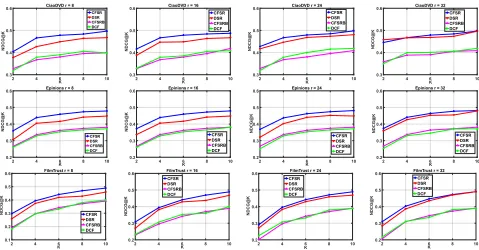
Figure 1: Performance of NDCG@K w.r.t., code length ranging from 8 to 32 in the in-matrix recommendation task.
2 4 6 8 10
K 0 0.1 0.2 0.3 0.4 0.5 R ec al l@ K
FilmTrust r = 8
CFSR DSR CFSRB
2 4 6 8 10 K 0 0.1 0.2 0.3 0.4 0.5 R ec al l@ K
FilmTrust r = 16
CFSR DSR CFSRB
2 4 6 8 10
K 0 0.1 0.2 0.3 0.4 0.5 R ec al l@ K
FilmTrust r = 24
CFSR DSR CFSRB
2 4 6 8 10
K 0 0.1 0.2 0.3 0.4 0.5 R ec al l@ K
FilmTrust r = 32
CFSR DSR CFSRB
Figure 2: Performance of Recall@K w.r.t., code length ranging from 8 to 32 in the out-matrix recommendation task.
Comparative Methods We compare our method with several state-of-the-art approaches including binary code based collaborative filtering without considering any social information (DCF) and real-valued based social collabora-tive filtering method (CFSR) as well as its variant.
DCF:The discrete collaborative filtering (DCF) is the first one-stage method directly optimizing the binary codes in collaborative filtering (Zhang et al. 2016). This method outperforms almost all two-stage binary code learning methods for collaborative filtering. We note that DCF directly tackles a discrete optimization problem for seeking informative and compact binary codes without taking social information into account so it is not designed for social recommendation.
CFSR:The collaborative filtering for social recommenda-tion model proposed by (Ma et al. 2008) which factorizes user-item rating matrix and user-user linkage matrix si-multaneously. This is a classic social recommendation model widely adopted in many different applications. We use CFSR as a baseline to demonstrate the performance gap between real value representations and binary code representations.
CFSRB:Here binary codes are derived from CFSR through round-off binary quantization, which is a two-stage discrete learning method. We take this method as a baseline to show how quantization loss degrades the model’s performance for two-stage binary code representations.
DSR:The proposed discrete social recommendation method which directly learns informative yet compact binary codes for users and items at the presence of social information.
We use grid search and 5-fold cross validation to find the best parameters. The hyper-parameters α0 is tuned within
the range of [10−3, . . . ,102], β1, β2 are tuned within the
range of [10−5, . . . ,1], and β
3 is tuned within the range
of [10−4, . . . ,101]. For baselines, we either adopt the
8 Code Length16 24 32 0
5 10 15 20 25
Te
st
T
im
e
C
os
t
CiaoDVD DSR CFSR
8 16 24 32
Code Length 0
5 10 15
Te
st
T
im
e
C
os
t
Epinions
DSR CFSR
8 Code Length16 24 32
0 5 10 15 20 25
Te
st
T
im
e
C
os
t
FilmTrust
DSR CFSR
Figure 3: Efficiency comparison between DSR and CFSR w.r.t., TTC (minutes) where the code length ranges from 8 to 32 on three datasets.
0 5 Iteration 10 15
0.6 0.8 1 1.2 1.4 1.6 1.8 2
O
bj
ec
tiv
e
Va
lu
e
CiaoDVD r = 16
with init without init
X105
2E-5 2E-4 2E-3 0.02 0.2 2 20 200 hyper-parameter 0.3
0.35 0.4 0.45 0.5 0.55 0.6
N
D
C
G
@
10
CiaoDVD FilmTrust Epinions
Figure 4: Convergence curve of the overall objec-tive function with/without initialization on the CiaoDVD dataset(left). Sensitivity analysis of social parameter α0(right).
Dataset CFSR DSR Memory Reduction Memory CiaoDVD 1.32MB ×36 38KB FilmTrust 671KB ×34 20KB Epinions 14.57MB ×37 407KB
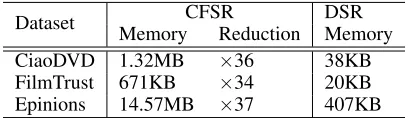
Table 2: Memory usage of DSR and CFSR with the same code length (32) on three datasets.
Experimental Results
Comparison with State-of-the-arts. In Figure 1, we com-pare DSR with the baseline methods whose code lengths vary from8to32in terms of NDCG@K on three datasets. From this figure, we can find that DSR considerably outper-forms CFSRB on all datasets. Compared with CFSRB, DCF can even achieve comparable performance on CiaoDVD and Filmtrust datasets. This is consistent with the findings in (Zhang et al. 2016) that the direct discrete optimization is stronger than two-stage approaches, and the balanced uncor-related constraints on the binary codes are necessary for the optimization. Besdies, DSR shows very competitive perfor-mance compared with CFSR. As the bit size increases, the performance gap between DSR and CFSR shrinks quickly. DSR is able to achieve the same performances with CFSR when the bit size is set to32. One possible reason is that CFSR suffers from overfitting with the increasing latent fea-ture vector dimensions, whereas binarizing the real-value latent feature vectors can alleviate the model’s overfitting problem. This observation again verifies the effectiveness of the proposed DSR. Finally, DSR and CFSR demonstrate
consistent improvement over DCF which does not take so-cial information into consideration. This performance boost should be attributed to the benefit of utilizing social infor-mation for recommendation.
Performance on Cold-Start Users. We further drill down to the cold-start users. The comparison results with varying lengths of binary codes in the out-matrix task (in which DCF fails to make any recommendations and is therefore ignored) are shown in Figure 2. Similar to the results in in-matrix task, we observe that when code length is32, DSR is able to achieve the same performance as CFSR.
Sensitivity Analysis of Hyperparameter α0. Figure
4(right) shows the recommendation performance of DSR on NDCG@10 regarding the relative importance of the rating matrix and the social relation matrix. We can see that the per-formance continuously improves as we increase α0 which
validates the advantage of utilizing social relationship for recommendation. But the performance significantly drops as we keep increasing the impact of the social relationship ma-trix. The optimal setting ofα0varies from different datasets.
Time and Memory Usage. Figure 3 displays the experi-ments on efficiency comparisons regarding test time cost (TTC) on three datasets. First, we find that DSR achieves significant speedups on all datasets w.r.t. TTC and is particu-larly much faster than CFSR, indicating the great advantage of binarizing the real-valued parameters adopted in CFSR. Second, the acceleration ratio of DSR against CFSR is stable on all the datasets with code lengths varying from 8 to 32. This experiment indicates that DSR is a suitable model for large-scale social recommender systems where the retrieval time for items is restricted within a limited time quota.
Last but not least, Table 2 shows the memory usage (stor-ing the whole model) of DSR and CFSR with the same code length. It is obvious that DSR significantly reduces the mem-ory storage of model for 37 times within the same dimen-sion. The memory cost of DSR is less than 1M for storing binary codes from all three datasets. These results imply that DSR can adapt to some resource-limited scenarios, e.g., mo-bile devices.
Conclusion
codes for users and items in the context of social recom-mendation. Given the untractability (NP-hardness) of opti-mizing DSR, we make some relaxations to the constraints and develop an efficient alternating optimization method to solve DSR through iteratively solving several mixed-integer programming subproblems. Extensive experiments on three real-world datasets demonstrate the advantages of our pro-posed method against several competitive baselines in terms of recommendation accuracy, retrieval cost and storage cost.
Acknowledgments
This research is supported by the National Research Foun-dation Singapore under its AI Singapore Programme [AISG-RP-2018-001], and the National Research Foundation, Prime Minister’s Office, Singapore under its International Research Centres in Singapore Funding Initiative. It is also supported by China Postdoctoral Science Foundation No. BX201700136, National Program on Key Basic Re-search Project No. 2015CB352300, National Natural Sci-ence Foundation of China Major Project No. U1611461.
References
Das, A. S.; Datar, M.; Garg, A.; and Rajaram, S. 2007. Google news personalization:scalable online collaborative filtering. In
In-ternational Conference on World Wide Web, 271–280.
Gionis, A.; Indyk, P.; and Motwani, R. 1999. Similarity search in high dimensions via hashing. 8(2):518–529.
Grauman, K., and Fergus, R. 2013. Learning binary hash codes for large-scale image search. Machine learning for computer vision
411(49-87):1.
H˚astad, J. 2001. Some optimal inapproximability results.Journal
of the ACM (JACM)48(4):798–859.
Jamali, M., and Ester, M. 2010. A matrix factorization technique with trust propagation for recommendation in social networks. In
Proceedings of the fourth ACM conference on Recommender sys-tems, 135–142. ACM.
Karatzoglou, A.; Smola, A. J.; and Weimer, M. 2011. Collaborative filtering on a budget. 389–396.
Lian, D.; Liu, R.; Ge, Y.; Zheng, K.; Xie, X.; and Cao, L. 2017. Discrete content-aware matrix factorization. InProceedings of the 23rd ACM SIGKDD International Conference on Knowledge
Dis-covery and Data Mining, 325–334. ACM.
Liu, H.; He, X.; Feng, F.; Nie, L.; Liu, R.; and Zhang, H. Discrete factorization machines for fast feature-based recommendation. In
Twenty-Seventh International Joint Conference on Artificial
Intel-ligence ijcai, pages=3449-3455, year=2018,.
Liu, X.; He, J.; Deng, C.; and Lang, B. 2014. Collaborative hash-ing. InIEEE Conference on Computer Vision and Pattern Recog-nition, 2147–2154.
Liu, C.; Jin, T.; Hoi, S. C.; Zhao, P.; and Sun, J. 2017. Collaborative topic regression for online recommender systems: an online and bayesian approach.Machine Learning106(5):651–670.
Ma, H.; Yang, H.; Lyu, M. R.; and King, I. 2008. Sorec: social rec-ommendation using probabilistic matrix factorization. In Proceed-ings of the 17th ACM conference on Information and knowledge
management, 931–940. ACM.
Ma, H.; Zhou, D.; Liu, C.; Lyu, M. R.; and King, I. 2011. Rec-ommender systems with social regularization. InProceedings of
the fourth ACM international conference on Web search and data
mining, 287–296. ACM.
Muja, M., and Lowe, D. G. 2009. Fast approximate nearest neigh-bors with automatic algorithm configuration. VISAPP (1) 2(331-340):2.
Salakhutdinov, R., and Hinton, G. 2009. Semantic hashing.
Inter-national Journal of Approximate Reasoning50(7):969–978.
Shen, F.; Shen, C.; Liu, W.; and Tao Shen, H. 2015. Supervised discrete hashing. InProceedings of the IEEE Conference on Com-puter Vision and Pattern Recognition, 37–45.
Tang, J.; Hu, X.; and Liu, H. 2013. Social recommendation: a review. Social Network Analysis and Mining3(4):1113–1133. Wang, X.; Lu, W.; Ester, M.; Wang, C.; and Chen, C. 2016. So-cial recommendation with strong and weak ties. InProceedings of the 25th ACM International on Conference on Information and
Knowledge Management, 5–14. ACM.
Wang, X.; Hoi, S. C.; Ester, M.; Bu, J.; and Chen, C. 2017a. Learn-ing personalized preference of strong and weak ties for social rec-ommendation. InProceedings of the 26th International
Confer-ence on World Wide Web, 1601–1610. International World Wide
Web Conferences Steering Committee.
Wang, X.; Hoi, S. C.; Liu, C.; and Ester, M. 2017b. Interac-tive social recommendation. In Proceedings of the 2017 ACM
on Conference on Information and Knowledge Management, 357–
366. ACM.
Wang, J.; Kumar, S.; and Chang, S.-F. 2010. Semi-supervised hashing for scalable image retrieval. InComputer Vision and
Pat-tern Recognition (CVPR), 2010 IEEE Conference on, 3424–3431.
IEEE.
Wang, J.; Kumar, S.; and Chang, S.-F. 2012. Semi-supervised hash-ing for large-scale search. IEEE Transactions on Pattern Analysis & Machine Intelligence(12):2393–2406.
Zhang, H.; Shen, F.; Liu, W.; He, X.; Luan, H.; and Chua, T.-S. 2016. Discrete collaborative filtering. InProceedings of the 39th International ACM SIGIR conference on Research and
Develop-ment in Information Retrieval, 325–334. ACM.
Zhang, Y.; Yin, H.; Huang, Z.; Du, X.; Yang, G.; and Lian, D. 2018. Discrete deep learning for fast content-aware recommendation. In
the Eleventh ACM International Conference on Web Search and
Data Minig, 717–726.
Zhang, Y.; Lian, D.; and Yang, G. 2017. Discrete personalized ranking for fast collaborative filtering from implicit feedback. In
AAAI, 1669–1675.
Zhou, K., and Zha, H. 2012. Learning binary codes for collab-orative filtering. InProceedings of the 18th ACM SIGKDD
in-ternational conference on Knowledge discovery and data mining,
498–506.
Zhou, Y.; Wilkinson, D.; Schreiber, R.; and Pan, R. 2008. Large-scale parallel collaborative filtering for the netflix prize. In
Inter-national Conference on Algorithmic Applications in Management,