Issues
ISSN: 2146-4138
available at http: www.econjournals.com
International Journal of Economics and Financial Issues, 2015, 5(Special Issue) 121-127.
The Spatial Transformation of the Urban Environment in the Conditions of Post Industrial Development of Society: Dedicated to the 100th Anniversary of Jean Gottmann, Immanuel Kant Baltic Federal University, 23-26 August 2015, Russia.
Formation of Human Resources in the Process of Circumpolar
Region Development
Anatoliy N. Silin
1*, Nina A. Tkacheva
21Department of Marketing and Municipal Man agement, Institute of Management and Business, Tyumen State Oil and Gas
University, Tyumen, Russia, 2Department of Marketing and Municipal Management, Institute of Management and Business, Tyumen State Oil and Gas University, Tyumen, Russia. *Email: [email protected]
ABSTRACT
Article reveals the specific features and problems of human resources formation in oil and gas regions of the Russian Arctic and Subarctic. The
research objective is to clarify the correlation of the “labor resources” and “human resources” concepts, identify of mechanisms of their formation, and determine the characteristics and capabilities of the most effective use of human potential through the use of non-traditional methods of organizing production shift in the circumpolar region. Human resources are treated as the most capacious concept with extended space-time and socio-cultural
characteristics, additionally containing the hidden features and quality. The factors that determine the specificity of the formation of human resources
in the circumpolar region, the inconsistency of regional identity and the perception of further development of the territories of indigenous and newly arrived population are allocated. The study is based on sociological surveys held from 1980 to 2015 covering various population categories of the circumpolar zones: The old-timers, newcomers, shift workers, representatives of indigenous peoples of the north. Research results enable the representatives of public authorities and oil and gas companies understand the effects of exploration and production operations on the way of life of indigenous peoples as well as to develop solutions for combining cultural traditions and modern industrial innovation as to help minimize social and ethno-cultural harm. Additionally, study reveals the features of the shift workers’ interactions with the indigenous population, as well as
in labor collectives, define areas of possible constructive dialogue. Expert interviews revealed behavioral features of stationary and shift staff of oil
and gas companies, the dynamics shift workers’ assessment of their living standards. The authors consider it necessary to continue research of the social problems arising in the course of development of Arctic regions, to develop a system of standards governing the quality of human resources, and quality of life.
Keywords: Shift Method, Autochthonous Population, Regional Identity, Arctic Region
JEL Classifications: Q3, M54, J6, R11
1. INTRODUCTION
Since the second half of the XX century, the process of intensive development of the resources of northern Russia actualized the need to resolve the contradictions between the development of the fuel and energy complex of the country that provides a significant portion of exports and the limitations of human resources of the given territories. The need for alternative methods of formation of human resources and the organization of work, which would correspond to the complex tasks of production in underdeveloped areas with extreme climatic conditions, has therefore arose since
Without getting into a discussion that falls beyond the framework of this article, we emphasize that nowadays the circumpolar territories, being dominated by a sparse and patchy development, require more sophisticated governance processes rather than “culling” and liquidation of unpromising businesses, cities and regions. On the contrary, the maximum preservation and strengthening of existing network of settlements and communications is needed. This corresponds not only to the interests of the state, but also reflects the opinion of inhabitants of the North of the Tyumen region - public interest. Furthermore, while comparing the key socio-economic indicators (e.g. GDP per capita, life expectancy, etc.) we find that following the north and south of the equator, these figures drastically improved. At the same time, the best values observed at the most northern countries - Iceland, Sweden, and others. This dependence is confirmed by the results of fundamental research under the guidance of the US economists (Gallup et al., 1999).
Over the years the number of the shift method supporters was gradually growing, which was due to the high cost of infrastructure in the North, particularly in the large-scale projects in remote areas, the lack of work force, the chronic backlog of housing and residential construction. We believe that the shift method significantly contributed to the formation of human resources in the north of the Tyumen region (Silin, 2013).
2. HUMAN RESOURCES IN THE
FRAMEWORK OF SIMILAR CONCEPTS
While sharing the current opinion on the leading role of the human factor in economic development, the article clarifies the “labor resources” and “human resources” concepts, as well as defines the natural, socio-economic, socio-cultural and institutional factors that affect the formation of human resources in the circumpolar area, and mechanisms for their implementation.
Human resources are considered part of the population (of the region or country) with the necessary physical and intellectual development, professional skills and knowledge required to work in any sphere of production of material goods and services. It is natural that the shift (rotational) method, the purpose of which is to ensure remote work sites with qualified personnel arriving from other regions, determines the quality of the labor force. The selection of shift personnel accounts following components: The level of professional training, education, health, teamwork, creativity, activity, organization capabilities, and assertiveness. Rotational method involves the execution of the necessary work by the workforce of regularly changing mobile units that travel to sites that are remote from the deployment of the enterprise; thus, the daily return of workers to a permanent place of residence is not possible or economically unfeasible. At the inter-regional form of this unconventional method of production, the travel distance is 1-3 thousand km, and the timing of the watch lasts from 1.5 to 3 months. Long stay of the staff and uneasy cohabitation conditions enable define the specific characteristics of the labor force, which should be evaluated and adjustments during the subsequent employment. The challenging environment of the harsh nature, difficult working conditions, the need to take quick and innovative
solutions to production problems define the specificity of human resources of the northern territory of Tyumen.
Human resources are a combination of different qualities of people that not only reflect their past experience, but the experience being accumulated in the process of development of the northern territories, which defines their ability to function and develop in new conditions. Unfortunately, for a long time in Russia neither the authorities nor company managers realized the uniqueness of human resources as resource for economic development, and as people - the consumers of goods and services. Moreover, the pressure of political factors, the requirements of the central authorities for the annual increase in oil and gas production turned the social sphere in the appendage of little importance (Karpov, 2005). Meanwhile Becker (2015) considered spending on education, vocational training, and medical care as a contribution to human capital. It is no coincidence that Schultz (1972) studied the human resources from the perspective of a huge number of human characteristics - physical, biological, physiological and cultural, determining the rights and preferences of the economic needs of producers and consumers, regardless of the business or leisure activity. It is therefore inappropriate to evaluate the productive and intellectual abilities of a person using only quantitative factors of production. It inevitably leads to an increase of negative processes in the formation of human resources.
Many researchers recognize the complexity and ambiguity of human resource management (HRM) (Guest, 1999). Storey (1989) highlights the hard and soft options to HRM. The first option perceives human resources as an important organizational resource, while the second - soft model, focuses on the perception of human resources as a source of competitive advantage. Mabey et al. (1998) argue that the formation of human resources in practice requires commitment and competence at all levels of governance. However, not only the governance factors influence the formation and HRM. In the circumpolar zone, a significant role in the formation and use of HR is played by climatic and demographic, socio-economic, socio-cultural and institutional factors.
3. INFLUENCE OF VARIOUS FACTORS
ON THE FORMATION OF HUMAN
RESOURCES
population migration had a decisive influence on the formation of the cities. Since the mid-1960s to mid-1980s, the region experienced a “migration explosion” - actively arriving people from central and southern regions of the country. The number of inhabitants, which remained relatively stable and low over the centuries, has increased 10-fold and exceeded 1 million (Tkacheva, 2010).
Industry specifics, the administrative pressure, and particularly of migratory flows led to the formation and development of territorial social communities by bringing people together in the professional, corporate, ethnic, religious or other grounds. Therefore, the socio-political and socio-cultural communities of the northern cities have significance not only for oil and gas sector, but geologists, builders, and national groups from Azerbaijan, Tatarstan, Ukraine. Nevertheless, the migration is equally characterized by the “counter migration flows,” with the “northern test” being held by a large number of the inhabitants of Russia, CIS and Baltic countries. Every second visitor returns to the home region, having lived in the northern Tyumen at least 18 months.
The originality and the inextricable relationship of socio-economic and socio-cultural factors are vivid, first of all, in high concentration areas of circumpolar zone inhabited by indigenous peoples with a specific economic structure and way of life. This predetermined a number of difficulties in interaction for industrial companies as well as newcomers with indigenous peoples. It should be noted that the formation of oil and gas industry has contributed to the socio-economic development of the region, but it has also destroyed the resource and the socio-cultural basis of traditional environmental management of northern people and expel them from the ancestral territories. Accelerated industrial and transport development of resources has led to the emergence and consolidation of the special status of indigenous peoples. From the the socio-economic point of view it is expressed in the material support of the Khanty, Mansi, Nenets, Selkup, etc., but at the same time to a certain extent it shaped the dependency mentality of the representatives of ethnic elite.
Research held by ethnologist Golovnev (2014) revealed that this duality in mentality of indigenous peoples in different ways assessed the residents of cities and towns and the inhabitants of the tundra, who preserve the traditional lifestyle. From the standpoint of the citizen-shift worker, the herders should better use the compensatory payments, leave troublesome herding and settle down in a comfortable village in the south of the tundra. However, these seemingly rational arguments are not consistent with the values of nomadic reindeer herders. For them, the territory of nomads is not only the best pastures, but also the location of the shrines, the traditional activities carried out cultural and recreational functions (Golovnev, 2014).
Research held in 2004-2007 under the supervision of Forbes and Stammler in the framework of the project “Environmental and social impacts of industrial development in the north of Russia” has resulted in the “Declaration of co-existence of indigenous peoples and the oil/gas industry in the Nenets and Yamal-Nenets autonomous region and other territories of the Russian North.”
Scolars emphasize that the mutually beneficial co-existence of traditional lifestyles of indigenous and the oil and gas production is an urgent task of the three interested parties: The reindeer herding/ fishing, industry, and the public bodies. To start negotiating the herders/fishermen/hunters should have the right to delegate themselves by qualified, professionally trained and independent individuals (Forbes, 2008; Stammler and Forbes, 2006).
In the current socio-economic and socio-cultural situation the institutional factors determining the formation, development and utilization of HR are particularly important. As noted above, all counterparts, above all, felt like members of the production team, as residents of departmental cities and towns. Thus, demographic, ethnic and other factors of social communities’ formation have obeyed the industrial scheme despite the massive and largely spontaneous influx of people (Ganopolsky, 2007). Technological features of production and the corresponding ways of organizing people involved in the labor process, spread to most areas of life. A system of selection and initial adaptation of the migrants followed the image and likeness of production technology, which then shaped the social infrastructure (Ganopolsky, 2007).
While a strategic level problem of professional socialization and adaptation of immigrants and the indigenous population to the new conditions of the North is admitted, it is the responsibility and the discretion of the public authorities. HR as a structuring set of labor resources and human capital is influenced by personal qualities that lead to human interactions in the process of direct production, creating a close-knit team, which has the overall objective, based not only on the distribution of roles in the production process, but also mutual support and assistance in their daily lives. All of which contributes to the development of specific regional identity.
The authors share the opinion of the Finnish researcher Paasi (2002, p. 804), asserting that the regions should be seen as a social construct, as a result, or as the product of “historically determined practices and discourses in which actors establish and endow values more or less related material and symbolic worlds.” Despite the fact that the status of the space is often questioned, for example, Giddens (2004, p. 83) notes that the new opportunities for interaction with “the absence of other” have reduced value of the space factor to zero, the north has formed a certain culture over the centuries. North has influenced on the formation of regional identity circled around respect for nature and the man, readiness to help, the understanding of the fact that no one can survive “alone” in this harsh environment. It resulted in a fusion of the physical reality, and the resulting emotions. The formation of regional identity in the Soviet period contributed to the pride of the people for their work and high-income of the residents of northern communities as compared with other regions.
the Khanty-Mansi Autonomous District of the Tyumen region has 3.01 people per 1 km2, in the Yamalo-Nenets Autonomous District of the Tyumen region this figure is 0.7. At the same time, the population of the Khanty-Mansi Autonomous District for the past quarter of a century of intensive development has increased 5 times and the Yamal-Nenets Autonomous District 6 times, which by 2015 accounted to 1612.1 thousand people (of which 92.14% are urban residents) and 539.9 thousand people (83.8% urban residents) respectively (Rossat, 2015a, b). However, the population growth has not affected the extent of the use shift method. Today, one in four working on the territory of Tyumen North is a shift worker. When considering the North-West Siberia as a whole, the proportion of shift personnel is slightly lower, but it is still more than 10% of total employment in manufacturing. This is a destination for employees from the old oil and gas producing regions (Bashkortostan, Tatarstan) and stagnating Russian hinterland, as well as for representatives of the CIS, for whom this is often the only way to survive. The volume of inter-regional use of labor resources in the North will increase even more, given the amount of work planned for the development of the Yamal Peninsula and the shelf of the northern seas.
In order to be prepared, it is necessary to draw attention to the need for interdisciplinary research of the problems associated with large-scale use of shift work. The effective formation of human resources in the circumpolar area is largely determined by the conditions of employment and life, the attitude to a rotational work, conflicts in the workplace, as well as with local residents, the willingness to continue career. In this vein an interesting anthropological research in the areas of oil and gas exploration was conducted by a team of Austrian scientists from the University of Vienna, led by Gertrude Saksinger, which showed the differences of three social spaces of human activity, who practice a mobile multilocus lifestyle “home - road - work” (Saxinger et al., 2014). No less interesting for our study are the results of other scientific disciplines - psychology, physiology, and others.
Thus, the study aims to test the hypothesis that the development of the circumpolar region using the traditional methods is not effective due to both economic and social settings, and often impossible. New production and wellbeing management technologies are required and, above all, the involvement of staff using the criteria that characterize the state of health, professional competence, level of conformity, the ability to quickly adapt to extreme and changing conditions, etc. Otherwise, the growth of social dissatisfaction, destructive conflicts, frequent disease, injury, and staff turnover are inevitable.
4. RESEARCH METHODS
The study of the social aspects of the rotational organization of work was initially conducted in the framework of the sociological service held by Glavtyumengeologia, and from 1994 to present - by the staff of the “Social Management” and “Marketing and municipal management” departments at the Tyumen State Oil and Gas University. The object of the study are the workers of the northern oil and gas producing and geological organizations operating both on fixed and rotational basis.
The methodical toolkit is solely developed by the authors. The questionnaire survey of shift personnel has not changed significantly over the years, allowing to analyze the dynamics of the ongoing processes in this field. It contains 45 questions, including one open and five semi-open questions. The survey is conducted in the workplace at the time between the shifts. Since 1980, the questionnaire is most often carried out on the drill, since 1995 - at the comprehensive gas treatment units, in dormitories, training centers, as well as while waiting for planes in the collection points, airports and helipads.
Sampling is based on territorial and social criteria, and is consisted of two stages. The first step is the selection of settlements, according to their sectoral specialization, the status in the system of settlement, such as population and climatic zones. In the second stage, the selection of respondents is held according to the social structure of the settlement or organization. The criteria for evaluating the representativeness of the survey were the traditional demographic parameters (e.g. gender, age) and experience in the shift mode, which is particularly significant for this study. It was annually surveyed approximately 10% of shift workers. The representativeness of the sample was checked periodically re-checked and fixed if necessary, so that the error does not exceed the permissible values. Total for this period thousands of respondents were interviewed: 1,047 questionnaires processed in 1980, 1134 profiles in 1995, 981 profiles in 2005, 726 profiles in 2010, and 672 profiles in 2015.
Collection of information, as a rule, was based on self-filling questionnaires. The survey was slightly different in the northern organizations and the steady-state organizations in other regions of the country. Regional-industry specifics of the northern territories associated with the mobility of production, high staff turnover, special personal qualities of respondents, uncertainty of the production situation as a result of natural and climatic conditions - all makes it difficult to advance the planning and selection of respondents providing formal representativeness of the sample. Particular difficulties arose in the survey of indigenous peoples on the allocation of their relationship with shift workers. The survey was made possible only through the involvement of representatives of the local radical intelligentsia as interviewers.
This article presents the descriptive, diagnostic and evaluative study results, which aim to identify the specificity of the forms and terms of engagement of shift teams, as well as the influence of the rotational work on the life quality of shift workers.
5. RESEARCH RESULTS
on the basis of non-formal interviews with 46 experts - managers at various levels of linear and functional units of “Gazprom dobycha Yamburg” Ltd. (Table 1).
Features of the work management, the conflict frequency, and economic factors influence the perception by the rotational work method made by the workers. While comparing the research results obtained in different years, it is possible to trace the dynamics of the reaction of workers to changes in both social and economic conditions of inter-regional shift method. According to the data presented in Table 2, the modern social infrastructure and a sophisticated system of air traffic have changed the hierarchy of the factors influencing the attitude toward a rotational work method. The priorities are now related to the labor and production management, as well as the system of remuneration and financial incentives.
The potential of the rotational form of work management is large enough. According to a recent survey, this method satisfies those working in this mode, and the majority do not intend to change it to the traditional method of working. Thus, 81.8% of workers surveyed plan to work on a rotational basis for more than 5 years, and 38.3% of respondents named an even longer term - more than 10 years. Only about 4% of respondents plan to work in this mode for <3 years. Nevertheless, almost one in five workers aged 20-25 years would like to change a place of employment in the next 3 years.
The reasons for the dismissal of workers on a rotational basis in the circumpolar zone largely correlate with the factors influencing the formation of human resources. Due to the severe climatic conditions of labor, 14.5% of surveyed workers would prefer to leave, another 19.8% of respondents due to the health condition, giving 34.3% in total. It is undeniable that severe environmental conditions can provoke an aggravation of health problems. This suggests the importance of a preliminary medical examination during the selection process of employees for long-range watches. Salary does not meet the expectations of the 19.4% of respondents, and as a result, the inability to solve the housing problem (i.e. apartment purchase) - 15.7% of respondents. Working conditions are unsatisfying for 8.5% of the respondents.
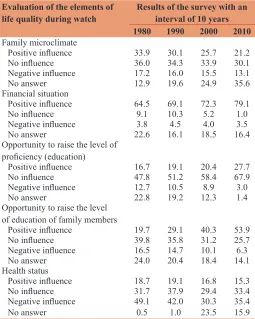
While the family reasons, being related or unrelated to work, may course the retirement of 6.0% and 12.3% of respondents respectively. This index correlates with the data presented in Table 3. The experts suggest that 36.8% of all layoffs are caused by family circumstances. Experts interviewed insisted on the high importance of this reason for the dismissal. This is to some extent confirmed by the fact that as many as 46.7% of men aged 31-40 years (i.e., the most active and able-bodied part of the shift team) have listed the “family circumstances” among the possible reasons for their dismissal.
Assessment of the quality of human resources and prospects of their further formation is largely determined by the influence of the shift method of work on the quality of life (Table 3).
A possible increase in the life quality makes it possible adequately meet the needs of the person, including in personal and family members’ education, in high quality medical services, etc. At the same time, the quality of life can be seen as an important factor in the formation of human capital, one of the conditions for the development of human resources. The results showed that in order
Table 1: Characteristic features of the behavior of staff, depending on the work organization method
Work organization method Traditional (stationary) Rotational (shift)
Informal groups are formed spontaneously Formal structure determines the social contacts due to the limited space Relative independence from the formal structures Strong influence of the formal structure and limited contact with people from
other formal structures Informal control over the behavior of employees,
their activities are not fully regulated by the directives and rules
The initial stages of the shift period feature the lower informal control than in normal conditions (formation of the shift by workers living in different cities), but later it can become much stronger because of the density of involuntary contacts The system of informal status, leadership, group
morality play an important role in organizational behavior
System of informal statuses has a high value due to limited contact with other people and groups, but is limited in time (the duration of the watch), which may
be the cause of conflicts in case of collision of informal subgroups Reflexive relationships provide the individual with
understanding of the logic of reasoning and actions of other members of the social group, coordinating and synchronizing the activities and interactions in a team
Reflexive communication may be more important, and even acquire an exaggerated significance (influence of climatic conditions,
the accumulation of fatigue)
Table 2: Ranking of factors influencing the attitude towards inter-regional rotational work
List of factors Significance ranking of the
factor (with 1 being the highest) 1980 1995 2005 2010 2015
Social and living conditions
of residence 3 11 9 10 10
Organization of transportation 1 5 10 11 12
Daily regime of work and leisure 8 12 11 12 11
Wage 2 1 3 3 2
Workplace relationships 9 10 12 9 8
Social and cultural living
conditions on watch 7 7 8 8 9
Material incentives 4 2 2 1 1
Labour conditions 6 8 4 4 5
Health status 10 9 7 5 4
Rotation mode of managers
and specialists 5 3 5 6 7
Rotation mode of workman 11 6 6 7 6
to improve the manageability of the processes of HR formation, it is important to regulate those areas of social life, the state of affairs in which cause or are likely to have a positive and (or) negative impact on human development. Such areas as family relations, employment, activities of educational, cultural and medical institutions, the media.
6. CONCLUDING REMARKS
Recognizing the interdependence of the “human factor” and the prospects for socio-economic development of the circumpolar region and the state as a whole, the assessment of the compliance of existing human resources with objective requirements of the economy should take into account the needs, abilities and willingness of different population groups of the northern territories, including shift workers, to be economically involved at the socially necessary level. This will to some extent enable to overcome the mechanistic approach to the interpretation of the concept of “human resources,” which was prevailing in Soviet science and considered as the volume of available human capital and human potential available for utilization in the long run (Akulov, 2009).
Of course, the definition of “human resources” can be distinguished into educational, cultural, spiritual, intellectual, and a number of other components. Obviously, this list is, to some extent, arbitrary, because it has no unified theoretical and methodological foundation. However, these characteristics become important for the assessment of human resources, when considered in the light of the ability and willingness
to use them in the production process under certain conditions. Moreover, the formation and development of human resources is always associated with internal and external opportunities. This necessitates the use of objective factors in the analyses, such as natural-environmental, socio-economic, political, and socio-cultural environment in which human resources exist and function. Thus, it is the contextual factors that surround human resources in the region that both contribute and limit the opportunities for manifestation, development, activation, and operation of the human potential. The integrated approach to the study of the human resources of the northern regions can be effective in recognition of the fact that human resources overall include three basic components, each being relatively independent and interactive under certain circumstances. These components are personal resources, group or team resources, whose activities are carried out in the institutional framework in a limited social space, and resources of various social communities - socio-demographic, socio-territorial, socio-professional.
With the development of the circumpolar regions the particular importance in comparison with the traditional methods of production organization in the southern and central regions of Russia, takes on the quality of human resources. That is why the authors focus on the quality of life of shift personnel. In the formation of the human resources of the northern territories, it is important to consider not only the state of people’s health, their education and professional competence, but also other social and psychological indicators.
This determines the feasibility of the development and implementation of innovative technologies in the selection of personnel to work in the North, including those engaged on a rotational basis, its adaptation to the climatic, social and cultural conditions of arctic and subarctic regions. Adaptation should include a gradual shift of climatic conditions and time zones, the training to understand the characteristics of the culture and way of life of indigenous peoples, as well as explaining the need to preserve the fragile nature of the north. The professional socialization should not be limited to the career in closed collectives with an unconventional mode of work and leisure but also form a need, ability and willingness to fulfill one’s potential in employment and social activities.
The authors came to the conclusion about the need to create a system of interdependent social technologies enabling to neutralize the negative impact on the people caused by extreme conditions of the North, and the shift method of work organization. Part of such technologies is developed for a subsidiary of Gazprom - “Gazprom dobycha Yamburg” Ltd. and “Varioganneft” oil and gas company. Given the increased worldwide interest in the study and development of the Arctic in recent years, the authors consider it necessary to address the problem of development of circumpolar regions from a interdisciplinary perspective.
7. ACKNOWLEDGMENT
The authors are grateful to Russian Humanitarian Scientific Foundation (RHSF) for their support in the preparation of the material (project № 15-03-00367а).
Table 3: Assessing the impact of inter-regional shift method on the life quality of staff (% of respondents)
Evaluation of the elements of
life quality during watch Results of the survey with an interval of 10 years 1980 1990 2000 2010
Family microclimate
Positive influence 33.9 30.1 25.7 21.2
No influence 36.0 34.3 33.9 30.1
Negative influence 17.2 16.0 15.5 13.1
No answer 12.9 19.6 24.9 35.6
Financial situation
Positive influence 64.5 69.1 72.3 79.1
No influence 9.1 10.3 5.2 1.0
Negative influence 3.8 4.5 4.0 3.5
No answer 22.6 16.1 18.5 16.4
Opportunity to raise the level of
proficiency (education)
Positive influence 16.7 19.1 20.4 27.7
No influence 47.8 51.2 58.4 67.9
Negative influence 12.7 10.5 8.9 3.0
No answer 22.8 19.2 12.3 1.4
Opportunity to raise the level of education of family members
Positive influence 19.7 29.1 40.3 53.9
No influence 39.8 35.8 31.2 25.7
Negative influence 16.5 14.7 10.1 6.3
No answer 24.0 20.4 18.4 14.1
Health status
Positive influence 18.7 19.1 16.8 15.3
No influence 31.7 37.9 29.4 33.4
Negative influence 49.1 42.0 30.3 35.4
REFERENCES
Aganbegyan, A.G., Bagrinovsky, K.A., Granberg, A.G. (1972), The system of economic planning models. Moscow: Misl.
Akulov, R.I. (2009), Human resources as a complex economic category. Journal of Economic Theory, 4, 7-16.
Becker, G.S. (2015), Human Capital. The Concise Encyclopedia of Economics. Chicago: University of Chicago Press.
Forbes, B.C. (2008), Equity, vulnerability and resilience in social-ecological systems: A contemporary example from the Russian Arctic. Research in Social Problems and Public Policy, 15, 203-236. Gallup, J.L., Sachs, J.D., Mellenger, A.D. (1999), Geography and
Economic Development. International Regional Science Review, 22(2), 179-232.
Ganopolsky, M.G. (2007), The structure of the settlement of the Tyumen region as an object of socio-spatial analysis. Ecumene, 1, 16-22. Giddens, A. (2004), The Missing Peace: Globalization is Changing Our
Lives. Moscow: Ves Mir.
Golovnev, A.V. (2014), Ethnological assessment scenarios of resource development of the North. Ural Historical Journal, 2(43), 143-153. Guest, D.E. (1999), Human resource management: The workers’ verdict.
Human Resource Management Journal, 9(2), 5-25.
Hill, F., Gaddy, C. (2003), The Sibеrian Curse: How Communist Planners
Left Russia Out in the Cold. Washington, D.C.: Brookings Institution Press.
Karpov, V.P. (2005), History and development of the West Siberian oil and
gas complex (1948-1990). Tyumen: Tyumen Oil and Gas University. Mabey, C., Skinner, D., Clark, T. (1998), Experiencing Human Resource
Management. London: Sage.
Paasi, A. (2002), Place and region: Regional worlds and words. Progress in Human Geography, 26(6), 802-811.
Rossat. (2015a), Population. Territorial body of the Federal State Statistics Service in the Khanty-Mansiysk Autonomous Okrug – Yugra. Available from: http://www.khmstat.gks.ru.
Rossat. (2015b), Population. Territorial body of the Federal State Statistics Service of Yamalo-Nenets. Available from: http://www.yamalstat. gks.ru.
Saxinger, G., Höfner, E., Shakirova, E., Ivanova, M., Yakovlev, M., Gareev, E. (2014), I'm ready - the next generation of mobile professionals in the Russian oil and gas industry. Austrian Studies in Social Anthropology, 2, 1-24.
Schultz, T.W. (1972), Human Capital: Policy Issues and Research Opportunities. Chicago: University of Chicago.
Silin, A.N. (2013), Oil and Gas North: The Social Situation and the Technology of Its Control. Moscow: INFRA-M.
Stammler, F., Forbes, B. (2006), Oil and gas development in the Russian Arctic: West Siberia and Timan-Pechora. IWGIA Newsletter Indigenous Affairs, Arctic Oil and Gas Development, 2(3), 48-57. Storey, J. (1989), From personnel management to human resource
management. In: Storey, J., editor. New Perspectives on Human Resource Management. London: Routledge. p1-18.