TICKS
Edward M. Addison1,2, Robert F. McLaughlin1,3, and Peter A. Addison1,4
1
Wildlife Research and Development Section, Ontario Ministry of Natural Resources, 300 Water Street, 3rd Floor North, Peterborough, Ontario, Canada K9J 8M5.
ABSTRACT: Eighteen captive moose calves (Alces alces) were divided into 3 groups that represented 3 levels of winter tick (Dermacentor albipictus) infestation (0, 21,000, and 42,000 ticks). A total of 321 body temperatures (Tb) were taken on 19 occasions between late November and mid-April. The
mean Tbof individuals was 38.2 ± 0.4 °C, ranging from 38.0–38.3 °C, and was not different among
the control and infested groups (P= 0.816), but varied temporally (P< 0.001) with a significant inter-action effect between treatment and time (P= 0.041); these temporal differences are unexplained. The Tbs measured in this study are some of the lowest reported for moose and presumably represent the
resting Tbof free-ranging moose, more so than those measured after pursuit, restraint, and/or
immobi-lization during capture. This was not a definitive test of the effects of tick infestation on wild moose because the captive moose consumed a high quality diet throughout winter and surprisingly low numbers of ticks remained on the animals in mid-April.
ALCES VOL. 50: 81–86 (2014)
Key words: body temperature,Alces alces,Dermacentor albipictus, moose, Tb, winter tick.
Premature hair loss by moose (Alces alces) in winter that is associated with infes-tations of winter tick (Dermacentor albipic-tus) is well documented (e.g., Addison et al. 1979, Samuel and Barker 1979, Samuel 1991) including by McLaughlin and Addi-son (1986) studying the same captive moose reported here. This hair loss might influence body temperature (Tb) that is reflective of increased energetic cost and stress in moose. The typical Tb of moose reported in the lit-erature is usually measured on individuals that were pursued, restrained, and/or immo-bilized during capture. Many of these values may reflect higher than resting Tb since excitability raises Tb in moose (Franzmann et al. 1984). Objectives of this study were to assess the possible effects of winter tick infestation on Tb of moose, and to obtain
Tbfrom captive animals that more accurately represent resting Tbof unstressed free-ranging moose. Importantly, animals in this study were young-of-the-year, exceptionally tract-able, and readily accepted the measurement procedure. Because technological advances in telemetry now allow Tb to be measured in free-ranging moose, these data are also valuable for related comparisons.
METHODS
The experiments were conducted in Algonquin Provincial Park, Ontario (45° 30′N, 78° 35′W) where 13 of 18 calves were captured at <2 weeks of age in May 1982; 5 calves were from other areas in cen-tral and northeastern Ontario (Addison and McLaughlin 1993). Male and female calves were paired in each of 6 adjacent pens
2Present Address: Ecolink Science, 107 Kennedy Street West, Aurora, Ontario, Canada L4G 2L8 3R.R. #3, Penetanguishene, Ontario, Canada L0K 1P0
4
(29.6 × 16.5 m) located within a mixed forest stand with little undergrowth and a partial canopy (50% in summer) of white pine (Pinus strobus), white birch (Betula papyri-fera), trembling (Populus tremuloides) and big tooth aspen (P. grandidentata). Calves were weaned as described by Addison et al. (1983) and from late October to the end of the experiment were fed ad libitum a rumi-nant ration containing 16% crude protein, 2.5% crude fat, and 6% crude fiber (United Cooperative of Ontario, Mississauga, Ontario, Canada). Husbandry of moose and experi-mental design for this study were as described in Addison et al. (1994) with all animals assumed born on 15 May 1982.
The 18 calves were divided into 3 treat-ment groups: moose with no winter ticks (n = 5; 2F:3M), moose infested with 21,000 larval winter ticks (n = 7; 3F:4M), and moose infested with 42,000 larval winter ticks (n = 6; 3F:3M). Larval ticks were applied between September and mid-October 1982, and all moose were eutha-nized at the end of the experiment (18–28 April 1983). The hair was dissolved and hides checked for ticks as described by Addison et al. (1979).
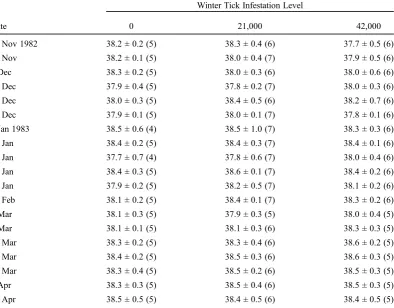
For months prior to the application of ticks, the study animals were attracted with food to a monitoring station where they stood quietly while we measured weight and took linear measurements. The Tb was measured by inserting a standard, large ani-mal mercury thermometer into the rectum. For 16 moose, Tb was usually measured every 5–9 days from 24 November 1982 to 14 April 1983, except for a 2-week period from late January to mid-February 1983 (Table 1). Fewer data were available from the 2 other moose that were sacrificed prior to the completion of this study.
The mean Tb of individuals within and between sampling times was calculated using all 18 moose; however, data were missing for certain individuals on particular
dates. All data for 3 moose with missing rec-tal temperatures for≥3 of the 19 dates were removed from statistical analysis. Further, because measurements were missing from 3 moose on one of the 19 dates, all were removed from the analysis for this date. After removing these data, each treatment group was comprised of 5 moose with measure-ments from 16 dates, for a total of 80 mea-surements per treatment. We tested for treatment effect (among groups), temporal effect, and an interaction effect between treat-ment and time using a two-factor ANOVA with repeated measures of Tb with the AOV function in R (R Core Team 2013).
RESULTS
Female and male calves respectively weighed 161 ± 8 and 178 ± 5 kg in mid-November, and 200 ± 17 and 218 ± 20 kg at the end of the experiment when 11 months old (Addison et al. 1994). The 5 control moose harboured 0, 0, 4, 21, and 85 winter ticks at the conclusion of the experiment; the animal harbouring 85 ticks had limited (5%) hair loss (McLaughlin and Addison 1986). In contrast, 1179–8290 ticks were recovered from the infested moose at the end of the experiment. Hair loss was estimated at 23–44% in 8 of 10 infested animals, and 2 and 4% in the other 2 moderately infested moose (see McLaughlin and Addison 1986).
Table 1. Mean rectal body temperature (Tb,°C) of standing captive calf moose exposed to 3 levels of winter
tick loads (0, 21,000, 42,000 larvae) in fall 1982, Algonquin Provincial Park, Ontario; moose sample size is in parentheses.
Winter Tick Infestation Level
Date 0 21,000 42,000
24 Nov 1982 38.2 ± 0.2 (5) 38.3 ± 0.4 (6) 37.7 ± 0.5 (6)
30 Nov 38.2 ± 0.1 (5) 38.0 ± 0.4 (7) 37.9 ± 0.5 (6)
5 Dec 38.3 ± 0.2 (5) 38.0 ± 0.3 (6) 38.0 ± 0.6 (6)
12 Dec 37.9 ± 0.4 (5) 37.8 ± 0.2 (7) 38.0 ± 0.3 (6)
19 Dec 38.0 ± 0.3 (5) 38.4 ± 0.5 (6) 38.2 ± 0.7 (6)
26 Dec 37.9 ± 0.1 (5) 38.0 ± 0.1 (7) 37.8 ± 0.1 (6)
3 Jan 1983 38.5 ± 0.6 (4) 38.5 ± 1.0 (7) 38.3 ± 0.3 (6)
12 Jan 38.4 ± 0.2 (5) 38.4 ± 0.3 (7) 38.4 ± 0.1 (6)
17 Jan 37.7 ± 0.7 (4) 37.8 ± 0.6 (7) 38.0 ± 0.4 (6)
25 Jan 38.4 ± 0.3 (5) 38.6 ± 0.1 (7) 38.4 ± 0.2 (6)
31 Jan 37.9 ± 0.2 (5) 38.2 ± 0.5 (7) 38.1 ± 0.2 (6)
15 Feb 38.1 ± 0.2 (5) 38.4 ± 0.1 (7) 38.3 ± 0.2 (6)
1 Mar 38.1 ± 0.3 (5) 37.9 ± 0.3 (5) 38.0 ± 0.4 (5)
7 Mar 38.1 ± 0.1 (5) 38.1 ± 0.3 (6) 38.3 ± 0.3 (5)
15 Mar 38.3 ± 0.2 (5) 38.3 ± 0.4 (6) 38.6 ± 0.2 (5)
23 Mar 38.4 ± 0.2 (5) 38.5 ± 0.3 (6) 38.6 ± 0.3 (5)
28 Mar 38.3 ± 0.4 (5) 38.5 ± 0.2 (6) 38.5 ± 0.3 (5)
5 Apr 38.3 ± 0.3 (5) 38.5 ± 0.4 (6) 38.5 ± 0.3 (5)
14 Apr 38.5 ± 0.5 (5) 38.4 ± 0.5 (6) 38.4 ± 0.5 (5)
0 0.05 0.1 0.15 0.2 0.25 0.3
37 37.2 37.4 37.6 37.8 38 38.2 38.4 38.6 38.8 39 39.2 39.4 39.6 39.8 40 40.2 40.4 40.6 40.8 Body Temperature (°C)
Propor
tional Fre
q
u
enc
y
Heavily Infested Moderately Infested Not Infested
DISCUSSION
Although one could postulate that hair loss is one factor influencing Tb, the lack of difference in Tbamong the treatment groups was not surprising. The number of recovered ticks was relatively low in contrast with tick loads measured on heavily infested wild moose (Samuel and Barker 1979, Samuel 2004). The number of larval winter ticks applied was ana prioriestimate of the max-imum numbers of ticks that would allow for the parasitic phases of the tick-moose cycle to be completed, while maintaining accept‐ able standards for the humane treatment of experimental animals, an objective that was achieved. For example, although re‐ duced pericardial and abdominal fat reser-voirs occurred in the infested versus control moose (McLaughlin and Addison 1986), we presume that all moose retained sufficient tissue reservoirs for adequate thermoregula-tion. Further, given the wide range in volume of hair loss reported within a single treatment group (i.e., 2–24% in moderately infested moose; McLaughlin and Addison 1986)
and the limited number of moose per treat-ment group, it would be difficult to detect treatment differences.
The negligible to limited seasonal varia-tion in Tbis consistent with previous reports of seasonal variation in Tbin moose (Franz-mann et al. 1984) and wapiti (Cervus ela-phus) (Parker and Robbins 1984). On a cautionary note, the Tbs measured in this study should not be considered representa-tive of those of heavily infested wild moose with extensive hair loss. The captive moose received higher quality, more accessible food throughout winter compared to free-ranging moose, and seldom experienced ambient temperatures considered thermally stressful (Renecker and Hudson 1986, Addi-son and McLaughlin 2014).
The significant interaction effect bet‐ ween treatment and time indicated that Tb of treatment groups varied over time, but did so in different directions. Environmental factors that might influence temporal differ-ences remain unclear, but could include effects of handling during measurements as
36.0 36.5 37.0 37.5 38.0 38.5 39.0 39.5
11/5/82 11/25 12/15 1/4/83 1/24 2/13 3/5 3/25 4/14 5/4
Body Temperature (°C) Heavy
Moderate None Poly. (Heavy) Poly. (None) Poly. (Moderate)
higher Tb occurs with increased excitability in immobilized moose (Franzmann et al. 1984). However, we recognized no overt excitability in the study animals during mea-surements and the differences may simply reflect normal variation. The Tbs measured in this study were lower than any reported from healthy moose, and likely reflect the psychical state of our calm tractable moose, or conversely, the more stressful condit‐ ions associated with measurements of free-ranging moose.
The upper end of the range of Tb was consistent with data from prior studies (e.g., Franzmann et al. 1984) and most similar to those of captive moose (38.0–39.7 °C) that were not immobilized (Renecker and Hudson 1986). Seal et al. (1985) reported a mean Tb of 38.6 °C for free-ranging moose immobilized from the ground as they approached mineral licks. In contrast, higher Tb was reported for wild moose pursued and restrained (X¯= 39.3 °C, range = 38.0– 40.4 °C), or pursued and immobilized (X¯ = 40.5 °C, range = 38.0–42.8 °C, Roussel and Patenaude 1975; X¯ = 39.1–39.7 °C, Delvaux et al. 1999). Most Tbs of moose have been measured in adults and not young-of-the-year as reported here. Differ-ences in size and age likely have little if any influence on Tbsince in most ungulates Tb varies little relative to body mass, and if variable, young animals generally have higher Tb than adults (Parker and Rob-bins 1985).
In summary, there was no evidence that presence of winter ticks as applied in this experiment had any direct influence on Tb of moose. The Tbs measured in our highly tractable animals were the lowest reported for healthy moose, and consistent with the view that level of excitability influences Tb. Importantly, they provide the baseline Tb for resting moose that is important for meta-bolic modeling and comparison with Tb
measured via telemetry of free-ranging moose.
ACKNOWLEDGEMENTS
We appreciate D. J. H. Fraser for his coordination of many early aspects of this study. Special thanks go to A. Rynard, A. MacMillan, M. Jefferson, V. Ewing, and D. Bouchard for their steadfast assistance in collection of data and moose husbandry under adverse conditions. Additional assis-tance was provided by C. Pirie, M. A. McLaughlin, D. Carlson, D. Joachim and P. Methner, and L. Smith, K. Paterson, K. Long, A. Jones, S. Gadawski, S. Fraser, D. Fraser, and L. Berejikian assisted in the ear-lier care of calves. We appreciate the assis-tance of C. D. MacInnes and G. Smith and staff for their administrative support. Thanks to A. R. Rodgers for advice with statistics. Field work was conducted at the Wildlife Research Station in Algonquin Park where R. Keatley, P. C. Smith and staff were of great help. Thank you to M. Lankester and anony‐ mous reviewers whose valuable suggestions were incorporated into the manuscript.
REFERENCES
ADDISON, E. M., F. J. JOHNSON, and A. FYVIE. 1979.Dermacentor albipictuson moose (Alces alces) in Ontario. Journal of Wild-life Diseases 15: 281–284.
———, and R. F. MCLAUGHLIN. 1993. Seaso-nal variation and effects of winter ticks (Dermacentor albipictus) on consump-tion of food by captive moose (Alces alces) calves. Alces 29: 219–224.
———, and ———. 2014. Shivering by captive moose infested with winter ticks. Alces 50: 87–92.
———, ———, and D.J.H. Fraser. 1983. Raising moose calves in Ontario. Alces 18: 246–270.
DELVAUX, H., R. COURTOIS, L. BRETON, and R. PATENAUDE. 1999. Relative efficiency of succinylcholine, xylazine, and carfenta-nil mixtures to immobilize free-ranging moose. Journal of Wildlife Diseases 35: 38–48.
FRANZMANN, A. W., C. C. SCHWARTZ, and D. C. JOHNSON. 1984. Baseline body tempera-tures, heart rates, and respiratory rates of moose in Alaska. Journal of Wildlife Dis-eases 20: 333–337.
MCLAUGHLIN, R. F., and E. M. ADDISON. 1986. Tick (Dermacentor albipictus)-induced winter hair-loss in captive moose (Alces alces). Journal of Wildlife Diseases 22: 502–510.
PARKER, K. L., and C. T. ROBBINS. 1984. Ther-moregulation in mule deer and elk. Cana-dian Journal of Zoology 62: 1409–1422.
———, and ———. 1985. Thermoregula-tion in ungulates. Pages 161–182 in R. J. Hudson and R. G. White, editors. Bioenergetics of Wild Herbivores. CRC Press, Boca Raton, Florida, USA. R CORE TEAM. 2013. R: A language and
environment for statistical computing. R Foundation for Statistical Computing, Vienna, Austria. <http://www.R-project. org/>.
RENECKER, L. A., and R. J. HUDSON. 1986. Seasonal energy expenditures and ther-moregulatory responses of moose. Cana-dian Journal of Zoology 64: 322–327. ROUSSEL, Y. E., and R. PATENAUDE. 1975.
Some physiological effects of M99 etor-phine on immobilized free-ranging moose. Journal of Wildlife Management 39: 635–636.
SAMUEL, B. 2004. White as a Ghost: Winter Ticks and Moose. Natural History Series, Volume 1. Federation of Alberta Natural-ists, Edmonton, Alberta, Canada. SAMUEL, W. M. 1991. Grooming by moose
(Alces alces) infested with the winter tick, Dermacentor albipictus (Acari): a mechanism for premature loss of winter hair. Canadian Journal of Zoology 69: 1255–1260.
———, and M. J. BARKER. 1979. The winter tick, Dermacentor albipictus (Packard, 1869) on mooseAlces alces(L.) of cen-tral Alberta. Proceedings of the North American Moose Conference and Work-shop 15: 303–348.