JIEM, 2014 – 7(1): 194-217 – Online ISSN: 2013-0953 – Print ISSN: 2013-8423 http://dx.doi.org/10.3926/jiem.846
Integrated Management Systems and Workflow-Based Electronic
Document Management: An Empirical Study
Hang Thu Pho, Torben Tambo
AU Herning, School of Business and Social Science, Aarhus University (Denmark)
h [email protected], [email protected]
Received: April 2013
Accepted: January 2014
Abstract:
Purpose:
Many global organizations have aligned their strategy and operation via the
ISO-based framework of integrated management system (IMS) that allows the merge of quality,
environment, health and safety management systems. In such context, having a robust
electronic document management system (EDMS) is essential, especially at global enterprises,
where a large amount of documents generated by processes, flows through different work
cultures. However, there is no "one-size-fits-all" design for EDMS because it depends on
organizations' needs, size and resource allocation. For this reason, it is crucial to conduct
empirical studies in the area of EDMS in order to capture experience and best practices. This
article firstly outlines a common understanding of relevant concepts such as process-oriented
organizations, workflow, document flow, IMS and EDMS from literature study. Furthermore,
this article discusses the vital role of EDMS in supporting global enterprises to implement the
ISO-certified IMS approach. Finally, from a case study of a global enterprise employing IMS,
this article examines the benefits of using EDMS, practical issues arise and lessons learned.
Findings:
IMS improvement and effectiveness has been overlooking EDMS as a key factor in
establishing appropriate technological support of the IMS processes. Rightful application of
EDMS can further contribute to continuous improvement (CI) by advancing document
controlling process and facilitating organizational learning and cross-organisational
collaboration.
Research limitations/implications:
Theorising on IMS needs a stronger perspective of the
technological limitations and potentials of basing IMS on EDMS.
Practical implications:
IMS is a complex system involving a large number of administrative
functions. EDMS provides a formal representation with automation potentials in both
heightening and securing document trustworthiness.
Social implications:
IMS has a tendency to stay with professionals, e.g. line managers and
QA/QC/QMS/QHSE professionals. The EDMS line of discussions suggests a broader
inclusion, i.e. effective management as well as human collaboration and involvement.
Originality/value:
Research on EDMS as a technological platform for document control is
supporting the alignment of IMS with other business processes and is bringing IMS closer to
the operational activities within enterprises.
Keywords:
document workflow, electronic document management system, process-oriented, integrated
management system
1. Introduction
Integrated Management Systems (IMS) has gained an increased attention as a process-oriented approach to support organizations in combining quality, environment, health and safety management systems in compliance with ISO 9001, ISO 14001 and OHSAS 18001 standards (Eriksson & Hansson, 2003; Rasmussen, 2007; Tambo, 2012; Oliveira, 2013). Integration of management systems has been central to the interest of small and medium-sized enterprises (SMEs) and global enterprises engaging in providing reliable, economical and environmental compatible products and services (Simon, Karapetrovic & Casadesus, 2012; Zutshi & Sohal, 2003; Wilkinson & Dale, 2002).
being utilized through the organization. Therefore, in order to comply with IMS standards, efficiency of a well-established document management system is critical in the relevant organizations.
In the area of document management, Electronic Document Management System (EDMS) has originated as a concept to reduce paper usage (Agarkar, Borle, Deshmukh & Bhagat, 2012; Ralph, 1995). EDMS is having the essential tools for companies to document business processes and manage the internal flow of information. EDMS has multiple roles of storage, archiving, management, approbation and flow-control of IMS documents to facilitate organizational workflows (Bae & Kim, 2002). However, complexity and cost of operation of EDMS still impose issues for being affordable for SMEs (Agarkar et al., 2012).
This article investigates the use of an EDMS in a global enterprise pursuing the IMS-based ISO approach. From the case study, the EDMS has shown some pros and cons after four years of operation. The research position is that conceptualization of EDMS is generally insufficient in guiding IMS implementation and, especially, ongoing management on IMS. The research question is therefore on how to create a clearer picture of approaches to manage EDMS as an indispensable part of IMS and how this will underpin organizations in reducing non-conformities related to document control. The research is thus aimed at strengthen the capacity to integrate the individual proportions of the IMS along with integration of business processes and transnational operations.
2. Literature Review
2.1. Process-Oriented Organizations
With the growth of globalization and market competitions, organizations have focused on the internal processes that could help them improve their capacities (Wong, 2013). Muehlen (2004) defines structure of a process-oriented organization as:
"A process-oriented organization is structured in such a way that the organizational entities are grouped according to the processes they perform. The emphasis of process-oriented organizations is on the optimization of process-, market- and motivation-efficiency, while the maximization of resource and delegation efficiency is of lesser importance."
2.2. Organizational Workflow vs. Document Workflow
Organizational workflow is related to organizational structure in a way that it coordinates activities, applications and process participants (Muehlen 2004). Computer-based workflow management systems have been developed to support an automatic, efficient execution of business processes in organizations (Bae & Kim, 2002). To accomplish these processes, documents are used as a support mechanism through organizations. Ralph (1995) notes that two trends are being heavily dependent on documents are quality management processes and process reengineering.
Document workflow refers to a sequence of actions from the first level of creating document content, through the revision phase, to the final stage of publishing document. Other names of "document workflow" have been used including "document flow" (Sarantinos, 2008) and "document lifecycle" (Volarcvic, Strasberger & Pacelat, 2000). Bae and Kim (2002) argue that document processing should not be considered separately from process flow because in a typical business process, an activity is often associated with filling in a form document. Pertaining to lifecycle perspectives is furthermore the ability to record drafts during development processes and maintain current and past versions.
2.3. Electronic Document Management System (EDMS)
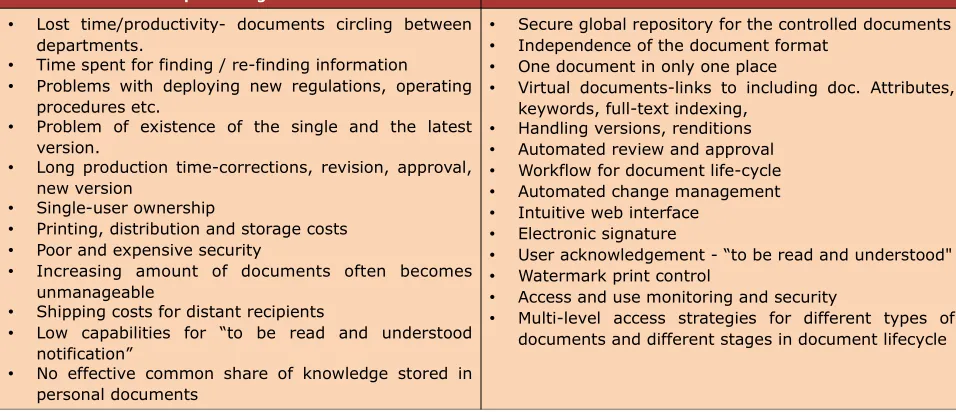
Paper Management EDMS
• Lost time/productivity- documents circling between departments.
• Time spent for finding / re-finding information
• Problems with deploying new regulations, operating procedures etc.
• Problem of existence of the single and the latest version.
• Long production time-corrections, revision, approval, new version
• Single-user ownership
• Printing, distribution and storage costs
• Poor and expensive security
• Increasing amount of documents often becomes unmanageable
• Shipping costs for distant recipients
• Low capabilities for “to be read and understood notification”
• No effective common share of knowledge stored in personal documents
• Secure global repository for the controlled documents
• Independence of the document format
• One document in only one place
• Virtual documents-links to including doc. Attributes, keywords, full-text indexing,
• Handling versions, renditions
• Automated review and approval
• Workflow for document life-cycle
• Automated change management
• Intuitive web interface
• Electronic signature
• User acknowledgement - “to be read and understood"
• Watermark print control
• Access and use monitoring and security
• Multi-level access strategies for different types of documents and different stages in document lifecycle
Table 1. EDMS characteristics. Source: Volarevic et al. (2000)
Khedduci, 2012; Wild, McMahon & Liu, 2010). Electronic document management system (EDMS) is the computer-based system designed for this purpose. Obviously, EMDS eliminates the manual paper work and reduce duplications regarding documentation and recordkeeping. Table 1 compares the characteristics of two approaches: traditional paper management and EDMS.
The term EDMS is mostly related to management, storage and flow of documents. It is related to a “family” of products and concepts also including (Katuu, 2012; Lappin, 2010; Sarantinos, 2008):
• Enterprise Content Management Systems (ECMS) – mostly related to a broad range of content types and a wide access
• Enterprise Records Management Systems (ERMS) – mostly related to maintaining legal status of documents
• Knowledge Management Systems (KMS) – mostly related to broad content types but with narrow focus and perspective of learning and collaborative knowledge exchange processes (Yang & Wei, 2010)
The systems are fundamentally storing data and providing various systems of control and flow and lifecycle management. In a broader sense, the systems are suggestions for electronically supported “borderless” information exchange internally and externally with the company and its partners and actors. Furthermore, the EDMS materializes and automates communication although the system provides no assurance of clarity of information from the sender or perception and interpretation from the receiver.
2.4. Integrated Management System (IMS)
“If the companies’ strategy is to implement more than one management system, there is a clear advantage of doing it supported on an integrated approach, avoiding the development of organizational “islands” related to each subsystem.”
There are different understanding regarding the term “integration” and it refers to two approaches being adopted in Quality Management System (QMS) (Zelnik, Maletič, Maletič & Gomišček, 2012). The first approach is a merging of the documentation through alignment of standards having similarities (e.g. ISO 9001:2008 and ISO 14001:2004). The second approach is the implementation of the integrated system through a Total Quality Management approach that incorporates quality, environmental and occupational health and safety systems (Wilkinson & Dale, 2002; Shahin & Dabestani, 2011; Vicencio-Ortiz & Kolarik, 2012). As a consequence, contemporarily the term “Integrated Management System” (IMS) primarily refers to the combination of three standards: ISO 9001, ISO 14001 and OHSAS 18001. IMS can act as a vehicle for any further added management systems within products, processes and environment, e.g. the standard of TS16949 for adapting to customer specific requirements in the automotive supplier industry, ISO50001 for energy management, and ISO26000 for social responsibility. Giess, Wild and McMahon (2008) propose classification scheme for electronic management of engineering documents to promote and ensure appropriate quality measures.
ISO 9001, a member of “ISO 9000 family”, specifies certification requirements. The philosophy behind the ISO 9000 series is that quality should be built into the systems and procedures of the organization, where the emphasis is on prevention rather than cure (Sallis, 2002).
The ISO 14000 family addresses different aspects of environmental management by (1) identifying and controling the environmental impact of its activities, products or services, (2) improving its environmental performance continually, and (3) implementing a systematic approach to setting environmental objectives and targets (Holdsworth, 2003).
OHSAS 18001 2007 was developed by the OHSAS Project Group (Occupational Health & Safety Advisory Services), a consortium of 43 organizations from 28 countries. This consortium includes national standards bodies, registrars (certification bodies), OH&S institutes, and consultants. The purpose of this standard is to facilitate the integration of quality, environment, occupational health and safety management systems under a methodology of Plan-Do-Check-Act (PDCA).
2.5. EDMS for IMS
From the ISO9000 standard, control of documents are necessary to the organizations implementing IMS because documents are the means used by organizations to communicate legitimacy, work requirements, instructions, methods and results (Hoyle, 2009). Beyer, Ashmos and Osborn (1997) propose the following steps in establishing Total Quality Management systems: Adoption, implementation and institutionalisation. Here we regard the EDMS as a cornerstone in the institutionalisation. Bräker (2005) is very specific in assuming IT-based support throughout the organisation if IMS should succeed. Castillo-Barrera, Durán-Limón, Médina-Ramírez and Rodriguez-Rocha (2012) argument that extending the EDMS from “storage” to an ontological approach increases the organisational adherence to IMS (IMS exemplified with the TS16949 management system). Hussain, Barber and Hussain (2009) specifically emphasize not EDMS but intranet as the information system to enable implementation of quality standards throughout the organisation; extended by (Tan, Lin & Hsiang-chin, 2003) to e-commerce environments.
An ISO-based IMS requires the implementation of a document control system to ensure that only authorized documents are used throughout the organization. Documents that should be controlled mainly include (1) policies, (2) procedures, (3) work instructions, and (4) forms and records. Each document has a lifecycle from initiation to invalidation with the participation of involved people, and the document management system controls the workflow of this lifecycle. Effective control of documents is to reduce duplication of policies, procedures and instructions as well as decrease volume of papers and forms in the company (Zutshi & Sohal, 2003). Document control has been described in the ISO9000 Quality Systems Handbook as follows:
"The standard requires documents required by the quality management system to be controlled. Documents required by the management system are those documents used by or generated by a process that forms part of the management system. Controlling documents means regulating the development, approval, issue, change, distribution, maintenance, use, storage, security, obsolescence or disposal of documents" (Hoyle, 2009)
Reports have shown that major ISO9000 non-conformances are found related to document problems (Yao, Trappey & Ho, 2003). In order to integrate and conform to ISO standards, organizations need to employ effective EDMS solutions for controlling documents. This EMDS framework must have the advantages of a common EDMS while demonstrating the compliance with document control principles provided by ISO standards.
Staples and McKeen (2007) are adding the issue that the information systems (EDMS) themselves must meet quality measures.
3. Method and Research Questions
The theoretical approach applied is multidisciplinary and based on several paradigms (Gioia & Pitre, 1990; Willmott, 1993; Schultz & Hatch, 1996). It is seen as an advantage that different approaches carries different views, ontologies and epistemologies. It should be noted however that theory on change is left and as implicit, only indirectly referring to a sociological conceptualization of organisational change as suggested by Pettigrew, Woodman and Cameron (2001) contextualist view on longitudinal strategic change.
This study conducts a review of literature on the concepts of process, workflow and process-oriented approach to get a basic understanding towards ISO-based Integrated Management Systems, which is a process-oriented model. The scope of this article is to emphasize the important role of document management system in successfully operating and maintaining an IMS.
This study aims at answering the questions regarding (1) how important is the role of document management system in successfully employing the IMS framework and (2) what are the benefits, problems to be tackled and lessons learned when designing and operating an effective EDMS.
A case study was performed over 24 months from February 2011 to January 2013 to demonstrate benefits and problems in operating an EDMS in compliance with the IMS approach (Klein & Myers, 1999; Ellram, 1996). The methodological assumption underlying this article is that implementation of IMS differs from organization to organization depending on size, complexity and culture, however, the meta-model nature of IMS based on the standardized management systems is supporting a claim of general learning across organizations. The collection of empirical data and contextual information in this study is necessary to capture practical lessons learned.
Empirical data was gathered based on action research including unstructured interviews, participant-as-observer and direct observations of the EDMS user groups' behaviour. Because the company involved in this study is a global enterprise, its EDMS user groups include the employees from different regions such as the America (Brazil), USA, Asia (China) and Europe (Denmark, Germany, France and UK). Most data was collected by participating in the daily work of IMS department at the company involved in this study in Denmark.
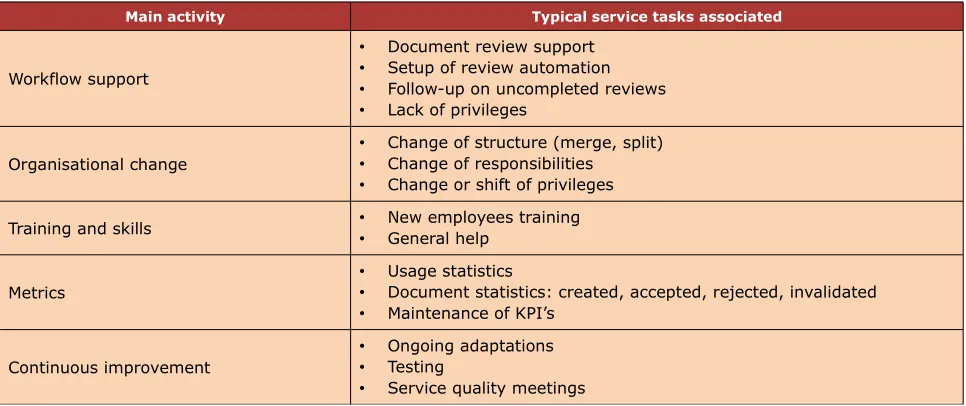
requests during the period was around 1000. The service requests were generally of a highly qualitative nature with free text expressions of issues to be resolved and typically more than one issue in each request or vaguely or ambigously expressed issues. The service requests reflected the ongoing processes of management and improvement of the EDMS for the IMS. A qualitative grouping of the service requests and associated tasks is presented in Table 2.
The service requests were directed to the IMS department of Business Excellence Unit in Denmark that is responsible for the global EDMS operation.
Main activity Typical service tasks associated
Workflow support
• Document review support
• Setup of review automation
• Follow-up on uncompleted reviews
• Lack of privileges
Organisational change •
Change of structure (merge, split)
• Change of responsibilities
• Change or shift of privileges
Training and skills • New employees training
• General help
Metrics •
Usage statistics
• Document statistics: created, accepted, rejected, invalidated
• Maintenance of KPI’s
Continuous improvement •
Ongoing adaptations
• Testing
• Service quality meetings
Table 2. Data collection from service requests
4. Case Study
4.1. The IMS structure
Figure 1. The case study IMS structure
The policies have the highest authority in this pyramid system, providing the IMS framework and setting quality goals for the company to achieve. The IMS Manual describes the IMS structure and methods to achieve quality, environmental, health and safety. Processes are placed in the core of the IMS, including four main types
• plan processes,
• strategic processes,
• business processes, and
• support processes.
These processes are described and supported by documentation at both global and regional levels. The processes are linked to the corporate strategy via the business process management product ARIS. In ARIS processes are described, the IMS documents are readily available as links, and relevant business processes are furthermore supported in the corporate ERP-system.
4.2. The document flow
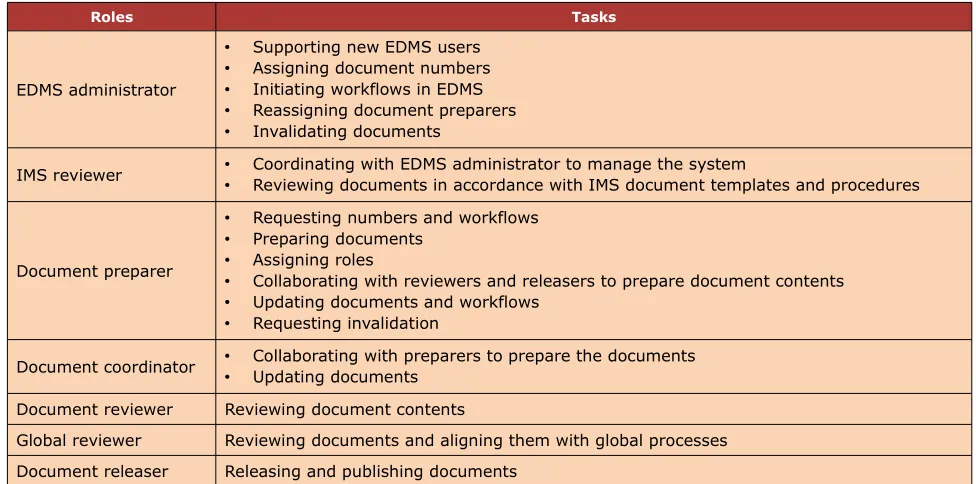
corresponding processes. They coordinate and play different roles such as EDMS administrators, document preparers, document coordinators, IMS reviewers, global reviewers and releasers (Table 2).
Figure 2. The lifecycle of a document
Roles Tasks
EDMS administrator
• Supporting new EDMS users
• Assigning document numbers
• Initiating workflows in EDMS
• Reassigning document preparers
• Invalidating documents
IMS reviewer •• Coordinating with EDMS administrator to manage the systemReviewing documents in accordance with IMS document templates and procedures
Document preparer
• Requesting numbers and workflows
• Preparing documents
• Assigning roles
• Collaborating with reviewers and releasers to prepare document contents
• Updating documents and workflows
• Requesting invalidation
Document coordinator • Collaborating with preparers to prepare the documents
• Updating documents Document reviewer Reviewing document contents
Global reviewer Reviewing documents and aligning them with global processes Document releaser Releasing and publishing documents
Table 3. Roles and tasks in EDMS
In Table 3, the tasks and responsibilities of the roles are presented. It is worth noting that the EDMS and IMS administrators are static but the remaining roles are dynamic and always dependent on the scope on the documents.
advising people on the use of correct document templates, initiating workflows and invalidating documents when requested. They also make sure that important people are involved in the process of reviewing and approving the documents.
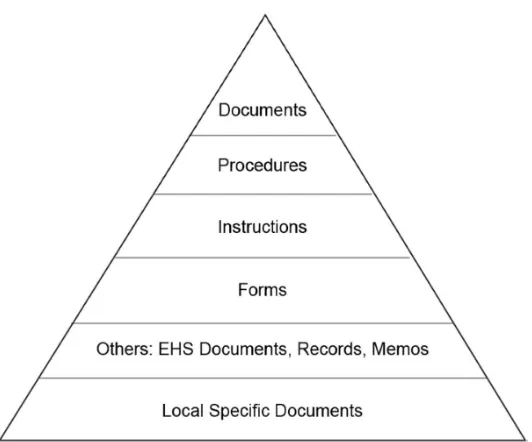
Figure 3. The document hierarchical structure
Both IMS and EDMS implementations are relatively new. Some of the first documents on IMS are from 2006. These were practically mostly used in and around the headquarter. The globalisation of the production took place from 2008 and several manufacturing sites have only been operating for a few years. The IMS have played an important role in the globalisation to have the company “talk one language”, but have also failed in capturing local and regional issues. The EDMS have been lagging behind the globalisation and the local IMS implementations, but have still displayed a role of usefulness up to a certain point of localisation. For established and mature manufacturing sites, the EDMS is now turning in to a “single source of truth” pertaining IMS; the global transparency is also easing criticism and local request for adaptations.
5. Discussion
globalisation of the case organisation and the expansion scenario could not have happened without the EDMS. This doesn’t mean that the EDMS is undisputed in terms of information quality, ruggedness of review processes and system quality at large. The following sections present benefits, challenges and lessons learned from the workflow-based document management approach of the company involved in this study.
5.1. Benefits
5.1.1. Enhanced processes description
The IMS model is process-oriented with a clear differentiation of levels of processes. Each process is shown visually with links to relevant documents that are stored in the EDMS. This mechanism provides a holistic view on all processes and implementation procedures. For instance, some instructions, procedures and forms are attached to the transportation and logistics process indicating that it is required to follow the transport instructions and fill in the related forms when transporting goods. Especially, when transporting hazardous goods or climbing in height, employees must strictly follow some safety guidelines as specified in the attached relevant documents. Process descriptions are thus elevated from a local and individualistic position to a regional or enterprise wide position. This follows the line of arguments from Anttila and Jussila (2013) however the concrete IT implementation is the actual and pragmatic representation of processes (Scheer & Nüttgens, 2000).
5.1.2. Distribution of authorized documents
5.1.3. Leveraging of information silos
Silos are widely discussed from their simplification of the organisational design and detrimental effect to necessary cross-organisational collaboration (Sampaio et al. 2012; Wong, 2013). It is a typical advantage of an EDMS capable of operational reciprocity within organization. The system eliminates redundant documents and records created by individuals and groups by publishing standardized and authorized documents. EDMS actualizes documents, and remove redundancy and ambiguity. First hand collaboration lies within the review, management and authorization system. Second hand collaboration is based on the global organisations ability to relate to a lingua franca of business processes.
5.1.4. Collaboration and communication promotion
The workflow-based document management system demonstrates the flow of documents and involves relevant people in its lifecycle. Workflows are system-based representations of defined actions and actors. The EDMS must not only be viewed from its ability to store documents but also to manage the workflow-style of activities and roles (Sarantinos, 2008; Bae & Kim, 2002; Muehlen, 2004). Based upon the aforementioned service requests, EDMS administrators or IMS reviewers will assign new roles to responsible people. They will be granted permission to login the system and perform the assigned tasks (e.g. preparing, reviewing or releasing documents). People collaborate to prepare and revise documents not only via emails but also via phones and face-to-face meetings. This fosters a better collaborative culture and encourages the exchange of both tacit and explicit knowledge in the organization.
5.2. Challenges
5.2.1. Cross-cultural misunderstandings
The literature and the international standards are not specifying rules on how to implement IMS as it depends on organizations' sizes, management decisions and business directions. As the company involved in this article is a global enterprise, EDMS is implemented centrally from Denmark with technical support from Germany. The standard document templates and usage guidelines have been designed in Denmark for the whole organization. Empirical data shows that there were different understandings regarding how to define and use “procedure” and
the IMS department in Denmark. This was mentioned by an interviewee from IMS department in Denmark as "a problem caused by the differences between work cultures in two countries". Consequently, it led to confusion and extra time to communicate back and forth between two units.
5.2.2. Increased level of complexity
The hierarchy structure of documents has added more complexity to the management task in line with Oliveira’s (2013) considerations. The IMS department received many questions regarding how to select the right templates, what kind of document should be used (e.g. procedure, instruction or form) and how to handle problems rising during the document workflow. Furthermore, many local specific documents must be aligned with the superior documents issued by global units and when the owners of these local specific documents were not aware of this before preparing the contents, it could increase waiting time before the documents being released.
5.2.3. Organisational dynamics
In large enterprises, people often move around for new positions in different units or change their jobs. This challenges IMS as each process has a process owner and each document has a document owner (the document owner can be either the preparer or releaser). When people change their jobs, they need to find someone who can take over the process and document ownership. In many cases, the handover task was forgotten causing time-delays and the "asking around" issue when handling document workflows. A separation between roles (e.g. CFO or QA Manager) and individuals (e.g. Jones or Müller) is required to ensure independency of individuals and smooth and transparent transition of responsibilities. A full, fine-grained role structure was not implemented in the observed project.
5.2.4. Awareness and perception
5.2.5. The "gatekeeper" bottleneck
In order to ensure the document quality, EDMS administrators and IMS reviewers act as the "gatekeepers" to check the validity of each document request before issuing a number. Nevertheless, an increasing amount of documents in such a global enterprise could cause bottleneck in processing. The introduction of IMS is still relatively new and simplification of document structures and counts is lagging behind compared to the underlying management systems for quality, environment, etc.
5.2.6. Cross-referencing issues
Cross-referencing means that each document can have multiple references to related documents within the document body as discussed by Wild et al. (2010). For example, a work safety instruction can be connected to some other environmental safety instructions. This caused difficulties and time-consuming in updating these references because people had to open the documents to edit their contents. It is therefore necessary to develop a solution for updating these references automatically or from outside the documents.
5.3. Lessons learned
The role of EDMS can be understood as the materialization of IMS. On IMS Zutshi and Sohal (2006) have stressed the importance of having a controlled EDMS when contemplating the integration. With EDMS, such as Microsoft Sharepoint or Lotus Notes as commonplace in enterprises, it is obvious to use these to resolve the manual paper work issues. However, an emerging question is that how to design an effective EDMS complying with IMS standard. There is no "one-size-fits-all" system because it depends on infrastructure, business functions and resource allocation of each company. Hence, each company should develop a learning curve concept in order to create a flexible EDMS approach to meet the IMS-based ISO requirements.
is just a separate document and record keeping system and it is not necessary to adhere to the IMS guidelines on document workflow participation. They have created different types of document-related non-conformances in consequence such as using non-authorized and outdated document templates, neglecting to update their own documents, or not aligning their documents with global processes. Designing an effective training program can help companies clearly explain the functions of EDMS to all employees, increase their awareness and reduce document-related nonconformance and cross-cultural misunderstanding issues.
With the rapid growth in software applications technology, companies should also search for an appropriate platform to develop their EDMS to resolve the problems of cross-referencing, automate the "gatekeeper" task and automatically check the companies' directories to inform involved people when a document owner has changed his/her job.
5.4. Final reflections
This study uses a qualitative, case-based, longitudinal approach. The case has been selected to provide the study with practical and context-dependent knowledge. According to Flyvbjerg (2006), knowledge generated from a single case study could contribute to "the collective process of knowledge accumulation in a given field or in a society".
This approach has been therefore proven to be useful in capturing the evolvement of the EDMS-based IMS over time. EDMS changed from “document storage” to a flow-orientation with a much more active role in the enterprise. The multi-paradigmatic analysis (Gioia & Pitre, 1990) included quality management as well as information systems research thereby demonstrating a distinct interdisciplinarity in study of IMS implementation and organisational engagement.
The contribution of EDMS must be understood in the right sense of being a technological subsystem supporting IMS’ general operations with a requirement for organizational acceptance of the technology. The origination of IMS from QA professionals is important to highlight as IMS tends to form a context of its own – a rather closed Community of Practice (Yang & Wei, 2010) where EDMS must open this up. Related to globalization, IMS still tends to rely on communication between QA professionals. Following the critical TQM implementation parameters of Shahin & Dabestani (2011), EDMS actively supports ‘Adoption & Communication’, ‘Closer Customer/Supplier Relationships’, ‘Increased training’, ‘Open Organisation’ and ‘Process Improvement’. The combination of EDMS and IMS is thus indicating broader inclusion of non-QA professionals as a key success factor.
EDMS “competes” with many other information platforms: Intranet, ERP, work instructions, engineering systems, supplier and customer systems, informal local systems, vocational skills, and verbal and non-verbal instructions. The pluralism of information sources is critical to understand in designing EDMS as well as IMS. The case shows that proper and ongoing management of the EDMS can ensure the EDMS as “above” competing systems.
In the case study, the EDMS was fully integrated with the intranet both technologically and operationally, reducing information silos, data access problems and binding barriers in the context of QA professionalism. Furthermore the EDMS was integrated with the overall business process management system. Enterprise-wide IMS implementation must therefore be related to
• adequate and relevant technological choices and appropriate information technology portfolio,
• an interdisciplinary approach aiming at broadening the QA context,
• a rightful technological design involving active roles (e.g. automated flow-control),
• training on both IMS and EDMS to improve the awareness of this coalescence,
• relevant metrics for follow-up, and
• guiding principles of the chosen technology as a creator of a transparent and positive climate to facilitate knowledge sharing and necessary discussions on both local and central levels.
Most of the available EDMS have been however developed based on the traditional method using HTML format, posing some limitations regarding information exchange, document customization and search engine. The XML-based ISO9000 EDMS has been proposed by Yao et al. (2003) to improve the document flow and document management.
This study has pointed out the interrelation between EDMS and IMS as a key factor in managing globalized enterprises with IMS as a driving mechanism by creating uniform processes supported by the information technology. The uniform processes are related to development of IMS documents, management of IMS documents and associated flows, and the persistent use of the EDMS as the global repository for reading and learning from IMS documents.
6. Conclusion
An effective EDMS is important to support organizations in approaching a qualified IMS. Based on the empirical data collected from the in-depth case study, this article has addressed the merits of using EDMS to control documents in compliance with ISO standards, manage challenges arising and lessons learned.
Further research is to be directed towards potentials for deeper implementation of the EDMS in the corporate information systems architecture to ensure more direct inclusion of the IMS in not only strategic business processes, but also daily work practices with more clear integration to engineering and shop floor systems. The research is aiming at understanding the role of EDMS in IMS for continuous improvement programs particularly in creating shorter change-cycles and leverage cross-organizational collaboration.
References
Agarkar, M., Borle, A., Deshmukh, A., & Bhagat, M. (2012). An Enhanced Document Management System for SME. 2012 IEEE Eighth World Congress on Services.
http://dx.doi.org/10.1109/SERVICES.2012.67
Anttila, J., & Jussila, K. (2013). An advanced insight into managing business processes in practice. Total Quality Management & Business Excellence, 24(7-8), 918-932.
http://dx.doi.org/10.1080/14783363.2013.791105
Asif, M., Bruijn, E., & Fisscher, O. (2008). Process embedded design of integrated management systems. International Journal of Quality & Reliability Management, 26(3), 261-282.
http://dx.doi.org/10.1108/02656710910936735
Bae, H., & Kim, Y. (2002). A document-process association model for workflow management.
Computers in Industry, 47, 139-154. http://dx.doi.org/10.1016/S0166-3615(01)00150-6
Beyer, J.M., Ashmos, D.P., & Osborn, R.N. (1997). Contrasts in Enacting TQM: Mechanistic vs. Organic Ideology and Implementation. Journal of Quality Management, 2(1), 3-39.
http://dx.doi.org/10.1016/S1084-8568(97)90020-1
Bernardo, M., Casadesus, M., Karapetrovic, S., & Heras, I. (2009). How integrated are environmental, quality and other standardized management systems? An empirical study. Journal of Cleaner Production, 17, 742-750. http://dx.doi.org/10.1016/j.jclepro.2008.11.003
Bräker, S. (2005). Support of Integrated Management Systems by the Use of In-Plant Information, Management and Monitoring Systems. In Hilty, L., Seifert, E., Treibert, R.,
Information Systems for Sustainable Development. Hershey: IGI Global.
Castillo-Barrera, F.-E., Durán-Limón, H.A., Médina-Ramírez, C., & Rodriguez-Rocha, B. (2012). A method for building ontology-based electronic document management systems for quality standards: the case study of the ISO/TS 16949:2002 automotive standard. Appl Intell, 38, 99-113. http://dx.doi.org/10.1007/s10489-012-0360-1
Ellram, L.M. (1996). The Use of Case Study Method in Logistics Research. Journal of Business Logistics, 17(2), 93-138.
Eriksson, H., & Hansson, J. (2003). Integrated Management Systems-Theoretical and Practical Implications.Asian Journal on Quality, 7(2), 69-82. http://dx.doi.org/10.1108/15982688200600017
Flyvbjerg, B. (2006). Five misunderstandings about case study research. Qualitative Inquiry, 12(2), 219-245. http://dx.doi.org/10.1177/1077800405284363
Giess, M.D., Wild, P.J., & McMahon, C.A. (2008). The generation of faceted classification schemes for use in the organisation of engineering design documents. International journal of information management, 28(5), 379-390. http://dx.doi.org/10.1016/j.ijinfomgt.2007.10.001
Guimares, T., Staples, D.S., & McKeen, J. (2007). Assessing the Impact From Information Systems Quality. The Quality Management Journal, 14(1).
Holdsworth, R. (2003). Practical applications approach to design, development and implementation of an integrated management system. Journal of Hazardous Materials, 104, 193-205. http://dx.doi.org/10.1016/j.jhazmat.2003.08.001
Hoyle, D. (2009). ISO 9000 Quality Systems Handbook: Using the standards as a framework for business improvement. 6th Edition. Oxford: Butterworth Heinemann.
Hussain, Z., Barber, K., & Hussain, N. (2009). An Intranet based system as an enabler in effective project management and implementation of quality standards: A case study. Journal of Engineering Technology Managent, 26, 196-210.
http://dx.doi.org/10.1016/j.jengtecman.2009.06.003
Jørgensen, T., Remmen, A., & Mellado, D. (2006). Integrated management systems e three different levels of integration. Journal of Cleaner Production, 14, 713-722.
http://dx.doi.org/10.1016/j.jclepro.2005.04.005
Karapetrovic, S. (2003). Musings on integrated management systems. Measuring Business Excellence, 7(1), 4-13. http://dx.doi.org/10.1108/13683040310466681
Katuu, S. (2012). Enterprise content management (ECM) implementation in South Africa.
Records Management Journal, 22(1), 37-56. http://dx.doi.org/10.1108/09565691211222081
Klein, H.K., & Myers, M.D. (1999). A set of principles for conducting and evaluating interpretive field studies in information systems. MIS Quarterly, 23(1), 67-93.
http://dx.doi.org/10.2307/249410
Lappin, J. (2010). What will be the next records management orthodoxy? Records Management Journal, 20(3), 252-264. http://dx.doi.org/10.1108/09565691011095283
Liu, S., McMahon, C.A., & Culley, S.J. (2008). A review of structured document retrieval (SDR) technology to improve information access performance in engineering document management. Computers in Industry, 59(1), 3-16.
http://dx.doi.org/10.1016/j.compind.2007.08.001
McDonald, M., Mors, T., & Phillips, A. (2003). Management Systems Integration-can it be done?
Muehlen, M. (2004). Workflow-Based Process Controlling: Foundation, Design, and Application of Workflow-Driven Process Information Systems. Advances in Information Systems and Management Science Series, 6.
Oliveira, O. (2013). Guidelines for the integration of certifiable management systems in industrial companies. Journal of Cleaner Production, 1-10.
Pettigrew A., Woodman, R., & Cameron, K. (2001). Studying Organizational Change and Development. Challenges for future research. Academy of Management Journal, 44, 697-713.
http://dx.doi.org/10.2307/3069411
Quintana, V., Rivest, L., Pellerin, R., & Khedduci, F. (2012). Re-engineering the Engineering Change Management process for a drawing-less environment. Computers in Industry, 63, 79-90. http://dx.doi.org/10.1016/j.compind.2011.10.003
Ralph, S. (1995). Electronic Document Management: Challenges and Opportunities for Information Systems Managers. MIS Quarterly, 19(1)
Rasmussen, J.M. (2007). Integrated Management Systems-An Analysis of Best Practice in Danish Companies. Master Thesis, Aalborg University.
Sallis, E. (2002). Total Quality Management in Education. 3rd Edition. Routledge.
Sampaio, P., Saraiva, P., & Domingues, P. (2012). Management systems: integration or addition? International Journal of Quality & Reliability Management, 29(4), 402-424.
http://dx.doi.org/10.1108/02656711211224857
Sarantinos, V. (2008). Considering Document Workflow Issues: Pros and Cons for the Non-experts. International Journal of Business and Management, 3(7).
Scheer, A.-W., & Nüttgens, M. (2000). ARIS Architecture and Reference Models for Business Process Management. In Oberweis, A. (Ed.). Business Process Management-Models, Techniques, and Empirical Studies. Springer, Berlin, 376-389.
Schultz, M., & Hatch, M.J. (1996). Living with Multiple Paradigms: The Case of Paradigm Interplay in Organizational Culture Studies. The Academy of Management Review, 21, 529-55.
Shahin, A., & Dabestani, R. (2011). A feasibility study of the implementation of total quality management based on soft factor. Journal of Industrial Engineering and Management, 4(2), 258-280. http://dx.doi.org/10.3926/jiem.2011.v4n2.p258-280
Simon, A., Karapetrovic, S., & Casadesus, M. (2012). Evolution of Integrated Management Systems in Spanish firms. Journal of Cleaner Production, 23(1), 8-19.
http://dx.doi.org/10.1016/j.jclepro.2011.10.025
Tan, B., Lin, C., & Hsiang-chin, H. (2003). An ISO 9001: 2000 quality information system in e-commerce environment. Industrial Management + Data Systems, 103(8/9), 666-676.
http://dx.doi.org/10.1108/02635570310506089
Tambo, T. (2012). Referencemodels and managerial leeway (in danish, “Referencemodels og ledelsesmæssigt frirum”). Proceedings of Danish Academy of Management Annual Conference. Copenhagen.
Tari, J.J., Molina-Azorin, J.F., & Heras, I. (2012). Benefits of the ISO 9001 and ISO 14001 standards: A literature review. Journal of Industrial Engineering and Management, 5(2), 297-322. http://dx.doi.org/10.3926/jiem.488
Terziovski, M., & Hermel, P. (2011). The Role of Quality Management Practice in the Performance of Integrated Supply Chains: A Multiple Cross-Case Analysis. The Quality Management Journal, 18(2), 10-25.
Vicencio-Ortiz, J.C., & Kolarik, W.J. (2012). The Assessment of the Impacts of Improvement Projects in the Interrelated Processes: A Cross-Case Study. The Quality Management Journal, 19(3), 38-50.
Volarcvic, M., Strasberger, V., & Pacelat, E. (2000). A philosophy of the electronic document management. 22n d Int. Conf. information Technology Interfaces/TI2000. June 13-16, Pula,
Croatia
Wild, P.J., McMahon, C., & Liu, S. (2010). A diary study of information needs and document usage in the engineering domain.Design Studies, 31, 46-73.
http://dx.doi.org/10.1016/j.destud.2009.06.002
Wilkinson, D., & Dale, B. (2002). An examination of the ISO 9001:2000 standard and its influence on the integration of management systems. Production Planning & Control: The Management of Operations, 13(3).
Willmott, H. (1993). Breaking the paradigm mentality. Organization Studies. 14, 681-719.
http://dx.doi.org/10.1177/017084069301400504
Wong, W. P. (2013). Business-process management: a proposed framework for future re s e ar ch . Total Quality Management & Business Excellence, 24(5-6), 719-732.
http://dx.doi.org/10.1080/14783363.2013.776773
Yang, C.-L., & Wei, S.-T. (2010). Modelling the performance of CoP in knowledge management.
http://dx.doi.org/10.1080/14783363.2010.487707
Yao, Y., Trappey, A., & Ho, P. (2003). XML-based ISO9000 electronic document management system. Robotics and Computer Integrated Manufacturing, 19, 355-370.
http://dx.doi.org/10.1016/S0736-5845(03)00003-6
Zelnik, M., Maletič, M., Maletič, D., & Gomišček, B. (2012). Quality management systems as a link between management and employees. Total Quality Management & Business Excellence, 23(1), 45-62. http://dx.doi.org/10.1080/14783363.2011.637781
Zutshi, A., & Sohal, A. (2003). Integrated management system: The experiences of three Australian organisations. Journal of Manufacturing Technology Management, 16(2), 211-232.
http://dx.doi.org/10.1108/17410380510576840
Journal of Industrial Engineering and Management, 2014 (www.jiem.org)
Article's contents are provided on a Attribution-Non Commercial 3.0 Creative commons license. Readers are allowed to copy, distribute and communicate article's contents, provided the author's and Journal of Industrial Engineering and Management's names are included.