Issues
ISSN: 2146-4138
available at http: www.econjournals.com
International Journal of Economics and Financial Issues, 2019, 9(4), 60-73.
Value for Money in Mexico? Including the Missing Risks in
Infrastructure Project Evaluation
Jeremy Heald*
Department of Economics and Finance, Division de Ciencias Economico Administrativas, Universidad de Guanajuato, Mexico. *Email: [email protected]
Received: 29 April 2019 Accepted: 19 June 2019 DOI: https://doi.org/10.32479/ijefi.8090
ABSTRACT
According to economists and financiers of multilateral organizations, banks and consultancies, “Public Private Partnerships” are the answer to traditional inefficiencies in infrastructure procurement, providing “Value for Money (VfM).” While that proposition requires corroboration, so does the reliability of the methodology underlying the measurement of it, especially before project implementation with a view to improving current
investment decisions, but also after, to appraise impact and improve future infrastructure procurement. Based on a review of the international literature
on infrastructure evaluation together with direct experience by the author of Mexican procurement, the article makes specific recommendations for rebalancing the economic measurement of risk and VfM. It does so by including missing risks, flexibility and stakeholders in the VfM calculation. The proposal is timely considering the erosion of public confidence in the VfM methodology and the inclination of stakeholders to avoid appraisal obligations and public scrutiny.
Keywords: Public Private Partnerships, Evaluation, Value for Money, Risk, Stakeholders
JEL Classifications: O2, 022
1. INTRODUCTION
On the one hand, infrastructure is hugely expensive with numerous construction and other risks, whoever finances it. Some projects can effectively be privatised where users pay tolls (transport) or domiciled bills (drinking water), however, many projects cannot, such as a tariff-free road network. On the other hand, payback, whether through end-user charges or government periodic payments, is long-term and risky, due to demand uncertainties. Financial analysis will therefore always form part of the evaluation process for infrastructure, however economic analysis from the public view point, known as Social Cost-Benefit Analysis (SCBA) and its more recent extension, Value for Money (VfM), is under threat, for two reasons.
First, the private partners in Public Private Partnerships (PPPs) are increasingly funding infrastructure rather than the government,
which means that the logic behind the appraisal of projects to
ascertain whether they are in the public interest still exists where departments make periodic payments as infrastructure becomes operational, but the dynamic is rather different because the government does not need to justify the funds up-front. Where projects are profitable and wholly privately financed, the case for public evaluation becomes weaker still. Construction companies
and even governments will evade their evaluation obligations
unless obliged to by public and media scrutiny.
Second, important issues have been flagged up in the evaluation
literature concerning both the measurement of VfM and the decision process which selects the procurement format
based on it. There are questions concerning the transfer of risks to private partners and the evaluation of that risk (Burke and Demirag, 2017). There are also accusations of selection
bias in favour of PPPs. One political economy interpretation of the PPP defines it as a “…politically motivated project-financing mechanism” (Siemiatycki and Farooqi, 2012. p. 298) in which VfM provides the formal justification for “a decision already taken” (Shaoul et al., 2012b. p. 38). According to Hodge and Greve (2018. p. 12), the re-establishment of trust in the evaluation of projects in the context of emerging economies requires a “renewed emphasis on public sector integrity, transparency and corruption avoidance.”
Although interlinked, this article centres on the methodological
issue of measuring VfM rather than ideological preferences
combined with opaque decision-making which can bias a selection process based on VfM - or any other evaluation criterion for
that matter. For example, Mexican law still permits the direct adjudication of infrastructure projects, circumventing the
tendering process altogether, however it is a path which frequently ends in controversy, provoking the belated elaboration of the
relevant evaluations. Improvements on both methodological and
transparency fronts are essential if SCBA and VfM are to survive as evaluation tools. Analysis draws on the international practitioner
and academic research literature, together with direct experience
by the author of evaluation practices in Mexico, as infrastructure
project evaluator and participant in training programs supported
by government at federal and state levels.
The article analyses two frequent problems associated with project
evaluation and the choice of procurement format in the context
of Mexico. The first is missing risks in the evaluation of VfM,
which can bias the procurement format decision. The second is
inflexible decision-making processes with restricted stakeholder participation. The focus here is on the first problem although the two are related and the second is analysed in relation to how it prejudices the first. Together they encourage deterministic, closed contracts in an uncertain environment, limited risk transfer to
the private sector, lopsided distributions of project costs and
benefits, and ultimately project conflict and renegotiation. All of which weakens the justification for using SCBA and VfM in the first place.
Strictly speaking, if a PPP is VfM, it means that the savings obtained within the PPP format outweigh the associated costs. But more than that, the format increases net benefits for society above and beyond those achievable via Tradition Procurement (TP), while delivering private profits at the same time (refer to VfM analysis).
The VfM issue is important for Mexico and elsewhere for three
reasons. First, infrastructure procurement is hugely expensive
but essential for national welfare and economic development.
Second, development multilaterals, banks and project consultants of public infrastructure strongly promote the PPP procurement format. Third, VfM is a key criterion used to earmark projects as PPPs, providing the economic rational which underpins financial
and legal processes in infrastructure procurement.
According to Mexico,s infrastructure planning and evaluation
agency (CEPEP, 2004), project benefits costs should be identified, quantified in physical units and valued monetarily, and in that
order, to avoid omissions and errors in SCBA, which is the
approach used in this article for measuring VfM. Evaluation is
complex because it entails accounting for costs and benefits using various criteria including efficiency, willingness to pay and the generation of end-user savings, but it also requires measuring the economic value of service quality which is challenging.
After introducing the research question and methodology, the first section outlines the economic theory behind the PPP and TP procurement formats, briefly revises the international literature, identifies the PPP formats used in Mexico and summarizes the country’s experience. The second section discusses the ex-ante procedures used for establishing VfM in Mexican PPPs, which include SCBA, eligibility analysis, risk analysis and the VfM
calculation. It also outlines some ex-post procedures which
are unfortunately not systematically implemented in Mexico, including the analysis of delays and cost over-runs, impact surveys
and VfM recalculations based on real SCBA data once projects
are operational. As risk management is the essence of PPPs, the third section discusses the assignment of risks, responsibilities
and sanctions in Mexican projects, including contract rescission.
However, the assignment of risks in Mexico appears to be biased, swelling the ex–ante cost of TP while ignoring some project risks associated with both formats, but particularly PPPs, which can load decisions in favour of them. To this end some missing risks are identified, which is part of a wider problem of an inflexible approach to evaluation by a narrow group of stakeholders, skewing benefits in favour of contractors, concessionaires and their financial backers. In the fourth section, the article recommends creative solutions for including missing risks inherent in Mexican projects in the VfM calculation, while the conclusions summarize those
solutions in the context of a volatile evaluation environment.
2. BACKGROUND TO PPPS
The distinction between the TP and PPP formats is far from black and white, as can be appreciated from the acronym soup of
formats, which describe variations on a theme along a procurement continuum moving through traditional public-sector provision
and different versions of PPPs to full privatization. TP refers to the conventional system of infrastructure procurement, financed up-front by the government using tax revenue and public debt,
which hires a private contractor via tender, to build an installation,
which will be administered by a government entity or outsourced, again by tender, to a private operator (Burger and Hawkesworth, 2011; Ridolfi, 2003; WBI, 2012). Whole-of-life PPPs use a private consortium to design, finance, construct, renovate, operate and maintain infrastructure, while operational PPPs are contracted to manage existing installations, frequently including an initial renovation (Bauhaus-Universität Weimar, 2009; Ridolfi, 2003; WBI, 2012) (refer to Infrastructure in Mexico).
2.1. Monopoly Economics
It is debatable whether PPPs offer the best solution for infrastructure due to problems inherent in monopoly provision, which has ramifications for risk and stakeholder management. Infrastructure projects require complex negotiations and contracts because they do not operate in competitive markets and for a given
to the enormous investments required. If there are two providers, they are generally imperfect substitutes, offering different routes, locations, technologies or service specifications to end users. A tendering process increasingly subcontracts the phases of project design, financing, construction, renovation and operation to private contractors, either in a package or in separate contracts. As the market is highly monopolistic it requires a strong regulatory framework. (Baumol et al., 1982; Tan, 2011).
Infrastructure procurement is also risky because it occurs in essentially incomplete markets in which long-term contracts cannot specify ex-ante a myriad of possible outcomes, some of which may be unknowable at the time of contracting. The situation is further complicated by asymmetric information in which one party (the contractor or financier) has better and more up-to-date information than the other (the government) bestowing it a favourable negotiating position (Oliveira-Cruz and Cunha-Marques, 2013). The problems are more complex for PPPs than TP, especially when the contracts are whole-of-life and include initial construction risks as well as subsequent operator demand risks, which are qualitatively distinct (Grossman and Hart, 1986; Hart and Moore, 1999; Maskin and Tirole, 1999) .
The traditional view of a private company is that it exists to increase value for the owners or shareholders (Freeman, 1984). Infrastructure projects do not fit that model because the numerous stakeholders include the relevant government department, the construction contractor, property owners who need compensating to provide “rights of way,” private banks, multilateral banks, contracted service providers and, in the case of PPPs, equity owners. Finally, there are service users who may have historic claims and rights, for example, access to community drinking
water. The constellation of participants varies per project, but the
key decisions are taken by a trusteeship or Special Purpose Vehicle (SPV) comprising the key supply-side stakeholders normally with no end-user representation, creating potentially inequitable
outcomes that are prone to conflict (Marques and Berg, 2010; Mitchell et al., 2015).
2.2. Practitioner and Academic Opinion
The international practitioner literature is generally favourable to PPPs which supposedly offer VfM via improvements in cost efficiency and service performance in three ways. First, by implementing private sector cutting-edge technologies and superior operational capability. Second, by using a single management vehicle in the case of whole-of-life PPPs to design, finance, build and operate an installation, which supposedly avoids the perennial problem of hidden construction defects. Third, by accessing additional sources of private funding, which may relieve
public budget restrictions constraining infrastructure procurement
(WBI, 2012). So even though PPPs are for-profit operations which require compensation in the form of dividends and private debt which is costlier than comparable public debt, they can still be VfM because TP typically delivers late, over budget and provides poor service quality (Allan Consulting, 2007; Bain, 2010; Burger and Hawkesworth, 2011; Duffield, 2008; Eadie et al., 2013, Graham, 2010, Henjewele et al., 2014, Mott MacDonald, 2002). Web-based propaganda supporting this position includes the
principal multilateral policy sites that promote the format as the frontier of modern infrastructure procurement, such as the World Bank´s PPP catalogue, the European Bank´s PPP Expertise Centre and the Mexican PIAPPEM site (EPEC, 2011; PIAPPEM, 2017; WBG, 2016).
Much of the academic journal literature is critical of PPPs, for six reasons. First, they negotiate overpriced, excessively profitable contracts with limited risk transferal to the private
sector, due to the inherent limitations of private provision in a
monopoly service environment that cannot mimic the efficiency benefits of competitive markets, as postulated by economic theory (Asenova and Beck, 2010; Hellowell and Vechi; 2012, Henjewele et al., 2014; Siemiatycki, 2015; Tan, 2011; Willoughby, 2013). Second, they concentrate investment in developed and
emerging economies, leaving less developed countries without
access to finance. Third, they benefit a small group of developed or emerging country multinational construction companies (Siemiatycki, 2013). Fourth, they fail to increase global funds
available for infrastructure procurement because developing countries cannot repeat the initial success of the few in securing
international project finance as worldwide savings are ultimately finite (Fischer, 2011). Fifth, they hamper the investment programs of future governments which pay onerous periodic service payments to pre-existing PPPs. Sixth, on occasion, they keep
infrastructure off the national balance sheet to reduce visible
public debt (Benitoet al., 2008; EPEC 2011; House of Commons Treasury Committee, 2013). The title of Tan,s (2011) article sums up the critical position on PPPs by claiming that infrastructure privatization, whether partial or complete, is “Oversold, misunderstood and inappropriate.”
2.3. Infrastructure in Mexico
Unfortunately, there has been limited published evidence concerning Latin American and specifically Mexican PPPs as
internal government research studies have not been released
(Hinojosa, 2015), however the available evidence, published by Burger and Hawkesworth, 2011; Gassner et al., 2009; Guasch, 2014; Guasch et al., 2014; Marin, 2009 and Risso, 2014, is
presented here.
The Inter-American Development Bank (IDB) estimates that an equivalent of 5% of regional GDP needs investing in infrastructure from 2015 to 2020 to bring Latin America up to international competitiveness, while the Economic Commission for Latin America and the Caribbean (ECLAC) of the United Nations proposes a similar annual investment of 6.2%. This requires a big increase from the 2 or 3% points of GDP which the region has been spending on infrastructure at least since the start of the century. All the main infrastructure sectors require investment i.e. transport, energy, telecommunications, water and sanitation (Espelt, 2015; Economic Intelligence Unit, 2015). The format debate therefore concerns not just the quality of infrastructure provision, but also the need for quantity.
for non-tariff infrastructure procurement, and from 2005 onwards by most state governments. In a PPS, the SPV is responsible for project financing (using its own and bank resources), building and operating the infrastructure. There are also PPP Concesiones, a more recent equivalent of the PPS, and Aprovechamiento de Activos, for the operation of existing tariff-charging highways, often with an initial commitment to renovate and modernize. Where
the service offered is tariff-free to end-users, the government
reimburses the private sector by making periodic payments to the SPV during the infrastructure´s operating life. If the installation is profitable, as in some Concesiones and most Aprovechamiento
de Activos, payments go in the opposite direction i.e. profits are shared with the government. Mexican PPP contracts typically run for 15, 20 or 30 years, after which time the relevant government department decides what follows. There is one other PPP format, Pidiregas, which has operated since the 1990s in the energy sector, is self-financing via the application of tariffs and guaranteed by the federal government which subsumes most of the risks. A PPP law, enacted in 2012 and updated in 2014, has reduced ambiguity in a previously fragmented institutional and legal landscape for implementing PPPs (DOF, 2014; Economic Intelligence Unit, 2013; Quesada-Lastiri, no date, PIAPPEM, 2017; Weihmann and
Figueroa, 2013; Woodhouse, 2010).
PPPs have accounted for up to 15% of total infrastructure investment in Mexico, accounting for over 50 PPPs, of which two-thirds were supervised at federal level, and the rest by state governments, providing 27 roads, six hospitals, three bridges, three universities/cultural centres/museums, public offices and others. (Burger and Hawkesworth, 2011; Economic Intelligence Unit, 2015; Grimsey and Lewis, 2005). The country has a special agency for promoting PPPs within the IDB, called Programa para el Impulso de Asociaciones Público-Privadas en Estados Mexicanos (PIAPPEM, 2017). Article 14 of Mexico´s federal PPP law states that a formal evaluation including social, economic and financial criteria is required to validate the project and the appropriateness of the PPP option compared with other infrastructure format solutions (DOF, 2014). State laws tend to mimic the federal version (Gobierno del Estado de Guanajuato, 2010).
3. BEFORE AND AFTER VFM
PROCEDURES
There are important measurement issues in the calculation of
comparative PPP and TP efficiency, effectiveness and VfM in the ex-ante feasibility analysis of Mexican infrastructure projects which requires reviewing for bias. Projects undergo an initial evaluacion social (SCBA) and if they achieve a positive net present
value (NPV), further evaluation may follow, which includes eligibility, risk and VfM analysis, as illustrated in Figure 1:
Mexico uses SCBA, eligibility, risk and VfM analysis across the board at federal level, although regional governments may only provide a SCBA to comply with federal and state law (Benitez, 2013; Hinojosa, 2013).
3.1. SCBA
The first stage in the Mexican ex-ante VfM calculation is a
standard application of SCBA which for new projects compares the
estimated whole-of-life costs and benefits of a project. For existing infrastructure, only renovation and operation are relevant. SCBA uses shadow or efficiency prices which are market prices stripped of taxes, subsidies and other government or monopoly distortions. SCBA is a federal and state prerequisite for infrastructure
procurement in Mexico and measures the impact of the project on end-users and effected third parties within the relevant geographic
area. It calculates benefits as the area below an individual's demand curve (consumer surplus) for drinking water consumed per day on
a municipal water procurement project, or it sums up individual
savings on travel time, fuel and vehicle wear-and-tear per journey
attributable to a road project, or it sums up quayside or kilometre-based truck and rail freight savings per journey of a new port
location. It then sums through the whole user population for the
day-week-month-year and then life of the project.
These benefits and savings are compared with the cost of providing a municipal water supply, a road or a port. Federal and state facilities require social rentability, calculated using the country's officially calculated discount for social capital, to include NPV, internal rate of return and momento óptimo or the optimum starting date which maximizes NPV. If the rentability criteria are achieved,
the project can be included in a portfolio of approved projects,
however the hurdle at this stage is real and many potential projects
fail this initial test and are postponed or abandoned. In other cases,
the forecasted social returns on projects can be very high, which
would indicate that the infrastructure is long overdue or constitutes
a real opportunity both for users and providers. In this case, there may be financial as well as social benefits which need distributing fairly in an ensuing infrastructure procurement contract.
Unfortunately, some benefits and costs, especially environmental ones, may be identifiable or even quantifiable in some form, but cannot be monetized, in which case they are detailed in an intangibles section but excluded from the rentability equation (DOF, 2012). Sometimes a pragmatic way around the problem can
be used such as calculating the cost of avoiding the environmental
problem in the first place and including it as a project expense,
provided of course that avoidance forms part of project design.
A further limitation of SCBA is it requires a complementary approach to adequately measure service quality using interview and survey instruments which are not applicable at the design stage, which demands proxying them from similar projects already
operational.
If the initial SCBA approves projects which are public welfare
creators, they must also provide profitable opportunities for private
SCBA Eligibility Risk VfM
Figure 1: Procedures for measuring ex-ante value for money
constructors and operators to ensure success. The initial study also
includes a private evaluation of costs and tariff revenue for each
of the key stakeholders to confirm overall viability. The precise
conditions of procurement and service contracts are negotiated at
a later stage (CEPEP, 2004; Fontaine, 2008).
SCBA was developed simultaneously by teams within the Development Centre of the Organization for Economic
Cooperation and Development and the United Nations Industrial
Development Organization in the 1960s with a view to providing
sound evaluation criteria for burgeoning infrastructure provision
programs in developing countries. (Curry and Weiss, 2000; Dinwiddy and Teal, 1996; Little and Mirrlees, 1988). It was adapted for Latin America by a team of economists from the University of Chicago and the Chilean government during the 1980’s and adopted across the region, including Mexico, by the economic planning unit of the ECLAC and the IDB (PIAPPEM, 2017) with standardized methodologies per infrastructure sector. It is an open question whether the methodology will remain a legal requirement into the future bearing in mind that governments using the PPP format may no longer finance projects or even make periodic payments to the service provider where projects are profitable on
a tariff paying basis. However, it provides the only guarantee that
infrastructure procurement contracts are in the public interest.
3.2. Eligibility Analysis
The second stage in the evaluation of the PPP potential of a project is to subject it to an “eligibility” test at a workshop. One IDB eligibility matrix used in Mexico scores 32 criteria within ten factors which include institutionalism (which translates as organizational support structure in place, with appropriate feasibility studies and leadership), strategy (which means that the project is contemplated in strategic plans with high social impact) and risk (which is reduced where there is ample private sector experience, low impact on public finances and enhancement of institutional innovation and flexibility), and so on. Each criterion
is scored, and a weighted average calculated: Minimum threshold
scores are required at criteria level and overall to make a project eligible as a PPP. Factor Analysis is used to increase objectivity
in the modelling and weighting process, although the selection of the criteria themselves and the scoring process are subjective
(Hinojosa, 2010).
3.3. Risk Analysis
The third stage usually entails measuring risk in brain storming session among experts from banks, government departments and evaluation consultancies to identify the various sources of financial, organizational, construction, political, environmental, etc. risks, consensually dividing them into retainable (by the public sector) and transferable (to the SPV). A strong justification for calculating risks particularly of the transferrable variety is that TP significantly
underestimates project time schedules and construction costs, a
phenomenon identified in the literature as “optimism bias” (Allan Consulting, 2007; British Department for Transport, 2004; Mott MacDonald, 2002). Whether the underestimates in TP are “errors or lies,” which is the question raised in an article by Flyvbjerg et al. (2002), can perhaps be explained by the shared psychological incentives of stakeholders who seek project approval for a
combination of development, political or pecuniary motives. However, the private sector requires payment for accepting risks, and perhaps the bias can work both ways. For example, risk analysis may inflate the value of TP transferable risks above reasonable estimates, enabling the subsequent tender-winning SPV to negotiate an overly generous public sector periodic payment schedule for the PPP, especially where there are important information asymmetries enjoyed by contractors and financiers (refer to Monopoly Economics) (Bankwatch, 2016; House of Commons Treasury Committee, 2013). The classification of risks is therefore fundamental to the justification of PPPs because they can supposedly be transferred to lower cost superior management in the private sector in the PPP format. They explain the sources of savings in efficiency and effectiveness, and therefore the existence of VfM (refer to VfM Analysis).
In Mexico, risks are generally costed within the VfM framework by a group of internal staff and external consultants, with specific percentage probabilities assigned to each individual risk. The expected cost of the risky event occurring is calculated by simply multiplying the projected cost of the event by the estimated probability of it happening, based on the evidence of previous, similar projects. A potentially long list of risks in the risk matrix can then be summed to obtain a monetary value of total risk in the TP format. (Grimsey and Lewis, 2005). Alternatively, Monte Carlo statistical simulation can integrate a series of project risks simultaneously, using the past behaviour of key benefit and cost parameters, although the selection of the shapes of probability
distributions and the upper and lower limits are subjective and
the methodology requires that the parameters included behave independently of each other, which is a strong assumption (Hinojosa, 2013, Oliveira-Cruz and Cunha-Marques, 2013, Partnerships Victoria, 2003).
3.4. VfM Analysis
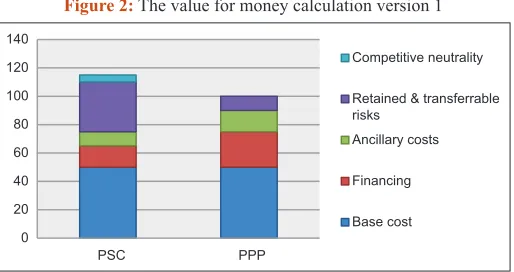
The fourth stage involves calculating the Public-Sector Comparator (PSC) which is simply the net integrated cost of TP, i.e. what the project would cost if carried out conventionally. In Mexico it is simply the SCBA for new projects with a simplified version for the tendering of existing infrastructure (Burger and Hawkesworth, 2011; DOF, 2012; DOF, 2014). While both TP and PPPs should be able to demonstrate positive NPVs in a cost-benefit analysis, PPPs supposedly reduce costs further while improving service quality, generating VfM (EPEC, 2011; Grimsey and Lewis, 2005; Ridolfi, 2003). Figure 2 illustrates a hypothetical project.
0 20 40 60 80 100 120 140
PSC PPP
Competitive neutrality
Retained & transferrable risks
Ancillary costs
Financing
Base cost
Sources: TechVirtual (2012)
The budgeted TP alternative (PSC) is compared with the PPP. According to PPP proponents, the public sector exacerbates project risks which can be better managed in a PPP. On the other hand, PPP private financing with debt and equity is more expensive than public TP because interest payments on private debt are higher, there are dividends to be paid, and there are also the ancillary costs of running the complex management structure or SPV. Some
writers consider that the basic procurement or base cost is also
lower in PPPs as they have incentives to capture savings which public operators may not aspire to (Marques and Berger, 2010). Finally, to create a level playing field, many countries factor back to TP a variety of tax concepts which public sector projects avoid, to ensure “competitive neutrality” (US Federal Highway Administration, 2013; WBI, 2013).
An equivalent approach to VfM compares the PSC with the periodic payments made to the SPV in the PPP format, as
illustrated in Figure 3 (Bain, 2010; Risso, 2014). It does however contain an important methodological drawback which is discussed below in Ex-Ante Risks.
The other side of the evaluation coin is the measurement of
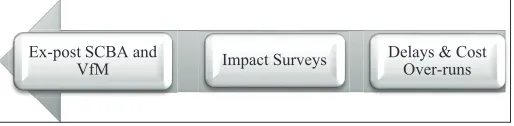
ex-post VfM which should include an analysis of delays and cost over-runs, impact surveys and a full ex-ante versus ex-post SCBA and VfM comparison, as indicated in the flow diagram in Figure 4.
Unfortunately, while the ex-ante process is a legal requirement for federally financed projects in Mexico, ex-post evaluation is not enforced or systematically implemented.
3.5. Delays and Cost Over-runs
One approach to measuring VfM ex-post is to compare TP and PPPs delays and cost overruns, measured as the difference between ex-ante and ex-post calculated time schedules and costs, known as “Earned Value” analysis in the project management literature. Internationally TP comes out significantly worse in surveys of delays and-cost over-runs, which has provided a strong justification
for the PPP model. (Allan Consulting, 2007; Duffield, 2008; Flyvbjerg et al., 2002, Mott MacDonald, 2002; Risso, 2014; WBG, 2014). However, not all Mexican PPPs score well on the “Earned Value” calculus, for example, the Durango-Mazatlan, highway was completed 60% overbudget in 2013 (ObrasWeb, 2014, SCT, 2010). The delays and cost overrun approach is incomplete because it
ignores the optimism bias behind the ex-ante under-budgeting of
TP which is at the root of ex-post delays and cost overruns. Nor can it identify overly generous contingencies and premiums for transferred risks that can bloat PPP budgets and enable them to
meet time and cost deadlines with ease.
3.6. Impact Surveys
A second approach requires a broader definition of VfM promoted by many researchers to interpret value provided for end-users both quantitatively and qualitatively. The conventional formula employed by economists which compares PSC and PPP benefits and costs (refer to Figures 2 and 3 in VfM Analysis) does not measure service quality adequately. Research from developed countries suggests that evaluation requires “narrative” to complement “numbers,” for example, in health care (Shaoul, 2005; Shaoul et al., 2012a). PPPs may work better in sectors such as transport and utilities in which services can be standardized to high levels of performance (Fischer, 2011, Gassner et al., 2009, Marin, 2009, Willoughby, 2013), while highly customized services such as health and prison services, which continue to be partially administered by public sector providers, may be less successful in the format. Success can of course mean different things to different stakeholders, for example, in education, VfM may be interpreted very differently by head teachers who look for quality in building design and functionality while local and central authorities seek financial evidence of cost savings (Demirag and Khadaroo, 2008). However, there is little consensus concerning
overall format benefits and costs, within or across different
infrastructure sectors (Eadie et al., 2013, Fischer, 2011) and very
little evidence from Mexico.
3.7. Ex-post SCBA and VfM
A third and more complete approach requires reproducing the SCBA and VfM calculations ex-post to verify ex-ante budgeting against project experience, using project accounts, reports of delays and cost overruns, and impact surveys of providers and end-users. Ex-post analysis should pick up the missing risks and costs which
become evident once projects are implemented, including service
quality issues (Bain, 2010) (refer to Missing Risks). Unfortunately, ex-post VfM analysis is unusual in Mexico, although its importance has been officially recognized in guidelines for ex-post evaluation published on the CEPEP web page by the Mexican government (DOF, 2016; Morín Maya and Alvarado-Roldan, 2017). Authorities have not relished publishing project shortcomings, unless required to by law or by a multilateral agreement as part of a bilateral funding rule. However ex-post analysis could go a long way
towards improving SCBA and VfM calculations and restoring
credibility to the format selection process.
4. MISSING RISKS
Risk takes us to the very heart of PPP justification, because the savings assigned to cost reduction through transferred risk must
Figure 3: The value for money calculation version 2
0 20 40 60 80 100 120 140
PSC PPP
Cost of service payments Risk transferable to the private sector Competitive neutrality Base costs
Risk to be retained by the public sector
Sources: Bain (2010), Edwards et al. (2004), Grimsey and Lewis (2005) and Risso (2014)
Impact Surveys Delays & Cost Over-runs Ex-post SCBA and
VfM
Figure 4: Procedures for measuring ex-post value for money
compensate for the additional financial costs (interest payments and dividends) incurred in the PPP format. Analysing risks requires methods for identifying and quantifying the impacts of all project risks and opportunities. The inevitability of unidentifiable risky events requires more flexible contracts then are usually negotiated in Mexico, while the achievement of satisfactory outcomes for
interested parties demands including a wider constellation of
stakeholders than is typically the case in the region.
4.1. Categorizing Risks
Although different installations have their peculiarities, the
assignment of risks between the public sector and the SPV are strikingly similar over different types of project in Mexico. Through negotiation between government and private sector stakeholders, risks are assigned to the public sector, the SPV or to both as joint risks, depending on who can best manage them through the project life-cycle. A typical list of Mexican project risks includes five categories. First, planning and political risks as political parties
and government departments manoeuvre for position with respect
to project and wider objectives. Second, design and building risks, including land access risks, archaeological discoveries, errors, delays and cost over-runs in design and building. Third, operation and maintenance risks, comprising differences between forecasted and actual demand, the availability and performance quality of
services provided, operation and maintenance cost overruns and
vandalism. Fourth, financial risks, principally inflation, interest rate, exchange rate, and refinancing risks. Fifth, risks involving changes in legislation and natural disasters known as “force majeure” (Merritt et al., 2016; Oliveira-Cruz and Cunha-Marques, 2013; Soberano, 2011; WBG, 2016).
In Mexican PPPs, most risks in the second and third groups are allocated to the SPV, while those in the first, fourth and fifth groups lean towards public sector allocation. The assignment of risks does not mean that the SPV is in every case exclusively liable for the risks apportioned to it. An example is where demand turns out to
be lower than projected, which reduces revenues and
wear-and-tear costs to the infrastructure in question. In Mexico, the risk is generally included in the PPP contract as a “Subordinated Risk Capital” contribution made by the public sector as a contingency
measure.
4.2. Punishing Risky Events
In Mexico, a multi-criteria system is used to measure service quality, distinguishing between disponibilidad (availability) and desempeño (performance quality). Quantitative and qualitative compliance is punishable and there are usually fines for non-availability, non-rectification and lack of performance quality. A points system is used to quantify errors or omissions and associated fines, with deductions made to the periodic payments which the public sector pays to the SPV. Usually a maximum payment deduction is fixed in percentage terms in advance to safeguard underperforming SPV financial viability, although once a pre-established threshold number of fines or points tally is reached, the PPP contract may be rescinded and the SPV removed, for future re-tendering (SEP, 2005; Soberano, 2011; Villa, 2009a; Villa 2009b).
4.3. Ignoring Risks
It appears that not all project risks are included in the ex-ante VfM calculation, and in both TP and PPP formats. The intuition here is that the missing risks are the consequence of opaque risk, opportunity and stakeholder management. Risks and costs
associated with bad management appear to be more prevalent in
TP than in PPPs especially where design, building and operation are all handled separately by authorities which may not prepare sufficiently for the financial and management dilemmas which await them. In this scenario, the costs are simply passed on to customers and taxpayers in the form of expensive and inadequate infrastructure (Marques and Berg, 2011; Oliveira-Cruz and Cunha-Marques; 2013). These may be transferable risks which can be identified and assigned to the PPP in risk analysis (refer to Risk Analysis).
However, there are other identifiable risks which are generally absent from the analysis, at least in Mexico. There are ex-ante risks which can occur before construction gets under way and ex-post risks which become evident once projects become operational. These risks and missed opportunities may be the consequence of inflexibilities in project design or omissions in biased evaluation processes dominated by supply-side stakeholders. The definition of risk used here is broader than that used to compile a typical evaluation risk matrix. Not all the risks presented here can be reduced to a probability of the risky event occurring multiplied by
the cost of that same event, a case in point being the discount rate.
4.4. Risks of Discounting
Although not considered a risk in the methodology, a measurement
dilemma for long-life projects and for VfM in particular, is the
discount rate which interestingly affects the relative profitability of the procurement formats, favouring PPPs over TP. The higher
the discount rate, the greater the advantage of a scheme where
government payments to a SPV are spread through a 20 or 30-year contract, because discounting progressively whittles away the value of those payments the further into the future they occur and the higher the discount rate. To visualize this, refer to Figure 3 and
contemplate the PPP Cost of Service Payments. The alternative TP format requires a large upfront public investment with smaller subsequent expenditures for operations and maintenance in which the discounting effect is much more limited (Edwards et al., 2004). Risso (2014) corroborates the effect in a Uruguayan study of deep-water ports worldwide, as does Bain (2010) for PPP transport projects in the UK. In practice, the difference in profitability between the PPP and TP formats may not be large and it seems
incongruous that the discount rate could be the deciding factor,
especially as there is no international consensus on the discount rate for public projects. It can be the marginal productivity of private capital (which is generally much higher), the after-tax return on private savings (which is much lower) or the marginal cost of foreign borrowing (which is somewhere in between). Many Latin American countries including Mexico, favour a weighted
average approach based on the sources of funds used, called the
2008). Mexico’s rate has declined from 18% in 1995 to 10% by 2014 (DOF, 2014), but it is still between 2 and 3 times the UK rate for infrastructure which has been progressively lowered from 8% in 1995, through 6% to just 3.5% by 2010, which means that the discounting problem explained above is more likely to be significant in Mexican projects (Bain, 2010; House of Commons Treasury Committee, 2013).
4.5. Risks of Unsolicited Proposals, Pre- and Preferred-Bidders
There may be ex-ante cost creep as well. Unsolicited proposals are encouraged in many countries and can be considered a welcome innovation by service providers who foresee a win-win opportunity for themselves, service users and government alike. The issue is how they are rewarded. Schemes include automatic access to a second stage of bidding, a developer’s fee, a bid bonus (extra points in a bidding tally) and the “Swiss challenge,” where the proponent has the option to match the winning bid (WBI, 2012; WBI, 2013).
Some countries also promote pre-bid participation with a view to improving initial project design, which can favour the pre-bidders
in the subsequent tendering process, where they can win even when
their proposals are costlier than those of their competitors - in
some countries by up to 5 or 10% points (Bankwatch, 2016; TechVirtual, 2012). Yet other countries acknowledge a “preferred bidder-status” for the winner of the tender process in which the terms of the contract are fine-tuned after tendering, such as in Europe and South Africa (though not in Mexico) (Bankwatch, 2016; Hellowell et al., 2008; WBI, 2012).
4.6. Risks of Lengthy PPP Gestation
Although never on the risk menu, a specifically PPP ex-ante cost is the time, from 3 to 6 years, required to set up a PPP, which employs specialist firms of lawyers and financers to negotiate between the relevant government department and the SPV (Hellowell et al., 2008; Willoughby, 2013). It may be worth the wait if it avoids substandard TP infrastructure, however it represents an opportunity
cost of a later start. The costs would be twofold. First, the stream
of future PPP cost savings would be delayed years and second,
current congestion which the project has been designed to solve
(for example, in a transport or water supply system), would persist
further into the future and could be considered a societal cost of
project delay.
4.7. Risks of Inflexibility
It is a paradox that infrastructure is built to last for decades in an
uncertain world based on forecast information which is “always wrong” (Neufville and Scholtes, 2011). Provided foreseeable risks and opportunities are identified, ex-ante evaluation can incorporate them by including options “on” projects (such as to delay or abandon) and “in” projects (in the form of flexible construction and engineering design). While real options are well established in the infrastructure literature, they are frequently not included
in deterministic project evaluations. The idea builds on a Monte
Carlo risk and distribution analysis of project outcomes which produces expected rather than deterministic project results. Real Options can reduce the probability of “down side” losses by cutting initial investments to compress the left (loss-making) side of the NPV probability distribution, while taking advantage of “upside
gains” or opportunities, stretching out the right (profit-making) side of the same distribution and improving expected ex-ante NPV in the process. A flexible multi-story car park design provides an example, whereby initially only a few stories are built, but
due to foundation reinforcements, there is an option to add
more floors as and when demand increases. Real options can be legal, administrative and operational, as well as financial. By incorporating options, risk management takes a more flexible approach and recognizes that risk can confer benefits as well as costs (Hinojosa 2010; Neufville et al., 2008; Oliveira-Cruz and Cunha-Marques, 2013).
However not all risks and opportunities are foreseeable, in which case they cannot be included in an ex-ante cost-benefit and VfM analysis. Faced with uncertainty private contractors and bankers attempt to negotiate “bullet-proof” PPP contracts in which relatively few risks are transferred to the private sector, eliminating the supposed advantages of the procurement format completely, as has been alleged in the UK´s PFIs (Asenova and Beck, 2010; House of Commons Treasury Committee, 2013). Alternatively, risks may be transferred but contracts become overly complex,
rigid and expensive in their attempt to be all encompassing.
According to Oliveira-Cruz and Cunha-Marques (2013. p. 149), “The effort to increase contract completeness by foreseeing all possible contingencies can incur unbearable transaction costs.” The approach may also be unworkable if the concessionaire is obliged to absorb big losses, leading to renegotiation or bankruptcy.
4.8. Risks of Missing Stakeholders
Although not considered in project risk matrices, effective project evaluation and management requires an organizational structure which liaises between government, SPV members on the supply side, and the missing stakeholders on the demand side of the equation (Oliveira-Cruz and Cunha-Marques, 2013; Partnerships for Public Procurement, 2014; PMI, 2013; PPP Cell, 2015; Partnerships Victoria, 2013). Infrastructure projects in both the TP and PPP format can create inefficient and unequitable
outcomes where stakeholder participation has been narrowly defined. For example, some whole-of-life PPPs have acquired windfall gains for SPV members through re-financing to reduce
debt obligations at the end of the construction stage, illustrating
the problem of risk calculations for infrastructure projects with distinct risks associated with different project stages (Grimsey and Lewis, 2005). UK projects refinanced after construction are legally required to distribute the refinancing gains between public (70%) and private (30%) stakeholders (House of Commons Treasury Committee, 2013). However, many developing countries that operate PPPs, including Mexico, do not possess regulation mechanisms that share refinancing gains among stakeholders.
sector services (Ranganath, 2011; Sabyasachi-Nayak, 2013). According to Rajaram et al. (2014. p. 177). “… to make this a win-win situation, an optimal partnership needs to be fostered… whether by TP or PPP.” But not all infrastructures lend themselves to community involvement on the demand side, for example, large-scale transport systems. A SPV may collect road tolls at well above an efficient price to honour an agreement to transfer the facility back to the government at the end of the concession “as new,” reducing usage below the optimum and creating congestion on other parts of the road network. A stand-alone PPP tariff can be inefficient in the context of congested local public goods,
in which a new installation can create positive externalities for
users of other parts of the network, known as “indirect effects” in the Mexican SCBA literature (DOF, 2012). For large transport projects, solutions need to be systems based.
4.9. Risks of Poor Service Quality
A thorny question and one inadequately handled in economic evaluation is service quality, which becomes evident once projects become operational and can be detected in impact surveys. However, if it can be established that different procurement formats, management systems and technology solutions result
in different customer experiences, what can be measured should
surely be valued and included in ex-ante risk analysis. Even so, converting service quality into a cost or benefit can be challenging, for which reason, it is not adequately included in risk analysis.
4.10. Risks of Conflict, Renegotiation and Rescission
Although rarely included as project risks, conflicts between private providers and government are costly, adding between 3 and 15% points to the cost of PPP installations internationally, while increasing the cost of capital between 2 and 4% points in the process (Guasch, 2014; Guasch et al., 2014). Conflicts are generally precursors for contract renegotiation.
Between 1988 and 2012, fully two thirds of PPP contracts had been renegotiated internationally once they were operational, including 39% of electricity projects, 78% of transport projects and 87% of water contracts. Renegotiations are usually the result of a SPV petition (61%) although they may be requested by governments
(26% of reported cases). They may also be opportunistic bearing in mind the asymmetries of information in the contractor’s favour (refer to Monopoly Economics). The consequence of renegotiation is generally an improvement in the financial position of the SPV at the expense of the service user and taxpayer, including tariff increases (62% of reported cases), reductions in investment obligations (62%), and, where applicable, decreases in the annual fee paid by the operator to the government (31%). Some renegotiations, however, go in the government´s favour. The mean fiscal cost of renegotiation per project for the period 1993-2010 for three Latin American countries was, in constant US Dollars (December 2009, million), Chile $47.2, Colombia $266.8 and Peru $28.9. Worldwide, many concessions underwent renegotiation relatively early, with an average of just 2.2 years between the initial
awarding of the concession and renegotiation. If most contracts
are renegotiated, the competitive quality of the tendering process is compromised, because weaker i.e. cheaper winning bids can be
reopened and sweetened ex-post, often including new unregulated
lucrative project add-ons (Fischer, 2011; Guasch, 2004; Guasch et al., 2014). Due to its prevalence, renegotiation is therefore a significant potential project cost.
Occasionally, contract renegotiation ends up in rescission. This is a messy outcome, particularly for long-term PPP arrangements and leads to large restructuring losses which are ultimately footed by the tax payer. A famous case of PPP insolvency is the Mexican toll road program of 50 highly leveraged concessions that collapsed in 1997 when the expected increase in demand failed to materialize (Ehrhardt and Irwin, 2004). Contract rescission can be considered a worst-case scenario because generally everybody loses. Between 1990 and 2012, only 3.5% of PPP projects had been cancelled internationally (Guash, 2004; Guash, 2014; Guasch et al., 2014; Harris et al., 2002).
5. RECOMMENDATIONS
To address some of the issues raised in the critical literature
concerning measurement of VfM and format decisions requires practical solutions for the missing risks analysed above, at both ends of evaluation cycle (Shaoul et al., 2012b; Siemiatycki and
Figure 5: Ex-ante solutions
Reexamine discount rate
Include unsolicited proposals, pre -bidding & preferred bidder status
Include PPP gestation
period
Include Real Options
Include end -user stakeholders
Sources: Own formulation
Include service quality
Include conflict, renegotiation & contract recission Include delays & cost over-runs,
customer surveys, ex-post SCBA & ex-post VfM
Figure 6: Ex-post solutions
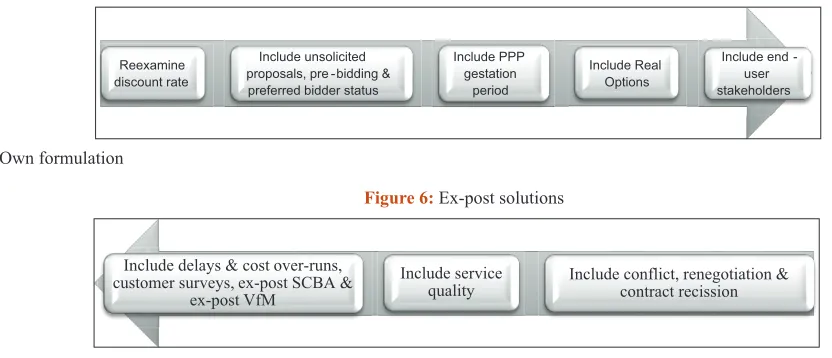
Farooqi, 2012; Tan, 2011), as portrayed in the flow diagrams of Figures 5 and 6.
A measurement issue at the beginning of the evaluation process
(refer to Figure 5) is the discount rate used to calculate project rentability, because it can be used to discount long-term service payments made by governments to service providers and enhance the attractiveness of the PPP format in the process (Bain, 2010; Edwards et al., 2004; Risso, 2014). The UK reduces the social discount rate from its usual 3.5% to 1% for the distant future, for example when evaluating environmental benefits (Doyle, 2013; Harrison, 2010; Faber and Hemmersbaugh, 1993). Decisions which favour PPPs due to the heavy discounting of future service payments should use the VfM formula presented in Figure 2
rather than the “PPP friendly” service payments version of the
formula illustrated in Figure 3 (refer to VfM Analysis). For
long-life Mexican installations which are essential capital goods, a case can be made for reducing the discount rate in line with
European practice which uses the comparatively low after-tax
savings rate rather than the much higher returns on productive or
foreign capital rate. One justification is that although infrastructure projects compete with other projects for funding, potentially displacing investments elsewhere in the economy, they enable future development which can crowd-in subsequent investment. Another justification is that a proportion of future users are yet to be born, which calls into the question the validity of discounting of their future benefits to the present. In the case of Mexico that would require changing the official methodology for fixing the discount rate, in other words, a decision for CEPEP.
Possibly less important but worthy of analysis is potential
cost creep due to ex-ante tendering processes associated with unsolicited proposals and pre-bidding which are more prevalent
in the PPP format where they are actively encouraged, if they can be shown to increase the cost of winning proposals (Bankwatch, 2016; TechVirtual, 2012). The same goes for the “preferred bidder-status” for the winner of the tender process if the terms of the contract are fine-tuned after tendering (which is not the case with Mexican PPPs (Bankwatch, 2016; Hellowell et al., 2008; TechVirtual, 2012; WBI, 2012; WBI, 2013). The ex-ante risks associated with cost creep can be included in the risk matrix with associated probabilities like any other design, construction or operation risk.
The ex-ante cost of lengthy PPP gestation and contracting of between 3 and 6 years should also be factored into the VfM equation, as it represents an opportunity cost for society especially
if it prolongs problems associated with transport congestion
or water rationing (Hellowell et al., 2008; Willoughby, 2013). In SCBA and VfM analysis time lost can be included by both postponing the project in the yearly capital budget, thereby discounting away the potential benefits of a PPP, while increasing the costs of extra years of congestion or service rationing at the beginning of the evaluation period if an alternative TP exists which
could have been implemented at an earlier date.
Successful infrastructure procurement outcomes also depend on complex contracts in an uncertain world in which projects are
unique for location specific considerations pertaining to geology, communities, legal requirements, etc. Private partners prefer
closed contracts which are problematic in uncertain environments
where risks need to be transferred. There is scope for improving risk management by requiring a Real Options approach where feasible to strengthen Monte Carlo risk analysis and introduce upside opportunity gains as well as reduce the usual downside risk losses in the evaluation procedure (Oliveira-Cruz and Cunha-Marques, 2013). The methodology is well established, although frequently not used, which is a procedural issue.
Unforeseeable uncertainty on the other hand creates contract incompleteness because it cannot be fully accounted for ex-ante, which means that either fewer risks are transferred to the private partners of a PPP (Asenova and Beck, 2010) or that contract
renegotiation becomes inevitable once a risky event occurs (Marques and Berg, 2013; Oliveira-Cruz and Cunha-Marques; 2013; Zhang and Xiong, 2015). This requires increasing contract flexibility, the specifics of which lie outside the remit of this article.
A narrow stakeholder focus can create windfall gains for service providers and financiers, (El-Gohary et al., 2006; Grimsey and Lewis, 2005). The experts who are invited to participate in eligibility, risk and multi-criteria workshops in Mexico
and elsewhere are technical and financial specialists from
supply-side government departments, banks or consultancies with inherent preferences (Burke and Demirag, 2017; Heald, 2003). The instruments which price risk are usually confidential and not publicly disclosed, which makes it challenging to widen stakeholder participation (Burke and Demirag, 2017). The “… apparent exactness of a quantitative VfM result can belie the subjectivity of the process…” (WBI, 2013. p. 20), creating “spurious precision” (Hellowell et al., 2008, p. 18). Practitioners and academics have also pointed out that because VfM analysis is undertaken later in the methodological sequence after cost-benefit, eligibility and risk analysis, there is a danger that the VfM calculation may be compromised to produce “the right result” i.e. rationalize an earlier decision in favour of the PPP format, which makes a mockery of the evaluation process (Shaoul et al., 2012b; WBI, 2013). Stakeholder bias in decision-making can be
reduced via a legal obligation to include service-user or social
sector representation in project evaluation and decision-making
processes.
Asian PPCP for the provision of water in rural areas provides an interesting example of widening stakeholder participation in initial project evaluation (Rajaram et al., 2014). In rural Mexico, for example, the operation of irrigation systems in communities of small landholders called pequeña propiedad and cooperative farms known as ejidos is strongly regulated by the Comisión Nacional del Agua. In the Mexico context, a more equitable PPCP type model would require a change of mind-set and new legislation (Rodriguez-Haros, 2012).
included in the procurement contract and overseen by a public authority like CEPEP in Mexico which should act in the wider public interest to optimize network efficiency rather than prioritize the financial recovery of a specific infrastructure investment (Sadka, 2006).
A measurement issue once projects are operational (refer to
Figure 6) and in both formats, but particularly PPPs, is the sequence of risks which commences as contract conflict, detonates
a renegotiation process and in the worst-case scenario leads to
contract rescission. This potentially disruptive chain of events is generally not identified in ex-ante evaluations in Mexico. By far the most important risk is renegotiation, because it occurs in two thirds of international PPPs and can significantly increase
costs, while rescission, which is more unusual, can be devastating
for all stakeholders as it is often accompanied by bankruptcies and shutdowns (Fischer, 2011; Guasch, 2014). This sequence of ex-post risks should be included in the risk matrix, with corresponding probabilities as occurs with other risks typically
included in design, construction and operation categories.
Another “risk” which becomes apparent when projects become operational is service quality. If it can be measured, it should be valued and included in the rentability criteria,
rather than included in an intangibles section of the evaluation
report (CEPEP, 2004; DOF, 2012). Low service quality could
be proxied as an additional cost or as a reduction in an expected
benefit. For example, the unavailability of drinking water could reduce the benefit provided to end-users which is measured as the area below their individual demand curves; an inferior road service could reduce drivers’ savings in time, fuel and vehicle ware-and-tear; while a substandard port operation could reduce freight carriers’ savings in quayside costs. In other words, poor service quality could be considered a risky event like any other, multiplied by a corresponding probability and included in the risk matrix. However, service quality translates imperfectly into monetary equivalence.
Ex-post evaluation is unusual in Mexico and Latin America in general (Hinojosa, 2015), because there is little legal or administrative incentive to do it. That is a pity, because ex-post analysis could uncover the missing risky events of conflict,
renegotiation and contract rescission which occur when the
installation is already operational. It could also pick up service quality issues which are identified and quantified as risky events via surveys, as well comparing forecasted ex-ante costs and benefits with those recorded during execution and operation. As with projects supported by multilateral funding from organizations like the World Bank, there needs to be legally enabled access to project accounting data for research purposes. The public authority which overseas project evaluation should legally require an ex-post
evaluation of infrastructure projects to calculate the costs of project
delays and cost overruns, implement impact surveys and revisit
the initial SCBA and VfM calculations to correct estimation errors in line with experience. In the case of Mexico, recent legislation
refers to both ex-post evaluation and PPPs, which is a move in the right direction and if implemented should provide the feedback necessary to improve the evaluation process (DOF, 2016).
6. CONCLUSIONS
There is evidence that developed country governments are reviewing infrastructure procurement in view of the high profits earned by PPP service providers relative to the limited risks transferred. In Texas in 2009, the state legislature approved a 2-year moratorium on PPPs in the transport sector because they had become politically “radioactive” (Poole, 2009; Siemiatycki, 2013). In the UK, the government recalled its Treasury’s detailed guidance for quantitative PSC assessment in 2013, replacing it with a mixed qualitative and quantitative assessment (WBG, 2014).
It would be logical to presume that SCBA and VfM will continue to be used for infrastructure evaluation into the foreseeable future due
to the large sums of money invested, the significant risks involved and the legal requirements concerning public accountability and financial feasibility. However, there are two good reasons why that may not be the case. First, where projects are funded privately and even more where those projects are profitable as a result of
end-user tariffs, financiers and even government departments may evade SCBA and VfM analysis in the absence of public and media pressure. Second, the SCBA and VfM methodology used for evaluating and selecting the procurement format is under attack, the consequence of omissions, inaccuracies and opaqueness in the evaluation process. For SCBA and VfM analysis to survive long-term, both the methodology and transparency issues exposed in the literature and documented here require remedying.
This article revises methodological shortcomings in the form of a
sequence of missing risks which are exacerbated both by a narrow stakeholder focus and evaluation inflexibilities. It suggests a number
of practical improvements for strengthening the VfM calculation
and related decision-making process. Recommendations cover risks
regarding high discount rates, cost creep in the tendering process,
lengthy PPP gestation, inflexible evaluation and narrow stakeholder
participation in ex-ante evaluation, and omissions concerning the
measurement of service quality and contract conflict, renegotiation and rescission in ex-post analysis.
REFERENCES
Allan Consulting. (2007), Performance of PPPs and Traditional Procurement in Australia. Australia: University of Melbourne. Asenova, D., Beck, M. (2010), Crucial silences: When accountability
met PFI and finance capital. Critical Perspectives on Accounting,
21, 1-13.
Bain, R. (2010), Public sector comparators for UK PFI roads: Inside the black box. Transportation, 37, 447-471.
Bankwatch. (2016), Background on PPPs. Available from: http://www. bankwatch.org/public-private-partnerships/background-on-ppps. Bauhaus-Universität Weimar. (2009), Public-private Partnership in
Infrastructure Development: Case Studies from Asia and Europe.
Germany: Bauhaus-Universität Weimar.
Baumol, W., Panzar, J., Willig, D. (1982), Contestable Markets and the Theory of Industry Structure. San Diego: Harcourt Brace Jovanovich. Benitez, D. (2013), Recent Developments in VfM Analysis in Latin
America. Washington DC: World Bank.
Document, Department for Transport.
Burger, P., Hawkesworth, I. (2011), How to attain value for money: Comparing PPP and traditional infrastructure public procurement.
OECD Journal on Budgeting, 1, 1-55.
Burke, R., Demirag, I. (2017), Risk transfer and stakeholder relationships in public private partnerships. Accounting Forum, 41(1), 28-43. Centro de Estudios Para la Preparacion y Evaluacion Socioeconomica
de Proyectos (CEPEP). (2004), Apuntes Sobre Evaluacion Social de Proyectos. México: CEPEP, Banobras.
Curry, S., Weiss, J. (2000), Project Analysis in Developing Countries.
2nd ed. London: Palgrave MacMillan.
Demirag, I., Khadaroo, I. (2008), Accountability and value for money in private finance initiative contracts. Financial Accountability and Management, 24(4), 455-478.
Diario Oficial de la Federacion (DOF). (2012), Lineamientos Para la Elaboracion y Presentacion de Los Analisis Costo y Beneficio de Los Programas y Proyectos de Inversion, 27-04-2012.
Diario Oficial de la Federacion (DOF). (2014), Ley De Asociaciones Publico Privadas, 16-01-2012, Reformada 11-08-2014.
Diario Oficial de la Federación (DOF). (2016), Lineamientos Para la Elaboracion y Presentacion del Informe de Ejecución y Evaluacion Ex-post de Los Programas y Proyectos de Inversion, Proyectos de Infraestructura Productiva de Largo Plazo y Proyectos de Asociaciones Publico-privadas de la Administracion Publica Federal, 29-04-2016.
Dinwiddy, C., Teal, F. (1996), Principals of Cost-benefit Analysis for Developing Countries. Cambridge: Oxford University Press. Doyle, J. (2013), Survey of time preference, delay discounting models.
Judgment and Decision Making, 8(2), 116-135.
Duffield, C. (2008), National PPP Forum Benchmarking Study, Phase II. University of Melbourne. Available from: http://www.
infrastructureaustralia.gov.au/publicprivate partnership related reports.aspx.
Eadie, R., Millar, P., Grant, R. (2013), PFI/PPP, private sector perspectives of UK transport and healthcare. Built Environment Project and Asset Management, 3(1), 89-104.
Economic Intelligence Unit (EIU). (2013), Evaluando el Entorno Para Las Asociaciones Publico Privadas en America Latina y el Caribe: Infrascope 2012. New York: Economic Intelligence Unit (EIU). Economic Intelligence Unit (EIU). (2015), Evaluando el Entorno Para
Las Asociaciones Publico-Privadas en America Latina y el Caribe: Infrascope 2014. New York: Economic Intelligence Unit (EIU). Edwards, P., Shaoul, J., Stafford, A., Arblaster, L. (2004), Evaluating the
Operation of PFI in Roads and Hospitals, Association of Chartered
Certified Accountants, Research Report 84.
Ehrhardt, D., Irwin, T. (2004), Avoiding Customer and Taxpayer Bailouts in Private Infrastructure Projects: Policy towards Leverage, Risk Allocation, and Bankruptcy, Working Paper 3274. Washington, D.C: World Bank.
El-Gohary, N., Osman, H., Diraby, T. (2006), Stakeholder management for public private partnerships. International Journal of Project Management, 24(7), 595-604.
Espelt, F. (2015), Lessons Learned and Best Practices in Public-Private Partnerships, Inter-American Development Bank (IDB), FOMIN. Report.
European PPP Expertise Centre-EPEC. (2011), The Non-financial Benefits of PPPs, a Review of Concepts and Methodology. Luxembourg: European PPP Expertise Centre-EPEC.
Farber, D., Hemmersbaugh, P. (1993), The shadow of the future: Discount rates, later generations, and the environment. Vanderbilt Law Review, 46, 267-304.
Fischer, R. (2011), The Promise and Peril of Public-Private Partnerships: Lessons from the Chilean Experience. Working Paper 1/0483.
International Growth Centre, London School of Economics. Flyvbjerg, B., Holme, M., Buhl, S. (2002), Underestimating costs in
public works projects. Error or lie? Journal of the American Planning Association, 68(3), 279-295.
Fontaine, E. (2008), Evaluacion Social de Proyectos. México: Pearson. Freeman, E. (1984), Strategic Management: A Stakeholder Approach.
Boston: Pitman.
Gassner, K., Popov, A., Pushak, N. (2009), Does Private Sector Participation Improve Performance in Electricity and Water Distribution? Washington, D.C: World Bank.
Gobierno del Estado de Guanajuato. (2010), Ley de Concesiones de Servicios e Infraestructura, Periodico Oficial del Gobierno del Estado, Numero 93, Segunda Parte, de Fecha 11 de junio de 2010. Graham, D. (2010), Value for Money in PPP Procurement. Australia:
New South Wales Treasury.
Grimsey, D., Lewis, M. (2005), Are public private partnerships value for money? Evaluating alternative approaches and comparing academic and practitioner views. Accounting Forum, 29, 345-378.
Grossman, S., Hart, O. (1986), The costs and benefits of ownership: A theory of vertical and lateral integration. Journal of Political Economy, 94, 691-719.
Guasch, J. (2004), Granting and Renegotiating Infrastructure Concessions. Doing it Right.Washington, DC: World Bank Institute.
Guasch, J. (2014), Renegotiacion de Contratos APP, Alzheimer, Cancer o una Gripe? Available from: http://www.piappem.org/file.php?id=359. Guasch, J., Benitez, D., Portabalez, I., Lincoln, F. (2014),The
Renegotiation of PPP Contracts: An Overview of its Recent Evolution in Latin America,International Transport Forum,OECD,Discussion
Paper No. 2014-2018.
Harris, C., Hodges, J., Schur, M., Shukla, P. (2002), Infrastructure Projects: A Review of Cancelled Private Projects. Washington, DC: World Bank.
Harrison, M. (2010), Valuing the Future. The Social Discount Rate in Cost Benefit Analysis, Australian Government Productivity Commission. Visiting Researcher Paper.
Hart, O., Moore, J. (1999), Foundations of incomplete contracts. The Review of Economic Studies, 66(1), 115-138.
Heald, D. (2003), Value for money tests and accounting treatment in PFI schemes. Accounting Auditing and Accountability Journal, 16(3), 342-371.
Hellowell, M., Price, D., Pollock, A. (2008), The Use of Private Finance Initiative (PFI). Public Private Partnerships (PPPs) in Northern Ireland. Belfast: Northern Ireland Public Service Alliance (NIPSA). Hellowell, M., Vechi, V. (2012), An evaluation of the projected returns
to investors on 10 PFI projects commissioned by the national health service. Financial Accountability and Management, 28(1), 77-100. Henjewele, C., Sun, M., Fewings, P. (2014), Comparative performance
of healthcare and transport PFI projects: Empirical study on the influence of key factors. International Journal of Project Management, 32, 77-87.
Hinojosa, S. (2010), Opciones Reales en Inversiones Publicas: Un eslabon que falta. Chile: Ikons ATN. p1-83.
Hinojosa, S.A. (2010), Un Indicador de Elegibilidad para Seleccionar Proyectos de Asociaciones Publico-Privadas en Infraestructura y Servicios en Etapas Tempranas. Mexico: PIAPPEM, IDB.
Hinojosa, S.A. (2013), Hacia un Analisis Costo Beneficio Integral y Secuencial para Esquemas de Asociaciones Publico-Privadas en America Latina. Mexico: PIAPPEM, IDB.
Hinojosa, S.A. (2015), Chief Advisor on PPPs. PIAPPEM, IDB, Interview. Hodge, G., Greve, C. (2018), Contemporary public private partnerships:
Towards a global research agenda. Financial Accounting and
Management, 34(1), 3-16.