This is a repository copy of
A polymer based sensor for phosphate detection in water
.
White Rose Research Online URL for this paper:
http://eprints.whiterose.ac.uk/99175/
Version: Accepted Version
Proceedings Paper:
Hassani, F.A., Morley, N.A. and Romero-Gonzalez, M. (2015) A polymer based sensor for
phosphate detection in water. In: Proceedings of 2015 IEEE SENSORS. 2015 IEEE
SENSORS, 1-4 November 2015, Busan, South Korea. Institute of Electrical and
Electronics Engineers . ISBN 9781479982028
https://doi.org/10.1109/ICSENS.2015.7370510
[email protected] https://eprints.whiterose.ac.uk/
Reuse
Unless indicated otherwise, fulltext items are protected by copyright with all rights reserved. The copyright exception in section 29 of the Copyright, Designs and Patents Act 1988 allows the making of a single copy solely for the purpose of non-commercial research or private study within the limits of fair dealing. The publisher or other rights-holder may allow further reproduction and re-use of this version - refer to the White Rose Research Online record for this item. Where records identify the publisher as the copyright holder, users can verify any specific terms of use on the publisher’s website.
Takedown
If you consider content in White Rose Research Online to be in breach of UK law, please notify us by
A polymer based sensor for phosphate detection in
water
Faezeh Arab Hassani
1, Nicola A Morley
2, Maria Romero-González
31,3
Dept. Civil and Structural Engineering, The University of Sheffield, Sheffield, United Kingdom
2Dept. Materials Science and Engineering, The University of Sheffield, Sheffield, United Kingdom 1[email protected], 2[email protected], 3[email protected]
Abstract— This paper presents the detection of phosphate
(PO4 -3
) concentration in water by using a commercial quartz crystal microbalance (QCM) sensor that was coated with a novel polymeric affinity layer for the first time. The QCM sensor was exposed to PO4-3 and chloride (Cl-) solutions in various concentrations to investigate the sensitivity of the affinity layer. Changes in the viscosity of a solution, and weak binding of ions onto the polymeric layer eliminated the effect of PO4
-3
binding to the polymer and hardened the concentration detection. Therefore, we have proposed a new method in which an intermediate Cl- solution is applied before introducing the PO4-3 solution to detect the concentration level in a continuous flow.
Keywords—Quartz crystal microbalance sensor; polymeric affinity layer, phosphate detection, viscosity, mass binding
I. INTRODUCTION
Phosphorus is an essential nutrient for plants and animals that is available in rock and soil minerals, as well as fertilizers, sewage and detergents [1]. The release of phosphorus in rivers’ water and lakes due to weathering or waste pollution will results in the over enrichment of phosphate ions (PO4-3).
This increase can cause massive growth of plankton and aquatic plants which leads to an eutrophication process [2].
Wastewater discharge from sewage treatment plants contributes the largest proportion of the phosphorus in rivers [3]. For this reason, the presence of PO4-3 in river water with
concentrations greater than 0.1 mg/L is not permitted by the European Water Framework Directive, and needs to be carefully monitored [4]. The currently available instruments for collecting water quality data from fields such as automatic samplers, portable and fixed site water quality monitors are cumbersome and not accurate [5].
Cantilever-based and quartz crystal microbalance (QCM) sensors are the two mass-sensing options [6] for phosphate detection, however, the damping of the output signal of cantilever-based sensors in liquid made them unsuitable for commercial use even with their high sensitivity [6, 7]. QCM sensors are the best option for phosphate detection in water, and they are capable of rapid, sensitive, and cost effective detection of various types of biological and chemical molecules in liquid [8, 9]. A QCM sensor consists of a thin disk of quartz with parallel circular electrodes patterned on both sides. The front side is in contact with the analyte of interest and the
backside is exposed to air [10]. The QCM sensor operates by applying a potential across the electrodes and generating a shear force. The quartz crystal resonates as electromechanical standing waves are created [10]. The QCM sensor measures a mass per unit area by measuring the change in resonance frequency, f0. The mass responsivity of the QCM sensor is
calculated as following based on the Sauerbrey equation [11]:
= ( )
.
(1)
where m is the adsorbed mass, f is changes in frequency, Apiezo is the active sensing area, and and are shear
modulus and density of quartz, respectively.
The above equation is correct for the added solid layers onto the QCM sensor, but in the case of adding a soft layer such as polymer and performing a measurement in liquid, the changes in the energy dissipation of the oscillating system will violate the linear relation between f and m. In this case, the following equation should be considered to include the liquid viscosity, ηl, and liquid density, ρl [11]:
= . (2)
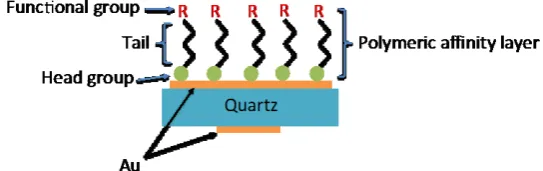
The schematic of the QCM sensor and the added polymeric affinity layer is shown in Fig. 1.
II. METHODOLOGY
We aim to provide detection of PO4-3 concentration in water
[image:2.595.296.568.606.691.2]by using a polymeric affinity layer spin coated onto a QCM sensor. The commercial gold coated 5 MHz crystals (Q-Sense sensors, Biolin Scientific) [12] have been used in our experiments.
Fig. 1. The schematic of the added polymeric affinity layer on top of a QCM sensor.
At the start of the experiment, the polymer coated QCM sensor is exposed to ultra high quality (UHQ) water to measure the baseline. This is followed by an injection of a PO4-3
solution, and this process is repeated for a number of cycles. Other solutions including diluted hydrochloric acid (HCl, 0.1M), Sodium Chloride (NaCl, 0.1M), and Calcium Chloride (CaCl2, 0.05M)) have also been applied to investigate the
polymer response to changes in solution ionic strength.
The polymeric layer has been spin coated onto the QCM sensors at 3000 rpm for 20 sec. Prior to the coating step, the crystals were cleaned by sonication using acetone and isopropyl alcohol followed by rinsing in ultra high quality (UHQ) water, and nitrogen drying.
III. RESULTS AND DISCUSSION
The measurement setup (Fig. 2) consists of a flow cell constantly fed using solutions of PO4-3 or HCl in water at
different concentrations with the help of a peristaltic pump. Two flow rates of 1.9 and 3.9 mL/min have been used during the experiments. A QCM instrument (eQCM 10M, Gamry Instruments) [13] was used for reading the frequency changes versus time.
A. Phosphate-water cyclic experiment
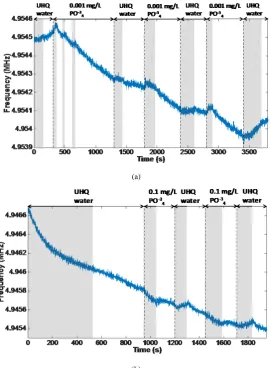
Fig. 3 shows the change in frequency of the sensor in response to the cyclic feeding of UHQ followed by a PO4-3
solution at concentrations of 0.001 and 0.1 mg/L over time. The grey areas in the figures represent the period that the pump was left ON with the flow rate of 1.9 mL/min. Changes in the room temperature and hydration of the polymer layer in solution causes a decreasing slope throughout the experiment for both phosphate concentrations. By the introduction of phosphate solution, the Cl- functional groups will be replaced by PO4-3 with larger molar mass via an ion exchange process.
The introduction of a 0.001 mg/L PO4-3 solution after a UHQ
water cycle results in negative changes in the resonance frequency due to the binding of PO4-3 to the polymer surface.
No slope changes were observed when the cycle was performed using a 0.1 mg/L PO4-3 solution.
B. Introducing a new method for phosphate detection in a continous flow
To confirm the effect of the PO4-3 molecules interaction on
the frequency increase solely, we introduced different chloride solutions (i.e. HCl, NaCl, and CaCl2) keeping the molarity of
Cl- ions constant. No slope changes were expected by applying Cl- solutions as the polymer surface is terminated by chloride ions.
[image:3.595.296.567.38.407.2]
Fig. 2. The measurement setup.
(a)
(b)
Fig. 3. Cyclic UHQ-PO4-3 solution experiment of the polymer coated QCM sensor for: (a) 0.001 mg/L, and (b) 0.1 mg/L phosphate concentrations.
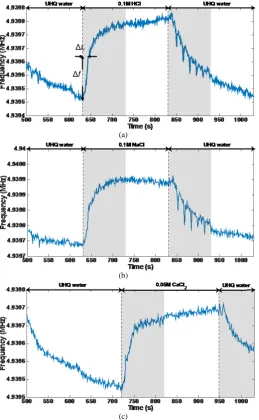
Fig. 4 shows the response of the coated QCM sensor to Cl -solutions in cyclic UHQ-Cl- solution experiments. The pump was left ON with the flow rate of 1.9 mL/min during the grey intervals in Fig. 4. The positive resonance frequency change of
≈150 Hz has been seen for all the Cl- solutions. This change is owing to molecular interactions in the solid-liquid interface of the sensor that result in reduction of the viscosity of the liquid due to shear thinning in the interface [14], and weak binding of positive ions to the surface of the sensor [15, 16]. Table I presents the frequency change over time ( f/ tr) for all Cl
-
solutions in Fig. 4. As f/ tr shows the maximum slope after
adding Cl- solution, tr presents the time interval between the
time of applying Cl- solution and the time that the slope starts to reduce. Similarly, f is the frequency changes between these two points. Table I shows similar level of sensitivity for all Cl- solutions.
A cyclic experiment performed using an uncoated QCM sensor exposed to HCl solution (Fig. 5), it showed that the positive frequency change observed in the presence of the polymer is reduced to ≈40 Hz with no polymer. This is because of the viscosity changes at the interface, as no binding should happen on the sensor surface when there is no polymer coating.
A similar frequency change for the HCl solution in Fig. 5 happened for the 0.1 mg/L PO4-3 solution in Fig. 3. This
Solution QCM
Instrument Computer
Pump
Flow cell Waste
[image:3.595.52.271.595.703.2]frequency change in different direction has cancelled out the effect of PO4-3 binding to the polymer layer. Therefore,
applying intermediate Cl- solutions to the polymer surface before introducing PO4-3 solution will improve the detection of
changes in frequency.
Fig. 6 shows the response of QCM sensor to a full cyclic experiment using UHQ-HCl-PO4-3 solution fed in that
particular order. The pump was left ON with the flow rate of about 3.9 mL/min during the experiment. Injecting the 0.01 mg/L PO4-3 solution results in the sensitivity of f/ tr=45. The
sensitivity has been calculated as explained for Fig. 4. The required time for the polymer to be saturated by the phosphate ions, ts, has been calculated from Fig. 6 to be about 627 s. The
sensor response in Fig. 6 demonstrates that conditioning using HCl solution previous to introducing the PO4-3 solution is
essential to detect mass binding to the polymer coated QCM sensor.
(a)
(b)
(c)
Fig. 4. The response of polymer coated QCM sensor to various chloride solutions: (a) 0.1M HCl, (b) 0.1M NaCl, and (c) 0.05M CaCl2
TABLE I. THE SENSITIVITY OF THE POLYMER LAYER TO VARIOUS CHLORIDE SOLUTIONS
Solution f/ tr
0.1M HCl 13.45
0.1M NaCl 9.81
[image:4.595.39.299.264.685.2]0.05M CaCl2 10.63
Fig. 5. Cyclic UHQ-HClexperiment of the uncoated QCM sensor.
[image:4.595.308.554.333.478.2](a)
Fig. 6. The response of polymer coated QCM sensor to UHQ-HCl-PO4-3 solution experiment for 0.01 mg/L phosphate concentrations.
CONCLUSION
This paper presents a new cyclic experiment technique to characterize the sensitivity of the QCM sensor to different concentrations of phosphate in water by using a novel polymeric affinity layer spun coated onto the sensor. The introduction of intermediate Cl- solutions to the polymer surface before introducing PO4
-3
solution will ease the detection of changes in frequency in the presence of a continuous flow. This technique will be applied to our future designed QCM-based sensor for sensing various pollutants in river water. Increasing the sensitivity of the polymer layer to the pollutants while keeping the saturation time as long as possible is considered in our future work.
ACKNOWLEDGMENT
Authors would like to express thanks to Tom Turton for preparing the polymer layer.
tr
f
REFERENCES
[1] D. Cordell, J. -O. Drangert, and S. White, “The story of phosphorus: Global food security and food for thought”, Global Environmental Change, vol. 19, pp. 292-305, 2009.
[2] S. Carpenter, N. F. Caraco, D. L. Correll, R. W. Howarth, A. N. Sharpley, and V. H. Smith, “Nonpoint pollution of surface waters with phosphorus and nitrogen”, Issues in Ecology, nr. 3, 1998.
[3] Phosphate resources, Houses of parliament, nr. 477, August 2014. www.parliament.uk/briefing-papers/POST-PN-477.pdf.
[4] Observatory Monitoring Framework in UK - Indicator Data Sheet, 2009.https://statistics.defra.gov.uk.
[5] R. J. Wagner, H. C. Mattraw, G. F. Ritz, and B. A. Smith, “Guidelines and standard procedures for continuous water-quality monitors: Site selection, field operation, calibration, record computation, and reporting”, Water-Resources Investigations Report, 2000.
[6] Y. Lu, S. Peng, D. Luo, and A. Lal, “Low-concentration mechanical biosensor based on a photonic crystal nanowire array,” Nature Communications, pp. 1-6, 2011.
[7] F. A. Hassani, Y. Tsuchiya, and H. Mizuta, “In-plane resonant nano-electro-mechanical sensors: A comprehensive study on design, fabrication and characterization challenges,” Sensors, vol. 13, no. 7, pp. 9364-9387, 2013.
[8] K.A. Marx, “Quartz crystal microbalance: A useful tool for studying thin polymer films and complex biomolecular systems at the solution-surface interface”, Biomacromolecules, vol. 4, nr. 5, pp. 1099-1120, 2003. [9] S. K. Vashist and P. Vashist, “Recent advances in quartz crystal
microbalance-based sensors”, J. Sensors, pp. 1-13, 2011.
[10] N. Gufflet. Quartz crystal resonators- Brief Overview. KVG Quartz Crystal Technology GmbH, 2011.
[11] E. Pérez-Lorenzo, A. Zuzuarregui, S. Arana, and M. Mujika, “Development of a biological protocol for endotoxin detection using quartz crystal microbalance (QCM)”, Appl. Biochem. Biotecnol., vol. 174, nr. 7, pp. 2492-2503, 2014.
[12] http://www.biolinscientific.com/q-sense/ [13] https://www.gamry.com/
[14] M. Zourob, S. Elwary, and A. P. F. Turner, “Principles of Bacterial Detection: Biosensors, Recognition Receptors and Microsystems”, Springer-Verlag New York, 2008.
[15] J. Sorial, “A piezoelectric interfacial phenomena biosensor”, MSc thesis, Drexel University, 2000.