Calculation of Reactive Power Cost to Support
Producers in Restructured Systems using Optimal
Power Flow Method
Farid Kamel
Department of Electrical Engineering, South Tehran Branch, Islamic Azad
University, Tehran, Iran
Payam Rokni
Sama Technical and Vocational Training College, Qaemshahr Branch, Islamic Azad
University, Qaemshahr, Iran
Seyed Hossein Hosseinian
Department of Electrical Engineering,South Tehran Branch, Islamic Azad University, Tehran, Iran
Abstract – The part of power new rule is performing in different countries of the world. The new rule emphasize on the role of competitive markets in order to prepare and support lateral services. Among these lateral services, we can refer to producing reactive power and controlling the voltage of transfer network so that is ensures the system reliability. The objective of this article has two sections: reactive power producing services and voltage control which nowadays are divided into two sections: the first section is the voltage profile management and the second section is voltage adjusting. Similarly, margin cost is recommended so that the overall rule of producers' performance and supporting the consumers will be unfolded. In this paper, we deal with the calculation of reactive power cost in restructured environment through OPF method.
Keywords – Producers, Reactive Power, Voltage Control, OPF.
I.
I
NTRODUCTIONRestructuring in an industry means the variation and change in old rules and making that structure in another from. Nowadays, this word conveys the change in industry from traditional and exclusive state into non-traditional and competitive state.
In restructured facilities (vertical complex), its rules are based on link concluding in all grounds of production, transfer and distribution. System independent exploiter is responsible for concluding contract between producers and consumers determines the amount of producers' income from contract and the amount of payment by consumers. Only final consumers usually undergo a fine that is related to the rate of consuming active-reactive power [1,2].
Whenever the industry power production is based on competitive markets, the rules of lateral services of around these markets seem reasonable. In this state, the importance of lateral services is determined for reliability and service quality, its complexity and their special technical characteristic. This article discusses the production competitive markets that are based on pool, in the presence of competitive environment; motivation creation is prepared between participation [3].
In the second section of this article, two main voltage services, one related to voltage profile management and reactive power transmission and the other related to voltage control and dynamics of security aspect have been discussed. In the third section the possible organization of two difference reactive markets has been recommended: i) the market of reactive power that is based on setting the
capacity of reactive payment. Then in the fourth and fifth sections, the concept and computation of instantaneous price and or support have been prepared. Finally, in the sixth section, markets have been suggested that are based on the previous recommended organization, applied reward and the support of producers for producing reactive power services and voltage control.
II.
R
EACTIVEP
OWERS
UPPORTS
ERVICES ANDV
OLTAGEC
ONTROLReactive power management and voltage control services can be divided in to two main kinds in transfer network:
A. Voltage
profile management
and reactive power
transmission.
This service has been generated to optimize reactive power loss cost system to maintain system transient security in obstacles and probable conditions (for example, through keeping voltage profile and reactive power reservation without margin). This service is based on market hourly and is prepared by generators, capacitors and distribution load management.
The role of system independent exploiter is to do reactive power exchanges through computing the elements of controlling reactive power which depended on elements such as production, transfer and distribution that these exchanges must be done obviously and in discriminatorily. To this end, the economical power flow has been used. These kinds of services have many similarities with active power economical exchange in hourly pool market.
B. Voltage
control
As you know, voltage adjustment is a service that prepares the network voltage maintenance is time dynamic framework. Generators, SVCs and adjustable equipments can obtain it quickly. This kind of service similarly can be posted to reserve reactive power and frequency control services (adjusting primary and lateral AGC frequency)
III.
O
RGANIZINGR
EACTIVEP
RODUCTIONM
ARKETS ANDV
OLTAGES
ERVICEa) Characteristics of geographical region of reactive power against system are wider than active power market. b) Similarly investment of new equipments required to generate reactive power is less than active power. Less investment simplifies the competition reactive power, since more elements can participate in market (for example, investment is SVCs). On the other hand, the regional characteristic of reactive power flows in some mordents can cause only one generator to produce the reactive.
One way to avoid the occurrence is through prolonging the duration of recommendations in reactive power market. In this way, producers can't be propounded in both cases. Their reactive energy has more cost than the average production of alternative reactive power. Indeed, the size of market grows because it has been extended with transitory and temporary. Endeavor to compensate losing the competition is one of the elements through expansion.
The economical theory shows that, under the general fair circumstance, the optimized level of reward and supports are provided when the reactive power cost, injective or absorptive (service level size) is equal with its instantaneous price. The instantaneous price in bus I , is the cost of end incremental production of reactive power request is bus I, that can be divided into two parts, in one section related to system loss cost (includes generator loss) and in other section related to increase security. The more completed discussion is presented in section 4.
The component of instantaneous price of reactive power is related to loss that has relation with time even changes and its amount usually is less than a dollar in each MVar hour. On other hand, the components of reactive instantaneous price depend on security system that its size is very small, but security system is threatening, when it reaches much high amounts.
This different behavior of creating two different market of reactive power necessitates: a reactive energy market in relation with minimizing loss price and a reactive capacity market in relation with voltage security aspects.
A. Reactive energy market
Reactive energy market which is based on long-term mutual contracts with generator and other control elements that are prepared by system exploiter. The suggestion from includes margin change of reactive power (production and absorption) and loss curve, that says the loss of internal equipments and productive or absorptive reactive power of control element.
These loss curves will value in margin cost hourly of reactive power market. System exploiter must send a system consist of reactive power productive loss curves in addition to minimized cost. Both production and demand of reactive power must be supported by the multiplication of amount of reactive power by the responsibility of minimized instantaneous price of loss.
Distribution companies or large consumers of will be adjusted demand of their reactive power production current reactive power.
Figure 1, shows the information of exchange between elements that by them the reactive energy market will be
closed. Producers or other control elements send the productive or absorptive margin reactive power and their own internal loss curves to the system exploiter and distribution companies and consumers send their approximate reactive power to system exploiter. System exploiter does the optimum exchange of reactive power that computes all resources of reactive power and available legal equipments. By solving this optimization problem, instantaneous price of reactive loss is prepared is each system bus i. system exploiter not only sends the amount of reference voltage of generator and control elements which must be controlled, but also the instantaneous price of reactive power that wants to be used in improving control elements and support of applicants [4].
B. Reactive power capacity market
The market of reactive capacity is based on capacity market with long-term suggestion that is prepared by generators. SVCs and system exploiter in order to assure system voltage security. For suggestion to be selected, a long-term obligation exists to adjust voltage in their linkage buses. For this service, the control element will receive a payment capacity. By avoiding the undesirable effects of increasing the volatile of instantaneous price of reactive power security, this service adjusting will be rewarded by a payment capacity.
The whole supportive equipments must be expected proportional equipments on non-productive energy and the amount of capacity of reactive power produced by system exploiter and the control type are calculated.(temporal constant, AVR response, integral in control loop of secondary voltage, etc). Figure 1, shows the scheme of reactive power market. In the fifth section, a theoretical discussion is presented that the amount of payment capacity is composed.
Fig.1. Scheme of reactive power market
IV.
O
PTIMIZATIONC
ONDITION ANDC
ALCULATION OFI
NSTANTANEOUSP
RICEincrease in load benefit must be equal the increase in cost of other parts of the system. This incremental cost is known as instantaneous cost of reactive power. The instantaneous cost of reactive power in node i, is marked with i. The incremental cost can be divided into two
kinds: the ones that are related to system loss and the ones that are related to voltage. During an achievement, similarly, the instantaneous price of reactive power can be analyzed into two components: loss component ii and
security component gi. OPF algorithms can solve the
problem of optimized exchange of reactive power and prepare the strict point of optimization to control variable and reactive instantaneous price in each bus of system. Finally, it must assume that OPF of system operational minimized cost, optimizes the cost of system loss (includes generator loss suggestion), besides the security level is adjusted with the suitable adjustment of operational. Under this hypothesis, the approximate formula for margin cost of reactive power is prepared finally.
A. Calculation of instantaneous price of reactive
power in production buses
It is considered that the first step of bus J is connected to the resource of reactive power, generator or svc, with the sufficient reactive power limit. Usually, every increase of reactive load in bus must approximately be prepared totally by reactive resource equipments connected to bus equally, so the instantaneous price of reactive power from internal loss related to reactive power is productive or absorptive.
For the given injective reactive power, this cost can be written as 𝐶𝑗 𝑄𝑗, 𝑉𝑗 . In case of generators, loss function
very approximately can be written as 𝐶𝑝𝑗 𝑃𝑗 +
𝐶𝑗 𝑄𝑗, 𝑉𝑗 𝑄𝑗, 𝑉𝑗 . only the second statement is dependent
in addition, generator similarly works in its maximum or minimum output). They are dependent on the injected active power Qj and terminal voltage Vj. The marginal cost
of reactive power:
𝜎𝑗 = 𝜕𝑐𝑗 𝑄𝑗,𝑉𝑗
𝜕𝑄𝑗 +
𝜕𝑉𝑗 𝜕𝑄𝑗
𝜕𝑐𝑗 𝑄𝑗,𝑉𝑗
𝜕𝑉𝑗 (1)
Sensitivity 𝜕𝑉𝑖
𝜕𝑄𝑗in power plant voltage is variable, when the injected reactive power is changed. Usually the second statement is less than the first statement, although it may be an exception.
B. Calculation of instantaneous price of reactive
power in load buses
Now, we consider loading bus i, when no resource of reactive power production is not connected, so when the reactive power of load increase we assume that other load remains constant system cost increase in three reasons: a) Increase in productive reactive power
b) Increase in loss of system active power, to increase the reactive power flow.
c) The possibility of resending is created by some provision of system.
Instantaneous cost of reactive power can be analyzed by:
𝜎𝑗 = 𝑗 ∈𝐺𝑊𝑖𝑗𝜎𝑗+ 𝛾 𝜕𝑝𝑖
𝜕𝑄𝑖 (2)
The weighted factor wii shows that the amount of
responses of each equipment of reactive power production in the absence of system provision, increase in demand of reactive power is assumed the expression σNk ,i is the
increase in loss of network reactive power that is created by increase in the assumed reactive load. Parameter is the margin cost of system active power. (This cost is assumed approximately equal the instantaneous price of active power.) Expression Nki , system margin share, NK
provision shows the system utility expenses. This expression is opposite the zero, since the NK is abiding. A
numerical example is presented in appendix A that discusses the analyzed instantaneous price.
The comparison of formula 2 with formula 3 for instantaneous price of reactive power in bus i is interesting:
𝜎𝑗 = 𝛾 + 𝑃𝐿𝑖+ 𝑁𝐾𝜌𝑁𝐾 ,𝑖 (3)
Instantaneous priceof active power can be known by sum of margin cost of system active power in addition to incremental expense of network loss in addition to incremental expense related to network active provisions.
The main difference with formula relation of instantaneous priceof active power is that the sum of costs of reactive power of generators is the substitute of system margin expense whose response is increase in load reactive power [5-7]. This substitution bears the local characteristic of reactive power flow and is the main reason, for the costs of reactive power usually are less than active power costs.
C. Costs of reactive power security and loss
Previously it is given that instantaneous priceof reactive power is divided into component of loss and security that in the view point of organization of reactive power markets is useful.
The system utility provisions to system maintenance are dependent under the special security levels. Such as enforcing a certain level of reserving reactive power in each region of system or keeping voltage system up to the lowest security level, it is assumed that all system provisions are depend on security. The strict expression of sub identity for component of loss Gii and security SJ of
reactive power cost.
𝜎𝑗 = 𝑁𝐾𝜎𝑁𝐾.𝑖 (4)
The security component can ascend to high values especially if the sending reactive power, enforce the higher expenses of productive units, so it will demand the other way of requirements.
V.
S
ECURITYC
OSTA
NDT
HEC
APACITYO
FR
EACTIVEP
OWERR
EWARDSecurity component of instantaneous price of reactive power can be provided from solving the problem of optimization of reactive power exchanges. In this problem, each provision of security utility can be written as follow:
rNk ( Pi,Qi, Vi, k) ≥ RNk (5)
Here, RNK is network variables function and constant of
RNK is depended on force. For example, RNK can be the
Two variables are obtained through solving the problem of optimization of power exchange, which are used in computing the value of si. In section four, we presented its similar. In each condition of utility, for example in each hour, a reward must be paid to the equipments connected to bus i and productive power Qi is:
si(h)Qi(h) (6)
Therefore, whole vale during the pasted period is calculated as follow:
A= 𝜎𝑠𝑖 ℎ 𝑄𝑖(ℎ) (7)
Though the security component si shows the high freedom degree, in some critical times it reaches high values (for example, when the reserve of reactive power is needed) and most of the time it reaches zero.
By avoiding this undesirable effect it is recommended that reward is dependent on reservations and reactive power adjustability so that the ((payment capacity)) will be obtained.
By computing the payment capacity, we assume that under the ideal conditions for full competition, the optimizes value of investment are given by the obtained interest with equipments that have been paid in instantaneous price. On the other hand, investment in new equipments connected to bus I by capacity of available reactive power (Qmax) and special kind of adjustable
control ( AVR, SVC, loop of secondary voltage and etc( is equal the critical increase of utilization RNK in the quantity
of ∆RNK ( for example, equal the increase in reactive
reserve in one region).
Therefore the marginal interest is dependent on new investment, for example it is said that the amount of decrease in non- productive energy expense ( NSE) is equal the margin expense of investment. So:
Total – investment (8) Q max,i
= 𝜕𝐶 (𝑁𝑆𝐸)
𝜕𝑅𝑁𝐾 ∆𝑅𝑁𝐾 𝑄𝑚𝑎𝑥 .𝑖
ℎ
Remember that the margin stock asset in addition to MVAr are given in one system bus si, so whole produce stocks are by equipments formula A ( formula7) and margin stock:
𝜕𝐶 (𝑁𝑆𝐸 ) 𝜕𝑅𝑁𝐾
∆𝑅𝑁𝐾
𝑄𝑚𝑎𝑥 .𝑖
ℎ =
𝐴
𝑄𝑚𝑎𝑥 .𝑖 (9)
Pay attention that this formulation can be used in establishing payment capacity in every bus. For example, during the given time, Six months or one year. We can expect that the security component depends on reactive reserves, reactive power costs calculated in each system region and payment capacity that finally is calculated as follow:
Payment capacity is bus
𝜎ℎ 𝑠𝑖 ℎ 𝑄𝑖(ℎ )
Qavailable .i (10)
VI.
R
EWARD ANDS
UPPORT OFR
EACTIVEP
OWERP
RODUCTION ANDV
OLTAGEC
ONTROLS
ERVICESThe basis of organization of recommend markets was presented in section 3 theoretical concepts of reactive
power instantaneous price have been described in sections 4 and 5 in detail. The applicable procedures of reward for producing reactive power and voltage control services are as follow:
A) Reward for reactive energy rules, which deals with generators and other equipments of voltage control. Reward value, I adjustable by costs of reactive power loss ($/MVAr-h) in injection time of reactive power. Instantaneous prices are computed by using the resources in their long – term suggestions and hourly market margin cast to active energy.
B) Reward for capacity of adjusting reactive power that deals with generators and other equipments of voltage control. The amount of reward has been depended on capacity and control of available reactive power (temporal constant, integration in controlling. Secondary voltage, etc). Capacities of regional payment must be computed. Giving this payment capacity must be with the agreement of producer agencies and system exploiter.
C) Payments by large consumers and distribution participators must be dependent on the times of their reactive energy and corresponding with reactive loss instantaneous prices. Additionally, bounded must be built on expense so that the support of over payment is related to security instantaneous pries. If the bounds of power factor aren’t suitable, the consumer agent can cut its own relationships with system exploiter in order to avoid this over payment.
D) The difference is created between reward of part A and B and payments of reactive energy by large consumers and distribution companies which has been divided in to service section. This section can receive the support of all pool participants that is proportional with the bought or sold amount of active energy or similar increase the pool market cost.
VII.
C
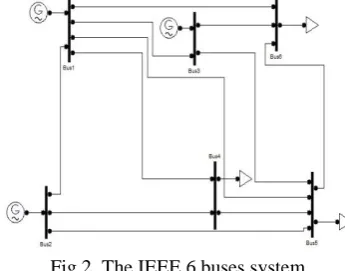
ONCLUSIONThe objective of this section is showing the analyzing the shown instantaneous price in section. The IEEE 6 buses system has been shown to do the computations in figure 2. The generator active power limit is assumed 165 MW and reactive power limit about 150 MVAR. Generator 2 also has about 95MW active power limit and 30 MVAR reactive power limit. Generator 3 has active power limit and 80 MV reactive powers limit about 300 MVAR. Utility point has been calculated by using conclusion of OPF for the mentioned system.
Table 1: Conclusions of OPF for the IEEE 6 buses system Price of Power Active ($/MW-h) Price of Power Reactive ($/MVAr-h) Power Active )MW( Power
Reactive )MVAR( Bus Number 8.8 0.5 156.9927 118.9267 1 8.878 0.7 90 43.6617 2 8.9721 0.8 80 29.2138 3 9.4976 1.045 -115 -76.6665 4 9.6286 1.1738 -110 -77 5 9.3325 0.99301 -90 -60 6
A. Simulation without considering reactive power
limit of generator 1
When the reactive power demand has been increased 19 MVAr in bus 6, OPF concludes the shown utilization point in table 2. It is considered that reactive power of generator 1 have been added 2/2272 MVAr, generator 2, 0/6178MVAr, generator 3, 8/0738MVAr.
It is considered that Sam of payments of generators (139/4$) is less than payment by load (230/08$) this problem, says the interest efficiently (income) (Main problem in supportive mechanism of instantaneous price) which is conveyed in the recommended reward scheme in point (D).
Table 2: Increase in reactive power in bus 6 Price of Power Active ($/MW-h) Price of Power Reactive ($/MVAr-h) Power Active )MW( Power Reactive )MVAR( Bus Number 8.8 0.5 157.2338 121.1539 1 8.8791 0.7 90 44.2795 2 8.9743 0.8 80 37.2876 3 9.4985 1.0462 -115 -76.6665 4 9.6324 1.1842 -110 -77 5 9.3383 1.0326 -90 -70 6
B. Simulation by considering reactive power limit of
generator 1
By case study of provision effects, it has been considered that, when the reactive power limit of generator 1 is strictly in 75 MVAr, the production of reactive power is in basis value. OPF output in table 3 has been shown. Table 3: applied reactive power limit in generator
Price of Power Active ($/MW-h) Price of Power Reactive ($/MVAr-h) Power Active )MW( Power Reactive )MVAR( Bus Number 8.8 0.83481 155 75 1 8.7748 0.7 90 46.83 2 8.9598 0.8 80 76.7744 3 9.4733 1.27 -115 -76.6665 4 9.5868 1.3046 -108.712 -76.0981 5 9.3176 1.1225 -90 -70 6
Pay attention that if the utilization point doesn’t change. The instantaneous price of reactive power of bus 1 is added to 0.83481$ MVAr. This is because generator of reactive power in bus 1. Surcharge of instantaneous price
in figure 2 of component of instantaneous price related to system provision.
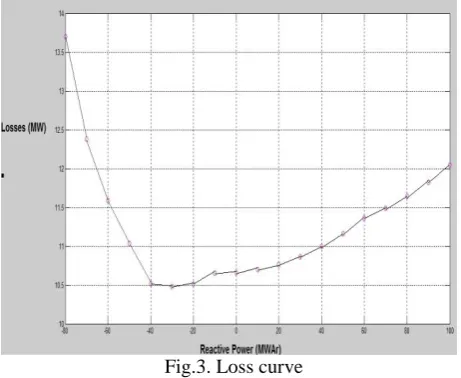
Figure 3 shows the curves of loss for load connected to bus 6 that its information has been provided in table 5. For different amounts of injected reactive power, in this time bus of high voltage is assumed constant in 400 KV.
Fig.3. Loss curve
A
PPENDIXIn this section, information related to lines and information of loss curve has been extracted. Besides, lines have been presented based on base power of 100 MVA.
Table 4: Lines information
C (p.u.) L (p.u.) R (p.u.) Line 0.04 0.2 0.1 𝐿𝑖𝑛𝑒1−2 0.06 0.25 0.05 𝐿𝑖𝑛𝑒1−3 0.02 0.1 0.05 𝐿𝑖𝑛𝑒1−4 0.04 0.3 0.1 𝐿𝑖𝑛𝑒1−5 0.05 0.2 0.07 𝐿𝑖𝑛𝑒1−6 0.04 0.2 0.05 𝐿𝑖𝑛𝑒2−4 0.06 0.3 0.08 𝐿𝑖𝑛𝑒2−5 0.05 0.26 0.12 𝐿𝑖𝑛𝑒3−5 0.02 0.1 0.02 𝐿𝑖𝑛𝑒3−6 0.08 0.4 0.2 𝐿𝑖𝑛𝑒4−5 0.06 0.3 0.1 𝐿𝑖𝑛𝑒5−6
Table 5: Information of loss curve
11.159 50
11.367 60
11.491 70
11.641 80
11.824 90
12.042 100
R
EFERENCES[1] C. M. Bastos and M. A. Abdalá, “Reform of the Electric Power Sector in Argentina,” Editorial Antartica S.A., Buenos Aires, 1996.
[2] P. Fox-Penner, “Electric Utility Restructuring. A Guide to the Competitive Era,” Public Utilities Report Inc., Vienna, Virginia, 1997.
[3] S. H. Hao and A. Papalexopoulos, “Reactive Power Pricing and Management,” IEEE Transactions on Power Systems, vol. 12, no. 1, Feb 1997.
[4] N. H. Dandachi, M. J. Rawlins, O. Alsac, M. Prais, and B. Stott, “OPF for Reactive Pricing Studies on the NGC System,” IEEE Transactions on Power Systems, vol. 11, no. 1, Feb. 1996. [5] M. Rivier and I. J. Pérez-Arriaga. Computation and
decomposition of spot prices for transmission pricing. 11th PSCC, Avignon, Francia, Agosto 1993.
[6] J. I. Pérez Arriaga, “Curso de Doctorado Mercados de Energía Eléctrica,” (in Spanish), Universidad Pontificia Comillas, Instituto de Investigación Tecnológica, Madrid, 1994.