Development of Efficient and Secured Face
Recognition using Biometrics
Deepa Indrawal
1*, Sunita Waykole
2and Dr. Archana Sharma
3 1Research Scholar, Mewar University, India.2Research Scholar, University, India. 3Prof. TIT Bhopal, India.
Date of publication (dd/mm/yyyy): 14/08/2019
Abstract – With the rapid development of the computer & increasing security authentication application where virtually any environment or situation requires a key , card as passwords for access can be replaces as further enhanced by face recognition, Face recognition has reduce significant attention due to its wide range of application, not only to the public sector, such as security, surveillance and access control for offices, since a key or a card can be easily reduplicated (or lost) and a password might be cracked, So either an authorized person might not get the access.In using biometric data privacy laws, it is important for biometric data users .In biometric data safety and security, there are various modality or technology are used. Biometric methods used for this are conventional and unconventional in future.
Keywords – Authentication, Authorized,Face RecognitionSurveillance, Conventional, Unconventional.
I. I
NTRODUCTIONIn current digital era, most of security authentication applications where virtually any environment or situation requires a key, card, or password for access can be replaced or further enhanced by face recognition. Since a key or a card can be easily reduplicated (or lost) and a password might be forgotten (or cracked), so either an authorized person might not get the access while a fraudulent fellow might. Hence forth most of the systems are shifting from what we know? and what we have? to what we are?. The Greek words “bio” and “metrics” mean “life” and “to measure” respectively, henceforth "Biometrics" literally means "life measurement" which is often associated with the use of unique behavioral or physical traits to identify an individual. “Biometrics” identification has eventually a much broader relevance that for security aspect based application as one expects computers of the future to have the capabilities to know a person it is having conversation.
Fig. 1. The different classes of Biometrics traits.
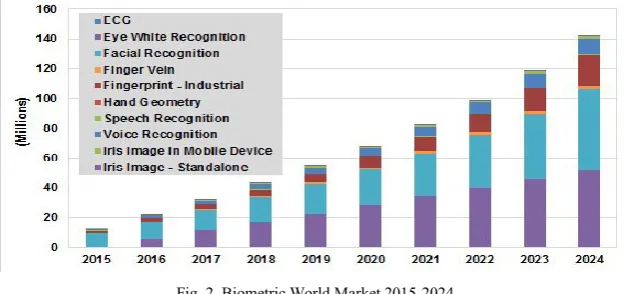
The biometric traits where considerable amount of research is concentrated are ear based recognition, gait (walking/posture) based recognition, body odour based recognition, foot based recognition, brain wave based recognition, vein based recognition, hand geometry (palm) based recognition and etc. It is evident from the figure 2, that the global market for biometrics based applications is constantly diversifying [2]. Application market as per market intelligence [1].
Initially the application of biometrics is concentrated for identity identification based services, and access control based services. But currently, the biometrics based global market which has been growing at a faster rate has addressed the surveillance and monitoring of individuals with criminal background or intent.
Fig. 2. Biometric World Market 2015-2024.
Comparision Chart of Biometrics
In the rise of biometric application, there is a major advantage over this recognition technology. In the risk of storing the biometric data, it may start losing confidence in this recognition technology. In this approach different biometric characteristics of behavioral biometric tactics are taken into account to create user profile. There are even unconventional biometric methods that are used in the future.
Fig. 3. Comparison Chart [15].
II. L
ITERATURES
URVEYFace based analysis (i.e. detection, recognition, and emotional status) is the fastest growing biometric technology today [4]. Despite their lingering questions regarding the practical usefulness of facial analysis based technology, law enforcement and military have been using them for several years without arousing too much controversy. According to industry insiders, this is because these applications have proven quite successful in carrying out specific objectives and the public is often unaware of these uses. In addition, automated face recognition has been accepted in law enforcement agencies as an effective means for recognizing an unknown individual from surveillance cameras. In surveillance video, image frames are generally of low quality due to the compression of the signal, low resolution cameras and unconstrained external parameters (pose, illumination, occlusion). Although face recognition systems are known for decades, there are many active research works on the topic. The subject can be divided into three parts;
1. Detection (Emotion based analysis).
2. Recognition.
3. Detection & Recognition.
They measured the key features in a face using templates of the features of the different parts of the face. They then plotted all the pieces on to a general template. Even though this method was more automated then the previous it proved to be too inconclusive as the features used did not include enough distinctive data to represent a face. The commonly employed techniques for face detection make explicit use of face knowledge and follow the classical detection methodology in which low level features are derived prior to knowledge-based analysis [6]. The apparent properties of the face such as skin colour and face geometry are exploited at different system levels. Typically, in these techniques face detection tasks are accomplished by manipulating distance, angles, and area measurements of the visual features derived from the scene. Since features are the main ingredients, these techniques are termed the feature-based approach [7].
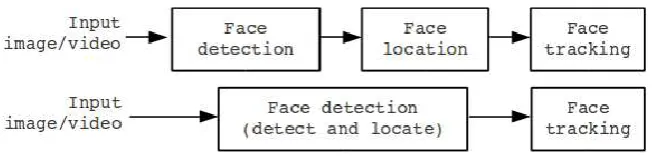
Taking advantage of the current advances in pattern recognition theory, Image-based [22] representations of faces, for example in 2D intensity arrays, are directly classified into a face group using training algorithms without feature derivation and analysis. Unlike the feature-based approach, these relatively new techniques incorporate face knowledge implicitly [7] into the system through mapping and training schemes. Nowadays some applications of Face Recognition don’t require face detection. In some cases, face images stored in the data bases are already normalized. There is a standard image input format, so there is no need for a detection step. An example of this could be a criminal data base. There, the law enforcement agency stores faces of people with a criminal report. If there is new subject and the police has his or her passport photograph, face detection is not necessary. However, the conventional input images of computer vision systems are not that suitable. They can contain many items or faces. In these cases face detection is mandatory. It’s also unavoidable if we want to develop an automated face tracking system. For example, video surveillance systems try to include face detection, tracking and recognizing. So, it’s reasonable to assume face detection as part of the more ample face recognition problem. Face detection must deal with several well known challenges. They are usually present in images captured in uncontrolled environments, such as surveillance video systems as presented in the figure below.
Fig. 4. Schematic of the face detection and location.
For biometric systems that use faces as non-intrusive input modules, it is imperative to locate faces in a scene before any recognition algorithm can be applied. An intelligent vision based user interface should be able to tell the attention focus of the user (i.e., where the user is looking at) in order to respond accordingly. To detect facial features accurately for applications such as digital cosmetics, faces need to be located and registered first to facilitate further processing. It is evident that face detection plays an important and critical role for the success of any face processing systems. Detection methods in the literature are difficult to classify strictly, because most of the algorithms are combination of methods for detecting faces to increase the accuracy. Mainly, detection can be classified into two groups as Knowledge-Based Methods and Image-Based Methods.
Skin color is modeled in each color spaces like RGB, YCbCr, HSV, YUV and in statistical models. Face has a unique pattern to differentiate from other objects and hence a template can be generated to scan and detect faces.
Face recognition is based on analyzing facial characteristics. Facial features are important information for human faces and standard images can be generated using these information. In literature, many detection algorithms based on facial features are available [8 - 13].
Zhi-fang et al. [8] detect faces and facial features by extraction of skin like region with YCbCr color space and edges are detected in the skin like region. Then, eyes are found with Principal Component Analysis (PCA) on the edged region. Finally, Mouth is found based on geometrical information. Another approach extracts skin like region with Normalized RGB color space and face is verified by template matching. To find eyes, eyebrows and mouth, color snakes are applied to verified face image [9]. Ruan and Yin [10] segment skin regions in YCbCr color space and faces are verified with Linear Support Vector Machine (SVM). For final verification of face, eyes and mouth are found with the information of Cb and Cr difference. For eye region Cb value is greater than Cr value and for mouth region Cr value is greater than Cb value. Another application segments skin like regions with statistical model. Statistical model is made from skin color values in Cb and Cr channel in YCbCr color space. Then, face candidates are chosen with respect to rectangular ratio of segmented region. Finally, the candidates are verified with eye & mouth map [11]. Also, RGB color space can be used to segment skin like region and skin color like region is extracted to be face candidate. Candidate is verified by finding facial features. Eyes and mouth are found based on isosceles triangle property. Two eyes and one mouth create an isosceles triangle and also distance between two eyes and distance from mid-point of eyes to mouth are equal. After eyes and mouth is found, Feed Forward Neural Network (FFNN) is used for final verification of face candidate [12]. Bebar et al. [13] segment with YCbCr color space and eyes & mouth are found on the combination of segmented image and edged image. For final verification, horizontal and vertical profiles of the images are used to verify the position of the eyes and mouth. All the methods are using firstly skin segmentation to eliminate non-face objects in the images to save computational time.
III. O
BJECTIVES ANDS
COPEThe human face plays an important role in our social interaction, conveying people’s identity. Using the human face as a key to security, biometric face recognition technology has received significant attention in the past several years due to its potential for a wide variety of applications in both law enforcement and on-law enforcement. As compared with other biometrics systems using fingerprint/ palmprint and iris, face recognition has distinct advantages because of its non-contact process. Face images can be captured from a distance without touching the person being identified, and the identification does not require interacting with the person. In addition, face recognition serves the crime deterrent purpose because face images that have been recorded and archived can later help identify a person. On developing face recognition methods within the framework of biometric security systems and is now applying face recognition technology. Face recognition technology was ranked number one in the latest Biometric Grand Challenge's (MBGC) "Still Face Challenge”, carried out by the National Institute of Standards and Technology (NIST), commissioned by the U.S.
algorithm is able to run on the given system. The following are the intermediate deliverables or the scope of the thesis.
1. To improve the occlusion in low resolution and quality of the video signal. Thus, making the signals suitable for matching and processing efficiently.
2. To enhance the facial images captured from a larger standoff, we will be developing enhancement algorithm for selective regions wise (for enhancement of occlusion regions) along with complete facial image for effectiveness in face recognition test [28].
3. To minimize false detection rate, we propose a new multi-modal method using a combination of face and ear traits to further boast the positive detection rate. We will also incorporate soft computing techniques to develop a robust and effective recognition system.
4. To limit any tampering of the information stored, we propose a new encryption algorithm for securing the biometric information of the individual.
A.
Research Method
The basic algorithm starts with a pre-processing step, consisting of digitization, enhancement and segmentation. The next step is called face segmentation. We define the face segmentation problem as: given a scene that may contain one or more faces, create sub-images that crop out individual faces. After face segmentation, the device enters into the face identification mode, as shown.
Fig. 5. Face Identification System.
The prime advantage of incorporating gait, ear, voice (multimodal) as a biometric is that it can be used for recognition at a distance whereas other biometrics (contact based biometrics like IRIS, Fingerprint, and etc) cannot. There is a rich selection of approaches and many advances have been made, as will be reviewed in this talk. Soft biometrics is an emerging area of interest in biometrics where we augment computer vision derived measures by human descriptions. Applied to face biometrics, this again can be used where other biometric data is obscured or at too low resolution. The human descriptions are semantic and are a set of labels which are converted into numbers. Naturally, there are considerations of language and psychology when the labels are collected. As well as reinforcing biometrics, this approach might lead to a new procedure for collecting witness statements, and to the ability to retrieve subjects from video using witness statements.
A. Computer Usage and Data of the programming will be carried out using MATLAB, due to the computational competency and inbuilt function database. We will be using the standard NIST database of image for designing the proposed algorithm. Testing will be carried out using a real time video feed collected.
(small)
Suspect database
Face Data Base
Feature Data Base
Face
Segmentation
Feature
Extraction classifier
matches
GUI
B. Thesis Timeline
Task
Literature survey
Face Detection & Recognition
Soft Biometrics & Encryption
Analysis & Simulation
Documentation & Presentation
Months -> 0 6 12 18 24 30 36 42 48
R
EFERENCES [1] http://www.engineersgarage.com/sites/default/files/imagecache/Original/wysiwyg_imageupload/1/biometric-chart-imgae.jpg [2] http://www.google.co.in/imgres?imgurl=http://ww1.prweb.com/prfiles/2009/09/02/58582/application.jpg [3] http://www.bccresearch.com/market-research/information-technology/biometrics-global-market-ift042b.html [4] http://finance.yahoo.com/news/global-fingerprint-biometrics-market-us10-153139564.html [5] http://cnx.org/content/m12535/latest/[6] Brunelli, R., & Poggio, T. (1993). Face recognition: Features versus templates. IEEE transactions on pattern analysis and machine intelligence, 15(10), 1042-1052.
[7] Valentin, D., Abdi, H., O'Toole, A.J., & Cottrell, G.W. (1994). Connectionist models of face processing: A survey. Pattern recognition, 27(9), 1209-1230.
[8] D. Anijiantis, E. Dernzatas and G. Kukkinakis, 1999, “A Neural Network Method for Accurate Face Detection on Arbitrary Images”, Proc. The 6th IEEE International Conference on Electronics, Circuits and Systems, pp. 109 - 112 vol.1, Pafos, Cyprus.
[9] Hjelmås, E., & Low, B.K. (2001). Face detection: A survey. Computer vision and image understanding, 83(3), 236-274.
[10] Seo, K.H., Kim, W., Oh, C., & Lee, J.J. (2002). Face detection and facial feature extraction using color snake. In Industrial Electronics, 2002. ISIE 2002. Proceedings of the 2002 IEEE International Symposium on (Vol. 2, pp. 457-462). IEEE.
[11] Wang, Y., Chua, C.S., & Ho, Y.K. (2002). Facial feature detection and face recognition from 2D and 3D images. Pattern Recognition Letters, 23(10), 1191-1202.
[12] Zhao, W., Chellappa, R., Phillips, P.J., & Rosenfeld, A. (2003). Face recognition: A literature survey. Acm Computing Surveys (CSUR), 35(4), 399-458.
[13] Zhi-fang, L., Zhi-sheng, Y., Jain, A.K., & Yun-qiong, W. (2003, September). Face detection and facial feature extraction in color image. In Computational Intelligence and Multimedia Applications, 2003. ICCIMA 2003. Proceedings. Fifth International Conference on (pp. 126-130). IEEE.
[14] www.biometric.com/global-biometric market analysis [15] www.pantech.ae/pantech-biometric.html
[16] Berbar, M.A., Kelash, H.M., & Kandeel, A. A. (2006, August). Faces and facial features detection in color images. In Geometric Modeling and Imaging--New Trends, 2006 (pp. 209-214). IEEE.
[17] Kun, Y., Hong, Z., & Ying-jie, P. (2006, August). Human face detection based on SOFM neural network. In Information Acquisition, 2006 IEEE International Conference on (pp. 1253-1257). IEEE.
[18] Tsai, C. C., Cheng, W. C., Taur, J. S., & Tao, C. W. (2006, October). Face detection using eigenface and neural network. In Systems, Man and Cybernetics, 2006. SMC'06. IEEE International Conference on (Vol. 5, pp. 4343-4347). IEEE.
[19] Ruan, J., & Yin, J. (2009, February). Face detection based on facial features and linear support vector machines. In Communication Software and Networks, 2009. ICCSN'09. International Conference on (pp. 371-375). IEEE.
[20] Kherchaoui, S., & Houacine, A. (2010, October). Face detection based on a model of the skin color with constraints and template matching. In Machine and Web Intelligence (ICMWI), 2010 International Conference on (pp. 469-472). IEEE.
[21] Zengxi Huang, Yiguang Liu, Chunguang Li, Menglong Yang and Liping Chen, “A robust face and ear based multimodal biometric system using sparse representation”, Pattern Recognition, 2013, Vol. 46, No. 8, pp.2156–2168.
[22] Cevikalp, H., Triggs, B., & Franc, V. (2013, April). Face and landmark detection by using cascade of classifiers. In Automatic Face and
Gesture Recognition (FG), 2013 10th IEEE International Conference and Workshops on (pp. 1-7). IEEE.
[23] Huang, Z., Liu, Y., Li, C., Yang, M., & Chen, L. (2013). A robust face and ear based multimodal biometric system using sparse representation. Pattern Recognition, 46(8), 2156-2168.
[24] Hofmann, M., Geiger, J., Bachmann, S., Schuller, B., & Rigoll, G. (2014). The TUM gait from audio, image and depth (GAID) database: Multimodal recognition of subjects and traits. Journal of Visual Communication and Image Representation, 25(1), 195-206.
[25] Wang, Z., Miao, Z., Wu, Q. J., Wan, Y., & Tang, Z. (2014). Low-resolution face recognition: a review. The Visual Computer, 30(4), 359-386.
[26] Youssef, I. S., Abaza, A. A., Rasmy, M. E., & Badawi, A. M. (2014, May). Multimodal biometrics system based on face profile and ear.
In SPIE Defense+ Security (pp. 907506-907506). International Society for Optics and Photonics.
[27] Pflug, A., & Busch, C. (2014). Segmentation and Normalization of Human Ears using Cascaded Pose Regression. In 19th Nordic
Conference on Secure IT Systems.