This is an open access journal, and articles are distributed under the terms of the Creative Commons Attribution-Non Commercial-ShareAlike 4.0 License, which allows others to remix, tweak, and build upon the work non-commercially, as long as appropriate credit is given and the new creations are licensed under the identical terms.
© 2018 Journal of Advanced Pharmacy Education & Research | Published by SPER Publication
32
Assessment issues in content and language integrated learning
(CLIL)
Zhetpisbayeva B. A.
1*, Kitibayeva A. K
2, Kazimova D. A.
3, Akbayeva G. N.
3, Zatyneiko M. A.
31 Doctor of pedagogical sciences, full Professor, Ye.A. Buketov Karaganda State University, Kazakhstan, 2Phd student, Ye. A. Buketov Karaganda state University, 3Candidate of pedagogic sciences, Ye. A. Buketov Karaganda state University, Kazakhstan.
Correspondence: Zhetpisbayeva B. A., Doctor of Pedagogical Sciences, Full Professor, Ye.A. Buketov Karaganda State University, Kazakhstan.
ABSTRACT
In this article, the authors considered the issues of assessment in the content and language integrated learning. The new system for evaluating the learning outcomes would be used in all classes of the secondary schools in Kazakhstan in 2019–2020 academic year. A special organization of the educational process in the classroom, changes of the approaches of planning and defining the objectives, assessments of learning outcomes, selection of teaching materials, combining the content of the subjects and the process of learning the language would be needed to achieve the effectiveness of studying the subjects in English in a comprehensive school. In order to study the practice of CLIL assessment, the authors conducted a research among the teachers in Karaganda region who taught biology, chemistry, physics, and computer science in English; and the detailed analysis of the results of this study was presented. The primary task for tracking the development of the language skills and their assessment was developing a system of language learning objectives for CLIL.
Keywords:Content and Language Integrated Learning, assessment, formative assessment, summative assessment, learning objectives in senior classes.
Introduction
A new system for evaluating the learning outcomes would be used in all classes of secondary schools in Kazakhstan from 2019–2020 academic year [1]. In this regard, the cardinal changes would occur in the assessment of the students' academic achievements in the control-assessment activity of the teachers.
The relevance of the revision of the assessment process has been determined by the modern strategic objectives of education, the need to improve the level of education by taking the international standards and modern requirements for the quality of education into account, the need to develop unified requirements for the assessment of the students' academic achievements in order to ensure the objectivity of the learning outcomes.
The phased introduction of the trilingual education in secondary education organizations, which involves the study of 4 school
subjects in the science-mathematical course (including computer science, physics, chemistry, biology) in English in high schools has been defined in the State Program for the Development of Education and Science of the Republic of Kazakhstan in 2016-2019 (State Program for the Development of Education and Science). A special organization of the educational process in the classroom, some changes in approaches including planning and definition of goals, an evaluation of learning outcomes, a selection of teaching material, allowing to combine the content of the subject and the process of learning the language, would be needed to achieve the effectiveness of studying the subjects in English in a comprehensive school.
In this regard, the relevant method can be the content and language integrated learning (CLIL). The importance of assessing the educational achievements of the schoolchildren in CLIL has been determined by the fact that when learning in a non-native / foreign language, there is a risk of unclear and unfair assessments of the learning outcomes, especially in case of students who have language difficulties: the students may have subject knowledge, but be unable to express their thoughts, or demonstrate their knowledge in the language of instruction.
In order to study the practice of assessment at CLIL, this research was conducted on the teachers in Karaganda region, Access this article online
Website: www.japer.in E-ISSN: 2249-3379
How to cite this article:Zhetpisbayeva B. A., Kitibayeva A. K, Kazimova
D. A., Akbayeva G. N., Zatyneiko M. A. Assessment issues in content and language integrated learning (CLIL). J Adv Pharm Edu Res 2018;8(4):32-38.
who taught subjects of science-mathematical direction in English.
Methodology
The use of CLIL in high schools has been a developing area of the theoretical and applied research, and there has been no unified concept of how a school should implement such training.
The implementation of CLIL in Kazakhstan has been sporadic and, if it has been carried out, it was done just partially, in the framework of the individual educational organizations in which the teachers began to teach the subject in English and know the methodology of the content and language integrated learning. Despite the peculiarities of teaching in content and language integrated learning, a number of foreign researchers believed that CLIL has not been a completely new method of teaching, neither the language nor the subject content.
CLIL is an innovative combination of existing methods for the joint teaching of a language and a non-language subject. Therefore, it is quite logical to assume that any educational system already contains the necessary (although still separate) basic elements for implementing CLIL. Consequently, the organizational basis of the multilingual education, aimed at mastering new cognitive-communicative complexes (the language of instruction in the framework of the studied subjects), have been the principles and methods of learning activities. In this case, it refers to an integrated type of an educational content, in which all the cultural paradigms of the pedagogical activity known today have been equally represented [2].
The content and language integrated learning of the subject should be carried out in accordance with the methodological principles of the conceptual foundations of the multilingual education, have been discussed in the scientific literature:
• the principle of the continuity: the relationship, consistency and perspective of all the components of the system (goals, learning outcomes, tasks, content, methods, tools, forms) at the levels of education (vertical);
• the principle of the continuity as a factor ensuring the integrity of all the components of the system (goals, learning outcomes, tasks, content, methods, tools, forms) at each level of the multilingual education (horizontally);
• the principle of “double entry of knowledge” provides the parallel mastering of the languages through the study of the language disciplines and through the language of instruction of non-language disciplines;
• the principle of the functional activity of languages being in contact with the ethnocultural educational space, which means creating of conditions for the active use of various languages in accordance with the needs and interests of the society in the institutional sphere, and with the interests and needs of the individual and certain social groups in extra-institutional and informal spheres;
• the principle of studying the language and culture: learning of the language forms the attitude to the language as a social value, as a tool for cognizing the surrounding reality [3].
The general didactic and particular principles of the CLIL method [4] have been developed enough; and various aspects of CLIL have been considered included : CLIL models [5], the basic elements of the Framework (Соntent,Соmmunication,
Соgnition, Сulture) [6], the distributed leadership of CLIL programs [7], the influence of the students' age and CLIL variables on the speech activity skills [8], the role of CLIL in the internationalization of European higher education, CLIL as a natural approach to the development of the language [9], the practical forms of CLIL which have been used in various countries (Italy, Latvia, Lithuania and Sweden) [10]. There have been practical tools for developing the curricula for training future teachers to work in multilingual schools [11].
The analysis of the sources made it possible to single out the common features of CLIL including: the integration of the subject and language, the basing on the content, the communicative approach, and the functional language learning. CLIL Integration has been oriented as follows:
1) The subjects (in this study - physics, chemistry, biology, & computer science) include the language learning. This meant that, the information is taught in the language being studied in a supportive form. The language is the form; the subject is the context.
2) Teaching material, having been learned on the subjects, is used in language lessons. The language teacher uses the terminology and texts of the subjects. The pupils enlarge their vocabulary, master the expressions, patterns of the sentences and reasoning that they need to understand and use the subject knowledge.
In general, despite the available research on the content and language integrated learning, there have been questions of CLIL assessment which still have been little studied.
Studies, devoted to the search of the objective tools for evaluating CLIL results, have been conducted by scientists from different perspectives. Thus, Casal (2016) considered the possibility of the combined assessment of the subject content and the language knowledge in terms of CLIL from a socio-cultural point of view [12].
development of the objectives and the assessment criteria in the process of teaching subjects in a foreign language.
The Results of the Study
As mentioned above, in order to study the practice of CLIL assessment, this research was conducted among the teachers of Karaganda region who taught subjects of science and mathematical direction in English. There were 68 teachers of biology, physics, chemistry, and computer science in schools with Kazakh and Russian languages who took part in the survey. In total, there were 50 of such schools in the region on January 1, 2018. For this study, a questionnaire was developed, aimed at studying the practice of assessment with content and language integrated learning.
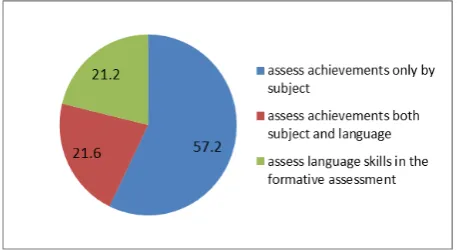
The survey testified the different opinions of the teachers on the assessment of the knowledge and skills in the subjects and language considering the process of teaching the subjects in English. Thus, the need to assess the language skills of the students who were taught the subjects in English, was recognized by 42.8% of the respondents, while 57.2% of the teachers believe that only the scores of the students in the subject should be evaluated. At the same time, some teachers considered it as important to evaluate the students' achievements in English with a formative assessment (Fig. 1). It could be assumed that the denial of the need to assess the language skills was associated with the lack of the methodological preparedness of the teachers, since 39% of the respondents were not familiar with the methodology of CLIL. This assumption was based on a comparison with the results of another study conducted among the teachers who taught the content-language courses, the program of which included the study of the CLIL technique [14]. In this case, out of 144 respondents, 83% believed that the assessment should include not only monitoring the results of the educational achievements in the subject, but also tracking the development of the language skills.
Figure 1.The teachers’ position on the CLIL assessment
The teachers of physics, chemistry, biology, and computer science, who underwent the lengthy refresher courses, took part in this study. At the end of the course, the audience took two exams: according to the method of teaching subjects in English - the Cambridge Teaching Knowledge Examination Test (TKT CLIL) and the Cambridge English Language Assessment.
In order to study the educational environment and professional needs of the teachers starting to teach the subjects in English, an electronic survey was conducted from 12th to 20th of January, 2018. The questionnaire also included the questions aimed at identifying the difficulties of teachers in the implementation of the integrated teaching of the content and language, including the organization of the assessment.
Both studies showed that in the process of planning CLIL lessons, the majority of the teachers (78%) included the language goals in the short-term lesson plan, but the analysis of the teachers' answers allowed the researchers to conclude that teachers, including those who were trained in the content-language courses, did not realize how to carry out assessment at the integrated training in a subject and language. The teachers named the lack of the qualifications for assessing the level of English proficiency and ignorance of the methods of teaching English as the difficulties of CLIL assessment.
At present, in Kazakhstan there have been only general recommendations on CLIL assessment in textbooks on the integrated teaching of the English language and the subjects of science and mathematical direction [15]. As mentioned above, in foreign sources, with the unanimous understanding by the authors of the scientific-theoretical and scientific-practical works of the need to evaluate the substantive results, and the level of language proficiency, the practical implementation of the assessment in the integrated teaching of the subject and language has also been poorly understood.
It has been believed that the mechanisms and tools for assessment of the educational achievements in terms of CLIL should be developed on the basis of the requirements for the level of training of the students and pupils specified in the educational standards (2016), developed learning objectives for school subjects and the conceptual provisions of the system of the criterion assessment in schools of Kazakhstan.
A special CLIL feature in Kazakhstan’s schools was implemented in the context of updating the content of the secondary education, which has led to the changes in the teachers’ assessment activity and the organization in the standard curricula for subjects. The system of learning objectives has been included in the structure of all the model curricula of the secondary education on the basis of what was expected.
In the process of studying a subject in English, learning outcomes have been assessed within the framework of the criterion assessment, i.e. through the implementation of the formative and summative assessments. At the same time, it has been difficult to separate the language proficiency and the knowledge of the subject, since “students could demonstrate their knowledge only through language” [16]. Therefore, it was necessary to define separate goals for the subjects and the language.
subject content. The objectives of teaching the subject “English” realized at the lessons of the English language, and the level of the achievement of the objectives of training and the curriculum level determined by the curriculum were assessed in the process of the formative and summative assessments.
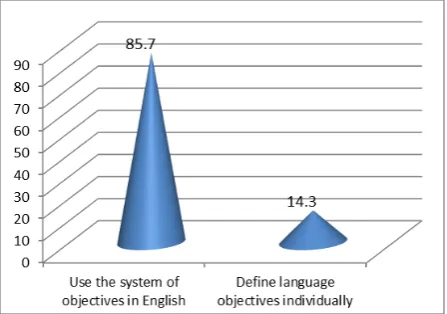
In the practice of the teachers, the analysis of the results of the survey showed the followings - 78% of 68 interviewed teachers used the language objectives when planning a CLIL lesson, and only part of them (14.3%) took into account the level of the pupils' language in the assessment, and independently formulated the language objectives in developing short-term lesson plan; and the vast majority (87%) in teaching the subjects in English were guided by the system of the objectives of the curriculum on the subject "English" (Fig. 2).
Figure 2.Approaches to selecting of language objectives for CLIL
In the CLIL methodology, a subject teacher teaches the subjects to the students in a non-native or foreign language, but the systematic language teaching from the subject teacher is not required. This is the task of the language teacher. When studying a subject in a non-native or foreign language, the focus of learning should be on the subject (knowledge and skills), and the language and teaching methods determine the form of the instruction. Nevertheless, the subject teacher has a very difficult role - on one hand, he is not a language teacher and, therefore, he should not teach the language. On the other hand, it is necessary to understand the difficulties that students have in using the language; evaluate and ensure the understanding of the subject matters’ content, and support the language development. Thus, the subject teacher becomes a model of a native speaker and a teacher of this language. In turn, in the process of learning in a non-native or foreign language, the students simultaneously study the subject, and master the language that is needed to explore the subjects’ content or communicate within the school subjects that is, the students learn the language using it in a class during the social and academic activities. In this regard, with the content and language integrated learning of the subject, it is necessary to distinguish the language of the communication and the language of thinking, which are two different types of the language competence.
To designate two types of language competence, Cummins (2001) introduced two new terms into the scientific circulation [17]: BICS (“basic interpersonal communicative skills” - basic
communicative skills of everyday communication) and CALP (“cognitive academic language proficiency” - cognitive-academic language competence that is necessary in the situations of everyday communication). The division of language competence into BICS and CALP has been associated with the concepts of context and degree of the cognitive difficulty. Some communication tasks do not present cognitive difficulties, especially if they are accompanied by a verbal context that creates a kind of situational cliché. Other situations can be “decontextualized” and thus represent a greater cognitive load for the communication participants [17]. Everyday communication situations remain within the frame of BICS competence. And, on the contrary, the intensive flow of the educational information in a lesson requires a CALP level, since the abstract information is peculiar to such information, when there is no contextual content. Thus, BICS skills are developed and evaluated mainly in the contextual activities and communication with each other, while CALP skills are identified in the academic situations that have little connection with the context, as well as in working with the academic text that requires the use of the language of thinking, and reflects the intellectual child development in general.
According to the researchers, the level of development of the native language is a prerequisite for the development of another language [17]. In terms of the development of thinking skills and conceptual perception, languages are interdependent on a bilateral basis. Language and the learning skills learned in one language are transferred to another; therefore, if the educational environment provides learning of two or more languages, they enrich each other. The semantic and functional means of the language (language competence), and the skills of the analysis and synthesis (central operating system) are common for proficiency in different languages and are used for complex tasks in the cognitive plan. The knowledge and skills that a person learns in the process of mastering his first language are transferred to other languages through this common language competence. On this basis, Cummins (2000) drew the following conclusions [18]:
• regardless of the language used, language skills come from the same central system;
• the language activity in two / several languages contributes to the development of the cognitive system;
• the information processing skills can be developed in one, two or more languages; languages function as channels that feed the central information processing system;
• if a second / third language is used, it must be well developed to function as a channel for the central system. Languages unite core competence (Common underlying proficiency - CUP), by means of the knowledge, skills, ideas acquired in one language which are transferred to another language.
schools. In the transition to the study of the subjects of the science and mathematical direction in English, it is in high schools that the teacher can rely on the BICS and CALP students' native and English language learning and language skills created by the end of the 9th grade.
Secondly, the English language as a means of learning has been a mechanism for the integration with the subjects of “Physics”, “Chemistry”, “Biology”, “Informatics”, the teaching of which, has been in accordance with the State Compulsory Education Standard of general secondary education in 10th grade from September 1, 2018 in 11 classes to September 1, 2019. At the same time, according to the Standard Curriculum for the grades of 10-11 in the science-mathematical direction, these non-linguistic subjects have been assigned to the component of the choice of an in-depth level. From this component, the students would choose two subjects, i.e. two subjects of choice would be studied in English. The subject “Informatics” has been the component of the choice of the standard level for grades 10-11 in the social and humanitarian field, i.e., the students in the social sciences and humanities would study one subject in English.
An analysis of the various models of the multilingual education allowed the researchers to conclude that the transition to learning a subject in a non-native or foreign language implies a lesson structure with a gradual increase in the proportion of the target language of instruction from 20% in the initial stage of the transition to the full lesson or non-native language.
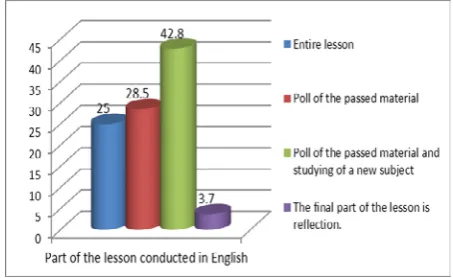
To make a decision on increasing the part of a lesson conducted in a non-native or foreign language, the teachers needed to carry out the continuous formative assessment of the progress of students' language skills, therefore, the developed CLIL language objectives and assessment tools have been needed. The results of the survey on teachers confirmed the presence of a transitional stage in teaching physics, chemistry, biology and computer science in English. The entire lesson in English was conducted by 25% of the teachers including 68 people who took part in the survey, a large proportion of the respondents (42.8%) indicated that almost the entire lesson (the survey of the material studied and the study of the new topic) was organized in English, 28.5% were conducted by the target language, only 3.7% were the final part of the lesson (Fig.3).
Figure 3.CLIL lesson structure
As has been known, making mistakes in the learning process has been a completely logical and simply integral part of this process, regardless of the age of the students. In the process of teaching the subjects in English, the teachers responded to the students’ errors. At the same time, 7.1% of the respondents ignored the language errors, 25% corrected the communicatively significant errors (affecting the understanding of the content of the speech), 25% corrected all the errors, in case of the error in speech, in 42.9% of the cases, the answer given by the student was repeated, in accordance with the rules of grammar (Fig. 4).
Figure 4.The reaction of teachers to language errors of students at CLIL lessons
The comparison of the results of the survey on the teachers already practiced CLIL with the results of the survey on the teachers just starting to teach the subjects in English indicated the similarity of the reaction of the teachers to the students' language errors. Thus, more than 50% of the teachers surveyed corrected the students' mistakes that affected the understanding of the content of the text. 37% of them corrected the students’ answer in accordance with the norms of the grammar. 10% of the teachers thought differently about mistakes; they believed that all the errors should be corrected.
The teachers’ repetition of the answer given by the students that contained a language error, according to the normative grammar, could be considered as language scaffolding. In this case, the language scaffolding aimed to support the students to improve their language skills.
The experts of multilingual education in terms of CLIL recommended to plan an assessment based on a number of the statements regarding the subject knowledge and the language skills, and conduct an assessment, formal or informal, several times over a quarter (half-year) on the basis of different scales [16]. This type of control and assessment activity has been defined as a generalized assessment, with the aim of studying and evaluating the quality of the educational process.
language objectives were not included in the specification of the assessment. Therefore, when teaching a subject in English, the assessment of the results of teaching English should be carried out in the process of the formative assessment.
The formative assessment which was carried out in the course of everyday work in the classroom, has been a current indicator of the learning outcomes, and would provide an operational relationship between the students and the teachers during the training. The feedback between the students and the teachers would allow to improve the educational process, and direct the students to improve their educational achievements. The formative assessment was aimed at identifying the students' learning difficulties and understanding their reasons for supporting learning.
So, in terms of CLIL, clear, precise learning objectives should be formulated in the form of the expected learning outcomes with a focus on the assessment of, first of all, the content and the skills on the subject, and then on the assessment of the language skills in a non-native (foreign) language. To assess the results of teaching the subject studied in English, the teachers should use a system of the objectives for teaching the subjects, on the basis of which they should develop the criteria for the assessment. For the assessment of language skills, the same mechanism was needed based on the predetermined expected learning outcomes and the assessment criteria. The analysis of the results of the study on the practice of assessment in the content and language integrated learning of the subjects in the schools of the Karaganda region suggested that the subject teachers were at a loss in defining the assessment criteria, since there has been a problem with the selection of the learning objectives.
The criteria proposed by the teachers for the assessment of language skills were abstract, and non-specific in nature, which did not contribute to the full realization of the tasks of the formative assessment. So, the criteria for assessing the language skills of a teacher should include the following:
• the use of terminology on the subject;
• the ability to read and understand tasks, perform practical work;
• the correct pronunciation of terms;
• speaking and reading skills;
• knowing the meaning of the words and their correct spelling;
• the demonstration of the ability of the speech interaction, the ability to use the terms and the concepts to solve the problems;
• knowing English grammar;
• the ability to express their thoughts in language and the ability to argue them
The proposed criteria have been primarily due to the lack of a system of goals for teaching a language as expected results when teaching a subject in English. Therefore, the primary task for tracking the development of the language skills and their
assessment has been the development of a system of language learning objectives in CLIL.
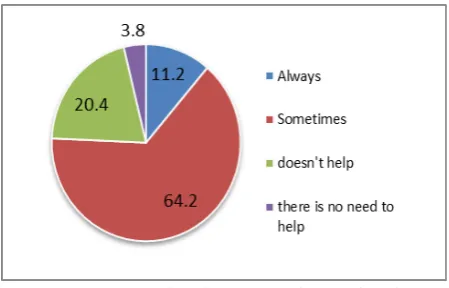
Teaching the subject of the science- mathematical direction in English and conducting the formative assessment would be more effective if the subject teacher worked closely with the English teacher. The need for the teamwork in the multilingual education has been indicated by many experts, and the effectiveness of this approach to the organization of the teachers' activities has been confirmed by the practice of introducing the multilingual education in national schools of Kazakhstan. The analysis of the survey results on the teachers of the above mentioned two surveys (198 people altogether) indicated that the subject teachers and the English language teachers did not effectively organize the joint work in the preparation of the CLIL lesson. Thus, only 11.2% of the teachers indicated that an English teacher always helped in preparing of a lesson, the majority of the subject teachers (64.6%) only occasionally received help from an English teacher; 20.4% of them did not receive such support at all. 3.8% of the subject teachers believed that in preparing of a lesson on a subject, there is no need to work with an English teacher (Fig. 5).
Figure 5.Support of the language teachers to the subject teachers
Conclusion
Thus, the results of the study of the practice of the assessment in the study of the subjects in English revealed the following problems:
1) the lack or insufficient attention of subject teachers to assess language skills;
2) the lack of methodological resources on the assessment of language skills in CLIL;
3) the low level of interaction of the subject teachers with the teachers of the English language;
References
1. State mandatory educational standards of the relevant levels of education. Appendix 1 to the Resolution of the Government of the Republic of Kazakhstan dated May 13, 2016 No. 292 // Adlet. Information and legal system of regulatory legal acts of the Republic of Kazakhstan [ER].
Access modehttp: //adilet.zan.kz/rus/docs/P1600000292#5
2. Vitchenko O.V. Theoretical foundations of CLIL as a possible model of professionally oriented foreign language teaching in a non-linguistic university. - Karaganda: Publishing house of Karaganda State Technical University, 2014. - 102 p.
3. Zhetpisbayeva B.A. Multilingual Education: Theory and Methodology: Monograph. - Almaty: Bilim, 2009. – 343p.
4. Mehisto P., M.J. Frigols, Marsh D. Content and Language Integrated Learning in Bilingual and Multilingual Education. Oxford: Macmillian Books for Teachers. 2008. 240 p.
5. Coyle D., Hood P., Marsh D. Content and language integrated leaning. London: Cambridge University Press, 2010. 184 p.
6. Marsh D. Content and Language Integrated Learning: The European Dimension. – Actions, Trends and Foresight Potential / D. Marsh. OUP, 2002. – 204 p.
7. Soler, D., Gonzalez-Davies, M., Inesta A. What makes the CLIL leadership effective? Research Results // ELT Journal. - T.71. - Issue 4. - P.478-490.
8. Gallardo del Puerto, Gomes Lacabex. Results of oral skills of students according to the method of CLIL: an attempt to control external factors of influence // European Journal of Applied Linguistics. – 2017. – Т.5. – Ed.1. – P. 31-54.
9. Ramiro S., Salaberry, Paras M., Self-organization and self-assessment in the system of higher education in the context of CLIL // The Fifth International Conference on Education, Research and Innovation, 2012. – С .3935-3940.
10. Hurajova L., Chmelikova G. CLIL Forms in a different educational context // Journal of learning English for
specific and academic purposes. - 2017. - Vol.5. - Issue 7. -P.241-246.
11. Rannut, M., Raik, K. Integrated Content and Language Learning and Teacher Training: Introductory material for teachertraining students and for the compilers of these curricula. – Narva College of the University of Tartu and authors, 2016. 77 P.
12. Cassal C. Joint evaluation of training in CLIL conditions // ESTUDIOSSOBRE. – 2016. –Iss.3. – P.139-157. 13. Leal, Joanna P. CLIL evaluation: development of tests for
understanding the content and language, for teaching the natural sciences in English as a foreign language // Latin American Journal of Integrated Language and Content CLIL. - 2016. - Т.9. - Issue 2. - p. 293-317.
14. Educational program of advanced training courses for teachers “Formation of subject and communicative language competence of teachers in terms of instruction in three languages” for teachers of physics, chemistry, biology, computer science in schools with Kazakh and Russian languages of instruction / Appendix 63 to order of the Minister of Education and Science of the Republic of Kazakhstanot” 15” January 2016 № 32 // Adol. Information and legal system of regulatory legal acts of the Republic of Kazakhstan [ER]. Access modehttp: //adilet.zan.kz/rus/docs/V1700014873
15. The system of criteria evaluation of educational achievements of students. Textbookt. - Astana: National Academy of Education. I. Altynsarin, 2013. –80 p. 16. Stoyanova A., Glushkova M. Bilateral immersion
programs: features and benefits. Information and methodological materials / Appendix to the information and methodological bulletin on multilingual and multicultural education in the countries of Central Asia “Dialogue”, 2017. - 68 p.
17. Cummins, J. Bilingual Children̕s Mother Tongue: Why is it Important for Education? – 2001, Fabruary. – Sprogforum, 7(19). 15-20.