Mohan V R
Ethnopharmacology Unit, Research Department of Botany,
V.O.Chidambaram College, Tuticorin 628008-Tamil Nadu, India.
Email: [email protected] Address for correspondence
Access this article online www.japer.in
Pharmacognostic and Phytochemical evaluation of the bark of
Naringi crenulata
(Roxb.) Nicolson
INTRODUCTION
The importance of plants is known to us well. The
plant kingdom is a treasure house of potential drugs
and in the last few decades there has been an
exponential growth in the field of herbal medicine. It
is getting popularize in developing and developed
countries owing to its natural origin and lesser side
effects.[1] Evaluation of plant materials and their
derived products has always been an important part
of the professional expertise workers in the field of
discovery of phytopharmaceuticals. [2] A big quantum
research works in the area of authentication of the
correct plant source has been undertaken to provide
means of differentiation among many available plant
sources.[3] Chemical analysis and biological assays are
very important aspects in pharmacognostic evaluation
of medicinal plants.[4, 5, 6] Therefore, the investigations
of micromorphological, phytochemical
physicochemical characterization of bark of Naringi
crenulata, an important ethnomedicinal plant have
been carried out. This investigation will provide some
useful markers for identification of crude drug
obtained.
Naringi crenulata (Roxb.) Nicolson that belongs to
Rutaceae family (subfamily- Aurantioideae) is a
widespread species of the genus “Naringi”. It is
commonly known as ‘Mahavilvam’ in Tamil. It has
been used as folk medicine. The root extract is used
for vomiting, dysentery and colic disorders. Fruit
decoction is used as an antidote to insect poison. The
bark juice is applied externally for getting speedy
relief in sprain. It is reported that its methanolic
extract showed significant anthelmintic activity.
Pectic polysaccharides have been isolated from the
fruits of N. crenulata by extraction with water.
However, biological activities such as anticancer,[7]
hepatoprotectivity,[8] aphrodisiac activity,[9]
anti-inflammatory activities[10] of ethanol extracts of leaf
and bark of N. crenulata have also been reported in
our earlier studies.
The present research work is concerned with the bark
of the above mentioned Indian medicinal plant
Naringi crenulata, which has reported folk-lore uses
but yet not thoroughly explored so far for their
exploitation in medicinal use. The first and foremost
step, is the characterization of different
pharmacognostical parameters, botanical
identification, microscopic study, powder
characteristics and fluorescence study has been
included here, A preliminary phytochemical screening
of leaves has also been carried out. Research
Research Research
Research ArticleArticleArticleArticle
Naringi crenulata (Roxb,) Nicolson is an important medicinal plant of the family Rutaceae. It is commonly known as ‘Mahavilvam’ in Tamil, The present investigation deals with the pharmacognostic studies of the bark of the above said plant. Pharmacognostic studies include microscopic, physicochemical constants (ash and extractive values), fluorescence analysis and preliminary phytochemical evaluations. The results of the study are useful in setting some diagnostic indices for the identification and preparation of a monograph of the plant.
Keywords: Pharmacognosy, physicochemical, fluorescence, phytochemical
ABSTRACT ABSTRACT ABSTRACT ABSTRACT Sarada Kuppusamy, *Mohan
Veerabahu Ramasamy, Sakthidevi Gurusamy
Ethnopharmacology Unit, Research Department of Botany, V.O.Chidambaram College, Tuticorin-628008, Tamil Nadu.
MATERIALS AND METHODS
Botanical identification
The bark material was collected from the well grown
trees found in the natural forests of Agasthiarmalai
Biosphere Reserve, Western Ghats, Tamil Nadu. Small
pieces of bark measuring about 3cm2 were chiseled
out from the trunk of the tree at the breast level. The
samples of Naringi crenulata were identified and
authenticated by Prof. P. Jeyaraman, Plant Anatomy
Research Centre, Chennai (PARC/2012/1382). The
voucher specimen was deposited in the
ethnopharmacological unit, Research Department of
Botany, V.O.Chidambaram College, Tuticorin.
Anatomical studies
For anatomical investigations, standard microtome
techniques were followed.[11] Both T.S. and T.L.S. of 10
to 12µm thickness of bark were prepared. These
microtome sections were stained with 0.25% aqueous
Toludine blue (Metachromatic stain) adjusted to pH
4.7.[12] Photomicrographs were taken with NIKON
trinocular photomicrographic unit. The most accepted
descriptive terms were being used to describe the root
and stem anatomy.[13]
Physicochemical constants and fluorescence
analysis
These studies were carried out as per the standard
procedures.[14] In the present study, the trunk bark
powder was treated with 1N aqueous sodium
hydroxide and 1N alcoholic sodium hydroxide acids
like 1N hydrochloric acid, 50% sulphuric acid, nitric
acid, acetic acid, nitric acid with ammonia, ferric
chloride, ammonia, benzene, petroleum ether,
acetone, chloroform, methanol and ethanol. These
extracts were subjected to fluorescence analysis in
visible/daylight and UV light (254nm and 365nm).
Various ash types and extractive values were
determined by following standard methods.[15]
Preliminary phytochemical analysis
Shaded dried and powdered bark was successively
extracted with petroleum ether, benzene, chloroform,
methanol, ethanol and water. The extracts were
filtered and concentrated using vacuum distillation.
The different extracts were subjected to qualitative
tests for the identification of various phytochemical
constituents as per standard procedure[16, 14]
RESULTS
Pharmacognostic evaluation
BARK (Plate 1- Fig. 1, 2): The bark is 2-8mm thick. It
includes two distinct zones- outer part periderm and
inner zone of secondary phloem. The periderm is
deeply fissured; the fissures are irregular; they are
wide at the surface and narrow down towards the
interior. The periderm consists of homogeneous
phellem cells which are tabular in shape and
suberised. Secondary Phloem includes two zones:
outer collapsed phloem and inner non-collapsed
phloem. The transition between collapsed and
non-collapsed phloem zones is gradual.
Collapsed Phloem: The collapsed phloem consists of
crushed phloem elements which appear as dark
tangential lines and thick elliptical tangentially
elongated blocks of sclereids.
Non-collapsed Phloem includes fewer amounts of
sclerenchyma masses, intact sieve elements and other
components. The sclerenchyma cells are angular and
the inner walls are gelatinous (Plate I- Fig. 3).
Tangential longitudinal sections of the phloem (TLS):
In TLS view, the phloem appears non storied, The rays
are uniseriate, biseriate and seriate. Biseriate and
3-seriate rays are more common. The rays are
heterocellular; they consist of elongated marginal
upright cells and middle procumbent cells. The rays
are 100-200µm in height and 10-30µm thick. The ray
cells are thick walled and compact. Ray frequency is
10-12/1mm. The sieve tube members are narrow and
run straight. The sieve plate is oblique and compound.
The sieve tubes are 150-250µm long and 20µm wide.
Calcium oxalate crystals are abundant in the stem and
bark (Plate 2- Fig. 1). The crystals are exclusively
prismatic type. In the stem they are located adjacent
to the cortical fibres. In the phloem of the bark they
occur in uniseriate vertical lines within the phloem
Radial Longitudinal Section of the Phloem (RLS):
In RLS view, the phloem rays appear as horizontal
ribbon like bands (Plate II- Fig. 3). In the middle part
of the ray, the cells are horizontally oblong and
rectangular. In the marginal part, the cells are
vertically elongated. The body cells are called
procumbent cells and the marginal cells are upright
cells.
Powder analysis of the trunk bark
Physicochemical evaluation
The physicochemical parameters like ash and
extractive values, fluorescence analysis of bark of N.
crenulata were determined. Preliminary
phytochemical screening was also performed and
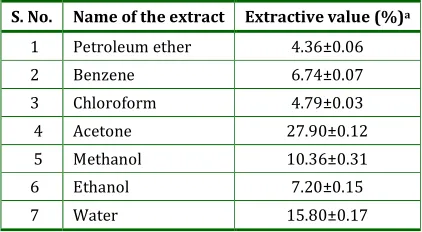
results are presented below. Ash and Extractive Values
The results of the ash and extractive values of the
powdered bark of N. crenulata are depicted in Tables
1a and 1b. The total ash content of the powdered bark
of N. crenulata is 7.37%. The extractive value of water
is more than the other solvents investigated in the
present study.
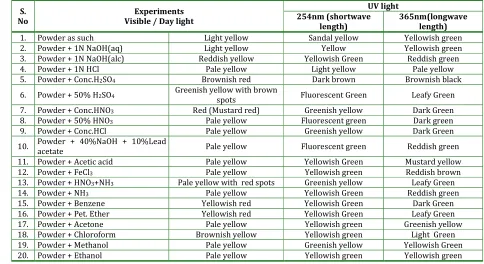
Fluorescence analysis
The results of fluorescent analysis of bark powder of
N. crenulata are shown in Table 2. The powder from
the bark of N. crenulata emitted light yellow under day
light, sandle yellow under short UV light and yellowish
green under long UV light. The bark powder shows the
characteristic fluorescent green colour when treated
with 50% H2SO4, 50% HNO3 and 40% NaOH+10% lead
acetate.
Preliminary phytochemical screening:
Petroleum ether, benzene, chloroform, methanol,
ethanol and aqueous extracts of bark powder of N.
crenulata are qualitatively analysed for the presence
of different phytoconstituents and the results are
presented in Table 3. The methanol and ethanol
extracts of bark of N. crenulata shows the presence of
alkaloids, coumarins, flavonoids, saponins, steroids,
tannins, glycosides, phenols quinines, terpenoids and
xanthoproteins.
DISCUSSION
It is globally accepted that herbal based drugs have
many advantages over the synthetic drugs. However,
one of the major problems in utilization of phytodrugs
is correct diagnosis of the medicinal plants that are
used either in the traditional systems or modern
systems of preparation of the drugs. It is regrettable to
note that most of the people involved in the
manufacture or preparation of herbal drugs lack the
basic background of botanical knowledge of the drugs.
Consequently adulteration or substitutions of plants
in the place of original ones permeate the
pharmaceutical industries, rendering the herbal drugs
undependable and invalid. This will lead to
unpopularity of phytodrugs among the people. So, it is
the most essential that a medicinal plant, when found
to be of high pharmacological potentials, should be
subjected to thorough botanical standardization so
that there wouldn’t any ambiguity with respect to
botanical identity of the plants. Identification of plants
involves the study of the external features of the
vegetative and floral parts. This study must be
complemented with anatomical parameters which are
very often useful to identify the fragmentary plant
specimens. Raw drugs pose problem of identification
and to establish their genuineness when they lack any
external diagnostic features or any organoleptic clues.
During such situations, the microscopic analyses of
the specimen will offer a helping hand to establish the
identity of the phytodrugs.
Literature dealing with anatomy of bark of N.
crenulata is minimal. The present study attempts a
modest comprehensive investigation of the bark of N.
crenulata. Since the bark of N. crenulata as the
folklore claims has therapeutic qualities. The present
investigation has laid down a set of anatomical
features of the trunk bark which can be employed for
its botanical diagonosis. The salient features of
identification of the fragmentary bark sample are as
follows
The stem exhibits normal, dicot type of
heavily circularised epidermal cells, wide
parenchymatous cortex and discontinuous
segments of sclerenchyma.
The vascular cylinder is thick and hollow
having wide continuous cylinder of phloem and
secondary xylem comprising diffuse vessels,
thick walled xylem fibres and thin straight
xylem rays.
Stem bark shows deeply fissured periderm;
cells of periderm homogeneous and thin
walled.
Secondary phloem wide with several discrete,
tangial lobes of phloem fibres and scleroids in
the collapsed phloem zone.
Prismatic calcium oxalate crystals are abundant
in the collapsed phloem; the crystals occur in
vertical strands associated.
Phloem rays are non- storied; they are 1-3
seriate, heterocellular; short and spindle
shaped
Sieve tubes have simple oblique sieve plates.
Pharmacochemical characterization
Physiochemical constituents
Ash value
The physical constant evaluation of the drug is an
important parameter in detecting adulteration or
improper handling of drugs.[15] Equally important in
the evaluation of crude drugs, is the ash value and acid
insoluble ash value determination. The total ash is
particularly important in the evaluation of purity of
drugs, that is, the presence or absence of foreign
organic matter such as metallic salts and/ or silica.[17]
The ash value of bark of N. crenulata is 7.37%. The ash
value is indicative of the impurities present in the
drug and the value is also one of the diagnostic
parameters of the drug. Total ash usually consists of
carbonates, phosphatases, oxidases, silicates and
silica. The total ash of crude drugs also reflects the
care taken in drug preservation and purity of crude
and prepared drug.[18] This value varies within fairly
wide limits and is therefore an important parameter
for the purpose of evaluation of crude drugs. In certain
drugs, the percentage variation of ash from sample to
sample is very small and any marked difference
indicates the change in quality. A high value is
indicative of contamination, substitution, adulteration
or carelessness in preparing the crude drug for
marketing. Samples have more water soluble ash than
acid soluble ash. The ash values are generally the
index of the purity as well as identity of the drug.
Fluorescence analysis
The phytoconstituents present in the crude drug
interact with the chemical reagents and may produce
certain products which may be present inside the cell
or may come out of the cell and react in the medium,
thus resulting in a specific fluorescence pattern. This
is the basis of the fluorescence analysis. The powder
from the bark of N. crenulata fluoresced light green
under day light, short UV light and dark green under
UV light.
Many phytocompounds fluoresce when suitably
illuminated. The fluorescent color is specific for each
compound. A non-fluorescent compound may
fluoresce if mixed with impurities that are fluorescent.
The fluorescent method is adequately sensitive and
enables the precise and accurate determination of the
analyze over a satisfactory concentration range
without several time consuming dilution steps prior to
the analysis of pharmaceutical samples.[19]
Phytochemical studies
Presence or absence of certain important compounds
in an extract is determined by color reactions of the
compounds with specific chemicals which act as dyes.
This procedure is a simple preliminary prerequisite
before going for detailed phytochemical investigation.
Various tests have been conducted qualitatively to
find out the presence or absence of bioactive
compounds such as flavonoids terpenoids, tannins,
saponins, steroids and xanthoprotein are detected in
N. crenulata bark which could made the plant useful
for treating different ailments as having a potential of
providing useful drugs of human use.
Pharmacognosy implies a particular knowledge of
drugs obtained from plants which include
macromorphology, anatomy, phytochemical and
pharmacological studies. The major problem of the
commercial supply of crude drugs is the identification
of genuine drug. Crude drugs may easily be
adulterated or substituted by or confused for other
ones because neither it has trade name printed on it
nor it carries any identifying structure for the easy
identification of it by the plant taxonomists, rather
drug samples supplied are shrunked, rolled, twisted,
deformed and discoloured.[20] So, pharmacognostic
evaluation of crude drugs with macromorphology,
micromorphology, ash value, fluorescence study and
phytochemical screening will help in identifying
genuine drugs because the tests are very specific for a
particular drug. Thus for checking the adulteration or
the use of substitutes can be easily detected to prove
purity of the drugs.
CONCLUSION
Thus, it is evident that the present study of the plant
material bark provides various resourceful
information in relation to pharmacognostical
identification of this plant material. Furthermore,
information regarding physicochemical
characteristics of trunk bark and nature of chemical
constituents present in them would also be useful for
standardization of such herbal drugs of folk medicinal
practice of present era and enrichment of Ayurvedic
Pharmacopoeia. It would also help scientists to utilize
such needful information regarding the plants identity
and characteristics in building new polyherbal
formulations
ACKNOWLEDGMENT
The first author Mrs. K. Sarada gratefully
acknowledges and expresses her sincere thanks to
University Grants Commission, New Delhi for providing financial assistance to this Minor research
project and thankful to Dr. P. Jayaraman, Plant
Anatomy Research Centre, Chennai for extending their
help in the anatomical studies.
Plate 1 Anatomy of the bark
1. T.S. of bark – entire view
2. T.S. of outer bark (periderm and collapsed phloem) 3. T.S. of Non-collapsed phloem
Plate 2
Different views of phloem 1. Prismatic crystals in the parenchyma cells and rays
2. RLS of phloem
3. RLS Phloem ray - enlarged
Cr – Crystal; PC – Procumbent cell; PhR – Phloem Ray; SE – Sieve Element; UR – Upright cells
Table 1a: Ash values of the powdered bark of Naringi crenulata
S. No. Type of Ash Ash Value (%)a
1 Total Ash 7.37±0.68
2 Water soluble ash 3.15±0.03
3 Acid insoluble ash 2.55±0.01
4 Sulphated Ash 8.41±0.65
Table 1b: Extractive values of the powdered bark of Naringi crenulata
S. No. Name of the extract Extractive value (%)a
1 Petroleum ether 4.36±0.06
2 Benzene 6.74±0.07
3 Chloroform 4.79±0.03
4 Acetone 27.90±0.12
5 Methanol 10.36±0.31
6 Ethanol 7.20±0.15
7 Water 15.80±0.17 aAll values are mean of triplicate determinations expressed on dry weight basis
Table 2: Fluorescence analysis of the powdered bark of Naringi crenulata
S. No
Experiments Visible / Day light
UV light 254nm (shortwave
length)
365nm(longwave length)
1. Powder as such Light yellow Sandal yellow Yellowish green
2. Powder + 1N NaOH(aq) Light yellow Yellow Yellowish green
3. Powder + 1N NaOH(alc) Reddish yellow Yellowish Green Reddish green
4. Powder + 1N HCl Pale yellow Light yellow Pale yellow
5. Powder + Conc.H2SO4 Brownish red Dark brown Brownish black
6. Powder + 50% H2SO4 Greenish yellow with brown
spots Fluorescent Green Leafy Green 7. Powder + Conc.HNO3 Red (Mustard red) Greenish yellow Dark Green 8. Powder + 50% HNO3 Pale yellow Fluorescent green Dark green 9. Powder + Conc.HCl Pale yellow Greenish yellow Dark Green
10. Powder + 40%NaOH + 10%Lead
acetate Pale yellow Fluorescent green Reddish green
11. Powder + Acetic acid Pale yellow Yellowish Green Mustard yellow 12. Powder + FeCl3 Pale yellow Yellowish green Reddish brown 13. Powder + HNO3+NH3 Pale yellow with red spots Greenish yellow Leafy Green
14. Powder + NH3 Pale yellow Yellowish Green Reddish green
15. Powder + Benzene Yellowish red Yellowish Green Dark Green 16. Powder + Pet. Ether Yellowish red Yellowish Green Leafy Green 17. Powder + Acetone Pale yellow Yellowish green Greenish yellow 18. Powder + Chloroform Brownish yellow Yellowish green Light Green 19. Powder + Methanol Pale yellow Greenish yellow Yellowish Green 20. Powder + Ethanol Pale yellow Yellowish green Yellowish green
Table 3: Phytochemical screening of powdered bark of Naringi crenulata
S. No. Test Petroleum ether Benzene Chloroform Methanol Ethanol Water
1. Alkaloids - - - + + +
2. Anthraquinones - - - -
3. Catechins - - - -
4. Coumarins - - - + + -
5. Flavonoids - - - + + -
6. Phenols - - - + + -
7. Quinones + + + + + -
8. Saponins - - - + + -
9. Steroids + + + + + -
10. Tannins - - - + + +
11. Terpenoids + - + + + +
12. Sugar - - - + + +
13. Glycosides + + + + + +
14. Xanthoprotein - - - + + -
REFERENCE
1. Bairagi V.A., Shinde P.R., Sentailkumar K.L., Sandu N.
Pharmacognostic and phytochemical investigation of
leaves and flowers of Quisqualis indica Linn. Int. J.
Pharm. Biomed. Sci. 2012; 3: 13-19.
2. Raja M.K.M.M., Sethiya N.K., Mishra S.H. A
comprehensive review on Nymphaea stellata: A
traditionally used bitters. J. Adv. Pharm Tech
Res. 2010; 1: 311–319.
3. Padashetty SA, Mishra SH. Phytochemical and
pharmacognostical parameters for standardization
of Tricholepis glaberrima: A medicinal herb. J. Med.
Aroma. Pl Sci. 2008; 30: 381–388.
4. Trease G.E., Evans W.C. Pharmacognosy 11th ed.
London Bailliere Tindall English Language Book
Soceity: 1978.
5. Trease G.E., Evans W.C. Pharmacognosy 11th ed.
London Bailliere Tindall English Language Book
6. Harborne JB, Williams CA. Advances in flavonoid
research since 1992. Phytochemistry. 2000; 55:
481-504.
7. Sarada K, Jothibai Margret R and Mohan V.R.2012.
Anticancer activity of ethanol extract of leaf and bark
of Narirgi crenulata against Ehrlich Ascites
carcinoma. Int. J. Res. Pharm. Chem.2: 267-272
8. Sarada K, Jothibai Margret R, Mohan V.R.
Hepatoprotective and antioxidant activity of ethanol
extracts of Narirgi crenulata (Roxb) Nicolson against
CCl4 included hepatotoxicity in rats. Int. J.
Pharmaceu. Sci. Res. 2012; 3: 874-880.
9. Sarada K, Jothibai Margret R, Mohan V.R. Aphrodisiac
potential of ethanol extracts of leaf and bark of
Naringi crenulata (Roxb.) Nicolson in male rats. In:
Proceedings of the International conference on
“Biologically active molecules” organized by
Department of Chemistry, Gandhigram Rural
Institute-Deemed University, Gandhigram. March,
2012.
10. Sarada K., Jothibai Margret R, Mohan V. R.
Anti-inflammatory activity of ethanol extracts of leaf and
bark of Naringi crenulata (Roxb.) Nicolson. Int. J.
Pharmaceu. Sci. Res. 2012; 3: 4540-4544.
11. Johansen, D.A. 1940. Plant Microtechnique. Mc Graw
Hill Book Co; New York. pp. 523.
12. O’ Brien J.P., Feder N., Mc Cull M.E. Polychromatic
staining of plant cell walls by toluidine blue-O.
protoplasma. 1964; 59: 364-373.
13. Junikka L. 1994. Survey of English Macroscopic bark
terminology. IAWA Bull. 15: 3-45.
14. Lala P.K. 1993. Lab Manuals of Pharmacognosy, CSI
Publishers and Distributors, Calcutta, 5 th Edition.
London.pp. 38-48.
15. African Pharmacopoeia .1986. General Methods for
Analysis Ist ed. 2: (OAU/STRC) Lagos.123.
16. Brindha P., Sasikala P., Purushothaman K.K.
Pharmacognostic studies on merugan kizhangu. Bull.
Med. Eth. Bot. Res. 1981; 3: 84 - 96.
17. Musa K.Y., Katsayal A.U., Ahmed A., Mohammed Z.,
Danmalam U.H. Pharmacognostic investigation of the
leaves of Gisekia pharmacioides. African J. Biotech.
2006; 5: 956 - 957.
18. Kokate C.K., Purohit A.P., Gokhale S.B.
Pharmacognosy. Nilgiri Prakashan Publishers.2005;
pp. 542-545.
19. Pimenta A.M., Montenegro M.C., Ara Ujo A.N.,
Martinez J. C. Application of sequential injections
analysis to pharmaceutical analysis. J. Pharm.
Biomed. Anul. 2006; 40: 16 - 34.
20. Muthukumarasamy S, MohanVR, Kumaresan S.
Pharmacognostic studies on the trunk bark of Ochna
lanceolata. J. Med. Aroma. Plant Sci. 2003; 25:
344-349.
How to cite this article: Sarada Kuppusamy, *Mohan Veerabahu Ramasamy, Sakthidevi Gurusamy; Pharmacognostic and Phytochemical evaluation of the bark of Naringi crenulata (Roxb.) Nicolson; J. Adv. Pharm. Edu. & Res. 2014: 4(1): 93-100.