An Enhanced Authenticated Key Agreement for Session Initiation Protocol
Mohammad Sabzinejad Farash
1, Mahmoud Ahmadian Attari
21 Department of Information and Communication Technology, Malek Ashtar University of Technology, Tehran, Iran.
e-mail: [email protected]
2 Faculty of Electrical and Computer Engineering, K. N. Toosi University of Technology, Tehran, Iran
e-mail: [email protected]
http://dx.doi.org/10.5755/j01.itc.42.4.2496
Abstract. In 2012, Xie proposed an authentication scheme based on Elliptic Curve Cryptography (ECC) for Session Initiation Protocol (SIP). However, this paper demonstrates that the Xie's scheme is vulnerable to impersonation at-tack by which an active adversary can easily forge the server's identity. Based on this attack, we also show that the Xie's scheme is also defenceless to off-line password guessing attack. Therefore, we propose a more secure and efficient scheme, which does not only cover all the security flaws and weaknesses of related previous protocols, but also provides more functionalities. We also evaluate the proposed protocol by AVISPA (Automated Validation of Internet Security Protocols and Applications) tools and confirm its security attributes.
Keywords: Authenticated Key Agreement; Elliptic Curve; Impersonation Attack; Password Guessing Attack; Session Initiation Protocol; AVISPA tools.
1. Introduction
The session initiation protocol (SIP) is an application layer signalling protocol for creating, modifying, and terminating multimedia sessions among one or more participants. SIP was developed by the Internet Engineering Task Force (IETF) in 1996. With the widespread application of the Voice over IP (VoIP) in Internet [1] and mobility management [2{4], SIP has been receiving a lot of attention and the security of SIP is becoming increasingly important [5]. When a user wants to access a SIP service, he or she has to perform an authentication process from the remote server. Thus, authentication is one of the most important issues for SIP. Various authentication schemes, especially based on Elliptic Curve Cryptography (ECC), have been proposed to provide security for SIP for a decade [6−12].
In 2005, Yang et al. [13] indicated that the original SIP authentication scheme is vulnerable to off-line password guessing attack and server-spoofing attack. To overcome the attacks, Yang et al. proposed a modified scheme based on Diffie-Hellman key exchange protocol. However, Huang et al. [14] pointed out that the Yang et al.'s scheme may not be suitable for users with limited computational power
and further proposed a new scheme. In [15], Jo et al. demonstrated that the schemes by Yang et al. and Huang et al. are both vulnerable to off-line password guessing attack.
Based on Yang et al.'s scheme, Durlanik and Sogukpinar [16] introduced an efficient authentication scheme for SIP by using Elliptic Curve Diffie-Hellman (ECDH) key exchange protocol. Because of the adoption of elliptic curves, Durlanik and Sogukpinar's scheme reduced the total execution time and the requirements for memory in comparison with Yang et al.'s scheme. However, Yoon and Yoo [17] indicated that Durlanik and Sogukpinar's scheme still suffered from off-line password guessing and Denning-Sacco attacks, and projected an improved scheme to overcome the weaknesses. However, Liu and Koenig [18] demonstrated that Yoon and Yoo's scheme still puts up with off-line password guessing and insider attacks.
defenceless to off-line password guessing, Denning-Sacco and stolen-verifier attacks, furthermore, it did not provide any key agreement, known-key secrecy and perfect forward secrecy (PFS) [20−22]. To deal with the problems, Arshad and Ikram proposed an ECC-based authentication scheme [22]. But, Tang and Liu [23] demonstrated the vulnerability of Arshad and Ikram's scheme to off-line password guessing attack and introduced an improved scheme to overcome the weakness.
In 2010, Yoon et al. [24] also proposed an authentication scheme based on ECC to deal with the problems in Tsai's scheme [19]. In 2012, Xie [25] pointed out that Yoon et al.'s scheme still suffers from stolen-verifier and off-line password guessing attacks, and proposed a new security enhanced scheme for SIP to solve these problems. However in this paper, we indicate that the Xie's scheme is still vulnerable to impersonation attack, by which an active adversary can easily forge the identity of the server. Based on this attack, we also show that the Xie's scheme still suffers from off-line password guessing attack. Then, we propose an improved scheme to enhance the security of the Xie's scheme. Our improved scheme does not only maintain the merits and cover the demerits of the Xie's scheme, but also meets all the requirements of such schemes. Our scheme also provides mutual authentication with key agreement. Moreover, our scheme provides a password change phase. Specifically, the users could renew their passwords anytime and anywhere. Finally, the security analysis is presented.
Typically, the theoretical analysis of cryptographic protocols is normally used to verify the security attributes in the design. However, it is not sufficient, and simulation tools must also be employed to verify all the security requirements of the protocol. AVISPA [26] is a strong simulation engine for automated security analysis of cryptographic protocols [32]. Therefore, we make use of the AVISPA tools to confirm the security attributes of the proposed protocol.
The rest of this paper is organized as follows. In Section 2, we review the Xie's authenticated key agreement for session initiation protocol. In Section 3, we propose impersonation attack and off-line password guessing attack on the Xie's scheme. An enhanced authentication scheme for SIP is proposed in Section 4. The proposed protocol is then analyzed for security by the use of theoretical analysis and AVISPA tools in Section 5. In Section 6, we make a comparison between our scheme and some related schemes. Finally, Section 7 concludes the paper.
2. A brief review of the Xie's scheme
This section briefly reviews the Xie's authentication scheme for SIP [25]. The Xie's scheme consists of three phases: the setup phase, the
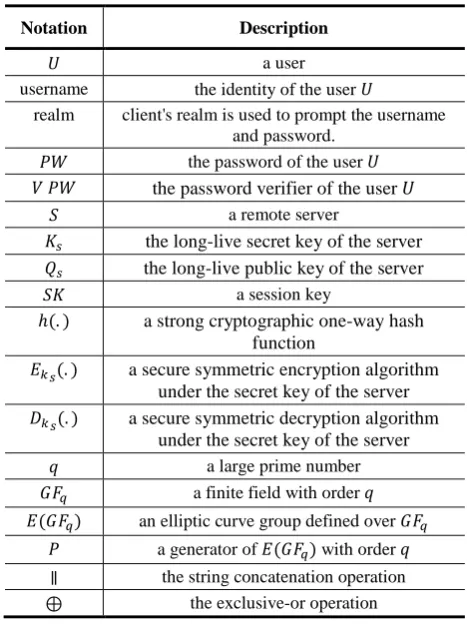
registration phase and the authentication phase. The notations used in this paper are shown in Table 1.
2.1. System setup phase
In this phase, the server 𝑆 sets the following system parameters: let 𝑞 be a large prime number,
𝐸(𝐺𝐺𝑞) an elliptic curve group defined over a finite field 𝐺𝐺𝑞, P a generator of 𝐸(𝐺𝐺𝑞)of order 𝑞, and ℎ(. ) a cryptographic hash function. 𝑆 also selects an integer
𝐾𝑠∈(1;𝑞) as the long-live secret key, and computes the corresponding public key 𝑄𝑠=𝐾𝑠𝑃. At the end of this phase, 𝑆 publishes all parameters except 𝐾𝑠.
2.2. Registration phase
When U wants to register and become a new legal user, 𝑈 and 𝑆 execute the following steps over a secure channel:
R1: 𝑈 sends password 𝑃𝑃 to 𝑆 via a secure channel. R2: 𝑆 computes 𝑉𝑃𝑃=𝐸𝐾𝑠(𝑃𝑃) and stores 𝑉𝑃𝑃
to the user account database (i.e., the registration table) corresponding to 𝑈's information.
2.3. Authentication phase
If the legal user 𝑈 wants to login into 𝑆, 𝑈 and 𝑆 perform the following steps:
A1: 𝑈 → 𝑆: REQUEST{𝑢𝑢𝑢𝑢𝑢𝑢𝑢𝑢,𝑢𝑃}
𝑈 chooses a random integer 𝑢(∈1,𝑞), computes and sends 𝑢𝑃 together with his or her username in a request message to 𝑆.
A2: 𝑆 → 𝑈: CHALLENGE{𝑢𝑢𝑢𝑟𝑢,𝑏𝑃,σ, KPx}
Upon receiving the request message, 𝑆 rst randomly chooses 𝑏,𝑘 ∈(1,𝑞) and computes 𝑏𝑃,
𝑆𝐾𝑠=𝑏𝑢𝑃, �𝑘 ∙ ℎ(𝑆𝐾𝑠‖𝑏𝑃)�𝑃= (𝐾𝑃𝑥,𝐾𝑃𝑦) and
σ=𝑘 − �ℎ(𝑆𝐾𝑠∥ 𝑏𝑃 )�−1𝐾𝑠(mod 𝑞). Then, 𝑆 sends the challenge message
CHALLENGE{𝑢𝑢𝑢𝑟𝑢,𝑏𝑏,𝜎,𝑘𝑃𝑥} back to 𝑈. A3: 𝑈 → 𝑆: RESPONSE {𝑢𝑢𝑢𝑢𝑢𝑢𝑢𝑢,𝑢𝑢𝑢𝑟𝑢,
ℎ(𝑢𝑢𝑢𝑢𝑢𝑢𝑢𝑢‖𝑢𝑢𝑢𝑟𝑢‖𝑆𝐾𝑢‖𝑃𝑃)}
Upon receiving the challenge message, 𝑈 computes 𝑆𝐾𝑢=𝑢𝑏𝑃, 𝑢=𝜎 ∙ ℎ(𝑆𝐾𝑢∥ 𝑏𝑃 )𝑃 +
𝑄𝑠 = (𝑢𝑥; 𝑢𝑦) and checks if 𝑢𝑥 =𝐾𝑃𝑥. If so, 𝑈 computes ℎ(𝑢𝑢𝑢𝑢𝑢𝑢𝑢𝑢 ∥ 𝑢𝑢𝑢𝑟𝑢 ∥ 𝑆𝐾𝑢∥ 𝑃𝑃) and sends RESPONSE{𝑢𝑢𝑢𝑢𝑢𝑢𝑢𝑢,𝑢𝑢𝑢𝑟𝑢,
ℎ(𝑢𝑢𝑢𝑢𝑢𝑢𝑢𝑢‖𝑢𝑢𝑢𝑟𝑢‖𝑆𝐾𝑢‖𝑃𝑃)} back to 𝑆 . Otherwise, 𝑈 rejects it.
A4: Upon receiving the response message, 𝑆 computes
𝑃𝑃=𝐷𝐾𝑢(𝑉𝑃𝑃) and ℎ(𝑢𝑢𝑢𝑢𝑢𝑢𝑢𝑢 ∥ 𝑢𝑢𝑢𝑟𝑢 ∥
𝑆𝐾𝑢∥ 𝑃𝑃) , and verifies if ℎ(𝑢𝑢𝑢𝑢𝑢𝑢𝑢𝑢 ∥
𝑢𝑢𝑢𝑟𝑢 ∥ 𝑆𝐾𝑢∥ 𝑃𝑃) =ℎ(𝑢𝑢𝑢𝑢𝑢𝑢𝑢𝑢 ∥ 𝑢𝑢𝑢𝑟𝑢 ∥
𝑆𝐾𝑢∥ 𝑃𝑃). If so, 𝑈 is authenticated. Otherwise,
𝑆 aborts the session.
At the end of the execution of the protocol, the session key shared between 𝑈 and 𝑆 is set to 𝑆𝐾=
Table 1. The Notations
Notation Description
𝑈 a user
username the identity of the user 𝑈
realm client's realm is used to prompt the username and password.
𝑃𝑃 the password of the user 𝑈
𝑉𝑃𝑃 the password verifier of the user 𝑈
𝑆 a remote server
𝐾𝑠 the long-live secret key of the server
𝑄𝑠 the long-live public key of the server
𝑆𝐾 a session key
ℎ(. ) a strong cryptographic one-way hash function
𝐸𝑘𝑠(. ) a secure symmetric encryption algorithm under the secret key of the server
𝐷𝑘𝑠(. ) a secure symmetric decryption algorithm under the secret key of the server
𝑞 a large prime number
𝐺𝐺𝑞 a finite field with order 𝑞
𝐸(𝐺𝐺𝑞) an elliptic curve group defined over 𝐺𝐺𝑞
𝑃 a generator of 𝐸(𝐺𝐺𝑞) with order 𝑞
∥ the string concatenation operation
⊕ the exclusive-or operation
3. Cryptanalysis of the Xie's scheme
3.1. The proposed impersonation attack on the Xie's scheme
In this section, we show that the Xie's scheme is vulnerable to impersonation attack. We show that an active adversary can easily introduce himself to the users as a legal server. The proposed attack works as follows:
I1: When the legal user 𝑈 wants to login into the
server 𝑆 , sends the request message
{𝑢𝑢𝑢𝑢𝑢𝑢𝑢𝑢,𝑢𝑃} to the 𝑆.
I2: An active adversary 𝒜 may eavesdrop the communication flows between 𝑈 and 𝑆, intercept the request message {𝑢𝑢𝑢𝑢𝑢𝑢𝑢𝑢,𝑢𝑃}, and do the following steps:
I2.1: Select a random number 𝑏′𝜖(1; 𝑞) and compute 𝑏′𝑃 and 𝑆𝐾𝑠′ =𝑏’𝑢𝑃.
I2.2: Select another random number 𝜎′ ∈(1,𝑞) as a signature and compute
𝑢′(ℎ(𝑆𝐾𝑠′‖𝑏′𝑃 ))𝑃+𝑄𝑠= (𝐾𝑃𝑥′,𝐾𝑃𝑦′) (1) I2.3: Send the challenge message
{𝑢𝑢𝑢𝑟𝑢,𝑏’𝑃,𝜎′,𝐾𝑃
𝑥′} back to the user 𝑈 on behalf of 𝑆.
I3: Upon receiving the challenge message, 𝑈 computes 𝑆𝐾𝑢=𝑢𝑏′𝑃 and
𝑢=𝜎′�ℎ(𝑆𝐾
𝑢‖𝑏′𝑃)�𝑃+𝑄𝑠= (𝑢𝑥,𝑢𝑦), (2) and checks if 𝑢𝑥=𝐾𝑃𝑥′. The following statements indicate that the verification equation 2 holds:
�𝑢𝑥,𝑢𝑦� =𝑢′�ℎ(𝑆𝐾𝑢‖𝑏′𝑃)�𝑃+𝑄𝑠
=𝑢′�ℎ(𝑏′𝑃‖𝑏′𝑃)�𝑃+𝑄 𝑠
=𝑢′�ℎ(𝑆𝐾
𝑠′‖𝑏′𝑃)�𝑃+𝑄𝑠
= (𝐾𝑃𝑥′,𝐾𝑃𝑦′).
Thus, 𝑈 would believe that the received mes-sage is generated by the legal server 𝑆. Then, 𝑈 computes ℎ(𝑢𝑢𝑢𝑢𝑢𝑢𝑢𝑢 ∥ 𝑢𝑢𝑢𝑟𝑢 ∥ 𝑆𝐾𝑢∥ 𝑃𝑃) and sends the response message
{𝑢𝑢𝑢𝑢𝑢𝑢𝑢𝑢,𝑢𝑢𝑢𝑟𝑢,𝑆𝐾𝑢,𝑃𝑃) to 𝑆. Finally, 𝑈 computes the session key 𝑆𝐾=ℎ(𝑆𝐾𝑢‖𝑃). I4: The adversary intercepts the response message and
computes the session key 𝑆𝐾=ℎ(𝑆𝐾𝑠′‖𝑃).
As can be clearly seen, the session key shared between 𝑈 and the adversary 𝒜 is set to 𝑆𝐾=
ℎ(𝑆𝐾𝑢‖𝑃) =ℎ(𝑆𝐾𝑠′‖𝑃) =ℎ(𝑢𝑏′𝑃‖𝑃) . Thus, the adversary without knowing the password 𝑃𝑃 and the server's private key 𝐾𝑠 can easily impersonate the server 𝑆 and share a secret key with 𝑈.
3.2. The proposed off-line password guessing attack on the Xie's scheme
As a result of the impersonation attack (see Section 3.1), off-line password guessing attack also can be applied to the Xie's scheme by an active adversary. To do so, the adversary 𝒜 applies an impersonation attack and obstructs the response message {𝑢𝑢𝑢𝑢𝑢𝑢𝑢𝑢,𝑢𝑢𝑢𝑟𝑢,ℎ(𝑢𝑢𝑢𝑢𝑢𝑢𝑢𝑢 ∥ 𝑢𝑢𝑢𝑟𝑢 ∥
𝑆𝐾𝑢‖𝑃𝑃)} at the end of the Step I3 in Section 3. After receiving the response message, 𝒜 launches the off-line password guessing attack as follows:
G1: A selects a candidate password 𝑃𝑃′ from the uniformly distributed dictionary of size |𝐷|. G2: As mentioned in the impersonation attack (see
Section 3.1, Step I2.1), the session key 𝑆𝐾𝑢=
𝑆𝐾𝑠′=𝑢𝑏′𝑃 , is known for the adversary. Therefore, 𝒜 can compute ℎ(𝑢𝑢𝑢𝑢𝑢𝑢𝑢𝑢 ∥
𝑢𝑢𝑢𝑟𝑢 ∥ 𝑆𝐾𝑠′∥ 𝑃𝑃′).
G3: 𝒜 compares ℎ(𝑢𝑢𝑢𝑢𝑢𝑢𝑢𝑢 ∥ 𝑢𝑢𝑢𝑟𝑢 ∥ 𝑆𝐾𝑠′∥
𝑃𝑃′) with ℎ(𝑢𝑢𝑢𝑢𝑢𝑢𝑢𝑢 ∥ 𝑢𝑢𝑢𝑟𝑢 ∥ 𝑆𝐾𝑢∥ 𝑃𝑃). If they are equal, 𝒜 guesses the right password of
𝑈. Otherwise, the adversary goes to the step G1 and does the next loop.
4. The proposed scheme for SIP
4.1. System setup phase
In the system setup phase, 𝑆 generates the following system parameters: an elliptic curve 𝐸 over a finite field 𝐺𝐺𝑞, an additive group of points on the elliptic curve 𝐸(𝐺𝐺𝑞), the generating point 𝑃 on
𝐸(𝐺𝐺𝑞) of order q and a secure hash function ℎ(. ). 𝑆 also selects an integer 𝐾𝑠∈(1,𝑞) as the long-live secret key, and computes 𝑄𝑠=𝐾𝑠𝑃 as the corresponding public key. Finally, S publishes the parameters {𝐸�𝐺𝐺𝑞�,𝑃,𝑞,ℎ(. ),𝑄𝑠}.
4.2. Registration phase
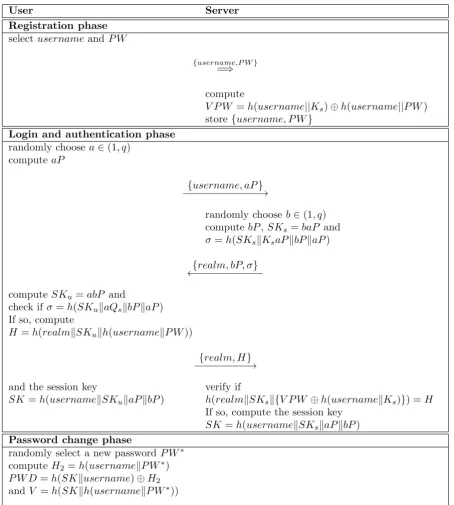
Figure 1 shows the registration phase of our scheme. When a user wants to login into the remote server, he/she firstly should register to the remote server. In this phase, the user communicates with the server through a secure channel. The details of this phase are as follows.
R1: The user freely chooses his or her 𝑢𝑢𝑢𝑢𝑢𝑢𝑢𝑢 and password 𝑃𝑃, and interactively sends them to the server through a secure channel.
R2: The server computes 𝑉𝑃𝑃 =ℎ(𝑢𝑢𝑢𝑢𝑢𝑢𝑢𝑢 ∥
𝐾𝑠) ⊕ ℎ(𝑢𝑢𝑢𝑢𝑢𝑢𝑢𝑢 ∥ 𝑃𝑃 and stores
(𝑢𝑢𝑢𝑢𝑢𝑢𝑢𝑢,𝑉𝑃𝑃) in its database.
4.3. Login and authentication phase
Figure 1 shows the login and authentication phase of our scheme. In this phase, the user communicates with the remote server through a public channel. When the user U wants to login into the remote server, he or she performs the following steps to execute a session of the protocol:
A1: 𝑈 → 𝑆: REQUEST{𝑢𝑢𝑢𝑢𝑢𝑢𝑢𝑢,𝑢𝑃}
𝑈 chooses a random integer 𝑢 ∈(1,𝑞), computes
and sends 𝑢𝑃 in the request message
REQUEST{𝑢𝑢𝑢𝑢𝑢𝑢𝑢𝑢,𝑢𝑃} to 𝑆. A2: 𝑆 → 𝑈: CHALLENGE{𝑢𝑢𝑢𝑟𝑢,𝑏𝑃,𝜎}
Upon receiving the request message, 𝑆 first randomly chooses 𝑏 ∈(1,𝑞) and computes 𝑏𝑃,
𝑆𝐾𝑠=𝑏𝑢𝑃 and 𝜎=ℎ(𝑆𝐾𝑠∥ 𝐾𝑠𝑢𝑃 ∥ 𝑏𝑃 ∥ 𝑢𝑃).
Then, 𝑆 sends the challenge message
CHALLENGE{𝑢𝑢𝑢𝑟𝑢, 𝑏𝑃,𝜎} back to 𝑈. A3: 𝑈 → 𝑆: RESPONSE{𝑢𝑢𝑢𝑟𝑢,𝐻}
Upon receiving the challenge message, 𝑈 computes 𝑆𝐾𝑢=𝑢𝑏𝑃 and checks if 𝜎=ℎ(𝑆𝐾𝑢∥
𝑢𝑄𝑠∥ 𝑏𝑃 ∥ 𝑢𝑃) . If so, 𝑈 computes 𝐻=
ℎ(𝑢𝑢𝑢𝑟𝑢 ∥ 𝑆𝐾𝑢∥ ℎ(𝑢𝑢𝑢𝑢𝑢𝑢𝑢𝑢 ∥ 𝑃𝑃) and sends
RESPONSE{𝑢𝑢𝑢𝑟𝑢,ℎ(𝑢𝑢𝑢𝑟𝑢 ∥ 𝐻)} back to 𝑆 and computes the session key 𝑆𝐾=ℎ(𝑢𝑢𝑢𝑢𝑢𝑢𝑢𝑢 ∥
𝑆𝐾𝑢∥ 𝑢𝑃 ∥ 𝑏𝑃 ). Other-wise, 𝑈 rejects it.
A4: Upon receiving the response message, 𝑆 verifies if
ℎ(𝑢𝑢𝑢𝑟𝑢 ∥ 𝑆𝐾𝑠∥{𝑉𝑃𝑃 ⊕ ℎ(𝑢𝑢𝑢𝑢𝑢𝑢𝑢𝑢 ∥
𝐾𝑠)}) =𝐻.
If so, 𝑈 is authenticated and 𝑆 computes the session key 𝑆𝐾=ℎ(𝑢𝑢𝑢𝑢𝑢𝑢𝑢𝑢 ∥ 𝑆𝐾𝑠∥ 𝑢𝑃 ∥
𝑏𝑃). Otherwise, 𝑆 aborts.
Finally, the session key shared between U and S is set to
𝑆𝐾 =ℎ(𝑢𝑢𝑢𝑢𝑢𝑢𝑢𝑢 ∥ 𝑆𝐾𝑢∥ 𝑢𝑃 ∥ 𝑏𝑃)
=ℎ(𝑢𝑢𝑢𝑢𝑢𝑢𝑢𝑢 ∥ 𝑆𝐾𝑠∥ 𝑢𝑃 ∥ 𝑏𝑃)
4.4. Password change phase
Figure 1 shows the password change phase of our scheme. The user U can change the password freely in this phase. To do so, he/she firstly needs to execute the login and authentication phase with his/her username and old password 𝑃𝑃. After receiving the successful authentication confirmation from the server and sharing the session key 𝑆𝐾, the user 𝑈 inputs the new password 𝑃𝑃∗ as follows:
C1. 𝑈 → 𝑆: {𝑃𝑃𝐷,𝑉}
The user 𝑈 computes 𝑃𝑃𝐷= ℎ(𝑆𝐾 ∥
𝑢𝑢𝑢𝑢𝑢𝑢𝑢𝑢) ⊕ ℎ(𝑢𝑢𝑢𝑢𝑢𝑢𝑢𝑢 ∥ 𝑃𝑃∗) and
𝑉=ℎ(𝑆𝐾 ∥ ℎ(𝑢𝑢𝑢𝑢𝑢𝑢𝑢𝑢 ∥ 𝑃𝑃∗)) , an sends them to the server.
C2. 𝑆 → 𝑈: {𝐴𝐴𝐴𝑢𝑏𝐴,𝑅1} or {𝑅𝑢𝑅𝑢𝐴𝐴,𝑅2}
Upon receiving the message 𝑃𝑃𝐷 and 𝑉, the server computes 𝐻2′=𝑃𝑃𝐷 ⊕ ℎ(𝑆𝐾 ∥
𝑢𝑢𝑢𝑢𝑢𝑢𝑢𝑢) and checks whether 𝑉 is equal to
ℎ(𝑆𝐾 ∥ 𝐻2′). If so, the server accepts the password change request, computes 𝑅1=ℎ(𝐴𝐴𝐴𝑢𝑏𝐴 ∥
𝑢𝑢𝑢𝑢𝑢𝑢𝑢𝑢 ∥ 𝑃𝑃𝐷 ∥ 𝑉 ∥ 𝑆𝐾) and sends
{𝐴𝐴𝐴𝑢𝑏𝐴,𝑅1} back to the user. Otherwise, they are not equal, the server rejects the password change request, computes 𝑅2 =ℎ(𝑅𝑢𝑅𝑢𝐴𝐴 ∥ 𝑢𝑢𝑢𝑢𝑢𝑢𝑢𝑢 ∥
𝑃𝑃𝐷 ∥ 𝑉 ∥ 𝑆𝐾) and sends {𝑅𝑢𝑅𝑢𝐴𝐴,𝑅2} back to the user. Finally, the server replaces 𝑉𝑃𝑃 with
𝑉𝑃𝑃∗=ℎ(𝑢𝑢𝑢𝑢𝑢𝑢𝑢𝑢 ∥ 𝐾
𝑠) ⊕ 𝐻2′.
It is obvious that the verification equation
ℎ(𝑢𝑢𝑢𝑟𝑢 ∥ 𝑆𝐾𝑠∥{𝑉𝑃𝑃∗⊕ ℎ(𝑢𝑢𝑢𝑢𝑢𝑢𝑢𝑢 ∥ 𝐾𝑠)}) =
𝐻 in Section 4.3, item A.4 is passed because
𝑉𝑃𝑃∗=ℎ (𝑢𝑢𝑢𝑢𝑢𝑢𝑢𝑢 ∥ 𝐾
𝑠) ⊕ 𝐻2′
=ℎ(𝑢𝑢𝑢𝑢𝑢𝑢𝑢𝑢 ∥ 𝐾𝑠)⊕ 𝑃𝑃𝐷 ⊕ ℎ(𝑆𝐾 ∥
𝑢𝑢𝑢𝑢𝑢𝑢𝑢𝑢)
=ℎ(𝑢𝑢𝑢𝑢𝑢𝑢𝑢𝑢 ∥ 𝐾𝑠)⊕ ℎ(𝑆𝐾 ∥ 𝑢𝑢𝑢𝑢𝑢𝑢𝑢𝑢)
=ℎ(𝑢𝑢𝑢𝑢𝑢𝑢𝑢𝑢 ∥ 𝑃𝑃∗)⊕ ℎ(𝑆𝐾 ∥ 𝑢𝑢𝑢𝑢𝑢𝑢𝑢𝑢)
=ℎ(𝑢𝑢𝑢𝑢𝑢𝑢𝑢𝑢 ∥ 𝐾𝑠 )⊕ ℎ(𝑢𝑢𝑢𝑢𝑢𝑢𝑢𝑢 ∥ 𝑃𝑃∗) and,
ℎ(𝑢𝑢𝑢𝑟𝑢 ∥ 𝑆𝐾𝑠 ∥{𝑉𝑃𝑃∗⊕ ℎ(𝑢𝑢𝑢𝑢𝑢𝑢𝑢𝑢 ∥ 𝐾𝑠)})
=ℎ(𝑢𝑢𝑢𝑟𝑢 ∥ 𝑆𝐾𝑠∥ ℎ(𝑢𝑢𝑢𝑢𝑢𝑢𝑢𝑢 ∥ 𝑃𝑃∗))
=ℎ(𝑢𝑢𝑢𝑟𝑢 ∥ 𝑆𝐾𝑢∥ ℎ(𝑢𝑢𝑢𝑢𝑢𝑢𝑢𝑢 ∥ 𝑃𝑃∗))
5. Security analysis
5.1. Theoretical analysis
Replay attack. Suppose an attacker 𝒜 intercepts
REQUEST(𝑢𝑢𝑢𝑢𝑢𝑢𝑢𝑢,𝑢𝑃 ) from 𝑈 in step A1 and replays it to impersonate 𝑈. However, 𝒜 cannot compute a correct session key 𝑆𝐾=𝑢𝑏𝑃 and deliver it to 𝑆 in step A3 unless he/she can correctly guess the password PW and guess 𝑏 from 𝑏𝑃 or 𝑢 from 𝑢𝑃. When 𝒜 tries to guess a from 𝑢𝑃 or 𝑏 from 𝑏𝑃, he/she will face the Elliptic Curve Discrete Logarithm Problem (ECDLP) which is untraceable. On the other hand, suppose 𝒜 intercepts CHALLENGE(𝑢𝑢𝑢𝑟𝑢,
𝑏𝑃,𝑢) from 𝑆 in step A2 and replays it to impersonate
𝑆. The replied message cannot pass the verification process 𝜎=ℎ(𝑆𝐾𝑢∥ 𝑢𝑄𝑠∥ 𝑏𝑃 ∥ 𝑢𝑃), since 𝑢 is a new nonce chosen by 𝑈 in each session and the adversary has no control of it. Therefore, the proposed scheme can resist the replay attack.
Stolen-verifier attack. When attacker 𝒜 steals verifier 𝑉𝑃𝑃=ℎ(𝑢𝑢𝑢𝑢𝑢𝑢𝑢𝑢 ∥ 𝐾𝑠)⊕ ℎ(𝑢𝑢𝑢𝑢𝑢𝑢𝑢𝑢
∥ 𝑃𝑃) from the database of the server, he/she cannot obtain the right password 𝑃𝑃 from 𝑉𝑃𝑃 without knowing the secret key 𝐾𝑠 of the server, which is a high entropy number and cannot be guessed by enumeration. Therefore, the proposed scheme is secure against stolen-verifier attack.
Denning-Sacco attack. Attacker 𝒜 may obtain the session key 𝑆𝐾=ℎ(𝑢𝑢𝑢𝑢𝑢𝑢𝑢𝑢 ∥ 𝑆𝐾𝑢∥ 𝑢𝑃 ∥
𝑏𝑃) =ℎ(𝑢𝑢𝑢𝑢𝑢𝑢𝑢𝑢 ∥ 𝑆𝐾𝑠 ∥ 𝑢𝑃 ∥ 𝑏𝑃) for some reasons, but he/she cannot obtain user's secret password 𝑃𝑃 and server's secret key 𝐾𝑠 because he/she will face to obtain 𝑢𝑏𝑃 which is protected by a hash function.
Impersonation attack. An adversary 𝒜 cannot masquerade as server, because he/she cannot compute the signature 𝜎=ℎ(𝑆𝐾𝑠 ∥ 𝐾𝑠𝑢𝑃 ∥ 𝑏𝑃 ∥ 𝑢𝑃) with-out knowing the server's secret key 𝐾𝑠. 𝒜 also cannot impersonate the user to authenticate with the server, because he/she cannot construct the message
𝑅𝐸𝑆𝑃𝑅𝑅𝑆𝐸{𝑢𝑢𝑢𝑢𝑢𝑢𝑢𝑢,𝑢𝑢𝑢𝑟𝑢,ℎ(𝑢𝑢𝑢𝑟𝑢 ∥ 𝑆𝐾𝑢∥
ℎ(𝑢𝑢𝑢𝑢𝑢𝑢𝑢𝑢 ∥ 𝑃𝑃)} without the knowledge of 𝑃𝑃. Therefore, the proposed scheme resists im-personation attack.
Password guessing attack. It is divided into online password guessing attack and off-line password guessing attack. Online password guessing attack can be preserved by limiting the login times. The exchanged messages between the user and the server, in the login phase (step A1) and verification phase (step A2), are independent of the user's password; therefore the adversary cannot execute any off-line guessing attack on our scheme.
Man-in-the-middle attack. Password 𝑃𝑃 of 𝑈 and the secret key 𝐾𝑠 of 𝑆 are used to prevent the man-in-middle attack. Therefore, the active adversary 𝒜
cannot intrude into the communication between 𝑆 and
𝑈 to intercept the exchanged data and inject false information.
Modification attack. An adversary 𝒜 cannot modify the communicated messages (𝑢𝑢𝑢𝑢𝑢𝑢𝑢𝑢,𝑢𝑃) in step A1, (𝑢𝑢𝑢𝑟𝑢,𝑏𝑃,𝜎) in step A2 and {𝑢𝑢𝑢𝑢𝑢𝑢𝑢𝑢,
𝑢𝑢𝑢𝑟𝑢,ℎ(𝑢𝑢𝑢𝑟𝑢 ∥ 𝑆𝐾𝑢∥ ℎ(𝑢𝑢𝑢𝑢𝑢𝑢𝑢𝑢 ∥ 𝑃𝑃))} in step A3, because the user and the server detect them by verifying 𝑢 and ℎ(𝑢𝑢𝑢𝑟𝑢 ∥ 𝑆𝐾𝑢∥ ℎ(𝑢𝑢𝑢𝑢𝑢𝑢𝑢𝑢 ∥
𝑃𝑃)), respectively.
Known-key security. In this attack, an adversary, who has some previous session keys, is willing to compute the next session keys. Assume that some previous session keys are known for the adversary 𝒜. It does not give any useful information to 𝒜 for computing the next session keys, because the short-term private keys 𝑢 and 𝑏 are changed in each session. Note that, A cannot obtain 𝑢 from 𝑢𝑃 or 𝑏 from 𝑏𝑃 because he/she will face the ECDLP. Therefore, the proposed protocol satisfies the known-key security.
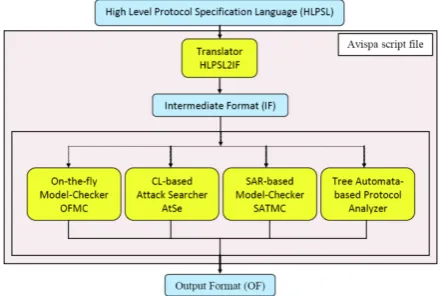
Figure 2. The architecture of the AVISPA tools
Perfect forward secrecy. Perfect forward secrecy means that if long-term private keys of one or more entities are compromised, the secrecy of previous session keys established by the trusted entities is not affected. In the proposed protocol, the adversary who knows 𝑃𝑃 and 𝐾𝑠 cannot determine the previous session keys because long-term private keys are not utilized for computing the session keys. In addition, the adversary cannot compute neither 𝑢 nor 𝑏 from
𝑢,𝑢𝑃,𝑏𝑃 and 𝐾𝑠 since he/she has to solve Elliptic Curve Deffie-Hellman Problem (ECDHP). Therefore, the proposed protocol satis es the perfect forward secrecy.
5.2. Simulation results
validation of Internet security-sensitive protocols and applications. It provides a modular and expressive formal language for specifying protocols and their security properties, and integrates different back-ends that implement a variety of state-of-the-art automatic analysis techniques.
The architecture of AVISPA is shown in Figure 2. The firrst step in using the tool is to present the analyzed protocol in a special language called High Level Protocol Specification Language (HLPSL). The HLPSL presentation of the protocol is translated into the lower level language called Intermediate Format (IF). This translation is performed by the translator called HLPSL2IF. This step is totally transparent to the user. IF presentation of the protocol is used as an input to the four different back-ends: On-the-fly Model-Checker (OFMC), CL-based Attack Searcher (CL-AtSe), SAT-based Model-Checker (SATMC) and Tree-Automata-based Protocol Analyzer (TA4SP). These back-ends perform the analysis and output the results in precisely defined output format stating whether there are problems in the protocol or not.
% OFMC
% Version of 2006/02/13 SUMMARY
SAFE DETAILS
BOUNDED_NUMBER_OF_SESSIONS PROTOCOL
/ h o me / a v i s p a / w e b - i n t e r f a c e - c o mp u t a t i o n / . / t e m p d i r / w o r k f i l e a T P T 9 E . i f
GOAL
as_s p e c i f i e d BACKEND OFMC COMMENTS STATISTICS
parseTime : 0.00 s searchTime : 0.09 s visitedNodes : 21 nodes depth : 4 p l i e s
Figure 3. The output of OFMC back-end
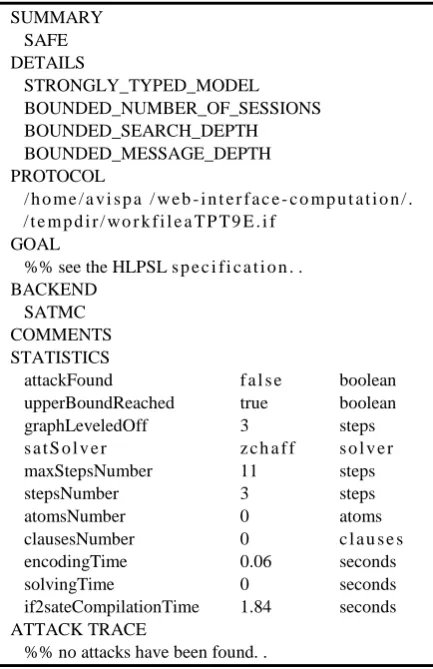
In order to evaluate the security of the proposed protocol by the AVISPA tools the protocol is coded in HLPSL. The HLPSL code of the proposed protocol is included in Appendix A. After execution of the code in AVISPA tool, the outputs of OFMC (Figure 3), CL−AtSe (Figure 4) and SATMC (Figure 5) back-ends were generated. According to the summary results, the proposed protocol is SAFE and there are no major attacks on it. Therefore, these results confirm the theoretical analysis in Section 5.1.
SUMMARY SAFE DETAILS
BOUNDED_NUMBER_OF_SESSIONS TYPED_MODEL
PROTOCOL
/ h o me / a v i s p a / w e b - i n t e r f a c e - c o mp u t a t i o n / . / t e m p d i r / w o r k f i l e a T P T 9 E . i f
GOAL As S p e c i f i e d BACKEND CL_AtSe STATISTICS
Analysed : 26 s t a t e s Reachable : 15 s t a t e s Translation : 0.01 seconds Computation : 0.00 seconds
Figure 4. The output of CL-AtSe back-end
SUMMARY SAFE DETAILS
STRONGLY_TYPED_MODEL BOUNDED_NUMBER_OF_SESSIONS BOUNDED_SEARCH_DEPTH BOUNDED_MESSAGE_DEPTH PROTOCOL
/ h o me / a v i s p a / w e b - i n t e r f a c e - c o mp u t a t i o n / . / t e m p d i r / w o r k f i l e a T P T 9 E . i f
GOAL
%% see the HLPSL s p e c i f i c a t i o n . . BACKEND
SATMC COMMENTS STATISTICS
attackFound f a l s e boolean upperBoundReached true boolean graphLeveledOff 3 steps s a t S o l v e r z c h a f f s o l v e r maxStepsNumber 11 steps stepsNumber 3 steps atomsNumber 0 atoms clausesNumber 0 c l a u s e s encodingTime 0.06 seconds solvingTime 0 seconds if2sateCompilationTime 1.84 seconds ATTACK TRACE
%% no attacks have been found. .
Figure 5. The output of SATMC back-end
6. Security and performance comparison
We mainly consider the computations of login and authentication phase and session key agreement since these are the principal parts of an authentication protocol and should be implemented for each session. In Table 3, it is obvious that the computation cost of the proposed protocol is lesser than the Xie's scheme. However, it is worth several additional hash operations to achieve the security and functionality properties.
Table 4 lists the security comparisons among our pro-posed protocol and other related protocols. It demonstrates that our protocol has many excellent features and is more secure than other related protocols.
Table 2. Computation cost of login and authentication phase
User Server Total
No. of scale multiplication 3 3 6 No. of hash function 4 4 8 No. of exclusive or 0 1 1
7. Conclusions
In this paper, we briefly reviewed the Xie's authenticated key agreement protocol session initiation protocol. We demonstrated that the Xie's scheme is vulnerable to the impersonation attack in which an active adversary with-out knowing the users' password and the server's private key can easily impersonate the server to the users and share secret keys with them. As a result of the impersonation attack, we pointed out that the Xie's scheme also suffers from the off-line password guessing attack. The main aw of the Xie's scheme is due to the signature scheme used by the server which is forgeable. To overcome the security weaknesses, we proposed an improved scheme. In comparison to the related schemes, the proposed scheme not only is secure against well-known crypto-graphical attacks such as guessing attacks, replay attacks, but also provides mutual authentication, perfect forward secrecy and secure password change.
Table 3. Comparison of computation costs
Durlanik [16]
Yang
[13] Tsai [19]
Yoon [24]
Arshad [22]
Tang
[23] Xie [25] Ours
No. of exponentiation 0 4 0 0 0 0 0 0
No. of scale multiplication 4 0 0 6 5 4 6 6
No. of point addition 0 0 0 3 0 2 1 0
No. of hash-to-point 0 0 0 0 0 2 0 0
No. of hash function 6 8 7 4 8 7 6 8
No. of exclusive or 4 4 3 0 2 1 0 1
No. of modular inverse 0 0 0 0 0 0 1 0
No. of symmetric key encryption 0 0 0 0 0 0 2 0
Security ECDLP DLP HASH ECDLP ECDLP ECDLP ECDLP ECDLP
Table 4. Comparison of security attributes
Durlanik
[16] Yang [13] Tsai [19]
Yoon [24]
Arshad
[22] Tang [23] Xie [25] Ours
Reply attack Secure Secure Secure Secure Secure Secure Secure Secure
Man-in-the-middle attack Secure Secure Insecure Secure Secure Secure Insecure Secure
Impersonation attack Insecure Insecure Insecure Secure Insecure Secure Insecure Secure
Password guessing attack Insecure Insecure Insecure Insecure Insecure Secure Insecure Secure
Denning-Sacco attack Insecure N/A Insecure Insecure Secure Secure Secure Secure
Stolen-verifier attack Insecure Insecure Insecure Insecure Secure Secure Secure Secure
Mutual authentication Provided Provided Provided Provided Provided Provided Provided Provided
Session key security Provided N/A Provided Provided Provided Provided Provided Provided
Known key secrecy Provided N/A Not provided Provided Provided Provided Provided Provided
Perfect forward secrecy Provided N/A Not provided Provided Provided Provided Provided Provided
References
[1] W. E. Chen, Y. L. Huang, Y. B. Lin. An effective IPv4-IPv6 translation mechanism for SIP applications in next generation networks. International Journal of Communication Systems, 2010, Vol. 23, No. 8, 919−928.
[2] C. C. Lee, I. E. Liao, M. S. Hwang. An ex-tended certificate-based authentication and security protocol for mobile networks. Information Technology and Control, 2009, Vol. 38, No. 1, 61-66.
[3] C. T. Li. A more secure and efficient authentication scheme with roaming service and user anonymity for mobile communications. Information Technology and Control, 2012, Vol. 41, No. 1, 69-76
[4] Y. H. Cheng, F. M. Chang, S. J. Kao. Efficient hierarchical SIP mobility management for WiMAX networks. Computers & Mathematics with Applica-tions, 2012, Vol. 64, No. 5, 1522-1531.
[5] D. Geneiatakis, T. Dagiuklas, G. Kambourakis, C. Lambrinoudakis, S. Gritzalis, S. Ehlert, D. Sisalem. Survey of security vulnerabilities in session initiation protocol. IEEE Communications Surveys and Tutorials, 2006, Vol. 8, No. 3, 68-81. [6] S. S. Mousavi-Nik, M. H. Yaghmaee-Moghaddam,
M. B. Ghaznavi-Ghoushchi. Proposed secure SIP authentication scheme based on elliptic curve cryptography. International Journal of Computer Applications. 2012, Vol. 58, No. 8, 25-30.
[7] E. J. Yoon, K. Y. Yoo, C. Kim, Y. S. Hong, M. Jo, H. H. Chen. A secure and efficient SIP authentication scheme for converged VoIP networks. Computer Communications, 2010, Vol. 33, No. 14, 1674-1681. [8] L. Wu, Y. Zhang, F. Wang. A new provably secure
authentication and key agreement protocol for SIP using ECC. Computer Standards & Interfaces, 2009, Vol. 31, No. 2, 286-291.
[9] Y.P. Liao, S. S. Wang. A new secure password authenticated key agreement scheme for SIP using self-certified public keys on elliptic curves. Computer Communications, 2010, Vol. 33, No. 3, 372-380. [10] S. Wu, Q. Pu, F. Kang. Practical authentication
scheme for SIP. Peer-to-Peer Networking and Applications. 2013, Vol. 6, No. 1, 61-74.
[11] D. He, J. Chen, Y. Chen. A secure mutual authentication scheme for session initiation protocol using elliptic curve cryptography. Security and Communication Networks, 2012, Vol. 5, No. 12, 1423−1429.
[12] J. W. Hong, S. Y. Yoon, D. I. Park, M. J. Choi, E. J. Yoon, K. Y. Yoo. An new efficient key agreement scheme for VSAT satellite communications based on elliptic curve cryptosystem. Information Technology and Control, 2011, Vol. 40, No. 3, 252−259.
[13] C. C. Yang, R. C. Wang, W. T. Liu. Secure authentication scheme for session initiation protocol.
Computers & Security, 2005, Vol. 24, No. 5, 381-386. [14] H. F. Huang, W.C. Wei, G. E. Brown. A new
efficient authentication scheme for session initiation protocol. In: 9th Joint Conference on Information Sciences, 2006.
[15] H. Jo, Y. Lee, M. Kim, S. Kim, D. Won. Off-line password-guessing attack to Yang's and Huang's authentication schemes for session initiation protocol. Fifth International Joint Conference on INC, IMS and IDC, 2009, pp. 618-621.
[16] A. Durlanik, I. Sogukpinar. SIP authentication scheme using ECDH. World Enformatika Socity Transations on Engineering Computing and Technology, 2005, Vol. 8, 350-353.
[17] E. J. Yoon, K. Y. Yoo. Cryptanalysis of DS-SIP authentication scheme using ECDH. In: International Conference on New Trends in Information and Service Science, 2009, pp. 642-647.
[18] F. W. Liu, H. Koenig. Cryptanalysis of a SIP authentication scheme. In: 12th IFIP TC6/TC11 International Conference, CMS 2011, Lecture Notes in Computer Science, 2011, Vol. 7025, 134-143.
[19] J. L. Tsai. Efficient nonce-based authentication scheme for session initiation protocol. International Journal of Network Security, 2009, Vol. 8, No. 3, 312−316.
[20] E. J. Yoon, K. Y. Yoo. A new authentication scheme for session initiation protocol. In: International Conference on Complex, Intelligent and Soft-ware Intensive Systems, CISIS'09, 2009, pp. 549-554. [21] T. H. Chen, H. L. Yeh, P. C. Liu, H. C. Hsiang,
W. K. Shih. A secured authentication protocol for SIP using elliptic curves cryptography. In: FGCN 2010, Part I, Communications in Computer and Information Science, 2010, Vol. 119, pp. 46-55.
[22] R. Arshad, N. Ikram. Elliptic curve cryptography based mutual authentication scheme for session initiation protocol. Multimedia Tools and Applications, 2013, Vol. 66, No. 2, 165-178.
[23] H. Tang, X. Liu. Cryptanalysis of Arshad et al.'s ECC-based mutual authentication scheme for session initiation protocol, Multimedia Tools and Applications, 2013, Vol. 65, No. 3, 165-178.
[24] E. J. Yoon, Y. N. Shin, I. S. Jeon, K. Y. Yoo. Robust mutual authentication with a key agreement scheme for the session initiation protocol. IETE Technical Review, 2010, Vol. 27, No. 3, 203-213.
[25] Q. Xie. A new authenticated key agreement for session initiation protocol. International Journal of Communication Systems, 2012, Vol. 25, No. 1, 47-54. [26] The AVISPA Project. http://www.avispa-project.org. [27] B. Blanchet. An effcient cryptographic protocol
verifier based on Prolog rules. In: 14th IEEE Computer Security Foundations Workshop (CSFW), 2001, pp. 82-96.
[28] C. Cremers. The Scyther Tool: verification, falsification, and analysis of security protocols. In: CAV08, LNCS, 2008, Vol. 5123, pp. 414-418.
Appendix A. HLPSL code of the proposed
protocol
role client(
A, S : agent , SND,RCV : channel (dy) ,
H : hash_func ,
P, Qs : public_key )
played by A def=
local State : nat ,
PW : symmetric_key,
Kas, Rs, Ra, Sigma, SKu, Ta, Ts,F : text, Username , Realm : message
const sec_kas1 , sec_sku ,
sec_ra , sec pw : protocol_lid
init State :=0 transition
1. State =0/\RCV(start)=|> State’:=1
/ \ Ra’:=new ()
/ \ SND({Ra’}_P . Username) / \ witness (A, S , na , Ra’) / \ secret(Ra’, sec_ra ,A)
2. State=1
/ \ RCV( Realm.{Rs’}_ P.H({Ra.Rs’}_P. {Ra’}_Qs.{Rs’}_P, {Ra’}_P)) = | > State’:=2
/ \ F’:=H(Realm.{Ra.Rs}_P.H(Username.PW)) / \ SND(Realm.F’)
/ \Kas’:=H(Username.{Ra.Rs}_P.{Ra}_P.{Rs}_P) / \ secret(PW,sec_pw,A)
/ \ secret(Kas’, sec_kas1, {A,S}) / \ request (A, S, ns, Ra)
/ \ request (A, S, ns, PW) end role
role server (
S ,A : agent,
SND,RCV : channel(dy),
H : hash_func,
P, Qs : public_key)
played_by S def=
local State : nat,
PW : symmetric_key,
Ra, Rs, Sigma, SKs, Ta, Ts, F, Kas : text,
Username, Realm : message
const sec_kas2, sec_rs, sec_pw1 : protocolid
init State :=0
transition
1. State =0/ \RCV({Ra’}_P.Username)=| > State’:=1
/ \Rs’:=new( )
/ \ Sigma’:=H({Rs’.Ra}_P.{{Ra}_P}_ inv (Qs ).{Rs’}_P,{Ra}_P) / \SND(Realm.{Rs’}_P.Sigma’) / \ witness (S, A, ns, Rs ‘) / \ secret (Rs’, sec_rs, S) / \ secret (PW, sec_pw1, S) 2. State=2 / \RCV(Realm.F’)=| >
State’:=3
/ \F’:=H(Realm.{Rs.Ra}_P.H(Username.PW)) / \Kas’:=H(Username.{Rs.Ra}_P.{Ra}_P.{Rs}_P) / \ secret (Kas’, sec_kas2, {A, S})
/ \ request (S ,A, na , Rs) end role
role session (
A, S : agent ,
H : hash_func ,
P, Qs : public_key )
def= local
SA, RA, SS, RS : channel (dy)
composition
client (A, S, SA, RA, H, P, Qs) / \ server (S, A, SS, RS, H, P, Qs) end role
role environment ( ) def=
const
na, ns : protocolid ,
a, s, i : agent ,
h : hash_func ,
p, qs, qi : public_key
intruder_knowledge={a, s, h, p, qs, qi}
composition
session (a, s, h, p, qs) / \ session (a, i, h, p, qi) / \ session (i, s, h, qs, qi) end role
goal secrecy_of
sec_kas1, sec_kas2, sec_ra, sec_rs, sec_pw, sec_pw1
authentication_on na authentication_on ns end goal