INFORMATION TECHNOLOGIES FOR LIBRARIES AND
INFORMATION CENTRES
A LAKSHMANA MOORTHY and V RAJENDRAN
Defence Scientific Information and Doeurnentation Centre, Delhi- 1 10 054
ABSTRACT ever shrinking library-budget; cannot help in
For the past few years, the tremendous strides taken in the fields of information technologies have changed the society into an information conscious society. There is little doubt that the impact of these technologies on the day-to-day functions of information centres is an everlasting one. The innumerable advances in different fields such as computers, communi- cations, electronic mail, voice mail, teletext, videotext, telefax, videodisc,
CD-ROM,
electronic publishing, etc have left no area in the library, and information field immune for their application. And many areas still remain undiscovered.This paper, first in a series, makes an attempt to overview the impact of the information technologies on the library and information services. A brief discussion of electronic message and documentdelivery systems,and electronic mail are also presented.
1. INTRODUCTION
lnformation is becoming one of the major resources on which our information kociety is based. Technology is the means by which this resource is stored, retrieved, and transmitted to the users in the form and at the location of their choice. Much of our attention is centred on the ways and means by which the above activities are best achieved.
Now a days, information centres are facing multiple problems. The number of documents published in any subject field is so vast that the libraries cannot think of acquiring comprehensive collections in any field. The
acquiring balanced collections to satisfy the needs of its clientele. And the escalating prices ,
of books and serials cannot keep libraries to maintain status quo in journal subscriptions and document acquisitions. This situation changed the basic norm of the libraries, from acquiring comprehensive collections to providing comprehensive access to information. To achieve the comprehensive access to information, libraries have to use various technologies and services.
Any information service will deal with the aspects of acquisition, storage, analysis, retrieval and dissemination of information to the usersfor whom the service is intended. The technologies which improve the efficiency and effectiveness are taken as inputs into the information system. These input technologies have been increasing in number and are known by the generic term 'information technologies' (ITS). Some of these are available for libraries for many years, while a few are now emerging as important tools of overcoming the barriers in the access of information. An appropriate mix of ITS and applications provide a compelitive edge and ensure a timely and efficient dissemination of information.
The changes which resulted in the need forimproving the information services are [I]: {a) The numberof usersof information is ever
increasing and is hence becoming difficutl to have informal, personal communication;
(b) The geographic distances involved in certain routines of information acquisition
are too large. Though technology developments in other fields such as aeronautics, etc. has made the world closer, the huge prices involved in the acquisition of information by such means made it impossible. This has led to innovations in telecommunication fields; (c) The urge to use modern developments in
the related fields of electronics, computers, and telecommunicatirpns; (d) The increasing role of information in
shaping the economy of a society.This stems from the development that the countries which produce more information have an edge over others because of the use of that information results in technological developments and the dissemination brings in financial resources in foreign exchange; and (e) The changing notion of the information
f ~ o m something to know to something to
have as any other commodity.
And unlike other commodities which can be exhausted by usage, information as a commodity is not depleted by use, rather the usage incre- ments it; not lost by sharing, and is indivisible and accumulative. It has an important property of self-multiplication.
1.1 What Is Information Technology?
Broadly speaking, the
telecommunications and computers constitute the major part of the information technology. While the latter's penetratjon is more in house-keeping, information processing, retrieval and dissemination, the former's penetration is i n accessing the remotely-located databases. Perhaps there is no other technology which has penetrated libraries so much. The technology of information comprises a vast range of processes for storing information and duplicating it, for transmitting it from one place to another, for displaying it and fortransforming
it. The effects of the ever increasing usage of IT are felt in every day life, including home.
The first information revolution brought the written language for communication, the second came from the day printing and printed book came into vogue. Now computer and telecommunication technologies have brought the third information revolution, the effects of which, in terms of information, are far reaching.
In the present day society, information plays a dominant role. It has become a commodity in the industrialised countries. The contribution of information industry to the GNP
has been ever increasing in the developed and industrialised countries. It was reported by Eileen Shanahan back in October 1985 in New York Times that over 7Qer c w t of work force of the United States are involved in organisations directly producing information- based services. It also reported that for every US $ earned, 50 cents are coming from an information-related activity. It was stated [2]
that sales in the overall online market (which is
only a part of the information industry) look good and is expected to reach US$9.9 billion by 1990 showing an actual increase of 15.8 per cent in 1985 with an increase of 36 per cent over 1984 revenues.
It is estimated [3] that six per cent of the GDP of the European Community (EC) is produced by
IT
core industries such as computers and peripherals, computer services, software and components. A further 29 per cent GDP is produced by industries which are highly dependent upon IT including telecommunications, office and factory automation, consumer products, banking and insurance, and defence applications. A further20 per cent GDP is derived from activities highly dependent upon efficient information systems supported by IT including wholesaling and retailing, CAD, CAM, quality control, etc. Consequently some 55 per cent of the EC's GDP is directly or indirectly dependenTupon IT including telecommunications.
The number of the sectors supplying inputs to IT, telecommmunication components,
systems and subsystems are large. There
Is
no doubt that the information industry is theworid's fastest growing sector which includes computers, software, databases, compact and videodiscs, communication equipment and a large number of the electronic gadgetry as well as the traditional printed media. Application of IT in information centres raises the efficiency of inlormatin acquisition, handling and use, and thereby assist us in being better informed abaut our relative economic performance.Lancaster [4] is one of the few who foresaw a paperless information society. In his words, the society finds itself in the early stages of natural evolution from print-on-paper type communication to an electronic media type communication. In another context he reported
(51
that by the year 2000, 50 per cent of the existing abstracting services will be available only in electronic form, while 25 per cent of the existing periodicals i n science and technology, social sciences and the humanities will not reach this conversion level until after2000. 25 per cent of the reference books will be in electronic form by 1990.If the current trends i n CD-ROM technology is any indication, there is no doubt that the above prophesy will become a reality in a very short time. In the times to come, more emphasis will probably be on non-print or audio-visual products such as microforms, videodiscs, videotex and teletext. As technology changes library activities too are certainly bound to change. This paper aims at overviewing the different technologies that penetrated the libraries and their impact on the information services. However, as the impact of computers is well known, this was not included in this review.
1.2 Electronic Library
An electronic library is one which provides a widest possible access to information by making use of the latest ,.information technologies for retrieving information, to increase and manage its
.\.
information resources; and Is equipped with a .communication network for retrieving information that is not available locally. The main stress of an electronic library wit1 be on the ability to enhance resources, speed of retrieval and communicaf'in of information; and usageof
the ITS for timeliness of its information services, probably more cheaply than what we have been doing.2. COMPUTER-BASED ELECTRONIC MESSAGE SYSTEMS
Computers are becoming common tools i n many sectors of the society. The technological developments in the fields of computers and communications over the past three decades have led to
a
tremendous change in the electronic interchange of information between two points even if they are located in different continents.A computer-based message system (CBMS) allows communication between people using computers. A message, or a unit of communication, is sent by its originator to one or more recipients 161.
CBMS can be used for communication between person-to- person, human-to- machine and machine-to-machine. DARPA Internet, CSNET, MLNET MZnet,and Diamond are examples of networks,which use CBMS. A
document or message sent through electronic systems may contain text, graphics, images, speech as well as other types of information such as electronic spread~sheetq. A
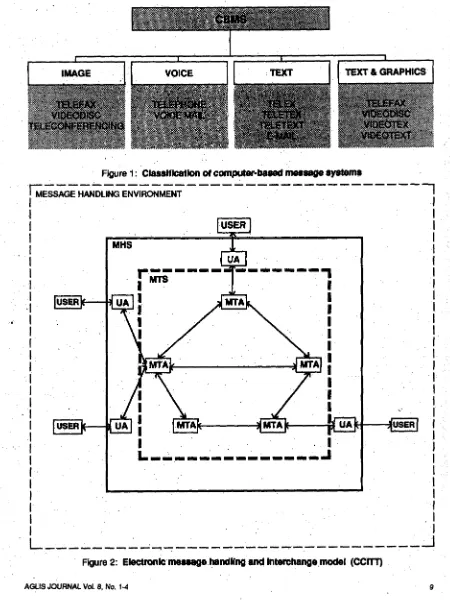
computer-based system used for sending a message or document may have such facilities as creating, editing, filing, receiving, transmitting and printing of the multimedia documents, all eleeronically. CBMS can be classified as shown iq Fig. 1.
I S 0 (International Standards Organisation), EMCA (Electronic Mail Corporation of America), and CCITT (International Consultative Committee for Telephony and Telegraphy), etc. have
I I I i
f
IMAGE1
I
VOICE1 I
TEXT TEXT & GRAPHICSFigure 1 : clss~nIcatfon of computer-based messnga systems
---I---
LESSAGE
HANDLING ENVIRONMENT7
I
I
1
USERL m 4
MHS
1
U A
m m m i - - l i r ~ - m m m ~ -
r
1
I
I
I
t - - - m m - - - m - J
.
A
Figure 2: ElecWonk message handling and interchange model (CCtTT)
developed models for electronic message handling and interchange. CCITT's model is shown in Fig. 2.
The CClTT recommendations on MHS
[7J
cover a wide range of subjects including service elements, protocols for message transfer, service facilities available to users, presentation, type conversion, tetetex access, open system interconnection, etc.An electronic message handling system (MHS) is a complex system comprising a message transfer system (MTS) which itself is
a network of message transfer agents (MTA) and is aided by an intermediary, called user agent (UA). UA has two functions, viz. providing facilities to the user and allowing reception and transmission of messages to the MTA. The user can access the MHS through the UA to which commands can be given according to the need to send the message to a destination. The message is then passed to the MTS via the MTA associated with the userlintermediary which ultimately reaches the destination through the network.
Dissemination of information in an accurate, timely and economical manner is an important factor that can decide the future of any information system. Electronic messaging offers many advantages in improving the information flow process. The information may be orders for online acquisitions, invoicing, numerical data or any other information needed by the user.
Electronic messaging does not require the information proqder (originator) and seeker (user) available at the same time. Systems using mailbox can offer a wide variety of options which include receiving, transmitting, sorting, filing and retrieving stored information when needed. Different persons working on the same project spread over a large area, and warking in different hours can communicate with each other. Electronic transfer of information decreases
preparation and delivery costs compared to the traditional services such as telex, letter or courier. The person who is sending information can transmit the message faster avoiding a lot of intermediary, routines associated with traditional services.
3. ELECTRONIC DOCqMENT DELIVERY SYSTEMS
One of the important functions of an .information system is to provide material requested by its users. When the required material is not available in-housefhe system may try to obtain the material from other libraries or a documentsupply centre (DSC). Electronic document delivery system (EDDS) can provide immediate access to the user provided that the system is connected to the DSC and the required information is stored in electronic media. Magnetic tape, video tape, videodiscand CD- ROM, etc. can effectively be used in EDDS. This eliminates the inordinate delays i n the supply of documents by conventional means, including online ordering. In online ordering, even when the required document is available, due to communication sho~wmings and the time taken in supplying, it may take several days before the required document is received by the user, Though this can reduce the delay considerably over conventional ordering, it is not a match for EDDS which can provide immediate access. Another feature ot EDDS, apart from speed, is the convenience in access.
Four major steps are involved in EDDS, namely inputting, storage,:transmission and output or delivery. In inputting stage, the information in print media is converted into digital form using a suitable method such as optical character recognition
(OCR)
devices or scanners. When the information is already in machine-readable form, through a conversion program, this can be digitised. Far storage there are three main media, viz. magnetic tape,video tape and' digital optical disc. Trans- mission of information is achieved by several means. Telefax or facsimile transmission can be used to transmit both textual and graphical material over telecommunication links. But satellites can offer a better transmission than telephone lines (for a comprehensive treatment of the subject see [8]). The output can be chosen in one of the three forms, namely, hardcopy, microform or alternately display on a TV screen or a VDU.
The following factors influenced to the establishment of many projects on EDDS.
* The need for a rapid, reliable delivery of
high quality primary information;
The latest developments in the technology of information capturing, storing, transmission and display;
The development of optical discs as an alternate medium of printed publications; The support given by inter-governmental agencies like the European Commission and the consortia like that of ADONIS; and The success, growth and popularity of online bibliographical retrieval services.
The Commission for European Communities (CEC) in 1979 has commissioned, a large American Consulting firm to undertake a feasibility study on large-scale document delivery system. As a result, ARTEMIS (Automated Retrieval of Text from Europe's Multinational Information Service), an open-ended network of computers and communication links through which a number of documentation centres could provide full-text on demand either in facsimile or digitised form was conceived. There have been a number of other projects and schemes for electronic transmission of documents. HERMES, which is basically a telex system sponsored by British National Physical Laboratory, Department of Trade and Industry and Printing Industry Research Association, UK, (1 981 ); APOLLO (Article
Procurement with Online Local Ordering), a joint project of CEC and European Space Agency (1 981), the British Library Facsimile Transmission Project, launched by the R&D Division of the British Library (1984), Transdoc, a French Consortium (1982), Fiz4 of West Germany (1982) and the Eurodocdel, a pint venture of Europe Data (of ELsevier) and CII Honey Well Bull of France, are a few to mention.
Specific mention is to be made here of the ADONIS (Advanced Document Over
Network Information Services) project which is
a
Consortium of major European Publishers including Blackwell, Springer-Verlag, Pergamon, Elsevier, Academic and Wiley. The Consortium has undertaken discussions in Europe, USA, Japan and other governmental agencies and publishers, 'and document supply centres like BLDSC with a view to set up a world-wide electronic document supply system. ADONIS aims to supply articles on demand froma
database of about 5000 important journals supplemented by a f ive-year back-file provided by 200 publishers. The journals will be stored on optical videodiscs from original printed versions and transmitted to local centres where they will be printed and supplied for a fee [9]. Useful features of the system include* dissemination of contents lists of S&T periodi- cals, books, monographs, etc; full-text of patents, standards, articles required;
availability of a comprehensive range of documents from a single source;
easy online document ordering and delivery;
automatic document delivery ofpre-specified documents, such as documents on standing order, on regular basis;
lists of current periodicals; and SDI.
The low level usage of EDDS, as of now, extensionof the traditional telex service with an can be attributed to the high cost factor exception that thg sending and receiving points (compared to conventional services) and the are not centralised as in the case of Telex not-so wider acceptance of the technology by Office
[ l o ] .
Here any computer can the developing countries. It also needs deposit communicate with a host computer. To send accounts to be maintained with the DSCs in the mail, the user needs a modem to convert advance, which means further cutting in the the computer signals into a, form suitable for already dwindling library resources. The wide transmission and vice versa.range of equipment and systems needed to Based on the target group, E-mail can establishthe service initially are expensive and be conveniently grouped into four, viz. causes a frowning attitude in the library one-to-one, one-to-many, many-to-one, and authorities. It can be seen that the majority of many-to-many. One-to-orie mode is the most the users still wish to use traditional means to common of all and is useful to send order and receive a document in need. communications from one user to any other Because the user has very simple need to be user. In one-to-many, the mail is directed to satisfied* a service that
can
supply needful many users, while many-to- one is exactly the documents in a reasonable time, Say a week opposite of this mode. any-to-many is a or ten days, reliably and that too at a price his mode which enables 'posting' a library or the user himself can afford to pay, communication publicly, where others can Ther are sane doubts about the long time 'read and leave their comments to be read by effects of the EDDS on the traditionally printed many. ~ ~ ~[1 11 k discussed the l ~ ~ d Journals. But at a time when the publication of applications of these four modes as 'notes, printed journal becomes totally uneconomical broadcasts, comments, and bulletin boards'. due to the rising costs of input materials, Computer conferencing can be taken as a form processes and the ever diminishing the fourth group,
subscriptions, publishing from totally electronic
data on demand could become common. messagesuntif the user wishes to access them The E-mail would look after the Usage of the broadcasting satellites would at the time and place of his or her choice. A greatly enhance the quality of such systems mailbox can sort the mail into different and reduce the a!s0. EDDS is a categories, inform the urgent matters which
conglomeration of new technologies. A few of needs immediate attention, help in dealing with them are briefly discussed in the f0ll0~ing messages, take care of filing, searching and
pages. retrieving of messages upon request, thus
4. ELECTRONIC MAIL virtually becoming a sort of personal assistant. When individual codes, possibly with Electron ic mail (E-mail) is a encryption or passwords are assigned, users computer-based EDDS, used to create and could log-on from different locations while in transmit messages electronicaHy addressed to trip at any time of the day and send messages an individual or a specified group of individuals, to others or retrieve messages a c c ~ ~ u l a t e d With its origin in 1960s, it became an important Since Ihe previous
means of sending information via a Another advantage of the E-mail is that computer-based network between addressed the distribution lists can be stored in the computer workstations. Like facsimile, telex system, which aids in selecting the recipients and other message systems, E-mail systems to receive a particular information or message allow people to send messages to each other and transmits simultaneously to all the electronically. This can be taken as an recipients.
E-mail is primarily used at present tor informal communications between people separated by geographical distance and time zone differences. This benefits the individuals by saving time, reducing interruptions and improving communications. However these benefits are intangible, difficult to measure and do not make a direct impact on the profitability of an organisation.
Three importanrbenificiat characters of E-mail are the speed and reliability of delivery and security and privacy of messages [I 21. The potential uses include general correspondence, exchange of documents, teleconferencing, announcements, etc. On the library side, E-mail is being used heavily for transmitting interlibrary loan requests and document purchase orders. OCLC has a subsystem (OCLC ILL) connecting some 700 libraries which is a dedicated inter library loan system. Of late, library professionals have also begun to use E-mail for communications among officers of professional associations. E-mail can also be used for reference queries that could range from ready reference-type to problem solving questions in the areas of cataloguing or MARC formats which can be greatly expedited by the use of E-mail. A record of the responses can also be kept. Both the sender and recipient can initiate the message or pick up the message when it is convenient for them. This applications list is by no means exhaustive. Many uses remain undiscovered.
The E-mail is much cheaper than conventional telex for sending messages to outstations. Combined with its easy readability due to the mixed letter base (upper/iower case), which is not available in telex, it is a v W aJ~xrn2.j~~
to
t ~ J e x for institutions for international communications. The communication is faster through E-mail than telex or cable.Many E-mail networks of universities, commercial agencies, etc are interconnected through major networks such as USENET, INTERNET and BITNET, which in turn are
interconnected through gateway machines. This interconnection between commercial networks
are
non-existant until recently. It 1spossible to send messages, documents from one network to another only when they are interconnected by means of gateways. Conformity of protocols, etc with the CClTT
X.400 standard will allow the interconnectivity
01 different networks with each other. In this environment one can send mail to anyone having mailbox in any other system because of '
.
their connections to diverse communication media. Some E-mail systems have sophisticated features which make them extremely useful. E-mail can be sent to even fax machines, [I31 telex printers and remote printers. AT&T Mail is an example of such an advanced features system.Document supply centres like NTIS, University Microlilm International Article Clearinghouse and British Library Document Supply Centre (BLDSC) have E-mail addresses, and accept orders through E-mail, thus speeding and facilitating the delivery of required documents. This feature is also available with most of the online search services such as DIALMAIL of DIALOG, EasyPlex and InfoPlex of CompuServe network, and public packet-switched networks. These can forward the retrieved citations by E-mail to a DSC of the searcher's choice.
Systems with E-mail features OnTyme II, designed and marketed for library community, include JANET (Joint Academic Network), Envoy Post of Canada Telecom, Postcorp, E-COM (Electronic Computer Originated Mail) of EMCA (USA), DMAlL of Delphi, MCI Mail, ALANET of the American
Lrbrary Assdccirrhbn,
7e&rn&
€iv/M
& ? Facilities provided by E-mail systems are categorised as follows [I 41:Message Preparation: Word processing, note book facilities, annotation of messages received prior to forwarding or filing.
Message Transmission: Timed delivery, directory services, multiple addressing, distribution lists, abbreviated addressing, message priorities, automatic route selection, message transfer information, links to other networks.
Message Receipt:Mail scanning, selection replying, fowarding, rerouting, filtering of messages, and notification of new messages.
Security and Reliability: System security, protection against message lost, encryption, security software and inhibiting hard copy.
Message Filing and Retrieval: Storage capacity, retrieval and archival facilities. Message Logging: Accounting and management reports.
One main disadvantage of E-mail is that the current systems normally allow foles of more than 1 OOKbytes, whereas document files may be of the order of several megabytes. Bill Tuck has compared [I51 the cost of sending a megabyte file over Telecom Gold of the British Telecom (80 pounds in peak time and 20 in off-peak time) and Integrated Digital Access also available through British Telecom (13p or
4.4p!). Other factors include the ongoing high cost involved in the usage of E-mail, equipment and service overhead costs. Set up costs of E-mail services can include training, documentation, monthly minimums of usage and telecommunications cost [16]. lnspite of these factors, E-mail is widely recognised as a convenient and cost-effective means of communication.
The main difference between E-mail and teletex (or telefax) is that-in the case of E-mail, messages can be held in the memory of the sender's computer and transferred to receiving computers (as per the E-mail addresses). The received messages can be stored till they are retrieved by the recipient. In the teletex (or telefax) transmission is instantaneous and no intermediary storage is
possible as these operate on point-to-point mode (i.e., from sending terminal to receiving terminal).
4.1 Electronic (Online) Ordering
To avoid delays taking place in the conventional ordering, many document supply centres (for example, B L D S ~ ) and information retrieval services such as DIALOG and CAS have been offering electronic ordering facility for the users. BLDSC is accepting document supply requests over telex for quite sometime now, and has been offering online ordering facility called ADRS since 1981. This still did not get full acceptance of the users as the requests are not growing at any significant rate. The prerequisite in this type of service is that the customer has to have an account with the DSC. The dial-order services ofCAS introduced in 1982 has evoked good response with nearly 25,000 requests in the first months by more than 1,300 subscribers. Many prefer to use conventional post for ordering. Information retrieval services such as DIALOG and those linked with E-mail systems and many major publishers and book vendors are accepting dial-order services or entertain electronic ordering (for example, Baker &
Taylor, lngram in USA). Many also maintain mail- boxes with E-mail systems like DIALMAIL, ALANET, etc where possible, the requested document can also be delivered via an EDDS.
4.2 Voice Mall
This is the most sophisticated type of the E-mail.This does not require anyone to type or input a message to be sent. The recipient of the communication is to be named first and the message is dictated. The system transmits the message by digitising the analog voice signals. At the receiver's end, the message is reconstructed.
In a voice mail system, the computer records the message, stores and then delivers the message as and when called for. Modems
are used to convert the binary signal info an ac signal for transmission and the transmitted ac signal into binary signal upon receipt.
There are W o methods of voice digitisation 1171. In the first method,speechcan he digitisetf by vocoders. The vocoders anaiyse the pitch of the voice and vocoder filters divide the signal into dilferent trequency ranges. The advantages of the system include the use of the transmission lines to a maximum
efficiency, error control and correction, and data encryption. This is more compact than the anatog speech on a voice-grade line and uses the transmission medium to a lesser extent.
Second method is the .waveform analysis. Here voice digitisalion depends on
the soft ware used for digitisation. Pulse code modulation
is
a type of waveform analysis. The main advantage of this is its lower cost.Voice mail system can do most of the things that an E-mail system does, i.e.,
messages can be read, printed, answered, filed, etc. Image mail system, where one can see the picture ot the message sender actually speakhg, is too expensive and luxury. As
all
these technologies have common basic features, image, voice and text may converge in the future to givea
comprehensive E-mail system.5.
CONCLUSION
The impact of the information technologies has akeady been ielt by the library community. Quite a few number of libraries already are
using
the new techno(ogies inmany
fields.Use
of computers in house keepingpracess
has been on the increase. So is the access to online databases through gateway packet- switching networksand
DjALOG etc, and the transmission ofimportant and urgent documents through telefacsimile. Thanks to the breakthroughs and developments in electronics and related fields, the cost of these technologies is within the
reach
and
these technologies which werelooked
upon as'elitist'a
decade ago are finding their wide acceptance and usage in many libraries. Though etectronicmai
tis
alate
corner
to India, already
a
few centres have the facility(for example,
DESIDOC
andINSDOC)
to sews the users inan
efficient way. E-mailwill
greatly
improve the information delivery, particutady for document supply centres. The convergence of online information retrieval and E-mail (as is evident from the addiition of E-mail features to the major online informationretrieval
systems),have already proven their acceptance. It isalso
envisaged thatthe
E- mail networks would provide access to online information shortly. It is time for adopting ourselves to the 'order of information society' which has great potential to enhance the economical growth of the nation.ACKNOWLEDGEMENTS
The authors are grateful to Dr SS Murthy,
Director,
DESIDOC
for giving permission to publish the paper.REFERENCES
1. Jones,
Barry
0.
Social implications of information-based society: the role of libraries and librarians. In Meeting the challenge of technology, Proceedings of the VALA National Conference onLibrary
Automation, Vol. 1. Victoria Association for Library Automation, Melbourne, 1982. pp. 3-4.
2. Department of Commerce, USA. US Industrial Outlook
for
1986. NTIS, Springfield, 1986.3. Huber, Roland. The role of information t ethnology and 1 elecommunications in
promoting economic development in the European Community. lnlernational Journal of Technology Management,
1989, 2(3/4), 501
-51
4.4. Lancaster, F.W. Towards paperless information systems. Academic Press, New York, 1978.
Lancaster, F.W. The futuie of the libraw in the age of telecommunications.
In
Telecornmuni- cations and tSbraries:a primary f o ~ librarians and information managers, edited by D.W. King and others. Knowledge Industry, White Plains, 1981.
Deusch, Debra P. Implementing distribution lists in computer-based message systems. In Computer-based message systems, edited by H.T. Smith. North-Holland, Amsterdam, 1984. p. 3. CCITT 5Nll. Recommendations X.400 MHS: system model service elements and optional user facilities. ITU, Geneva, 1983.
News, trends and comments. Information Services 8 Use, 1989, 9(3), 177-188. Lee, Peter W. Electronic document delivery: current European developments. In Beyond 1984: the futute of the library technical services, edited by Peter Gellatly. Howarth Press, New York, 1983. pp. 233-239.
Bourne, Charles P. CD-ROM and other computer-based information tools for developing countries. In Bibliographic
databases and
networks,
Proceedings of the International Conference, New Delhi, 22-25 February' 1989, edited by S.S.Murthy, Anuradha Ravi and A. Lakshmana Moorthy. Tata McGraw- Hill,
New Delhi, 1990. pp. 1.75-1 33.
11. Buckland, Michael H. Combining electronic mail with online retrieval in a library context. lnformatiopn Technology
and Libraries. December 1987,268-271. 12. Trudell, Libby, et al. Options for electronic
mail. Knowledge Industry, White Plains, 1984. pp.21.
13. Hawkins, Donald T. Technotrends: information delivery-paper and E-mail. Online, 1990,14(2), 100- 103.
14. Welch, J.A. and Wilson, P.A. Electronic ,mail systems
-
a practical evaluationguide. NCCIWiley, London, 1981:
15. Tuck, Bill. Using ISDN for document delivery. Prograrrt 1988, 22(4), 360. 16. Whitaker, Becki. Electronic mail in library.
Library Trends, 1989,39(3), p.363.
17. Marney-Petix, Victoria C. Networking and data communications. Reston, Reston, 1986.1 80 p.