www.ijper.org
Evaluation of Computer-based Simulation Learning
on Knowledge, Learning Approaches and Motivation
among Pharmacy Students
Chun-Wai Mai1,2*, E-Lyn Lee3, Pei-Se Wong3, Hui-Meng Er1
1Department of Pharmaceutical Chemistry, School of Pharmacy, International Medical University, Bukit Jalil, Kuala Lumpur, MALAYSIA. 2Center for Cancer and Stem Cell Research, International Medical University, Bukit Jalil, Kuala Lumpur, MALAYSIA.
3Department of Pharmacy Practice, School of Pharmacy, International Medical University, Bukit Jalil, Kuala Lumpur, MALAYSIA.
ABSTRACT
Background: With the exponential influence of technology on students’ learning, Computer-based Simulation Learning (CSL) has perceived to have great potential in enhancing the training of healthcare professionals including pharmacists. However, limited evidence is available to compare its impacts on knowledge gained and learning approaches to that of conventional lectures. Materials and Methods: A total of 168 pharmacy students were randomly assigned to “CSL group” (Group I, intervention group) or “Lecture group” (Group II) in this study. The students’ knowledge and deep information processing capabilities were evaluated through a quantitative survey, followed by focus group interviews to obtain an in-depth perspective of the student learning through CSL. Results and Discussion: Compared to didactic lecture, CSL significantly enhanced knowledge gained by the students. There was no significant difference between CSL and didactic lecture on students’ deep information processing skills, although CSL was more effective at promoting the critical reading domain. On the other hand, didactic lecture had higher impacts on healthcare students’ structuring skills. The features to be considered in designing an effective computer-based learning tool were highlighted in this study. Conclusion: Both CSL and didactic lecturing have its role in training pharmacy students’ knowledge and deep information processing skills.
Key words: Computer, Learning, Knowledge, Information Processing, Pharmacy.
DOI: 10.5530/ijper.53.4.120 Correspondence: Dr. Chun-Wai Mai (PhD, BPharm),
Department of Pharmaceuti-cal Chemistry, School of Pharmacy, International Medical University, No.126, Jalan Jalil Perkasa 19, Bukit Jalil, 57000, Kuala Lumpur, MALAYSIA.
Phone: +60 3 27317596 E-mail: chunwai_mai@imu. edu.my,
INTRODUCTION
Simulation is commonly used in profession-als training programme including healthcare professionals, pilots and engineers to encour-age active learning through application of knowledge and skills using real-world scenarios.1-4 In healthcare professionals’
education, simulation in pharmacy education for learning and mastering clinical skills is less commonly reported as compared to medical education. Nevertheless, simulation in pharmacy education can be found from literature in various forms including simulation with real patients, high fidelity human simulation, simulation using elec-tronic medical record and simulation using
Submission Date: 05-03-2019; Revision Date: 17-05-2019; Accepted Date: 17-07-2019
standardised patients.5 There is also growing
evidence suggesting the use of computer simulation in pharmacy education to teach specific skills such as dispensing and health-care analytics.6,7
Computer-based Simulation Learning (CSL) refers to as the learning using com-puter or electronic device in order to gain mastery of knowledge or skills. In science
education, it is believed that CSL can affirm
educa-tors especially as a preparatory learning activity prior to the actual laboratory experiment. It has been reported that the students’ performance in a physics course had improved using CSL.8
CSL supports a constructivist approach to learning, as the students are given the opportunity to develop, compare and understand multiple perspectives on an issue.9Constructive learning, characterised by learning
processes that involve knowledge integration and critical analysis, is related to a learning environment that is student-oriented and promotes conceptual connection.10 This can bring about positive influences on the students’
learning approach, learning process and subsequently the learning outcomes.11 Meanwhile, the deep learning
approach is preferred as it promotes complete under-standing and long term memory12 and encourages
higher intellectual skills such as reasoning and problem solving.13 In addition to cognitive learning, the idea that
the process of deep learning approach has also been linked to motivation to learn. Deep learning approach was argued to empower students with feelings of enjoyment to learn and students with high intrinsically motivated were also reported to have a deeper approach in learning.14
Our previous study, Chemistry and Toxicology are core subjects in training competent pharmacists.15
The study of environment toxicology is increasingly important with the rise burden of disease and mortality caused by environmental pollutants but is generally not very appreciated among health sciences including pharmacy students. Smog City 2, an interactive air pollution simulation software developed by the United States Environmental Protection Agency could offered as a suitable CSL to promote and stimulate knowledge acquisition in the area of environmental toxicology.
Despite reported benefits pertaining to CSL, its values
compared to traditional didactic lecture for knowledge acquisition is uncertain. In what we believe is a unique approach to CSL in teaching environment toxicology, this study used CSL in compared to traditional teaching method to prepare pharmacy students to learn
environ-mental toxicology. Building on to our previous findings
where academics’ integrity and professionalism has an impact to students’ skill and competency training, we were interested to determine whether CSL can replace didactic teaching, in order to increase the consistency in teaching by lecturer and to minimise human’s errors.16,17
Therefore, the purpose of this study was to evaluate and compare the effect of CSL and traditional lecture on knowledge, Deep Information Processing (DIP) and motivation among pharmacy students.
MATERIALS AND METHODS
Methods
This study was conducted using intervention mixed-methods comprised of two phases; (1) knowledge and deep information processing survey and (2) focus group interviews at the International Medical University, at Kuala Lumpur, Malaysia. Study approval was obtained from the Centre for Education, International Medical University (Innovative Medical Education Grant ID: ILTIG 16/3).
Study Population
All 179 Year 3 (Semester 6) Bachelor of Pharmacy students were invited to participate in the study. A total of 168 participants (93.9%) provided informed consent prior to inclusion in the study.
Study Design
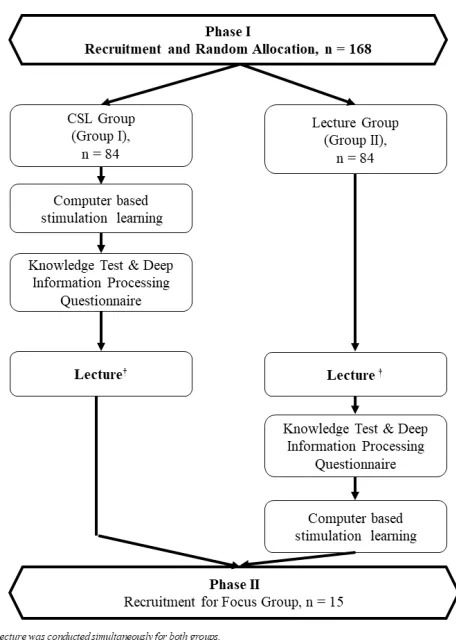
All 168 students were randomly assigned to either the traditional lecture group or CSL group (84 students each group, Figure 1) by an independent academic service staff. The CSL group received a 60 min CSL session using SmogCity 2, a computer based learning tool about environmental toxicity. Students were asked to complete the study questionnaire at the end of the session. The lecture group received a 60 min lecture presented by CWM with consistent content with Smog City 2 software. At the end of the lecture, the students completed the study questionnaire.
Study Questionnaire
The questionnaire consisted of two sections; (1) a 20-item knowledge test and (2) a 23-item deep
infor-mation processing scale (Table 1). The first section of
the study questionnaire was developed by authors and content-validated by two pharmacy academics with expertise in environmental toxicity. It comprised of 20 multiple choice items to assess students’ knowledge of environmental toxicology. The number of correct answers were added to a maximum of 20 (100%). The
items were piloted in 20 final year students and alpha reliability coefficient obtained was 0.670, indicating satisfactory reliability. The findings from the pilot study were excluded from the final analysis.
The second section of the study questionnaire collected data on impact of CSL or lecture on the depth of learning using a validated 23 items instrument adapted from Heijne-Penninga et al. (2008), for students’ deep information processing (DIP) capabilities.18 In the DIP
one’s context and structuring, having 9, 8 and 6 items respectively. Critical reading relates to learners’ learning to understand the learning material, while broaden one’s context relates the learner’s learning by elaboration through correlating the learning material with other sources of knowledge. Structuring refers to learners learning through analysis to clarify and verify learning. All items were rated on a 5-point Likert scale (1 = never, 5 = always). A total DIP score and a score for each scale were calculated.
Statistical Analysis
The mean and standard deviation of the scores were
calculated using SPSS for Statistics. Statistical significant
difference was determined by using 2-independent samples of Kolmogorov-Smirnov Z test (p<0.05).
Focus Groups
Following the Phase I questionnaire survey, we invited all participants for focus group interviews to obtain insights about impact of CSL on motivation to learn. Out of the 168 participants, 15 participants were willing to be interviewed. The focus groups were conducted in English using an interview guide consisting of
Figure 1: The Flow Chart of Phase I and Phase II Study Design. A total of 168 participants were recruited and
randomized into CSL group or Lecture group.
Table 1: Deep Information Processing (DIP) Scale. Deep Information Processing Scale
Domain I: Critical Reading
I attentively and critically look at the argumentation. I understand the meaning of the text very quickly. I cannot get an overview when the text is long.‡
I read on even when I do not know a certain expression.‡
I quickly distinguish facts from side issues. I find it difficult to get an overview quickly.‡
I assume difficult things without really understanding them.‡
I cannot distinguish facts from side issues unless I read the text several times.‡
I keep on reading without really understanding the previous parts.‡
Domain II: Broaden Ones Context I think of questions while I read. I try to think of counter-arguments.
I try to relate new concepts to concepts that I already know. I try to relate different courses.
I look for the how and why of statements. I try to apply things in daily living.
I compare what I read with things I already know. I think of examples myself.
Domain III: Structuring
I try to find structure in a text by looking at the title and headlines.
I make notes on the most important issues. I pay attention to titles and headlines.
I pay attention to the paragraph division of the text. I write down my conclusions on a text.
I also look at other books to gain a broader view of a subject.
‡Reverse scoring was applied since it is a negative statement.
predefined topic and questions agreed by the research team. The focus group topics evolved as the interviews progressed through constant comparative analysis. All interviews were conducted in a private discussion room in the university building.
To ensure that the participants were comfortable in voicing opinions freely, the focus groups were conducted by ELL or PSW who were not involved in Environ-mental Toxicology teaching. All focus group discussions were audio taped, transcribed verbatim and analysed using the General Inductive Approach19 The first two
transcripts were independently coded by ELL and PSW and compared to create a coding list. Based on this list, ELL coded the remaining transcripts. Codes were linked in various relationships to form themes. ELL and PSW continuously discussed with research team
Focus group interviews were conducted until data saturation is achieved where no new themes emerged from the interviews. To enhance readability, some of the main messages in the participant quotes in this study were cleaned by removing words and sounds. Some explanations were also added in parentheses to further enhance the readability of the quotes.
RESULTS
A response rate of 93.84 % was achieved where 168 pharmacy students consented to participate in this study. The consented 168 participants were randomly assigned to CSL group (n=84) or lecture group (n=84) (Figure 1)
Knowledge Test
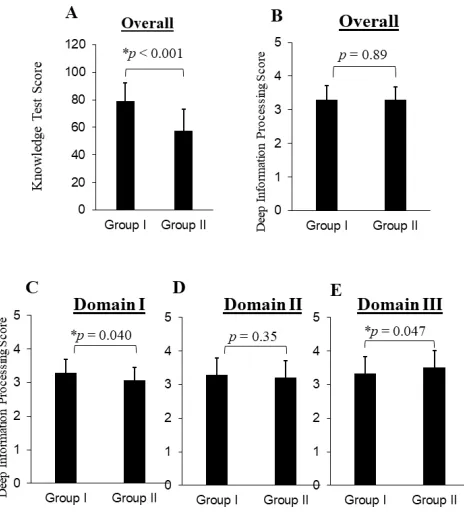
An average knowledge score of 78.98±14.15% was achieved by CSL group compared to 58.45±15.59% in lecture group (p<0.001, Figure 2A). Students in CSL group achieved a higher average knowledge score compared to lecture group.
Deep information processing (DIP)
Overall, there was no significant difference (p=0.89) in the overall DIP score between participants from CSL group (3.29±0.39) and lecture group (3.30±0.38) (Figure 2B). Figure 2C shows the impact of CSL on participant’s critical reading. CSL group (mean score
= 3.28±0.81) have a significantly better critical reading
score as compared to lecture group (mean score = 3.06±0.43) (p=0.0040). No significant difference
(p=0.35, Figure 2D) between found between CSL and lecture groups in the ‘Broaden one’s context” domain
scores. Lecture group (3.51±0.61) has a significantly
higher mean score (p=0.047) as compared to CSL group (3.32±0.53) in the ‘Structuring” domain (Figure 2E).
Correlation between knowledge test and DIP scores
When correlating data of all participants, no correlation (r2=0.0203) was found between knowledge gained and
participants’ DIP capabilities. Segregated analysis of lecture group and CSL group found a relatively better correlation for CSL group participants (r2=0.13, Table 2)
compared to lecture group participants (r2=0.014).
The knowledge gained score were considered poorly correlated (r2 <0.5) with DIP score of both groups of
participants and in each domain of DIP.
Motivation to learn
Fifteen students took part in the focus group interviews. Three main themes emerged: CSL features, individual learning styles and CSL topic. A summary of themes and quotations from the participants (S=Student) are illustrated in Appendix 1.
Participants in the focus groups discussed extensively on the effect features of the CSL on their learning. Majority of them found that they learn and understand better through the CSL compared to lecture. The element that they found most engaging and helpful in learning was the active control of parameters and response on environmental pollution. Such features led
Figure 2: Comparison of Knowledge Test score and Deep Information Processing Scale between Group I and Group II. Results were presented as mean with standard deviation. (A) The average score of Knowledge Test score for Group I and II were recorded. The overall average (B), domain I (C), domain II (D) and domain III (E) of Deep Information Processing Scale
were calculated. Statistical significant difference was determined by using 2-independent samples of
Kolmogorov-Smirnov Z test (p <0.05).
Table 2: Correlation of Deep Information Process-ing Score and Knowledge Test Score.
Overall
DIP (r2) Domain I (r2) Domain II (r2) Domain III (r2)
CSL and lecture
group
0.0203 0.010 0.00061 0.0075
CSL
group 0.13 0.014 0.078 0.0024
Lecture
group 0.014 0.019 0.0023 0.000039
Appendix 1:
Theme Illustrative quotations
Features of CSL S3: I also enjoy the animation. It’s quite clear because if I adjust. For example, I adjust the population to very less so there are no people in the city anymore so I can instantly see clearly that visualize out.
S7: For me, I felt like the pollution then can imagine this is what you are facing in daily life so you can relate to the picture that you see in the game then you can see that Oh, it’s actually happening in our surrounding so it can make use of it.
S9: The scenery doesn’t really change. Just the same factory, the cars and the clouds. Just one scenery, one scene like that. Cause in games will be like many things like you fight against people, you fight, you go on adventures and stuff. And then this one is just like a basic Sims game. You know Sims? It’s like you playing in one room only. Don’t go anywhere else.
S12: (The game) Enhance the memory. Because I like the animation, so I will memorize the animation, increase the temperature, increase pollution.
Individual learning styles S5: I think it depends on what kind of like what the learner type like how do you learn because some of the people actually learn from hearing and then some people actually learn from seeing, something like that.
S6: Because I prefer a hardcopy information in front of me instead of looking at animation. Because I don’t remember at the end of the session. And I will How to say, because the animation don’t have any explanation in voice, audio or what. I would. I would prefer a lecture.
S8: Ya. I prefer reading because it’s more informative than just adjusting the parameters. Adjusting the parameters itself is not so time time-efficient cost-effective.
Simulation topics S9: Probably if like maybe they (game) talking about diabetes all those things, maybe I would have went and google to know more about it. But environment like this. I didn’t go and search more.
S10: No, like what he (another participant) said, because this is relating to environment and then we always have the mind-set that we are just the student, we can’t do anything much to help the environment. There no power for us to do so. Like we have those kind of mind-set.
S12: Particularly interested about altitude. It’s like whether mountain area have like better air condition, I’m quite interested in that. So, I go search something.
S=Student
to better understanding and enjoyment in learning as well helped them to relate to real-world scenarios. Some
participants have benefited from the visual changes
which aided memorisation of knowledge learnt from the CSL. Nevertheless, some participants expected more advanced features such as including missions for
users, varying difficulty levels through the game and
reward systems with points or badges to motivate them
to continue with the CSL. Technical difficulties such as specific browser set-ups and delays in loading the CSL
interface also negatively affected their learning experience. Some students preferred learning through visual displays, while some students felt that they learnt best through listening in lectures. When asked about experiences with learning through CSL in comparison to lecture, some participants disclosed that they took more time to familiarise and learn from the CSL. These students who preferred lecture over CSL explained that they learn better when they listen to the explanations given by
the lecturer, which gave them confidence and provided
assurance that what they learnt is correct.
Participants were also asked if the CSL activity has motivated them to learn further about environmental pollution after the session. Most participants did not learn or explore further due to lack of interest in the topic. Only one student expressed interest in the study of the environment and had explored further with additional reading on her own. Some participants felt learning from the CSL activity was limited because the topic was not relatable and views that they have no control over the environment and its pollutants in the
real world. Among topics that were identified as relevant
and relatable to the pharmacy profession were disease-related topics which would prompt our participants to be motivated to learn further. Also, participants explained that they will be more likely read further if there is an assessment of the topic in the form of a quiz or test after the CSL activity.
DISCUSSION
acting as a stimulus to grab a person’s attention and senses for information processing. The results of our study suggest that students have better knowledge acquisition with CSL as compared to lecture, but both CSL and lecture have no different in affecting deep learning approach.
We postulated that the enhanced knowledge could have been contributed by the better understanding with the interactivity of visual effect of CSL which was evident in our focus group interviews. The CSL enabled the students to assess the impact of various pollution parameters on air quality based on simulation of air pollution scenarios. The process involved the Kolb’s experiential learning cycle, whereby the students
progressed through concrete experience, reflective
observation, abstract conceptualization and active experimentation.20 This is strongly supported by literature which highlighted significant positive benefits of the
visual effect on memory and learning.21-24
Deep Information Processing (DIP) skills refer to one of higher orders in processing spectrum of mental recall through analysis. It is expected that the visual in CSL
would enhance the DIP skills, nevertheless, our findings
showed no advantage of CSL over lecture on deep processing information skills. The learning of “critical reading”, however, was better among students who have undergone CSL. The greater impact of critical reading is possibly due to the nature of the CSL learning envi-ronment. The CSL activity simulates real-life challenges which enhance learning in a safe environment.25-27
In addition, CSL enhances learners’ interactivity and engagement as well as learning experience. With the safe interactive learning experience, students develop stronger critical thinking. This is further supported by literature that engagement in learning has a positive effect in competency and skills.28
Our findings found a better ‘structuring’ among lecture
group compared to CSL. Structuring relates to learners learning through analysis to clarify and verify learning, involves systematic order of acquiring knowledge. This could be explained by the nature of traditional class-room setting which is often delivered from one topic to the next and students acquire the knowledge in stages from start at the beginning in any area of study.29 This
conforms to the linear learning that most learners are familiar with. In comparison, CSL provides active and non-linear learning. CSL contains elements of interactive animation and visual elements displayed in response to the learner’s actions and hence, the learners do not necessary follow a standard learning path. The lack of
significant difference in the domain of “Broaden One’s
Context” between the two groups could be attributed to
the limited context covered during the CSL activity or lecture within the allocated teaching time. Deep conceptual understanding and transfer of knowledge develop through the encounter of the same concept at work in multiple contexts.30 Real life exposure to varied
practices associated with the concepts would be more appropriate to promote context broadening.31
Consistent with the literature, our study found that
gamification features such as rewards and competition
and personal interest in a topic as motivation to learning32-34 Although participants in our study believed
the need to adapt materials or teaching to individual learning styles, there is no evidence for existence of individual learning styles. There is also no evidence on
the benefits of adapting learning resources to suit
individual learning styles.35
There were several limitations in the study. Firstly, the
study studied impact of a specific CSL software, hence
may limits its generalizability to all type CSL activity. The deep information processing scores were obtained from was a self-reported instrument, may not
neces-sarily reflect true learning behaviours. Nevertheless, to our best knowledge, this is the first study in to evalu -ate the impact of CSL and lecture on depth of learning in pharmacy education. The results of this study suggest that CSL can be as effective as lecture in promoting knowledge and depth of learning. CSL also has the potential to provide self-directed approach for learning. It is imperative that pharmacy educators continue to evaluate this new technology.
CONCLUSION
Our study found that CSL significantly improved
knowledge acquisition over didactic lecturing. Both CSL and lecture-based learning shown different strengths in terms of deep processing information skills. Both CSL and didactic lecturing are equally important in training students’ deep information processing skills. With the advancement in computer, the curriculum designer should be reminded to continue to assess the effect of new technology in training the pharmacists.
ACKNOWLEDGEMENT
The authors wish to acknowledge the Centre for Educa-tion, International Medical University (Innovative Medical Education Grant ID: ILTIG 16/3) for the approval and support.
CONFLICT OF INTEREST
ABBREVIATIONS
CSL: Computer-based Simulation Learning; DIP: Deep Information Processing.
REFERENCES
1. Scalese RJ, Obeso VT, Issenberg SB. Simulation technology for skills training
and competency assessment in medical education. J Gen Intern Med. 2008;23(1):46-9.
2. Bradley P. The history of simulation in medical education and possible future
directions. Med Educ. 2006;40(3):254-62.
3. Vyas D, Bray BS, Wilson MN. Use of simulation-based teaching methodologies
in US colleges and schools of pharmacy. Am J Pharm Educ. 2013;77(3):53. 4. Chen B, Wei L, Li H. Teaching complicated conceptual knowledge with
simulation videos in foundational electrical engineering courses. J Tech Sci Edu 2016. 2016;6(3):18.
5. Hasan S, Chong D, Se W, Kumar S, Ahmed S, Mittal P. Simulation-based
instruction for pharmacy practice skill development: A review of the literature. Archives Pharm Practice. 2017;8(2):43-50.
6. McDowell J, Styles K, Sewell K, Trinder P, Marriott J, Maher S, et al. A simulated learning environment for teaching medicine dispensing skills. Am J Pharm Educ. 2016;80(1):11.
7. See HQ, Chan JN, Ling SJ, Gan SC, Leong CO, Mai CW. Advancing pharmacy service using Big Data - are we fully utilising the Big Data’s potential yet?. J
Pharm Pharm Sci. 2018;21(1):217-21.
8. Makransky G, Thisgaard MW, Gadegaard H. Virtual simulations as preparation for lab exercises: Assessing learning of key laboratory skills in Microbiology and improvement of essential non-cognitive skills. PLoS One.
2016;11(6):e0155895.
9. Yiasemina K, Loizos S. Translating constructivism into instructional design: Potential and limitations. J Edu Tech Soc. 2005;8(1):17-27.
10. Wierstra RFA, Kanselaar G, DerLinden JLV, Lodewijks HGLC, Vermunt JD. The impact of the university context on European students’ learning approaches and learning environment preferences. Higher Edu. 2003;45(4):503-23.
11. Newble DI, Entwistle NJ. Learning styles and approaches: Implications for
medical education. Med Educ. 1986;20(3):162-75.
12. Marton F, Saljo R. Qualitative Differences in Learning-Outcome and Profecss.
B J Edu Psy. 1976;46(1):4-11.
13. Dacre JE, Fox RA. How should we be teaching our undergraduates?. Ann
Rheum Dis. 2000;59(9):662.
14. Everaert P, Opdecam E, Maussen S. The relationship between motivation,
learning approaches, academic performance and time spent. Account Edu. 2017;26(1):78-107. doi:10.1080/09639284.2016.1274911.
15. Mai CW, Anitha R, Tiong JJL, Lai PK, Pichika MR, Gray AI. Chemistry content in the pharmacy curriculum: relevance to develop pharmacists fit-to-work
in diverse pharmacy profession sectors. Indian Journal of Pharmaceutical Education and Research. 2015;49(4):240-7.
16. Tiong JJL, Kho HL, Mai CW, Lau HL, Hasan SS. Academic dishonesty among academics in Malaysia: A comparison between healthcare and
non-healthcare academics. BMC Medical Education. 2018;18(1):168.
17. Tiong JJ, Mai CW, Yong AC. Academic integrity of health care educators:
Requisite for nurturing professionalism. Med Educ. 2015;49(11):1060-2. 18. Heijne-Penninga M, Kuks JB, Hofman WH, Cohen-Schotanus J. Influence of
open- and closed-book tests on medical students’ learning approaches. Med
Educ. 2008;42(10):967-74.
19. Thomas DR. A general inductive approach for analyzing qualitative evaluation data. American Journal of Evaluation. 2006;27(2):237-46
20. Kolb D. Experiential learning as the science of learning and development. Englewood Cliffs, NJ. Prentice Hall. 1984.
21. Yellepeddi VK, Roberson C. The use of animated videos to illustrate oral solid
dosage form manufacturing in a pharmaceutics course. Am J Pharm Educ. 2016;80(8):141.
22. Hurst KM. Using video podcasting to enhance the learning of clinical skills: A qualitative study of physiotherapy students’ experiences. Nurse Educ Today.
2016;45:206-11.
23. Lin ML, Chiang MS, Shih CH, Li MF. Improving the occupational skills of students with intellectual disability by applying video prompting combined with dance pads. J Appl Res Intellect Disabil. 2017;24(10):12368.
24. Shabiralyani G, Hasan KS, Hamad N, Iqbal N. Impact of visual aids in
enhancing the learning process case research: District Dera Ghazi Khan. J Edu Prac. 2015;6(19):226-33.
25. Leung R. Evaluating the benefits of collaboration in simulation games:
the case of health care. JMIR Serious Games. JMIR Serious Games. 2014;2(1):e1.
26. Mann KV. Theoretical perspectives in medical education: Past experience and future possibilities. Med Educ. 2011;45(1):60-8. doi:
10.1111/j.1365-2923.2010.03757.x.
27. Head BA, Bays C. Engaging nursing students and community partners in
the development of decision cases. J Nurs Educ. 2010;49(6):346-50. doi: 10.3928/01484834-20100217-06
28. Looyestyn J, Kernot J, Boshoff K, Ryan J, Edney S, Maher C. Does
gamification increase engagement with online programs?. A systematic
review. PLoS One. 2017;12(3):e0173403. doi: 10.1371/journal.pone.0173403
29. Nergiz EC, Soner Y, Meral A. Students’ preferences on web-based instruction:
Linear or non-linear. J Edu Tec Soc. 2006;9(3):122-36.
30. Anderson JR, Greeno JG, Reder LM, Simon HA. Perspectives on learning,
thinking and activity. Educational Researcher. 2000;29(4):11-3.
31. Brown JS, Collins A, Duguid P. Situated cognition and the culture of learning. Educational Researcher. 1989;18(1):32-42.
32. DaRocha SL, Gomes AS, DeMelo FIJ. Effectiveness of gamification in the engagement of students. Computers in Human Behavior. 2016;58:48-63.
33. Pashler H, McDaniel M, Rohrer D, Bjork R. Learning styles: Concepts and evidence. Psychol Sci Public Interest. 2008;9(3):105-19.
34. Hwang GJ, Sung HY, Hung CM, Huang I, Tsai CC. Development of a personalized educational computer game based on students’ learning styles.
Edu Tech Res Develop. 2012;60(4):623-38.
35. Kirschner PA, Merriënboer JJGV. Do learners really know best? urban
legends in education. Educational Psychologist. 2013;48(3):169-83.
SUMMARY
• Computer Simulated Learning (CSL) improved knowledge gained over conventional lecturing for pharmacy students
• Both CSL and lecturing are equally effective in training pharmacy students’ deep information pro-cessing skills.
• A better ‘structuring’ aspect of deep information skills among pharmacy students who were taught using lecture compared to CSL.
• Software features, the learners’ individual learning styles and interest in the respective topics should not be neglected in designing an effective CSL tool.
Cite this article:Chun-Wai Mai CW, Lee EL, Wong PS, Er HM. Evaluation of Computer-based Simulation Learning on Knowledge, Learning Approaches and Motivation among Pharmacy Students. Indian J of Pharmaceutical Education and Research 2019;53(4):595-602.
Dr Chun-Wai Mai currently works as Senior Lecturer in Department of Pharmaceutical Chemistry, School of Pharmacy, International Medical University (IMU). He is also the Head, Centre for Cancer and Stem Cells Research, Institute for Research, Development and Innovation (IRDI). His primary research interests are cancer immunology, pharmacology and toxicology with great interest in collaborative learning, pharmacy education and professionalism.