R E S E A R C H
Open Access
Examining social competence, self-perception,
quality of life, and internalizing and externalizing
symptoms in adolescent females with and without
autism spectrum disorder: a quantitative design
including between-groups and correlational
analyses
T. Rene Jamison
*and Jessica Oeth Schuttler
Abstract
Background:Adolescent females with an autism spectrum disorder (ASD) are an understudied population, yet are also quite vulnerable, due to the increased complexities of social interaction and increased risk for internalizing symptoms in adolescence. Most research literature currently focuses on males with ASD, limiting our understanding of social experiences for females with ASD, and thus the potential to better inform supports and intervention to promote social-emotional functioning. This study examined similarities and differences in selected indicators of social-emotional health (social competence, self-perception, quality of life) and problematic behaviors such as externalizing and internalizing symptoms for adolescent females with and without ASD.
Methods:This study employed a quantitative design utilizing correlational analysis as well asttest comparisons to examine selected indicators of social-emotional health and problematic symptoms using the Social Skills Improvement System (SSIS), Youth Quality of Life Instrument (YQOL), and the Self-Perceptions Profile for Adolescents (SPPA) for adolescent females with ASD in relation to their typically developing peers.
Results:Significant differences were found between females with and without ASD in terms of their self-ratings of social-emotional health and problematic behaviors. The no-ASD group rated themselves higher across all areas of social-emotional health. Findings also suggest strong relationships between these constructs, especially for females without ASD. Parent reports of autism symptoms and social-emotional health indicated that as symptoms of autism are more severe, so too was the impact on individuals’social competence.
Conclusions:Adolescent females with ASD perceive themselves as having lower social competence, self-worth, and quality of life and higher levels of internalizing and externalizing symptoms as compared to their typically developing peers. Parent ratings indicate that higher levels of autism symptoms relate to lower levels of social competence. These findings lend support to the postulate that adolescent females with ASD are more vulnerable than their typically developing counterparts due to the compounded impact of ASD symptoms on social-emotional health and the higher risk for internalizing disorders for adolescent girls. Limitations and implications for further research and intervention are discussed.
Keywords:Autism, Females with autism, Adolescents, Social competence, Self-perception, Internalizing disorders
* Correspondence:[email protected]
Center for Child Health and Development, University of Kansas Medical Center, 3901 Rainbow Boulevard, Kansas, KS 66160, USA
Background
Social impairment is a core deficit for the diagnosis of autism spectrum disorder (ASD) [1], impacting individ-uals’relationships across all domains. Social impairment compounds into adolescence and beyond due to the in-creasing complexity of age-typical interactions [2]. Ado-lescence is a time of social vulnerability and biological change for typically developing individuals, even more so for those with disabilities such as ASD that signifi-cantly impact social functioning as well as adaptive skills such as self-care. Females represent 1 in 5 individuals with ASD, yet adolescent females may experience the most significant impact of social impairment on their functioning [3, 4]. The confluence of difficulties with social interaction and self-care have the potential to negatively influence self-perceptions, leading to an increased risk for internalizing disorders for this population above and be-yond their neurotypical peers [4]. There is ample literature describing the variability of how ASD impacts males with very little information about how ASD is expressed in fe-males and no published intervention research specifically targeted to adolescent females with ASD [3].
Social competence and self-perception
Interpersonal skills are a keystone behavior in develop-ing healthy relationships and in successful adjustment. Impairments increase risks for internalizing and exter-nalizing problems such as disruptive behaviors, anxiety, and depression [5, 4]. Social impairments in ASD often persist across one’s development and across multiple do-mains, including communication, school, friendships, rela-tionships, work, and community. Many individuals with ASD report difficulties making friends and navigating so-cial norms and rate themselves as less soso-cially competent compared to their typically developing peers [6]. Improved social skills are frequently an intervention target for indi-viduals with ASD, with social skills training or social skills groups implemented in various formats [7]. Although so-cial skills training (SST) is considered an evidence-based practice for school-age children with ASD, the evidence for effectiveness is variable [8] with some of the greatest challenges related to generalizing improved social skills outside of the therapeutic setting and fluently using skills across multiple settings, people, and situations [9]. This is not surprising, however, based on the complexity of un-derstanding and demonstrating social skills and required fluidity to navigate the ever changing social norms and ex-pectations across development and within the multiple domains described above (i.e., communication, school, work, etc.). Although the goal of SST is often to improve social competence for individuals with ASD, this is a lofty goal as social competence is a sophisticated construct encompassing numerous skills necessary to navigate these complexities. This is also likely reflected by the variable
effectiveness and limited generalization. Bierman and Welsh [10] define social competence as the“social, emo-tional, cognitive skills and behaviors that children (people) need for successful social adaptation.”Their definition im-plies a broad range of skills and understanding, often not addressed in SST programs, including well developed emotional and cognitive skills.
Although research priorities in ASD now include a greater focus on adolescence and adulthood [11], less is known about interpersonal skills and social-emotional health for adolescents with ASD. In addition to bio-logical changes associated with puberty, social norms and expectations become more complex during adoles-cence and reflect increased independence with less reli-ance on adults and more relireli-ance on peers [12, 13]. Social interactions and friendships shift from play and turn taking towards a greater emphasis on conversation and building relationships [14]. Adolescents are also de-veloping a sense of “self” with a heightened importance of healthy relationships and friendships in perceived self-worth [15]. For example, Bauminger and colleagues [13] found that friendship correlated positively with cog-nitive competencies and general self-worth and nega-tively with loneliness. Self-esteem and self-worth appear to be significant contributors to social-emotional health throughout adolescence [13] and negatively associated with symptoms of depression and anxiety [5]. Although there is an increased risk in general for emotional and behavioral problems into adolescence, females exhibit more internalizing symptoms such as anxiety and de-pression [16, 5] and often rate themselves lower on mea-sures of self-esteem as compared to males [17].
Social competence is a crucial component of healthy functioning, especially during adolescence. This under-standing emphasizes the importance of supporting indi-viduals who have difficulties in the social domain in order to promote better overall functioning, especially social-emotional health. While it is clear that individuals with ASD are at increased risk for internalizing and ex-ternalizing disorders, we are still emerging in our under-standing of how males and females with ASD may be affected differently and in relation to typically developing peers.
Considering sex differences for adolescents with ASD
for individuals with ASD suggested females with ASD are more cognitively impaired than males with ASD [19, 20], however some studies speculate higher func-tioning girls may be “missed” [4]. Kirkovski and col-leagues [3] reviewed the available literature to examine gender differences in symptoms of ASD, demonstrating variability in findings across studies and the complexity of interpreting sex differences, or lack thereof, in the presentation of ASD. Some researchers suggest females may be more affected by their ASD during adolescence as compared to males [3, 5, 4, 14] and demonstrate greater social impairment during this time [21]. Solomon and colleagues [5] examined potential differ-ences in girls and boys with high functioning ASD and also included typically developing comparison groups for both genders. Symptom profiles (language, social, repetitive behaviors) were similar for boys and girls with ASD, while girls with ASD differed significantly from typically developing girls in language and social abilities. Interestingly, girls with ASD demonstrated sig-nificantly more internalizing symptoms as compared to boys with ASD and typically developing girls. Solomon describes the increased risk of internalizing symptoms for adolescent girls and the increased risk of internaliz-ing symptoms for individuals with ASD as a “double hit”(sex and diagnosis) for females with ASD [5].
Social-emotional health for females with ASD
The relationship between social competence, self-perception, and levels of internalizing symptoms such as anxiety and depression are areas of focus in under-standing social-emotional health across the develop-mental trajectory of ASD in boys and girls. This is especially important during the adolescent period when social differences between adolescents with and without ASD become more apparent and the risk for mental health problems increases. Females with ASD are of particular focus based on symptom presentation, in-cluding increased social impairments during adoles-cence [12, 13] and possibly their heightened risk of internalizing symptoms [5]. Biological changes associ-ated with puberty result in more sophisticassoci-ated adaptive skills required to maintain appropriate self-care, which is potentially problematic as some individuals with ASD demonstrate variable adaptive skills or skills signifi-cantly below what would be expected given their cogni-tive functioning [22]. Thus, for adolescent girls with ASD who have self-care skills below expected norms and limited social interactions, the potential impact on self-perception is significant. Although studies suggest sex differences in the characteristics of ASD [14, 2] and a sub-stantial body of evidence identifies sex differences in social behavior [23, 18], studies rarely compare characteristics of females with and without ASD or consider these
similarities and differences in their interpretation of the female autism phenotype. Due to this dearth of avail-able literature targeting the specific experiences of ado-lescent females with ASD in comparison to their typically developing peers, little is known about the pat-terns of symptoms and inter-relationships among social competence, self-perceptions, quality of life, and prob-lematic behaviors such as internalizing and externaliz-ing symptoms for adolescent females with ASD in comparison to their typical peers. Cridland and col-leagues [12] examined these experiences in a qualitative study through interviews with adolescent girls with ASD and their mothers. Although the sample was small, these early findings indicated that girls with ASD had challenges making friends, perhaps partially due to sus-tained involvement of mothers in self-care and social experiences, while noting that typical peers were increas-ingly independent in social experiences and self-care. Investigating potential relationships among social and emotional variables, including similarities and differences between adolescent girls with and without ASD, provides a platform for building hypotheses regarding potential protective and/or risk factors associated with social and emotional impairments. In this study, we examine specific research questions in working towards this effort.
Research questions
1 What is the relationship among indicators of social-emotional health (social competence, global self-worth, quality of life) for adolescent females with and without autism spectrum disorder? We hypothesize there is a strong relationship between social competence, self-perception, and quality of life for adolescent girls with autism spectrum disorder as well as for adolescent girls without ASD.
2. To what extent are there differences between adolescent females with and without autism spectrum disorder in measures of social-emotional health (social competence, social self-perception, quality of life) and problematic behaviors (internalizing and externalizing symptoms)? We hypothesize adolescent females without ASD will rate themselves higher than their peers with ASD in terms of social competence, self-perception, and quality of life and report lower rates of internalizing and externalizing symptoms.
3. How are problematic behaviors such as internalizing and externalizing symptoms related to the overall social-emotional health (social competence, global self-worth, quality of life) of adolescent females with and without ASD?
externalizing symptoms) and self-perception, among problematic behaviors and social competence, and among problematic behaviors and quality of life for adolescent girls with and without ASD. Further, we hypothesize that these inverse relationships will be stronger (especially for internalizing symptoms) in females with ASD because this group, by definition, has more difficulty with social interaction and as a result may experience more negative, internalizing processes than girls with less social difficulties. 4. How are social competence and problematic
behaviors (internalizing and externalizing symptoms) related to parent perceptions of autism symptom severity?
Given our statement above regarding the impact of social difficulties on internalizing symptoms, we would also hypothesize to find a significant relationship between autism symptom severity, ratings of social competence, and internalizing symptoms as reported by parents on the Social Skills Improvement System (SSIS). We expect that as parents rate autism symptoms as more severe, they would also report lower ratings of social competence and higher rates of internalizing symptoms.
Methods
We explored the research questions above via a quanti-tative design utilizing correlational analysis and/or t-test comparisons. The independent variables included the existence (or not) of an autism spectrum disorder. Dependent variables included measures of social compe-tence, self-perception, and quality of life as well as prob-lem behaviors, specifically internalizing and externalizing symptoms. We examined data from an existing database within our lab containing data collected over the past 4 years.
Participants
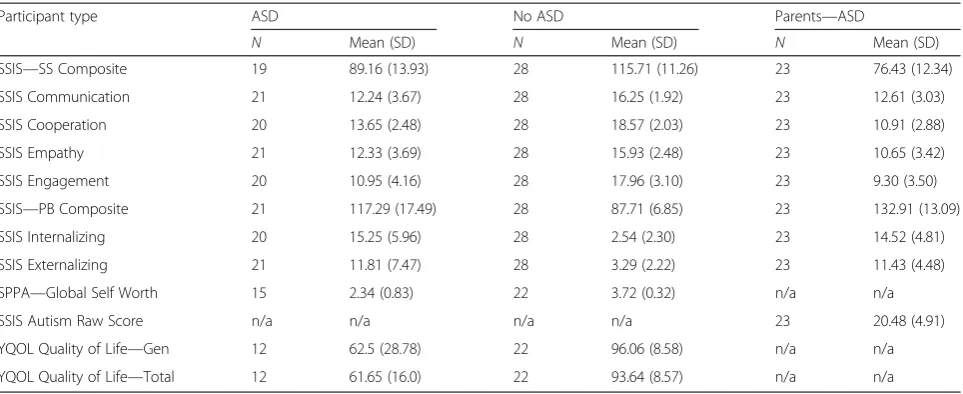
Tables 1 and 2 provide demographic characteristics for the sample, including sample sizes and mean scores for
participants on measures of social-emotional health. Par-ticipants included adolescent females (14–19 years old) with and without ASD that participated in a social skills and self-care program for adolescent females, with par-ticipant data collection from six separate social groups over the course of a 4-year period (2010–2014). All par-ticipants lived in a large, Midwestern city or the sur-rounding suburbs. Inclusion criteria for females with ASD included (1) documentation of an ASD diagnosis by a psychologist, psychiatrist, developmental pediatrician, or interdisciplinary team (all diagnoses were based on DSM-IV-TR criteria), (2) reading skills at fourth grade level or higher, established by parent report or school evaluations when available, and (3) the ability to speak in 2–3 word phrases at a rate of 1–2 phrases per minute. Exclusion cri-teria (as part of the larger intervention program) included a recent history of significantly aggressive behavior sug-gesting the participant would be a danger to self or others. However, to date, no participants have been excluded from the study due to potentially dangerous behaviors. Participants in the ASD group were high functioning (no participants with a diagnosis of intellectual disability), with autism symptom severity scores ranging from 13–34, with mean scores in the above average range (mean = 20.48, SD = 4.91) on the SSIS. Participants demonstrated deficits in overall social skills as evidenced by the SSIS Social Skills composite scores falling in the below average range on the parent report (mean = 76.43, SD = 12.34) and in the lower end of average for self-report (mean = 89.16, SD = 13.93) measures. Female participants without ASD were peer mentor volunteers in the social skills program and deemed an appropriate volunteer for the program following a phone interview with the program director (i.e., commit-ment to attend weekly sessions, demonstrated appropriate behaviors, parental permission, and access to transporta-tion). Although information regarding potential mental health diagnosis was not collected at screening, peer volun-teers did not demonstrate any obvious social or mental health problems during the phone interview. Because data collection was part of a larger program evaluation examin-ing the effectiveness of a social skills program for females with ASD, only females are included in this study.
Measures
Data collection included self and parent respondent measures to evaluate adolescent females’ perceptions of social competence as well as self-perceptions in various social-emotional domains. Data analyses in this study are based on measures completed at baseline prior to completing the social skills intervention program.
Social Skills Improvement System (SSIS)
The SSIS [24] is a standardized, informant-based rating tool designed to measure individuals’social skills as well
Table 1Demographic characteristics of GNO participants with and without ASD and parents of girls with ASD
Participant type N Mean age (SD) % White
ASD 23 16.04 (1.72) 91 %
No ASD 29 16.75 (1.14) 97 %
Parents—ASD 23 n/a n/a
Note:nsize indicates maximum possible number that could have completed ratings. In many cases, the availablenfor selected analyses is smaller. Specific
as problem behaviors. Respondents make ratings using a Likert-type scale on areas of social competence as well as social difficulty and challenging behaviors. Reliability is sufficient, with internal consistency coefficients in the upper 0.90s for Skills and Problem Behavior subscales. The SSIS has adequate test-retest reliability (parent form = 0.72–0.88; student form = 0.59–0.81) and validity and is correlated with other measures of social skills (r = 0.50–70). Analyses primarily include data from self-report forms. However, the parent self-report version provides data about the relationship between social-emotional health and parent perception of ASD severity.
Harter’s Self-Perception Profile for Adolescents (SPPA)
The SPPA [25] is a self-perception rating scale for ad-olescents between the ages of 14–18 years old. The 45-item instrument presents pairs of statements that describe adolescents and asks the individual to choose which statement from each pair best describes him/ her and then to rate how much (a lot or a little bit) that statement describes him/her. Items come together to form subscales related to self-perceptions of global self-worth, as well as eight other domains. Internal consistency estimates range from 0.65 to 0.89. Using oblique rotation, factor analysis showed clear factor loadings for eight scales (0.47–0.84). The tool was de-veloped in 1998 and updated in 2012 [26]. For this study, most participants completed the original (1988) version, with the most recent participants (n= 7 ASD, 6 no ASD) completing the updated edition.
Youth Quality of Life Instrument—Research Version (YQOL-R)
The YQOL-R [27] is a questionnaire completed by indi-viduals between the ages of 12 and 18 years old. The
41-item instrument presents statements about an indi-vidual’s perceptions of self, relationships, environment, and general life enjoyment and satisfaction and asks the respondent to rate the degree to which the statement applies to them (10-point Likert-type scale ranging from “not at all” to “a great deal”). Items combine to form four subscales and a total scale score. Internal consistency estimates range from 0.77 to 0.96. Factor ana-lysis showed a factor structure for four subscales and a principal component analysis provided support for a total scale (eigenvalue = 3.2).
Procedures
Completion of measures
Upon being accepted to participate in the program, parents completed informed consent and participants under the age of 18 completed assents. Prior to starting the intervention, all participants and peers (no-ASD group) completed measures related to self-perceptions of social competence (SSIS) and self-worth (SPPA), along with quality of life (YQOL-R). Parents, primarily mothers (only 2 fathers served as the reporter), of indi-viduals with ASD completed parallel parent forms of the SSIS. Parents of individuals without ASD did not complete parallel parent forms in an effort to minimize the paperwork burden for peer volunteer partici-pants and their families. Only data collected prior to completing the intervention program are included in this study.
Data selection
Data for this study comes from a sample of 45 adolescent females that completed the aforementioned measures. Sample sizes for each outcome measure are presented in
Table 2Specificnsizes, mean scores, standard deviation, and range for global and subscale measures of social-emotional health, autism severity, and quality of life
Participant type ASD No ASD Parents—ASD
N Mean (SD) N Mean (SD) N Mean (SD)
SSIS—SS Composite 19 89.16 (13.93) 28 115.71 (11.26) 23 76.43 (12.34)
SSIS Communication 21 12.24 (3.67) 28 16.25 (1.92) 23 12.61 (3.03)
SSIS Cooperation 20 13.65 (2.48) 28 18.57 (2.03) 23 10.91 (2.88)
SSIS Empathy 21 12.33 (3.69) 28 15.93 (2.48) 23 10.65 (3.42)
SSIS Engagement 20 10.95 (4.16) 28 17.96 (3.10) 23 9.30 (3.50)
SSIS—PB Composite 21 117.29 (17.49) 28 87.71 (6.85) 23 132.91 (13.09)
SSIS Internalizing 20 15.25 (5.96) 28 2.54 (2.30) 23 14.52 (4.81)
SSIS Externalizing 21 11.81 (7.47) 28 3.29 (2.22) 23 11.43 (4.48)
SPPA—Global Self Worth 15 2.34 (0.83) 22 3.72 (0.32) n/a n/a
SSIS Autism Raw Score n/a n/a n/a n/a 23 20.48 (4.91)
YQOL Quality of Life—Gen 12 62.5 (28.78) 22 96.06 (8.58) n/a n/a
YQOL Quality of Life—Total 12 61.65 (16.0) 22 93.64 (8.57) n/a n/a
Table 2 by type of participant (no ASD and ASD). Sample sizes vary (n= 12–45) based on participant type (ASD vs no ASD), type of analysis, and availability and quality of outcome data. For example, in some analyses, we ex-amined relationships among variables across collapsed groups, and for others, we parsed out the relationship for just individuals with ASD or no-ASD. Findings in this manuscript include participant data over the course of 4 years and across six intervention groups. Thus, vari-ability of sample size is related to (1) changes in outcome measures employed across multiple years of program evaluation and (2) adequate completion of measures by parents and participants (i.e., missing or incomplete data).
Data analysis
We calculated Pearson product moment correlations to examine relationships among adolescent self-ratings of social-emotional health (i.e., social competence, self-worth, and quality of life) as well as parent ratings of their daughter’s autism symptom severity, social compe-tence, and problem behaviors. We conducted independ-ent sample t tests (level of significance set at 0.05) to examine the differences between adolescent females with and without ASD on positive and negative indicators of social-emotional health. In addition to statistical signifi-cance, we evaluated the magnitude of differences or strength of relationships using guidelines established by Cohen [28]. For correlations, the r value will reflect a small (0.100), medium (0.243), or large (0.371) effect size. When comparing means, effect sizes will be inter-preted as small (0.2), medium (0.5), and large (0.8).
Results
What is the relationship among indicators of social-emotional health (social competence, global self-worth, quality of life) for adolescent females with and without autism spectrum disorder?
First, we examined the overall relationship between glo-bal social competence (SSIS Composite), self-perception (SPPA Global Self Worth), and quality of life (YQOL-R Total QoL) across both groups. Results of the Pearson product moment correlation indicate a statistically signifi-cant (and large) relationship between global self-worth and global social competence for adolescent females, regardless of ASD diagnosis (r(36) = 0.74,p= 0.000). We also found large, significant relationships between social competence and quality of life (r (33) = 0.68, p= 0.000) and global self-worth and quality of life (r (32) = 0.72, p= 0.000) for the combined groups. Next, we examined the rela-tionship between global social competence and global self-perception for the ASD and no-ASD groups, respect-ively. Correlations revealed a large and statistically signifi-cant relationship between social competence and global self-worth for the no-ASD group (r(22) = 0.62,p= 0.002)
but not for the ASD group (r (14) = 0.32, p= 0.258). In evaluating the relationship between quality of life, social competence, and self-worth, this difference in effect was also noted between the ASD and no-ASD groups. For the no-ASD group, there was a large correlation be-tween quality of life and social competence (r (22) = 0.81, p= 0.000) and for quality of life and self-worth (r(21) = 0.50, p= 0.021). However, there were not signifi-cant relationships between quality of life and social compe-tence (r(11) =−0.177, p= 0.602) or for quality of life and self-worth (r(11) =−0.09,p= 0.801) for the ASD group.
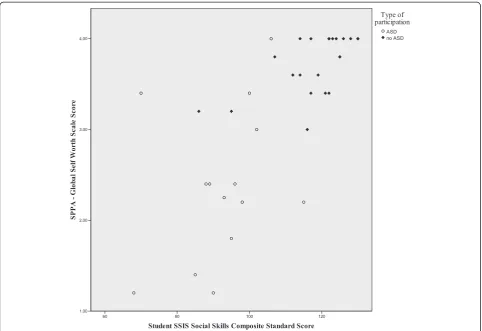
Figures 1, 2, and 3 illustrate the differences in the pat-terns of relationship among quality of life, social compe-tence, and self-worth between the ASD and no-ASD groups. For the no-ASD (peer) group, we note a trun-cated range of scores in the average to above average range, while for the ASD group, there is a wider disper-sion of scores and these scores fall in the average to below average range. It is also important to note the dif-ferences in sample size for each analysis, with nearly double the number of scores available for the no-ASD group as opposed to those in the ASD group.
To what extent are there differences between adolescent females with and without autism spectrum disorder in measures of social-emotional health (social competence, social self-perception, quality of life) and problematic behaviors (internalizing and externalizing symptoms)?
How are problematic behaviors such as internalizing and externalizing symptoms related to the overall social-emotional health (social competence, global self-worth, quality of life) of adolescent females with and without ASD?
We first examined the overall relationships between prob-lematic behaviors (internalizing and externalizing symp-toms) and social-emotional health (social competence, quality of life, and global self-worth) collapsed across the ASD and no-ASD groups. Results show significant, and large, inverse relationships between internalizing symp-toms and social competence (r(46) =−0.74, p= 0.000) as well as between internalizing symptoms and global self-worth (r (36) =−0.77, p= 0.000). We found a similar in-verse relationship between internalizing symptoms and quality of life (r(33) =−0.69, p= 0.000). Thus, indicat-ing that for both females with and without ASD, as higher internalizing symptoms were reported, girls re-ported lower ratings for social competence, self-worth, and quality of life. Results also show significant, inverse relationships across groups for externalizing symptoms and quality of life (r(34) =−0.47, p= 0.005), as well as social competence (r (47) =−0.76, p= 0.000) and self-worth (r (37) =−0.67, p= 0.000). Next, we examined
these relationships within each group (ASD and no ASD). See Table 3 for a summary of all possible correla-tions. Results show significant, inverse relationships be-tween problematic behaviors and social-emotional health for most analyses in the no-ASD group, with the exception of the relationship between externalizing symptoms—global self-worth and externalizing symp-toms—quality of life. Results within the ASD group demonstrate small to moderate relationships between most constructs, with a significant correlation between the externalizing symptoms and social competence scales (r(19) = 0.59,p= 0.008) as well as between internal-izing and externalinternal-izing symptoms (r(20) = 0.79,p= 0.000) and a modest correlation between internalizing symp-toms and social competence (r (18) =−0.27, p= 0.284). Differences in effect were found for the patterns of relations between internalizing symptoms and social competence, self-worth, and quality of life. For all three relationships, the effect for the no-ASD group was sig-nificant but not for the ASD group. The relationship be-tween internalizing symptoms-self-worth was moderate and inverse for both the ASD (r(14) =−0.41, p= 0.148) and no-ASD groups (r (22) =−0.43, p= 0.048). For in-ternalizing social competence, the ASD group effect
(r (18) =−0.27, p= 0.284) was smaller than the no-ASD group (r (28) =−0.49, p= 0.008). And for intern-alizing quality of life, there was an inverse, moderate effect for the no-ASD group (r (22) =−0.59, p= 0.004), but no effect for the ASD group (r(11) = 0.06, p= 0.864).
To further examine the pattern of relationships, specifically the differences in effect between groups for the relationships between internalizing symptoms and social-emotional health, grouped scatter plots are shown in Figs. 6, 7, and 8. While the scatter plots illus-trate the strong overall inverse relationship, for both groups, there is a truncated range of scores for the no-ASD group, lessening the strength of relationship between variables within respective groups. It also il-lustrates the significant differences in the relationships between internalizing symptoms and both social com-petence and self-perceptions between the girls with and without ASD. Scatter plots show a cluster of ratings in the average to above average range for peer partici-pants, and a greater spread of scores in the below average lower range for participants with ASD. Additionally, their ranges do not overlap.
How are social competence and problematic behaviors (internalizing and externalizing symptoms) related to parent perceptions of autism symptom severity?
Autism symptom severity is indicated by the Autism Symptom Index on the SSIS parent report form. We used parent ratings in these analyses because this index is not included on the self-report form. We first exam-ined the relationship between student and parent ratings on the SSIS, in order to examine consistency of percep-tions of social competence and problem behaviors be-tween parents and daughters. Because analyses revealed nonsignificant relationships between parent and daugh-ter ratings for global social competence, global problem behaviors, and internalizing symptoms, only parent rat-ings were used for this analysis. This inconsistency be-tween parent and daughter report is not unique to individuals with autism but is a phenomenon seen in adolescent-parent reports on the whole and is near that reported in the SSIS manual [24]. Results from the Pearson correlation show that there was not a significant relationship between parent ratings of their daughter’s autism symptom severity and their rating of her internal-izing symptoms (r (23) = 0.20,p= 0.354) or externalizing
symptoms (r(23) = 0.29,p= 0.176). There was however a significant, inverse relationship between autism symptom severity and social competence, as measured by the SSIS Autism Symptom Index and Social Skills Composite (r (23) =−0.61, p= 0.002). Thus, as parents rated their daughter’s autism symptoms as more severe, they made lower ratings of social competence. We examined this ef-fect more closely by evaluating the correlation between the Autism Symptom Index and specific Social Skills and Problem Behavior subscales on the SSIS (summarized in Table 4). Follow-up correlations indicated significant, inverse relationships between autism symptom severity and the specific social skill domains of communication, empathy, and engagement (r=−0.57 to −0.72) but not for cooperation (r (23) =−0.15, p= 0.499). Correlations among problem behavior subscales of internalizing and externalizing symptoms and autism symptom severity were not significant (see Table 4).
Discussion
We examined existing data to explore the relationship between selected indicators of social-emotional health and problematic behaviors specific to internalizing and externalizing symptoms for adolescent females with and without ASD. We compared self-perceptions of social
competence, self-worth, and quality of life between groups and examined the impact of internalizing and externaliz-ing symptoms on these constructs. Lastly, we examined the impact of autism symptom severity as rated by parents (according to the SSIS) on social competence and problem behaviors.
Overall, there was a significant relationship among the constructs of social-emotional health (quality of life, social competence, global self-worth), across both ASD and no-ASD groups. This relationship remains for the no-ASD group, however, for females with ASD in this study, the relationship among social competence, self-worth, and quality of life diminishes to small or nonex-istent. Adolescent females with ASD rated themselves significantly lower in all three areas compared to their non-ASD peers. Social impairments, such as in ASD, are reflected in the lower ratings of social competence made by girls with ASD. Adolescence includes changes in social norms and expectations that result in complex interactions and relationships with a greater emphasis on independence and less reliance on adults. Research indicates sex differences in social behaviors throughout development, with female friendships possibly more complex, including a greater emphasis on emotions and relationships [18]. Biological changes associated with
puberty impact self-care routines and related adaptive behaviors, which could prove even more difficult for some individuals with ASD who demonstrate variable or delayed adaptive behavior skills [22]. Harter and col-leagues [25] found that self-perceptions about appear-ance and friendships were most related to self-esteem and that relationships significantly contribute to global self-worth. Our findings, showing that females with ASD made significantly lower ratings in these areas,
along with poor reported social competence and quality of life, suggests the potential for a significant impact on their social-emotional health. Consistent with some re-cent literature [5, 29], females with ASD in our sample also reported more internalizing and externalizing symptoms as compared to typically developing females. In general, females experience more internalizing symp-toms as compared to males [30]. In our sample, we found an extremely large difference between adolescent
Fig. 4Selected subscales from the self-report version of theSocial Skills Improvement System(SSIS). Figure depicts score differences between adolescent females with and without ASD. Higher scale scores indicate better developed skills. However, the Internalizing & Externalizing Subscales are reverse scored, thus higher scores reflect a greater level of concern.Note: Scores between 11-19 are considered in the Average range for Social Skills Composite subscales on the SSIS. For Problem Behavior Subscales of Internalizing and Externalizing Problems, scores between 1-14 are considered Average. Mean scores for the no-ASD group across SSIS subscales Communication, Cooperation, Empathy and Engagement ranged from 15.93-18.57 (SD = 1.92-3.10). Average scores for the ASD group ranged from 10.95-13.65 (SD = 2.48-4.16). For the reverse-scored items of the Internalizing and Externalizing subscales, means for the no-ASD group were 2.54 (SD=2.30) and 3.29 (SD= 2.88) for Internalizing and Externalizing respectively. For the ASD group Internalizing mean = 15.25 (SD =5.96) and for Externalizing mean = 11.81 (SD= 7.47)
Table 3Correlations among self-ratings of self-worth (SPPA Global), social competence (SSIS SS Composite), and externalizing (SSIS Externalizing subscale) and internalizing (SSIS Internalizing subscale) symptoms for adolescent females with and without ASD
SPPA Global Self Worth SSIS Social Skills Composite SSIS Externalizing subscale SSIS Internalizing subscale
ASD No ASD ASD No ASD ASD No ASD ASD No ASD
SSIS Social Skills Composite r= 0.32 p = 0.258
n= 14 r = 0.62 p = 0.002n = 22 – – – – – –
SSIS Externalizing subscale r=−0.42p= 0.117
n= 15 r
=−0.30p= 0.175
n= 22 r =n = 19−0.59 p = 0.008 r =n = 28−0.56 p = 0.002 – – – –
SSIS Internalizing subscale r=−0.41p= 0.148
n= 14 r =n = 22−0.43 p = 0.048 r
=−0.27p= 0.284
n= 18 r =n = 28−0.49 p = 0.008 r = 0.79 p = 0.000n = 20 r = 0.72 p = 0.000n = 28 – – YQOL-R Total QOL r=−0.09p= 0.801
n= 11 r = 0.50 p = 0.021n = 21 r
=−0.18p= 0.602
n= 11 r = 0.81 p = 0.000n = 22 r
= 0.26p= 0.417
n= 12 r
=−0.39p= 0.069
n= 22 r
= 0.06p= 0.864
n= 11 r
=−0.59p= 0.004 n= 22
Note: italic values indicate significance atp≤0.05
er
Molecular
Autism
(2015) 6:53
Page
11
of
females with and without ASD, suggesting internalizing symptoms significantly impact the female ASD popula-tion. Thus, if adolescent females with ASD have lower self-perceptions, report lower quality of life, and report poor social competence in addition to greater problem behaviors compared to peers, they become an extremely vulnerable population with significant risk to develop co-existing mental health conditions and related problems. Although only significant for the no-ASD group, we found moderate correlations (r= 0.41–0.43) between internaliz-ing symptoms and global self-worth. The increased risk for problematic internalizing and externalizing symptoms, coupled with complex social relationships with social im-pairment as a core feature in ASD, results in girls with ASD experiencing a“double whammy”in adolescence or “double hit” as described by Solomon [5]. We also de-scribed this “double whammy” with respect to sex and diagnosis, suggesting that a unique intervention program is needed to address the complex needs of adolescent fe-males with ASD [31]. While all adolescents experience an increased complexity of social norms and expectations and biological changes associated with puberty, females with ASD experience both the potential impact of ASD (social impairments, difficulties in adaptive behavior) as well as sex (focus on emotion, conversation, relationships;
increased risk for internalizing symptoms; and biological changes that significantly impact self-care routines). This “double whammy,” along with additional variables that contribute to unique challenges for this population (e.g., primarily male peer group, research based on male sam-ples, limited focus on adolescents and adults), supports the need to target the social-emotional health in this population.
Interestingly, we found significant relationships be-tween indicators of social-emotional health and prob-lematic behaviors across groups but no longer found significance within the ASD group when parsing out the relationships among these variables within each group. As noted above, correlations between internalizing symp-toms and global self-worth were moderate and similar for both groups with a lack of significance in the ASD group as a result of a smaller sample. As seen in the scatter plots (Figs. 3, 4, 5, 6, 7, and 8), ratings for ado-lescent females without ASD generally indicated better social-emotional functioning and fewer problematic be-haviors compared to those in the ASD group and fell within a truncated, clustered range (average to above average). Ratings for adolescent females with ASD gener-ally indicated lower functioning and were more dispersed in terms of score ranges (average to extremely low). Larger
samples are needed to determine if the pattern of data would suggest similar general relationships within both groups or if data would reveal a significant relationship in constructs within only one group.
In an attempt to determine how ASD symptom severity is related to social-emotional health, we examined the re-lationship between autism symptom severity (according to parent report on the SSIS), social competence, and prob-lematic behaviors (internalizing and externalizing symp-toms). There were no significant relationships between parent ratings of ASD symptom severity and their rat-ings of internalizing or externalizing symptoms. In con-trast, there was a significant, inverse relationship between parent ratings of autism symptom severity and their perceptions of their daughter’s social competence. As parents perceived a higher intensity and severity level of their daughter’s autism symptoms, they also saw a negative impact on her social competence. For adoles-cent females with autism, this finding supports the no-tion that parents continue to be aware of the impact of their daughter’s symptoms and see it continue to affect her social relationships in significant ways. Parent data for typically developing females was not collected, thus, a comparison of similarities and differences was not able to be conducted in the same manner. Some research,
including data from our recent qualitative research, in-dicates that parents continue to be involved at a high level in their daughters’social experiences, which is in contrast to the reduction in parent involvement in social activities and increasing social independence of typically developing adolescents [12]. A larger sample is needed to further explore the relationship between these vari-ables and how autism symptom severity may or may not impact social-emotional health for adolescent females with ASD. Understanding these relationships could lead to hypotheses about directional causation and interven-tions that target and promote possible“protective factors” (e.g., autism symptom severity, self-perception) result-ing in improved health and less impairments durresult-ing adolescence.
Exploring the interplay between social-emotional health and problematic behaviors such as internalizing and exter-nalizing symptoms in the context of autism is a crucial first step to better understand the experiences of adoles-cent females with ASD. These findings further demon-strate how girls in adolescence experience an intersection of social complexity and sense of self—where social expe-riences and self-concept relate to one another and affect one’s quality of life, which in turn influence one’s ability to address internal stress and inhibit challenging behaviors.
Our data indicate that young women with ASD see them-selves as more challenged, reporting lower levels of social competence, self-concept, quality of life, and higher rates of negative internal and external symptoms, meaning they are at higher risk for negative experiences across the domains examined in this study. Parent reports also elab-orate the impact of autism on the functioning of these young women, indicating that for young women with ASD, as their symptoms are more elevated, their social competence is lowered. The impact of autism on a popu-lation that is already at higher risk due to increased social complexity, higher risk for negative self-concept and in-ternalizing disorders, supports the need for prevention and intervention tailored to the unique experiences of this population.
Conclusions
We acknowledge some limitations in this study. Al-though sample size is relatively small and varies between groups and for specific measures, results suggest robust effects and an adequate sample size for most analyses. Females represent less than 15 % of participants in pub-lished autism studies, with a very small proportion of research (approximately 1 %) focusing specifically on females with ASD [32], suggesting studies with small
Table 4Correlations among parent ratings of autism symptoms and their perceptions of their daughter’s social competence on the SSIS
Autism Raw Score—SSIS SSIS Social Skills Composite −0.61
p = 0.002
SSIS Communication −0.72
p = 0.000
SSIS Cooperation −0.15
p= 0.499
SSIS Engagement −0.66
p = 0.001
SSIS Empathy −0.57
p = 0.005
SSIS Problem Behavior Composite 0.36
p= 0.091
SSIS Internalizing 0.20
p= 0.354
SSIS Externalizing 0.29
p= 0.176
Note: Only parents of participants with ASD completed SSIS (n= 23) Italic values indicate significance atp< 0.01
samples could make a significant contribution to the lit-erature. Findings should be interpreted and generalized within the context of our limited sample. Participants were primarily white, living in suburban areas. Partici-pants in the ASD group are mostly representative of higher functioning females with ASD, although not vali-dated through cognitive testing for inclusion in the study. Our sample of females without ASD might repre-sent a somewhat“biased” sample of typically developing adolescent females. There could be something inherently different about this group, as all participants agreed to volunteer as peer participants for a social skills program. However, the use of only baseline data limits potential bias from intervention effects and could mirror similar biases likely to occur for similar situations in which par-ticipants volunteer for research. Parent report measures are not available for participants in the no-ASD group, limiting data analysis to comparisons between self-report measures and examining relationships in parent report data only in the ASD group. Findings are also limited by only including respondent measures and a lack of multiple measures evaluating each construct. Additionally, this study focused only on differences between females and did not include comparisons between males with and without ASD. As this study was preliminary and emerged from a broader program evaluation of a social skills curriculum designed for females, males were not included. Future studies comparing males and females with and without ASD would provide a much broader picture of social-emotional health in adolescents and would allow for an analysis of sex-specific similarities and differences in social-emotional constructs and how the expression of ASD symptoms impacts males and females. Although lack of a male comparison group is a limitation in understand-ing potential sex differences, the inclusion of a female, typ-ically developing reference group is a strength of the study and contributes to the purpose of this study which is to better understand females with ASD in comparison to their peers.
Further analyses are needed, with larger data sets, comparisons with adolescent males, and measures of autism symptom severity from the perspective of the adolescent and other sources. These analyses could also inform a broader model of the degree to which various factors of the experience of adolescent females with ASD (autism symptoms, internalizing disorders, and negative self-perceptions) could contribute to their social compe-tence and vice versa. Understanding these relationships ultimately informs intervention programming to more ef-fectively support skill development that promotes healthy social-emotional development and protective factors to address the risk of internalizing symptoms and greater im-pairment during adolescence.
These findings have implications for supports and intervention programming. Understanding the relation-ship among indicators of social-emotional health and problematic behaviors speaks to the importance of de-veloping specialized programming that addresses not only skills crucial for building social competence but that also involves developing positive self-concept and thus potentially protecting against internalizing symp-toms. In terms of intervention, a program such as the Girls Night Out model [31] incorporates curricula re-lated to social competence and self-care (both in terms of physical hygiene and positive self-concept), delivered through evidence-based strategies within the natural en-vironment. This model (GNO) targets specific skills re-lated to the “double whammy” described earlier and is designed to promote social-emotional health across the domains explored in this study and address a critical need for this vulnerable population. Future research and intervention programs should consider potential sex dif-ferences in social behavior as well as individual differ-ences related to the expression of ASD when examining social-emotional constructs and generalizing findings.
Abbreviations
ASD:autism spectrum disorder; SPPA: Self-Perception Profile for Adolescents; SSIS: Social Skills Improvement System; YQOL-R: Youth Quality of Life Instrument—Research Version; SST: social skills training.
Competing interests
The authors declare that they have no competing interests.
Authors’contributions
TRJ conceived of, designed, and provided the Girls Night Out program, a social skills intervention for adolescent girls with autism. The data for this paper has been continually collected throughout Girls Night Out intervention programs, and TRJ has developed significant understanding and theories concerning this topic through her experience in this program. TRJ and JOS developed the research questions included in this paper, participated in data analysis, and drafted the manuscript. TRJ and JOS collaborate on related quantitative and qualitative research resulting in collaborative hypotheses and theories regarding phenotypes of females with ASD. Both authors read and approved the final manuscript.
Acknowledgements
We thank Megan Hadorn and Rohini Chakravarthy for their contributions to data entry and manuscript preparation.
T. Rene Jamison is currently supported by funds from Maternal Child and Health Bureau, the State of Kansas, and the Center for Child Health and Development at the University of Kansas Medical Center. Dr. Jamison previously received support for related projects from an Autism Speaks Family Service Grant, the Kansas Center for Autism Research and Training, the Children’s Miracle Fund from the Department of Pediatrics, and in part by an NIH Clinical and Translational Science Award grant (UL1TR000001, formerly UL1RR033179), awarded to the University of Kansas Medical Center. Jessica Oeth Schuttler is currently supported by funds from the Maternal Child and Health Bureau in a post-doctoral training position at the Center for Child Health and Development. Dr. Schuttler was previously supported for related projects by funds from the Children’s Miracle Fund from the Department of Pediatrics at the University of Kansas Medical Center.
References
1. American Psychiatric Association. Diagnositc and statistical manual of mental disorders. 5th ed. Arlington, VA: American Psychiatric Publishing; 2013. 2. Rivet TT, Matson JL. Review of gender differences in core symptomatology
in autism spectrum disorders. Res Autism Spect Dis. 2011;5(3):957–76. 3. Kirkovski M, Enticott PG, Fitzgerald PB. A review of the role of female
gender in autism spectrum disorders. J Autism Dev Disord. 2013;43(11):2584–603. doi:10.1007/s10803-013-1811-1.
4. Koenig K, Tsatsanis KD. Pervasive developmental disorders in girls. In: Bell DJ, Foster SL, editors. Handbook of Behavioral and Emotional Problems. New York: Kluwer Academic/Plenum Publishers; 2005. p. 211–37. 5. Solomon M, Miller M, Taylor SL, Hinshaw SP, Carter CS. Autism symptoms
and internalizing psychopathology in girls and boys with autism spectrum disorders. J Autism Dev Disord. 2012;48:48–59. doi:10.1007/s10803-011-1215-z. 6. Matson JL, Matson ML, Rivet TT. Social-skills treatments for children with
autism spectrum disorders: an overview. Behav Modif. 2007;31(5):682–707. doi:10.1177/0145445507301650.
7. McConnell SR. Interventions to facilitate social interaction for young children with autism: review of available research and recommendations for educational intervention and future research. J Autism Dev Disord. 2002;32(5):351–72.
8. Bellini S, Peters JK, Benner L, Hopf A. A meta-analysis of school-based social skills interventions for children with autism spectrum disorders. Rem Spec Educ. 2007;28(3):153–62.
9. DuPaul GJ, Eckert TL. The effects of social skills curricula: now you see them, now you don’t. School Psychol Quart. 1994;9(2):113.
10. Bierman KL, Welsh JA. Social relationship deficits. In: Mash EJ, Terdal LG, editors. Assessment of childhood disorders. 3rd ed. New York: Guilford Press; 1997.
11. Interagency Autism Coordinating Committee (IACC), U.S. Department of Health and Human Services. 2010 IACC Autism Spectrum Disorder Research Portfolio Analysis Report. 2010. http://iacc.hhs.gov/portfolio-analysis/2010/ index.shtml. Accessed 13 Jan 2015.
12. Cridland EK, Jones SC, Caputi P, Magee CA. Being a girl in a boy’s world: investigating the experiences of girls with autism spectrum disorders during adolescence. J Autism Dev Disord. 2014;44:1261–74. doi:10.1007/s10803-013-1985-6.
13. Bauminger N, Shulman C, Agam G. The link between perceptions of self and of social relationships in high-functioning children with autism. J Dev Phys Disabil. 2004;16(2):193–214.
14. McLennan JD, Lord C, Schopler E. Sex differences in higher functioning people with autism. J Autism Dev Disord. 1993;23(2):217–27.
15. Harter S, Waters P, Whitesell NR. Relational self-worth: differences in perceived worth as a person across interpersonal contexts among adolescents. Child Dev. 1998;69(3):756–66. doi:10.1111/j.1467-8624.1998.tb06241.x.
16. Compas BE, Connor-Smith J, Jaser SS. Temperament, stress reactivity, and coping: implications for depression in childhood and adolescence. J Clin Child Adolesc. 2004;33(1):21–31. doi:10.1207/S15374424JCCP3301_3. 17. Frost J, McKelvie S. Self-esteem and body satisfaction in male and female
elementary school, high school, and university students. Sex Roles. 2004;51(1–2):45–54.
18. Hannah A, Murachver T. Gender and conversational style as predictors of conversational behavior. J Lang Soc Psychol. 199;18(2):153–174. doi:10.1177/02691927X99018002002.
19. Lord C, Schopler E, Revicki D. Sex differences in autism. J Autism Dev Disord. 1982;12(4):317–30.
20. Tsai LY, Beisler JM. The development of sex differences in infantile autism. Brit J Psychiat. 1983;142(2):373–8.
21. Holtmann M, Bolte S, Poustka F. Autism spectrum disorders: sex differences in autism behaviour domains and coexisting psychopathology. Dev Med Child Neurol. 2007;49:361–6. doi:10.1111/j.1469-8749.2007.00361.x. 22. Ditterline J, Oakland T. Relationships between adaptive behavior and
impairment. In: Assessing Impairment. Springer:2009. p.31-48.
23. Crombie G. Gender differences: implications for social skills assessment and training. J Clin Child Psychol. 1988;17:116–20.
24. Gresham FM, Elliott SN. Social skills improvement system rating scales (SSIS) rating scales. Bloomington, MN: Pearson Assessments; 2008.
25. Harter, S. (1988). Manual for the Self-Perception Profile for Adolescents. Denver, CO: University of Denver.
26. Harter S. Self-Perception Profile For Adolescents: manual and questionnaires, University of Denver. 2012.
27. Topolski T, Edwards T, Patrick D. User's manual and interpretation guide for the Youth Quality of Life (YQOL) Instruments. Seattle, WA: University of Washington, Dept. of Health Services; 2002.
28. Cohen J. A power primer. Psychol Bull. 1992;112(1):155–9.
29. Head AM, McGillivray JA, Stokes MA. Gender differences in emotionality and sociability in children with autism spectrum disorders. Molecular autism. 2014;5(1):1–9.
30. Nolen-Hoeksema S. Gender differences in depression. Current Directions in Psychol Sci. 2001;10(5):173–6.
31. Jamison R, Schuttler J. An overview of a social skills and self-care curriculum for adolescent females with autism: The Girls Night Out model. Manuscript in preparation.
32. Watkins EE, Zimmerman ZJ, Poling A. The gender of participants in published research involving people with autism spectrum disorders. Res Autism Spect Dis. 2014;8(2):143–6. doi:10.1016/j.rasd.2013.10.010.
Submit your next manuscript to BioMed Central and take full advantage of:
• Convenient online submission • Thorough peer review
• No space constraints or color figure charges • Immediate publication on acceptance
• Inclusion in PubMed, CAS, Scopus and Google Scholar
• Research which is freely available for redistribution