P R O T O C O L
Open Access
Acceptance and commitment therapy
for chronic pain: protocol of a systematic
review and individual participant data
meta-analysis
Jiaxi Lin
1*, Whitney Scott
2, Lewis Carpenter
2, Sam Norton
2, Matthias Domhardt
3, Harald Baumeister
3and
Lance M. McCracken
4Abstract
Background:
Acceptance and commitment therapy (ACT) can be effective in treating chronic pain. Despite evidence
supporting the effectiveness of ACT, uncertainties remain regarding which subgroups in the chronic pain population
are likely to benefit most and least. This protocol describes the application for two meta-analytic approaches, one at
the level of individual participant data and the other at the level of aggregated data, from randomized controlled trials
of ACT for chronic pain (ACT-CP-MA).
Methods:
We will systematically conduct literature searches in CENTRAL, MEDLINE, EMBASE, PsycINFO, and trial registers.
Two reviewers will independently select studies for inclusion and data extraction. ACT-CP-MA will include randomized
controlled trials with ACT for chronic pain compared to control conditions for adults (
≥
18 years) with chronic
pain (> 3 months). We will invite the authors of all eligible trials to share individual participant data. Outcomes
will include standardized measures of pain interference, pain intensity, depression, anxiety, health-related quality
of life, participants
’
rating of overall improvement, and ACT-related process variables. Using the Cochrane
Collaboration
’
s tool and GRADE, reviewers will independently check for risk of bias, quality of evidence, and
strength of recommendations. In the individual participant data meta-analysis, we will use a one-step approach
where participants are clustered with studies and data from all studies are modeled simultaneously. For analyses,
we will use mixed-effects models. Additionally, we will employ a meta-analysis with aggregate data and compare
the results of both meta-analyses.
Discussion:
This collaborative meta-analysis of individual participant data from randomized controlled trials of
ACT for chronic pain versus control conditions will demonstrate how the known benefits of ACT for chronic pain
vary across different subtypes of the chronic pain population. The results of the meta-analyses will be based on a
comprehensive search of multiple databases and will help to inform future clinical trials and decision-making on
the use of ACT in chronic pain and improve the quality, design, and reporting of future trials in this field.
Systematic review registration:
PROSPERO CRD42019120901.
Keywords:
Individual participant data meta-analysis, Acceptance and commitment therapy, Chronic pain, Subgroups
© The Author(s). 2019Open AccessThis article is distributed under the terms of the Creative Commons Attribution 4.0 International License (http://creativecommons.org/licenses/by/4.0/), which permits unrestricted use, distribution, and reproduction in any medium, provided you give appropriate credit to the original author(s) and the source, provide a link to the Creative Commons license, and indicate if changes were made. The Creative Commons Public Domain Dedication waiver (http://creativecommons.org/publicdomain/zero/1.0/) applies to the data made available in this article, unless otherwise stated.
* Correspondence:[email protected]
1Sportpsychology, Institute for Sports and Sport Science, University of
Freiburg, Freiburg, Germany
Background
Chronic pain is defined as pain lasting more than
3 months and can be seen as a disease in its own right [
1
].
The prevalence rates of chronic pain are in the range of
27% in European countries [
2
], equivalent to international
estimates [
3
,
4
]. This condition is associated with a high
disease burden in terms of personal suffering, low quality
of life, and high economic costs, and is considered as a
major health care problem worldwide [
5
,
6
]. According to
the Global Burden of Disease Study of 2017 [
7
], over the
28-year period from 1990 to 2017, low back pain,
head-ache disorders, and depressive disorders have prevailed as
three of the top four leading causes of years lived with
disability worldwide.
The biopsychosocial approach is regarded as the gold
standard in the treatment of chronic pain [
8
,
9
].
Psycho-logical interventions, such as the acceptance and
com-mitment therapy (ACT), constitute a core component
within this approach. ACT aims to increase openness to
difficult experiences such as pain, as well as awareness
of behavioral options, and to facilitate behavior change
processes that are in line with personal life values in the
presence of these experiences [
10
,
11
]. Various methods
of delivering ACT have been shown to be effective in
treating chronic pain: either as individual face-to-face
intervention (e.g., [
12
,
13
]), group-delivered face-to-face
(e.g., [
14
–
23
]), self-help books [
24
,
25
], or Internet-based
delivery [
26
–
30
]. The British Pain Society recommends
ACT in the treatment of chronic pain [
31
] and although
ACT has also been implemented in public care for
patients with chronic pain in some countries,
consi-derable barriers to implement psychological
interven-tions have been observed [
32
].
The effectiveness of ACT for improving pain-related
outcomes has been supported in several (non-Cochrane)
reviews, with the consistent conclusion that ACT
appears to be equally effective as traditional cognitive
behavior therapy [
33
–
36
]. The latest meta-analysis found
small to large effect sizes for measures of functioning,
anxiety, and depression (SMD =
−
0.45,
−
0.57 and
−
0.84,
respectively) [
35
]. No treatment effects were observed
with regard to the outcomes for quality of life and pain
intensity [
35
]. This evidence-base suggests that the effects
of ACT, as with most treatments for chronic pain, need to
be improved. One way to do so is to broaden our
under-standing of which patient characteristics and conditions as
well as mode of treatment delivery (e.g., internet-based or
face-to-face) are associated with treatment effects and
which are not [
32
,
35
,
37
,
38
]. Hence, examining effect
moderators of chronic pain treatment would greatly
facili-tate patient tailored interventions and constitute a crucial
step forward in the management of chronic pain.
A few systematic reviews have already investigated
this issue. There is one review focusing on ACT and
mindfulness-based approaches by Gilpin and colleagues
[
39
], and reviews on other psychological and
non-psy-chological pain approaches [
40
–
42
], and with regard to
certain specified aspects, such as fear-avoidance beliefs
[
43
]. In the review by Gilpin and colleagues [
39
], some
evidence was found that higher psychological distress or
history of depression is associated with greater
improve-ments in mindfulness-based interventions. Equivalent to
an earlier review on behavioral and cognitive-behavioral
interventions [
42
], this review found that relationships
between demographic variables and treatment outcome
were inconsistent and not significant in most cases [
39
].
In the review on self-management programs in
musculo-skeletal pain [
41
], one study showed that higher levels of
depression at baseline predicted poorer physical
function-ing at 6 months [
44
]. In patients with low back pain, high
fear-avoidance beliefs were associated with more pain
and/or disability and lower likelihood to return to work
[
43
]. In general, most of the trials reviewed did not include
subgroup analyses and most of the trials with these
analyses lacked the power to find reliable treatment effects
for specific subgroups. Hence, the evidence-base of
treat-ment moderators is inconsistent. Also, due to the high
heterogeneity of the included studies, meta-analyses (MA)
of aggregated data (AD, hereinafter referred as AD-MA)
were not conducted in the above reviews. Consequently,
the current state of scientific knowledge on treatment
predictors and moderators is fragmented, inconclusive,
and therefore difficult to interpret.
A meta-analysis of individual participant data (IPD,
here-inafter referred as IPD-MA) may therefore be a reliable
method to overcome high heterogeneity across trials. This
not only refers to methodological aspects (e.g., choice of
predictor, moderator, and outcome variables, length of
follow-up) but also to aspects of the study population, such
as gender or a specific pain condition. By using IPD,
standardization of analyses and reporting of results across
studies, direct derivation of outcomes can be facilitated,
independent of how these were reported [
45
]. IPD also
increases the power to detect differential treatment effects
between individual participants, allowing for additional
examination of who is most likely to respond with a wider
range of statistical analyses. Given these reasons and the
advantages over AD-MAs, the IPD-MA has been described
as the gold standard of systematic reviews [
46
].
Therefore, the present project aims to conduct an
IPD-MA and an AD-MA to systematically review studies
on ACT for chronic pain (ACT-CP-MA) in order to
provide comprehensive insights into the effects of ACT
for chronic pain. In detail, ACT-CP-MA aims
2. To conduct an IPD-MA to evaluate the effects of
ACT on pain interference and other key outcomes
of individuals with chronic pain.
3. To identify
(a) individual-related effect modifiers (predictive
markers): socio-demographic and pain-related
characteristics, ACT-related processes,
(b) treatment-related effect modifiers: traditional
one-to-one face-to-face ACT, group-delivered
face-to-face ACT, or internet intervention,
number of sessions, and
(c) study-related effect modifiers (recruitment
strategy, quality of assessment, control groups)
factors that moderate treatment effects of ACT in
chronic pain in the included randomized controlled
trials (RCTs). For these analyses based on IPD, we will
derive various factors from ACT theory and research on
chronic pain and formulate specific research questions
[47
–
51].
Due to the complexity of this research field, this study
protocol describes the general aims of ACT-CP-MA.
The specific research questions for the moderator
analyses will be presented and reported separately in
respective future publications.
Methods
We will conduct ACT-CP-MA in accordance with the
Preferred Reporting Items for Systematic reviews and
Meta-Analyses statement (PRISMA [
52
], see PRISMA-P
checklist in Additional file
1
) and the extension of
PRISMA for IPD-MAs [
53
]. Studies will be selected
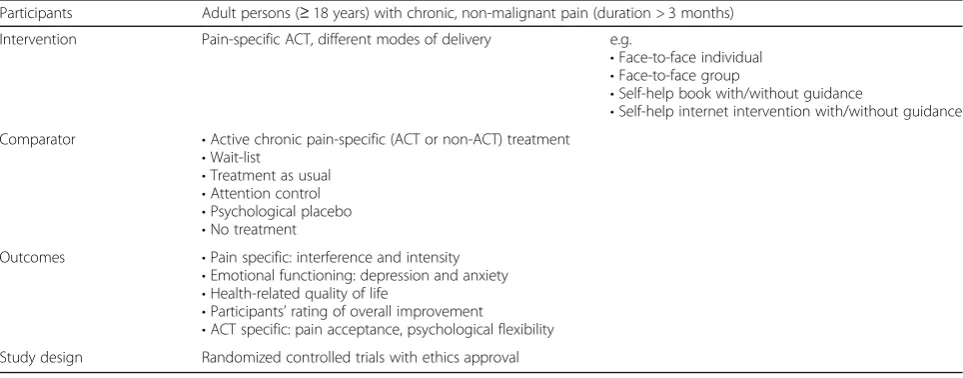
according to the PICOS criteria [
54
] outlined in the
fol-lowing and summarized in Table
1
.
Participants
The population of interest consists of adult persons (
≥
18 years) with chronic (duration > 3 months),
non-malignant pain. If a study has included both adolescents
and young adults over the age of 18 years, this study will
be excluded since it can be assumed that the treatment
settings for adults and children/adolescents/young adults
can be very heterogenous. Inclusion of primary studies
will not be further limited to specific clinical subgroups
in order to increase power and the ability to inspect the
role of individual and study differences.
Intervention
In this review, we will exclusively focus on ACT-based
interventions. Consistent with a recent review on ACT
for chronic pain [
35
], studies will be included only if the
intervention explicitly uses the full ACT model. In
accordance with a recent review on predictors and
mo-derators in ACT and mindfulness-based approaches [
39
],
the high heterogeneity in the theoretical base of
treat-ment and therapeutic mechanisms can cause differences
in individual responsiveness and may explain
inconsis-tencies between studies. Consequently, we will exclude
studies with purely mindfulness-based interventions. All
ACT interventions regardless of their mode of delivery
will be included in the review (e.g., face-to-face,
indivi-dual, group, self-help book, internet intervention).
Comparator(s)
We will include trials if the comparison group received
either an active treatment for chronic pain (ACT or
non-ACT) or a control condition, i.e., treatment as
Table 1
PICOS elements of the study inclusion criteria
Participants Adult persons (≥18 years) with chronic, non-malignant pain (duration > 3 months)
Intervention Pain-specific ACT, different modes of delivery e.g.
•Face-to-face individual •Face-to-face group
•Self-help book with/without guidance
•Self-help internet intervention with/without guidance Comparator •Active chronic pain-specific (ACT or non-ACT) treatment
•Wait-list
•Treatment as usual •Attention control •Psychological placebo •No treatment
Outcomes •Pain specific: interference and intensity •Emotional functioning: depression and anxiety •Health-related quality of life
•Participants’rating of overall improvement
usual, psychological placebo, attention control condition,
waitlist control, or no treatment.
Outcomes
Our selection of outcomes is based on recommendations
from the Initiative on Methods, Measurement, and Pain
Assessment in Clinical Trials (IMMPACT; [
50
,
51
,
55
]) as
well as on theoretically relevant aspects of ACT [
39
,
56
–
62
].
Pain-specific outcomes
IMMPACT recommends the use of the
Multidimen-sional Pain Inventory (MPI; [
63
]) or interference scale of
the Brief Pain Inventory (BPI; [
64
]) as validated
self-report questionnaires for pain interference. In case of
multiple outcome measures for pain interference, we will
favor the MPI due to the higher number of items (nine
in the MPI versus even in the BPI) and given that it is
the most frequently used outcome measure across
studies. If none of these questionnaires were used in the
studies, comparable validated self-report questionnaires,
such as the pain disability index (PDI; [
65
]) will be used
(randomly in case of multiple measure). The scores of
different questionnaires will be standardized to allow all
measures of pain to be modeled together.
The following secondary outcome measures must be
assessed by standardized measures:
Pain intensity (numeric or visual analogue scales)
Depression (e.g., Patient Health Questionnaire
(PHQ-9 [
66
]) or The Hospital Anxiety Depression
Scale (HADS [
67
]))
Anxiety (e.g., HADS [
67
], Generalized Anxiety
Disorder-7 scale [
68
])
Health-related quality of life (HrQol; e.g., short form
12-item survey (SF-12 [
69
]), Assessment of Quality of
Life (AQoL-8D [
70
]), or the EuroQol (EQ-5D [
71
]))
Participants’
rating of overall improvement (e.g.,
Patient Global Impression of Change (PGIC [
72
]))
ACT-related variables (e.g., psychological flexibility
the Acceptance and Action Questionnaire-II
(AAQ-II [
73
]), the Chronic Pain Acceptance
Questionnaire (CPAQ [
74
]), or the Committed
Action Questionnaire (CAQ [
60
]))
Predictors and moderators of treatment outcome
We differentiate between individual predictors,
treatment-related moderators, and study-level moderators for
treat-ment outcome. Individual predictors for treattreat-ment
outcome are variables assessed at baseline before the
start of the treatment. The following factors are defined as
potential individual predictors for treatment outcome in
this study: socio-demographic factors (age, gender,
employment status, level of education, relationship status,
comorbid somatic/psychiatric conditions), pain-related
factors (pain duration, baseline pain interference, and
intensity), and baseline ACT-related factors (e.g., pain
acceptance). We identified these factors to be potential
predictors of treatment effect from single studies and
reviews with inconsistent findings [
32
,
35
,
38
–
41
,
75
–
81
].
Treatment-related factors are the proportion of intended
number of sessions attended.
Study-level moderators for treatment outcome include
intervention characteristics (i.e., mode of intervention
delivery, number of modules/sessions, level of guidance)
and study characteristics (i.e., recruitment setting, such
as open recruitment through self-referral, or recruitment
in primary, secondary or tertiary care). We will also
collect information on adverse events and adherence to
the treatment as reflected by the percentage of
com-pleted modules in each study-specific treatment. We will
summarize these data on a descriptive level, given that
these aspects are not expected to be reported in all
iden-tified studies and as adherence can only be observed in
the interventions groups.
Study design
Randomized controlled trials (RCTs) of any length of
follow-up and any setting will be included if reported.
We will not apply any exclusion based on publication
status, date, or type. We will only use data from
stud-ies that received ethics approval and that are
pub-lished in English.
Study identification and selection
To minimize publication bias, we will search for
pub-lished and unpubpub-lished trials. For the pubpub-lished trials,
we will search for RCTs of ACT for chronic pain in the
following databases using medical subject headings
(MeSH): (1) Cochrane Central Register of Controlled
Trials (CENTRAL), (2) MEDLINE, (3) EMBASE, and (4)
PsycINFO. We will use RCT filters for MEDLINE and
EMBASE and applied adaptations of these to the other
databases. Two reviewers (JL and WS) developed the
MEDLINE strategy. The search strategy for the literature
search is included in Additional file
2
.
Additionally, we will search in the International Standard
Randomized Controlled Trial Number register (ISRCTN),
WHO International Clinical Trials Registry Platform
(ICTRP), ClinicalTrials. Gov, and PROSPERO and examine
reference lists of all references of included trials and
reviews to identify other potentially relevant studies.
Further, we will contact all corresponding authors of
included trials and asked about other RCTs, published or
unpublished, which might be eligible for the review.
These strategies are important in order to find eligible
Two reviewers (JL and WS) will independently select
relevant studies for inclusion. First, we will examine a
list of titles and abstracts. If title and abstract contain
sufficient information to determine exclusion, we will
exclude the respective article. For all remaining articles,
we will retrieve and review the full text independently.
In addition, we will review all other potentially relevant
articles identified by checking the reference lists or
personal communications. If there are discrepancies
between reviewers at any stage of the process, we will
consult a third reviewer (LM).
Data collection
We will initially contact the corresponding author of
all identified trials to invite them to participate in
ACT-CP-MA and to share their raw data (see
Additional file
3
for contact letter, a modified version of
[
83
]). This invitation contains a short introduction to
ACT-CP-MA, including the aim, inclusion criteria,
and outcomes as well as a short description of the
ACT-CP-MA procedures. We will offer PIs who have
shared their data to become a co-author in the result
publications. They are also invited to become active
collaborators within the project. If we cannot contact the
corresponding author, we will email all co-authors listed.
If we fail to receive a response to our initial email
invita-tion, we will send reminders after two and if, necessary,
after 4 weeks. If the study investigators are still not
responding or unwilling to contribute their study data, we
will send a final note inquiring why they are unable to
participate. If there is no response after 4 weeks, the trial
will be excluded as
“
unavailable.
”
In order to increase the feasibility of the IPD-MA, we
will provide regular e-mail updates to keep the
colla-borative group up to date and involved. On an online
collaboration platform (
trello.com
), we will present all
procedures during the acquisition of the data and the
analysis and their respective deadlines so that the
procedures will be transparent to all collaborators.
We will seek from all relevant trials data for all
partici-pants at all assessment times, including those excluded
from the investigators
’
own analyses. In order to
minimize the amount of work for study authors, we will
accept databases in all formats. Before transferring the
data, we will ask the investigators to anonymize the data
and to use a password-protected encryption. Once we
have received the original data file, we will archive
the original data as backup and transfer the IPD to a
converted and combined overall dataset with
stan-dardized variables, the ACT-CP-IPD database. For
data harmonization, we will apply the procedures
described in Buffart et al. [
84
]. We will discuss any
inconsistencies with the original authors and make
corrections when necessary.
For the AD-MA, a standardized data extraction form
has been developed and will be piloted, based on the
template of the Cochrane good practice data extraction
form (Version 4, April 2014, see Additional file
4
) to
extract data from the selected studies.
Assessment of risk of bias in included studies
Two reviewers (JL and WS) will independently assess
risk of bias using the Cochrane Risk of Bias
assess-ment tool, focusing on the evaluation of sequence
generation, allocation concealment, blinding
(partici-pants, personnel, and outcome assessors), incomplete
data, selective outcome reporting, and assessing other
biases [
85
]. Additionally, the researchers (JL and WS)
will assess the evidence profiles for each of the
identified outcomes based on the GRADE (Grading
of Recommendations, Assessment, Development and
Evaluation) approach to reviewing evidence [
86
–
88
]. In
case of disagreement between the reviewers, discussions
or consultation of a third reviewer (MD) will take
place. For the trials that were conducted by JL or
WS, MD will assess the risk of bias instead of JL or
WS, respectively. If needed, a statistician (SN or LC)
will be consulted regarding judgments relating to
statistical analyses.
Statistical analysis
Individual participant data meta-analyses
We will perform analyses according to current expert
recommendations for individual participant data
meta-analysis [
45
,
89
]. By using mixed-effects models, we will
apply the one-stage approach IPD-MA based on the
com-bination of all data in a single meta-analysis [
89
,
90
]. In
order to consider clustering effects from study to study,
we will apply a two-level hierarchical structure: the
partici-pants within each trial as level 1 and the trial as level 2.
We will perform all analyses on a modified
intention-to-treat (ITT) basis using a statistical interpolation strategy
for missing data within the mixed-effects model. For this
strategy, we will include all randomized participants with
outcome data.
Aggregate data meta-analyses
For those studies where IPD were not provided, a
sensitiv-ity analysis exploring the estimated treatment effect with
AD will be conducted. To estimate the treatment effect of
ACT compared to different control groups, we will
calcu-late the effect sizes (Hedges
’
g
) [
92
], which will be pooled
using a random-effects meta-analysis. We will test for
statistical heterogeneity using the Chi2 test (significance
level: 0.1) and
I
2statistic on the basis of the Cochrane
Handbook [
93
] recommendations. To examine
publi-cation bias, we will visually inspect the funnel plot, by
using the trim and fill procedure and Egger
’
s test of funnel
plot asymmetry [
94
,
95
]. A sensitivity analysis will also be
conducted excluding studies with high risk of bias.
This AD-MA will exclusively examine treatment
ef-fects on the specified outcomes without investigating
potential treatment moderators or predictors. This
decision is based on the lack of studies investigating
these variables in ACT and mindfulness-based
treat-ments for chronic pain as documented in a recent
meta-analysis [
39
]. Further, for variables measured at
the individual level, the IPD-MA will have considerably
greater power to investigate this research question in
comparison to an AD-MA.
The results with regard to the treatment effects of
both meta-analyses will be compared: By doing this, we
will analyze and discuss potential differences between
studies included in the IPD-MA and those not included.
Discussion
ACT-CP-MA will use a thoroughly defined methodology
and provide an updated review on the effect of ACT for
chronic pain. It will be the first study that comprehensively
examines data with an explorative study approach including
important potential predictor and moderators of treatment
effects. Therefore, it can overcome predefined hypotheses
that were applied in each included primary study and
allows for an overview of factors that may be crucial to
treatment effects observed in ACT for chronic pain.
The central strength of this study lies in the
methodo-logical approach which will use an IPD-MA of
random-ized controlled studies on ACT for chronic pain based on
an extensive search of multiple databases, journals,
re-ferences, and citations. We will deal with a wide array of
outcomes based on theory and experts
’
recommendations
as well as with individual-based predictors and
treatment-related moderators of treatment effects. Using the same
systematic procedures, harmonization of variables and
analyses on these variables across multiple studies, we will
provide a consistent evidence synthesis across all variables.
Results of this review will be published in international
medical and psychological journals and presented at
na-tional and internana-tional conference meetings following the
PRISMA statement [
52
,
53
].
Limitations
We will possibly face some difficulties in obtaining
original data from all of the identified trials. These
difficulties may result in a bias to the IPD-MA [
45
].
Therefore, we will additionally conduct an AD-MA
with all identified studies. This AD will provide a
basis for comparisons between the AD-MA and IPD-MA.
Furthermore, we will increase the exchange in the
field of research on ACT and chronic pain in order
to build a collaborative network to facilitate the exchange
of data.
Conclusions
In ACT-CP-MA, we will review RCTs of ACT for chronic
pain and bring together relevant evidence. We will discuss
the findings with regard to future directions of research
on ACT for chronic pain as well as implications for health
care services to help people make well-informed decisions.
The information on different treatment predictors and
moderators may help clinicians match patients most likely
to benefit from ACT with this treatment approach in the
sense of personalized medicine. This will also allow
conclusions on which characteristics of individuals would
best benefit from which form of intervention (face to face,
internet-based, group-based, individual). Thereby,
ment costs may be better controlled by allocating
treat-ment resources where they are likely to be most effective
[
42
]. Therefore, the results of this review may provide a
basis for treatment guidelines for chronic pain patients
with respect to the provision of ACT and its type of
deli-very. The findings of this study will help researchers to
refine ACT-based interventions for chronic pain. In the
development phase, knowledge of user characteristics that
are linked to greater improvements can be used to
enhance the efficacy of ACT through greater targeting of
treatment toward those characteristics.
Additional files
Additional file 1:ACT-CP-MA PRISMA-P checklist. (DOCX 31 kb) Additional file 2:ACT-CP-MA bibliographic database searches. (DOCX 20 kb)
Additional file 3:ACT Pain IPD invitation letter. (DOCX 26 kb) Additional file 4:ACT-CP-MA data extraction form. (DOC 187 kb)
Abbreviations
ACT:Acceptance and commitment therapy; AD: Aggregated data;
CP: Chronic pain; IMMPACT: Initiative on Methods, Measurement, and Pain Assessment in Clinical Trials; IPD: Individual participant data; MA: analysis; PRISMA: Preferred Reporting Items for Systematic reviews and Meta-Analyses statement
Acknowledgements
We would like to thank Vivien Hohberg, Laura Gabel, Sophia Gänser, and Geena Fischer for their support in this project.
Transparency declaration
The lead author (the manuscript’s guarantor) affirms that the manuscript is an honest, accurate, and transparent account of the reported study; that no important aspects of the study have been omitted.
Funding
The German Academic Exchange Service (DAAD) funded JL in a Postdoc Fellowship program. JL and MD have received a peer-mentoring prize from the German Psychological Society, Section Health Psychology to conduct this project. The funders have no role in the study design, data collection and analysis, decision to publish, or preparation of the manuscript.
This is an independent research partially funded by the National Institute for Health Research (NIHR Postdoctoral Fellowship, Dr. Whitney Scott, PDF-2015-08-059). The views expressed here are those of the author and not necessar-ily those of the NHS, the National Institute for Health Research, or the De-partment of Health.
The article processing charge was funded by the German Research Foundation (DFG) and the University of Freiburg in the funding program Open Access Publishing.
Availability of data and materials
The search strategies for all databases and (Additional file2), invitation letter (Additional file3), and data extraction form (Additional file4) are provided as supplementary material. Statistical codes of the analyses will be available in the respective result publications. The availability of the data will depend on the consent of the data provider of each study.
Authors’contributions
JL, HB, MD, and LM were involved in the concept and design of the study. JL is responsible for realization of the systematic review, the electronic searches and subsequent hand searches, and located and obtained trial reports. JL and WS will screen titles and abstracts, and the full-text screening. JL, LM, WS, SN, and LC contributed to the development of the selection criteria, the risk of bias assessment strategy, and data extraction criteria. JL and LM are responsible for the communication with the authors of the primary studies. JL and WS will perform the risk of bias assessments and SN and LC will act as consultants during this procedure. JL and WS will perform all data extraction and will check the data. SN and LC provided statistical expertise and JL, MD, SN, and LC made the data analysis plan. JL and MD will be responsible for data harmonization. JL wrote the initial draft of the manuscript and all authors had major contributions to the write-up and editing of the manuscript, read, and approved the final manuscript.
Ethics approval and consent to participate
The ACT-CP-MA project does not require ethics approval. Nevertheless, we will only include IPD from studies that obtained ethical clearance and informed consent in the ACT-CP-MA-database. As the objectives of ACT-CP-MA are consistent with the objectives of the primary studies which already received ethics approval, and only anonymized data will be available to the investigators of ACT-CP-MA, this project does not require ethics review.
Consent for publication
Not applicable.
Competing interests
JL, HB, WS, SN, and LMM are authors of trials eligible for inclusion in the review and will not extract data from their own study or studies. All other authors declare that they have no competing interests.
Publisher
’
s Note
Springer Nature remains neutral with regard to jurisdictional claims in published maps and institutional affiliations.
Author details
1Sportpsychology, Institute for Sports and Sport Science, University of
Freiburg, Freiburg, Germany.2Psychology Department, Institute of Psychiatry,
Psychology & Neuroscience, King’s College London, London, UK.
3Department of Clinical Psychology and Psychotherapy, Institute of
Psychology, Ulm University, Ulm, Germany.4Department of Psychology,
University of Uppsala, Uppsala, Sweden.
Received: 14 January 2019 Accepted: 13 May 2019
References
1. Nicholas M, Vlaeyen JWS, Rief W, Barke A, Aziz Q, Benoliel R, et al. The IASP classification of chronic pain for ICD-11. Pain [Internet]. 2019;160(1):28–37. Available from: http://insights.ovid.com/crossref?an=00006396-201901000-00004. [cited 2019 Mar 24]
2. Leadley RM, Armstrong N, Lee YC, Allen A, Kleijnen J. Chronic diseases in the European Union: the prevalence and health cost implications of chronic pain. J Pain Palliat Care Pharmacother. 2012;26(4):310–325. Available from:
http://www.tandfonline.com/doi/full/10.3109/15360288.2012.736933. [cited 2017 Oct 26]
3. Gureje O, Von Korff M, Simon GE, Gater R. Persistent pain and
well-being. JAMA. 1998;280(2):147 Available from:https://jamanetwork.com/ journals/jama/fullarticle/187723TS - CrossRef.
4. IASP. Unrelieved pain is a major global healthcare problem. Vol. 15, Iasp. 2004. Available from:https://www.iasp-pain.org/files/Content/ ContentFolders/GlobalYearAgainstPain2/20042005RighttoPainRelief/ factsheet.pdf
5. Breivik H, Eisenberg E, O’Brien T. The individual and societal burden of chronic pain in Europe: the case for strategic prioritisation and action to improve knowledge and availability of appropriate care. BMC Public Health. 2013;13(1):1229 Available from:http://bmcpublichealth.biomedcentral.com/ articles/10.1186/1471-2458-13-1229.
6. Rice ASC, Smith BH, Blyth FM. Pain and the global burden of disease.
Pain. 2016;157(4):791–6 Available from:http://content.wkhealth.com/ linkback/openurl?sid=WKPTLP:landingpage&an=00006396-201604000-00006. [cited 2017 Sep 18].
7. James SL, Abate D, Abate KH, Abay SM, Abbafati C, Abbasi N, et al. Global, regional, and national incidence, prevalence, and years lived with disability for 354 diseases and injuries for 195 countries and territories, 1990–2017: a systematic analysis for the Global Burden Of Disease Study 2017. Lancet. 2018;392(10159):1789–858.
8. Gatchel RJ, Peng YB, Peters ML, Fuchs PN, Turk DC. The biopsychosocial
approach to chronic pain: scientific advances and future directions. Psychol Bull. 2007;133(4):581–624 Available from:https://psycnet.apa.org/ record/2007-09203-002.
9. Turk DC, Wilson HD, Cahana A. Treatment of chronic non-cancer pain.
Lancet. 2011;377(9784):2226–35 Available from:http://linkinghub.elsevier. com/retrieve/pii/S0140673611604029.
10. Hayes SC, Strosahl K, Wilson KG. Acceptance and commitment therapy: an
experiential approach to behavior change. New York: Guilford Press; 1999. xvi, 304 s. TS-WorldCat T4-An experiential a. Available from:http://www. worldcat.org/oclc/487262239
11. Hayes SC. Acceptance and commitment therapy, relational frame theory, and the third wave of behavioral and cognitive therapies. Behav Ther. 2004; 35(4):639–65 Available from:https://www.sciencedirect.com/science/article/ pii/S0005789404800133.
12. Dahl J, Wilson KG, Nilsson A. Acceptance and commitment therapy and the
and pain symptoms: a preliminary randomized trial. Behav Ther. 2004 ;35(4): 785–801. Available from:https://www.sciencedirect.com/science/article/pii/ S0005789404800200/pdf?md5=07ce4249a4fab54dc41d138ad24d6287&pid= 1-s2.0-S0005789404800200-main.pdf. [cited 2017 Nov 1]
13. Wicksell RK, Kemani M, Jensen K, Kosek E, Kadetoff D, Sorjonen K, et al. Acceptance and commitment therapy for fibromyalgia: a randomized controlled trial. Eur J Pain. 2013;17(4):599–611. Available from:http://doi. wiley.com/10.1002/j.1532-2149.2012.00224.x. [cited 2017 Sep 20] 14. Kemani MK, Olsson GL, Lekander M, Hesser H, Andersson E, Wicksell RK.
Efficacy and cost-effectiveness of acceptance and commitment therapy and applied relaxation for longstanding pain: a randomized controlled trial. Clin J Pain. 2015;31(11):1004–16. Available from:https://insights.ovid.com/ pubmed?pmid=25585272.
15. Luciano J V., Guallar JA, Aguado J, López-del-Hoyo Y, Olivan B, Magallón R, et al. Effectiveness of group acceptance and commitment therapy for fibromyalgia: a 6-month randomized controlled trial (EFFIGACT study). Pain. 2014 ;155(4):693–702. Available from:https://journals.lww.com/pain/ Abstract/2014/04000/Effectiveness_of_group_acceptance_and_ commitment.9.aspx. [cited 2017 Aug 21]
16. McCracken LM, Sato A, Taylor GJ. A trial of a brief group-based form of
acceptance and commitment therapy (ACT) for chronic pain in general practice: pilot outcome and process results. J Pain. 2013;14(11):1398– 1406. Available from:https://doi.org/10.1016/j.jpain.2013.06.011. [cited 2017 Nov 1].
17. Wetherell JL, Afari N, Rutledge T, Sorrell JT, Stoddard JA, Petkus AJ, et al. A randomized, controlled trial of acceptance and commitment therapy and cognitive-behavioral therapy for chronic pain. Pain. 2011; 152(9):2098–107 Available from:https://journals.lww.com/pain/Abstract/ 2011/09000/A_randomized,_controlled_trial_of_acceptance_and.24.aspx. [cited 2017 Aug 23].
18. Plumb Vilardaga JC. Acceptance and commitment therapy for longstanding
chronic pain in a community-based outpatient group setting. Diss Abstr Int Sect B Sci Eng. 2013;74(5–B(E)):No-Specified. Available from:http://gateway. proquest.com/openurl?url_ver=Z39.88-2004&rft_val_fmt=info:ofi/fmt:kev: mtx:dissertation&res_dat=xri:pqm&rft_dat=xri:pqdiss:3550275%5Cn;http:// ovidsp.ovid.com/ovidweb.cgi?T=JS&PAGE=reference&D=psyc10&NEWS= N&AN=2013–99220-469.
19. Mo’Tamedi H , Rezaiemaram P, Tavallaie A. The effectiveness of a group-based acceptance and commitment additive therapy on rehabilitation of female outpatients with chronic headache: Preliminary findings reducing 3 dimensions of headache impact. Headache. 2012 ;52(7):1106–1119. Available from:http://doi.wiley.com/10.1111/j.1526-4610.2012.02192.x. [cited 2017 Nov 1] 20. Herbert MS, Afari N, Liu L, Heppner P, Rutledge T, Williams K, et al.
Telehealth versus in-person acceptance and commitment therapy for chronic pain: a randomized noninferiority trial. J Pain. 2017 ;18(2):200–211. Available from:http://www.sciencedirect.com/science/article/pii/ S1526590016302929?via%3Dihub. [cited 2017 Nov 2]
21. Alonso-Fernández M, López-López A, Losada A, González JL, Wetherell JL. Acceptance and commitment therapy and selective optimization with compensation for institutionalized older people with chronic pain. Pain Med. 2015;17(2):n/a. Available from:https://academic.oup.com/ painmedicine/article-lookup/doi/10.1111/pme.12885. [cited 2017 Nov 2] 22. Alonso-Fernandez M, Lopez-Lopez A, Losada A, Gonzalez JL, Wetherell JL.
Acceptance and commitment therapy and selective optimization with compensation for institutionalized older people with chronic pain. Behav Psychol / Psicol Conduct Rev Int Clin y la Salud. 2013; Available from:http:// onlinelibrary.wiley.com/journal/10.1111/(ISSN)1526-4637%5Cn;http://eproxy. lib.hku.hk/login?url=http://ovidsp.ovid.com/ovidweb.cgi?T=JS&CSC= Y&NEWS=N&PAGE=fulltext&D=emed18&AN=605802722%5Cn;http:// metadata.lib.hku.hk:3410/hku?sid=OVID:embase&id=pmid:&i.
23. Pincus T, Anwar S, McCracken LM, McGregor A, Graham L, Collinson M, et al. Delivering an optimised behavioural intervention (OBI) to people with low back pain with high psychological risk; results and lessons learnt from a feasibility randomised controlled trial of contextual cognitive behavioural therapy (CCBT) vs. physiotherap. BMC Musculoskelet Disord. 2015;16(1):147 Available from:http://bmcmusculoskeletdisord.biomedcentral.com/articles/ 10.1186/s12891-015-0594-2. [cited 2018 Feb 1].
24. Thorsell J, Finnes A, Dahl J, Lundgren T, Gybrant M, Gordh T, et al. A comparative study of 2 manual-based self-help interventions, acceptance and commitment therapy and applied relaxation, for persons with chronic pain. Clin J Pain. 2011;27(8):716–23 Available from:https://journals.lww.com/
clinicalpain/Fulltext/2011/10000/A_Comparative_Study_of_2_Manual_ based_Self_Help.9.aspx. [cited 2017 Aug 23].
25. Johnston M, Foster M, Shennan J, Starkey NJ, Johnson A. The effectiveness of an acceptance and commitment therapy self-help intervention for chronic pain. Clin J Pain. 2010;26(5):393–402 Available from:https://journals. lww.com/clinicalpain/fulltext/2010/06000/The_Effectiveness_of_an_ Acceptance_and_Commitment.6.aspx. [cited 2017 Nov 1].
26. Yang S-Y, Moss-Morris R, LM MC. iACT-CEL: a feasibility trial of a face-to-face and internet-based acceptance and commitment therapy intervention for chronic pain in Singapore. Pain Res Treat. 2017;2017:1–14 Available from:
https://www.hindawi.com/journals/prt/2017/6916915/. [cited 2017 Aug 2]. 27. Scott W, Chilcot J, Guildford B, Daly-Eichenhardt A, McCracken LM.
Feasibility randomized-controlled trial of online acceptance and commitment therapy for patients with complex chronic pain in the United Kingdom. Eur J Pain. 2018;22(8):1473–1484. Available from:http://doi.wiley. com/10.1002/ejp.1236. [cited 2018 Aug 13]
28. Lin J, Paganini S, Sander L, Lüking M, Ebert DD, Buhrman M, et al. An internet-based intervention for chronic pain: a three-arm randomized controlled study of the effectiveness of guided and unguided acceptance and commitment therapy. Dtsch Arztebl Int. 2017;114(41):681–8. 29. Buhrman M, Skoglund A, Husell J, Bergström K, Gordh T, Hursti T, et al.
Guided internet-delivered acceptance and commitment therapy for chronic pain patients: a randomized controlled trial. Behav Res Ther 2013;51(6):307– 315. Available from:https://www.sciencedirect.com/science/article/pii/ S000579671300048X?via%3Dihub. [cited 2017 Aug 25]
30. Trompetter HR, Bohlmeijer ET, Veehof MM. Schreurs KMG. Internet-based guided self-help intervention for chronic pain based on acceptance and commitment therapy: a randomized controlled trial. J Behav Med. 2015; 38(1):66–80 Available from: http://link.springer.com/10.1007/s10865-014-9579-0. [cited 2017 Aug 25].
31. The British Pain Society. Guidelines for pain management programmes for adults an evidence-based review prepared on behalf of the British Pain Society. 2013. Available from:www.britishpainsociety.org. [cited 2019 May 2] 32. Feliu Soler A, Montesinos F, Gutiérrez-Martínez O, Scott W, McCracken L,
Luciano J. Current status of acceptance and commitment therapy for chronic pain: a narrative review. J Pain Res. 2018;11:2145–59 Available from:
https://www.dovepress.com/current-status-of-acceptance-and-commitment-therapy-for-chronic-pain-a-peer-reviewed-article-JPR.
33. Veehof MM, Trompetter HR, Bohlmeijer ET, Schreurs KMG.
Acceptance-and mindfulness-based interventions for the treatment of chronic pain: a meta-analytic review. Cogn Behav Ther. 2016;45(1):5–31. Available from:https://www.tandfonline.com/doi/full/10.1080/16506073.2015. 1098724. [cited 2017 Aug 2]
34. Sturgeon JA. Psychological therapies for the management of chronic pain. Psychol Res Behav Manag. 2014;7:115–24 Available from:https://www.ncbi. nlm.nih.gov/pmc/articles/PMC3986332/. [cited 2017 Aug 30].
35. Hughes LS, Clark J, Colclough JA, Dale E, McMillan D, Hughes, et al. Acceptance and commitment therapy (ACT) for chronic pain. Clin J Pain. 2017 ;33(6):552–568. Available from:http://insights.ovid.com/crossref?an= 00002508-201706000-00010. [cited 2017 Aug 9]
36. Yang S-Y, McCracken LM. Acceptance and commitment therapy for chronic pain. Journal of Clinical Outcomes Management 21.3 (2014): 134-144. Available from https://www.mdedge.com/jcomjournal/article/147127/pain/acceptance-and-commitment-therapy-chronic-pain.
37. Turk DC. The potential of treatment matching for subgroups of patients with chronic pain: lumping versus splitting. Clin J Pain. 2005;21(1):44–55. 38. Vlaeyen JWS, Morley S. Cognitive-behavioral treatments for chronic pain: what works for whom? Clin J Pain. 2005;21(1):1–8 Available from:https:// journals.lww.com/clinicalpain/Fulltext/2005/01000/Cognitive_Behavioral_ Treatments_for_Chronic_Pain_.1.aspx.
39. Gilpin HR, Keyes A, Stahl DR, Greig R, LM MC. Predictors of treatment outcome in contextual cognitive and behavioral therapies for chronic pain: a systematic review. J Pain. 2017;18(10):1153–64 Available from:http:// linkinghub.elsevier.com/retrieve/pii/S1526590017305576. [cited 2017 Oct 18]. 40. Gurung T, Ellard DR, Mistry D, Patel S, Underwood M. Identifying potential
moderators for response to treatment in low back pain: a systematic review. Physiotherapy. 2015, 101;(3):243–51 Available from:http://linkinghub.elsevier. com/retrieve/pii/S0031940615000279. [cited 2017 Aug 21].
sub-group analysis within RCTs. Eur J Pain. 2011;15(8):775.e1–775.e11. Available from:http://doi.wiley.com/10.1016/j.ejpain.2011.01.016. [cited 2017 Oct 26] 42. McCracken LM, Turk DC. Behavioral and cognitive-behavioral treatment for
chronic pain: outcome, predictors of outcome, and treatment process. Spine (Phila Pa 1976). 2002;27(22):2564–73 Available from:https://journals. lww.com/spinejournal/Fulltext/2002/11150/Behavioral_and_Cognitive_ Behavioral_Treatment_for.33.aspx.
43. Wertli MM, Rasmussen-Barr E, Held U, Weiser S, Bachmann LM, Brunner F. Fear-avoidance beliefs—a moderator of treatment efficacy in patients with low back pain: a systematic review. Spine J. 2014;14(11):2658–78 Available from:http://linkinghub.elsevier.com/retrieve/pii/S1529943014002344. [cited 2017 Oct 26].
44. Hurley MV, Walsh NE, Mitchell HL, Pimm TJ, Patel A, Williamson E, et al. Clinical effectiveness of a rehabilitation program integrating exercise, self-management, and active coping strategies for chronic knee pain: a cluster randomized trial. Arthritis Rheum. 2007;57(7):1211–9 Available from:http:// doi.wiley.com/10.1002/art.22995. [cited 2017 Oct 29].
45. Riley RD, Lambert PC, Abo-Zaid G. Meta-analysis of individual participant data: rationale, conduct, and reporting. BMJ. 2010 ;340(7745): 521–525. Available from:https://www.bmj.com/content/340/bmj.c221. long. [cited 2017 Aug 2]
46. Clarke MJ, Stewart LA. Systematic reviews: obtaining data from randomised controlled trials: How much do we need for reliable and informative meta-analyses? BMJ. 1994;309(6960):1007 Available from:http://www.bmj.com/ content/309/6960/1007.long. [cited 2017 Aug 18].
47. Wicksell RK, Olsson GL, Hayes SC. Psychological flexibility as a mediator of improvement in acceptance and commitment therapy for patients with chronic pain following whiplash. Eur J pain. 2010;14(10):1059.e1-1059.e11. Available from:https://onlinelibrary.wiley.com/doi/full/10.1016/j. ejpain.2010.05.001. [cited 2018 Feb 1]
48. Hayes SC, Villatte M, Levin M, Hildebrandt M. Open, aware, and active: contextual approaches as an emerging trend in the behavioral and cognitive therapies. Annu Rev Clin Psychol. 2011;7(1):141–68 Available from:
http://www.annualreviews.org/doi/10.1146/annurev-clinpsy-032210-104449. [cited 2017 Sep 9].
49. Hayes SC, Luoma JB, Bond FW, Masuda A, Lillis J. Acceptance and commitment therapy: model, processes and outcomes. Behav Res Ther. 2006;44(1):1–25 Available from:https://www.sciencedirect.com/science/ article/pii/S0005796705002147?via%3Dihub. [cited 2017 Sep 20]. 50. Turk DC, Dworkin RH, Allen RR, Bellamy N, Brandenburg N, Carr DB, et al.
Core outcome domains for chronic pain clinical trials: IMMPACT recommendations. Pain. 2003;106(3):337–45 Available from:https://journals. lww.com/pain/Abstract/2003/12000/Core_outcome_domains_for_chronic_ pain_clinical.14.aspxTS - CrossRef.
51. Dworkin RH, Turk DC, Farrar JT, Haythornthwaite JA, Jensen MP, Katz NP, et al. Core outcome measures for chronic pain clinical trials: IMMPACT recommendations. Pain. 2005;113(1–2):9–19 Available from:https://journals. lww.com/pain/Citation/2005/01000/Core_outcome_measures_for_chronic_ pain_clinical.5.aspx. [cited 2017 Sep 20].
52. Liberati A, Altman DG, Tetzlaff J, Mulrow C, Gøtzsche PC, Ioannidis JPA, et al. The PRISMA statement for reporting systematic reviews and meta-analyses of studies that evaluate health care interventions: explanation and elaboration. Vol. 6, PLoS Med;2009 . p. e1000100. Available from:
http://dx.plos.org/10.1371/journal.pmed.1000100. [cited 2017 Aug 2]. John Wiley & Sons
53. Stewart LA, Clarke M, Rovers M, Riley RD, Simmonds M, Stewart G, et al. Preferred reporting items for a systematic review and meta-analysis of individual participant data: The PRISMA-IPD statement. JAMA. 2015;313(16): 1657–65 Available from:http://jama.jamanetwork.com/article.aspx?doi=10. 1001/jama.2015.3656. [cited 2017 Aug 2].
54. Dissemination C for R and. CRD’s guidance for undertaking reviews in health care. York: Centre for Reviews and Dissemination, University of York; 2009. 294.
55. Dworkin RH, Turk DC, Wyrwich KW, Beaton D, Cleeland CS, Farrar JT, et al. Interpreting the clinical importance of treatment outcomes in chronic pain clinical trials: IMMPACT recommendations. J Pain. 2008;9(2):105–21. 56. Wicksell RK, Olsson GL, Melin L. The chronic pain acceptance questionnaire
(CPAQ)-further validation including a confirmatory factor analysis and a comparison with the Tampa Scale of Kinesiophobia. Eur J Pain. 2009;13(7): 760–8 Available from:http://doi.wiley.com/10.1016/j.ejpain.2008.09.003. [cited 2017 Sep 20].
57. McCracken LM, DaSilva P, Skillicorn B, Doherty R. The cognitive fusion questionnaire: a preliminary study of psychometric properties and prediction of functioning in chronic pain. Clin J Pain. 2014;30(10):894–901 Available from:https://journals.lww.com/clinicalpain/fulltext/2014/10000/ The_Cognitive_Fusion_Questionnaire__A_Preliminary.9.aspx.
58. Yu L, Norton S, McCracken LM. Change in“self-as-context”(“ perspective-taking”) occurs in acceptance and commitment therapy for people with chronic pain and is associated with improved functioning. J Pain. 2017;18(6): 664–72 Available from:https://www.sciencedirect.com/science/article/pii/ S1526590017300214?via%3Dihub.
59. Yu L, Norton S, Harrison A, McCracken LM. In search of the person in pain: a systematic review of conceptualization, assessment methods, and evidence for self and identity in chronic pain. J Context Behav Sci. 2015;4(4):246–62 Available from:http://www.sciencedirect.com/science/article/pii/ S221214471530017X.
60. LM MC, Chilcot J, Norton S. Further development in the assessment of psychological flexibility: a shortened Committed Action Questionnaire (CAQ-8). Eur J Pain (United Kingdom). 2015;19(5):677–85 Available from:
http://doi.wiley.com/10.1002/ejp.589. [cited 2017 Nov 2].
61. McCracken LM. Committed action: an application of the psychological flexibility model to activity patterns in chronic pain. J Pain. 2013;14(8):828– 35 Available from:https://www.sciencedirect.com/science/article/pii/ S1526590013008584?via%3Dihub.
62. Scott W, McCracken LM, Norton S. A confirmatory factor analysis of facets of psychological flexibility in a sample of people seeking treatment for chronic pain. Ann Behav Med. 2016;50(2):285–96 Available from:https://www.ncbi. nlm.nih.gov/pmc/articles/PMC4823341/.
63. Kerns RD, Turk DC, Rudy TE. The West Haven-Yale Multidimensional Pain Inventory (WHYMPI). Pain. 1985;23(4):345–56 Available from:https://journals. lww.com/pain/Abstract/1985/12000/The_West_Haven_Yale_
Multidimensional_Pain.4.aspx. [cited 2017 Sep 20].
64. Cleeland CS, Ryan KM. Pain assessment: global use of the Brief Pain Inventory. Ann Acad Med Singapore. 1994 ;23(2):129–138. Available from:
https://psycnet.apa.org/record/2015-49222-001. [cited 2017 Oct 31] 65. Chibnall JT, Tait RC. The Pain Disability Index: factor structure and normative
data. Arch Phys Med Rehabil. 1994;75(10):1082–1086. Available from:http:// www.ncbi.nlm.nih.gov/pubmed/7944912%5Cn;http://www.archives-pmr. org/article/0003-9993(94)90082-5/pdf. [cited 2017 Oct 29]
66. Löwe B, Kroenke K, Herzog W, Gräfe K. Measuring depression outcome with
a brief self-report instrument: sensitivity to change of the Patient Health Questionnaire (PHQ-9). J Affect Disord. 2004;81(1):61–6 Available from:
http://www.sciencedirect.com/science/article/pii/S0165032703001988. 67. Zigmond AS, Snaith RP. The Hospital Anxiety and Depression Scale. Acta
Psychiatr Scand. 1983 ;67(6):361–370. Available from:https://onlinelibrary. wiley.com/doi/abs/10.1111/j.1600-0447.1983.tb09716.x?sid=nlm%3Apubmed. [cited 2017 Nov 2]
68. Löwe B, Decker O, Müller S, Brähler E, Schellberg D, Herzog W, et al. Validation and standardization of the generalized anxiety disorder screener (GAD-7) in the general population. Med Care. 2008;46(3):266–74 Available from:https://journals.lww.com/lww-medicalcare/Abstract/2008/03000/ Validation_and_Standardization_of_the_Generalized.6.aspx.
69. Luo X, George ML, Kakouras I, Edwards CL, Pietrobon R, Richardson W, et al. Reliability, validity, and responsiveness of the short form 12-item survey (SF-12) in patients with back pain. Spine (Phila Pa 1976). 2003;28(15):1739–45 Available from:https://journals.lww.com/spinejournal/fulltext/2003/08010/ Reliability,_Validity,_and_Responsiveness_of_the.20.aspx.
70. Richardson J, Iezzi A, Khan MA, Maxwell A. Validity and reliability of the assessment of quality of life (AQoL)-8D multi-attribute utility instrument. Patient - Patient-Centered Outcomes Res. 2014;7(1):85–96 Available from:
http://link.springer.com/10.1007/s40271-013-0036-x.
71. Rabin R, de Charro F. EQ-SD: a measure of health status from the EuroQol group. Ann Med. 2001;33(5):337–43 Available from:http://www.tandfonline. com/doi/full/10.3109/07853890109002087.
72. Guy W. ECDEU assessment manual for psychopharmacology. US Dept
Health, Education, and Welfare publication (ADM). Washington, DC: National Institute of Mental Health; 1976. p. 76–338.
74. Vowles KE, McCracken LM, McLeod C, Eccleston C. The chronic pain acceptance questionnaire: confirmatory factor analysis and identification of patient subgroups. Pain. 2008;140(2):284–91 Available from:https://journals. lww.com/pain/Abstract/2008/11300/The_Chronic_Pain_Acceptance_ Questionnaire_.6.aspx.
75. Gale EN, Funch DP. Factors associated with successful outcome from behavioral therapy for chronic temporomandibular joint (TMJ) pain. J Psychosom Res. 1984;28(6):441–8 Available from:http://www.sciencedirect. com/science/article/pii/0022399984900771?via%3Dihub. [cited 2017 Aug 21].
76. Dworkin RH, Richlin DM, Handlin DS, Brand L. Predicting treatment
response in depressed and non-depressed chronic pain patients. Pain. 1986;24(3):343–53 Available from:https://journals.lww.com/pain/Abstract/ 1986/03000/Predicting_treatment_response_in_depressed_and.6.aspx. [cited 2017 Aug 21].
77. De Rooij A, Van Der Leeden M, Roorda LD, MPM S, Dekker J. Predictors of outcome of multidisciplinary treatment in chronic widespread pain: an observational study. BMC Musculoskelet Disord. 2013;14(1):133 Available from:https://bmcmusculoskeletdisord.biomedcentral.com/track/pdf/10. 1186/1471-2474-14-133?site=bmcmusculoskeletdisord.biomedcentral.com. [cited 2017 Aug 30].
78. Witt CM, Schützler L, Lüdtke R, Wegscheider K, Willich SN. Patient characteristics and variation in treatment outcomes. Clin J Pain. 2011; 27(6):550–5 Available from:https://journals.lww.com/clinicalpain/fulltext/ 2011/07000/Patient_Characteristics_and_Variation_in_Treatment.12.aspx. [cited 2017 Oct 29].
79. Turner JA, Holtzman S, Mancl L. Mediators, moderators, and predictors of therapeutic change in cognitive-behavioral therapy for chronic pain. Pain. 2007;127(3):276–86 Available from:https://journals.lww.com/pain/Abstract/ 2007/02000/Mediators,_moderators,_and_predictors_of.11.aspx. [cited 2017 Aug 21].
80. Svanberg M, Stålnacke B-M, Enthoven P, Brodda-Jansen G, Gerdle B, Boersma K. Impact of emotional distress and pain-related fear on patients with chronic pain: subgroup analysis of patients referred to multimodal rehabilitation. J Rehabil Med J Rehab Med. 2017;49(49):354–361. Available from:http://www.diva-portal.org/smash/get/diva2:1091396/FULLTEXT01. pdf%0A;https://www.medicaljournals.se/jrm/content/abstract/0.2340/ 16501977-2212. [cited 2017 Aug 30]
81. Härkäpää K, Järvikoski A, Estlander A-M. Health optimism and control beliefs as predictors for treatment outcome of a multimodal back treatment program. Psychol Heal. 1996;12(1):123–34 Available from:http://www. scopus.com/inward/record.url?eid=2-s2.0-3142530682&partnerID=40&md5= 4da152587d8fff234639a4b45cfcaed1. [citd 2017 Aug 21].
82. Ahmed I, Sutton AJ, Riley RD. Assessment of publication bias, selection bias, and unavailable data in meta-analyses using individual participant data: a database survey. BMJ. 2012;344(7838):1–10. Available from:https://www.bmj. com/content/344/bmj.d7762.long. [cited 2017 Nov 6]
83. Taylor RS, Piepoli MF, Smart N, Coats AJS, Ellis S, Dalal H, et al. Exercise training for chronic heart failure (ExTraMATCH II): protocol for an individual participant data meta-analysis. Int J Cardiol. 2014;174(3):683–7.https://doi. org/10.1016/j.ijcard.2014.04.203.
84. Buffart LM, Kalter J, Chinapaw MJ, Heymans MW, Aaronson NK, Courneya
KS, et al. Predicting OptimaL cAncer RehabIlitation and Supportive care (POLARIS): rationale and design for meta-analyses of individual patient data of randomized controlled trials that evaluate the effect of physical activity and psychosocial interventions on healt. Syst Rev. 2013;2(1):75 Available from:http://systematicreviewsjournal.biomedcentral.com/articles/10.1186/ 2046-4053-2-75. [cited 2017 Oct 30].
85. Higgins JPT, Altman DG, Gøtzsche PC, Jüni P, Moher D, Oxman AD, et al. The Cochrane Collaboration’s tool for assessing risk of bias in randomised trials. BMJ. 2011 ;343(oct18 2):d5928. Available from:https://www.bmj.com/ content/343/bmj.d5928.long. [cited 2017 Oct 31]
86. Guyatt GH, Oxman AD, Vist GE, Kunz R, Falck-Ytter Y, Alonso-Coello P, et al. GRADE: An emerging consensus on rating quality of evidence and strength of recommendations. Chinese J Evidence-Based Med. 2009 ;9(1):8–11. Available from:https://www.bmj.com/content/336/7650/924.long. [cited 2017 Oct 31] 87. Guyatt GH, Oxman AD, Vist GE, Kunz R, Brozek J, Alonso-Coello P, et al. GRADE
guidelines: 4. Rating the quality of evidence—study limitations (risk of bias). J Clin Epidemiol . 2011 ;64(4):407–415. Available from:https://www.sciencedirect. com/science/article/pii/S0895435610004130?via%3Dihub. [cited 2017 Nov 6] 88. Guyatt G, Oxman AD, Akl EA, Kunz R, Vist GE, Brozek J, et al. GRADE guidelines:
1. Introduction—GRADE evidence profiles and summary of findings tables. J
Clin Epidemiol. 2011;64(4):383–394. Available from:https://www.sciencedirect. com/science/article/pii/S0895435610003306?via%3Dihub. [cited 2017 Nov 6]
89. Stewart GB, Altman DG, Askie LM, Duley L, Simmonds MC, Stewart LA.
Statistical analysis of individual participant data meta-analyses: a comparison of methods and recommendations for practice. Biondi-Zoccai G, editor. PLoS One. 2012 ;7(10):e46042. Available from:http://dx.plos.org/10.1371/ journal.pone.0046042. [cited 2017 Aug 9]
90. Simmonds MC, Higgins JPT, Stewart LA, Tierney JF, Clarke MJ, Thompson SG. Meta-analysis of individual patient data from randomized trials: a review of methods used in practice. Clin Trials. 2005;2(3):209–17 Available from:http://ctj. sagepub.com/cgi/doi/10.1191/1740774505cn087oa. [cited 2017 Aug 9]. 91. R Core Team. R: A language and environment for statistical computing.
Vienna: R Foundation for Statistical Computing; 2017.
92. Cohen J. Statistical power analysis for the behavioral sciences; 1988. 567. 93. O’Connor D, Green S, Higgins JP. Defining the review question and
developing criteria for including studies. In: Cochrane Handbook for Systematic Reviews of Interventions: Cochrane Book Series. Wiley-Blackwell; 2008. p. 81–94.
94. Stuck AE, Rubenstein LZ, Wieland D, Vandenbroucke JP, Irwig L, Macaskill P, et al. Bias in meta-analysis detected by a simple, graphical. BMJ. 1998; 316(7129):469. Available from:http://www.bmj.com/cgi/doi/10.1136/bmj. 316.7129.469. [cited 2017 Nov 7]
95. Duval S, Tweedie R. Trim and fill: a simple funnel-plot-based method of testing and adjusting for publication bias in meta-analysis. Biometrics. 2000; 56(2):455–63 Available from:http://doi.wiley.com/10.1111/j.0006-341X.2000. 00455.x. [cited 2017 Nov 7].
96. Burns JW. Mechanisms, mechanisms, mechanisms: it really does all boil down to mechanisms. Pain. 2016;157(11):2393–4 Available from:http:// content.wkhealth.com/linkback/openurl?sid=WKPTLP:landingpage&an= 00006396-201611000-00001. [cited 2017 Sep 18].
97. Lin J, Klatt L-I, McCracken LM, Baumeister H. Psychological flexibility mediates the effect of an online-based acceptance and commitment therapy for chronic pain. Pain. 2018;159(4):663–72 Available from:https://journals.lww.com/pain/ fulltext/2018/04000/Psychological_flexibility_mediates_the_effect_of.7.aspx. [cited 2017 Dec 27].
98. Probst T, Baumeister H, mcCracken L, Lin J. Baseline psychological inflexibility moderates the outcome pain interference in a randomized controlled trial on internet-based acceptance and commitment therapy for chronic pain. J Clin Med. 2018;8(1):24 Available from:http://www.mdpi.com/ 2077-0383/8/1/24.
99. Scott W, Hann KEJ, McCracken LM. A comprehensive examination of
changes in psychological flexibility following acceptance and commitment therapy for chronic pain. J Contemp Psychother. 2016;46(3):139–48 Available from:http://link.springer.com/10.1007/s10879-016-9328-5. 100. Vowles KE, Witkiewitz K, Sowden G, Ashworth J. Acceptance and
commitment therapy for chronic pain: evidence of mediation and clinically significant change following an abbreviated interdisciplinary program of rehabilitation. J Pain. 2014;15(1):101–13 Available from:http://linkinghub. elsevier.com/retrieve/pii/S1526590013012972. [cited 2017 Sep 20]. 101. Cederberg JT, Cernvall M, Dahl J, von Essen L, Ljungman G. Acceptance as a
mediator for change in acceptance and commitment therapy for persons with chronic pain? Int J Behav Med. 2016;23(1):21–9 Available from:https:// www.ncbi.nlm.nih.gov/pmc/articles/PMC4748004/.
102. Vowles KE, Sowden G, Ashworth J. A comprehensive examination of the model underlying acceptance and commitment therapy for chronic pain. Behav Ther. 2014;45(3):390–401 Available from:http://linkinghub.elsevier. com/retrieve/pii/S0005789413001421. [cited 2017 Sep 20].
103. Trompetter HR, Bohlmeijer ET, Fox J-PP, KMG S. Psychological flexibility and catastrophizing as associated change mechanisms during online acceptance & commitment therapy for chronic pain. Behav Res Ther. 2015; 74:50–9 Available from:https://www.sciencedirect.com/science/article/pii/ S000579671530036X?via%3Dihub. [cited 2018 Feb 1].
104. Baranoff JA, Hanrahan SJ, Burke ALJ, Connor JP. Changes in acceptance in a low-intensity, group-based acceptance and commitment therapy (ACT) chronic pain intervention. Int J Behav Med. 2016;23(1):30–8 Available from:
http://link.springer.com/10.1007/s12529-015-9496-9.