6
To study the etiology, pattern and short term
outcome of chest injuries as prospective study
Dr. M.S. Griwan
1, Dr. Suresh Kumar
2, Dr. Naresh Pal
31
Senior Prof., Dept. of Surgery, PGIMS, Rohtak
2
Junior Resident, Dept. of Surgery, PGIMS, Rohtak
3
Asst. Prof., Dept. of Surgery, PGIMS, Rohtak
ABSTRACT
Introduction: Chest injuries still are a continuing challenge to the trauma to the general surgeon practicing in developing countries. This study was conducted to define the etiological spectrum, injury patterns and short term outcome of these injuries in our institute.
Material and methods: This was a prospective study in one hundreds patients of chest injury between the age group 15-80 yrs with GCS 15/15, admitted in Pt. BD Sharma Postgraduate Institute of Medical Science, Rohtak over a period of one and quarter of a year period from August 2014 to November 2015.
Results: A total of 100 chest injury patients were included and found that the males were affected predominantly in comparison of female in ratio of 7.3:1. The included age was from 15 to 80 years (mean = 32.17 years). The 59% patients were having the cau sative factor of road side accident (being the commonest cause) and 96% injuries caused by Blunt including road side accidents (RSAs), fall from height, assaults or by animals. The rib fractures were found 87% was commonest nature of chest injury as all over. The pneumothorax, haemothorax, haemopneumothorax and lung contusions were found in 76%, 42% 28% and 51% respectively. 56.0% of patients were found along associated co-existing injuries in the form of head and neck (33.3%) and orthopedic (26.7%) and abdominal injuries. All of the patients were treated successfully with conservatively approach with minor procedure tube thoracostomy in 67%. Four patients were operated as exploratory laparotomy for associated abdominal injury; two of them were injured by penetrating injury of stab chest with abdominal component. The mean LOS was 5.6 days which was increased in case of associated injuries and it was maximum of fifteen days in one of the patient had tracheobronchial injury which was managed conservatively with negative suction underseal water drainage. Two patients were managed in respiratory intensive care unit (RICU) out of four with flail chest injuries patients.
Conclusion: RSAs was commonest cause in chest injuries which was responsible for the majority of morbidity and associated increased the Length of stay and overall impact of chest injury in our institute. The motorcycle was commonest vehicle (34 patients out of 59 patients of RSAs) found involved in RSAs followed by fall from height under influence of alcohol. Authority should be strict to implement the traffic laws and issue the driving permission after appropriate training to reduce the at least unwanted RSAs.
Key Words: Chest injuries, RSA, ICU, RICU, LOS, CT scan.
INTRODUCTION
Trauma continues to be a major general health problem all around the world and it is associated with high morbidity and mortality both in developed and developing countries.1 Mortality due to trauma stands at third rank after cardiovascular and carcinomatous diseases among the causes of adult death in allover world. Eastern Mediterranean region had studied the one of the commonest causes of trauma mortalities in the world. The World Health Organization (WHO) documented over 300,000 deaths in 2008 which was the nine percent of all world deaths.2 Universally, 10% of all trauma indoor patients result from chest injuries and 25% of trauma-related deaths are considered due to the chest injuries.3. The chest injuries to the thoracic cage which itself may cause considerable pathophysiological consequences, which may be fatal, if not timely and efficiently treated.4
injuries that may lead to life threatening consequences needs aggressive management of the chest injuries along with accurate treatment of co-existing injuries is essential for optimal patient outcome and to decrease significant morbidity and mortality.4
PATIENTS AND METHODS STUDY
The present prospective study was conducted in the patients of chest injuries who were admitted in surgery ward from the accident and emergency department of Pt. BD Sharma PGIMS Rohtak, after a complete detailed history, clinical examination with primary and secondary survey followed by radiological examination, were included in study after taking the full explanatory written consent. The patients were studied in respect of demographic characteristics (e.g. age, sex), circumstances of injury, and characteristics of injury, management, complications, the length of hospital stay (LOS) and mortality. The inclusion criteria were: 1.The patients between 15 yrs to 80 years of age in both male and female gender 3. Patients intercostal drainage (if indicated) in cases of pneumothorax, haemothorax or haemopneumothorax.4. The blunt and penetrating both were considered affecting the chest wall, the contents or parenchymal injury of the thoracic cavity e.g. pleura, lungs, lower respiratory tract, oesophagus, heart and great vessels. The patient with GCS <15 and who died or absconded before complete assessment were excluded from study.
OBSERVATIONS
A total of 100 patients with chest trauma were admitted, over a period of about one year. The majority of patients was males (88%) and belonged to a specific the age group of 21 to 40 years were 44%. Ninety six percentage (96%) suffered blunt trauma. Only a few 4% were sustained penetrating injuries which were all of injured during civil violence of assaults. And 2 of them required exploratory laparotomy. The commonest mechanism of injury was road side accidents (RSAs) i.e. 59% followed by falls and then assaults. 33 patients out of later 59 were on two wheelers involved in road side accident. Only five patients were hit by animals. The laterality was predominantly was on left side (55%).
Only 24 patients were presented within 2 hours of duration and 37 Patients were from 2 to 6 hours while rest of patients were come to institute after twenty fours of sustained of injuries. Rib fracture 87% was the most common overall chest injury while the various types of parenchymal chest injuries e.g. pneumothorax 76%, haemothorax 42%, haemopneumothorax 28%, and lung contusion 51% [Table 2]. Majority of patients (56%) had associated extra-thoracic injuries including head injury (22 patients), spinal injury (5 patients), and fractures of extremities (20 patients) in different patient’s injuries.
Intercostal drain was inserted in 67 patients, while 5 required major surgical procedures exploratory laparotomy for management of associated injuries. The rest of 98 patients were treated in the surgical wards. The patients in RICU had multiple rib fractures and 2 of these suffered from flail chest. The two patients of flail chest included in study initially with flail chest injury but due to non-availability of beds in ICU or RICU, they had left the institute against medical advice, so they were excluded from study.
DISCUSSION
Chest injuries mostly occur along with the component of multiple traumas. Early diagnosis and treatment is life-saving for the life-threatening chest injuries and best managed by early mobilization, aggressive pain control, proper fluid management, and chest physiotherapy.Several factors such as age, the total number of fractures, and the presence of bilateral fractures have been shown to contribute to the morbidity associated with thoracic wall injury. The frequencies of blunt trauma and penetrating injuries have been reported as 58-75% and 24-41% respectively.7,8 A study from Canada reported incidences of blunt thoracic trauma as 96.3%.9 In our study, 96% of the patients had blunt and 4% had penetrating thoracic trauma and it was similar to the Canadian study.
The vast majority (44%) of the patients were aged between 21-40 years i.e. early forty. Road side accidents (RSAs) and falls are the most frequently observed etiological factors in thoracic traumas.10 The reason for male predominance among chest injury patients in this age group is probably that males are more mobile with active participation in high risk taking activities. Identification of risk taking behavior among trauma patients has potential significance for the prevention of injuries.11,12
8 in chest injuries was sufficient to diagnose rib fractures, pneumothorax, haemothorax and lung contusions or combined as well and it was likewise with other studies done elsewhere.14,15
Ultrasound of the chest has been reported to be an important diagnostic tool in the diagnosis of pneumothorax, haemothorax, haemopneumothorax or lung contusions. Moreover, ultrasound also helps in differentiating between haemothorax and pulmonary contusion.16
Atri et al highlighted that ultrasound chest had a sensitivity of 94.6% for detecting pulmonary contusions and it was more sensitive than CT scan of the chest.17 in our study we examined every patients ultrasonologically to specify the chest injuries; also associated abdominal injuries. Trupka et al reported that computed tomography scan is superior to posterior-anterior chest X-rays in imaging contusion, pneumothorax and haemothorax screening in blunt thoracic trauma and should be considered the first method to be used in those having multiple injuries and suspected to have thoracic trauma. But it was also observed that postero-anterior chest X-ray should be performed in patients having thoracic trauma and computed tomography should be used if further examination is indicated.18
However early thoracic CT scan has been very important in detecting injuries missed out by chest x-ray and Ultrasound (USG). The CECT scan of the chest was done in our study as when required for further classify accurately the chest injury. Clinically in chest injuries ranges from a simple soft tissue injury to pneumothorax, haemothorax, haemopneumothorax, pulmonary contusion. The rib fractures are the most frequently observed findings due to blunt thoracic traumas.7,8 In our study, one or more rib fractures were diagnosed in 87.0% of the patients, and almost all of the rib fractures occurred due to blunt thoracic trauma while none of the patients had sternal fracture in our study.
The most frequently observed intrathoracic pathologies in thoracic trauma are pneumothorax, haemothorax or both, and the first stage of treatment is tube thoracostomy.19,20 In our study, the various types of parenchymal chest injuries e.g. pneumothorax 76%, haemothorax 42%, haemopneumothorax 28%, and lung contusion 51% were diagnosed and were subjected to tube thoracostomy in almost all patients. Regel et al. reported that chest injuries were most frequently associated by extremity fractures and this is followed by brain injuries.21 In similar studies, thoracic traumas have been reported to be associated most commonly by musculoskeletal injuries.6,7,25 The presence of associated injuries is an important determinant of the outcome of chest injury patients. Associated injuries increase the risk of complications in patients with chest injuries. Early recognition and treatment of associated extra-thoracic injuries is important in order to reduce mortality and morbidity associated with chest injuries.24 In our study, 56% of the patients had co-existing associated injuries, in which the musculoskeletal injuries 22 patients were the most frequently observed one study was coincided with studies of I Inci et al6,AA Adem et al14 andRM Shorr et al.12 In our study, the patients were examined and investigated for co-existing associated injuries and then managed by accordingly.
The majority of our patients (67%) were managed by conservatively with chest tubes and underwater seal begs with chest injury with or without associated injuries which is in similar to the studies conducted by G Ozgen et al,28 and KN Kimberly et al.29 The regular close monitoring of the blunt chest injury was of paramount with repeated examination, radiographs, electrocardiogram, and CT scan of the chest and blood gas analysis as appropriate to detect changes. The overall mean LOS 5.6 days in our study was higher compared to that reported by Atri et al,17 but lower than that reported in the Nigerian study.14 The hospital length of stay increased in our study in patients with penetrating chest injuries and those with associated head injuries, abdominal and long bone fractures. The length of hospital stay is an important measure of morbidity and bed occupancy rate. Limited study period and unavailability of thoracostomy tubes were the major limitation in this study.
CONCLUSIONS
Chest trauma is an important public health problem accounting for a considerable proportion of all traumas. The pattern of chest trauma and its management was almost similar to many series. RSAs still found to be the commonest causative factor for chest injuries and the commonly affected victims were young adult males in their active productive and reproductive age group as in other studies. Authority should take appropriate action like appropriate driving training, to issue the driving license to a trained person only to reduce the incidences of RSAs so as to reduce the chest injuries. Road safety and strict traffic laws should be implemented to decrease incidence of chest trauma caused by RSAs and thereby the severity of injuries and morbidity. The predictors of prolonged hospital LOS were blunt trauma, number of fractured ribs, associated extra-thoracic injuries.
[1]. Park K: Accidents. In Textbook of Social and Preventive Medicine. 17 edition. Edited by: Park K. Jabalpur: Banarsidas Co; 2000:304-5.
[2]. WHO.int [Internet]: Mortality and Global Burden of Disease. Geneva: World Health Organization; c2009-10;, [updated 2011 Jun 22; cited 2011 Jul 7]. Available from: http://www.who.int/entity/gho/mortality_burden_disease/ countries/deaths/en/index.html. [3]. Wisner D: Trauma to chest. Sabiston and Spencer B Saunders publication;,6 1995, 456.
[4]. Grimes OF. Nonpenetrating injuries to the chest wall and esophagus. Surg Clin North Am 1972;52(3):597–609. [5]. Frimpong-Boateng K, Amoati ABG: Chest injuries in Ghana. West Afr J Med 2000, 19:175.
[6]. Inci I, Ozçelik I, Tacyildiz O, Nizam N, Eren G, Ozen DB: Penetrating chest injuries: unusually high incidence of high velocity gunshot wounds in civilian practice. World J Surg 1998, 22:438-42.
[7]. Altunkaya A, Aktunc E, Kutluk AC, Buyukates M, Demircan N, Demir AS, et al. Analysis of 282 patients with thoracic trauma. Turk J Thorac Cardiovasc Surg. 2007;15:127-32.
[8]. Graeber GM, Prabhakar G, Shields T. Blunt and penetrating injuries of the chest wall, pleura and lungs. In: Shields TW, LoCicero J 3rd, Ponn RB, Rusch VW editors. General thoracic surgery. 6th ed. Philadelphia: Lippincott Williams & Wilkins; 2005:951-972.
[9]. Hill AB, Fleiszer DM, Brown RA. Chest trauma in a Canadian urban setting - implications for trauma research in Canada. J Trauma. 1991;31:971-3.
[10]. Senturk E, Dogan Y, Yoldas E. Chest Trauma; Analysis of 1142 Cases. Turkish Thoracic J. 2010;11:47-54.
[11]. Shorr RM, Crittenden M, Indeck M, Hartunian SL, Rodriguez A: Blunt thoracic trauma: analysis of 515 patients. Ann Surg 1987, 206:200-5.
[12]. Otieno T, Woodsfield J, Bird P, Hill A: Trauma in rural Kenya. Injury 2004, 35:1228-33.
[13]. Cakan A, Yuncu G, Olgac G, Alar T, Sevinc S, Ors Kaya S. Thoracic trauma: analysis of 987 cases. Turkish J Trauma Emerg Surg. 2001;7:236-41.
[14]. Ali N, Gali BM: Pattern and management of chest injuries in Maiduguri, Nigeria. Annals of African Medicine 2004, 3:181-4. [15]. Adem AA, R Ilagoa R, Mekonen E: Chest injuries in Tikur Anbessa Hospital, Addis Ababa, Ethiopia: 3-year experience. East and
Central African Journal of Surgery 2009, 6:11-4.
[16]. Dulchavsky SA, Hamilton DR, Diebel LN, Sargsyan AE, Billica RD, Williams DR: Thoracic ultrasound diagnosis of pneumothorax. J Trauma 1999, 47:970-1.
[17]. Atri M, Gurjit S, Arvind K: Chest trauma in Jammu region an institutional study. IJTCVS 2006, 22:219-222.
[18]. Trupka A, Waydhas C, Hallfeldt KK, Nast-Kolb D, Pfeifer KJ, Schweiberer L. Value of thoracic computed tomography in the first assessment of severely injured patients with blunt chest trauma: results of a prospective study. J Trauma.1997;43:405-11. [19]. Sirmali M, Turut H, Topcu S, Gulhan E, Yazici U, Kaya S, et al. A comprehensive analysis of traumatic rib fractures: morbidi ty,
mortality and management. Eur J Cardiothorac Surg. 2003;24:133-8.
[20]. Boyd AD. Pneumothorax and hemothorax. In: Hood RM, Boyd AD, Culliford AT (eds): Thoracic trauma, Philadelphia, 1989;133-48.
[21]. Regel G, Lobenhoffer P, Grotz M, Pape HC, Lehmann U, Tscherne H. Treatment results of patients with multiple trauma: an analysis of 3406 cases treated between 1972 and 1991 at a German Level I Trauma Center. J Trauma. 1995;38:70-8.
[22]. Leblebici IH, Kaya Y, Kocak AH. Analysis of 302 cases with chest trauma. Turkish J Thorac Cardiovasc Surg. 2005;13:392-6. [23]. Cagirici U, Uc H, Calkavur T, Gurcun U, Badak I, Bilkay O, et al. Thoracic Trauma: The 6-Year Experience. Turkish J Trauma
Emerg Surg. 1998;4:248-52.
[24]. William F, Anita L, Charlene M: Injury to the chest, complications and management: experience at a Level I trauma centre. Am. Journal of Surgery 1996, 1-6.
[25]. Kalliopi A, Michalis G, Nikolaos T: Management of 150 flail chest injuries: analysis of risk factors affecting outcome. Eur J Cardiothorac Surg 2004, 26:373-6.
[26]. Adem AA, R Ilagoa R, Mekonen E: Chest injuries in Tikur Anbessa Hospital, Addis Ababa, Ethiopia: 3-year experience. East and Central African Journal of Surgery 2009, 6:11-4.
[27]. Otieno T, Woodsfield J, Bird P, Hill A: Trauma in rural Kenya. Injury 2004, 35:1228-33.
[28]. Harrison WH, Gray AR, Couves CM, Howard JM: Severe nonpenetrating injuries to the chest. Clinical results in the management of 216 patients. Am J Surg 1960, 100:715-22.
10 Table 1: Age Distribution
Table 2: Mode of injury
Mode of injury Number of Patients
(n=100)
Percentage
RSA 59 59 %
Total Assault 14 14 %
Modes of Assault
Assault with blunt weapon 10 10 %
Stab 3 3 %
Firearm 1 1 %
Fall from height 22 22 %
Hit by animals 5 5 %
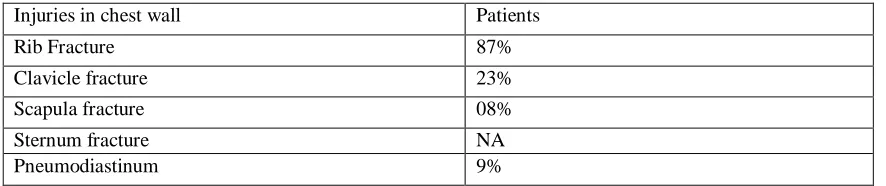
Table 3: Thoracic wall injuries:
Injuries in chest wall Patients
Rib Fracture 87%
Clavicle fracture 23%
Scapula fracture 08%
Sternum fracture NA
Pneumodiastinum 9%
Table: XI- Associated Extra-thoracic injuries: Age
distribution of various injuries
RSA Fall Assault domestic
work
animal injury stab
14-20 4 0 1 0 0 0
21-30 15 1 4 1 0 2
31-40 15 3 2 1 0 0
41-50 10 4 1 4 0 0
51-60 8 1 1 3 4 1
61-70 6 1 1 1 0 0
71-80 1 0 0 2 1 0
Total 59 10 10 12 5 3
Extra thoracic system Patients
Abdominal injuries Liver 6%
Spleen 3%
Hemoperitoneum 2%
Other Injuries (colon, kidney, diphargmatic ) 5%
Extremities injuries Upper limb 14%
Lower limb 08%
Head Injuries 12%
Table: XV- Relationship of nature of injuries with length of stay:
Table: Relationship between visceral lung injuries and length of stay: Number of Rib fractures Average length of stay Mean length of stay
No Rib fractures 5.7 5.2
Single Rib fractures 3.6 2.7
2 to 3 Rib fractures 4.9 4.4
>3 Rib fractures 6.8 6.6
Bilateral Rib fractures 7.9 7.6
Nature of Injuries 1-3days 4-7days >7days average length of stay
Pneumothorax 14 34 12 5.3
Haemothorax 8 24 8 5.5
Haemopneumothorax 6 17 7 5.6