A Comparative Study of Efficiency of Different AOPs for
Degradation of 4-nitrophenol in Batch and
Continuous Systems
Arvind Kale1 and M. K. N. Yenkie2
1Dharampeth M.P. Deo Memorial Science College,
Nagpur, INDIA.
2Department of Chemical Technology,
Laxminarayan Institute of Technology, Rastrasant Tukdoji Maharaj, Nagpur University, Nagpur, INDIA.
(Received on: April 25, 2016)
ABSTRACT
In the present investigation the performance of the efficiencies of five advance oxidation processes for the degradation of 4-nitro phenol was studied. Two different types of reactors, namely the batch reactor and cascade continuous flow photoreactor were used in this work. The influence of process parameters like pH, oxidant concentration and photocatalyst concentration on the substrate degradation was evaluated. The results show that the studied AOPs had maximum efficiency degradation at around pH = 4.6. The photo-Fenton process and photocatalyst using TiO2 also gave a degradation efficiency of about 90 % and 80 % respectively. The
order of efficiency of AOPs for the degradation of 4-nitrophenol followed the trend UV < UV/TiO2 < UV/TiO2/H2O2 < UV/H2O2 < UV/H2O2/Fe2+. The lower efficiency
of UV/TiO2/H2O2 when compared to UV/H2O2 was attributed to the induced turbidity
of the solution caused due to addition of TiO2 which reduced the efficiency of UV
radiations in producing the OH· free radicals. The photo-Fenton oxidation process
gave the maximum degradation efficiency in both batch and continuous reactors.
Keywords: AOP, Phenols, UV radiation, Photo-Fenton, Photocatalysis, Hydrogen
peroxide.
INTRODUCTION
in urban and agricultural waste. In the present work photolytic and photo -catalytic degradation of 4-NP have been investigated. 4-NP may enter the environment from industrial discharges1,
spills and possibly as a breakdown product of certain pesticides containing NP’s moieties2. It
is toxic as are the other phenol derivative, and one of the 114 hazardous compounds listed by EPA. Its maximum allowed concentration is 20 ppb. Even in very low concentration it causes chronic poisoning. It takes a long time for NPs to breakdown in deep soil and in groundwater. The destruction and mineralisation of it is possible by utilizing advanced oxidation processes, such as hydrogen peroxide photolysis, the Photo-Fenton and Photo-Catalysis3. UV-radiation
alone would attack and decompose some organic molecules by bond cleavage at very slow rates. The combination of UV-light and various oxidants can decompose pollutants very effectively4. The decomposition of various organic pollutants using hydrogen peroxide as an
oxidant under UV-illumination has been proven very effective.
In all these processes formation and participation of OH radical is most important. OH radical are extremely reactive and unstable 5. During the process of degradation it must be
produced continuously “in situ” through chemical and photochemical reactions. The main process to obtain these radicals is described below:
a) Photo-oxidation
Radiation with a wavelength lower than 400nm is able to photolize H2O2 molecule.
The mechanism accepted for the photolysis of hydrogen peroxide is the cleavage of the molecule into hydroxyl radicals with a quantum yield of two OH radicals formed per quantum of radiation absorbed 6-8.
hυ
H2O2 → 2HO· (1)
b) Photo-Fenton
Rate of organic pollutant degradation could be increased by irradiation of Fenton reagent with UV-light called Photo-Fenton process 9-12. UV light not only leads to the
formation of additional OH radical but also to recycling of Fe (II) catalyst by reduction of Fe(III). In this way concentration of Fe(II) increases and the overall reaction is accelerated. The increased efficiency of the process is attributed to the photoreduction of ferric iron, the efficient use of light quanta and the photolysis of Fe(III)-organic intermediate chelate. The mechanism for the ferric ion catalysed decomposition of hydrogen peroxide in acid solution has been widely described 12.
Fe(II) + H2O2 Fe(III) + H HO· (2)
Fe(III) + H2O2 Fe(II) + HO2. + H+ (3)
c) Photo-catalysis
compounds and water. In the 1st case, the redox reactions are responsible for the destruction of the organic compound, whereas in the latter hydroxyl radicals are generated and these radicals react with the organic compound13. The most common semiconductor used in
photocatalysis is TiO214-15. The added hydrogen peroxide inhibits the electron-hole
recombination by accepting photo generated electron from the conduction band of semiconductor and promotes charge separation and also forms HO· radical16, 17.
EXPERIMENTAL SECTION
The innovative photo reactors were use in this investigation. These reactors were designed and fabricated in the laboratory. The batch reactor (1m x 0.12m x 0.1m) was fabricated using soda-silica glass of 5 mm thickness. A 30W low pressure mercury UV lamp (Philips) was mounted lengthwise in the reactor such that the contaminant solution present in the reactor was directly irradiated by UV radiation During the experimental runs was covered with a parabolic lid made up of inert material lined internally by using aluminium foil to avoid external exposure of harmful UV radiation and quantitative reflection of radiation in the solution of reactor. During each run, 1L of solution containing known amount of pollutant was loaded in the reactor and was exposed to UV radiations for about 240 min with constant stirring using magnetic stirrers place below reactor. At desired intervals of time, the aliquots of solution were withdrawn from the reactor for analysis (Fig: 1).
A continuous flow cascade reactor having dimension (1.5m x 0.3m x 0.05m) was also fabricated of soda-silica glass for continuous photo-oxidative treatment studies. The total length of the cascade reactor was divided into smaller compartments by placing glass plates of 5mm thickness at a distance of 50 mm from each other such that solution flow slowy in zig –zag manner. The contents of the reactor were exposed to 30 W low pressure mercury lamp. The cascade flow reactor was placed on wooden stand, such that the reactor could be placed in horizontal position and angle could be adjusted to regulate the desired flow of the solution under gravity. The reactor was suitably covered. The substrate solution and the oxidant was fed to the reactor using infusion set with control knob. The aliquots were taken for analysis at desired intervals of time (Fig: 2).
Oxidation studies in batch and flow reactor
All the chemicals used were AR/GR grade. The sample was prepared by dissolving 4-NP in distilled water. The initial concentration of 4-4-NP in all experiment was 3 x 10⁻⁴ M. the
pH value was adjusted by 0.01M NaOH and 0.01M H2SO4. Degradation rate of 4-NP in
aqueous solution during Photo-Fenton treatment and Photo-catalytic process under batch and continuous (flow) systems. Different concentrations of H2O2 were utilized for optimizing the
dose by using different H2O2/COD ratios. The doses of Fe2+ were varied from 0.01mM –
0.05mM. In the Photo-Catalysis the TiO2 doses were varied from 0.2g/L – 0.6g/L. with
optimized dose of TiO2, H2O2 was also used in batch and continuous system. During the system
run, the concentration changes of the substrate and oxidant were monitored at desired intervals of time by withdrawing 10ml aliquot of solution from reactor. The analysis was done using UV-visible spectrophotometer. The degradation and hence the decolourisation of the substrate compound is observed. In certain cases the substrate solution turned from colorless to light brown to pale yellow, probably due to the formation of certain colored intermediates thereby interfering with the spectrophotometric analysis. The intermediates formed were short-lived as the UV scan of the reactor contents taken from time to time did not show any characteristic peaks indicative of particular compounds. In such cases the change in the concentration or a decrease in the concentration of the reacting substrate was carried out by determining the chemical oxygen demand (COD) of the samples taken out from time to time. The UV exposure time during the experiment was about 240 min. Experiments in the batch reactor were carried out at different pH, oxidant concentration doses of Fe2+ and TiO
2 to optimize these process
parameters for achieving efficient mineralization of contaminants studied.
Analytical Technique
UV spectrophotometry was used for determination of concentration of substrate. Calibration plots of 4-NP and H2O2 were prepared for determination of molar extinction
coefficient, which was used for determination of concentration of 4-NP, and H2O2. The values
of molar extinction coefficient for 4-NP and H2O2 were obtained to be 9549.5 and 875.78 at λ= 318nm and λ= 420nm respectively with regression coefficient R= 1. At different interval of time the aliquots were withdrawn and concentration was determined. The COD of samples was also determined by standard method to observe the extent of mineralization of 4-NP. To ascertain the concentration of substrate at desired interval of time, samples were withdrawn for determination of optical density as well as COD. In spectrophotometric determination decrease in the concentration of 4-NP is observed but presence of intermediates formed during the degradation process shows the incomplete mineralization of the sample. Therefore to observe the actual decay of the substrate, COD of the samples was determined to allocate the percentage oxidation of the sample substrate. Final comparative degradation profile is interpreted by using COD parameter.
Kinetics of the process
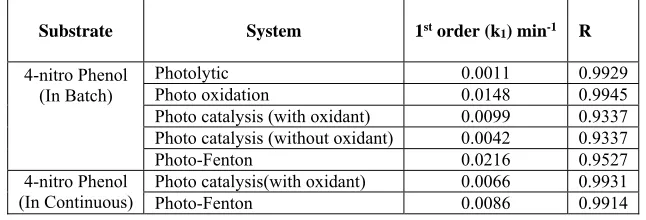
The decrease in the concentration of 4NP as a function of time for UV, UV-H2O2,
exponential decay as depicted in figures 3-9. The plot of concentration decay of H2O2 against
time was linear and followed 1st order kinetics. The concentration decay profile gives good
idea of order of reaction and in order to evaluate the same for oxidation of 4-NP, the experimental data obtained were fitted in the following rate expression,
- d[C]/dt = k [C]n (1)
For a first order reaction the integrated form of Eqn. (1) becomes,
ln {[C] / [C]o} = - k1 t
where, k1 (min-1) is the first order rate constant.
The plot of ln [Co/C] against time will be linear and 1st order kinetics are operative
(Table-1). In the present investigation, the plots were carried out using MS-excel that provides the facility for linear and non-linear regression of the data. The reliability of the kinetic data is understood by closeness of linear regression coefficient to 1. The possibility of adherence of rate data to 2nd order kinetics was also explored but none of the system obeyed the 2nd order
kinetics. The Photo-Fenton system seems to followed 1st order kinetics for t
1/2 of the
degradation of 4-NP, but later the rate becomes very slow and steady due to interference of intermediates; therefore the overall order of the process may be fraction which could be explored theoretically.
Table 1: - Order of reaction and regression coefficient for different processes.
Substrate System 1st order (k
1) min-1 R
4-nitro Phenol (In Batch)
Photolytic 0.0011 0.9929
Photo oxidation 0.0148 0.9945
Photo catalysis (with oxidant) 0.0099 0.9337 Photo catalysis (without oxidant) 0.0042 0.9337
Photo-Fenton 0.0216 0.9527
4-nitro Phenol
(In Continuous) Photo catalysis(with oxidant) Photo-Fenton 0.0086 0.0066 0.9931 0.9914
RESULT AND DISCUSSION
As can be seen from the concentration versus time plot in case of 4-NP, there is exponential decrease in concentration of the substrate. Degradation of 4-NP by using H2O2
oxidant is more effective at acidic pH 4.6, while, that of at pH= 9.5, the substrate is unstable and formation of hydroxide of Fe2+ takes place which affects the quantitative degradation (Fig:
3). The degradation of 4-NP at different H2O2 concentration were obtained and concentration
of H2O2 was optimized (Fig: 4). The substrate can be successfully degraded at significant rate
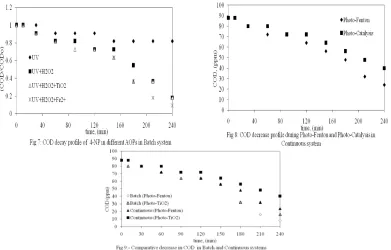
Photo Fenton process proved to be most effective in degradation of 4-NP with an optimum concentration of H2O2 equals to 8 mM and Fe2+ equals to 0.03 mM, several folds increase the
degradation rate of the substrate and finally the substrate degraded by 90% using Photo- Fenton process 18,19 (Fig: 6,7).
In the Photo catalysis, TiO2 is used as a photo catalyst in suspension form in both the
reactors. The observations show that addition of H2O2 considerably enhances the photo
degradation rate instead of using only TiO2 with illumination (Fig.-6). Most probably it takes
place via a reaction,
TiO2 (e-) + H2O2 → TiO2 + HO- + HO·
The limiting value of TiO2 i.e. 0.4 g/L for 4-NP mainly results from following two factors:
a) aggregation of TiO2 particles at high concentration, causing a number of surface active sites
and b) increase in opacity and light scattering of TiO2 particles at high concentration leading
Photo-Fenton and Photo-Catalysis systems of 4-NP were operated using continuous (Cascade falling film type photo reactor) system and observed that degradation upto 73% and 54% are obtained respectively. The efficiency of system with continuous reactor can be increased by varying the UV exposure time, as it is 240 min. in the batch reactor system.
The order of efficiency of AOPs for the degradation of 4-NP followed the trend UV < UV-TiO2 < UV-TiO2-H2O2 < UV-H2O2 < UV-H2O2-Fe2+. The Photo-Fenton oxidation process
gave maximum degradation efficiency in both in batch and continuous reactors (Fig: 9). In the recent years, researchers have reported the degradation of the pollutants using photo-Fenton effectively21.
Table 2: Comparative degradation study of the substrate with COD reduction
Substrate
Reactor type Photo-catalysis Photo-Fenton
4-nitro Phenol
Batch 60 min. 18 % 120 min. 27 % 180 min. 64 % 240 min. 81 %
60 min. 18 % 120 min. 27 % 180 min. 64 % 240 min. 91 %
Continuous 60 min. 9 % 120 min. 18 % 180 min. 36 % 240 min. 54 %
CONCLUSION
The removal of 4-NP was studied was using UV radiation, hydrogen peroxide, iron salt, and TiO2 as photocatalyst. The application of UV radiation assisted systems has been
found to be extremely effective for refractory substance like 4-NP. Fe2+ -mediated i.e.
photo-Fenton degradation led to rate enhancement through the rapid photolytic generation of hydroxyl free radical in presence of H2O2. By photo-Fenton application, about 90% of the
substrate was found to be degraded during the system run around the pH=4.6 (Table-2). While that of UV/TiO2/H2O2 application has shown little lower degradation, which was attributed to
the induced turbidity due to addition of TiO2, that reduces the efficiency of UV radiation in
producing the OH free radicals. The photo-Fenton oxidation process gave the maximum degradation efficiency in both batch and continuous reactors.
REFERENCES
1. ATSDR (Agency for Toxic Substances and Disease Registry). Toxicological profile for NPs. Department of Health and Human Services, Public Health Service, Atlanta, GA, US (1992).
2. Legrini, O., Oliveros, E., Braun, A.M., Photochemical processes for water treatment.
Chem. Rev. 30, 671–698 (1993).
3. Benýtez FJ, Beltran-Heredia J, Acero JL, Rubio FJ. Chemical decomposition of 2,4,6-trichlorophenol by Ozone, Fenton’s reagent and UV radiation. Ind Eng Chem Res; 38(4):
1341–9 (1999).
4. Hirvonen, A., Tuhkanen, T., Kalliokoski, P. Treatment of TCE- and PCE-contaminated graoundwater using UV/H2O2 and O3/H2O2 oxidation processes. Water Sci. Technol. 33,
67–73 (1996).
5. Chamarro E, Marco A, Prado J, Esplugas S. Tratamientode aguas y aguas residuales mediante utilizaci on deprocesos de oxidacion avanzada, Quý´mica & Industria. Sociedad Chilena de Quýmica,; 1/2:28–32 (1996).
6. Kochany, J., Bolton, J.R. Mechanism of photodegradation of aqueous organic pollutants. 2. Measurement of the primary rate constants for reaction of ·OH radicals with benzene and some halobenzenes using an EPR spintrapping method following the photolysis of H2O2. Environ. Sci. Technol. 26, 262–265 (1992).
7. B. Ensing, F. Buda, and E. J. Baerends. “Fenton-like chemistry in water: oxidation catalysis by Fe(III) and H2O2,” Journal of Physical Chemistry A, vol. 107, no. 30, pp.
5722–5731 (2003).
8. Bossmann SH, Oliveros E, Gob S, Siegwart S, Dahlen EP, Payawan Jr L, Straub M, Worner M, Braun AM. New evidence against hydroxyl radicals as reactive intermediates in the thermal and photochemically enhanced Fenton reactions. J Phys Chem A; 102(28):
5542–50 (1998).
9. Bigda RJ. Consider Fenton’s chemistry for wastewater treatment. Chem Eng Prog; 91(12):
10. Kang, S.F., Chang, H.M. Coagulation of textile secondary effluents with Fenton’s reagent.
Water Sci. Technol. 36 (12), 215–222 (1997).
11. Kiwi, J., Pulgarin, C., Peringer, P. Effect of Fenton and photo-Fenton reactions on the degradation and biodegradiability of 2 and 4-nitrophenols in water treatment. Appl. Catal. B: Environ. 3, 335–350 (1994).
12. Pignatello, J. Dark and photoassisted Fe3+-catalyzed degradation of chlorophenoxy
herbicides by hydrogen peroxide. Environ. Sci. Technol. 26 (5), 944–951 (1992).
13. Gimenez J, Curco D, Marco P. Reactor modelling in the photocatalytic oxidation of wastewater. Water Sci. Tech.; 35(4): 207–13 (1997).
14. P. Pichat, in: G. Ertl, H. Knözinger, J. Weitkamp (Eds.) Handbook of Heterogeneous Photo-catalysis, Vol. 4, VCH, Weinheim, p. 2111 (1997).
15. A. Mills, S. Le Hunte. J. Photochem. Photobiol. A 108, 1 (1997).
16. Pare B, Singh P. and Jonnalagadda S. B. J ScientInd Res, 68,724 (2009).
17. Bouras P, Lianos P. Synergy Effect in the Combined Photo degradation of an Azo Dye by TiO2 Photocatalysis and Photo-Fenton Oxidation. Catal Leet 123: 220-225 (2008).
18. Hermosilla D, Cortijo M, Huang CP. Optimizing the treatment of landfill leachate by convetional Fenton and Photo-Fenton processes. Sci Total Environ 407:3473-3481 (2009).
19. G. E. A. Mahmoud and L. F. M. Ismail. “Factors affecting the kinetic parameters related to the degradation of direct yellow 50 by Fenton and Photo-Fenton Processes,” Journal of Basic and Applied Chemistry, vol. 1, no. 8, pp. 70–79 (2011).
20. Kim HE, Lee J, Lee H, Lee C. Sinergestic effect of TiO2 photoctalysis in combination
with Fenton- like reaction on oxidation of organic compounds at circumneutral pH. Appl Catal B: Environ 115: 219-224 (2012).
21. Ardnendu Shekhar Giri, Animes Kumar Golder. Fenton, Photo-Fenton, H2O2 photolysis,
and TiO2 photocatalysis for Dipyrone oxidation: Drug Removal mineralization,