Software Process Improvements in Small Scale
Company
1
M.Suganya, Dr. K. Alagarsamy2
1Research Scholar, School of Information Technology, Madurai Kamaraj University 2Associate Professor Rtd, School of Information Technology, Madurai Kamaraj University Abstract
The software business knows the importance of very small enterprises in funding valued goods and services to the economy. As the quality of software increasingly becomes a subject of concern and procedure methods are growing and gaining the confidence of companies. Software process developments are essential to develop the framework and quality of software companies to reach their business purposes. It is a systematic method to increase the capabilities and work performance of software organizations. Established software quality is critical to confirm steadfast goods and services and to increase employee confidence and satisfaction. Single basic idea is to measure the organizations current activity and increase their software process on the foundation of the capabilities and knowledges of the practitioners working in the organization. Thus, in this paper we have defined and explained the software process improvement model which consists of the six basic phases. The new idea is finding in parallel phase and we have to obtain to satisfy the employee specification and flexible working arrangements.
Keywords Software Process Improvement, Process,
small corporation quality and SPISC phase.
I. INTRODUCTION
The fundamental belief of software process development is that improving the procedure will lead to improvements in the last framework. A software process can be defined as the way a company grows its Software framework and the steps that are monitored at each phase of the software lifecycle. There are an amount of software process standards in the market with the similar basic objective, to help software companies in handling their software development actions in Order to produce a high quality. The standards list steps that a development group should follow in individual phase of the software making. It similarly provides assistance in making software project estimation, increase plan and calculating worth of software development. Lyytinen and Robey says of a
learning failure in the software business. Not only do
numerous companies fail to learn and develop from previous knowledge, in time they need similarly learned to expect to fail.
Over time numerous companies have come to expect and approve poor performance though making organizational myths that continues short term optimization. The way with which we grow software influences the quality of the software and hence software procedure is one of the greatest crucial effects in determining the quality of the software. A software procedure is a set of actions, composed with ordering restrictions between them, such that if the activities are did properly and in accordance with the collation constraints, the wanted result is produced. The desired outcome is high quality software at low cost. As separately software development project is an occurrence of the procedure it follows, it is essentially the procedure that controls the expectable outcomes of a project. Software processes play a significant role in organizing dissimilar teams in large managements so that their practices don’t produce out of touch with single another. Preferably, these procedures should combine the necessary for flexibility and creativity, but that balance is hard to reach. A vast majority of software producers, which have not yet executed a way for software process development, are paying high costs of production and systems maintenance, and sot, not being on the similar competitiveness equal than companies that possesses a procedure development method.
II. SOFTWARE PROCESS IMPROVEMENT
FOR FRAMEWORK
Many systematic attempts must been
A. Software Process Improvement Small Company (Spisc)
The SPISC-Model is a structure that might be
applied by minor software administrations to
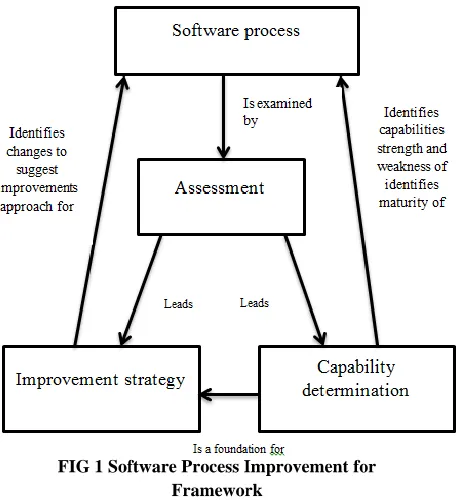
contribution them in improving their software procedures. It defines important elements, which is essential in order to attain an effective software method. The SPISC-Model is founded on stages as well as an iterative model which is successful in establishing particular cum generalized set of procedures at the discretion or will of minor scale industries. The primary two blocks are of main concern in which the SPISC structure is implemented which displays main cost cut offs, less rework, less mistakes, fewer delays, better quality products. In the SPISC Ladder next crossing the primary step, the product quality develops.
FIG 1 Software Process Improvement for Framework
Only after improving quality small scale businesses can think of the market by their better quality products Building profit is an additional stage after small scale industries withstand in competition. Profit means they can put more budget and resources to improve the processes effectively.
After building profit, small scale industries can go for continuous procedure development with which they can stay in business endlessly. SPISC structure delivers a strong basis for small scale industries to withstand the market situations. SPISC is an iterative, particular cum generalized model which is extra or fewer driven by the small scale industry’s individual business rules.
B. Project Management
The Project Management Phase is the
application of knowledge, services, tools, and methods to project actions to meet project necessities which establish the project, and co-ordinate and achieve its resources to produce a product or deliver a facility which satisfies the employee. The Engineering Stage contains of processes that directly specify, implement, or continue a system and software product. The Business Procedure Enhancing Phase concentrates on Development in Business Processes similar cost benefit analysis, measureable feedback, refining standard software procedures, executing better procedures effectively and also the human aspects.
FIG 2 SPISC Structure C. Supporting Set
The Supporting Setcontains of doings which
allow and support the performance of the other procedures on a project. The supporting actions can be employed at numerous life-cycles and can be executed with different Stages of Process models.
III. PROPOSED SYSTEM
Management therefore, continuously explores the market together with respect to increase the product and to improve its business procedures and took contact with the university as they had caught about research there concerning software process improvement. The development project is still going on and is subject of a longitudinal study.
A. Intellectual Approach
This approach contains six level stage of organization behavioral to complete the software process.
Starting Phase
Identifying phase
Developing Phase
Performing Phase
Parallel phase
Control Phase
1) Starting Phase
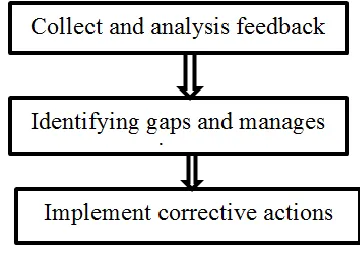
As a significance of the early contact, a start-up meeting among company administration and university individual took place. On that meeting management specified their vision for their organization as a business recognized for high quality products founded on professional craftsmanship. So they required to need all basic work practices recognized and kept below control as soon as possible, particularly with regard to the expected growth of personal. The researchers explained how a development project might look like. The complete objectives as specified by management provided the initiative a long-term perspective. To establish a short-term perspective as well, these were refined on that meeting. While management was maximum concerned by a measurable profile of the organization and common project and quality organization performs, the project leaders were maximum interested in concrete project scheduling and estimation ways.
FIG 3 Starting Phase
2) Identifying Phase
The two project leaders occupied in a questionnaire particularly designed for level 2 valuations and 6 persons remained interviewed before and after the questionnaire sessions, in all 7 out of 11 employees involved in R & D tasks were straight involved in these doings. In addition, documents were reviewed and observations were complete. The questionnaires, which remained complete in though the consultants were present for essential explanations, delivered the basic material for the requested,
quantified profiles. The responses from the
questionnaires were then complemented and
substantiated by the interview results.
3) Developing Phase
The transition among this stage and the previous one was someway blurred. The performance of the diagnosis results went, as described above, beyond a mere account of possible developments: it limited the distinction among acute difficulties and principle ñ process-centered - difficulties and utilized a specific model to explain their relationship and their
result. These were together used again through the
performance of the three main tasks the SEPG worked upon in this phase, namely a further refinement of the development proposals, a prioritization of the suggestions and the development and documentation of the last plan for action. The main parameters for the prioritization were to delimit extra economical resources and to delimit the extra workload for the employees. Through assignment in the now known life cycle model for the product growth it had develop clear which development suggestions fitted best to which development doings. Thus, due to the fact that the following actual life cycle activity in the growth project was testing the first version of the product, quality assurance which had been judged weak became the maximum priority together with the actual introduction of the life cycle perfect.
4) Performing Phase
The primary movement in the performing stage, which can also be considered as an developing action was the founding of the two working groups (TWGs ñ Technical Working Collections in terms of the model) which must effort with two of the acute problematic areas. In accordance with the organizations work procedures, all conference participants, thus all employees of the R & D department were in line with their own preferences allotted to one of the two temporary project groups. The SEPG members planned dates for first group meetings and selected one person as responsible for the preparation of that meeting. The SEPG members also participated in the primary meeting of each group. The meeting group wanted two additional sessions to grow a solution, whereas the code documentation group only met once more. Finally, on a common meeting the two groups informed each other and accepted the prepared suggestions. The complete procedure took one week and the remaining period was used to pilot and to implement the novel procedures. No special action had to be occupied for these tasks as all employees had been involved in the definition process.
5) Parallel Phase
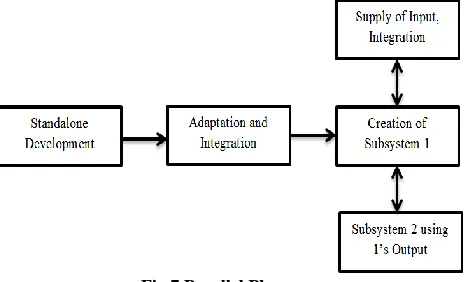
The concept of parallel phase implies a long-term viewpoint on software processes. In this view, the detailed definitions of individual steps in a software process are more important than the overall scope and configuration of the process considered as a system. Over the long term, factors such as the sources of change to the software product and the nature of the feedback paths in the process become more influential; these are also important factors in software evolution. Conversely, factors such as the choice of programming language or the use of specific software engineering techniques, like design reviews or code inspections, become less influential. Thus a parallel phase viewpoint has strong similarities, and complements, a software evolution viewpoint. They share many concerns e.g. system maintainability and modelling techniques e.g. system dynamics, but differ in whether the viewpoint’s focus is on the process or its product.
We use the period parallel procedure assortment to mention to the occurrence of diverse software procedures operating simultaneously. This type of procedure assortment is often found in projects that span through company limitations, and it has its greatest severe control when software from extra than one project companion is to be combined composed. This segment proposes a model for accepting its highest dimensions.
a) Part Variation
In the simplest kind of software project, the parts of employee, designer and user are incorporated in a solitary person. Though, as projects intensification in difficulty, these parts tend to discern in two ways.
1. The numerous practical parts (employee, developer, maintainer etc.) developed extra separate and perform as separate stake holders in the system, each requiring distinguishing purposes, distresses and imports.
2. Specific parts developed common by individuals, teams or establishments, which may have dissimilar concepts almost how the part must be approved out.
Mutual types of difference can prime to parallel procedure assortment. At any instant, the numerous units (individuals, teams, departments) inside a group may be complicated in:
• Execution dissimilar procedures (because
the components occupy dissimilar parts, e.g.
maintainer, product-line designer, employee); and/or • Performing the similar procedure in dissimilar methods since the components have dissimilar cultural or professional methods to the role’s
responsibilities, e.g. programmers and practical novelists creating system certification.
b) Racial assortment
As a manufacturing product, software is affected by the situation in which it is formed. An assortment of sociological issues e.g. the socio-cultural backgrounds of team associates, the structure and business performs of establishments may lead to modifications in the procedures that sides use to produce software realize for instances. Thus cultural variety of numerous classes can main to parallel diversity in software procedures. This develops maximum deceptive in multi-team developments, where parts of software from dissimilar groups essential to be combined into one system.
Fig 7 Parallel Phase
Equally primary improvement and succeeding
variations to the software are pretentious by a developing commercial situation. The business case cans alteration at any time for particulars that eventually are open-ended.
The practice of the system creates business
assistances. If the system is effective, this will incline to motivate co-evolution of the data organization and the business procedure. This will often result in unexpected variations in the system’s necessities.
One of the side-effects of the improved
inclination for growth is that occasionally it may be essential for the business situation to comprise some re-engineering of the information system.
6) Control Phase
The two process improvement specialists
assessed the complete process and formed an extra report. The report specified that the single development, which really had been institutionalized, were the meeting performance procedures as all meetings now had an agenda and minutes. In the start everybody followed the code documentation guidelines, but after a while some employees stopped using them. According to one project leader this was due to period pressure and lack of control. In general, organization
liked things as little administrative as possible, while the developers themselves would must like a little extra formalism. However both collections considered the project an achievement and the lessons learned, together with a refined action plan have been used to continue the development effort of the group and to present the novel, above mentioned processes and procedures. Extra than a year after the early project, the two process development specialists are still full-time employed by the business and work there as process improvement specialists.
IV. PERFORMANCE ANALYSIS
This methodology was tested in a software concern with small scale projects with the same project have been tested with parallel phase.
Our proposed model produces better result in employee satisfaction for standard deviation and description analysis as well as software process improvement.
Satisfaction domain N Mean Std. deviation
Job mission and evaluation system 137 3.98 1.27
Work environment 137 3.76 0.91
Satisfaction about working at SQU 137 3.57 0.612
Salary progression 137 3.54 0.832
Office services 137 3.43 0.727
Administration system 137 3.37 0.898
General services 137 3.17 0.91
total 137 3.55 0.612
Table 1 Means and Standard Deviations of Staff Job Satisfactions
GRAPH 2 Employees Satisfaction with Salary
V. CONCLUSION
Next doing the interview for the managers and the coordinators and the poll for the employees, it was noticed that the company below study is facing some difficulties connected to lack of inspiration and lack of working enthusiasm in their employees. Later the analysis of the poll for the employees, the highest reasons was recognized training, workloads and salary was the principal issues that affected inspiration. Examining the results, it was seen that particularly the newest employees are requiring extra difficulties with the company.
It is problematic for them to balance their individual goals and their wants with their workloads. Extra significant factor is the training programs, since the newest employees are not feeling maintained by the company in terms of working skills. The third factor is the salary, which someway might not spread their prospects. Concerning the salary, the rewarding system should be changed. The novel rewarding system should be based on an objective plan and timeline of each employee to determine productivity and an equal benefit.
To deal with the problem of the workload, a new workload analysis system should be developed in order to achieve three objectives in: Time, Effort and Resources. This system will help the company to detect the problems of performance, to reorganize the team, to distribute the workloads and to accomplish the better results. In terms of training, the company should be more engaged with the Human Resource Department and the coordinators of every section, trying to understand more their necessities connected with
knowledge and to deliver them effective trainings. By this way, the company can maximize their budget concerning their investments in training courses for the employees.
REFERENCE
[1] Avison, D., Baskerville, R. and Myers, M. 2001. Controlling
Action Research Projects. Information Technology & People 14(1): 28-45.
[2] Carvalho, L., Scott, L., and Jeffery, R.: An exploratory study
into the use of qualitative research methods in descriptive process modelling. Information and Software Technology. 47(2) (2005) 113 127.
[3] Dybå, T. 2001. Enabling Software Process Improvement: An
Investigation on the Importance of Organizational Issues. thesis. Norwegian University of Science and Technology.
[4] Hansen, B., Rose, J. and Tjørnhøj, G. 2004. Prescription,
Description, Reflection: the shape of the software process improvement field. International Journal of Information Management 24(6): 457-472.
[5] Lyytinen, K. and Robey, D. 1999. Learning failure in
information systems development Information Systems Journal 9(2): 85-101.
[6] Westergaard Hansen, H. , K. Thaysen (1998a). NP -
Assessment Process Report (in Danish). University of Aalborg, Institute for Electronic Systems, Department of Computer Science, Denmark.
[7] Westergaard Hansen, H., K. Thaysen (1998b). Process
Improvement in a Small Danish Software Company (in Danish). MSC Thesis, University of Aalborg, Institute for Electronic Systems, Department of Computer Science, Denmark.
[8] Kautz, K., K. Thaysen (2000). Knowledge, learning and IT
Support in a Small Software Company, in Proceedings of BPRC CONFERENCE on ’Knowledge Management: Concepts and Controversies’ 10-11, February, 2000: University of Warwick, Coventry, UK.
[9] Rogers, E. M. (1983). Diffusion of Innovations (3rd edition).
The Free Press, New York.
[10] Kautz, K. (1999). Software Process Improvement in very
Organizational Change with Software Process Improvement, Vol. 5.
[11] Borum, F. (1995). Strategies for Organizational Change (in
Danish). CBS Publishing Company. Copenhagen, Denmark.
[12] Basri, S., O’Connor, R.V.: Understanding the perception of
very small software companies towards the adoption of process standards. In: A. Riel, R.V. O’Connor, S. Tichkiewitch, R. Messnarz (eds.) Systems, Software and
Services Process Improvement, Communications in
Computer and Information Science, vol. 99, pp. 153–164. Springer, Berlin Heidelberg (2010)
[13] Boas, G., da Rocha, A., Pecegueiro do Amaral, M.: An
approach to implement software process improvement in small and midsized organizations. In: Proceedings of the International Conference on the Quality of Information and
Communications Technology, pp. 447–452. IEEE,
Washington, DC, USA (2010)
[14] Boehm, B., Turner, R.: Balancing Agility and Discipline: A
Guide for the Perplexed. Addison-Wesley, Boston (2003)
[15] Boucher, Q., Perrouin, G., Deprez, J.C., Heymans, P.:
Towards configurable ISO/IEC 29110- compliant software development processes for very small entities. In: D. Winkler, R.V. O’Connor, R. Messnarz (eds.) Systems, Software and Services Process Improvement, no. 301 in Communications in Computer and Information Science, pp. 169–180. Springer, Berlin Heidelberg (2012)
[16] Buchalcevova, A.: Software process improvement in small
companies as a path to enterprise architecture. In: R. Pooley, J. Coady, C. Schneider, H. Linger, C. Barry, M. Lang (eds.) Information Systems Development, pp. 243–253. Springer, Berlin Heidelberg (2013)
[17] Calvo-Manzano Villal´on, J.A., Gonzalo Cuevas, A., San
Feliu Gilabert, T., de Amescua Seco, A., Garcia S´anchez, L., Cota, M.P.: Experiences in the application of software process improvement in SME’s. Software Quality Journal 10(3), 261–273 (2002)
[18] Cater-Steel, A.: Process improvement in four small software
companies. In: Proceedings of the Australian Software Engineering Conference, pp. 262–272. IEEE, Washington, DC, USA (2001)
[19] Cater-Steel, A.: Lowrigour, rapid software process
assessments for small software development firms. In: Proceedings of the Australian Software Engineering Conference, pp. 368– 377. IEEE, Washington, DC, USA (2004)
[20] Cater-Steel, A., Toleman, M., Rout, T.: Process improvement
for small firms: An evaluation of the RAPID assessment-based method. Information and Software Technology 48(5), 323– 334 (2006)
[21] Cater-Steel, A.P.: COTS developers lead best practice
adoption. In: Proceedings of the Conference on Software Engineering, pp. 23–30. Los Alamitos, CA (2000)
[22] Chaves Weber, K., Ramalho de Araujo, E., Scaler, D.,
Pereira de Andrade, E., Cavalcanti da Rocha, A., Montoni, M.: MPS model-based software acquisition process improvement in brazil. In: Proceedings of the International
Conference on the Quality of Information and
Communications Technology, pp. 110–122. IEEE,
Washington, DC, USA (2007)
[23] Cholez, H., Girard, F.: Maturity assessment and process
improvement for information security management in small and medium enterprises. Journal of Software: Evolution and Process 26(5), 496–503 (2013)
[24] Clarke, P., O’Connor, R.V.: The influence of SPI on business
success in software SMEs: An empirical study. Journal of Systems and Software 85(10), 2356–2367 (2012)
[25] Clarke, P., O’Connor, R.V.: The situational factors that affect
the software development process: Towards a comprehensive reference framework. Information and Software Technology 54(5), 433–447 (2012)
[26] Clarke, P., O’Connor, R.V.: An empirical examination of the
extent of software process improvement in software SMEs. Journal of Software: Evolution and Process 25(9), 981–998 (2013)
[27] Coleman, G., O’Connor, R.: Investigating software process
in practice: A grounded theory perspective. Journal of Systems and Software 81(5), 772–784 (2008)
[28] Cruz, P., Villarroel, R., Mancilla, F., Visconti, M.: A
software testing process for the reference model of compete soft. In: Proceedings of the International Conference of the Chilean Computer Science Society, pp. 51–59. IEEE, Washington, DC, USA (2010)
[29] Davila, A., Basurto, C., Flores, L., Arisaca, R., Manrique, R.,
S´anchez, J., de Paula Pessˆoa, M.: The peruvian component of Compete soft project: Lesson learned from academic
perspective. In: Proceedings of the Conference
Latinoamericana In Informatics, pp. 1–7. IEEE, Washington, DC, USA (2012)
[30] European Commission: The new SME definition. Enterprise
and industry publications. Office for Official Publications of