University of Cincinnati College of Law Scholarship and
Publications
Faculty Articles and Other Publications
College of Law Faculty Scholarship
2017
Knowing Defense
Janet Moore
University of Cincinnati College of Law, [email protected]
Andrew L.B. Davies
Director of Research, New York State Office of Indigent Legal Services, [email protected]
Follow this and additional works at:
http://scholarship.law.uc.edu/fac_pubs
Part of the
Criminal Law Commons
This Article is brought to you for free and open access by the College of Law Faculty Scholarship at University of Cincinnati College of Law Scholarship and Publications. It has been accepted for inclusion in Faculty Articles and Other Publications by an authorized administrator of University of Cincinnati College of Law Scholarship and Publications. For more information, please [email protected].
Recommended Citation
345
Janet Moore
& Andrew L. B. Davies
Abstract
The field of empirical research on public defense is in an early stage of development. Yet the field is also diverse, as a growing community of researchers applies training in disciplines ranging from law and criminology to economics and social psychology. These facts invite reflection on baseline questions about the field that may inform future work. For example, what factors shape our research agendas? What data, methods, and theories are in play? Do these new research agendas align with the research priorities of public defenders and the communities they serve? Should they do so? To begin exploring such questions, this pilot study asked public defense providers for their views on the top-priority issues that empirical research should investigate in order to improve public defense. The study engaged 71 Mississippi defenders in a modified group-level assessment (GLA), which is a qualitative, participatory method of social science inquiry. Study goals included facilitating defender identification of empirical research priorities, comparing defender perspectives based on role and experience level, and assessing GLA’s utility in this new setting.
The modified GLA was productive. With little variation across provider role or experience level, defenders prioritized four main research topics: formation of positive attorney-client relationships, optimizing outcomes for clients, the prevalence and impact of resource disparities between defense and law enforcement, and systemic problems in areas that affect public defense such as policing, prosecution, the judiciary, and corrections. Project background, methodology, preliminary results, and limitations are discussed.
†
We thank the Office of the Mississippi State Public Defender and the Mississippi public defense lawyers, managers, and investigators who made this project possible. We also thank Will Berry, Jon Gould, Bruce Green, Lauryn Gouldyn, Ellen Podgor, Anna Roberts, Jonathan Simon, Lisa Vaughn, and Ron Wright for invaluable feedback, Alex Barengo for exceptional research assistance, and the editors of the Ohio State Journal of Criminal Law for their support and contributions.
Associate Professor of Law, University of Cincinnati College of Law. Email: [email protected].
I.INTRODUCTION
In recent years an emerging community of interdisciplinary researchers has undertaken data-informed analysis of public defense.1 This development invites reflection on baseline questions about this new research field that may inform future work. Such questions include: How do funders and researchers identify and prioritize topics and agendas for this new field of inquiry? What theories, methods, and data are considered in generating and implementing these research agendas? To what extent do—and should—these new research agendas align with priorities of the people who have the most skin in the game, that is, public defense providers and people who need public defense representation?
This pilot study begins to explore these issues by tapping the perspectives of 71 Mississippi public defense providers on the top-priority empirical research questions that should be investigated in order to improve public defense. The study used a modified group-level assessment (GLA), which is a qualitative, participant-centered method of social science inquiry.2 Immediate goals were to facilitate identification of defender research priorities, compare defender perspectives based on role and experience level, and assess the utility of GLA for generating such data. Longer-term goals are to refine methods3 for eliciting and analyzing different perspectives on priorities for public defense research, including perspectives of people who need public defense representation. Exploring these seldom-heard perspectives can yield what we call “defender-driven” empirical research agendas. Such data could support cross-jurisdictional and longitudinal content analysis as well as comparison with research agendas generated by drawing upon other data, methods, and theories.
Thus, this project aims to promote broader engagement with defender concerns and priorities, not only to increase knowledge in the field of public
1
See, e.g., Andrew L. B. Davies, How Do We “Do Data” in Public Defense?, 78 ALB.L. REV. 1179, 1183 (2015); Nadine Frederique et al., What is the State of Empirical Research on Indigent Defense Nationwide? A Brief Overview and Suggestions for Future Research, 78 ALB.L. REV.1317,1318(2015); Jennifer E. Laurin, Gideon by the Numbers: The Emergence of Evidence-Based Practice in Indigent Defense, 12 OHIO ST.J.CRIM.L.325,325(2015);Maureen McGough, Indigent Defense:International Perspectives and Research Needs, NAT’L INST. OF JUSTICE J.36(Oct. 2011), https://www.ncjrs.gov/pdffiles1/nij/235895.pdf [https://perma.cc/TL5F-9DBX]; Pamela Metzger & Andrew G. Ferguson, Defending Data, 88 S.CAL.L.REV. 1057 (2015).
2
See Lisa M. Vaughn & MaryAnn Lohmueller, Calling All Stakeholders: Group-Level Assessment (GLA)—A Qualitative and Participatory Method for Large Groups, 38 EVALUATION REV. 336 (2014).
3
See, e.g., JOHN W.CRESWELL &VICKI L.PLANO CLARK, DESIGNING AND CONDUCTING
defense research,4 but to make public defense research more relevant to practitioners5 and to facilitate practitioner-researcher partnerships. We anticipate that such partnerships can help to improve attorney training and performance in key areas such as defendant-attorney communication, case investigation, and advocacy.6 Those developments, in turn, might improve case outcomes as well as perceptions of system fairness and legitimacy.7 If such improvements support attorneys in their work, they may also increase motivation and happiness in the profession8 while encouraging development of a more self-reflective, candid, critical, and higher-quality advocacy community.
Finally, we hope to encourage public defense researchers to examine their own field with the same social science tools they use to investigate public defense.9 Bourdieu described such critical analysis as “epistemic reflexivity.”10
We agree
4
See, e.g., IAN LOADER & RICHARD SPARKS, PUBLIC CRIMINOLOGY? 38–56 (2011) (summarizing debates over the public purposes of social science).
5
The author and co-author serve on the expert panel and as co-principal investigator, respectively, on a research project supported by the U.S. Department of Justice Bureau of Justice Statistics (BJS) that reflects a similar goal by incorporating defender perspectives into survey design. See BUREAU OF JUSTICE STATISTICS,U.S.DEP’T OF JUSTICE,SURVEY OF PUBLIC DEFENDERS:ADESIGN
STUDY (SPDDS) (2016), http://www.bjs.gov/content/pub/pdf/spddssol.pdf [https://perma.cc/ZG4G-XWS2] (BJS guidelines on the application for the project); Detailed Information for Award 2016-R2-CX-K032, Survey of Public Defenders: A Design Study,BUREAU OF JUSTICE STATISTICS,U.S.DEP’T OF JUSTICE, https://external.ojp.usdoj.gov/selector/awardDetail?awardNumber=2016-R2-CX-K032& fiscalYear=2016&applicationNumber=2016-30145-DC-BJ&programOffice=BJS&po=All
[https://perma.cc/UHT3-GQW5] (award result). 6
See, e.g., Christopher Campbell et al., Unnoticed, Untapped and Underappreciated: Clients’ Perceptions of Their Public Defenders, 33 BEHAV.SCI.&L. 751 (2015); Marla Sandys & Heather Pruss, Correlates of Satisfaction Among Clients of a Public Defender Agency, 14 OHIO ST.J. CRIM.L. 431 (2017).
7 Cf. Devon Johnson, Edward R. Maguire & Joseph B. Kuhns, Public Perceptions of the Legitimacy of the Law and Legal Authorities: Evidence from the Caribbean, 48LAW &SOC’Y REV. 947,948(2014);Liana Pennington, A Case Study Approach to Procedural Justice: Parents’ Views in Two Juvenile Delinquency Courts in the United States, 55 BRIT. J. CRIMINOLOGY 901 (2015); Campbell et al., supra note 6, at 754–55.
8
See Lawrence S. Krieger & Kennon M. Sheldon, What Makes Lawyers Happy?: A Data-Driven Prescription to Redefine Professional Success, 83 GEO.WASH.L.REV. 554 (2015).
9
This goal emerges from our interest in interdisciplinary collaborations that bridge theory and practice, and related roles as co-conveners of the Indigent Defense Research Association (IDRA), a virtual community of researchers and practitioners who focus on using data to improve public defense. IDRA rhymes with “Hydra,” an entity that is many-headed, fierce, and resilient. See Hydra Lernaia, THEOI GREEK MYTHOLOGY, http://www.theoi.com/Ther/DrakonHydra.html [https://perma. cc/4ZMU-MN6J] (last visited Feb. 9, 2017).
10
with Wacquant that examining the “political economy of . . . knowledge”11
is not “an option (like vitamins in an intellectual smoothie). Rather, it is an indispensible ingredient of rigorous investigation and lucid action.”12
Our study is a preliminary step toward developing such analysis in the field of public defense research. To our knowledge, no other project has collected the pilot data necessary for examining the problems we seek to address, and for beginning to formulate potential solutions.
The discussion unfolds as follows. Part II sets the context by summarizing opportunities in the field of public defense research. Part III explains study theory and method. Part IV presents preliminary results. Part V discusses the study’s implications and limitations. The paper concludes by identifying avenues for further research.
II.OPPORTUNITIES IN PUBLIC DEFENSE RESEARCH
A. The Significance of Public Defense Research
Empirical research on public defense is significant for several reasons. First, in an adversarial system the defense function is vital to fair, accurate case resolution and to the balancing of competing social values such as liberty and security.13 Second, public defense attorneys handle most criminal cases in the United States.14 Third, public defense is particularly important to poor people, who are disproportionately people of color15 and who have high contact with crime and carceral systems, but relatively little voice in generating and administering relevant law.16 Moreover, research in the public defense field may improve
11
Loïc Wacquant, From ‘Public Criminology’ to the Reflexive Sociology of Criminological Production and Consumption: A Review of Public Criminology?by Ian Loader and Richard Sparks, 51 BRIT.J.CRIMINOLOGY 438, 438 (2011).
12
Id. at 439 (alternative spelling in original). See also W. LAWRENCE NEUMAN, SOCIAL
RESEARCH METHODS:QUALITATIVE AND QUANTITATIVE APPROACHES 102(7th ed. 2011) (describing
factors leading to dominance of positivist social science over earlier, “locally based studies that were action oriented and largely qualitative” and “conducted by social reformers”). Cf. Gabriel J. Chin, Agenda Setting as a Tactic in Institutional Criminal Defense, 41 NEW ENG. J. ON CRIM.&CIV. CONFINEMENT 29, 32–36 (2015) (discussing tactical agenda formation for public defense practices).
13
See, e.g., Gideon v. Wainwright, 372 U.S. 335, 344 (1963). 14
See, e.g., CAROLINE WOLF HARLOW, BUREAU OF JUSTICE STATISTICS, U.S. DEP’T OF
JUSTICE, NCJ 179023, DEFENSE COUNSEL IN CRIMINAL CASES 1, 5 (2000), http://www.bjs.gov/ index.cfm?ty=pbdetail&iid=772 [http://perma.cc/54XC-TNMS] (estimating that approximately 80% of felony cases involve defendants who cannot afford to hire counsel).
15
See KATHLEEN SHORT, U.S.CENSUS BUREAU, THE SUPPLEMENTAL POVERTY MEASURE: 2014, at 1–2 & 5 tbl.2 (2015), https://www.census.gov/content/dam/Census/library/publications/2015 /demo/p60-254.pdf [https://perma.cc/L4D3-JSGQ].
16
knowledge on the quality and efficacy of defense systems themselves.17 Thus, as public defense research offers new insights on best practices for deepened understanding of a fundamental constitutional guarantee,18 those insights have longer-term implications for larger social problems such as overincarceration and the related disenfranchisement of low-income people of color.19 The same insights have the potential to empower both defenders and people who need public defense in the furtherance of specific reform goals.
Despite the significance of public defense research, and, more particularly, of research on best-practice improvements in public defense, debate surrounds appropriate metrics or benchmarks for defining and evaluating the performance of public defense attorneys or systems.20 To be sure, there has been recent progress in the field,21 some of which is due to new research funding.22 Nevertheless, the
reasons. First, the latter term imputes unity and order to thousands of diverse, often opaque functions sprawling across federal, state, county, municipal, and tribal borders. See, e.g., Tom Meagher, 13 Important Questions About Criminal Justice We Can’t Answer – And the Government Can’t Either, MARSHALL PROJECT (May 15, 2016), https://www.themarshallproject.org/2016/05/15/13-important-questions-about-criminal-justice-we-can-t-answer#.eMtzpBwpU [https://perma.cc/MA8A-ZKJ4]. Second, for many people the term “criminal justice” is oxymoronic or utopian. See Utah v. Strieff, 136 S. Ct. 2056, 2070–71 (2016) (Sotomayor, J., dissenting) (discussing the carceral state); MARIE
GOTTSCHALK, CAUGHT: THE PRISON STATE AND THE LOCKDOWN OF AMERICAN POLITICS (2014) (discussing construction of the carceral state and its resistance to reform).
17
Seesupra note 1; see also MAREA BEEMAN, JUSTICE MGMT.INST., USING DATA TO SUSTAIN AND IMPROVE PUBLIC DEFENSE PROGRAMS (2012), http://www.americanbar.org/content/dam/aba/ administrative/legal_aid_indigent_defendants/ls_sclaid_def_sustaining_and_improving_public_defen se.authcheckdam.pdf [https://perma.cc/32TQ-RK4A].
18
See, e.g., Frederique et al., supra note 1. 19
See NAT’L RES. COUNCIL, THE GROWTH OF INCARCERATION IN THE UNITED STATES: EXPLORING CAUSES AND CONSEQUENCES 91–103, 233–58, 303–13 (Jeremy Travis, Bruce Western & Steve Redburn eds., 2014) [hereinafter NRCREPORT](discussing racially disparate impact of carceral systems, including creation of lower categories of citizenship and disenfranchisement).
20
See Frederique et al., supra note 1;see also Andrew Davies & Giza Lopes, Quality Legal Representation: Definition, Measurement, Theory and Practice (2015), https://www.ils.ny.gov/ quality_conference [https://perma.cc/9RKN-BBMT] (describing national conference focusing on defining and assessing performance);Robin Steinberg, Heeding Gideon’s Call in the Twenty-first Century: Holistic Defense and the New Public Defense Paradigm, 70 WASH.&LEE L.REV. 961, 984–87 (2013) (describing available metrics as “vague” and “aspirational”).
21
See, e.g.,MARGARET A.GRESSENS &DARYL V.ATKINSON,THE CHALLENGE:EVALUATING
INDIGENT DEFENSE:INNOVATION IN THE ART AND PRACTICE OF INDIGENT DEFENSE (2009); NORTH
CAROLINA OFF. OF INDIGENT DEFENSE SERV., NORTH CAROLINA SYSTEMS EVALUATION PROJECT
work to understand the production—and even the definition—of quality public defense has only just begun. As Jennifer Laurin put the problem:
[T]he field lacks any systematic understanding of how system inputs— attorney practices, client characteristics, compensation or hours spent— relate to desired outcomes, as well as any agreed-upon framework for stating and measuring what the desired outcomes are. Whether quality defense representation is evidenced by acquittals, favorable sentencing outcomes, charge reductions, pretrial release, protecting constitutional rights, sheer client satisfaction, or some mix of the above is a matter on which no consensus exists.23
This lack of definitional consensus and research development may be unsurprising. Defenders themselves might reasonably have other priorities, given the perpetual crisis that results when ballooning budgets for policing and prisons24 are unmatched by corresponding investments in public defense.25
Similar disparities in research funding may also help to explain the lack of robust data-informed analysis to support clear definition and rigorous assessment of best-practice public defense representation. For example, the U.S. Department of Justice (DOJ), a major source of support for criminal legal systems, was estimated to have allocated discretionary grant funds for research in the following proportions from 2005 to 2010: 30.7% for law enforcement, 8.3% for corrections, 7.1% for prosecution and courts, and 0.7% for indigent defense.26 To be sure, DOJ has supported public defense research since at least the 1970s,27 and in 2012, former Attorney General Eric Holder prioritized funding for public defense programs and research.28 Thereafter, DOJ’s Bureau of Justice Statistics (BJS)
22
See Frederique et al., supra note 1; see also National Institute of Justice, Indigent Defense Research, U.S.DEP’T OF JUSTICE (June 14, 2016, 9:50 AM), http://nij.gov/topics/courts/indigent-defense/Pages/research.aspx#standards [https://perma.cc/73ZW-5Y5K] (discussing NIJ’s interest in “increas[ing] the amount of rigorous research in the field of indigent defense services, policies and practices”).
23
Laurin, supra note 1, at 335–36. 24
See NRCREPORT,supra note 19, at 314–16. 25
See NAT’L RIGHT TO COUNSEL COMM., THE CONSTITUTION PROJECT, JUSTICE DENIED: AMERICA’S CONTINUING NEGLECT OF OUR CONSTITUTIONAL RIGHT TO COUNSEL (2009), http://www. constitutionproject.org/pdf/139.pdf [http://perma.cc/3NGS-3EPM] [hereinafter JUSTICE DENIED].
26
U.S. GOV’T ACCOUNTABILITY OFFICE, INDIGENT DEFENSE: DOJ COULD INCREASE
AWARENESS OF ELIGIBLE FUNDING AND BETTER DETERMINE THE EXTENT TO WHICH FUNDS HELP
SUPPORT THIS PURPOSE 8–9, 24 fig.5 (2012), http://www.gao.gov/assets/600/590736.pdf [https:// perma.cc/5H79-84H3] [hereinafter INCREASE AWARENESS].
27
Frederique et al., supra note 1, at 1321. 28
issued another study in a series on public defense;29 DOJ’s National Institute of Justice (NIJ) offered new funding for public defense research;30 DOJ’s Bureau of Justice Assistance (BJA) supported new projects with implications for public defense research;31 and DOJ convened meetings on the future of defense research and other needs in the field.32
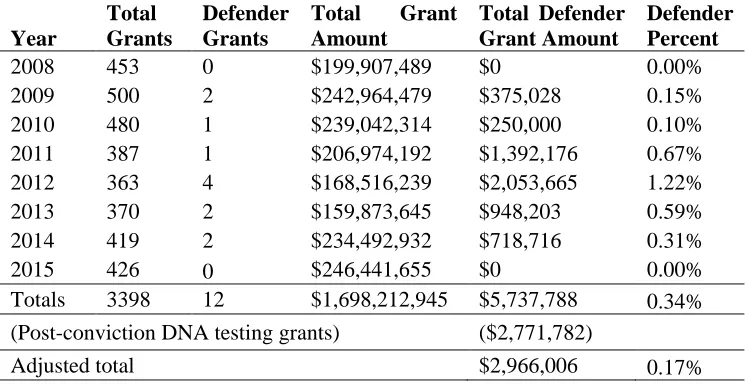
Despite these efforts, federal funding for defense research remains a small fraction of total research funding. As illustrated in Table 1, information on DOJ websites indicates that between 2008 and 2015, NIJ—a key funder of empirical research on criminal legal systems33—allocated 0.34% of available discretionary grant support to projects focused on public defense.34 That percentage includes grants for a DNA backlog-reduction program, but excludes NIJ-supported
attorney-general-holder-announces-67-million-improve-legal-defense-services-poor?_sm_au_=iVVN RSVF4f0rst WM [https://perma.cc/MU2R-EJVJ].
29
ERINN HERBERMAN &TRACEY KYCKELHAHN,BUREAU OF JUSTICE STATISTICS,U.S.DEP’T OF JUSTICE,NCJ246684,STATE GOVERNMENT INDIGENT DEFENSE EXPENDITURES, FY2008–2012– UPDATED (2014), https://www.bjs.gov/content/pub/pdf/sgide0812.pdf [https://perma.cc/QT4M-DSB7].
30
NAT’L INST. OF JUSTICE,U.S.DEP’T OF JUSTICE,SOCIAL SCIENCE RESEARCH ON INDIGENT
DEFENSE (2012), https://www.ncjrs.gov/pdffiles1/nij/sl001006.pdf [https://perma.cc/8XKX-DWFN]; see also Greg Ridgeway, Courts Research: Dear Colleague Letter From Greg Ridgeway, Fiscal Year 2014, NAT’L INST. OF JUSTICE (Feb. 7, 2014), http://www.nij.gov/funding/pages/fy14-dear-colleague-courts.aspx [https://perma.cc/QD3V-PE4Q].
31
BUREAU OF JUSTICE ASSISTANCE, U.S. DEP’T OF JUSTICE, ANSWERING GIDEON’S CALL: NATIONAL ASSISTANCE TO IMPROVE THE EFFECTIVENESS OF RIGHT TO COUNSEL SERVICES FY2013 COMPETITIVE GRANT ANNOUNCEMENT (2013), https://www.bja.gov/Funding/13AnsweringGideons CallSol.pdf [https://perma.cc/8F5R-A29K]; BUREAU OF JUSTICE ASSISTANCE,U.S.DEP’T OF JUSTICE, SMART DEFENSE INITIATIVE ANSWERING GIDEON’S CALL: IMPROVING PUBLIC DEFENSE DELIVERY
SYSTEMS FY 2015 COMPETITIVE GRANT ANNOUNCEMENT (2015), https://www.bja.gov/Funding/15 SmartDefenseSol.pdf [https://perma.cc/8G7X-Y6QQ]; JUSTICE PROGRAMS OFFICE, AMERICAN UNIV., Right to Counsel National Campaign, http://www.american.edu/spa/jpo/initiatives/right-to-counsel-nc/ [https://perma.cc/6X63-DET5] (last visited Feb. 9, 2017); Indigent Defense Grants, Training and Technical Assistance, U.S. DEP’T OF JUSTICE, https://www.justice.gov/atj/indigent-defense-grants-training-and-technical-assistance [https://perma.cc/LNQ7-H5DQ] (last visited Feb. 9, 2017).
32
See, e.g., NAT’L INST OF JUSTICE, U.S. DEP’T OF JUSTICE, TOPICAL WORKING GROUP
MEETING ON RIGHT TO COUNSEL AND INDIGENT DEFENSE(2015), https://www.ncjrs.gov/pdffiles1/nij/ 248692.pdf [https://perma.cc/25JG-Z5FQ].
33
INCREASE AWARENESS,supra note 26, at 8. 34
meetings that focused on public defense research.35 Of course, NIJ is just one source of federal funding for public defense research, and is constrained by proposals received and by peer review responses to those proposals.36 While multiple factors affect funding, Table 1 nevertheless indicates that DOJ support for public defense research remains relatively modest.
Table 1. NIJ Funding Allocations 2008–2015
Year
Total Grants
Defender Grants
Total Grant
Amount
Total Defender Grant Amount
Defender Percent
2008 453 0 $199,907,489 $0 0.00%
2009 500 2 $242,964,479 $375,028 0.15%
2010 480 1 $239,042,314 $250,000 0.10%
2011 387 1 $206,974,192 $1,392,176 0.67%
2012 363 4 $168,516,239 $2,053,665 1.22%
2013 370 2 $159,873,645 $948,203 0.59%
2014 419 2 $234,492,932 $718,716 0.31%
2015 426 0 $246,441,655 $0 0.00%
Totals 3398 12 $1,698,212,945 $5,737,788 0.34%
(Post-conviction DNA testing grants) ($2,771,782)
Adjusted total $2,966,006 0.17%
Federally-supported published research appears to follow a similar distributional pattern, as illustrated in Table 2’s collation of data from DOJ’s websites. According to these data, in the past twenty to thirty years, NIJ and NIJ grantees have published 1,432 research reports on corrections, courts, law enforcement, and reentry,37 while over an even longer period all DOJ agencies
35 See supra note 32. See also NAT’L INST. OF JUSTICE, NCJ 249533, ANNUAL REPORT 23 (2014), https://www.ncjrs.gov/pdffiles1/nij/249533.pdf [https://perma.cc/KZU5-HVQ6] (NIJ funding for DNA backlog projects totaled over $71 million in 2014).
36
Like many researchers, the authors have experienced both success and failure in seeking NIJ funding.
37
It is not possible to search the NIJ publication tabs for the terms public defense, defense, defender, indigent, indigency, and counsel. See Publications Related to: Corrections,NAT’L INST. OF
combined have published or supported the publication of 76 research studies on public defense.38
Table 2. DOJ-Funded Research Publications
Years 1979-2016 1986-2016 1980-2016 1995-2016 1975-2016
Function Law
Enforcement Corrections Courts Reentry
Indigent Defense
Publications 651 343 300 138 76
B. Accomplishments and Opportunities
Given the ongoing crisis in underfunded, overworked public defense systems and the lack of resource parity, including for research funding, it is remarkable that administrators of public defense agencies have led a number of empirical investigations into public defense.39 These projects include the development of metrics aimed at defining, assessing, and promoting best practices for improving public defense. Leading examples are North Carolina’s Systems Evaluation Project (NCSEP),40 Delphi workload studies undertaken in partnership with the American Bar Association,41 and the Texas Indigent Defense Commission’s (TIDC) work on data-sharing dashboards.42
Some of these projects have led to infusions of external funding to deepen and expand the research. For example, TIDC partnered with Texas A&M University in securing a BJA Smart Defense grant to build out the state’s web-based portal for
38
SeeIndigent Defense Publications,U.S.DEP’T OF JUSTICE,https://www.justice.gov/atj/idp (last visited Feb. 9, 2017) (documenting reports by DOJ’s Bureau of Justice Statistics, Bureau of Justice Assistance, Office of Juvenile Justice and Delinquency Prevention, Law Enforcement Assistance Administration, and National Institute of Justice).
39
See Laurin, supra note 1. 40
MARGARET A.GRESSENS &DARYL V.ATKINSON, THE CHALLENGE:EVALUATING INDIGENT
DEFENSE:NORTH CAROLINA SYSTEMS EVALUATION PROJECT PERFORMANCE MEASURES GUIDE (2012), http://www.ncids.org/systems%20evaluation%20project/performancemeasures/PM_guide.pdf [https://perma.cc/2ZH7-PN7P]. See generally The North Carolina Systems Evaluation Project (NCSEP), N.C.OFFICE OF INDIGENT DEF.SERVS.,http://www.ncids.org/Systems%20Evaluation%20 Project/SEP%20HomePage.html?c=Research%20%20and%20%20Reports,%20Systems%20Evaluati on%20Project [http://perma.cc/PA23-N3E8].
41
See Geoffrey T. Burkhart, How to Leverage Public Defense Workload Studies, 14 OHIO ST. J.CRIM.L.403(2017)(discussing use of expert panels to establish hours per case necessary, on average, to satisfy American Bar Association practice guidelines).
42
data collection and assessment.43 Similarly, the Open Society Foundations supported the National Legal Aid and Defender Association’s partnership with NCSEP to expand that project and extend it beyond North Carolina.44 In addition, the National Science Foundation supported a national conference in 2015 to explore diverse approaches to measuring quality public defense representation.45
These developments have coincided with new growth in related academic literature that spans disciplinary fields ranging from economic theory,46 to social psychology,47 criminology and criminal justice,48 sociology,49 history,50 and law.51 These studies are beginning to paint a nuanced picture of public defense as a dynamic field with a high level of local variation.52 And while the field of public defense research is admittedly young, small, and overmatched in resources dedicated to policing, prosecution, and prisons, it is at the same time quite energetic and diverse.
Unsurprisingly, defense practitioners have similarly diverse reactions to this new research field.53 Some appreciate the potential power of data-informed analysis; others are skeptical about the relevance of such research or worry over invasions from the “time-tracking” police.54 The early stage and diverse nature of this research field creates a timely opportunity to begin assessing factors that shape the generation of research questions and agendas. Those factors include resource disparities discussed above, and their disproportionate impact on poor people who have relatively little voice in generating and administering criminal legal policies
43
Texas, SMART DEF., http://smartdefenseinitiative.org/initiative-site/texas/ [https://perma.cc/ RF99-93S9].
44
OSFREPORT, supra note 21, at 1–2. 45
Davies & Lopes, supra note 20. 46
See, e.g., Benjamin Schwall, More Bang for Your Buck: How to Improve the Incentive Structure for Indigent Defense Counsel, 14 OHIO ST.J.CRIM.L.553(2017).
47
See, e.g., Sandys & Pruss,supra note 6;Erika Fountain & Jennifer Woolard, The Capacity for Effective Relationships Among Attorneys, Juvenile Clients, and Parents, 14 OHIO ST.J.CRIM.L.
493(2017). 48
See, e.g., Alissa Pollitz Worden et al., Court Reform: Why Simple Solutions Might Not Fail? A Case Study of Implementation of Counsel at First Appearance, 14 OHIO ST.J.CRIM.L.521 (2017).
49
See, e.g., NICOLE GONZALEZ VAN CLEVE, CROOK COUNTY: RACISM AND INJUSTICE IN
AMERICA’S LARGEST CRIMINAL COURT 157–80 (2016). 50
Sara Mayeux, What Gideon Did, 116 COLUM.L.REV.15(2016). 51
See, e.g.,Wright & Peeples, supra note 21. 52
See, e.g., Alissa P. Worden & Andrew L. B. Davies, Protecting Due Process in a Punitive Era: An Analysis of Changes in Providing Counsel to the Poor, 47 STUD.L.POL.&SOC’Y 71 (2009).
53
See infra Part IV. 54
that affect their lives and their communities.55 Such factors highlight the importance of decisions on research priorities, and of opportunities to make research matter by tying it to concrete improvements in public defense, in the lives of people who need public defenders, and in the lives of their communities.56
Yet there are also other vantage points for framing inquiries into the formation of agendas for public defense research. For example, who defines best-practice public defense? Defendants and defenders might generate metrics like Professor Laurin’s, which focus mainly on benefits to individual defendants in specific cases (“acquittals, favorable sentencing outcomes, charge reductions, pretrial release, protecting constitutional rights, sheer client satisfaction, or some mix of the above”).57
But other perspectives and metrics are possible; taxpayers, legislators, prosecutors, judges, police, prison personnel, reentry workers, and crime victims might all have different views.
Even when focusing exclusively on perspectives of defendants and defenders, different metrics may be in play. For example, recent movements in public defense (whether participatory,58 community-oriented,59 client-centered,60 holistic,61 heroic,62 or system-impact63) often prioritize longer-term outcomes in the lives of defendants, their families, and their communities,64 in balances of power within carceral systems,65 or in shifting perceptions of system legitimacy.66 Still another set of issues arises from disputes or uncertainty over core concepts that inform research methods. For example, the interdisciplinarity of public defense research leads to very different ideas of what the core concept of “theory” means.67
55
See Moore, supra note 16. 56
Cf. Martin Luther King, Jr., I Have a Dream (Aug. 28, 1963), reprinted in LENWOOD G. DAVIS,IHAVE ADREAM:THE LIFE AND TIMES OF MARTIN LUTHER KING,JR. 261 (1969) (discussing “the fierce urgency of now”).
57
See Laurin, supra note 1, at 336. 58
See Janet Moore et al., Make Them Hear You: Participatory Defense and the Struggle for Criminal Justice Reform, 78 ALB.L.REV.1281 (2015).
59
Kim Taylor-Thompson, Taking it to the Streets, 29 N.Y.U.REV.L.&SOC.CHANGE 153 (2004). 60
John D. King, Candor, Zeal, and the Substitution of Judgment: Ethics and the Mentally Ill Criminal Defendant, 58 AM.U.L.REV. 207, 210 n.8 (2008).
61
Lee et al., supra note 21. 62
Jonathan A. Rapping, Reclaiming Our Rightful Place: Reviving the Hero Image of the Public Defender, 99 IOWA L.REV. 1893 (2014).
63
See, e.g., Special Litigation Division, PUB. DEF. SERV. FOR D.C., http://www.pdsdc.org/ about-us/legal-services/special-litigation-division [https://perma.cc/9ESB-5SBK].
64
See Steinberg, supra note 20. 65
See Moore et al., supra note 58. 66
Or consider recent challenges to the clarity of the core concepts upon which decades of research on procedural justice have been founded.68 Such debates reflect the dynamism of research, which must be considered in analyzing the formation of public defense research agendas.
To be sure, such debates may appear arcane to public defense researchers whose mandates prioritize descriptive analysis, cost-benefit calculations, and related standards for system structure and attorney performance.69 That point underscores our thesis, however: The field of public defense research is young and small, but we already need a big tent. The field must not merely accommodate, but actively promote discussion across multiple diversities regarding sociopolitical influences on the formation of research agendas, varying theoretical and conceptual frameworks for analysis, differing methods, and alternative goals.70 Such open discussion will strengthen future work. Part III aims to advance that discussion by describing the theory and method informing our pilot study.
III.THEORY AND METHOD
This project explores new perspectives on the top-priority empirical research questions for the field of public defense by investigating whether and how role and experience level affect research priorities among 71 defense providers from a single state (Mississippi). We framed this project around the constitutional right to counsel and related ethical and professional duties. We also chose to ground our work in democratic theory, with particular emphasis on the normative value of equality in self-governance and on the increased transparency and accountability of criminal legal systems that can result when diverse voices are included in generating and administering the governing law.71
67
See, e.g., Lawrence B. Solum, Legal Theory Lexicon 053: It Takes a Theory to Beat a Theory, LEGAL THEORY LEXICON, http://lsolum.typepad.com/legal_theory_lexicon/2006/08/legal_ theory_le_1.html [https://perma.cc/9ZKQ-JQSB] (discussing debates over “theory” in legal scholarship).
68
See, e.g., Johnson et al., supra note 7, at 949–54; Robert J. MacCoun, Voice, Control, and Belonging: The Double-Edged Sword of Procedural Fairness, 1 ANN.REV.L.&SOC.SCI.171,188– 93(2005); Justice Tankebe, Viewing Things Differently: The Dimensions of Public Perceptions of Police Legitimacy, 51 CRIMINOLOGY 103 (2013); Anthony Bottoms & Justice Tankebe, Beyond Procedural Justice: A Dialogic Approach to Legitimacy in Criminal Justice, 102 J.CRIM. L.& CRIMINOLOGY 119(2012).
69
See Laurin, supra note 1, at 339–42; Caroline S. Cooper, The ABA “Ten Principles of a Public Defense Delivery System”: How Close Are We to Being Able to Put Them Into Practice?, 78 ALB.L.REV.1193(2015).
70
See PIERRE BOURDIEU,PASCALIAN MEDITATIONS 61 (2000); LOADER &SPARKS, supra note 4, at 37.
71
These choices informed two other aspects of our analysis. The first is our general aim of promoting epistemic reflexivity in the field of public defense research.72 We anticipate that self-critical analysis of public defense research will reinforce the value of including diverse voices in the quest to define and assess quality performance. The second is our selection of modified group-level assessment (GLA), a participatory large-group research method,73 for data collection. This method emphasizes the value of including diverse perspectives in the generation and pursuit of research agendas.
As Vaughn and Lohmueller describe, group-level assessment (GLA) is a method
that collaborates directly with relevant stakeholders and leads to the development of participant-driven data and relevant action plans. . . . As an evaluation tool, GLA best fits within the empowerment evaluation approach because of the focus on “helping people help themselves” and the ideas of self-determination and community action. . . . Thus, the GLA emphasizes ‘‘knowledge for action’’ with relevant stakeholders and informed consumers as active contributors within a nonhierarchical process.74
GLA involves seven steps.75 The first step is climate setting, in which the facilitator introduces the process and the prompts to which participants will respond. In steps two through four, participants respond to the prompts and spend time appreciating and reflecting on their collective responses. Steps five and six involve thematizing and prioritizing responses in small groups. The final step involves creating an action plan.
GLA’s benefits for this project include its empowerment approach to participant-centered data generation and assessment.76 GLA has two other advantages for research involving underresourced, overworked public defenders: It is cheap and efficient. As Vaughn and Lohmueller observe, “GLA rapidly results in concrete, meaningful ideas . . . because each participant has a piece of the puzzle. The group of inside stakeholders, rather than an outside ‘expert,’ is responsible for data generation, data revision, data prioritization, and presentation.”77
Finally, GLA “is unique because . . . it uses the verbatim words
72
See supra notes 46–70 and accompanying text. 73
See Lisa M. Vaughn, Group-Level Assessment: A Large Group Method for Identifying Primary Issues and Needs within a Community, SAGERESEARCH METHODS CASES (2014); Vaughn & Lohmueller, supra note 2.
74
Vaughn & Lohmueller, supra note 2, at 338–39 (internal citations omitted). 75
Id. at 339–45. 76
Id. at 338. 77
and themes of the participants co-constructed in real-time interaction versus the evaluator reporting back the participant words and exchanges,” while generating “common ideas that are most pressing to the group” and avoiding “having one individual dominate.”78
To maximize these benefits and accommodate site-specific constraints, we exploited GLA’s flexibility79
and modified the process in three ways. First, we concentrated activities into a two-hour time slot, in part by eliminating the final step of action planning. Second, we centered data collection in small groups at conference tables, where participants wrote ideas on post-it notes instead of moving around the room recording responses on flip charts. Third, participants generated most of the data in silence. Silence is a great equalizer (especially when trial lawyers are involved). Silence encourages participants to offer their own ideas in their own words, independently of the self-editing or anchoring that can occur through early exposure to the work product of others.
This modified GLA occurred at a conference of public defense lawyers sponsored by the Office of the Mississippi State Public Defender (OMSPD). Each modification was designed to further OMSPD goals of increasing defender interest in public defense research. To that end, we also anonymized data and assured participants that information on specific cases or attorney-client communication was off-limits as we focused instead on top-priority research questions to improve public defense. Participants were invited to self-sort into small groups by role (attorneys, staff, and managers) and, for attorneys, by experience level (< 5, 5–10, 10–20, or > 20 years). Climate-setting included distinguishing empirical research from legal research or case investigations with which public defense attorneys are more familiar, and descriptive empirical questions (“How many? How long? How much?”) from causal questions (“What’s the effect of x on y?”).80
The modified GLA process was explained along with the reasons for generating ideas in silence. Participants were assured that they could discuss their ideas later in the process.
The prompt asked participants to identify empirical research questions whose answers could improve public defense, and to assume that they could get all the resources necessary to find those answers. Working in their small groups, participants were invited to generate questions on post-it notes, post their questions on a large piece of paper, read all the questions, organize the questions into themes, and arrange the themes by priority. Participants then could discuss their questions, themes, and priorities, as well as potential risks and benefits of addressing top-priority questions, and action steps for answering those questions.
78
Id. at 350–51. 79
Id. at 339. 80
See MAREA BEEMAN, NAT’L LEGAL AID &DEF. ASS’N, BASIC DATA EVERY DEFENDER
PROGRAM NEEDS TO TRACK:A TOOLKIT FOR DEFENDER LEADERS (2014), https://www.nlada.org/ sites/default/files/pictures/BASIC%20DATA%20TOOLKIT%2010-27-14%20Web.pdf
They were invited to make changes and additions by adding post-it notes, including notes expressing disagreement with any question, theme, or priority generated by their small group. A reporter from each small group shared that group’s top-priority theme, question, and action step with the large group. We planned to close by describing examples of defender-driven empirical research that have led to system improvement and then inviting more discussion. Time constraints limited closing remarks to thanking participants for engaging in the process and discussing how their data would be reported to them.
All data were transcribed verbatim into Excel spreadsheets that replicated participants’ arrangements of their own data on the large sheets of paper. Data were color coded to reflect the contribution of each participant. The research team then conducted qualitative analysis of the spreadsheets. Each author and a research assistant independently read all the notes, composed memoranda reflecting on the meaning and interpretation on the contents, and developed an initial list of key themes. The notes were then re-read and categorized by theme using qualitative data analysis software NVivo11, with the themes subject to revision as the coding progressed.81 Initially, the data sets were analyzed separately based on participant roles and attorney experience levels. Once the codes and related themes were developed, the data sets were compared and contrasted and the coding scheme was refined.
IV.FINDINGS
This Part provides an overview of the data generated, then analyzes themes and priorities revealed in the data. The analysis reveals minimal variation across participant roles and experience levels. Shared concerns focused on four top-priority themes: quality of relationships between defense providers and people who need public defense representation, strategies for obtaining optimal outcomes for clients, resource disparities between public defense and law enforcement, and other issues involving police, prosecutors, and judges.
A. Data Overview
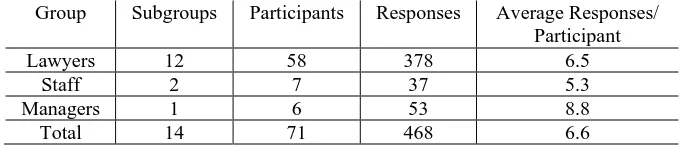
As shown in Table 3, a total of 71 participants self-selected into 14 subgroups and generated 468 responses during the course of the exercise. The majority of participants (58) were line attorneys (“lawyers”), who self-selected into 12 subgroups based on experience level and generated 378 responses. Participants also included 7 non-lawyer staff, who were mainly mitigation investigators and social workers. These participants self-selected into two subgroups and generated
81
37 responses. Six lawyer-managers (“managers”) formed a single group that generated 53 responses.
Table 3. Participants and Responses: Summary
Group Subgroups Participants Responses Average Responses/ Participant
Lawyers 12 58 378 6.5
Staff 2 7 37 5.3
Managers 1 6 53 8.8
Total 14 71 468 6.6
As a metric of participant engagement, we calculated average numbers of responses per participant. Response averages varied slightly across groups. As indicated in Tables 3 and 4, response averages were slightly higher for managers than for lawyers and staff, and also higher for lawyers with the least experience (< 5 years) and the most experience (> 20 years).
Table 4. Participants and Responses: Lawyers by Experience Level
Experience Level (Years)
Subgroups Total Participants/ Subgroup
Total Responses/ Subgroup
Average Responses/ Participant
<5 3 15 107 7.1
5–10 2 10 49 4.9
10–20 3 14 88 6.3
>20 4 19 134 7
Totals 12 58 378 6.5
Response content is another measure of participant engagement. Of the 468 responses, we identified 44 that did not state a research question. Most of these (34) were investigative questions a lawyer or social worker might ask (e.g., “Does
anyone in your family have mental issues?”). These responses suggest that some participants misunderstood the exercise, and that further clarification of process and goals would have been helpful during the climate-setting phase. The remaining 10 responses in which no research question was stated were either unintelligible, nonresponsive, or required interpretation with an unacceptable risk of inaccuracy (e.g., “Peer review?”). The following analysis is therefore based on
424 responses that clearly stated a research question.
attorneys with less than five years of experience, paraphrased her group’s top-priority question as “WE NEED MONEY!!!” This response sparked brainstorming on ways to turn that demand into a research question: “What factors help some jurisdictions get resources they need?” Similarly, when a more experienced lawyer posed a hypothetical question to a client (“Will you tell me the truth?”), large group discussion generated the question: “What factors create relationship of trust and confidence necessary for defendants to communicate effectively with their lawyers?”
After accounting for these exchanges and nonresponsive data, we thematically coded the remaining 424 responses based on the substantive focus of the research question posed.82 We also examined participants’ independent thematization and prioritization of topics. Next, we compared these responses by professional role across three categories (lawyers, managers, and staff). For the 58 lawyers, we also compared responses based on years of experience. Responses could be coded to multiple themes. For example, “Do indigent defendants get lower sentences than non-indigent defendants?” was coded as both a question about sentencing and a question about comparisons of defense attorney types. We made minor edits for readability.83
B. Themes
We discerned four major and interrelated themes in participant questions. The first theme concerned the attorney-client relationship. These questions probed ways to form positive attorney-client relationships and the benefits those relationships could bring to representation.84 The second theme focused on ways that defenders could get the best outcomes for their clients. “Outcomes” included case results as well as life outcomes such as future employment, behavioral health, and recidivism.85 Third, defenders asked about resource disparities and how those disparities affect outcomes for clients.86 Finally, defenders asked about the context in which they work and, particularly, about colleagues in the private defense bar, and about counterparts across criminal legal systems whose work has a strong impact on public defense such as law enforcement, prosecution, the judicial branch, and correctional agencies. Defenders wondered about inequities within these different criminal legal functions, and how they might be made to operate more fairly.87 We discuss each theme in turn.
82
Id. 83
For example, abbreviations were expanded (“vs.” was replaced with “versus”). Any wording changes in this article are indicated by ellipses and bracketed insertions.
84
107 questions were related to this theme. 85
136 references were made to this theme. 86
80 references were made to this theme. 87
1. The Attorney-Client Relationship
Meeting new clients, and winning their trust and respect, is a crucial part of defenders’ daily activity. That work entails confronting and overcoming the poor reputation of public defender agencies,88 often during a very short initial meeting with a client.89 Defenders asked many questions on the best strategy for these encounters, and how they could better understand their clients’ needs. Sixteen questions related specifically to the reputation that preceded them before they met clients. “Why don’t my clients think I’m a real lawyer?” asked one. “Are public defenders viewed as less capable than private attorneys?” added another. This issue extended to juveniles as well as adults: “How many children in Youth Court . . . believe their public defender is just another part of the court system?” Defenders were keen to find solutions. “People need to know we’re good lawyers,” one opined. “How do we change the clientele’s outlook of the public defender’s office as . . . good attorneys that care about them and their case?” Another asked, “What can be done to make the general public and our clients know that public defenders are just as valuable, talented, and skilled, and even more so than private or paid lawyers?”
Against this background of concern about their poor reputation, 26 questions addressed the need to establish good rapport with clients under difficult circumstances. Many of these questions sought direct, practical guidance. Examples included: “How do you deal with hostile clients who do not like you?”; “What can I do to get my clients to listen to my advice?”; and (looking to the future) “How do I get clients to stay in touch with me?” Six questions asked specifically about race in attorney-client relationships: “Are clients more or less likely to take advice from [attorneys of the] same gender/race?”
Additional questions suggested that attorney-client relationships were key to defenders’ ability to advocate effectively. “Why do clients so mistrust their lawyer [that] they would listen to the prosecution before me?” asked one, while another worried that a client’s “hostile attitude” might “affect the outcome of his/her case.” Defenders wondered whether poor communication might compromise effective investigation, with one asking, “How many defendants are afraid to tell our staff the truth?” and another, how to “build trust between the appointed attorney and the client in order to avoid . . . surprises at trial?”
Eight questions suggested specifically that research should be done with clients themselves to understand their perspectives on the quality of the services
88
See Cara H. Drinan, The National Right to Counsel Act: A Congressional Solution to the Nation’s Indigent Defense Crisis, 47 HARV. J. ON LEGIS. 487, 493 (2010) (discussing “public
pretender” trope). 89
See, e.g., ALISA SMITH &SEAN MADDAN,THREE-MINUTE JUSTICE:HASTE AND WASTE IN
attorneys provide. “What qualities do indigents feel are most important for a public defender to possess?” asked one. Another wanted to ask a similar question of clients who were in a position to look back on their representation at trial: “What is the most commonly discussed complaint regarding public defenders according to incarcerated clients?” One defender highlighted both the need for techniques to gather client feedback and the presumed connection between such data and outcomes, asking: “What client satisfaction tools could be implemented to achieve better results?” Another highlighted one specific outcome—transforming the clients’ experience from one of marginalization to one of empowerment— asking: “How can we ensure the client doesn’t feel erased from the process?”
Defenders inquired in detail about strategies for improving attorney-client relationships. “Does attorney experience affect attorney-to-client interactions?” asked one, while another wondered whether “having fixed times for client calls” would “improve or diminish useful interaction with clients?” Some sought to prioritize what they communicated (“What information do clients wish they had gotten at the beginning of a case?”) or to learn how to respond clearly to “much [asked] questions by defendants—such as speedy trial violation vs 270 rule.”90 Lurking behind many of these questions were issues not only of trust and rapport but also of comprehension, efficiency, and effectiveness. One defender identified this issue directly: “How can you determine if you have effectively communicated with your client?”
Perhaps in further reflection of the difficulties attorneys felt they had relating to their clients, 41 questions referred in some way to their interest in the life circumstances of the client population. “What factors in our client’s lives have led them to become incarcerated?” asked one. Others hinted at possible answers: 13 questions asked specifically about the prevalence of mental illness among clients. Others asked about rates of drug use, poverty, and lack of education, all of which were implicitly connected by questioners to their clients’ behavior. These questions reveal interest and concern on the part of defenders for understanding and addressing possible causes, both individual and ecological, of clients’ behavior. Like questions raised on other points, some of these queries were profound, complex, and challenging; one young lawyer wondered whether public defense would “be more effective if public defenders understood the political and social context in which crime occurs.”
2. Defender Strategy and Getting Better Outcomes
Defenders also were concerned about getting the best possible outcomes for their clients. They asked questions about everything from the systems for delivering defender service to strategic decisions in individual cases that could
90
deliver optimal results. “How is the effectiveness of indigent defense measured?” defenders wondered; “What factors are most important?” Defenders focused most commonly on how to change outcomes, both pretrial and at disposition or sentencing, as measured in favorable pleas, dismissals and acquittals, sentence length and the use of alternatives to incarceration. Success was also defined in processual terms, and particularly in terms of the timing of, and access to, services—the swiftness with which counsel was appointed, the overall length of a case, the time attorneys spent with clients, the amount of time “wasted” waiting in court, or the availability and use of referrals to mental health treatment or other forms of social support. Sometimes success was also defined in terms of longer-term outcomes in the client’s life such as reducing recidivism or making sure their treatment needs were met.
In addition, 12 questions asked about how to make strategic decisions in a case. “Does expert evidence really persuade juries?” asked one, while another asked, “Does the defendant’s decision not to testify affect the jury’s verdict? If so what are the factors?” Beyond juries, defenders were curious about judges (“What areas are criminal court judges interested in concerning the defendant’s case?”), prosecutors (“What is the most likely mistake that a prosecutor will make that will benefit your client?”) and key decision points like when to plead (“Plea—good offers versus not. When . . . [to] try case?”).
Defenders also wanted to know how best to organize their own services to get optimal results. Twenty-five questions asked whether certain types of defenders got better results than others. Seven of those focused on the differences in results obtained by privately retained and publicly funded counsel (e.g., “What is the
win-loss rate of a public defender to that of a . . . hired attorney, on average?”). Others focused on other comparisons, such as whether “full-time public defenders obtain better results for clients over part-time defenders.”91 Twenty-seven questions addressed internal office structures, such as: “Is it more effective to have one attorney doing lower court work than it is to spread [that] work out over multiple attorneys in an office?” Others were curious about the impact of auxiliary staff (e.g., “Is there a difference in sentencing outcomes when an investigator is available to public defenders?”) and ways to access such resources (e.g., “How [can you] get a team of experts as part of the public defender staff?” and “Can low budget rural public defender offices be funded for investigative work?”).
Defenders also worried about clients who fell through the cracks because they needed services beyond those that defenders traditionally provide. “How can mental health issues be handled better for our clients when insanity is not indicated?” asked one. Another asked, “Why don’t we have social workers and
91
psychologists in our offices?” and “Why is counseling and treatment not available to indigent defendants to prevent reoffending?”
3. Resource Constraints and Getting Better Outcomes
Even more common than questions about strategic choices in obtaining favorable outcomes were questions about the lack of resources to deliver those outcomes. No fewer than 77 questions referred to the resource constraints under which defenders operate and the way that shortages undercut defender service. Twenty questions focused specifically on the disparity in resources in comparison with the prosecution, referencing differences in salaries, personnel, budgets and ancillary resources. “Is there salary equality with prosecutors? Why not?” one asked, while another wrote, “Why can’t we have the same resources available to us like the DA’s office have?” A further 29 referenced caseload pressure, asking questions like, “Why do I have to prepare for 3 and 4 serious felonies at a time?” and “How many cases are continued because of the defender’s work load?”
Questions on resources stressed the need to track and demonstrate the constraints under which defenders worked. Defenders wanted to know, “What is the average number of staff for PD offices in comparison to DA offices?” and “How does the average case load for a PD vary across the state?” Others asked about the impact of resource deficits on case outcomes and about the connection between “pay and retention” of defenders themselves. Another, echoed on several occasions, was, “What correlation, if any, exists between time and money invested in the bench, prosecution, and defense, [and] trial convictions versus pleas, and the nature and duration of sentences?”
Defenders wanted to know, “What can be done to convince supervisors or paying entities to pay public defenders equal to prosecutors?” Another put it more personally: “Why don’t I make more money?” One questioner asked whether state intervention would make a difference: “How does it affect outcomes when the counties pay as opposed to when the state pays?” Others thought of evidence that might bolster an argument: “Does improvement in indigent defense result in a decrease in tax dollars spent on incarceration? How much?” Eight questions sought guidelines for an ethically acceptable workload. “What is the magic number of felony cases for one defender to handle?” asked one, then clarifying “How does handling misdemeanor cases . . . affect the magic number . . . ?” Defenders were also keen to have research to demonstrate the impact of such limits. One inquired, “What measurable factors are available to demonstrate the overall effects of different sized caseloads on individual public defenders? [And their] offices?” while another thought about the impact on other cost centers: “If you established caseload maximums for public defenders, would cost be justified by expedited dockets & releases from jails/prison?”
public defenders away from seeking a plea deal as more appetizing or appealing than trial work?” asked one. Another wondered about the impact of the stress of the work, asking: “What is rate of substance abuse among public defenders versus other areas of law practice?” Questioners wondered how the profession could be “made more attractive and/or available for young lawyers seeking experience in the courtroom” and “[w]hy . . . people leave indigent defense work.” One may even have questioned his or her own sanity: “Can we do a psych eval before taking a job as a public defender?”
4. Broader System Questions
Defenders also asked about the broader systems within which they worked, frequently evoking the inequitable or arbitrary nature of the decisions those systems produced. While defenders asked pointed questions about the actors and institutions that produced those outcomes, including police, prosecutors, judges, and corrections officials, they also had constructive thoughts about how those systems could work better. Interestingly, at first blush these inquiries might seem to exceed the scope of the prompt, which focused on research that could improve public defense. Emergence of this theme is unsurprising, however, in that these questions reflect concerns about systemic problems in areas that have a strong effect on public defense. Indeed, scholars have described the interrelationship of the actors and institutions that are most directly responsible for resolving criminal cases as sufficiently close to merit the label “courtroom workgroup.”92
Twenty-four of the questions in this theme focused on judges, and most of these related to judicial impartiality. “How does electing judges (as opposed to appointing them) affect outcomes?” asked one, while another wondered, “What specifically can be done to help judges who were formerly prosecutors, not favor the prosecution in criminal matters, especially trials?” Some respondents ruminated on the challenges of court administration, asking in one case how to implement “standard sentencing guidelines . . . when a district has more than one judge” or in another: “Are part-time judges better?” Others invoked the specter of racial bias. “Are judges who were former prosecutors more harsh on minority defendants than judges who were former defense attorneys?” asked one. Another wanted to know, “How many DUI charges are dismissed against whites each year?” and then reframed the question to ask, “against blacks?”
Thirty-two questions about sentencing decisions evoked issues of bias even more frequently. Five asked about defendant race (e.g., “Do prosecutors give
better deals to people based on race?”) while another 5 addressed defendant socioeconomic status and ability to retain private counsel (e.g., “Do indigent
92
defendants get lower sentences than non-indigent defendants?”). One question related to sentencing decisions involving defenders themselves: “When are we going to get rid of that psycho [Placename] judge that jails PDs?”
Fourteen responses relating to prosecutors, and 10 that mentioned police, also evoked unfairness, often in the context of adversarial proceedings. “Why is it all one-sided?” asked one. “[The] State gets use of experts without motion but not defenders.” Questioners lamented unfair laws and procedures that institutionalized prosecution and law enforcement advantages in court. “Why are there so many ‘good faith’ exceptions to Batson?”93 asked one, while another wondered, “Why are officers allowed to steer arrested persons away from counsel rather than lawyers being provided on the front end?”
Defenders also questioned discretionary decisions by prosecution and law enforcement that produced unjust or inequitable outcomes. “How many wealthy people are charged with child abuse and neglect every year?” one asked. Some sought data that would illuminate suspected disparities. “What is each prosecutor in Mississippi’s rating on use of [jury] strikes of people for race, gender and religion?” one asked, while another sought “individual arrest records of police officers by jurisdiction—number arrested, types of crimes, age, sex and race of perps.” More provocative still, others called for investigation of practices they saw as cynical or corrupt. “How many arrests are made on Friday afternoon/weekend when lawyers are not available?” one asked, and another, “What percentage of cases do I actually get all discovery available?”
Defenders were also concerned about jail and prisons. While these questions again evoked concerns about equity and justice, they raised another distinct concern: whether incarceration would actually help or harm their clients in the long term.94 “Does jail time deter shoplifting?” wrote one, while another wondered whether “not jailing non-violent offenders [would] increase/decrease recidivism.” Others asked if “drug and alcohol treatment really work” or whether or not “clients who stay in pre-trial detention longer have a greater chance of re-offending.”
In the end, defenders were very concerned about clients’ future entanglement with those systems: “What are the factors that would help the defendants not to reoffend?” Several sought to develop strategies to address the problem directly. “What can help manage defendant finances to pay court fees and costs?” asked one; another, in place of a question, wrote an answer: “We need good communication; to assist clients with social needs; to track fees problems.” Defenders wondered about the cost-benefit ratios of different initiatives: increased use of GPS trackers “for non-violent crimes in lieu of incarceration,” “quadrupling” the size of prison industries programs, and keeping “probation offices open one Saturday and one night until midnight per month.” Defenders
93
Batson v. Kentucky, 476 U.S. 79 (1986). 94