ARTICLE OPEN ACCESS
ASFMR1
splice variant
A predictor of fragile X-associated tremor/ataxia syndrome
Padmaja Vittal, MD, MS, Shrikant Pandya, BS, Kevin Sharp, MS, Elizabeth Berry-Kravis, MD, PhD, Lili Zhou, MD, Bichun Ouyang, PhD, Jonathan Jackson, BS, and Deborah A. Hall, MD, PhD
Neurol Genet2018;4:e246. doi:10.1212/NXG.0000000000000246
Correspondence
Dr. Hall
Abstract
Objective
To explore the association of a splice variant of the antisense fragile X mental retardation 1 (ASFMR1) gene, loss offragile X mental retardation 1(FMR1) AGG interspersions andFMR1 CGG repeat size with manifestation, and severity of clinical symptoms of fragile X-associated tremor/ataxia syndrome (FXTAS).
Methods
Premutation carriers (PMCs) with FXTAS, without FXTAS, and normal controls (NCs) had a neurologic evaluation and collection of skin and blood samples. Expression of ASFMR1 transcript/splice variant 2 (ASFMR1-TV2), nonsplicedASFMR1, totalASFMR1, andFMR1 messenger RNA were quantified and compared using analysis of variance. Least absolute shrinkage and selection operator (LASSO) logistic regression and receiver operating charac-teristic analyses were performed.
Results
Premutation men and women both with and without FXTAS had higherASFMR1-TV2 levels compared with NC men and women (n = 135,135,p< 0.0001), andASFMR1-TV2 had good discriminating power for FXTAS compared with NCs but not for FXTAS from PMC. After adjusting for age, loss of AGG, larger CGG repeat size (in men), and elevatedASFMR1-TV2 level (in women) were strongly associated with FXTAS compared with NC and PMC (combined).
Conclusions
This study found elevated levels ofASFMR1-TV2and loss of AGG interruptions in both men and women with FXTAS. Future studies will be needed to determine whether these variables can provide useful diagnostic or predictive information.
From the Department of Neurosciences (P.V.), Northwestern Medicine Regional Medical Group, Winfield, IL; the Department of Bioengineering (S.P.), University of Illinois at Chicago; the Department of Pediatrics, Neurological Sciences, Biochemistry (K.S., E.B.-K., L.Z., J.J.), and the Department of Neurological Sciences (B.O., D.A.H.), Rush University Medical Center, Chicago, IL.
Funding information and disclosures are provided at the end of the article. Full disclosure form information provided by the authors is available with the full text of this article at Neurology.org/NG.
The Article Processing Charge was paid for byNeurology: Genetics.
Fragile X-associated tremor/ataxia syndrome (FXTAS) is an inherited neurodegenerative disorder in adults older than 50 years because of 55–200 (permutation range) CGG repeat expansion in the 59 untranslated (UTR) region fragile X mental retardation 1(FMR1) gene causing adult-onset ataxia.1 Primary features include progressive action tremor and cer-ebellar ataxia, whereas associated findings include parkin-sonism, neuropathy, cognitive decline, and dysautonomia.2 The CGG repeat in the 59UTR is unstable and its repeat length in the normal population ranges from 6 to 55 repeats.3,4More than 200 repeats (full mutation) is associated with methylation and transcriptional silencing ofFMR1and consequent absence or deficiency of fragile X mental re-tardation protein, resulting in fragile X syndrome5(FXS). The estimated prevalence of theFMR1 premutation is approxi-mately 1/430 males and 1/209 females.6 The molecular mechanism of FXTAS includes elevated levels of the ex-panded CGG repeat–containing messenger RNA (mRNA) transcript and abnormal repeat-associated non– AUG-initiated (RAN) translation products that lead to cellular toxicity and neuronal intranuclear inclusions (including DNA damage response proteins).7–9
Although there is a relationship in a large group analysis be-tween the age at onset/motor severity of FXTAS and CGG repeat size10with increasing risk and severity at higher repeat lengths, the CGG repeat size alone does not fully explain risk. Women have a protective normal X allele, and hence, the propensity for developing FXTAS is different between men and women. In carrier women, a higher activation ratio (AR) (percentage of cells expressing the normalFMR1gene) may lower the presence and severity of motor signs of FXTAS.10–12 It is probable, however, that there are additional secondary genes, medical conditions, and environmental factors that af-fect the effects of the premutation expansion and contribute to the risk of developing symptoms.
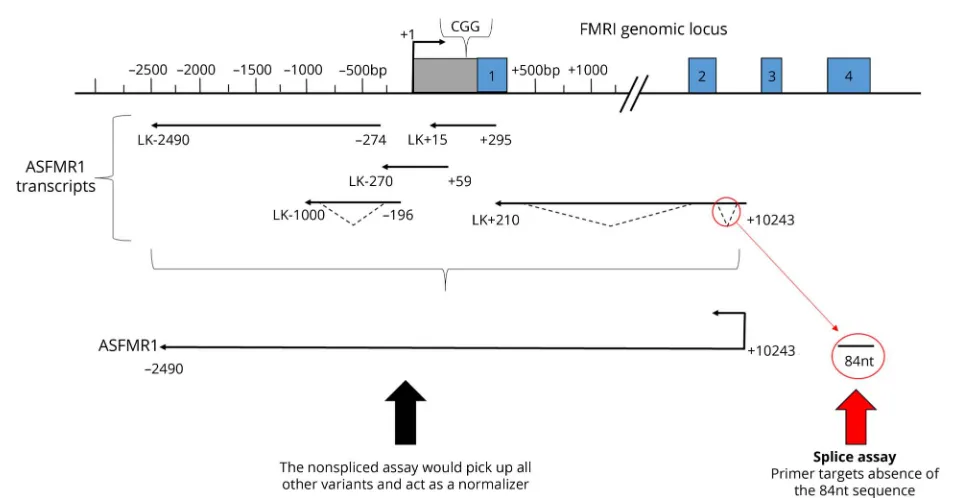
A second gene,antisense FMR1 (ASFMR1)overlaps a portion of theFMR1 gene including the CGG repeat sequence, is transcribed in the reverse direction fromFMR1with 5 splice variants of unclear exact clinical impact.13One of the variants previously described13 ASFMR1splice variant 2 (ASFMR1 transcript variant 2 [ASFMR1-TV2]) was further explored in this study. Elevated levels of the expanded GCC repeat– containingASFMR1transcript are observed in premutation carriers (PMCs),13and small unpublished studies have sug-gested that certain splice variants of theASFMR1transcript
are associated with the presence of neurologic symptoms in PMC men with FXTAS. Within the CGG repeat element of theFMR1 gene, there are AGG trinucleotide interruptions (typically separated by 9–11 CGG repeats), which are known to disrupt the otherwise pure CGG repeat motif. Normal FMR1 alleles typically possess 2 or 3 AGG interruptions; premutation alleles generally possess 2 or less interruptions, whereas larger premutation alleles tend to have fewer AGG interruptions. The loss of AGG interruptions is believed to increase the probability that large normal and small pre-mutation size alleles will be unstable on transmission and expand to a full mutation allele on transmission from small or moderate size alleles.14The rationale for investigating AGG interspersions is that pilot data from our group show that a lack of AGG interspersions is associated with neurologic signs. In this study, we hypothesized that elevated specific splice variants (ASFMR1-TV2) of theASFMR1transcript and a lack of AGG interspersions may play a role in FXTAS, and we attempted to determine the correlation between these features in development of clinical symptoms in FXTAS.
Methods
Participants
This is a case-control study. Adult PMCs and healthy NCs were recruited from the Rush University Fragile X-Associated Disorders Program. Recruitment occurred from 3 studies in-vestigating neurologic phenotypes in PMCs and NCs15–17 through clinics, and fragile X community events. The pub-lished criteria for FXTAS were followed to classify as possible, probable, or definite FXTAS participants.3,4
Standard protocol approvals, registrations, and patient consents
This study received approval from the Institutional Review Board at the Rush University Medical Center. Written in-formed consent was obtained from all patients (or guardians of patients) participating in the study. The family history of FXS from participants (but not FXTAS or other neurologic conditions in the family) was obtained.
Neurologic testing
Each subject was evaluated with a neurologic examination, the FXTAS Rating Scale (FXTAS-RS),18 and the Total Neu-ropathy Scale19(modified to exclude those items that require a nerve conduction study). The FXTAS-RS was developed to measure the salient features of the movement disorder seen in
Glossary
FXTAS. The scale was constructed by combining 3 published rating scales commonly used to assess tremor (Clinical Rating Scale for Tremor),20ataxia (International Cooperative Ataxia Rating Scale),21 parkinsonism (Unified Parkinson’s Disease Rating Scale),22and a tandem gait item (Huntington’s Dis-ease Rating Scale).23
CGG and AGG determination
TheFMR1PCR assay (Asuragen Inc, Austin, TX) was per-formed on blood samples from participants using a recently developed highly sensitive method, which detects allFMR1 expansions and allows accurate quantification of allele-specific CGG repeat length,24,25 including identification of AGG interspersions, using primers thatflank the repeat and internal repeat primers. Southern blot assay was performed on sam-ples from premutation women to determine the normal AR.26,27
Fibroblast collection
Skin biopsy was performed under sterile conditions and de-livered to the laboratory immediately for processing. The skin biopsy was placed in culture media and later diced under sterile conditions on a culture plate and then plated in T25
flasks in CHANG-Amnio™-Medium (Irvine Scientific, Santa Ana, CA), Theflasks were incubated at 37°C with 5% carbon dioxide. After cells grew out, longer-term cultures were maintained in Corning™ cellgro™ Cell Culture Media– Dulbecco’s Modified Eagle’s Medium supplemented with 10% fetal bovine serum (Gibco) and 1% Gibco
®
Antibiotic-Antimycotic (containing 10,000 units/mL of penicillin, 10,000 μg/mL of streptomycin, and 25 μg/mL of Gibco Amphotericin B). Aliquots of all cell lines were frozen and kept at−80° for long-term use in future studies.ASFMR1andFMR1messenger RNA assays
RNA was purified using the Qiagen RNeasy kit from blood or
fibroblast samples. Samples were treated with DNase and screened for contamination; then, complementary DNA (cDNA) synthesis was performed using the High Capacity cDNA Reverse Transcriptase Kit from Applied Biosystems, Foster City, CA. The defining characteristic ofASFMR1-TV2 is the 84-nucleotide deletion near the beginning of the open reading frame and does include the repeat. The 84-nucleotide deletion excises an AUG associated with a stronger Kozack sequence than the proline reading frame.13Because the AUG for the polyproline frame is retained and competition is re-duced, this potentially enhances the polyproline reading frame onASFMR1-TV2.13Relative expression of ASFMR1-TV2, nonsplicedASFMR1, totalASFMR1, and totalFMR1 mRNA were quantified using the VIIA 7 real-time quantitative PCR system (Applied Biosystems). The results were calcu-lated using a “Delta-Delta CT” (DDCT) algorithm (first Delta CT [DCT] = [target expression]−[Gus-B expression]; second Delta CT [DDCT] = [DCT]−normal control [NC]; fold increase of target vs NC = 2−(second delta CT)= 2−DDCT; fold increase = 2−DDCT) to compare relative expressions of target mRNA to the expression of the GUS-B control mRNA
and then to the expression of an NC sample (primers and probes in table e-1, links.lww.com/NXG/A58).
Statistical analysis
Analysis of variance (ANOVA) or the Kruskal-Wallis test (where appropriate) was performed to compare the levels of ASFMR1-TV2, nonsplicedASFMR1, totalASFMR1, and total FMR1 among NCs, PMCs without FXTAS (PMC), and PMCs with FXTAS (FXTAS). The sample size calculation was based on ANOVA comparing NCs, PMC without FXTAS, and FXTAS. Pairwise comparisons were conducted with Bonferroni adjustment for multiple comparisons. The FXTAS-RS scores were compared among different clinical phenotypes with ANOVA or the Kruskal-Wallis test. Receiver operating characteristic (ROC) curve analysis was performed to evaluate the performance ofASFMR1-TV2to discriminate patients with FXTAS from others (NC and PMC). The fol-lowing guide was used for interpretation: excellent 0.9–1; good 0.8–0.9; fair 0.7–0.8; poor 0.6–0.7; and fail 0.5–0.6. The Spearman correlation was used to examine the relationship between the CGG repeat size and the ratio of the splice variant and totalASFMR1mRNA (table e-2, links.lww.com/ NXG/A58). Least absolute shrinkage and selection operator (LASSO) logistic regression was performed to examine the association of the splice variant, CGG repeat size, AGG interruptions, nonsplicedASFMR1, totalASFMR1, FMR1, and family history of FXS with FXTAS adjusted for age. LASSO regression was used in this study to select the strongest predictors. AR was included in the regression for woman. Data for men and women were analyzed separately because the penetrance of FXTAS is much higher in men than in women. Missing data were excluded from the analysis.
Results
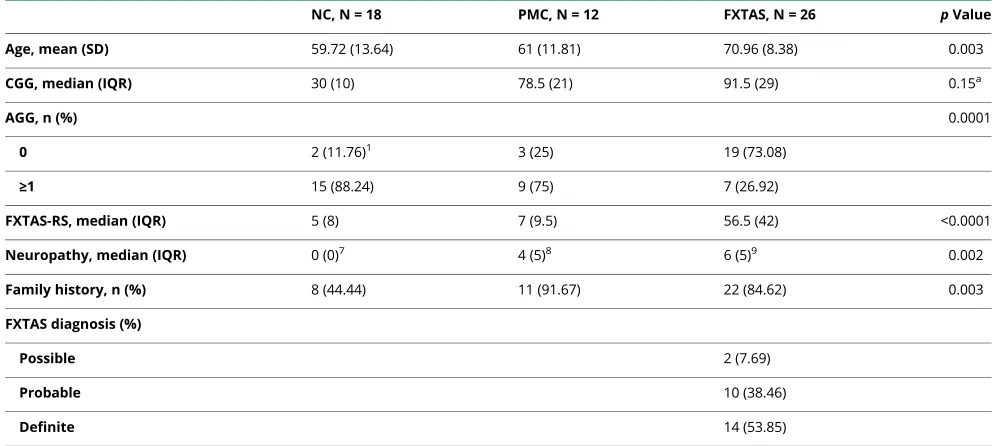
One hundred thirty-five participants including 56 men (mean, SD years; 65.2 ± 12.1 years) and 79 women (55.2 ± 15.5 years) were recruited.
Men
groups (p< 0.0001). The total (modified) neuropathy score was 6 (IQR 5) in those with FXTAS, 4 (IQR 5) in PMCs and 0 (IQR 0) in NCs. Eighty-four percent (p= 0.003) of men with FXTAS had a family history of FXS. Participants who met the diagnostic criteria for FXTAS included 2 with pos-sible, 10 with probable, and 14 with definite FXTAS. In men, there was a difference in all molecular variables (p < 0.01) among the 3 groups (table 2). Pairwise comparisons of the molecular results were only significant when comparing normal vs FXTAS and normal vs PMC, but not when com-paring PMC vs FXTAS. ROC curve analysis indicated that ASFMR1-TV2 has a good discriminating power of FXTAS in men (figure 1, A-F). The area under the curve (AUC) was 0.80 (95% CI = 0.68, 0.92). LASSO logistic regression analysis with the adjustment of age showed that loss of AGG (co-efficient = −0.55) has strongest relationship with FXTAS, followed by a larger CGG repeat size (coefficient = 0.47) and an elevated ASFMR1-TV2 level (coefficient = 0.21).
Coefficients for other independent variables including family history of FXS, nonspliced ASFMR1, total ASFMR1, and FMR1were shrunken to zero by the LASSO model, which indicates that these variables did not have a strong relation-ship with FXTAS.
Women
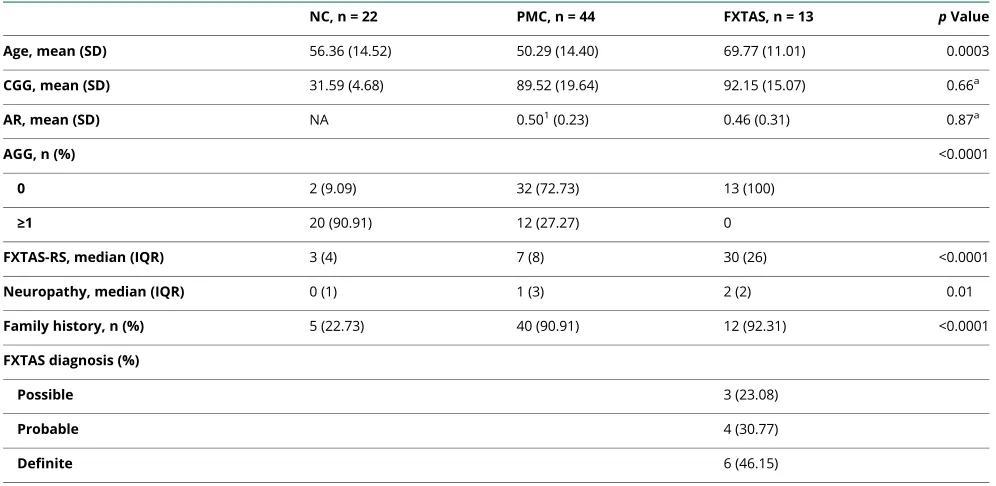
Thirteen participants who met the criteria for FXTAS, with a mean age of 69.8 ± 11 years, had an average CGG repeat length of 92.2 ± 15.1 (table 3). Forty-four PMCs without FXTAS, with a mean age of 50.3 ± 14.4 years, had an average CGG repeat length of 89.5 ± 19.6. Twenty-two NCs, with a mean age of 56.4 ± 14.5 years, had an average CGG repeat length of 31.6 ± 4.7. Women with FXTAS were older than PMC and NC, and the CGG repeat size was higher in women with FXTAS than in PMC women and NC women. Thirteen (100%) women with FXTAS, 32 PMCs (71%), and 2 (9%) healthy women had complete loss of AGG
Table 1Demographics in men (n = 56)
NC, N = 18 PMC, N = 12 FXTAS, N = 26 pValue
Age, mean (SD) 59.72 (13.64) 61 (11.81) 70.96 (8.38) 0.003
CGG, median (IQR) 30 (10) 78.5 (21) 91.5 (29) 0.15a
AGG, n (%) 0.0001
0 2 (11.76)1 3 (25) 19 (73.08)
≥1 15 (88.24) 9 (75) 7 (26.92)
FXTAS-RS, median (IQR) 5 (8) 7 (9.5) 56.5 (42) <0.0001
Neuropathy, median (IQR) 0 (0)7 4 (5)8 6 (5)9 0.002
Family history, n (%) 8 (44.44) 11 (91.67) 22 (84.62) 0.003
FXTAS diagnosis (%)
Possible 2 (7.69)
Probable 10 (38.46)
Definite 14 (53.85)
Abbreviations: FXTAS = fragile X-associated tremor/ataxia syndrome; FXTAS-RS = fragile X-associated tremor/ataxia syndrome rating scale; IQR = interquartile range; NC = normal control; PMC = premutation carrier.
Superscripts indicate the number of missing values.
aComparison between premutation and FXTAS.
Table 2Molecular data in men (n = 56)
NC, n = 18 PMC, n = 12 FXTAS, n = 26 pValue
ASFMR1-TV2, median 1.11 (1.42) 11.35 (20.22) 13.63 (15.74) <0.0001
NonsplicedASFMR1, mean 0.99 (0.59) 2.17 (1.54) 1.77 (1.22) 0.02
TotalASFMR1, mean 1.04 (0.78) 4.23 (3.26) 4.27 (2.91) 0.0002
TotalFMR1, median 0.94 (0.44) 1.43 (0.46)1 1.21 (0.51)1 0.02
interruptions. FXTAS-RS scores were higher in FXTAS participants (median [IQR]: 30 [26]) than in the other 2 groups (p< 0.0001). The total (modified) Neuropathy Scale score was 2 (IQR = 2) in those with FXTAS, 1 (IQR = 3) in PMC and 0 (IQR = 1) in NC women (p= 0.01). More than 90% of women with FXTAS and PMCs had a family history of FXS. Participants who met the diagnostic criteria for
FXTAS included 3 with possible, 4 with probable, and 6 with definite FXTAS. In women, ASFMR1-TV2 levels, total ASFMR1levels, andFMR1levels were different among the groups (table 4). There were no differences in the non-splicedASFMR1levels among the groups. In women, pair-wise comparisons of the molecular results were significant when comparing between NC vs FXTAS and NC vs PMC,
Figure 1ROC curve ofASFMR1-TV2
but were not when comparing PMC vs FXTAS.ASFMR1 -TV2 showed a good discriminating power of FXTAS from the ROC curve analysis (figure 2, AUC = 0.8, 95% CI = 0.67, 0.9). LASSO logistic regression, adjusting for age, showed that the loss of AGG (coefficient = −0.5555) has the strongest relationship with FXTAS, followed by ASFMR1-TV2 (coefficient = 0.4747) and totalASFMR1(coefficient = 0.2121). Other variables including family history of FXS, nonsplicedASFMR1, AR, CGG repeat size, and FMR1did not show a strong relationship with FXTAS from the LASSO regression model.
In men, we found a negative correlation between the CGG repeat size and the ratio of the splice variant and total ASFMR1mRNA among the NCs (correlation coefficient = −0.62,p= 0.04), but a positive correlation among the PMCs (correlation coefficient = 0.81,p< 0.0001). In women, there
was also a negative correlation among the controls (correla-tion coefficient = −0.74, p = 0.02), but no correlation was found among the PMCs (CGG was adjusted for AR) (correlation coefficient = 0.08,p= 0.70).
Discussion
The main purpose of this study was to identify molecular markers to help predict which PMC will get FXTAS because even for male carriers, not all PMC will get the disease.14The exact clinical impact ofASFMR1 splice variants is unclear; however; it has been postulated that in addition toFMR1, elevated levels of the expanded GCC repeat containing the ASFMR1transcript are observed in PMCs and may contribute to the variable phenotypes associated with the CGG repeat expansion.14
Table 3Demographics in women (n = 79)
NC, n = 22 PMC, n = 44 FXTAS, n = 13 pValue
Age, mean (SD) 56.36 (14.52) 50.29 (14.40) 69.77 (11.01) 0.0003
CGG, mean (SD) 31.59 (4.68) 89.52 (19.64) 92.15 (15.07) 0.66a
AR, mean (SD) NA 0.501(0.23) 0.46 (0.31) 0.87a
AGG, n (%) <0.0001
0 2 (9.09) 32 (72.73) 13 (100)
≥1 20 (90.91) 12 (27.27) 0
FXTAS-RS, median (IQR) 3 (4) 7 (8) 30 (26) <0.0001
Neuropathy, median (IQR) 0 (1) 1 (3) 2 (2) 0.01
Family history, n (%) 5 (22.73) 40 (90.91) 12 (92.31) <0.0001
FXTAS diagnosis (%)
Possible 3 (23.08)
Probable 4 (30.77)
Definite 6 (46.15)
Abbreviations: AR = activation ratio; FXTAS = fragile X-associated tremor/ataxia syndrome; FXTAS-RS = fragile X-associated tremor/ataxia syndrome rating scale; IQR = interquartile range; NC = normal control; PMC = premutation carrier.
Superscripts indicate the number of missing values.
aComparison between premutation and FXTAS.
Table 4Molecular results in women (n = 79)
NC, n = 22 PMC, n = 44 FXTAS, n = 13 pValue
ASFMR1-TV2, median 0.91 (0.67) 6.92 (10.29) 12.52 (29.37) <0.0001
NonsplicedASFMR1, mean 0.78 (0.41) 0.93 (0.69) 1.3 (0.96) 0.1
TotalASFMR1, mean 0.93 (0.48) 2.42 (1.87) 3.52 (2.62) 0.0002
TotalFMR1, median 0.89 (0.32) 1.05 (0.48) 1.22 (0.43) 0.01
This is thefirst study to evaluateASFMR1splice variant levels in PMCs and FXTAS patients. The reason this study con-centrated on ASFMR1-TV2 (figure 2) was because small unpublished studies suggested that this splice variant of the ASFMR1 transcript might be associated with neurologic symptoms in FXTAS men. This study reports elevated levels ofASFMR1-TV2 in FXTAS and a loss of AGG interruptions in men with FXTAS. In addition, this study also showed that the FXTAS-RS and Neuropathy Scale scores were higher in patients with FXTAS compared with PMCs and NCs. We were not able to distinguish between PMCs and FXTAS with pairwise comparisons ofASFMR1-TV2, nonsplicedASFMR1, totalASFMR1, or totalFMR1.
Although we found thatASFMR1-TV2 and lack of AGG were more common in FXTAS, the power to discriminate between PMCs and FXTAS was not high enough to use alone di-agnostically or in a predictive manner. This may be because our sample sizes were too small overall. Some of the groups, such as the PMC men without FXTAS and the FXTAS women group did not have many participants. Because the disease is highly penetrant in men, it was difficult to recruit PMC men without FXTAS. Women with FXTAS were also difficult to recruit because there is a lower prevalence in women. The published criteria for FXTAS3,4were followed, and because the women have milder features than men with FXTAS, many of them needed either the middle cerebellar peduncle sign or brainstem white matter lesions to qualify for probable FXTAS. Thus, the strict application of the diagnostic
criteria leads to the high number having the MCP sign rather than our population of FXTAS women being different from the populations that have been published in the past. Alter-natively, the patterns of relationships found may indicate that regardless of the sample size, elevated RNA products from the repeat-containing gene are a phenomenon more related to just the presence of a premutation, rather than reflecting a threshold of abnormal RNAs at which symptoms occur. RAN translation has been described in FXTAS as a potential additional mechanism of toxicity independent of the pre-sumed RNA toxicity. Measurement of RAN translation products could be more closely correlated with amount and on the time of the onset of symptoms. Additional studies may be warranted to combine molecular and other biomarkers, such as examination, imaging, or laboratory markers, to in-crease the positive predictive value and the clinical utility.
Both AUG-initiated and repeat-associated non-AUG (RAN) translation have been shown to occur from ASFMR1CCG repeats.28Associated transcripts are capable of forming strong secondary structures in vitro, either RNA hairpins or G-quadruplexes, and are important to the process underlying RAN translation. It is yet unknown if secondary structures linked to ASFMR1-TV2 may also be linked to RAN trans-lation and whether toxicity occurs from the expression of proteins generated from translation of this variant. Pilot work from our research group suggests an association between the lack of AGG interspersions inFMR1PMCs and higher rates of neurologic signs, which was confirmed in this study. It is
Figure 2Antisense FMR transcript variant 2
recognized that the results regarding the lack of AGG inter-ruptions may represent instead a relationship with the longest pure CGG repeat size. The loss of AGG interruptions is seen in PMCs at a much higher rate than NCs because it makes these repeats more unstable and hence more likely to expand meiotically and (presumably) somatically in tissues. Similarly, one would presume that PMCs with fewer AGG interruptions would have larger pure repeats. Then, these larger pure repeats are associated with enhanced transcription of the FMR1 and ASFMR1 loci because of changes in local chromatin.29,30 Additional studies are needed to determine which factor is responsible for the association.
It is important to find molecular markers that can serve as screening tools and increase diagnostic certainty, not only to help families of patients at risk of disorder but also to enable drug discovery, so timely treatment can be implemented. Both PMCs and FXTAS participants had elevated levels of ASFMR1splice variant 2, and loss of AGG interruptions was associated with FXTAS in men. These markers may have utility if combined with other predictive factors to better predict who will get FXTAS. Additional work also needs to be done to determine the contribution to the mechanism of CCG-mediated toxicity in PMCs.
Author contributions
P. Vittal: conception of the study, subject recruitment and neurologic evaluation, skin biopsy, and organizing and writing of thefirst draft of the manuscript. S. Pandya and K. Sharp: performance of RNA assays. J. Jackson: performance of gen-otyping and AGG analysis. L. Zhou: performance of geno-typing and AGG analysis,fibroblast cultures, and supervision of laboratory assays. B. Ouyang: statistical analysis. E. Berry-Kravis: conception of the study, review and critique of the manuscript, and oversight of laboratory studies. D.A. Hall: conception of the study, subject recruitment, and review and critique of the manuscript.
Acknowledgment
The authors thank the American Brain Foundation and the National Ataxia Foundation for their support of the Clinical Research Training Fellowship grant in Ataxia and Tracy Waliczek and Evelyn Perez for their assistance during skin biopsy and blood sample collection. They thank Integrated DNA Technologies (Coralville, IA) for custom-designed primers and probes. They also thank the participants of this study.
Study funding
Clinical Research Training Fellowship grant in Ataxia spon-sored by the American Brain Foundation and the National Ataxia Foundation.
Disclosure
P. Vittal has received funding for travel and/or speaker hon-oraria and served on speakers’bureaus of Teva Pharmaceu-tical Industries Ltd and Adamas PharmaceuPharmaceu-ticals Inc. and has
received research support from the American Brain Founda-tion and the NaFounda-tional Ataxia FoundaFounda-tion. S. Pandya and K. Sharp report no disclosures. E. Berry-Kravis serves or has served on the scientific advisory boards of Vteese, BioMarin, Marinus, Fulcrum, Cydan, GW, and Ovid; holds a patent regarding a method for assay of CCHS-causing polyalanine repeat expansion for diagnosis; receives or has received pub-lishing royalties for The Fragile X Tremor Ataxia Syndrome (FXTAS); consults or has consulted for Fulcrum and Zynerba; and has received research support from Vtesse, Ovid, Neuren, NIH/NICHD, NIH/NCATS, CDC, NIH/ NINDS, NIH/NIMH, and the John Merck Fund. L. Zhou, B. Ouyang, and J. Jackson report no disclosures. D.A. Hall served or has served on the scientific advisory board of the National Fragile X Foundation; serves or has served on the editorial board ofNeurology Today; consults or has consulted for the NIH; and has received research support from Pfizer, Neuro-crine, AbbVie, NIH, Shapiro Foundation, Anti-Aging Foun-dation, and Parkinson Foundation. Full disclosure form information provided by the authors is available with the full text of this article at Neurology.org/NG.
Received August 14, 2017. Accepted infinal form April 11, 2018.
References
1. Hagerman RJ, Leehey M, Heinrichs W, et al. Intention tremor, parkinsonism, and generalized brain atrophy in male carriers of fragile X. Neurology 2001;57: 127–130.
2. Hall DA, O’Keefe JA. Fragile x-associated tremor ataxia syndrome: the expanding clinical picture, pathophysiology, epidemiology, and update on treatment. Tremor Other Hyperkinet Mov (N Y) 2012;2.
3. Jacquemont S, Hagerman RJ, Leehey M, et al. Fragile X premutation tremor/ataxia syndrome: molecular, clinical, and neuroimaging correlates. Am J Hum Genet 2003; 72:869–878.
4. Brunberg JA, Jacquemont S, Hagerman RJ, et al. Fragile X premutation carriers: characteristic MR imagingfindings of adult male patients with progressive cerebellar and cognitive dysfunction. Am J Neuroradiol 2002;23:1757–1766.
5. Pieretti M, Zhang FP, Fu YH, et al. Absence of expression of theFMR-1gene in fragile X syndrome. Cell 1991;66:817–822.
6. Tassone F, Iong KP, Tong TH, et al. FMR1 CGG allele size and prevalence ascer-tained through newborn screening in the United States. Genome Med 2012;4:100. 7. Tassone F, Beilina A, Carosi C, et al. Elevated FMR1 mRNA in premutation carriers is
due to increased transcription. RNA 2007;13:555–562.
8. Todd PK, Oh SY, Krans A, et al. CGG repeat-associated translation mediates neu-rodegeneration in fragile X tremor ataxia syndrome. Neuron 2013;78:440–455. 9. Robin G, L´opez JR, Espinal GM, et al. Calcium dysregulation and Cdk5-ATM
pathway involved in a mouse model of fragile X-associated tremor/ataxia syndrome. Hum Mol Genet 2017;26:2649–2666.
10. Leehey MA, Berry-Kravis E, Goetz CG, et al. FMR1 CGG repeat length predicts motor dysfunction in FXTAS. Neurology 2008;70:1397–1402.
11. Berry-Kravis E, Potanos K, Weinberg D, et al. Penetrance of fragile X-associated tremor/ataxia syndrome (FXTAS) in two sisters related to X-inactivation pattern. Ann Neurol 2005;57:144–147.
12. Hall DA, Robertson-Dick EE, O’Keefe JA, et al. Repeat size and X-inactivation in the clinical phenotype of fragile X premutation carrier sisters: a familial case series. Neurol Genet 2016;2:e45. doi: 10.1212/NXG.0000000000000045.
13. Ladd PD, Smith LE, Rabaia NA, et al. An antisense transcript spanning the CGG repeat region of FMR1 is upregulated in premutation carriers but silenced in full mutation individuals. Hum Mol Genet 2007;16:3174–3187.
14. Yrigollen CM, Durbin-Johnson B, Gane L, et al. AGG interruptions within the ma-ternal FMR1 gene reduce the risk of offspring with fragile X syndrome. Genet Med 2012;14:729–736.
15. Hall D, Todorova-Koteva K, Pandya S, et al. Neurological and endocrine phenotypes of fragile X carrier women. Clin Genet 2016;89:60–67.
16. Berry-Kravis E, Goetz CG, Leehey MA, et al. Neuropathic features in fragile X pre-mutation carriers. Am J Med Genet A 2007;143A:19–26.
17. Jacquemont S, Hagerman RJ, Leehey MA, et al. Penetrance of the fragile X-associated tremor/ataxia syndrome in a premutation carrier population. JAMA 2004;291: 460–469.
19. Cornblath DR, Chaudhry V, Carter K, et al. Total neuropathy score: validation and reliability study. Neurology 1999;53:1660–1664.
20. Fahn S, Tolosa E, Marin C. Clinical rating scale for tremor. In: Jankovic J, Tolosa E, editors. Parkinson’s Disease and Movement Disorders. Baltimore, Munich: Urban & Schwartzenberg; 1987:225–234.
21. Trouillas P, Takayanagi T, Hallett M, et al. International cooperative ataxia rating scale for pharmacological assessment of the cerebellar syndrome: the Ataxia Neuropharmacology Committee of the World Federation of Neurology. J Neurol Sci 1997;145:205–211. 22. Fahn S, Elton R; members of the UPDRS Development Committee. Unified
Par-kinson’s disease rating scale. In: Fahn S, Marsden C, Calne D, Goldstein M, editors. Recent Development in Parkinson’s Disease. Florham Park, NJ: Macmillan Health Care Information; 1987:153–164.
23. Siesling S, Zwinderman AH, van Vugt JP, et al. A shortened version of the motor section of the Unified Huntington’s Disease Rating Scale. Mov Disord 1997;12:229–234. 24. Chen L, Hadd A, Sah S, et al. An information-rich CGG repeat primed PCR that
detects the full range of fragile X expanded alleles and minimizes the need for southern blot analysis. J Mol Diagn 2010;12:589–600.
25. Filipovic-Sadic S, Sah S, Chen L, et al. A novel FMR1 PCR method for the routine detection of low abundance expanded alleles and full mutations in fragile X syndrome. Clin Chem 2010;56:399–408.
26. Godler DE, Tassone F, Loesch DZ, et al. Methylation of novel markers of fragile X alleles is inversely correlated with FMRP expression and FMR1 activation ratio. Hum Mol Genet 2010;19:1618–1632.
27. Annemieke JMHV, Pieretti M, Sutcliffe JS, et al. Identification of a gene (FMR-1) containing a CGG repeat coincident with a breakpoint cluster region exhibiting length variation in fragile X syndrome. Cell 1991;65:905–914.
28. Krans A, Kearse M, Todd PK. Repeat-associated non-AUG translation from antisense CCG repeats in fragile X tremor/ataxia syndrome. Ann Neurol 2016;80:871–881. 29. Todd PK, Oh SY, Krans A, et al. Histone deacetylases suppress CGG repeat-induced
neurodegeneration via transcriptional silencing in models of fragile X tremor ataxia syndrome. PLoS Genet 2010;6:e1001240.
DOI 10.1212/NXG.0000000000000246
2018;4;
Neurol Genet
Padmaja Vittal, Shrikant Pandya, Kevin Sharp, et al.
splice variant: A predictor of fragile X-associated tremor/ataxia syndrome
ASFMR1
This information is current as of July 30, 2018
Services
Updated Information &
http://ng.neurology.org/content/4/4/e246.full.html
including high resolution figures, can be found at:
References
http://ng.neurology.org/content/4/4/e246.full.html##ref-list-1
This article cites 26 articles, 4 of which you can access for free at:
Subspecialty Collections
http://ng.neurology.org//cgi/collection/tremor Tremor
http://ng.neurology.org//cgi/collection/gait_disorders_ataxia Gait disorders/ataxia
following collection(s):
This article, along with others on similar topics, appears in the
Permissions & Licensing
http://ng.neurology.org/misc/about.xhtml#permissions
its entirety can be found online at:
Information about reproducing this article in parts (figures,tables) or in
Reprints
http://ng.neurology.org/misc/addir.xhtml#reprintsus
Information about ordering reprints can be found online:
reserved. Online ISSN: 2376-7839.
Published by Wolters Kluwer Health, Inc. on behalf of the American Academy of Neurology.. All rights an open-access, online-only, continuous publication journal. Copyright Copyright © 2018 The Author(s).
is an official journal of the American Academy of Neurology. Published since April 2015, it is