A Monthly Double-Blind Peer Reviewed Refereed Open Access International e-Journal - Included in the International Serial Directories Indexed & Listed at:
VOLUME NO.2(2012),ISSUE NO.8(AUGUST) ISSN2231-5756
CONTENTS
CONTENTS
CONTENTS
CONTENTS
Sr.No.
TITLE & NAME OF THE AUTHOR (S)
Page No.
1. ANALYSIS OF IPOS UNDERPRICING: EVIDENCE FROM BOMBAY STOCK EXCHANGE
ROHIT BANSAL & DR. ASHU KHANNA
1 2. BANKRUPTCY PREDICTION OF FIRMS USING THE DATA MINING METHOD
ATIYE ASLANI KTULI & MANSOUR GARKAZ
8 3. THE EFFECT OF BASEL III REQUIREMENTS ON IMPROVING RISK-MANAGEMENT CAPABILITIES IN JORDANIAN BANKS
DR. MOHAMMED FAWZI ABU EL HAIJA
12 4. CAPITAL STRUCTURE DETERMINANTS: CRITICAL REVIEW FOR SELECTED INDIAN COMPANIES
DR. AVANISH KUMAR SHUKLA
18 5. IMPACT OF INFLATION ON BANK LENDING RATE IN BANGLADESH
EMON KALYAN CHOWDHURY
23 6. THE PERCEPTION OF BANK EMPLOYEES TOWARDS COST OF ADOPTION, RISK OF INNOVATION, AND STAFF TRAINING’S INFLUENCE ON THE
ADOPTION OF INFORMATION AND COMMUNICATION TECHNOLOGY (ICT) IN THE RWANDAN COMMERCIAL BANKS
MACHOGU MORONGE ABIUD & LYNET OKIKO
27
7. ICT, ELECTION AND DEVELOPMENT IN AFRICA
NDUONOFIT, LARRY-LOVE EFFIONG & ONWUKWE, VIVIAN CHIZOMA
32 8. MODERATING ROLE OF EMOTIONAL INTELLIGENCE TOWARDS STRESS AND EMPLOYEE PERFORMANCE IN THE INDIAN BANKING SECTOR
BEULAH VIJI CHRISTIANA.M & DR. V. MAHALAKSHMI
35 9. FACTORS INFLUENCING CUSTOMER LOYALTY IN MOBILE PHONE SERVICE - A STUDY WITH REFERENCE TO COIMBATORE CITY
DR. V.T.R .VIJAYAKUMAR & B.SUBHA
39 10. A STUDY ON OCCUPATIONAL STRESS AMONG GRADE I POLICE CONSTABLES
M.SHUNMUGA SUNDARAM & DR. M. JAYA KUMARAN
44 11. A STUDY ON THE IMPACT OF SPIRITUALITY ON ORGANISATIONAL PERFORMANCE WITH SPECIAL REFERENCE TO ORGANIISATIONS IN
SALEM CITY
DR. M. G.SARAVANA RAJ & R. FLORENCE BHARATHI
49
12. A COMPARATIVE STUDY OF SELF- EFFICACY AND SUBJECTIVE WELL- BEING AMONG EMPLOYED WOMEN AND UNEMPLOYED WOMEN
DR. K. JAYASHANKAR REDDY
54 13. NETWORK SECURITY THREATS AND SOLUTIONS IN A VIRTUAL MARKETPLACE
DR. PANKAJ KUMAR GUPTA & DR. AJAY KUMAR TIWARI
58 14. A STUDY OF SUPPLIERS CERTIFICATION AT DIFFERENT LAYERS AND ITS IMPACT ON QUALITY IN AUTO COMPONENT INDUSTRY
DR.DATTATRY RAMCHANDRA MANE
61 15. GLOBAL LIFE INSURANCE PENETRATION AND DENSITY
DR. GUDALA SYAMALA RAO
69 16. AN ENHANCE SECURITY OF PLAYFAIR CIPHER SUBSTITUTION USING A SIMPLE COLUMNAR TRANSPOSITION TECHNIQUE WITH MULTIPLE
ROUNDS (SCTTMR)
GAURAV SHRIVASTAVA, MANOJ DHAWAN & MANOJ CHOUHAN
75
17. CONSUMERS PERCEPTIONS OF CORPORATE SOCIAL RESPONSIBILITY: EMPIRICAL EVIDENCE
AMIT B. PATEL, DR. VIMAL K. BHATT & JATIN K. MODI
79 18. A STUDY ON FINANCIAL HEALTH OF KINGFISHER AIRLINES LTD: (Z- SCORE APPROACH)
JIGNESH. B. TOGADIYA & UTKARSH. H. TRIVEDI
84 19. STRATEGIES OF CUSTOMER RELATION MANAGEMENT IN MODERN MARKETING
DR. T. PALANISAMY & K. AMUTHA
88 20. CORPORATE GOVERNANCE IN OIL & GAS SECTOR: AN EMPIRICAL INVESTIGATION
RASHESH PATEL & SWATI PATEL
92 21. KNOWLEDGE MANAGEMENT & MOBILIZING KNOWLEDGE IN EDUCATION BY FOLLOWING CASE STUDY OF YU;GI-OH WORLD
SMITA.S.JAPE
101 22. STUDY OF CRM THROUGH SOCIAL NETWORKING SITE: A FACEBOOK PERSPECTIVE
TEENA BAGGA & APARAJITA BANERJEE
107 23. ORDINARY LEAST SQUARES METHOD AND ITS VARIANTS
R. SINGH
114 24. I T INFRASTRUCTURE IN CREATING POTENTIAL MARKETING OPPORTUNITIES IN INDUSTRIES: AN EMPIRICAL STUDY OF SELECT INDUSTRIES
IN KARNATAKA
MANJUNATH K R & RAJENDRA M
120
25. THE IMPACT OF KNOWLEDGE MANAGEMENT ON BUSINESS ORGANIZATION
SUNITA S. PADMANNAVAR & SMITA B. HANJE
126 26. LOCUS OF CONTROL AMONG HIGH SCHOOL TEACHERS
DEEPA MARINA RASQUINHA
129 27. KNOWLEDGE MANAGEMENT: A CONCEPTUAL UNDERSTANDING
AINARY ARUN KUMAR
135 28. A STUDY ON EFFECTIVENESS OF ORGANIZATIONAL HEALTH IN SMALL SCALE INDUSTRIES
DR. J. S. V. GOPALA SARMA
142 29. JOB SATISFACTION DURING RECESSION PERIOD: A CASE STUDY OF PUBLIC & PRIVATE INSURANCE IN PUNJAB
HARDEEP KAUR
149 30. BANKING SECTOR REFORMS IN INDIA
DR. SANDEEP KAUR
156
CHIEF PATRON
CHIEF PATRON
CHIEF PATRON
CHIEF PATRON
PROF. K. K. AGGARWAL
Chancellor, Lingaya’s University, Delhi
Founder Vice-Chancellor, Guru Gobind Singh Indraprastha University, Delhi
Ex. Pro Vice-Chancellor, Guru Jambheshwar University, Hisar
PATRON
PATRON
PATRON
PATRON
SH. RAM BHAJAN AGGARWAL
Ex. State Minister for Home & Tourism, Government of Haryana
Vice-President, Dadri Education Society, Charkhi Dadri
President, Chinar Syntex Ltd. (Textile Mills), Bhiwani
CO
CO
CO
CO----ORDINATOR
ORDINATOR
ORDINATOR
ORDINATOR
AMITA
Faculty, Government M. S., Mohali
ADVISORS
ADVISORS
ADVISORS
ADVISORS
DR. PRIYA RANJAN TRIVEDI
Chancellor, The Global Open University, Nagaland
PROF. M. S. SENAM RAJU
Director A. C. D., School of Management Studies, I.G.N.O.U., New Delhi
PROF. M. N. SHARMA
Chairman, M.B.A., Haryana College of Technology & Management, Kaithal
PROF. S. L. MAHANDRU
Principal (Retd.), Maharaja Agrasen College, Jagadhri
EDITOR
EDITOR
EDITOR
EDITOR
PROF. R. K. SHARMA
Professor, Bharti Vidyapeeth University Institute of Management & Research, New Delhi
CO
CO
CO
CO----EDITOR
EDITOR
EDITOR
EDITOR
DR. BHAVET
Faculty, M. M. Institute of Management, Maharishi Markandeshwar University, Mullana, Ambala, Haryana
EDITORIAL ADVISORY BOARD
EDITORIAL ADVISORY BOARD
EDITORIAL ADVISORY BOARD
EDITORIAL ADVISORY BOARD
DR. RAJESH MODI
Faculty, Yanbu Industrial College, Kingdom of Saudi Arabia
PROF. SANJIV MITTAL
University School of Management Studies, Guru Gobind Singh I. P. University, Delhi
PROF. ANIL K. SAINI
Chairperson (CRC), Guru Gobind Singh I. P. University, Delhi
DR. SAMBHAVNA
Faculty, I.I.T.M., Delhi
DR. MOHENDER KUMAR GUPTA
VOLUME NO.2(2012),ISSUE NO.8(AUGUST) ISSN2231-5756
DR. SHIVAKUMAR DEENE
Asst. Professor, Dept. of Commerce, School of Business Studies, Central University of Karnataka, Gulbarga
MOHITA
Faculty, Yamuna Institute of Engineering & Technology, Village Gadholi, P. O. Gadhola, Yamunanagar
ASSOCIATE EDITORS
ASSOCIATE EDITORS
ASSOCIATE EDITORS
ASSOCIATE EDITORS
PROF. NAWAB ALI KHAN
Department of Commerce, Aligarh Muslim University, Aligarh, U.P.
PROF. ABHAY BANSAL
Head, Department of Information Technology, Amity School of Engineering & Technology, Amity University, Noida
PROF. A. SURYANARAYANA
Department of Business Management, Osmania University, Hyderabad
DR. SAMBHAV GARG
Faculty, M. M. Institute of Management, Maharishi Markandeshwar University, Mullana, Ambala, Haryana
PROF. V. SELVAM
SSL, VIT University, Vellore
DR. PARDEEP AHLAWAT
Associate Professor, Institute of Management Studies & Research, Maharshi Dayanand University, Rohtak
DR. S. TABASSUM SULTANA
Associate Professor, Department of Business Management, Matrusri Institute of P.G. Studies, Hyderabad
SURJEET SINGH
Asst. Professor, Department of Computer Science, G. M. N. (P.G.) College, Ambala Cantt.
TECHNICAL ADVISOR
TECHNICAL ADVISOR
TECHNICAL ADVISOR
TECHNICAL ADVISOR
AMITA
Faculty, Government H. S., Mohali
MOHITA
Faculty, Yamuna Institute of Engineering & Technology, Village Gadholi, P. O. Gadhola, Yamunanagar
FINANCIAL ADVISORS
FINANCIAL ADVISORS
FINANCIAL ADVISORS
FINANCIAL ADVISORS
DICKIN GOYAL
Advocate & Tax Adviser, Panchkula
NEENA
Investment Consultant, Chambaghat, Solan, Himachal Pradesh
LEGAL ADVISORS
LEGAL ADVISORS
LEGAL ADVISORS
LEGAL ADVISORS
JITENDER S. CHAHAL
Advocate, Punjab & Haryana High Court, Chandigarh U.T.
CHANDER BHUSHAN SHARMA
Advocate & Consultant, District Courts, Yamunanagar at Jagadhri
SUPERINTENDENT
SUPERINTENDENT
SUPERINTENDENT
SUPERINTENDENT
SURENDER KUMAR POONIA
CALL FOR MANUSCRIPTS
CALL FOR MANUSCRIPTS
CALL FOR MANUSCRIPTS
CALL FOR MANUSCRIPTS
Weinvite unpublished novel, original, empirical and high quality research work pertaining to recent developments & practices in the area of Computer, Business, Finance, Marketing, Human Resource Management, General Management, Banking, Insurance, Corporate Governance and emerging paradigms in allied subjects like Accounting Education; Accounting Information Systems; Accounting Theory & Practice; Auditing; Behavioral Accounting; Behavioral Economics; Corporate Finance; Cost Accounting; Econometrics; Economic Development; Economic History; Financial Institutions & Markets; Financial Services; Fiscal Policy; Government & Non Profit Accounting; Industrial Organization; International Economics & Trade; International Finance; Macro Economics; Micro Economics; Monetary Policy; Portfolio & Security Analysis; Public Policy Economics; Real Estate; Regional Economics; Tax Accounting; Advertising & Promotion Management; Business Education; Management Information Systems (MIS); Business Law, Public Responsibility & Ethics; Communication; Direct Marketing; E-Commerce; Global Business; Health Care Administration; Labor Relations & Human Resource Management; Marketing Research; Marketing Theory & Applications; Non-Profit Organizations; Office Administration/Management; Operations Research/Statistics; Organizational Behavior & Theory; Organizational Development; Production/Operations; Public Administration; Purchasing/Materials Management; Retailing; Sales/Selling; Services; Small Business Entrepreneurship; Strategic Management Policy; Technology/Innovation; Tourism, Hospitality & Leisure; Transportation/Physical Distribution; Algorithms; Artificial Intelligence; Compilers & Translation; Computer Aided Design (CAD); Computer Aided Manufacturing; Computer Graphics; Computer Organization & Architecture; Database Structures & Systems; Digital Logic; Discrete Structures; Internet; Management Information Systems; Modeling & Simulation; Multimedia; Neural Systems/Neural Networks; Numerical Analysis/Scientific Computing; Object Oriented Programming; Operating Systems; Programming Languages; Robotics; Symbolic & Formal Logic and Web Design. The above mentioned tracks are only indicative, and not exhaustive.
Anybody can submit the soft copy of his/her manuscript anytime in M.S. Word format after preparing the same as per our submission guidelines duly available on our website under the heading guidelines for submission, at the email address: [email protected].
GUIDELINES FOR SUBMISSION OF MANUSCRIPT
GUIDELINES FOR SUBMISSION OF MANUSCRIPT
GUIDELINES FOR SUBMISSION OF MANUSCRIPT
GUIDELINES FOR SUBMISSION OF MANUSCRIPT
1. COVERING LETTER FOR SUBMISSION:
DATED: _____________
THE EDITOR
IJRCM
Subject: SUBMISSION OF MANUSCRIPT IN THE AREA OF .
(e.g. Finance/Marketing/HRM/General Management/Economics/Psychology/Law/Computer/IT/Engineering/Mathematics/other, please specify)
DEAR SIR/MADAM
Please find my submission of manuscript entitled ‘___________________________________________’ for possible publication in your journals.
I hereby affirm that the contents of this manuscript are original. Furthermore, it has neither been published elsewhere in any language fully or partly, nor is it under review for publication elsewhere.
I affirm that all the author (s) have seen and agreed to the submitted version of the manuscript and their inclusion of name (s) as co-author (s).
Also, if my/our manuscript is accepted, I/We agree to comply with the formalities as given on the website of the journal & you are free to publish our contribution in any of your journals.
NAME OF CORRESPONDING AUTHOR: Designation:
Affiliation with full address, contact numbers & Pin Code: Residential address with Pin Code:
Mobile Number (s): Landline Number (s): E-mail Address: Alternate E-mail Address:
NOTES:
a) The whole manuscript is required to be in ONE MS WORD FILE only (pdf. version is liable to be rejected without any consideration), which will start from the covering letter, inside the manuscript.
b) The sender is required to mention the following in the SUBJECT COLUMN of the mail:
New Manuscript for Review in the area of (Finance/Marketing/HRM/General Management/Economics/Psychology/Law/Computer/IT/ Engineering/Mathematics/other, please specify)
c) There is no need to give any text in the body of mail, except the cases where the author wishes to give any specific message w.r.t. to the manuscript. d) The total size of the file containing the manuscript is required to be below 500 KB.
e) Abstract alone will not be considered for review, and the author is required to submit the complete manuscript in the first instance.
f) The journal gives acknowledgement w.r.t. the receipt of every email and in case of non-receipt of acknowledgment from the journal, w.r.t. the submission of manuscript, within two days of submission, the corresponding author is required to demand for the same by sending separate mail to the journal.
2. MANUSCRIPT TITLE: The title of the paper should be in a 12 point Calibri Font. It should be bold typed, centered and fully capitalised.
3. AUTHOR NAME (S) & AFFILIATIONS: The author (s) full name, designation, affiliation (s), address, mobile/landline numbers, and email/alternate email address should be in italic & 11-point Calibri Font. It must be centered underneath the title.
VOLUME NO.2(2012),ISSUE NO.8(AUGUST) ISSN2231-5756
5. KEYWORDS: Abstract must be followed by a list of keywords, subject to the maximum of five. These should be arranged in alphabetic order separated by commas and full stops at the end.
6. MANUSCRIPT: Manuscript must be in BRITISH ENGLISH prepared on a standard A4 size PORTRAIT SETTING PAPER. It must be prepared on a single space and single column with 1” margin set for top, bottom, left and right. It should be typed in 8 point Calibri Font with page numbers at the bottom and centre of every page. It should be free from grammatical, spelling and punctuation errors and must be thoroughly edited.
7. HEADINGS: All the headings should be in a 10 point Calibri Font. These must be bold-faced, aligned left and fully capitalised. Leave a blank line before each heading.
8. SUB-HEADINGS: All the sub-headings should be in a 8 point Calibri Font. These must be bold-faced, aligned left and fully capitalised.
9. MAIN TEXT: The main text should follow the following sequence:
INTRODUCTION
REVIEW OF LITERATURE
NEED/IMPORTANCE OF THE STUDY
STATEMENT OF THE PROBLEM
OBJECTIVES
HYPOTHESES
RESEARCH METHODOLOGY
RESULTS & DISCUSSION
FINDINGS
RECOMMENDATIONS/SUGGESTIONS
CONCLUSIONS
SCOPE FOR FURTHER RESEARCH
ACKNOWLEDGMENTS
REFERENCES
APPENDIX/ANNEXURE
It should be in a 8 point Calibri Font, single spaced and justified. The manuscript should preferably not exceed 5000 WORDS.
10. FIGURES &TABLES: These should be simple, crystal clear, centered, separately numbered & self explained, and titles must be above the table/figure. Sources of data should be mentioned below the table/figure. It should be ensured that the tables/figures are referred to from the main text.
11. EQUATIONS: These should be consecutively numbered in parentheses, horizontally centered with equation number placed at the right.
12. REFERENCES: The list of all references should be alphabetically arranged. The author (s) should mention only the actually utilised references in the preparation of manuscript and they are supposed to follow Harvard Style of Referencing. The author (s) are supposed to follow the references as per the following:
•
All works cited in the text (including sources for tables and figures) should be listed alphabetically.•
Use (ed.) for one editor, and (ed.s) for multiple editors.•
When listing two or more works by one author, use --- (20xx), such as after Kohl (1997), use --- (2001), etc, in chronologically ascending order.•
Indicate (opening and closing) page numbers for articles in journals and for chapters in books.•
The title of books and journals should be in italics. Double quotation marks are used for titles of journal articles, book chapters, dissertations, reports, working papers, unpublished material, etc.•
For titles in a language other than English, provide an English translation in parentheses.•
The location of endnotes within the text should be indicated by superscript numbers.PLEASE USE THE FOLLOWING FOR STYLE AND PUNCTUATION IN REFERENCES: BOOKS
•
Bowersox, Donald J., Closs, David J., (1996), "Logistical Management." Tata McGraw, Hill, New Delhi.•
Hunker, H.L. and A.J. Wright (1963), "Factors of Industrial Location in Ohio" Ohio State University, Nigeria. CONTRIBUTIONS TO BOOKS•
Sharma T., Kwatra, G. (2008) Effectiveness of Social Advertising: A Study of Selected Campaigns, Corporate Social Responsibility, Edited by David Crowther & Nicholas Capaldi, Ashgate Research Companion to Corporate Social Responsibility, Chapter 15, pp 287-303.JOURNAL AND OTHER ARTICLES
•
Schemenner, R.W., Huber, J.C. and Cook, R.L. (1987), "Geographic Differences and the Location of New Manufacturing Facilities," Journal of Urban Economics, Vol. 21, No. 1, pp. 83-104.CONFERENCE PAPERS
•
Garg, Sambhav (2011): "Business Ethics" Paper presented at the Annual International Conference for the All India Management Association, New Delhi, India, 19–22 June.UNPUBLISHED DISSERTATIONS AND THESES
•
Kumar S. (2011): "Customer Value: A Comparative Study of Rural and Urban Customers," Thesis, Kurukshetra University, Kurukshetra. ONLINE RESOURCES•
Always indicate the date that the source was accessed, as online resources are frequently updated or removed. WEBSITESBANKING SECTOR REFORMS IN INDIA
DR. SANDEEP KAUR
EX. STUDENT
DEPARTMENT OF ECONOMICS
PUNJABI UNIVERSITY
PATIALA
ABSTRACT
As economy grows and becomes more sophisticated, the banking sector has to develop pari pasu in a manner that it supports and stimulates such the growth. The banking sector reforms in India were started as a follow up measures of the economic liberalization and financial reforms in the country. Financial sector reforms in India introduced as a part of the structural adjustment and economic reforms programme in the early 1990s have had a profound impact on the functioning of the financial institutions, especially banks. The reforms were aimed at to make the Indian banking industry more competitive, versatile, efficient and productive to follow international accounting standard and to free from the government’s control. Although many improvements have been effected, this paper argues that the scope of many of these changes has been relatively narrow and predominantly mechanistic. The paper is presenting financial sector reforms in India, identify the emerging issues and explore the prospects for further reform.
KEYWORDS
Bank Rate, Cash Reserve Ratio, Financial Reforms in Banking Sector in India, Liberalization, Statutory Liquidity Ratio.
INTRODUCTION
ntil the early 1990s, the role of the financial system in India was primarily restricted to the function of channeling resources from the surplus to deficit sectors. Whereas the financial system performed this role reasonably well, its operations came to be marked by some serious deficiencies over the years. The banking sector suffered from lack of competition, low capital base, low productivity and high intermediation cost. After the nationalisation of large banks in 1969 and 1980, the Government-owned banks have dominated the banking sector. The role of technology was minimal and the quality of service was not given adequate importance. Banks also did not follow proper risk management systems and the prudential standards were weak. All these resulted in poor asset quality and low profitability. Among non-banking financial intermediaries, development finance institutions (DFIs) operated in an over-protected environment with most of the funding coming from assured sources at concessional terms. In the insurance sector, there was little competition. The mutual fund industry also suffered from lack of competition and was dominated for long by one institution, viz. the Unit Trust of India. Non-banking financial companies (NBFCs) grew rapidly, but there was no regulation of their asset size. Financial markets were characterized by control over pricing of financial assets, barriers to entry, high transaction costs and restriction on movement of funds/participants between the market segments. This, apart from inhibiting the development of the markets, also affected their efficiency. It was in this backdrop that wide-ranging financial sector reforms in India were introduced as an integral part of the economic reforms initiated in the early 1990s (Ahluwalia, 2002).
Financial sector reforms in India were grounded in the belief that competitive efficiency in the real sectors of the economy will not be realized to its full potential unless the financial sector was reformed as well. Thus, the principal objective of financial sector reforms was to improve the allocative efficiency of resources and accelerate the growth process of the real sector by removing structural deficiencies affecting the performance of financial institutions and financial markets. The main objective, therefore, of the financial sector reform process in India initiated in the early 1990s had been to (i) remove financial repression that existed earlier; (ii) create an efficient, productive and profitable financial sector industry; (iii) enable price discovery, particularly, by the market determination of interest rates that then helps in efficient allocation of resources; (iv) provide operational and functional autonomy to institutions; (v) prepare the financial system for increasing international competition; (vi) open the external sector in a calibrated fashion; and (vii) promote the maintenance of financial stability even in the face of domestic and external shocks (RBI, 1991).
The initiation of financial reforms in the country during the early 1990s was to a large extent conditioned by the analysis and recommendations of various Committees/ Working Groups set up to address specific issues. The process has been marked by ‘gradualism’ with measures being undertaken after extensive consultations with experts and market participants. From the beginning of financial reforms, India has resolved to attain standards of international best practices but to fine tune the process keeping in view the underlying institutional and operational considerations (Reddy, 2002).
The major aim of the reforms in the early phase of reforms, known as first generation of reforms, was to create an efficient, productive and profitable financial service industry operating within the environment of operating flexibility and functional autonomy. While these reforms were being implemented, the world economy also witnessed significant changes, coinciding with the movement towards global integration of financial services (Government of India, 1998). The focus of the second phase of financial sector reforms starting from the second-half of the 1990s, therefore, has been the strengthening of the financial system and introduction of structural improvements.
REVIEW OF LITRATURE
Reddy and Reddy (2003) are of the view that the new challenges faced by the banks are forcing to attempt all new things with the same old rigid structure and system. What required is more managerial and administrative freedom to the management with commensurate and result oriented accountabilities. They stressed that the banks should move towards professional banking with requisite freedom to operate freely in the market within the regulatory and prudential framework prescribed by the Reserve Bank of India
Aggarwal and Sharma (2005) analyzed the existing banking environment and suggested the strategies to build up a more strong and vibrant banking system. They stated that the evolution of banking sector in India is likely to take the form of emergence of universal or quasi-universal banks and therefore, risk management and development of an appropriate regulatory system will remain the main challenge to be faced by the banking industry in future. Higher provisioning norms, tighter asset classification norms, lowering of ceiling on exposure to a single borrower and group exposure etc. are among important measures initiated by the RBI in order to improve the banking sector.
Chakrabarti (2005) has examined that since the beginning of liberalization, the banking industry in India is undergoing a transformation. It has been observed that interest rate have declined considerably but there is evidence of under-lending by the banks. He has found that over time the performance of banks improved slightly, while the public sector banks are doing the worst among all banks. He has also investigated that the banking sector as a whole particularly the public sector banks still suffered from considerable NPAs, but the situation has improved over time. The study revealed that over time, the Indian banking industry has become more competitive and less concentrated. He has concluded that the new private sector banks are the most efficient though the recent collapse of Global Trust Bank has raised issues about efficiency and regulatory effectiveness.
Das and Ghosh (2006) investigated the performance of Indian commercial banking sector during the post-reform period. They have evaluated several efficiency estimates of individual banks using non-parametric data envelopment analysis. They have employed three different approaches, viz. intermediation approach, value-added approach and operating approach in defining inputs and outputs of banks. It has been observed that different approaches of measuring inputs and outputs of banks produced divergent sets of efficiency estimates. They have suggested that medium-sized public sector banks performed reasonably well and
VOLUME NO.2(2012),ISSUE NO.8(AUGUST) ISSN2231-5756
are more likely to operate at higher levels of technical efficiency. The study has observed a close relationship between efficiency and soundness as determined by bank’s capital adequacy ratio. They have investigated that technically more efficient banks are those that have, on an average, less non-performing loans. They concluded that most of the inefficiency has stemmed from the under-utilization of valuable resources as well as from current scale of operations.
Misra and Dhal (2010) analyzed the pro-cyclicality of bank indicators with a focus on the non performing loans (NPAs) of India‟s public sector banks. The analysis demonstrates that banks NPAs are influenced by three major sets of factors, i.e., terms of credit, bank specific indicators relating to asset size, credit orientation, financial innovations (non-interest income) and regulatory capital requirement and the business cycle shocks. The study found that the terms of credit variables such as interest rate, maturity and collateral and bank specific variables had significant effect on the banks' non-performing loans in the presence of macro-economic shocks.
OBJECTIVES
The major objective of the research paper is to make a simple assessment of the banking sector reforms in India. The thrust of the study is to examine the reform measures initiated in the banking sector on the recommendations of the Narasimham Committee-I and II (1991 and 1998) and the impact of those measures on the Indian banking system. The study also analyse the impacts of reforms upon prudential norms, Cash Reserve Ratio (CRR), Statutory Liquidity Ratio, Bank Rate. Therefore the important objective of the study is to analyse the impact of banking sector reforms on the advances disbursed to various sectors of the economy.
HYPOTHESIS
The study is carried out with the hypothesis that the reforms in banking sector transformed the regulated environment into a market-oriented one and induced competitiveness in banking industry. The introduction of prudential norms improved the financial health and credibility of banks.
RESEARCH METHODOLOGY
The methodology of the present study is very simple and straight one. To achieve the objectives of the study, the use is made of secondary data. The secondary data has been collected chiefly from the various RBI Bulletins, Statistical Tables relating to Banks in India, Trend and Progress Reports of Banking in India, Annual Reports of Commercial Banks, Banking Reports on Currency and Finance, Banking Statistics – Basic Statistical Returns (all brought out by the Reserve Bank of India, Mumbai).
FIRST GENERATION REFORMS
The first phase of reforms, which were introduced in 1992 subsequent to the report of the Committee on the Financial System (CFS), 1992 (Chairman : Shri M. Narasimham), brought about reduction in statutory pre-emption levels, dismantled the administered interest rate structure, laid down capital adequacy requirements and other prudential norms such as income recognition, asset classification, provisioning, exposure norms, etc. These recommendations are a landmark in the evolution of banking system from a highly regulated to more market-oriented system. These reforms introduced since 1992-93 breathed fresh air in the banking sector. The Reserve Bank of India (2004b) grouped the first phase of reform measures into three main areas: Enabling measures, Strengthening measures and Institutional measures. They can also be classified into five different groups (a) liberalization measures, (b) Prudential norms, (c) Competition directed measures, (d) Supportive measures, and (e) Other measures.
(a) Liberalization Measures (i) Reduction of Pre-emptions
As part of the financial sector reforms, reductions in CRR were effected in April 1992, October 1992 and April 1993. In view of the strong expansionary impact of the increase in the net foreign exchange assets, Reserve Bank of India had increased CRR from 14 per cent to 15 per cent in three phases: 14.5 per cent on June 11, 1994; 14.75 per cent on July 9, 1994; and 15 per cent on August 6, 1994. As a result of increase in the CRR, resources of scheduled commercial banks to the tune of Rs. 3700 crore were impounded during 1994-95 thereby moderating excessive monetary expansion. In 1996-97, as inflation rate decreased to single digit level, the Reserve Bank placed emphasis on the growth objective. Therefore, the CRR was brought down by as much as 4 per cent points. There was further reduction in CRR by 2 percentage points in eight phases of 0.25 percentage point and each phase released about Rs. 1200 crore into banking system. The CRR was further raised to 10 per cent on December 6, 1997 and to 10.5 per cent from January 17, 1998.
TABLE 1: CASH RESERVE RATIO (CRR) Effective CRR (%)
April, May 1993 14.00 July, August 1994 15.00 November 1995 14.50 December 9, 1995 14.00 April 27, 1996 13.50 May 11, 1996 13.00 July 6, 1996 12.00 October 26, 1996 11.50 November 9, 1996 11.00 January 4, 1997 10.50 January 18, 1997 10.00 October, November 1997 9.50 January 17, 1998 10.50 April 1998 10.00 August 29, 1998 11.00 May 5, 1999 9.00 April 1, 2000 8.00 July 29, 2000 8.50 August 12, 2000 8.00 March 19, 2000 7.50 December 2001 5.50 June 15, 2002 5.00 November 16, 2002 4.75 June 2003 4.50 January 21, 2005 5.00 December 29, 2006 5.25 January 12, 2007 5.50 November 23, 2007 7.50 October 17, 2007 6.50 October 31, 2007 6.00 November 14, 2008 5.50 January 17, 2009 5.00 November 19, 2010 6.00 February 3, 2012 5.50 March 23, 2012 4.75
Source: RBI Bulletin (Monthly), various issues, published by RBI, Mumbai.
In line with government’s objective of reducing fiscal deficit to a level consistent with macro-economic stability, the Narsimham Committee recommended that the SLR be brought down in a phased manner to 25 per cent over a period of 5 years. Consistent with the anticipated decline in the center’s borrowing programme, the SLR was reduced to 30 per cent on an incremented basis in April 1992 and a further reduction of 0.75 per cent point in the SLR of 38.50 per cent on the base net demand and time liabilities were announced in October 1992. SLR further reduced from 34.75 per cent to 33.75 per cent in two phases: 34.25 per cent from 20 August, 1994 and 33.75 per cent from 17 September, 1994. The SLR further reduced to 25 percent in October, 1997 (RBI, 2004b) and it remains stable for rest of the period (Table 2).
TABLE 2: STATUTORY LIQUIDITY RATIO Effective SLR (%)
April 3, 1992 38.50 January 9, 1993 38.25 February 6, 1993 38.00 March 6, 1993 37.75 August 21, 1993 37.50 September 18, 1993 37.25 October 16, 1993 34.75 August 20, 1994 34.25 September 17, 1994 33.75 October 29, 1994 31.50 End of March, 1995 29.30 October 1997 25.00
Source: RBI Bulletin (Monthly), various issues, published by RBI, Mumbai.
VOLUME NO.2(2012),ISSUE NO.8(AUGUST) ISSN2231-5756
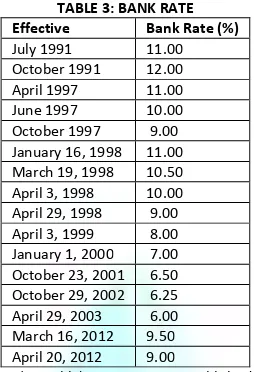
TABLE 3: BANK RATE Effective Bank Rate (%)
July 1991 11.00 October 1991 12.00 April 1997 11.00 June 1997 10.00 October 1997 9.00 January 16, 1998 11.00 March 19, 1998 10.50 April 3, 1998 10.00 April 29, 1998 9.00 April 3, 1999 8.00 January 1, 2000 7.00 October 23, 2001 6.50 October 29, 2002 6.25 April 29, 2003 6.00 March 16, 2012 9.50 April 20, 2012 9.00
Source: RBI Bulletin (Monthly), various issues, published by RBI, Mumbai.
(ii) Deregulation of Interest Rates
Prior to the reforms, interest rates were a tool of cross-subsidization between different sectors of the economy. To achieve this objective, the interest rate structure had grown increasingly complex with both lending and deposit rates administered by the RBI. As far as advances are concerned, there were as many as 20 administered rates in 1989-90. In regard to the regulated interest rate structure, the basic thrust of Narasimham Committee was that real rates of interest should be positive and concessional interest rates are a vehicle for subversion. Following reform measures, the various rates of interest are now market determined.
The lending rate for loans in excess of Rs. 200,000 that account for over 90 per cent of total advances was abolished in October 1994. Banks were at the same time required to announce a prime lending rate (PLR) which according to RBI guidelines had to take the cost of funds and transaction costs into account. For the remaining advances up to Rs. 200,000 interest rates can be set freely as long as they do not exceed the PLR (Arun and Turner, 2002; RBI, 2004a; Shirai, 2002). On the deposit side, there has been a complete liberalization for the rates of all term deposits, which account for 70 per cent of total deposits. The deposit rate liberalization started in 1992 by first setting an overall maximum rate for term deposits. From October 1995, interest rates for term deposits with a maturity of two years were liberalized. The minimum maturity has subsequently lowered from two years to 15 days in 1998. Thus, the term deposit rates were fully liberalized in 1997 (RBIs, 2004a). Scheduled Commercial Banks have now the freedom to set interest rates on their deposits subject to minimum floor rates and maximum ceiling rates. The four per cent differential interest scheme has been officially withdrawn. Though the Committee recommended reduction of target for priority sector advances from 40 per cent of total credit to 10 per cent, the Government did not agree to it.
(b) Prudential Norms
The report of the Narasimham Committee was the basis for the strengthening of prudential norms and the supervisory framework. Starting with the guidelines on income recognition, asset classification, provisioning and capital adequacy the RBI issued in 1992-93, there have been continuous efforts to enhance the transparency and accountability of the banking sector. The improvements of the prudential and supervisory framework were accompanied by a paradigm shift from micro-regulation of the banking sector to a strategy of macro-management (RBI, 2004a). The main objective of prudential norms is the strengthening financial stability of banks.
Adequate capital is one of the pre-requisites for the efficient working of banks. In the pre-reform period, there were no capital adequacy requirements and some banks were seriously undercapitalised. Hence, the Basle Accord capital standards were adopted in April 1992. It was prescribed that banks should achieve a minimum of 4 per cent capital adequacy ratio in relation to risk weighted assets by March 1993. The 8 per cent capital adequacy ratio had to be met by foreign banks operating in India by the end of March 1993; Indian banks with a foreign presence had to reach the 8 per cent by the end of March 1994, while purely domestically operating banks had until the end of March 1996 to implement the requirement (Joshi and Little, 1997; Shirai, 2002). Before arriving at the capital adequacy ratio of each bank, it is necessary that assets of banks should be evaluated on the basis of their realizable value. As per the recommendations of the Narasimham Committee, banks cannot recognize income (interest income on advances) on assets where income is not received within two quarters after it is past due. The committee recommended international norm of 90 days in a phased manner by 2002.
Another measure for ensuring transparency is the new prescription given for asset classification. After the introduction of reforms, the assets are now classified on the basis of their performance into four broad groups, namely, (a) standard, (b) sub-standard, (c) doubtful, and (d) loss assets. Adequate provision is required to be made for bad and doubtful debts (substandard assets). Detailed instructions for provisioning have been laid down. In addition, a credit exposure norm of 15 per cent to a single party and 40 per cent to a group has been prescribed. Banks have been advised to make their balance-sheets transparent with maximum ‘disclosure’ on the financial health of institutions. Further, provisioning standards which were left to the discretion of banks in the pre-reform period have been enhanced and tightened after the reforms. On outstanding substandard assets, 10 per cent general provision was made in 1992. On loss assets the provision has been 100 per cent. On secured portion of doubtful assets, the provision has been 20 to 50 per cent.
(c) Competition Directed Measures
The RBI announced guidelines for opening of private sector banks as public limited companies in January 1993. The conditions for opening of new private sector banks were: (a) capital of Rs. 100 crore, (b) moderate technology, and (c) head office at a non-metropolitan centre. In January 2001, paid-up capital of these banks was increased to Rs. 200 crore which has to be raised to Rs. 300 crore within a period of 3 years after the commencement of business. The promoters’ share in a bank shall not be less than 40 per cent. The new generation private sector banks have brought about a paradigm shift in service standards and set new benchmarks in terms of application of technology, speed in delivery of services, channels, and a high order of marketing orientation. These banks have been providing stiff competition to public sector banks and old private sector banks with their updated technology like electronic banking and compelled these banks to fall in line with new private sector banks. Foreign banks have also been permitted to set up subsidiaries, joint ventures or branches.
Banks have also been permitted to rationalize their existing branches, spinning off business at other centers, opening of specialized branches, convert the existing non-viable rural branches into satellite offices. Thus, the deregulating entry requirements and setting up new operations have benefited the Indian banking system from improved technology, specialized skills, better risk management practices and greater portfolio diversification (RBI, 2004a).
(D) Supportive measures
Security Interests (SARFAAESI) Act, 2002 enables the regulation of securitisation and reconstruction of financial assets and enforcement of security interests by secured creditors. The Act will enable banks to dispose of securities of defaulting borrowers to recover debt (RBI, 2004a).
(E) Other Measures
At the end of the 1980s, operational and allocative inefficiencies caused by the distorted market mechanism led to a deterioration of public sector banks’ profitability. Enhancing the profitability of public sector banks became necessary to ensure the stability of the financial system. The restructuring measures for PSBs were threefold and included recapitalization, debt recovery and partial privatization (Reddy, 2002).
Due to directed lending practices and poor risk management skills, India’s banks have accrued a significant level of NPAs. Prior to any privatization, the balance-sheets of PSBs have to be cleaned up through capital injections. In the fiscal years 1991-92 and 1992-93 alone, the Government of India provided almost Rs. 40 billion to clean up the balance- sheets of public sector banks. Between 1993 and 1999 another Rs. 120 billion were injected in the nationalised banks (Reddy, 2002). In 1993, the SBI Act of 1955 has amended to promote partial private shareholding. The SBI became the first public sector bank to raise equity in the capital markets. After the 1994 amendment of the Banking Regulation Act, public sector banks were allowed to offer up to 49 per cent to their equity to the public (Guha-Khasnobis and Bhaduri, 2000). There are number of other recommendations of the Narasimham Committee such as reduction in priority sector lendings, appointment of special tribunals for speeding up the process of loan recoveries, and reorganisation of the rural credit structure, all of which need special attention as these recommendations have far-reaching implications both in terms of structure of the financial system and also the financing required to implement them3.
The Committee proposed structural reorganisation of the banking sector which involves a substantial reduction of public sector banks through mergers and acquisitions.
SECOND GENERATION REFORMS
In order to initiate the second generation of financial sector reforms, a committee on Banking Sector Reforms was formed in 1998 under the chairmanship of M. Narasimham. The Narasimham Committee Report-II placed greater focus on structural measures and improvement in standards of disclosure and levels of transparency in order to align Indian standards with international best practices. The second generation reforms could be conveniently looked at in terms of three broad inter-related issues: (a) measures to strengthen the banking system, (b) streamlining procedures for upgrading technology and human resource development, and (c) structural changes in the system.
(a) Measures To strengthen The banking system (i) Capital Adequacy
The committee set new and higher norms of capital adequacy. For strengthening the banking system, the Committee recommended an increase in the minimum capital to risk assets ratio to 10 per cent by 2002 from its present level of 8 per cent. The RBI should have the freedom to increase the capital adequacy norm in respect of specific banks if in its judgments the situation warrants such increase.
(ii) Assets Quality NPAs and Directed Credit
The Committee recommended that the average level of net NPAs for all banks have to be brought down to below 5 per cent by the year 2000 and to 3 per cent by 2002 for all banks. However, banks with international presence should reduce gross NPAs to 5 per cent by 2000 and 3 per cent by 2002. On the other hand, net NPAs should be reduced to 3 per cent by 2000 and 0 per cent by 2002. The Committee also recommended the asset be classified as doubtful if it is in the substandard category for 18 months in the first instance and eventually 12 months and loss if it has been identified but not written off. Expressing concern over rising NPAs, the committee suggested the idea of the setting up an Asset Reconstruction Company to tackle the problem of huge NPAs of banks.
(iii) Prudential Norms and Disclosure Requirements
The Committee recommended moving to international practice for income recognition and brought down to 90 days norms in a phased manner by 2002 from the level of 180 days norms. In future income recognition, assets classification and provisioning must apply even to government guaranteed advances. Banks should pay greater attention to asset liability management to avoid mismatches.
(B) Systems and Methods in Banks
The Committee recommended a number of measures for internal control system. The internal control systems which are internal inspection and audit, including concurrent audit submission of controls returns by banks and controlling offices to higher level offices, risk management system, etc. should be strengthened. There are recommendations for recruitment of skilled manpower, introduction of computer audit, revision of operational manual and its regular updating including an additional whole time director on the board of the banks, etc.
(C) Structural Issues
The Committee is of the view that the convergences of activities between banks and DFIs (Development Financial Institutions), the DFIs over a period of time convert themselves into banks. There would be two forms of financial intermediaries: banks and non-bank financial companies. Mergers between banks and financial institutions need to be based on synergies and location and business specific complementarities of the concerned institutions. Merger of public sector banks should be emanated from the management of banks, the government playing supportive role. Mergers should not be seen as bailing out weak banks. Mergers between strong banks and financial institutions have been for greater economic and commercial sense.
FINDINGS
Following are the major findings from the discussions made above:
1. The period 1992-2003 has witnessed a radical departure from regulated banking towards market-oriented banking. The reform measures laid the basis for sound banking system and considerable progress has been made in implementing the reforms. The response of banks to the reforms has been impressive. The banks have been adjusting very well to the new environment, though gradually.
2. As a consequence of reforms, several new trends have been emerging in Indian Banking. Earlier deposits mobilized and outstanding figures of deposits were yardsticks for measuring performance. Today, strength of balance sheet is considered important.
3. The need for restructuring the banking industry in tune with reforms was felt greater with the initiation of the reforms measures in 1992. The reforms have enhanced the opportunities and challenges for the commercial banks making them operate in a market-led competitive environment.
4. The financial health of banks improved due to prescribed prudential norms. Almost all banks improved their Capital Adequacy and Asset quality during the period of study.
SUGGESTIONS
The commercial banks need to focus on the following suggestions and build required capabilities to cope up with the challenges of the dynamic banking environment.
CONCLUSION
VOLUME NO.2(2012),ISSUE NO.8(AUGUST) ISSN2231-5756
SCOPE FOR FURTHER RESEARCH
During the field survey, it occurred that there is scope for further research in the following areas.
1. A study to evaluates the performance of all public and private banks separately as a first step and compare the relative performance of two groups as the next one in response to reform measures initiated within the broader framework of Banking Sector Reforms.
2. A study to examine the challenge of NPAs in the Post-reform Period identifying causes and consequences thereof and to suggest remedies to overcome the NPA menaces.
3. A study to examine the profitability of Commercial Banks in pre and post-reform periods.
4. A study of the impact of Reforms on the banks leading to reorganization of inter and intra-bank group mergers and acquisition and strategic advantages thereof.
REFERENCES
1. Aggarwal, M. and Sharma, R. R. (2005), “Indian Banking: Present and Future,” the Indian Journal of Commerce, Vol. 58, No. 3, July-September. 2. Ahluwalia, M. S. (2002), “Economic Reforms in India Since 1991: Has Gradualism Worked?,” Journal of Economic Perspectives, Vol. 16 (3). 3. Arun, T.G. and Turner, J.D. (2002), “Financial Liberalization in India,” Journal of International Banking Regulation, Vol. 4 (2), pp. 183-188. 4. Chakrabarti, R. (2005), “Banking in India: Reforms and Reorganization,” Indian School of Business, Working Paper Series
5. Choudhary, C.M. (1996), “Financial Sector Reforms in India,” Sublime Publications, New Delhi.
6. Ghosh, S. and A. Das (2005) “Market discipline, capital adequacy and bank behavior,” Economic and Political weekly, Vol. 40, pp. 1210 -1215. 7. Government of India (1998), “Report of the Committee on Banking Sector Reforms, (Chairman: Shri M. Narasimham),” Publication Division, New Delhi. 8. Guha-Khasnobis, B. and Bhaduri, N. (2000), “A Hallmark of India’s New Economic Policy: Deregulation and Liberalization of the Financial Sector,” Journal of
Asian Economics, Vol. 11, No. 3, pp. 333-346.
9. Joshi, V. and Little, I.M.D. (1997), “India’s Economic Reforms: 1991-2001,” Oxford University Press, New Delhi.
10. Misra, B.M. and Dhal, S. (2010) “Pro-cyclical management of non-performing loans by the Indian public sector banks,” BIS Asian Research Papers. June. 11. RBI (1991), “Report of the Committee on the Financial System,” (Chairman: Shri M. Narasimham), RBI Publications, Mumbai.
12. RBI (2004a), Report on Trend and Progress of Banking in India,Mumbai, Annually.
13. RBI (2004b), “Financial Sector Reforms in India: Policies and Performance Analysis,” RBI Bulletin, Monthly.
14. Reddy, B. Rama Chandra and Reddy, S Vijayulu (2003), “Banking Sector Reforms in India – A Review,” Internet Edition, Business Line, Nov 19. 15. Reddy, Y.V. (2002), “Public Sector Banks and the Governance Challenge: Indian Experience,”RBI Bulletin, Monthly.
REQUEST FOR FEEDBACK
Dear Readers
At the very outset, International Journal of Research in Commerce, IT and Management (IJRCM)
acknowledges & appreciates your efforts in showing interest in our present issue under your kind perusal.
I would like to request you to supply your critical comments and suggestions about the material published
in this issue as well as on the journal as a whole, on our E-mail i.e.
for further
improvements in the interest of research.
If you have any queries please feel free to contact us on our E-mail
.
I am sure that your feedback and deliberations would make future issues better – a result of our joint
effort.
Looking forward an appropriate consideration.
With sincere regards
Thanking you profoundly
Academically yours
Sd/-