training on coping skills in female adolescents
Zahra Simi1, Abolfazl Karami2, Hossein Salimi3, Nezamaddin Ghasemi4
Abstract
This study aimed to investigate the efficacy of cognitive-behavioral stress inoculation training on increasing coping skills in female adolescent students. This quasi-experimental applied study had pretest-posttest and control group. A total of 30 students were selected by two-stage cluster sampling method and randomly divided into trial and control groups. The trial group received 10 sessions of educational intervention, and the control was placed on a waiting list. Data were collected through Endler & Parker coping styles and Cohen's perceived stress questionnaires in pretest-posttest stages, and were analyzed in SPSS-18 software using descriptive statistics and univariate covariance analysis. Study results demonstrated effectiveness of cognitive-behavioral stress inoculation training on students’ coping styles. However, this educational approach showed a significant effect on increasing problem-based coping styles, but was ineffective on emotion-based coping styles in students. It can be asserted that stress inoculation programs can be used to strengthen integrated and flexible coping skills in high school students.
Keywords: Adolescent, Coping, Female, Skill, Stress Journal of Research & Health
Social Development & Health Promotion Research Center
Vol.5, No.2, Summer 2015 Pages: 165-171
Original Article
1. MA in Family Counseling, Department of Counseling, Faculty of Educational Sciences & Psychology, Allameh Tabatab'i University, Tehran, Iran 2. Associate Professor of Psychology Department, Faculty of Educational Sciences & Psychology, Allameh Tabatab'i University, Tehran, Iran
3. Professor of Psychology Department, Faculty of Educational Sciences & Psychology, Allameh Tabatab'i University, Tehran, Iran
4. Correspondence to: Assistant Professor of Psychology Department, Faculty of Humanestic, Kazeron University, Kazeron, Fars, Iran
Tel/Fax: +98 71 42524840 Email: [email protected]
Received: 10 Sep 2012 Accepted: 08 Jul 2013
How to cite this article: Simi Z, Karami A, Salimi H, Ghasemi N. The effect of cognitive-behavioral stress inoculation training on coping skills in female adolescents. J Research Health2015; 5(2): 165-171.
Introduction
Today, stress is recognized as the disease of the century. Studies indicate that, besides individual's age, status, or position, stress generally affects various aspects of mental, social and academic performance of people [1]. Consequences of stress include increased anxiety, depression, suicidal behavior, and poor academic and school performance [2]. Greenberg & Waltoti (1980) suggest that, whether positive or negative, stress causes a reaction in the body and affects cardiovascular, gastrointestinal, and musculoskeletal systems and subsequently, intellectual and cognitive framework in people [3].
Adolescence is referred to as a period of crisis, storm and stress, or renaissance; it is one of
play their social roles in peer groups and in relationships with the opposite sex, and learn social skills, meet requirements for attending educational institutions, and decide about their future occupation. Thus, experiencing stress in adolescence is inevitable, and requires skills to cope for an adaptive change in this period. It is necessary to learn cognitive-behavioral strategies appropriate to adolescent's cognitive status for effective and adaptive transition from this period [6]. Lack of adaptive coping skills may be associated with negative outcomes such as greater behavioral problems, low self-esteem, depression, conflict with adolescence, academic failure, and poor social functioning [7]. In this regard [1], it has been shown that training stress inoculation and effective coping strategies can reduce anxiety in students, and subsequently enhance their academic performance.
Stress Inoculation Training (SIT) is recognized as a stress management strategy, in which people are taught cognitive-behavioral coping skills to control behavioral and psychological reactions in stressful situations. Stress inoculation training program has been designed as a rapid short-term intervention to prevent psychological symptoms associated with stress, and its effectiveness and efficacy has been demonstrated in several studies. For instance: studies have shown [8] that stress inoculation approach plays a significant role in adolescents' adjustment, increased coping skills, and academic performance. Hekmatpour studied the relationship between stress and coping styles in students, and found a significant relationship between stress and problem-oriented, emotion-oriented, and avoidance-oriented coping styles. Sultani et al. [10] showed that stress management training has a significant effect on academic achievements of high school girls. Also, Davood Mohammadi et al. [11] observed a relationship between 3 types of problem-solving styles (efficient, inefficient, and asking others) and emotion-management capability in students.
This approach was proposed by Mikenbam in 1986, in which stress is considered to have an
interactive nature. This approach attempts to provide patients with necessary training to reduce and treat stress and its associated problems over 3 training stages, including: 1) conceptualization, 2) skills acquisition and rehearsal, and 3) application and follow through. First, training is given to participants on sources of stress [12]. For instance, the relationship of stress with irrational thinking and possible methods to reduce physical and mental stress, and then coping skills are directed toward specific fostered stressors [The Persian sentence is vague]. For instance, relaxation and cognitive restructuring techniques are used. The final stage involves placement of participants in real or simulated situations to rehearse and apply coping skills [13]. Considering the importance of stress management and its relationship with adolescents' mental health and academic progress, assessment of efficacy of these interventions can be beneficial in arriving at a broad and efficient stress control model. Furthermore, a more effective model can be found for stress prevention and management in people in this age group. Accordingly, the present study aimed to examine the efficacy of this method in relation to increasing adolescent students' coping skills.
Method
1- Coping Inventory for Stressful Situations (CISS):
This scale was designed by Endler & Parker in 1990 and contains 48 items. Each item is ranked according to 5-option Likert scale. This scale measures three main coping behavior domains, including: problem-oriented, emotion-oriented, and avoidance-oriented, and higher score in any one of these domains means that certain domain is used more by the participant. Endler & Parker reported reliability coefficient of 0.9 for problem-oriented style, 0.85 for emotion-oriented style, and 0.82 for avoidance-oriented style [14]. In Iran, internal consistency of this tool was found by Piri & Shahrarai [15] 0.81 for problem-oriented style, 0.85 for emotion-oriented, and 0.80 for avoidance-oriented style 0.80. Using this scale on students, Razavi, Kazemi & Mohammadi [16] reported Cronbach's alpha of 0.92 for problem-oriented, 0.83 for emotion-oriented, and 0.79 for avoidance-oriented style.
2- Perceived stress scale:
Perceived Stress Scale was designed by Cohen in 1983, and includes three versions of: 4, 10 and 14 items. It is used to measure perceived stress over the past month. The paper and pencil scale and reading and writing literacy suffice to complete this questionnaire. In this study, the 4-item version was used. Scoring is according to 5-option Likert scale, and higher scores indicate higher level of stress experienced by the individual over the past month. Designers reported Cronbach's alpha or internal consistency between 0.74 and 0.86 for this questionnaire. Cohen et al. [17], reported Cronbach's alpha of 0.86 in the U.S., and Ghorbani et al. [18], reported 0.81 in Iran, which indicates favorable internal consistency. To conduct the study, after selecting schools, one of the researchers obtained permission from the school principal and the class teacher for attending the class and implementing the questionnaire and stress inoculation training program. Then, students were briefed about the study objectives, completion of questionnaire, and training program. First, students' stress was assessed using perceived stress scale, and 30
students with the highest level of perceived stress were selected (those with one standard deviation above mean were selected). Following completion of pretests, only the trial group received 10 training sessions (independent variable) with stress inoculation approach, lasting 60 minutes, and the control group received no training. Posttest was conducted in both groups following completion of training sessions. Sessions were conducted in groups using speeches and group discussion, and according to tasks provided in sessions and in educational package between sessions.
The objectives of stress inoculation training sessions were as follows:
Session 1: Introduction, explaining objectives and group rules, stress conceptualization and description, and symptoms and consequences of stress in causing illness and reducing health.
Session 2: Relaxation and stress relief training Session 3: Relaxation and stress relief training, practical and theoretical definition of stress. Session 4: Introduction to cognitive concepts, role of thoughts in generating stress, and the relationship of thoughts with emotions and behaviors, introducing automatic negative characteristics, and introducing cognitive errors.
Session 5: Behavioral techniques training, such as: deep breathing, exercising, and mental imaging.
Session 6: Coping with negative thoughts training, with brief review of previous session topics, review of tasks and problem solving, necessary steps to cope with negative thoughts by knowing them, response to negative thoughts and action to test these thoughts. Session 7: Instructional self-talk training, and role of negative self-talk in creating stress. Session 8: Focus thinking and distraction techniques.
Session 9: Problem-solving and its practice Session 10: Practicing skills learnt from previous sessions, and the need to use these skills in stressful situations
SPSS-18 software using descriptive and inferential statistics (univariate covariance analysis). The effect of pretest control variables was removed from posttest scores and two groups were then compared according to remaining scores.
Results
The present study recruited 30 female senior high school students aged 14 to 15 years. Results of student, correlation coefficient and chi-square tests showed no significant difference between trial and control groups in demographic variables of age, socioeconomic level, and birth order. Only pretest was controlled as a confounding variable.
Descriptive statistics of problem-oriented coping skills showed no significant difference between the two groups in pretest. In the posttest stage, mean and standard deviation were 99.2 and 11.55 in the control group, and 98.53 and 12.24 in the trial group, which indicates increased distribution of scores in the control group, due to factor of learning in some participants.
Pretest stage mean and standard deviation were 47.33 ± 12.4 and 44.93 ± 10.4, respectively in the control and the trial groups for emotion-oriented skill, and 53.8 ± 11.81 and 56.8 ± 14.03 in the posttest stage. These results indicate reduced distribution of scores in the control group, and increased distribution in the trial group, which suggests a gap between scores. Table 1 presents luven test results based on
equality of variances and other assumptions (linear relationship and normal distribution), together with covariance analysis results in posttest stage, investigating the effectiveness of stress inoculation method on overall coping styles in female students.
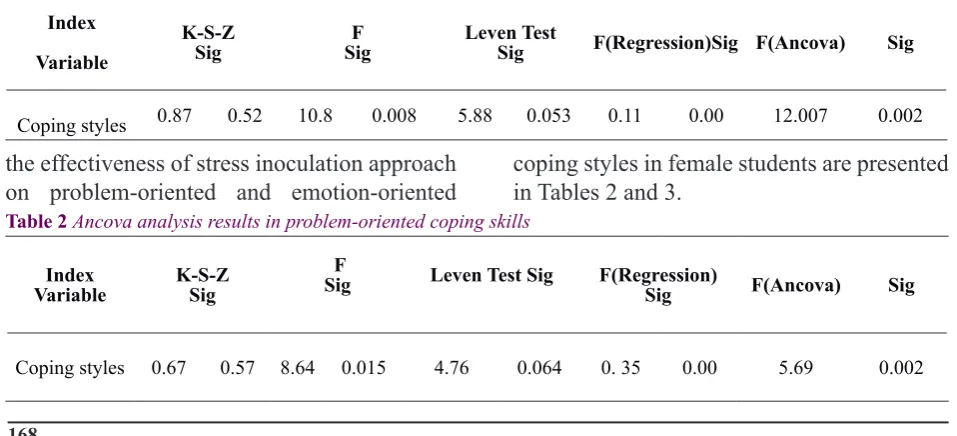
Table 1 shows that although the significant level of 0.05 is indicative of rejecting variance equality assumption, it is not difficult to do so because of the equality of samples and variance test rigor (F test), especially when samples are equal [the Persian sentence is vague]. Also, the assumption of homogeneity of regression coefficient slope, and normal distribution according to Kolmogorov-Smirnov test has been established, and F shows linearity assumption of the relationship. Thus, covariance analysis can be used. Table 1 shows that hypothesis zero is rejected, and study hypothesis is thus confirmed, which means there is a significant difference in mean scores between the trial and the control groups. Therefore, it can be concluded that stress inoculation training has an increasing effect on overall coping skills in female students (P=0.002). The effect of this therapeutic intervention on coping styles is 0.47, which means 47% of variance of overall remaining score belongs to group membership or the effect of method applied. Statistical power is at favorable level of 0.98, which indicates adequacy of sample size. Results of covariance analysis, investigating Table 1 Ancova analysis results in coping styles
Index Variable
K-S-Z
Sig Sig F Leven Test Sig F(Regression)Sig F(Ancova) Sig
Coping styles 0.87 0.52 10.8 0.008 5.88 0.053 0.11 0.00 12.007 0.002 the effectiveness of stress inoculation approach
on problem-oriented and emotion-oriented coping styles in female students are presented in Tables 2 and 3. Table 2 Ancova analysis results in problem-oriented coping skills
Index
Variable K-S-ZSig
F
Sig Leven Test Sig F(Regression)Sig F(Ancova) Sig
Tables 2 and 3 show that all necessary assumptions have been observed in using covariance analysis in relation to two dependent variables of emotion-oriented (Sig=0.063), and problem-oriented (Sig=0.06) coping styles. These results also confirm the effectiveness of intervention on female students' scores in problem-oriented coping style (Sig=0.002),
but its ineffectiveness on emotion-oriented coping style in posttest stage in the trial group compared to the control (Sig=0.06). The effect of this therapeutic intervention on problem-oriented coping style is 0.38, which means 38% of variance of overall remaining scores belongs to group membership or the effect of method applied.
Table 3 Ancova analysis results in emotional-oriented coping skills
Index
Variable K-S-Z Sig F Sig Leven Test Sig F(Regression) Sig F(Ancova) Sig
Coping styles 0.81 0.52 28.30 0.00 2.39 0.060 0. 5 0.00 4.53 0.006
Discussion
The present study aimed to investigate the efficacy of stress inoculation cognitive-behavioral training on coping styles in adolescent female students. The results showed the effectiveness of implementing weekly stress inoculation training programs on students' coping styles. These results are in line with those on Nancy Warren’s [19] study on the effect of coping with stress training program on reduced stress response and increased coping skills, and also that of Hekmatpour’s study [9]. Stress inoculation methods cause psychological and behavioral inoculation in people, so that they learn to influence their own coping capabilities by changing beliefs and self-talk about their performance in stressful situations. Accordingly, this approach prepares individuals and groups to face present and future highly-stressful situations through prior defenses or a set of coping skills, and individuals increase their resistance against stressful situations by building psychological antibodies or coping skills [20]. In this method, students learn to develop their stress coping levels by creating a sense of "already learnt skill" through successful experiences, and develop a defensive outlook, composed of skills and positive expectations that help them in facing stressful situations [12].
Other results showed that stress inoculation approach is effective in increasing students' problem-oriented coping skills, which agrees with the results of studies by Owla [21], Kampass et al. [22], and Kaffi [5] to show
emotion-oriented coping styles are poorly associated with mental health outcomes, nevertheless this is not always true. Their study also showed that although distraction is not a direct or problem-oriented or problem change coping style, it is an adaptive strategy in many situations. [Persian sentence is vague] Studying the effect of cognitive-behavioral therapies with relaxation and stress management on reducing emotional distress, Jeron [25] showed people that experience greater anxiety and stress use emotion-oriented rather than task-oriented strategies. This means that emotion-oriented coping strategies perform better in stressful events and stresses that are beyond our control and capabilities. It seems, since adolescents are not adequately trained in coping and problem-solving skills, and also, adolescents are capable of complex thinking, but are not adequately experienced to use such capabilities yet, use of interventions such as relaxation and positive self-talk can be effective in conditions with little effect on individual's performance [Persian sentence is vague]. Because of critical age of puberty, impulsiveness, and egocentrism, adolescents are less likely to think to find appropriate solutions, when faced with stressful situations. Perhaps, because they are more concerned about attracting attention, and thus they try to deal with stress by using irrational strategies. Therefore, they tend to use emotion-oriented strategies. For instance, a student that scores poorly in exam may focus on a deviated evaluation technique to reduce his stress. If the problem is not solved, one way to control stress is re-evaluation. To this end, the individual compares his position to others, and may conclude that his situation was not so bad after all [21]. However, besides study results, according to Sharidan & Radmacher theory, as quoted by Kaveh [26], emotion-oriented and problem-oriented coping styles are often used together, but conditions such as stressful situations, people's age, intelligence quotient, previous experiences can all influence use of either of these approaches.
Lack of comparison of efficacy of stress inoculation training programs between sexes,
lack of attention to students' mental and intelligence profiles and screening for mental disorders can influence the efficacy of intervention programs, and is a limitation in this study.
Conclusion
It can be inferred from the present study results that training programs in the form of stress management approaches for adolescents, can be beneficial and effective in enhancing primary preventions and creating preventive coping skills. Thus, considering the importance of educational-interventional programs, it is recommended that future studies move toward design and development, localization, and updating stress management programs for adolescents.
Acknowledgements
The authors should like to express thanks to Noor Abad Mamasani staff of education office, especially kowsar high school authorities and students who Patiently Porticipated in this study.
Contributions
Study design: ZS, AK, HS
Data collection and analysis: ZS, AK, HS, NGH
Manuscript preparation: ZS, AK, HS
Conflict of interest
"The authors declare that they have no competing interests."
References
1- Kiselica M, Baker SB, Thomas RN, Reedy S. Stress inoculation training for Adolescents with elevated self- reported anxiety symptoms.
2- Hains A, Szyjako w. Stressing collation training.
Intern J stress Manage2011; 11:45-58.
4- Ham M. Stress and “stoma and stress” in early adolescence. J youth adole2007; 18(6): 583-99.
5- Kafi M. ways of dealing with stress and relationship with mental health in adolescents ordinary schools and special city of Tehran: thesis of PhD. Tehran: university of teacher education1995. [In Persian].
6- Lewis R. Boys play sport and Girls Turn to anthers: Age, Gender and ehnicity as deteymainats of coping. J Adole2010; 16: 253. 266
7- Steiner H, Erikson MS. Coping styles as correlates of health in high school students. J adole Health2003; 30: 325-30.
8- Mullis RL, Chapman P. Age , gender, and self esteem differences in adolescent coping styles. J social psy2006; 140(4): 539-41.
9- Hekmatpor A. Relationship between stress and coping strategies in the county and city public university students in Tehran from 2000-2001 academic year: master´s thesis in psychology, Tehran: university of Teacher Esfahan 1380. [In Persian]
10- Soltani M, Aminoroaia, M and Attari A. Effect of stress managament skills training on the academic achievement of highschool girl students. J Research Behav Scien2009; 6(1): 1-16.
11- Mohammadi SM, Torabi SS, Gharaei B. The Relationship between Coping Styles and Emotional Intelligence in Students IJPCP2008; 14(2) 176- 183. 12- Donald M. Mobeni S. Stress inoculation training. Tehran: Roshd Press.1996.
13- Ghamari M. The Effectiveness of stress Inoculation training in decreasing student’s Anxiety :Quarterly. J Ira couns Assoc2005; 7(96): 35-7. [In Persian]
14- Endler NS, Parker JDA. Multidimensional assessment of coping: a critical evaluation. J Pers Soc Psy1990; 58(5): 844-54 .
15- Peri L. Relationsip between identity identity style, Assertiveness and coping styles. j psy studi, Facul Edu psy Alza uni1384; 4: 2-3. [In Persian].
16- Abdolhamid R, Soltanli K, mohamadi M. The relationship between personality traits and coping styles and social anxiety of college students with blindness and normal universities province of fars. J psy excep2010; 1(4): 127-35.
17- Cohen s, kamarck T, Mermelstein R. A global measure of perceived stress. J Health Soc Behav1983; 24 (4): 385-96.
18- Ghorbani N, Bing MN, Watson PJ, Davison HK, Mack DA. Self-reported emotional intelligence: Construct similarity and functional dissimilarity of
higher-order processing in Iran and the United States. International. J Psy 2002; 37(5): 297-308.
19- Nancy R, & Ahren RN. Examining factors that increase and decrease stress in adolescent community college student. J pedi nurs2010; 35:(2-3): 113-21. 20- Pzeshkyan F. Methods of stress coping in adolescents 13-17 years in connection with the coping strategies of their parents and Academic achievement of students: in a master’s thesis. Tehran: Alzahra university1998. [In Persian]
21- Olah A.Coping strategies among adolescent: a cross- cultural study. J adolescence2007:18, 491-512. 22- Compass B, Malcarhe V , Fondocarock M. Coping with stressful events in order children and young adolescents. J cons clini psy1988; 47: 321-450. 23- Carre E, Bartley C. Coping with daily stress: the role of conscientiousness. Personality Individual Differences2011: 50(1): 79-83.
24- Sander N, Teinj, W L. Coping , Stress, and the psychological symptoms of children of Divorcees: Across- Sectional and Longitudinal study. Child Development1994; 65(5): 1744-63.
25- Jeroen SN. Cognitive coping in anxiety- disordered adolescents. J adole2010; 46:1-8.