Simultaneous reduction and surface functionalization of
graphene oxide with POSS for reducing fire hazards in epoxy
composites
Xin Wang,a,b Lei Song,*a Hongyu Yang,a Weiyi Xing,a Baljinder Kandolac and Yuan
Hu*a,b
a State Key Lab of Fire Science, University of Science and Technology of China, Hefei, Anhui 230026, China. E-mail: [email protected]; Tel./Fax: +86-551-3601664
b Suzhou Key Laboratory of Urban Public Safety, Suzhou Institute for Advanced Study, University of Science and Technology of China, Suzhou, Jiangsu 215123, China
cInstitute for Materials Research and Innovation, University of Bolton, Deane Road, Bolton, BL3 5AB, United Kingdom
Abstract
Simultaneous reduction and surface functionalization of graphene oxide (GO) was
realized by simple refluxing of GO with octa-aminophenyl polyhedral oligomeric
silsesquioxanes (OapPOSS) without the use of any reducing agents. The presence of
OapPOSS made the hydrophilic GO hydrophobic, evidenced by the good dispersion
of the OapPOSS-reduced GO (OapPOSS-rGO) in tetrahydrofuran solvent. The
structure of OapPOSS-rGO was confirmed by XPS, FTIR and TEM. Morphologic
study showed that, due to the good interfacial interaction between the functionalized
graphene and epoxy, OapPOSS-rGO was dispersed well in the matrix. With the
incorporation of 2.0 wt% of OapPOSS-rGO, the onset thermal degradation
temperature of epoxy composite was significantly increased by 43 oC. Moreover, the
compared to that of neat epoxy. This dramatically reduced the fire hazards were
mainly attributed to the synergestic effect of OapPOSS-rGO: the adsorption and
barrier effect of reduced graphene oxide inhibited the heat and gas release and
promoted the formation of graphitized carbons, while OapPOSS improved the thermal
oxidative resistance of the char layer.
Introduction
As a new member of the family of carbon-based materials, graphene, an atomically
thick, two-dimensional (2-D) sheet composed of sp2 carbon atoms in a hexagonal
lattice,[1] has aroused extensive interests in both scientific and industrial fields.
Graphene exhibits fascinating electronic,[2, 3] thermal,[4, 5] and mechanical
properties[6, 7] due to its unique structure. These extraordinary properties and ability
to be dispersed in various polymer matrices make graphene suitable to be a new
reinforced filler for developing next-generation polymer nanocomposites.
Graphene sheets have been obtained by micromechanical cleavage, epitaxial growth,
chemical vapour deposition (CVD) and reduction of graphene oxide (GO). Among
these methods, the reduction of GO is the most promising method for large scale
production of graphene, also known as reduced graphene oxide (rGO).[1] As the
precursor of graphene, GO has been demonstrated as a promising flame retardant
nano-additive in polymers.[8] However, GO is thermally instable, and thereby it is
essential to convert GO into a more stable form, reduced-GO. Huang et al. has
stable even after exposing clean rGO to a flame, clearly indicating the high intrinsic
flame resistance of rGO.[9] Very recently, Huang’s group [10] and our group [11]
have reported the application of graphene as flame retardant additive in polymer
composites; however, the flame retardant used in the previous reports is bare graphene
so that high loading is needed to achieve good fire resistance, and the polymer
matrices investigated are all thermoplastic resins. Herein, to improve the fire retardant
efficiency of graphene, we demonstrated a facile approach to functionalize and in situ
reduce GO with octa-aminophenyl polyhedral oligomeric silsesquioxanes (OapPOSS)
without the addition of conventional chemical reducing agents. For electrical
applications, the OapPOSS-rGO composite was applied into flame retarding epoxy
resins, which provides a path to obtain a new class of graphene-based flame retardant
additives.
Experimental
Raw materials
Graphite powder (Spectrum Pure) was purchased from Sinopharm Chemical Reagent
Co. LtdS (Shanghai, China). Octa-aminophenyl polyhedral oligomeric
silsesquioxanes (OapPOSS) was provided by Hybrid Plastics Incorporation (USA).
Biphenol A-type epoxy resin (EP) was supplied by Hefei Jiangfeng Chemical Industry
Co. Ltd. (Anhui, China). Concentrated sulfuric acid (98%), sodium nitrate, potassium
permanganate, 30% H2O2 solution, hydrochloric acid, ethylene glycol (EG),
4,4’-diamino diphenyl methane (DDM) and tetrahydrofuran (THF) were all reagent
Synthesis of functionalized and reduced graphene oxide (OapPOSS-rGO)
Graphene oxide (GO) was prepared from graphite using Hummers’ method.[12] The
as-prepared GO (200 mg) was first suspended in THF (200 ml) with the assistance of
sonication for 60 min. Subsequently, the suspension was introduced into a 500 ml
three-neck flask, and another THF solution (50 ml) containing OapPOSS (400 mg)
was added with stirring. The mixture was heated to 70 °C and refluxed for 12 h under
nitrogen atmosphere. Afterwards, the mixture was separated by filtration through a
0.2-μm PTFE membrane and thoroughly washed with anhydrous THF to remove the
residual OapPOSS. The filter cake was then dried in a vacuum oven at 80 °C
overnight to remove the solvent. Scheme 1 illustrates the synthesis of functionalized
and reduced graphene oxide (OapPOSS-rGO).
Preparation of OapPOSS-rGO/epoxy composites
Briefly, the preparation of epoxy composite with 2 wt% OapPOSS-rGO was as
follows: OapPOSS-rGO (200 mg) was dispersed into acetone and sonicated until
OapPOSS-rGO completely dissolved to form a black suspension. Then, epoxy resins
(7.6 g) and DDM (2.2 g) were added to the suspension above and stirred until
homogeneous mixtures were obtained. The mixtures were heated in a vacuum oven at
about 60 °C to remove excess solvent. Then, the samples were cured at 100 °C for 2 h
and post cured at 150 ◦C for 2 h. After curing, all samples were cooled to room
temperature. For comparison, pristine GO/epoxy and OapPOSS/epoxy composites
with equivalent filler content were also prepared under similar processing conditions.
High resolution transmission electron microscopy (HRTEM) analysis was conducted
using a JEOL JEM-2100 instrument with an acceleration voltage of 100 kV. The
GNS/PU composties were dropped on copper grid for TEM imaging directly. X-ray
photoelectron spectroscopy (XPS) was carried out with a VG Escalab Mark II
spectrometer (Thermo-VG Scientific Ldt, UK), using Al Ka excitation radiation (hυ =
1253.6 eV). Fourier transform infrared (FTIR) spectra were recorded using a Nicolet
6700 spectrophotometer in KBr pellets. Thermogravimetric analyse (TGA) of samples
were carried out with Q5000 thermal analyzer (TA Co., USA) from 30 oC to 700 oC at
a heating rate of 10 oC/min in air atmosphere (flow rate of 100 ml/min). The
combustion properties were evaluated using a microscale combustion calorimeter
(MCC, GOVMARK). Approximately 4 ± 1 mg of each sample was raised into the
heated tube of a pyrolysis-combustion flow calorimeter (PCFC) that was purged with
nitrogen. The sample was gradually heated to 900 oC at a heating rate of 1 oC /s. The
gaseous pyrolysis products mix in the gas stream with oxygen prior to entering the
combustion zone of the PCFC, where they are completely oxidized. Oxygen and
nitrogen flow rates were set at 20 and 80 cm3/min, respectively. Flammability of the
samples was also characterized by cone calorimeter (Fire Testing Technology, UK)
according to ISO 5660. Samples were irradiated horizontally at a heat flux of 35
kW/m2. All the measurements were repeated three times and the results averaged.
Raman spectra were recorded from 500 to 2000 cm-1 on a LabRAM-HR Confocal
Raman Microprobe (Jobin Yvon Instruments, France) using a 514.5 nm argon ion
Results and discussion
Characterization of GO and OapPOSS-rGO
The presence of the OapPOSS has a significant influence on the solubility of
OapPOSS-rGO. Fig.1 shows the digital photos of (a) GO and (b) OapPOSS-rGO at a
concentration of 1 mg/ml. As is well known, GO is easily exfoliated in aqueous media
due to the carboxylic, epoxy, carbonyl, and hydroxide groups on its surface and edge.
[13, 14] After a suitable ultrasonic treatment, GO can produce stable dispersions of
very thin graphene oxide sheets in water,[15, 16] exhibiting a color of light yellow
(Fig. 1a). In the one-step functionalization and reduction process, the presence of the
OapPOSS makes the hydrophilic GO hydrophobic. Therefore, OapPOSS-rGO can
readily form stable colloidal suspensions in THF (Fig. 1b) due to the strong
interaction between OapPOSS and THF.
Interestingly, there is a color change from yellow GO in water to black
OapPOSS-rGO in THF (Fig. 1), which is usually considered to be a sign of GO
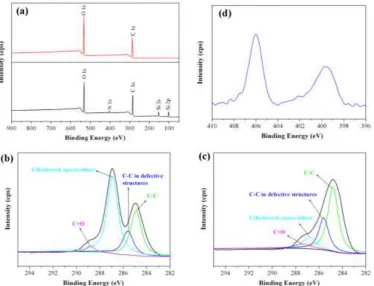
reduction.[17] XPS was employed to evaluate the chemical bonds formed on the
surface of GO before and after its functionalization with OapPOSS. The survey XPS
spectra of (a) GO and OapPOSS-rGO, and higher resolution C1s spectra of (b) GO, (c)
OapPOSS-rGO and (d) N1s spectra of OapPOSS-rGO are shown in Fig. 2. As can be
observed, the XPS spectrum of OapPOSS-rGO displays a significant increase in the
Si peak and N peak compared to that of GO. This increased intensity of Si and N
elements is originated from OapPOSS. Fig. 2b clearly demonstrates that GO has a
288.4 eV, which could be ascribed to the non-oxygenated ring C atoms, the C atoms
bonded to C atoms in defective structures, the C atoms in hydroxyl and epoxy/ether
groups, and the carbonyl C structure, respectively.[16, 18] The C1s XPS spectrum of
GNS (Fig. 2c) also exhibits these same oxygen functionalities, however, the peak
intensities of oxygenated C in epoxy/ether groups are much lower than those in GO,
indicating the occurrence of the reduction of GO. In the N1s spectra of
OapPOSS-rGO (Fig. 2d), there are two peaks at 406.0 eV and 399.6 eV. The former is
ascribed to the amino group, while the latter is due to C-N-Ph, suggesting the
successful covalent functionalization of GO by OapPOSS.
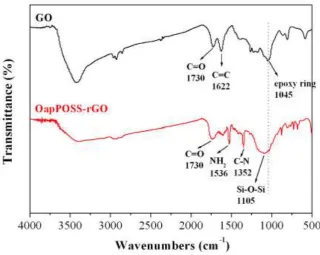
FTIR spectra of GO, and OapPOSS-rGO are presented in Fig. 3. The absorption
bands of GO at 1730 cm-1, 1622 cm-1 and 1045 cm-1 are ascribed to carboxyl groups,
C=C and epoxy ring, respectively. After the functionalization of GO by OapPOSS,
there are some new absorption bands in the spectra of OapPOSS-rGO. The strong
absorption band at around 1105 cm-1 is attributed to Si-O-Si group in POSS, and the
peak at 1536 cm-1 is corresponding to the stretching vibrations of the -NH2 groups.
The characteristic band of the -C-N- appears at 1352 cm-1, which together with the
significantly reduced intensity of epoxy ring at 1045 cm-1 are indicative of the
occurrence of covalent functionalization of GO by OapPOSS.
In order to obtain the morphological information of GO, OapPOSS-rGO and epoxy
composite, TEM observations were conducted, as shown in Fig. 4. TEM analysis
displays that GO sheets exhibit a typically flat yet wrinkled nano-platelet shape with
small dark dots, which are corresponding to OapPOSS particles, are observed to be
uniformly distributed on the graphene plane (Fig. 4b). In the OapPOSS-rGO/EP
composite, thin graphene sheets with high aspect ratio are randomly oriented over the
entire imaging area (Fig. 4c). The good dispersion of OapPOSS-rGO could be
attributed to the good interfacial interaction between the functionalized graphene and
polymer matrix.
Thermal properties
TG/DTG profiles for epoxy and its composites as a function of temperature at the
heating rate of 10 oC min-1 are shown in Fig. 5. The onset degradation temperature
(Tonset) is defined as the temperature at which the weight loss is 5%. As can be
observed, the thermal degradation process of pure epoxy has three stages based on the
DTG profile, which are mainly corresponding to the vaporization of small molecules,
the decomposition of the macromolecular chains, and the oxidation of char residue,
respectively. In the case of the GO/EP composite, its Tonset is lower than pure EP, since
GO is thermally unstable and its major mass loss occurs below 250 oC due to the
decomposition of the oxygen-contained functional moieties.[19] The addition of
OapPOSS exhibits a reverse trend in the Tonset compared to GO, and the Tonset of
OapPOSS/EP is increased by 24 oC compared to that of pure EP. Owing to the
multifunctional groups of OapPOSS, the cross-linking density of OapPOSS/EP is
increased, resulting in the improvement of thermal stability. When GO is reduced by
OapPOSS to convert into OapPOSS-rGO, OapPOSS-rGO/EP shows the best thermal
in thermal stability could be attributed to the so-called ‘‘tortuous path’’ effect of
graphene, which retards the permeation of heat and the escape of volatile degradation
products.[18]
Fire hazards evaluated by MCC and cone calorimeter
As is well known, expand graphite or carbon nanotubes have been used to impart the
flame retardant properties to polymers. Similarly, as carbon-based materials, graphene
is expected to reduce fire hazards of polymers due to its unique two-dimensional (2D)
atomic carbon sheet structure. To confirm this idea, the micro combustion calorimeter
(MCC) was used to characterize the epoxy composites with respect to their potential
flammability performance. Fig. 6 presents the heat release rate (HRR) curves of pure
EP, GO/EP, OapPOSS/EP and OapPOSS-rGO/EP. The addition of GO and OapPOSS
gives rise to a 36% and 31% reduction in peak HRR, respectively, compared to that of
pure EP. Furthermore, incorporating OapPOSS-rGO into EP exhibits the lowest peak
HRR value (nearly 58% reduction). The mechanism of OapPOSS-rGO in reducing the
flammability of polymers is probably attributed to create a barrier effect on the
surface of the polymers which could slow down the heat and mass transfer between
gas and condensed phases, and prevent the underlying material from further
combustion.
Cone calorimeter is an useful bench-scale tool for measuring the flammability of
materials in real-world fire conditions.[20] Fig. 7 gives the HRR, total heat release
(THR) and CO production rate (COPR) versus time curves of all the samples. From
the peak heat release rate value is 1730 kW/m2. As expected, incorporating GO into
epoxy resins makes the peak heat release rate decrease to 1345 kW/m2. For the
sample of OapPOSS/EP, the PHRR also decreases by 38% compared to that of pure
EP. Moreover, the PHRR of OapPOSS-rGO/EP exhibits further reduction compared to
both GO/EP and OapPOSS/EP. The best fire retardant properties of
OapPOSS-rGO/EP could be attributed to two aspects: firstly, the reduction of GO by
OapPOSS occurs to convert GO into a more stable form, reduced-GO (rGO);
secondly, POSS can create a stable silica layer on the char surface of EP, which
reinforces the barrier effect of graphene.[21] The THR curves (Fig. 7b) show similar
trend as HRR, and THR value of GO/EP, OapPOSS/EP and OapPOSS-rGO/EP is
significantly reduced by 17%, 23% and 37%, respectively, compared to that of pure
EP. In Fig. 7c, it can be seen that the COPR of pure EP remains the highest among the
four samples. Addition of GO and OapPOSS suppresses the release of CO. In addition,
CO production for OapPOSS-rGO/EP is much lower than that of pure epoxy resins,
which is probably due to the adsorption and barrier effect of graphene. The reduction
of toxic CO in the smoke and gases will be beneficial to fire rescue when an accident
happens.
The fire growth rate index (FIGRA), which indicates the burning propensity of a
material, has been calculated from the ratio of PHRR and time to PHRR for all
samples. The FIGRA value of pure EP is 13.3 kW/(m2 s), while that of GO/EP,
OapPOSS/EP and OapPOSS-rGO/EP is 10.5, 8.3 and 6.7 kW/(m2 s), respectively. The
material.
Flame retardant mechanism
Flame retardant additives in polymers may have an action either in the condensed
phase or in the gas phase or also in both phases at the same time. According to the
previous reports, numerous different nanoparticles, including organo-modified
clays,[22] layered silicate,[23] carbon nanotubes,[24] layered double hydroxides
(LDH),[25] or polyhedral silsesquioxanes (POSS),[26] act as “char reinforcer” or
“char expander” in the condensed phase. When a condensed phase action is the main
mechanism of the flame retardant additives, the efficiency depends strongly on the
structure and composition of the char during burning. Therefore, investigating the
properties and the structure of the resultant carbonaceous layers will provide the
insight into understanding how the flame retardant additives act in the condensed
phase.
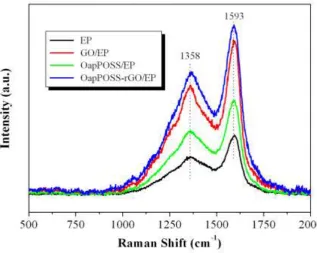
Raman spectroscopy offers a powerful tool for characterizing carbonaceous materials.
Fig. 8 shows the Raman spectra of the residual char of EP, GO/EP, OapPOSS/EP and
OapPOSS-rGO/EP after cone calorimeter. As can be observed, the Raman spectra of
all the four samples exhibit similar shape, with two peaks at 1593 cm-1 and 1358 cm-1.
The characteristic peak at 1593 cm-1 is called G band, corresponding to the first-order
scattering of the E2g mode,[16] while the other is called D band, arising from the
activation in the first order scattering process of sp3 carbons.[27] However, the
intensity of the Raman spectra of GO/EP is much higher than that of EP, indicating
incorporating OapPOSS-rGO into EP slightly increases the intensity compared to that
of GO/EP, suggesting GO is the main contributor for the formation of graphitized
carbons. The high content of graphitized carbons in the residual char is known to be
compact and efficient in terms of thermal insulation, which provides a protective
shield that leads to a decrease in heat and mass transfers between the flame and the
material.
The exterior and interior residual char of EP and OapPOSS-rGO/EP obtained from
cone calorimeter are further investigated by XPS analysis, and the results are
summarized in Table 1. As aforementioned, the characteristic C1s bands at 284.6,
286.8 and 288.4 eV are ascribed to C-H and C-C in aliphatic and aromatic species,
C-O (ether and/or hydroxyl group) and C = O, respectively. To study the thermal
oxidative resistance, Cox/Ca (Cox: oxidized carbons and Ca: aliphatic and aromatic
carbons) values are calculated.[29] The Cox/Ca values of the exterior and interior
residual char of OapPOSS-rGO/EP are 0.55 and 0.39, respectively, which are much
lower than those of EP. Moreover, the silicon concentration in the exterior residual
char of OapPOSS-rGO/EP is higher than that in the interior char, impling that silica
can be migrated and accumulated on the surface of burned char. As a result, the
presence of the silica layer improves the thermal oxidative resistance of theprotective
char layer, which could effectively inhibits the heat and mass transmission, and the
release of combustible gases from the matrix.
Conclusion
functionalize and reduce GO without the use of any reducing agents. The
functionalization of GO with OapPOSS makes the hydrophilic GO hydrophobic and
provides the active sites linked between GO and epoxy matrix, which ensures the
good dispersion of OapPOSS-rGO in epoxy matrix. With the incorporation of
OapPOSS-rGO, a significant enhancement in thermal stability is achieved, a 43 oC
increment in Tonset compared to neat epoxy. Moreover, the flammability of the
OapPOSS-rGO/EP composite has also been dramatically reduced, especially the
PHRR, THR and COPR values, indicating that OapPOSS-rGO is highly effective in
reducing the fire hazards of EP. The improvement of fire retardant properties is
mainly attributed to that addition of OapPOSS-rGO leads to the formation of the
compact and insulating char layer to protect the inner polymer matrix from further
burning. The approach described herein could provide a promising solution in the
development of a novel and efficient POSS-based/rGO flame retardant for polymer
nanocomposite applications.
Acknowledgements
The work was financially supported by the National Basic Research Program of China
(973 Program) (2012CB719701), the joint fund of National Natural Science
Foundation of China (NSFC) and Civil Aviation Administration of China (CAAC)
(61079015), the Fundamental Research Funds for the Central Universities
(WK2320000007) and the Chinese Academy of Sciences (CAS) and USTC Special
acknowledged for providing Visiting Professorship to one of the authors (B. Kandola)
under Senior International Scientists Scheme (2011T1G07).
References
1. H. Kim, A. A. Abdala, and C. W. Macosko, Macromolecules, 2010, 43, 6515.
2. A. K. Geim, and K. S. Novoselov, Nat Mater, 2007, 6, 183.
3. K. S. Novoselov, A. K. Geim, S. V. Morozov, D. Jiang, Y. Zhang, S. V. Dubonos, I.
V. Grigorieva, and A. A. Firsov, Science, 2004, 306, 666.
4.L. M. Veca, M. J. Meziani, W. Wang, X. Wang, F. S. Lu, P. Y. Zhang, Y. Lin, R. Fee,
J. W. Connell, and Y. P. Sun, Adv Mater, 2009, 21, 2088.
5. A. A. Balandin, S. Ghosh, W. Z. Bao, I. Calizo, D. Teweldebrhan, F. Miao, and C.
N. Lau, Nano Lett, 2008, 8, 902.
6. C. Lee, X. D. Wei, J. W. Kysar, and J. Hone, Science, 2008, 321, 385.
7. C. Gomez-Navarro, M. Burghard, and K. Kern, Nano Lett, 2008, 8, 2045.
8. A. L. Higginbotham, J. R. Lomeda, A. B. Morgan, and J. M. Tour, Acs Appl Mater
Inter, 2009, 1, 2256.
9. Y. M. Shi, and L. J. Li, J Mater Chem, 2011, 21, 3277.
10. G. B. Huang, H. D. Liang, Y. Wang, X. Wang, J. R. Gao, and Z. D. Fei, Mater
Chem Phys, 2012, 132, 520.
11. X. Wang, L. Song, H. Y. Yang, H. D. Lu, and Y. Hu, Ind Eng Chem Res, 2011, 50,
5376.
12. W. S. Hummers, and R. E. Offeman, J Am Chem Soc, 1958, 80, 1339.
13. S. Stankovich, R. D. Piner, S. T. Nguyen, and R. S. Ruoff, Carbon, 2006, 44,
14. S. Stankovich, D. A. Dikin, G. H. B. Dommett, K. M. Kohlhaas, E. J. Zimney, E.
A. Stach, R. D. Piner, S. T. Nguyen, and R. S. Ruoff, Nature, 2006, 442, 282.
15. S. Stankovich, R. D. Piner, X. Q. Chen, N. Q. Wu, S. T. Nguyen, and R. S. Ruoff,
J Mater Chem, 2006, 16, 155.
16. S. Stankovich, D. A. Dikin, R. D. Piner, K. A. Kohlhaas, A. Kleinhammes, Y. Jia,
Y. Wu, S. T. Nguyen, and R. S. Ruoff, Carbon, 2007, 45, 1558.
17. Z. Y. Lin, Y. G. Yao, Z. Li, Y. Liu, Z. Li, and C. P. Wong, J Phys Chem C, 2010,
114, 14819.
18. Y. W. Cao, J. C. Feng, and P. Y. Wu, Carbon, 2010, 48, 3834.
19. Z. Xu, and C. Gao, Macromolecules, 2010, 43, 6716.
20. K. C. Cheng, C. B. Yu, W. J. Guo, S. F. Wang, T. H. Chuang, and Y. H. Lin,
Carbohyd Polym, 2012, 87, 1119.
21. R. H. Baney, M. Itoh, A. Sakakibara, and T. Suzuki, Chem Rev, 1995, 95, 1409.
22. S. Pack, T. Kashiwagi, C. H. Cao, C. S. Korach, M. Lewin, and M. H.
Rafailovich, Macromolecules, 2010, 43, 5338.
23. J. W. Gilman, W. H. Awad, R. D. Davis, J. Shields, R. H. Harris, C. Davis, A. B.
Morgan, T. E. Sutto, J. Callahan, P. C. Trulove, and H. C. DeLong, Chem Mater,
2002, 14, 3776.
24. T. Kashiwagi, F. M. Du, J. F. Douglas, K. I. Winey, R. H. Harris, and J. R. Shields,
Nat Mater, 2005, 4, 928.
25. B. X. Du, and Z. P. Fang, Nanotechnology, 2010, 21,
26. F. Laoutid, L. Bonnaud, M. Alexandre, J. M. Lopez-Cuesta, and P. Dubois, Mat
Sci Eng R, 2009, 63, 100.
27. M. Fang, K. G. Wang, H. B. Lu, Y. L. Yang, and S. Nutt, J Mater Chem, 2009, 19,
7098.
28. P. Lespade, R. Aljishi, and M. S. Dresselhaus, Carbon, 1982, 20, 427.
29. S. Bourbigot, M. LeBras, R. Delobel, and L. Gengembre, Appl Surf Sci, 1997, 120,
Captions
Scheme 1. Schematic illustration of the synthetic route of functionalized and reduced
graphene oxide (OapPOSS-rGO).
Figure 1. Photographs of (a) GO dispersions in water and (b) OapPOSS-rGO
dispersions in tetrahydrofuran.
Figure 2. XPS spectra of (a) GO and OapPOSS-rGO, and higher resolution C1s
spectra of (b) GO, (c) OapPOSS-rGO and (d) N1s spectra of OapPOSS-rGO.
Figure 3. FTIR spectra of GO, and OapPOSS-rGO.
Figure 4. TEM images of (a) GO, (b) OapPOSS-rGO and (c) OapPOSS-rGO/EP
composite.
Figure 5. TG/DTG profiles for epoxy and its composites as a function of temperature
under air atmosphere.
Figure 6. Heat release rate (HRR) curves of pure EP, GO/EP, OapPOSS/EP and
OapPOSS-rGO/EP.
Figure 7. Heat release rate (HRR), total heat release (THR) and CO production rate
(COPR) versus time curves of epoxy and its composites.
Table 1 XPS data of the residual char of EP and OapPOSS-rGO/EP.
System Binding Energy (eV)
Area (%)
EP OapPOSS-rGO/EP
Exterior char
Interior char
Exterior char
Interior char
C1s (C-H, C-C) 284.6 44.9 56.0 57.1 65.9
C1s (C-O) 286.8 41.2 32.6 29.4 24.5
C1s (C=O) 288.4 5.6 4.7 1.9 1.4
Si2p 102.2 -- -- 2.3 0.4
Scheme 1. Schematic illustration of the synthetic route of functionalized and reduced
Figure 1. Photographs of (a) GO dispersions in water and (b) OapPOSS-rGO
Figure 2. XPS spectra of (a) GO and OapPOSS-rGO, and higher resolution C1s
Figure 4. TEM images of (a) GO, (b) OapPOSS-rGO and (c) OapPOSS-rGO/EP
Figure 5. TG/DTG profiles for epoxy and its composites as a function of temperature
Figure 6. Heat release rate (HRR) curves of pure EP, GO/EP, OapPOSS/EP and
Figure 7. Heat release rate (HRR), total heat release (THR) and CO production rate