A Monthly Double-Blind Peer Reviewed Refereed Open Access International e-Journal - Included in the International Serial Directories
Indexed & Listed at:
Ulrich's Periodicals Directory ©, ProQuest, U.S.A., EBSCO Publishing, U.S.A., Index Copernicus Publishers Panel, Poland, Open J-Gage, India [link of the same is duly available at Inflibnet of University Grants Commission (U.G.C.)]
VOLUME NO.2(2012),ISSUE NO.3(MARCH) ISSN 2231-5756
CONTENTS
CONTENTS
CONTENTS
CONTENTS
Sr.No.
TITLE & NAME OF THE AUTHOR (S)
Page No.
1. BRAND THEOLOGY: CONDITIONING AND CONFIGURING CONSUMER BEHAVIOUR
ANM FARUKH
1
2. IMPACT OF EMPLOYEE SATISFACTION AND UNION – MANAGEMENT RELATION ON ENHANCED CUSTOMER SATISFACTION- REGRESSION ANALYSIS: A STUDY OF ANDHRA PRADESH STATE ROAD TRANSPORT CORPORATION (A.P.S.R.T.C)
A. R. VIJAYA CHANDRAN, DR. MOHAMMED ABBAS ALI & DR. V. M. PRASAD
5
3. A STUDY OF THE ATTITUDE OF THE YOUTH TOWARDS ADOPTION OF INTERNET ENTERPRENEUERSHIP IN NIGERIA
DR. I C NWAIZUGBO & V N O AGHARA
7
4. THE IMPACT OF SMALL BUSINESS MANAGEMENT ON SOCIETAL MARKETING PRACTICES IN LAGOS MEGA CITY, NIGERIA
DR. HALIRU BALA
11
5. IMPACT OF HUMAN ERROR IN MAINTENANCE MANAGEMENT AND MINIMIZING METHODOLOGY
N. K. K. PRASANNA & TUSHAR N. DESAI
15
6. INTERPERSONAL RELATIONSHIP-AN ATTEMPT AT QUANTIFYING IT
T K PARAMESWARAN NAIR
21
7. PERFORMANCE APPRAISAL SYSTEM IN TEXTILE INDUSTRY WITH SPECIAL REFERENCE TO TIRUPUR- AN EXPLORATORY STUDY
DR. S. KUPPUSAMY, E.DEEPA & M. STELLA
27
8. MANAGERIAL PERCEPTION TOWARDS INDUSTRIAL SUBSIDY AND ITS IMPACT ON INDUSTRIALIZATION IN UTTRAKHAND: AN EMPIRICAL STUDY
DR. D S CHAUBEY, SIDHESWAR PATRA & PRAVEEN KUKRETI
33
9. EMPLOYEE’S DISSONANCE TOWARDS SAFETY, HEALTH AND ENVIRONMENT (SHE) IN CONFECTIONERY INDUSTRY
DR.MU.SUBRAHMANIAN & P. RENGANATHAN
40
10. ACCEPTANCE AND USAGE OF MANAGEMENT INFORMATION SYSTEM (MIS) IN SMALL SCALE INDUSTRIES
C.G. RAMACHANDRA & T.R. SRINIVAS
43
11. DEVELOPING RIGHT HUMAN EQUATION BY SELF KNOWLEDGE FOR CHANGE MANAGEMENT: LEARNING FROM INDIAN MYTHOLOGY
DR. K. V. ALIAS. BALAJI, DR. M.SIVAGNANASUNDARAM & BIDYANAND JHA
47
12. A STUDY ON WORK- LIFE BALANCE AMONG WOMEN TEACHERS WORKING IN SELF-FINANCING ENGINEERING INSTITUTIONS
S.PATTU MEENAKSHI & DR. K. RAVICHANDRAN
51
13. THE EFFECT OF TEAM PROCESS AND KEY COMPENSATION FACTORS WHILE MOTIVATING HIGH PERFORMANCE IN PHARMACEUTICAL SALES TEAMS
DR. SURENDRA KUMAR
56
14. SUPPLY CHAIN MANAGEMENT IN TWO WHEELER INDUSTRY - A STUDY ON HERO HONDA AND BAJAJ AUTO SUPPLY CHAIN PRACTICES
R.VENKATESHWAR RAO.
61
15. OPTIMUM PERFORMANCE OF TURMERIC EXTRACTION FIRMS: AN INPUT-OUTPUT ANALYSIS
V.ABIRAMI & DR. HANSA LYSANDER MANOHAR
67
16. ANALYSIS OF PERSISTENCY IN THE MONTHLY COIMBATORE RAINFALL
TAMIL SELVI .S & SAMUEL SELVARAJ. R
71
17. PROS AND CONS OF IMPLEMENTING EMPLOYEE EMPOWERMENT IN SERVICE SECTOR- A META ANALYSIS OF RESEARCH LITERATURE
ELIZABETH GEORGE & DR. ZAKKARIYA K.A.
73
18. STUDY OF CONSUMER AWARENESS ABOUT E-BANKING SERVICES AND ITS APPLICATION IN SELECT AREA OF PUNE CITY
KRISHNA MOHAN SHARMA & VINEETA DEOLIA
77
19. CSR – A NEW ROLE ENTRUSTED TO EDUCATIONAL INSTITUTIONS
PRAGATI CHAUHAN & YOGITA SHARMA
80
20. A STUDY ON EFFECTIVENESS OF CAPITAL STRUCTURE AMONG SELECTED PRIVATE TEXTILE COMPANIES IN INDIA
VIVEK SUBRAMANIAM
84
21. IMPACT OF GLOBAL FINANCIAL CRISIS ON BUSINESS CYCLES IN DEVELOPING ASIA AND THE DECOUPLING HYPOTHESIS
DR. RAVI SINGLA
91
22. SYSTEMATIC RISK AND RETURN ANALYSIS IN SECURITY MARKET
NIVEDHITA.J & REVATHI.P
97
23. ASSETS FORMATION AND BUSINESS IN PUNJAB NATIONAL BANK: A CASE STUDY
NAMITA MAINI
102
24. GOVERNANCE AND RESPONSIBILITY - A JOINT VENTURE (WITH SPECIAL REFERENCE TO TATA)
RADHAKRISHNA MISHRA & MALAVIKA PATTNAIK
105
25. FACTORS EFFECTING READING DECISION OF PRINT ADVERTISEMENT: AN EXPLORATORY AND EXPERIMENTAL STUDY
ANUPAMA SUNDAR & JATIN PANDEY
108
26. WORKING CAPITAL MANAGEMENT AND PROFITABILITY –A CASE STUDY OF BALRAMPUR CHINNI MILLS LIMITED
DR. P. C. NARWARE
111
27. ROLE OF ICT MICRO ENTERPRISES ON WOMEN DEVELOPMENT IN KERALA
DR. C.S. SIVA PRAKASH
115
28. ENTREPRENEURSHIP AMONG RURAL WOMEN -A STUDY IN ANDHRA PRADESH
DR. NANU LUNAVATH
122
29. BUSINESS EXCELLENCE MODELS: QUANTIFYING THE IMPLEMENTATION AND MATURITY LEVEL – A STATISTICAL APPROACH
RUCHIK GANDHI & JUBIN MEHTA
130
30. STUDENT’S ATTITUDE TOWARDS APPLICATION OF STATISTICS: A STUDY OF UNIVERSITY OF JAMMU
ANJU THAPA & ANKUSH BHARTI
135
INTERNATIONAL JOURNAL OF RESEARCH IN COMMERCE, IT & MANAGEMENT
CHIEF PATRON
CHIEF PATRON
CHIEF PATRON
CHIEF PATRON
PROF. K. K. AGGARWAL
Chancellor, Lingaya’s University, Delhi
Founder Vice-Chancellor, Guru Gobind Singh Indraprastha University, Delhi
Ex. Pro Vice-Chancellor, Guru Jambheshwar University, Hisar
PATRON
PATRON
PATRON
PATRON
SH. RAM BHAJAN AGGARWAL
Ex. State Minister for Home & Tourism, Government of Haryana
Vice-President, Dadri Education Society, Charkhi Dadri
President, Chinar Syntex Ltd. (Textile Mills), Bhiwani
CO
CO
CO
CO----ORDINATOR
ORDINATOR
ORDINATOR
ORDINATOR
AMITA
Faculty, Government M. S., Mohali
ADVISORS
ADVISORS
ADVISORS
ADVISORS
DR. PRIYA RANJAN TRIVEDI
Chancellor, The Global Open University, Nagaland
PROF. M. S. SENAM RAJU
Director A. C. D., School of Management Studies, I.G.N.O.U., New Delhi
PROF. M. N. SHARMA
Chairman, M.B.A., Haryana College of Technology & Management, Kaithal
PROF. S. L. MAHANDRU
Principal (Retd.), Maharaja Agrasen College, Jagadhri
EDITOR
EDITOR
EDITOR
EDITOR
PROF. R. K. SHARMA
Professor, Bharti Vidyapeeth University Institute of Management & Research, New Delhi
CO
CO
CO
CO----EDITOR
EDITOR
EDITOR
EDITOR
DR. BHAVET
Faculty, M. M. Institute of Management, Maharishi Markandeshwar University, Mullana, Ambala, Haryana
EDITORIAL ADVISORY BOARD
EDITORIAL ADVISORY BOARD
EDITORIAL ADVISORY BOARD
EDITORIAL ADVISORY BOARD
DR. RAJESH MODI
Faculty, Yanbu Industrial College, Kingdom of Saudi Arabia
PROF. SANJIV MITTAL
University School of Management Studies, Guru Gobind Singh I. P. University, Delhi
PROF. ANIL K. SAINI
Chairperson (CRC), Guru Gobind Singh I. P. University, Delhi
DR. SAMBHAVNA
Faculty, I.I.T.M., Delhi
DR. MOHENDER KUMAR GUPTA
VOLUME NO.2(2012),ISSUE NO.3(MARCH) ISSN 2231-5756
DR. SHIVAKUMAR DEENE
Asst. Professor, Dept. of Commerce, School of Business Studies, Central University of Karnataka, Gulbarga
MOHITA
Faculty, Yamuna Institute of Engineering & Technology, Village Gadholi, P. O. Gadhola, Yamunanagar
ASSOCIATE EDITORS
ASSOCIATE EDITORS
ASSOCIATE EDITORS
ASSOCIATE EDITORS
PROF. NAWAB ALI KHAN
Department of Commerce, Aligarh Muslim University, Aligarh, U.P.
PROF. ABHAY BANSAL
Head, Department of Information Technology, Amity School of Engineering & Technology, Amity University, Noida
PROF. A. SURYANARAYANA
Department of Business Management, Osmania University, Hyderabad
DR. ASHOK KUMAR
Head, Department of Electronics, D. A. V. College (Lahore), Ambala City
DR. SAMBHAV GARG
Faculty, M. M. Institute of Management, Maharishi Markandeshwar University, Mullana, Ambala, Haryana
PROF. V. SELVAM
SSL, VIT University, Vellore
DR. PARDEEP AHLAWAT
Reader, Institute of Management Studies & Research, Maharshi Dayanand University, Rohtak
S. TABASSUM SULTANA
Associate Professor, Department of Business Management, Matrusri Institute of P.G. Studies, Hyderabad
SURJEET SINGH
Asst. Professor, Department of Computer Science, G. M. N. (P.G.) College, Ambala Cantt.
TECHNICAL ADVISOR
TECHNICAL ADVISOR
TECHNICAL ADVISOR
TECHNICAL ADVISOR
AMITA
Faculty, Government H. S., Mohali
MOHITA
Faculty, Yamuna Institute of Engineering & Technology, Village Gadholi, P. O. Gadhola, Yamunanagar
FINANCIAL ADVISORS
FINANCIAL ADVISORS
FINANCIAL ADVISORS
FINANCIAL ADVISORS
DICKIN GOYAL
Advocate & Tax Adviser, Panchkula
NEENA
Investment Consultant, Chambaghat, Solan, Himachal Pradesh
LEGAL ADVISORS
LEGAL ADVISORS
LEGAL ADVISORS
LEGAL ADVISORS
JITENDER S. CHAHAL
Advocate, Punjab & Haryana High Court, Chandigarh U.T.
CHANDER BHUSHAN SHARMA
Advocate & Consultant, District Courts, Yamunanagar at Jagadhri
SUPERINTENDENT
SUPERINTENDENT
SUPERINTENDENT
SUPERINTENDENT
SURENDER KUMAR POONIA
INTERNATIONAL JOURNAL OF RESEARCH IN COMMERCE, IT & MANAGEMENT
CALL FOR MANUSCRIPTS
CALL FOR MANUSCRIPTS
CALL FOR MANUSCRIPTS
CALL FOR MANUSCRIPTS
Weinvite unpublished novel, original, empirical and high quality research work pertaining to recent developments & practices in the area of Computer, Business, Finance, Marketing, Human Resource Management, General Management, Banking, Insurance, Corporate Governance and emerging paradigms in allied subjects like Accounting Education; Accounting Information Systems; Accounting Theory & Practice; Auditing; Behavioral Accounting; Behavioral Economics; Corporate Finance; Cost Accounting; Econometrics; Economic Development; Economic History; Financial Institutions & Markets; Financial Services; Fiscal Policy; Government & Non Profit Accounting; Industrial Organization; International Economics & Trade; International Finance; Macro Economics; Micro Economics; Monetary Policy; Portfolio & Security Analysis; Public Policy Economics; Real Estate; Regional Economics; Tax Accounting; Advertising & Promotion Management; Business Education; Management Information Systems (MIS); Business Law, Public Responsibility & Ethics; Communication; Direct Marketing; E-Commerce; Global Business; Health Care Administration; Labor Relations & Human Resource Management; Marketing Research; Marketing Theory & Applications; Non-Profit Organizations; Office Administration/Management; Operations Research/Statistics; Organizational Behavior & Theory; Organizational Development; Production/Operations; Public Administration; Purchasing/Materials Management; Retailing; Sales/Selling; Services; Small Business Entrepreneurship; Strategic Management Policy; Technology/Innovation; Tourism, Hospitality & Leisure; Transportation/Physical Distribution; Algorithms; Artificial Intelligence; Compilers & Translation; Computer Aided Design (CAD); Computer Aided Manufacturing; Computer Graphics; Computer Organization & Architecture; Database Structures & Systems; Digital Logic; Discrete Structures; Internet; Management Information Systems; Modeling & Simulation; Multimedia; Neural Systems/Neural Networks; Numerical Analysis/Scientific Computing; Object Oriented Programming; Operating Systems; Programming Languages; Robotics; Symbolic & Formal Logic and Web Design. The above mentioned tracks are only indicative, and not exhaustive.
Anybody can submit the soft copy of his/her manuscript anytime in M.S. Word format after preparing the same as per our submission guidelines duly available on our website under the heading guidelines for submission, at the email addresses: [email protected]or [email protected].
GUIDELINES FOR SUBMISSION OF MANUSCRIP
GUIDELINES FOR SUBMISSION OF MANUSCRIP
GUIDELINES FOR SUBMISSION OF MANUSCRIP
GUIDELINES FOR SUBMISSION OF MANUSCRIPT
T
T
T
1. COVERING LETTER FOR SUBMISSION:
DATED: _____________
THE EDITOR
IJRCM
Subject: SUBMISSION OF MANUSCRIPT IN THE AREA OF .
(e.g. Finance/Marketing/HRM/General Management/Economics/Psychology/Law/Computer/IT/Engineering/Mathematics/other, please specify)
DEAR SIR/MADAM
Please find my submission of manuscript entitled ‘___________________________________________’ for possible publication in your journals.
I hereby affirm that the contents of this manuscript are original. Furthermore, it has neither been published elsewhere in any language fully or partly, nor is it under review for publication elsewhere.
I affirm that all the author (s) have seen and agreed to the submitted version of the manuscript and their inclusion of name (s) as co-author (s).
Also, if my/our manuscript is accepted, I/We agree to comply with the formalities as given on the website of the journal & you are free to publish our contribution in any of your journals.
NAME OF CORRESPONDING AUTHOR:
Designation:
Affiliation with full address, contact numbers & Pin Code: Residential address with Pin Code:
Mobile Number (s): Landline Number (s): E-mail Address: Alternate E-mail Address:
NOTES:
a) The whole manuscript is required to be in ONE MS WORD FILE only (pdf. version is liable to be rejected without any consideration), which will start from the covering letter, inside the manuscript.
b) The sender is required to mention the following in the SUBJECT COLUMN of the mail:
New Manuscript for Review in the area of (Finance/Marketing/HRM/General Management/Economics/Psychology/Law/Computer/IT/
Engineering/Mathematics/other, please specify)
c) There is no need to give any text in the body of mail, except the cases where the author wishes to give any specific message w.r.t. to the manuscript. d) The total size of the file containing the manuscript is required to be below 500 KB.
e) Abstract alone will not be considered for review, and the author is required to submit the complete manuscript in the first instance.
f) The journal gives acknowledgement w.r.t. the receipt of every email and in case of non-receipt of acknowledgment from the journal, w.r.t. the submission of manuscript, within two days of submission, the corresponding author is required to demand for the same by sending separate mail to the journal.
2. MANUSCRIPT TITLE: The title of the paper should be in a 12 point Calibri Font. It should be bold typed, centered and fully capitalised.
3. AUTHOR NAME (S) & AFFILIATIONS: The author (s) full name, designation, affiliation (s), address, mobile/landline numbers, and email/alternate email address should be in italic & 11-point Calibri Font. It must be centered underneath the title.
4. ABSTRACT: Abstract should be in fully italicized text, not exceeding 250 words. The abstract must be informative and explain the background, aims, methods,
VOLUME NO.2(2012),ISSUE NO.3(MARCH) ISSN 2231-5756
5. KEYWORDS: Abstract must be followed by a list of keywords, subject to the maximum of five. These should be arranged in alphabetic order separated by commas and full stops at the end.
6. MANUSCRIPT: Manuscript must be in BRITISH ENGLISH prepared on a standard A4 size PORTRAIT SETTING PAPER. It must be prepared on a single space and
single column with 1” margin set for top, bottom, left and right. It should be typed in 8 point Calibri Font with page numbers at the bottom and centre of every page. It should be free from grammatical, spelling and punctuation errors and must be thoroughly edited.
7. HEADINGS: All the headings should be in a 10 point Calibri Font. These must be bold-faced, aligned left and fully capitalised. Leave a blank line before each
heading.
8. SUB-HEADINGS: All the sub-headings should be in a 8 point Calibri Font. These must be bold-faced, aligned left and fully capitalised.
9. MAIN TEXT: The main text should follow the following sequence:
INTRODUCTION
REVIEW OF LITERATURE
NEED/IMPORTANCE OF THE STUDY
STATEMENT OF THE PROBLEM
OBJECTIVES
HYPOTHESES
RESEARCH METHODOLOGY
RESULTS & DISCUSSION
FINDINGS
RECOMMENDATIONS/SUGGESTIONS
CONCLUSIONS
SCOPE FOR FURTHER RESEARCH
ACKNOWLEDGMENTS
REFERENCES
APPENDIX/ANNEXURE
It should be in a 8 point Calibri Font, single spaced and justified. The manuscript should preferably not exceed 5000 WORDS.
10. FIGURES &TABLES: These should be simple, centered, separately numbered & self explained, and titles must be above the table/figure. Sources of data should be mentioned below the table/figure. It should be ensured that the tables/figures are referred to from the main text.
11. EQUATIONS: These should be consecutively numbered in parentheses, horizontally centered with equation number placed at the right.
12. REFERENCES: The list of all references should be alphabetically arranged. The author (s) should mention only the actually utilised references in the preparation
of manuscript and they are supposed to follow Harvard Style of Referencing. The author (s) are supposed to follow the references as per the following:
•
All works cited in the text (including sources for tables and figures) should be listed alphabetically.•
Use (ed.) for one editor, and (ed.s) for multiple editors.•
When listing two or more works by one author, use --- (20xx), such as after Kohl (1997), use --- (2001), etc, in chronologically ascending order.•
Indicate (opening and closing) page numbers for articles in journals and for chapters in books.•
The title of books and journals should be in italics. Double quotation marks are used for titles of journal articles, book chapters, dissertations, reports, working papers, unpublished material, etc.•
For titles in a language other than English, provide an English translation in parentheses.•
The location of endnotes within the text should be indicated by superscript numbers.PLEASE USE THE FOLLOWING FOR STYLE AND PUNCTUATION IN REFERENCES: BOOKS
•
Bowersox, Donald J., Closs, David J., (1996), "Logistical Management." Tata McGraw, Hill, New Delhi.•
Hunker, H.L. and A.J. Wright (1963), "Factors of Industrial Location in Ohio" Ohio State University, Nigeria.CONTRIBUTIONS TO BOOKS
•
Sharma T., Kwatra, G. (2008) Effectiveness of Social Advertising: A Study of Selected Campaigns, Corporate Social Responsibility, Edited by David Crowther & Nicholas Capaldi, Ashgate Research Companion to Corporate Social Responsibility, Chapter 15, pp 287-303.JOURNAL AND OTHER ARTICLES
•
Schemenner, R.W., Huber, J.C. and Cook, R.L. (1987), "Geographic Differences and the Location of New Manufacturing Facilities," Journal of Urban Economics, Vol. 21, No. 1, pp. 83-104.CONFERENCE PAPERS
•
Garg, Sambhav (2011): "Business Ethics" Paper presented at the Annual International Conference for the All India Management Association, New Delhi, India, 19–22 June.UNPUBLISHED DISSERTATIONS AND THESES
•
Kumar S. (2011): "Customer Value: A Comparative Study of Rural and Urban Customers," Thesis, Kurukshetra University, Kurukshetra.ONLINE RESOURCES
•
Always indicate the date that the source was accessed, as online resources are frequently updated or removed.WEBSITE
INTERNATIONAL JOURNAL OF RESEARCH IN COMMERCE, IT & MANAGEMENT
IMPACT OF HUMAN ERROR IN MAINTENANCE MANAGEMENT AND MINIMIZING METHODOLOGY
N. K. K. PRASANNA
SR. VICE PRESIDENT
RELIANCE INDUSTRIES LTD.
HAZIRA
TUSHAR N. DESAI
ASSOCIATE PROFESSOR
DEPARTMENT OF MECHANICAL ENGINEERING
S. V. NATIONAL INSTITUTE OF TECHNOLOGY
SURAT
ABSTRACT
Numerous research studies have shown that over fifty percent of equipment fails prematurely after maintenance work has been performed on it. Poor maintenance performance can affect both the safety and commercial performance of an organization. . As maintenance is heavily reliant on human activity, maintenance quality is largely dependent on the performance of maintenance staff. Although it is never possible to eliminate human error totally, it is possible through good maintenance management to move towards this goal. This paper overviews the work done in a petrochemical plant to reduce human errors in maintenance and discusses methodologies which were used to reduce errors and thereby improve safety, reliability and availability of the plant.
KEYWORDS
Reliability Centered Maintenance, Poka-Yoke, Failure Mode Effect Analysis, Preventive Maintenance, Performance Influencing Factors.
INTRODUCTION
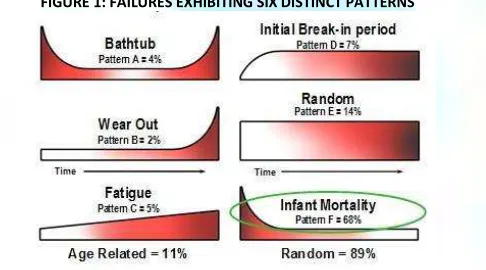
n their ground-breaking work that led to the establishment of the technique that we now know as Reliability Centered Maintenance, Nowlan and Heap found, while analyzing the failures of hundreds of mechanical, structural and electrical components in aircraft, that these failures exhibited six distinct patterns which have been depicted in figure 1.
FIGURE 1: FAILURES EXHIBITING SIX DISTINCT PATTERNS
The interesting finding was that more than two-thirds of all components exhibited early-life failure. It was estimated that, between 1982 and 1991, maintenance errors ranked second only to ‘controlled flight into terrain’ accidents in causing onboard aircraft fatalities (despite the application of RCM techniques in the
airline industry during that period)2. Furthermore, a study of coal-fired power stations indicated that 56% of forced outages occurred less than a week after a
planned or maintenance shutdown.
MAINTENANCE RISKS & HUMAN PERFORMANCE IN MAINTENANCE
The publication is focused on 18 human factors issues which can impact on safety and maintenance performance. These are based on the HSE HSG (65) (reference 7) model under ‘policy’, ‘planning/implementing’, and ‘audit/review’. The issues are listed below:
POLICY & ORGANIZING
Policy
Resource Allocation
Roles, Responsibilities & Accountabilities Formal Communications
Management of Change Organizational Learning
PLANNING & IMPLEMENTING
Procedures and Permits (Contents)
Procedures (Presentation, Understanding, Usability) Work Design
Crew/Shift Handover & Shift Work Individual Capabilities
Competence (Technical and Interpersonal Skills) Teamwork
Supervisory Effectiveness Environmental Factors Plant & Equipment Design
VOLUME NO.2(2012),ISSUE NO.3(MARCH) ISSN 2231-5756
MEASURING PERFORMANCE
Routine Checking of Maintenance Performance
AUDIT & REVIEW
REVIEW OF MAINTENANCE PERFORMANCE
The HSE publication “Reducing error and influencing behavior” suggests that three overall factors affect the performance of any work activity including maintenance. These human factor issues are described below.
• Individual factors: The attributes and capabilities of the person, this includes their personal attitudes, habits and personalities as well as their skills and
competence.
• Job factors: How the requirements of the task match the capabilities of the person undertaking the task. This includes consideration of workplace and environmental factors.
• Organizational factors: The organization has a great impact on the performance of individuals, yet the importance of the health and safety culture of the
organization is often overlooked.
To achieve error free performance from maintenance staff, all three factors were focused upon. Under these factors, following sub-factors were analyzed as follows:
INDIVIDUAL FACTORS
FORMAL COMMUNICATIONS: Maintenance involves activities that need coordination, formal communications. When maintenance errors are analyzed, poor communication, e.g. during shift changeover, is often identified as a contributory cause. Existence of formal communication system, such as permit-to-work, does not inevitably ensure that the right information is communicated to the right people at the right time or ensures that information is communicated unambiguously and that the recipient properly understands it.
To achieve reliable communication following issues were recognized:
• Staff need to hand over work or plant systems to other staff during maintenance
• Staff may forget the maintenance status of plant and equipment so information on this must be provided in a practical and appropriate manner
• Staff may not have a single place of work to which information can be directed, so it is important to check that messages have been received
• Staff must have information about the maintenance requirements and priorities in terms of general requirements and task-specific requirements
• Communication systems should be in place to allow staff to pass information and concerns back to management
• These systems must be structured to ensure that the message is not distorted
PROCEDURES (PRESENTATION, UNDERSTANDING AND USABILITY): Procedures and other documentation only assist in ensuring high standards of safety and maintenance performance if they are used and followed correctly. The level of detail provided must suit the needs of the user and can vary from full procedures to checklists or job aids.
• Use simple language and clearly highlight hazards, critical tasks and checks, eg with suitable warnings
• Clearly indicate part numbers and other reference information, particularly where part numbers are very similar
• Any special tools required should be stated at the start of the procedure.
• Highlight any changes in the procedure and use tick boxes to show stages in a sequence.
• Procedures should be located as close as practicable to the workplace. Ensure checklist/task-list and Standard Maintenance procedures (SMP) are not only
loaded in portal, but also they are kept in hard copy in bound form in workshop.
WORK DESIGN: When scheduling maintenance tasks, the workload of individuals needs to be controlled to avoid excessive stress or tiredness which can lead to poor maintenance performance. Additional problems arise because maintenance tasks are often carried out during unsocial hours (eg nights and weekends). Equally, there is a need to avoid under-utilizing staff as this induces boredom and a loss of skills, again leading to poor maintenance performance. High-hazard industries often make use of back-up systems to ensure safety systems are always available in the event of breakdowns. There is a need to stagger the maintenance of these systems. This will reduce the potential of individuals to repeat errors when maintaining a series of similar equipment.
Poor work design can have an adverse effect on job performance and occupational health, from factors such as excessive mental or physical stress (e.g. unrealistic timescales), excessive boredom (e.g. poor job variety) and lack of motivation (e.g. poor job satisfaction).
INDIVIDUAL CAPABILITIES: Maintenance tasks are often carried out by individuals working with little supervision. They comprise two main activities: manual manipulation of components; and decisions required during fault-finding or following maintenance inspections. People vary greatly in these two aspects, and hence, these factors should be taken into account when devising and implementing maintenance programs.
• Slips and memory lapses Slips and memory lapses (e.g. accidentally pressing the wrong button or missing out a step or steps in a task) usually occur in
tasks which are so frequently carried out that they become ‘automatic’. In general, it is not possible to eliminate these errors through instruction or training. The best approach to controlling these errors is through design, by eliminating the opportunity for making them, e.g. through interlock guards, and ensuring that components can only be fitted in the correct manner.
• Mistakes : Mistakes are situations where, despite a genuine attempt to comply with procedures, an error of judgment leads to an inappropriate rule being
applied or a step in a procedure being done out of sequence. It is possible to reduce such errors by improving the training and the quality of procedural documentation.
• Violation (non-compliance): Violation is a separate form of human failure that occurs when an individual or individuals deliberately contravene established
and known rules. Retraining staff in the correct practices cannot be the answer, as they already know what they should do. Violations are addressed by ensuring that staff does not perceive the benefits of non-compliance to be greater than any adverse consequences.
TEAMWORK:Maintenance staff may need to work in teams, particularly when maintaining larger items of plant and equipment. Therefore, it is important that maintenance staff have the ability to work well with a range of other people, providing mutual support and advice, particularly for new staff.
Shutdown teams – one engineer from a plant where annual turnaround is planned and other Engineer from second plant to work in a team to lead a particular work package is the style in a petrochemical unit considered for study while compiling this paper. More importantly, multi-disciplinary teams are formed for root cause analysis, improvement studies in addition to Quality Circle, Small Group Activity teams. Today’s trend is to follow the winning team concept rather than dependency on champions.
COMPETENCE (TECHNICAL AND INTERPERSONAL SKILLS): As maintenance tasks are often very varied, the experience and skills of maintenance staff are important factors in ensuring high standards of performance. Competency assessment is one of the tools used to implement “Quality Assured Maintenance Management”. The Standard Maintenance Practice includes required competency to carryout the job as detailed in the procedure.
INTERNATIONAL JOURNAL OF RESEARCH IN COMMERCE, IT & MANAGEMENT
JOB FACTORS
RESOURCE ALLOCATION: Failure to provide sufficient resources is a contributory cause in many maintenance incidents. For maintenance, the resources required will include people, time, tools and equipment, and procedures.
PROCEDURES AND PERMITS (CONTENTS): Maintenance procedures provide important controls for ensuring high standards of performance and safety. The role of maintenance procedures is to provide sufficient information to allow the user to carry out tasks correctly. The reasons often quoted for staff not following maintenance procedures and permits are that they are perceived to be inaccurate, out-of-date, impractical, too time consuming, or that they do not describe the ‘best’ way of carrying out the work. To address the accuracy and practicality of procedures and permits, they are periodically reviewed to ensure their relevance, accuracy and practicality through job cycle check.
ORGANIZATIONAL FACTORS
ROLES, RESPONSIBILITIES AND ACCOUNTABILITIES: In many organizations, maintenance can become undervalued by being primarily considered as an overhead with no contribution to profit. This tendency must be vigorously opposed if maintenance activities are to be successfully implemented. In particular, it is important that the maintenance program has clearly specified roles, responsibilities and accountabilities.
CREW/SHIFT HANDOVER AND SHIFT WORK: Failures in communication at crew or shift handovers are a common contributory factor to accidents associated with maintenance tasks carried out by multiple teams. Indeed, many of the UK’s major accidents involve failures in the communication of key aspects of ongoing planned maintenance during shift handover.
Although there is an increasing move away from shift-based maintenance in many industries, some will always remain, either because of the nature of the particular industry or because of the need to support 24-hour operations with breakdown maintenance.
To minimize the potential problems of shift/crew handovers, it is important to ensure that handovers receive a high priority with the necessary resources provided (e.g. Sufficient time) and handovers of higher-risk maintenance activities are identified in advance and are subject to greater control. More than one form of communication (face-to-face, written log sheets, electronic records, etc.) would be effective in this regard.
OTHER CONTRIBUTING FACTORS
PLANT AND EQUIPMENT DESIGN: It is important that plant and equipment are designed so that the required maintenance can be carried out reliably and safely. Many of the situations that can cause poor maintenance performance can be eliminated or alleviated by improved design. Common problems include components that are poorly labeled, not easily accessible and which can be fitted incorrectly (eg the wrong way round).
Designers should take account of ergonomic and human factors and design for maintainability, e.g. frequently visited areas will need safe, suitable and permanent access provided. In majority of process industries maintenance crew gets involved from the beginning of the project and review drawings, model and site conditions so that most of the design related issues are taken care of. Plants are commissioned after thorough pre-startup safety review correcting many such points discussed above.
ROUTINE CHECKING OF MAINTENANCE PERFORMANCE: By its nature, maintenance is made up of activities which are a mixture of routine and non-routine tasks. As such, maintenance errors can originate from various sources. Some errors can be identified and corrected during maintenance, while others may be identified subsequently during post-maintenance testing. However, some errors will remain undetected when the item returns to service. The performance of the maintenance department needs to be routinely checked to identify and correct poor maintenance practices and to identify areas for improvement
REVIEW MAINTENANCE PERFORMANCE
The overall performance of the maintenance function needs to be periodically reviewed to ensure that it is meeting the requirements of your organization and to identify opportunities for improvement in performance.
There are various approaches which can be used to review the performance of maintenance functions:
• Incident reviews to analyze the underlying causes of previous events
• Workplace audits using experienced personnel to look for error-causing factors
• Task analysis to provide a detailed understanding of tasks that appear to be error prone, thereby assisting the identification of preventive measures
• Hazard identification techniques such as failure modes and effect analysis (FMEA) to identify the effectiveness of controls over critical maintenance activities
If poor quality maintenance causes so many incidents in highly regulated and hazardous industries such as nuclear power generation and civil aviation, what proportion of failures is being caused by maintenance within your organization?
What are the outcomes of maintenance-induced failures? Clearly, depending on the industry in which you operate, there are potentially significant safety and environmental risks. There is a long list of catastrophic failures in which, the inadequate performance of a maintenance task played a significant role. But besides the obvious safety risks, perhaps the bigger consequences are economic. General Electric has estimated that each in-flight engine shutdown costs airlines in the region of US$500,000. What could maintenance-induced failures be costing your organization?
Clearly, we need to do something to reduce the number of equipment failures that are being caused, not prevented, by maintenance. This paper suggests that the most appropriate approach is to:
• admit that human error is inevitable (even in maintenance!) and design our systems and processes around this inevitability
• use appropriate tools to ensure that we are not unnecessarily over-maintaining plant and equipment (and therefore increasing the risk associated with the fact that this work may not be performed correctly)
• work to improve the quality with which maintenance activities are performed – including error-proofing where possible.
The quality of maintenance is a major contributory factor affecting safety and operational costs. It affects the operating life of plant and also the risk of accidents during or following maintenance. For example, the tragic accident on the Piper Alpha oil platform involved a series of errors during maintenance. It resulted in the loss of 167 lives and is estimated to have cost over £2 billion, including £76 million in direct insurance payments. The extent and nature of the impact will, of course, depend upon the type of industry and the activities carried out. The focus on human error comes from the recognition that maintenance is largely a human activity. Although it is never possible to totally eliminate human error, it is possible, through good maintenance management and an understanding of the issues that affect error, to move towards this goal and to control the likelihood of error.
MINIMIZE HUMAN ERRORS IN MAINTENANCE
The methodology for minimizing human errors in maintenance focuses on the following aspects:
1. Safety Commitment of Team Leaders and Managers
2. Perceived Impracticality of Safety Rules, Communications and Job Design
3. Plant & Equipment Ergonomics
4. Knowledge and Skills
5. Rules: Application: Relevance and Accuracy
6. Organizational Support and Working Conditions
7. Safety Commitment of Workforce
8. Complacency
VOLUME NO.2(2012),ISSUE NO.3(MARCH) ISSN 2231-5756
10. Organizational Learning and Committed Resources
11. Participation and Quality Training
12. Balance of Productivity and Safety
13. Management Style
SURVEY ON HUMAN FACTORS IN MAINTENANCE (HFIM)
Survey Feedback
1. The main issue in my opinion is “complacency”. A lot is due to repeated jobs over and over again, and not paying attention to little details.
2. Managers and Supervisors need to be more patient when shops get a lot of work. Most mistakes are made when technicians get interrupted during their
tasks to do other jobs and feel pressure to always get done quickly.
3. To improve or reduce HFIM management/errors you need:
a. Effective implementation of supervisory training
b. Timely sharing of information (incidents/ accidents)
c. Motivation at all levels
d. Involvement of leaders and supervisors with the subordinates
4. Personnel should be trained and watched by supervisors to make sure they are gaining an understanding of correct processes and sticking to the
procedures.
5. I think that work-pressure and fatigue are special human error producers. I think generally, the air forces have to consider a rest time for technicians just
like the rest time valid for crew members.
6. Most common outcome is repeat/recur of present malfunction due to lack of efficient maintenance procedures related to HFIM.
7. The most important is psychological factors (i.e. wants, expectations, attitudes and motivation) then next comes human sensory factors and physiological
factors.
AVOID UNNECESSARY MAINTENANCE: Using techniques such as Reliability Centered Maintenance and Preventive Maintenance optimization fully justify maintenance activities and accept the fact that human error is inevitable.
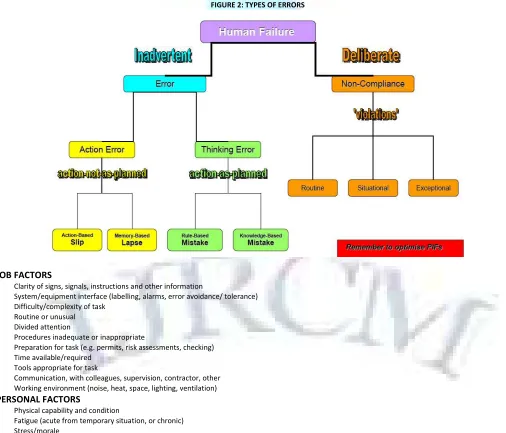
TYPES OF ERRORS AND SOLUTIONS: Performance Influencing Factors (PIFs) are characteristics of the job, the individual and the organization that influence human performance. Optimizing PIFs will reduce the likelihood of all types of human failures. Figure 2 exhibits types of errors.
FIGURE 2: TYPES OF ERRORS
JOB FACTORS
• Clarity of signs, signals, instructions and other information
• System/equipment interface (labelling, alarms, error avoidance/ tolerance)
• Difficulty/complexity of task
• Routine or unusual
• Divided attention
• Procedures inadequate or inappropriate
• Preparation for task (e.g. permits, risk assessments, checking)
• Time available/required
• Tools appropriate for task
• Communication, with colleagues, supervision, contractor, other
• Working environment (noise, heat, space, lighting, ventilation)
PERSONAL FACTORS
• Physical capability and condition
• Fatigue (acute from temporary situation, or chronic)
• Stress/morale
• Work overload/under load
• Competence to deal with circumstances
INTERNATIONAL JOURNAL OF RESEARCH IN COMMERCE, IT & MANAGEMENT
ORGANIZATIONAL FACTORS
• Work pressures e.g. production vs. safety
• Level and nature of supervision / leadership
• Communication
• Manning levels
• Peer pressure
• Clarity of roles and responsibilities
• Consequences of failure to follow rules/procedures
• Effectiveness of organizational learning (learning from experiences)
• Organizational or safety culture, e.g. everyone breaks the rules
SOLUTIONS
1) Writing effective work instructions
Omissions account for more than 50% of all maintenance errors, good work instructions can reduce it. Characteristics of good maintenance work instruction
• Written with the person who is going to read and use
• Avoid complex work instructions
• Simple consistent language
• Use figures and pictures wherever possible
• Use active not passive voice
• Incorporate adequate inspections at key points
• Highlight critical steps (Process Safety Management critical)
2) Training helps to avoid human error
• Qualified and skilled personnel
• Assign tasks appropriately
• Ensure good housekeeping standards
• Good spare part management
FIGURE 3: ROLE PLAYED BY HUMAN PERFORMANCE IN CIVIL AIRCRAFT ACCIDENTS
IATA, 1975 3) Poka-Yoke
Poka-Yoke is fool-proofing, which is the basis of the Zero Quality Control (ZQC) approach, which is a technique for avoiding and eliminating mistakes. Generally this technique is used in manufacturing processes, but has much wider uses, such as; offices - order and invoice processing, hospitals - drug dispensing, aircraft maintenance - particularly with processes having the potential of inducing catastrophic in-service failures.
The term Poka-Yoke is Japanese and can roughly be translated as mistake or fool-proofing. This is especially important when considering the technique and approach requires the workers active participation in the error cause removal programme. Use of dowel pins in assembly to match two mating parts is one of the simple examples of mistake proofing in maintenance. Notably, error cause removal and zero defects are phases first used by Philip Crosby but the approach is very different and should not be confused.
CONCLUSION
Poor maintenance performance can affect both the safety and commercial performance of an organization. No organization can afford to accept loss of image, property or human lives because of human errors. In today’s world of competitiveness, lot is expected from maintenance, and this service is considered as profit centre, and it is understood that maintenance drives manufacturing. The availability, reliability and integrity are assured by maintenance. Even though human errors are inevitable, error minimizing or eliminating techniques through procedures, checklist and training is part of maintenance organization in petrochemical plants. As a proactive move, lot of techniques, such as Positive Metal Identification, Last Chance Inspection, Quality Assurance Sheets, Welding Procedure System, Task List, Job Package Files, Things-to-Do List, Micro Planning, to name a few, are in place in most of the organizations.
ABBREVIATIONS
RCM Reliability Centered Maintenance
PM Preventive Maintenance
FEMA Failure Mode and Effect Analysis
PIF Performance Influencing Factors
HSE Health Safety and Environment
HFIM Human Factors In Maintenance
ZQC Zero Quality Control
UK United Kingdom
REFERENCES
VOLUME NO.2(2012),ISSUE NO.3(MARCH) ISSN 2231-5756
2. Davis R A, Human factors in the global marketplace, Keynote address, Annual Meeting of the Human Factors and Ergonomics Society, Seattle, 2 October
1993.
3. Smith A, Reliability Centered Maintenance, McGraw Hill, Boston 1992.
4. Reason J, Managing the Risks of Organizational Accidents, Ashgate Publishing, 1997.
5. Boeing, Maintenance error decision aid, Boeing Commercial Airplane Group, Seattle 1994.
6. Reason J and Hobbs A, Managing Maintenance Error, Ashgate Publishing, 2003.
7. Orlick T, In Pursuit of Excellence, Zone of Excellence, Ottowa 2000.
8. Assuring High Performance in an Age of Complexity, Jossey-Bass, 2001.
9. Reducing error and influencing behaviour HSG48 HSE Books 1999 ISBN 0 7176 2452 8 How Mistake Proof Are Your Processes? –
10. Improving Maintenance by Reducing Human Error, Steve Mason BSc (Hons) MSc EurErg FErgS MIOSH, Principal Human Factors Consultant, Health, Safety &
Engineering Consultants Limited (HSEC), Managing Human Error in Maintenance by Sandy Dunn.
11. Improving maintenance a guide to reducing human error – health and safety executive.
12. Work Instructions for Mistake Proofing - By Kiran Walimbe.
INTERNATIONAL JOURNAL OF RESEARCH IN COMMERCE, IT & MANAGEMENT
REQUEST FOR FEEDBACK
Dear Readers
At the very outset, International Journal of Research in Commerce, IT and Management (IJRCM)
acknowledges & appreciates your efforts in showing interest in our present issue under your kind perusal.
I would like to request you to supply your critical comments and suggestions about the material published
in this issue as well as on the journal as a whole, on our E-mails i.e.
or
for further improvements in the interest of research.
If you have any queries please feel free to contact us on our E-mail
.
I am sure that your feedback and deliberations would make future issues better – a result of our joint
effort.
Looking forward an appropriate consideration.
With sincere regards
Thanking you profoundly
Academically yours
Sd/-