http:// journals.tbzmed.ac.ir/JCS
* Corresponding Author: Roya Moeinpoor (MSc), E-mail: [email protected]
Emergency Contraception: Providers’ Knowledge and Attitudes and Their
Relationship with Users’ Knowledge and Attitudes at Public Health
Centers/Posts of Tabriz
Sakineh Mohammad-Alizadeh-Charandabi1, Azizeh Farshbaf-Khalili2, Roya Moeinpoor3* 1
PhD. Assistant Professor, Department of Midwifery, Faculty of Nursing and Midwifery, Tabriz University of Medical Sciences, Tabriz, Iran
2
MSc, Department of Midwifery, Faculty of Nursing and Midwifery, Tabriz University of Medical Sciences, Tabriz, Iran 3
MSc, Postgraduate student, Department of Midwifery, Faculty of Nursing and Midwifery, Tabriz University of Medical Sciences, Tabriz, Iran
ARTICLE INFO ABSTRACT
Article type:
Original Article
Introduction: Emergency contraceptives are accessible and acceptable methods for most women, which their proper use could prevent about three quarters of unwanted pregnan-cies. In this study, we aimed to determine the providers’ knowledge, attitudes and their relation with the pills and condoms users’ knowledge of and attitudes towards emergen-cy contraception at public health centers/posts in Tabriz, Iran. Methods: In this cross-sectional study, subjects were 140 health providers working in randomly selected 19 health centers and 33 health posts and 280 married women aged 15 to 49 years who were using contraceptive pills or condoms (two clients of each selected provider). A self-administered questionnaire was used to collect data from the providers, while the questionnaire for the clients was filled up by face-to-face interview. The relationships were determined by Pearson’s correlation test. Results: Mean score of the providers’ knowledge and attitude was 69.4 ± 11.8 and 70.1 ± 12.8, respectively (possible score range was 0-100). The providers’ knowledge score was good only in 35% (score > 75.0). High majority (95.7%) had positive attitudes (score > 50.0). Overall, there were no sig-nificant relationships, neither between the provider's and users' knowledge nor between their attitudes (p > 0.05).Conclusion: The providers’ knowledge was insufficient, and there was no significant association between the providers' and users’ knowledge and attitudes. Thus, in addition to the need for promoting providers' knowledge, the other barriers should also be recognized and removed in order to promote using this method. Article History:
Received: 7 Feb. 2012
Accepted: 2 May 2012
ePublished:26 May 2012
Keywords:
Knowledge, attitude
Provider
User
Post coital contraception
Introduction
Despite promising advances in technology
about modern methods of contraception,1
about one third of pregnancies in the world are
still unintended. 2 This is one of the most
im-portant health, social and economic problems
all around the world.3 One of the important
methods in family planning is the emergency
contraceptives (ECs)4 which refer to some
me-thods of birth control that are used in a certain
time after unprotected intercourse.5 The
emer-gency contraception promisingly introduce availability of an effective method to reduce
unintended pregnancies and abortion.6 The
main problem in the ECs is not their failure or side effects. The problem is the little or even no knowledge and also the neutral or negative attitude of both health workers and women
about ECs which prevents using them.7 This
problem has been shown in studies conducted
Tur-54 | Journal of Caring Sciences, 2012, 1 (1), 53- 59 Copyright © 2012 by Tabriz University of Medical Sciences
key.9 In this regard, the results of some studies
indicated a relationship between using the ECs with the knowledge and awareness of health
care personnel and the women.10, 11
Combined pills and pills with levonorge-strel are the only ways for the emergency con-traception provided at public health
cen-ters/posts in our country.12 To prevent
un-wanted pregnancies, the required education about the emergency methods should be pro-vided for all women at the risk of pregnancy and ensure them about the safety of these
me-thods.13 Health care workers, especially
mid-wives and family health graduates, have a heavy duty in preserving and promoting the public health and they are main responsible persons to provide family planning programs.
Limited studies have been conducted on knowledge and attitudes of health workers in
Iran8-14 and no study in this area was found in
Tabriz. Furthermore, we found no study about the association between knowledge and atti-tudes of providers and the users of emergency contraceptive pills (ECPs). In addition, choice of contraceptive method for people at the risk of unwanted pregnancy is among the research priorities of Tabriz University of Medical Sciences. Therefore, this study was conducted with the aim to determine the knowledge and attitudes of the providers and their relationships with knowledge and attitudes of the users of condoms and the combined pills about the ECPs.
Materials and methods
This cross-sectional study was conducted at public health centers and posts of Tabriz, Iran in 2010. The study population consisted of midwives and family health graduates work-ing in the centers/posts and all the married women of reproductive age (15 to 49 years) who were admitted to these centers for receiv-ing family plannreceiv-ing and/or maternal and child services. The sample size were calculated 130 persons according to the results of the previous
study14 using the formula to estimate one
pro-portion considering P = 57%, d = 0.085 and α = 0.05; and regarding almost 10% for
proba-bility of loss, the final sample size of 140 sub-jects was considered.
Among the 27 centers and 53 posts, 19 cen-ters and 33 posts were randomly selected. In the selected centers and posts, we recruited all eli-gible family planning providers, and one con-traceptive pill user as well as one condom user that were covered by each selected provider. The clients were selected through convenience sampling. The inclusion criteria for the provid-ers were midwives or family health graduates with associate or bachelor degree and at least six months duration of work at their working place. For the users, the inclusion criteria were the married women aged 15 to 49 years referred to receive health care services, not having any mental and physical illness, living in Tabriz, using the combined pills or condoms as a con-traceptive method for at least 6 months, receiv-ing family plannreceiv-ing services from the respective provider for at least 6 months.
of each provider (one pills and one condoms user) was considered as the scores of know-ledge and attitudes of the clients. The score of knowledge from zero to 50.0 was considered as poor, 50.1 to 75.0 as moderate and 75.1 to 100 as good knowledge. The attitudes score of up to 50.0 was considered as the negative attitude and more than 50.0 as a positive attitude.
To determine the content validity of the questionnaires we used the feedback of seven midwifery and gynecology faculty members and two service providers. In order to deter-mine the test-retest reliability, the question-naires was completed on two occasions with 10 days interval for 15 users and 10 providers and their correlation were calculated using the Pearson correlation test. Correlation coeffi-cients of 0.94 and 0.95 for knowledge and the attitude of providers and 0.81 and 0.82 for us-ers were obtained, respectively. Data were coded and analyzed using SPSS Version 13. Frequency, mean and standard deviation were computed for quantitative variables, and fre-quency distributions were generated for cate-gorical variables. The Pearson test was used to determine the relationship between knowledge and the attitudes score of the providers and users. The p < 0.05 was considered as statisti-cally significant.
Ethical permission for study was obtained from the Ethics Committee of Tabriz Universi-ty of Medical Sciences (no. 5/4/6715). An in-formed written consent was obtained from each of the subjects to participate in the study.
Results
About half (53%) of the providers were in the age group of 30 to 39 years, 80% were married, about two third (69%) had a bachelor's degree and the study field of three-quarters (76%) was midwifery. The overall average length of em-ployment and working in family planning unit was 12.3 ± 6.0 and 10.3 ± 5.9 years, respectively (Mean ± SD). Only 28% had worked as a fami-ly planning provider for less than 5 years. 88% had participated in in-service family planning courses over the past two years. Most
partici-pants (83%) mentioned the booklets and circu-lar letters of the Ministry of Health as a main source of information about ECPs. The average number of their pregnancies was 1.7 ± 0.9 and 6.2% had no pregnancy at all. One-tenth (9.7%) mentioned a history of unplanned pregnancies over the last 5 years and 44% had a history of ever using emergency contraception.
The average age of the users was 29.9 ± 5.8 years. About two-thirds (64%) of the users had a secondary or high school education. Average number of their pregnancies was 1.8 ± 0.9.
Eight of the users of the pills and four of condoms were not familiar with the ECPs which they were given a zero score for their knowledge but in terms of attitude, they were excluded from analysis.
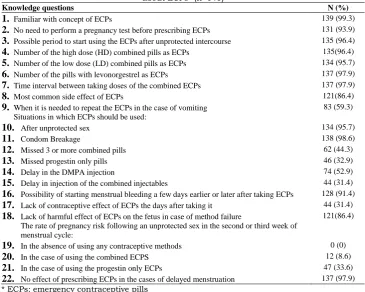
Mean knowledge score of the providers and users (score range 0-100) was 69.4 ± 11.8 and 52.3 ± 13.0, respectively. The providers' know-ledge was poor in the 3.6%, moderate in 61.4% and good in 35%. The users’ knowledge of ECPs in 44.3% was poor, 54.3% was moderate and 1.4% was good. In 7 out of 22 questions, more than half of the providers' knowledge was poor as shown in Table 1. The highest per-centages in lack of providers' knowledge were in the fields of possibility of pregnancy follow-ing an unprotected sex in the absence of usfollow-ing any contraceptive method (100%), in the case of using the combined ECPs (91%) and in the case of using the levonorgestrel ECPs (66%); lack of contraceptive effect of emergency pills the days after taking them (69%); the need of taking ECPs in late injection of combined injec-tables (69%), late taking of progestin only pills (67%), and missed 3 or more combined pills (56%), in the case of intercourse.
56 | Journal of Caring Sciences, 2012, 1 (1), 53- 59 Copyright © 2012 by Tabriz University of Medical Sciences with the statement that "if adolescents and
unmarried young people be aware of ECPS, the possibility of unprotected sex will be in-creased among them" (55%) and "using ECPs,
for reasons such as reducing the consistent and correct use of condoms, increase the rate of sexually transmitted diseases, such as HIV" (48%).
Table 1. Frequency of the providers’ correct answers to knowledge questions about ECPs* (n=140)
Knowledge questions N (%)
1. Familiar with concept of ECPs 139 (99.3)
2. No need to perform a pregnancy test before prescribing ECPs 131 (93.9)
3. Possible period to start using the ECPs after unprotected intercourse 135 (96.4)
4. Number of the high dose (HD) combined pills as ECPs 135(96.4)
5. Number of the low dose (LD) combined pills as ECPs 134 (95.7)
6. Number of the pills with levonorgestrel as ECPs 137 (97.9)
7. Time interval between taking doses of the combined ECPs 137 (97.9)
8. Most common side effect of ECPs 121(86.4)
9. When it is needed to repeat the ECPs in the case of vomiting 83 (59.3) Situations in which ECPs should be used:
10. After unprotected sex 134 (95.7)
11. Condom Breakage 138 (98.6)
12. Missed 3 or more combined pills 62 (44.3)
13. Missed progestin only pills 46 (32.9)
14. Delay in the DMPA injection 74 (52.9)
15. Delay in injection of the combined injectables 44 (31.4)
16. Possibility of starting menstrual bleeding a few days earlier or later after taking ECPs 128 (91.4)
17. Lack of contraceptive effect of ECPs the days after taking it 44 (31.4)
18. Lack of harmful effect of ECPs on the fetus in case of method failure 121(86.4) The rate of pregnancy risk following an unprotected sex in the second or third week of
menstrual cycle:
19. In the absence of using any contraceptive methods 0 (0)
20. In the case of using the combined ECPS 12 (8.6)
21. In the case of using the progestin only ECPs 47 (33.6)
22. No effect of prescribing ECPs in the cases of delayed menstruation 137 (97.9)
* ECPs: emergency contraceptive pills
Table 2. Frequency of positive attitude* of the providers towards ECPs (n=140)
Attitude statements N (%)
1. Using ECPs can cause abortion† 123 (87.9)
2. Using ECPs may reduce the correct and consistent usage of other methods of contraception† 91(65.0)
3. It is better that all women in childbearing age have information about ECPs 139 (99.3)
4. ECPs should be easily available without prescription 107 (76.4)
5. Teaching the proper use of ECPs to women of childbearing age can help reducing deliberate abortion rates in the community
134 (95.8)
6. If adolescents and unmarried young people be aware of ECPs, the possibility of unprotected sex will be increased among them†
63 (45.0)
7. Using ECPs increase the rate of sexually transmitted diseases such as HIV owing reasons such
as reducing the use of condoms† 72 (51.7)
8. All sexually active men should be aware of ECPs 107 (76.5)
9. Counseling about emergency contraception methods should be a part of rouine education and counseling on contraceptive methods
134 (95.7)
ECPs: emergency contraceptive pills
* Total responses of "completely agree" and "agree" in statements with positive direction and "disagree" and "completely disagree" in statements with the negative direction
Table 3. Frequency of the users' knowledge level by the providers' knowledge level The users’
knowledge* level
The providers' knowledge level Total
Good Moderate Poor
Good 1 (2.0) 1 (1.2) 0 (0.0) 2 (1.4) Moderate 30 (61.2) 45 (52.3) 1 (20.0) 76 (54.3) Poor 18 (36.8) 40 (46.5) 4 (80.0) 62 (44.3) Total 49 (35.0) 86 (61.4) 5 (3.6) 140 (100) The data are given as n (%)
* calculated from mean score of two clients (one pills and one condom user) of each provider
Table 3 shows frequency of the users' know-ledge by the providers' knowledge level. Pearson's correlation results showed that there was no significant relationship be-tween the knowledge as well as attitudes score of the providers and users about the
methods of emergency contraception
(p > 0.05).
Discussion
Findings of this study showed that 99% of the providers were familiar with the emergency contraception but only one third of them had a good knowledge of these methods in details. In Rahaman and colleagues research in India, 85% of the providers stated that they have heard about this method but only the know-ledge of 30% of them was good with the
de-tails of the methods.15 Jamali and colleagues in
Mazandaran,8 McDonald and colleagues in
Melbourne16 and Margaret and colleagues in
Nigeria17 also reported similar results.
The results showed that the majority of the providers had a well knowledge about the correct dose and time of taking ECPs. These results are consistent with Delaram and
col-leagues’ study results in Shahrekurd14 and
Bildircin and colleagues in Turkey.18
According to the WHO, the fetus is not at risk if a pregnant woman uses the emergency methods or if these methods fail in contracep-tion. Therefore, performing a pregnancy test before prescribing these methods is not
neces-sary.19 94% of the providers had correct
know-ledge in this case in the present study while the rate of 67% was reported by the study of
Abdulghani and colleagues in Pakistan.20
The most common side effects of taking ECPs are nausea and vomiting which may
lead not to take the second dose of the drug
and thus reducing its effectiveness.4-19 In this
study, the correct knowledge of the most common side effect of ECPs was 86.4% that is comparable with results of Chung-Park and
colleagues study in America with 80%.21 In
the present study, about 40% of providers did not know about the need to repeat the dose in case of vomiting within two hours after tak-ing the ECPs. In Abdulghani and colleagues study in Pakistan, one third of people were
not aware of this issue.20
Over 95% of providers were aware of the common use of emergency methods, includ-ing condom breakage and unprotected sex, but their information on using emergency methods in the case of the failure or forget-ting the usage of other methods of contracep-tion was poor. In the studies of Sevil et al. in
Turkey9 and Margaret et al. in Nigeria17
simi-lar results were reported too. These important findings indicate that the real purpose of pro-viding emergency methods is not understood by many health care providers as also shown
in other studies.9-22 So, the service providers
should be educated of the proper use of these methods in failure or misuse in all.
This is important to know that ECPs do not prevent of pregnancy following the next
unprotected sex.19 In This study, more than
two thirds of the providers were not aware of this issue. According to WHO, a chance of pregnancy following an unprotected sex in the second or third week of the cycle, in the absence of using any contraceptive methods is 8%, in case of using combined ECPs is 2% and in case of using pills with levonorgestrel
is 1%.19 Only a few of the providers were
58 | Journal of Caring Sciences, 2012, 1 (1), 53- 59 Copyright © 2012 by Tabriz University of Medical Sciences colleagues' research in America shows that
78% of the physicians considered the
emer-gency methods very effective.5 Goyal and the
colleagues’ study in America indicates that 67% of pediatricians were aware of the effect
of this method.23 Lack of proper information,
especially in cases where and when a contra-ceptive method should be used can be one of the main reasons for failure to provide the method. Therefore, the comprehensive and reliable information of the providers about the methods and counseling with clients about them can increase the usage of these
methods by women in necessary cases.24
About half of the providers believed that the awareness about the emergency contra-ception methods will reduce the use of con-doms and inevitably, will increase the rates of unprotected sex and the sexually transmit-ted diseases by seeking access to these me-thods. These findings are similar to the re-sults of Byamugisha and colleagues research
in Uganda.25 However, the results of studies
have shown that severe restrictions on access or easy access to EC methods had no associa-tion with the decrease of regular use of con-traceptive methods or made no increase in
sexually transmitted diseases.26
Despite the common negative views about some issues related to emergency methods, majority of providers (96%) had positive atti-tude in most areas. Most of them agreed that women in reproductive age should be further educated about these issues and the conve-nient access to this method should be provided.
Emergency contraception methods are complement and the effective support for
ongoing methods.9 However, it seems that
providing and the availability of these me-thods alone is not the solution for preventing unwanted pregnancies and proper counsel-ing in this area is more important. It seems acquisition of knowledge during pre- and in-service education of the providers in this area is not sufficed. Moreover, the health workers should be encouraged to notify women about EC methods as a part of routine programs
and family planning counseling.5
One of the limitations in our study was the lack of random sampling in the users of con-traceptive methods. Due to the lack of study in the field of barriers in prescribing emer-gency methods from the perspective of pro-viders in Iran, conducting a research in this area is recommended.
Conclusion
The results of this research showed inade-quate knowledge and negative attitudes of health workers and the users about the some aspects of EC method and the lack of signifi-cant correlation between knowledge and atti-tudes of providers and users. Therefore, in order to promote awareness and attitudes of the users, it is necessary that in addition to the use different educational methods to en-hance awareness and attitudes of providers, other barriers in service delivery should be identified and tried to eliminate them.
Ethical issues
None to be declared.
Conflict of interest
The authors declare no conflict of interest in this study.
Acknowledgments
This paper is extracted from thesis of the cor-responding author. We would like to appre-ciate the Research Deputy of the Tabriz Uni-versity of Medical Sciences for the approval and funding of this research project, the offi-cials and staff of the health centers/posts in Tabriz and the participating providers and women in this study.
References
1. World Health Organization. Unsafe abortion: glob-al and regionglob-al estimates of the incidence of unsafe abortion and associated mortality in 2003. 5th ed. Geneva: WHO, 2007.
3. Bernabe-Ortiz A, White PJ, Carcamo CP, Hughes JP, Gonzales MA, Garcia PJ, et al. Clandestine in-duced abortion: prevalence, incidence and risk fac-tors among women in a Latin American country. CMAJ 2009; 180(3): 298-304.
4. Fritz MA, Speroff L. Clinical Gynecologic Endo-crinology and Infertility. 8th ed. Philadelphia: Lip-pincott Williams & Wilkins; 2010. p. 1040-1.
5. Delbanco SF, Stewart FH, Koenig JD, Parker ML, Hoff T, McIntosh M. Are we making progress with emergency contraception? Recent findings on American adults and health professionals. J Am Med Womens Assoc 1998; 53 (5 Suppl 2): 242-6.
6. Jackson R, Schwarz EB, Freedman L, Darney P. Knowledge and willingness to use emergency con-traception among low-income post-partum women. Contraception 2000; 61(6): 351-7.
7. Chiou VM, Shrier LA, Emans SJ. Emergency post-coital contraception. J Pediatr Adolesc Gynecol 1998; 11(2): 61-72.
8. Jamali B, Azimi Orimi H. Knowledge, attitude and practice of practitioners and midwives working at health centers of main cities of Mazandaran prov-ince about emergency contraception. J Mazandaran Univ of Med Sci 2007; 17(57): 75-81. (Persian).
9. Sevil U, Yanikkerem E, Hatipoglu S. A survey of knowledge, attitudes and practices relating to emer-gency contraception among health workers in Ma-nisa, Turkey. Midwifery 2006; 22(1): 66-77.
10.Ebrahemi M, Mesgarzadeh M, Mogadam Tabrizi F. Use and educational needs about emergency con-traception among married woman. Journal of Go-nabad University of Medical Sciences 2006; 12(1): 19-22. (Persian).
11.Pakseresht S, Mirhagjoo S, Kazem Nejad E, Vazi-feh Shenas A. Women's educational needs regard-ing to family plannregard-ing methods. J Gilan Univ Med Sci 2005; 14(53): 9-12. (Persian).
12.Eslami M, Farrokh Eslamlo H. Clinical practice Guidelines for contraceptive in the Islamic Repub-lic of Iran. Tehran: The Ministry of Health and Medical Education. Department of Family Health and Population, Family Planning Office; 2010. p. 95-7. (Persian).
13.Brown B. Many women at high risk of unintended pregnancy are unaware of emergency contraception or how to use it. Family Planning Perspectives 2001; 33(1): 42-3.
14.Delaram M, Hasan pour Dehkordi A, Norian K, Kazemian A, Frozandeh N. Knowledge, attitude and practice regarding emergency contraception among providers at health centers of shahrekurd in
2007. Journal of Gorgan Bouyeh Faculty of Nurs-ing & Midwifery 2008; 5(1): 20-8. (Persian).
15.Rahaman H, Renjhen P, Kumar A, Pattanshetty S, Sagir A, Dubey H. A study on emergency contra-ception practice among nursing staff in Sikkim, In-dia - a cross sectional study. A M J 2010; 3(10): 667-71.
16.McDonald G, Amir L. Women's knowledge and attitudes about emergency contraception: a survey in a Melbourne women's health clinic. Aust N Z J Obstet Gynaecol 1999; 39(4): 460-4.
17.Ebuehi OM, Ebuehi OA, Inem V. Health care pro-viders' knowledge of, attitudes toward and provi-sion of emergency contraceptives in Lagos, Nige-ria. Int Fam Plan Perspect 2006; 32(2): 89-93.
18.Bildircin M, Sahin NH. Knowledge, attitudes and practices regarding emergency contraception among family-planning providers in Turkey. Eur J Contracept Reprod Health Care 2005; 10(3): 151-6.
19.World Health Organization Department of Repro-ductive Health and Research (WHO/RHR), Johns Hopkins Bloomberg School of Public Health /Center for Communication Program (CCP), Info Project.Family planning: a global handbook for providers. Baltimore and Geneva: CCP and WHO; 2008. p. 53
20.Abdulghani HM, Karim SI, Irfan F. Emergency contraception: knowledge and attitudes of family physicians of a teaching hospital, Karachi, Pakistan. J Health Popul Nutr 2009; 27(3): 339-44.
21.Chung-Park M. Emergency contraception know-ledge, attitudes, practices, and barriers among pro-viders at a military treatment facility. Mil Med 2008; 173(3): 305-12.
22.Tripathi R, Rathore AM, Sachdeva J. Emergency contraception: knowledge, attitude, and practices among health care providers in North India. J Ob-stet Gynaecol Res 2003; 29(3): 142-6.
23.Goyal M, Zhao H, Mollen C. Exploring emergency contraception knowledge, prescription practices, and barriers to prescription for adolescents in the emergency department. Pediatrics 2009; 123(3): 765-70.
24.Lindberg CE. Emergency contraception: the nurses' role in providing postcoital options. J Obstet Gyne-col Neonatal Nurs 1997; 26(2): 145-52.
25.Byamugisha JK, Mirembe FM, Faxelid E, Gemzell-Danielsson K. Knowledge, attitudes and prescribing pattern of emergency contraceptives by health care workers in Kampala, Uganda. Acta Obstet Gynecol Scand 2007; 86(9): 1111-6.