________________
*Corresponding author
Received April 1, 2016
934
Available online at http://scik.org
J. Math. Comput. Sci. 6 (2016), No. 5, 934-942
ISSN: 1927-5307
USING F-TRANSFORM TO REMOVE IMAGE NOISE
AWNI M. ABU-SAMAN* AND HUDA S. AL-ZERAI
Department of Mathematics, Al-Azhar University-Gaza (AUG), Gaza, PALESTINE
Copyright © 2016 Awni M. Abu-Saman and Huda S. AL-Zerai. This is an open access article distributed under the Creative Commons Attribution License, which permits unrestricted use, distribution, and reproduction in any medium, provided the original work is properly cited.
Abstract: This paper is devoted to investigate fuzzy transform from the approximation point of view and to incorporate it as a technique to remove image noise. It will be applied to remove random variation Impulsive Noise. The Numerical Algorithm based on fuzzy transform will be implemented as a user-subroutine in the mathematical code MATLAB. The algorithm will be simulated to remove different ratios of Random Variation Impulsive Noise. An example will be given to show the efficiency of applying F-transform to data processing and results will be compared with Adaptive Wiener Filter.
Keywords: F-transform; Numerical Algorithm; Image processing; Random Variation Impulsive Noise. 2010 AMS Subject Classification: 65N22, 26A33, 41A55, 65B05, 65L05, 65L06, 65D30.
1. Introduction
The main concept of fuzzy set theory was set by L.A. Zadeh [13] provided mathematicians
with solid infrastructure for modelling applied physical and engineering problems. The fuzzy
transform has been developed as one of the fields depending on the fuzzy approximation models.
Fuzzy transform has been proposed and used as an efficient and a pilot approximation technique
for approximating numerical solutions for fractional and non-fractional differential equations [1-
4].
The fuzzy transform has been introduced for the first time by I. Perfilieva in 2001, since
this time it already proved itself in solving many physical, mathematical, financial problems, data
compression and reconstruction, image processing and fusion, control systems, … etc. [1-4, 9, 10,
noise from images. In this paper, we developed I. Perfilieva algorithm [12] with f-transform
applied to data processing in removing the Random Variation Impulsive Noise.
Image noise is one of the most well-known problems in image data processing field, there
are many reasons to get an image with noise, it can be produced by the sensor of a scanner or
digital camera. Noise can damage data in the original image, so removing noise is a very important
task in image processing. There are many types of noises, each type has a different method to deal
with. In this study we will apply the F-transform to remove Random Variation Impulsive Noise.
2. F-Transform
In this section we will only include main definitions of F-transform that will be used in the
next sections of numerical implementations of image noise. Main definitions of fuzzy sets and
transform, triangular shaped basic functions and Sinusoidal shaped basic functions can be found
with details in [1, 3, 10].
Let [𝑎, 𝑏] as a common domain 𝓓 for all functions in our study, this domain is partitioned
into subintervals “Fuzzy Partition” to define membership functions to introduce fuzzy sets.
Definition 1[10] Let 𝑥0 = 𝑥1 < 𝑥2 < ⋯ < 𝑥𝑛 = 𝑥𝑛+1 be fixed nodes within 𝒟 = [𝑎, 𝑏] such that 𝑥1 = 𝑎, 𝑥𝑛 = 𝑏 and 𝑛 ≥ 2. We say that fuzzy sets 𝐴1, … , 𝐴𝑛 are basic functions and form a fuzzy
partition of 𝓓 if the following conditions hold true for each 𝑖 = 1, … , 𝑛:
𝐴𝑖: [𝑎, 𝑏] → [0, 1], 𝐴𝑖(𝑥𝑖) = 1,
𝐴𝑖(𝑥) = 0 if 𝑥 ∉ (𝑥𝑖−1, 𝑥𝑖+1),
𝐴𝑖 is continuous on 𝒟,
𝐴𝑖 strictly increases on [𝑥𝑖−1, 𝑥𝑖] and strictly decreases on [𝑥𝑖, 𝑥𝑖+1],
∑𝑛𝑖=1𝐀i(x) = 1, ∀x ∈ 𝒟.
If the nodes 𝑥1, … , 𝑥𝑛 are equidistant, then ℎ = 𝑏−𝑎
𝑛−1 ,and 𝑥𝑖 = 𝑎 + ℎ(𝑖 −
1), ∀ 𝑖 = 1, … , 𝑛
so the following properties are hold:
𝐴𝑖(𝑥𝑖 − 𝑐) = 𝐴𝑖(𝑥𝑖+ 𝑐), ∀𝑐 ∈ [0, ℎ], 𝑖 = 2, … , 𝑛 − 1, 𝑛 > 2,
𝐴𝑖(𝑥𝑖 + 𝑐) = 𝐴𝑖+1(𝑥𝑖+1− 𝑐), ∀𝑐 ∈ [0, ℎ], 𝑖 = 1, … , 𝑛 − 1, 𝑛 ≥ 2.
The most popular basic functions are triangular shaped and Sinusoidal shaped [10]
Since in image processing we deal with images as two dimensions matrix, we will introduce
the two dimensional forms of direct F-transform and inverse F-transform.
Definition 2 [10] Let a fuzzy partition of 𝒟2 be given by {𝐴1, … , 𝐴𝑛} × {𝐵1, … , 𝐵𝑚} and let 𝑓 ∈ 𝒞(𝒟2). We say that a real matrix 𝐹2[𝑓] = [𝐹
𝑖𝑗]𝑛×𝑚 given by
𝐹𝑖𝑗 =∫ ∫ 𝑓(𝑥, 𝑦)𝐴𝑖(𝑥) 𝑏 𝑎 𝐵𝑗(𝑦)𝑑𝑥𝑑𝑦 𝑑 𝑐 ∫ ∫ 𝐴𝑐𝑑 𝑎𝑏 𝑖(𝑥)𝐵𝑗(𝑦)𝑑𝑥𝑑𝑦 (1)
For 𝑖 = 1, … , 𝑛 , 𝑗 = 1, … , 𝑚
is the F-transform of 𝑓 with respect to the given fuzzy partition. The real number 𝐹𝑖𝑗 are called the
components of the F-transform of 𝑓.
And to transform the integral f-transform back we use the inverse F-transform formula
Definition 3 [10] Let 𝐹2[𝑓] be the F-transform of a function 𝑓 ∈ 𝒞(𝒟2) with respect to a given partition{𝐴1, … , 𝐴𝑛} × {𝐵1, … , 𝐵𝑚}. Then the function
𝑓𝑛,𝑚𝐹 (𝑥, 𝑦) = ∑ ∑ 𝐹𝑖𝑗𝐴𝑖(𝑥) 𝑚 𝑗=1 𝐵𝑗(𝑦) 𝑛 𝑖=1 (2)
is called the inverse F-transform of 𝑓
3. Random Variation Impulsive Noise
Random Variation Impulsive Noise is also called the Gaussian noise, it is randomly occurs
as white intensity values [7].
There are several ways through which noise can be introduced into an image, depending on how
the image is created such as Satellite images.
It can be generated by
𝑝(𝑥) = 1
𝜎√2𝜋𝑒
−(𝑥−𝜇)2𝜎22
Where 𝑥 represents the gray level, 𝜇 the mean value and 𝜎 the standard deviation.
To remove the noise from image we will develop the algorithm used in [12] for images
fusion, Taking into consideration the difference between the two processes.
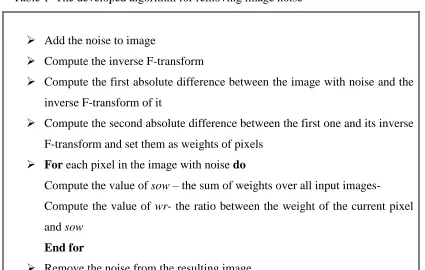
Table 1 The developed algorithm for removing image noise
Add the noise to image
Compute the inverse F-transform
Compute the first absolute difference between the image with noise and the
inverse F-transform of it
Compute the second absolute difference between the first one and its inverse
F-transform and set them as weights of pixels
For each pixel in the image with noise do
Compute the value of sow – the sum of weights over all input images-
Compute the value of wr- the ratio between the weight of the current pixel
and sow
End for
Remove the noise from the resulting image
5. Example and Results
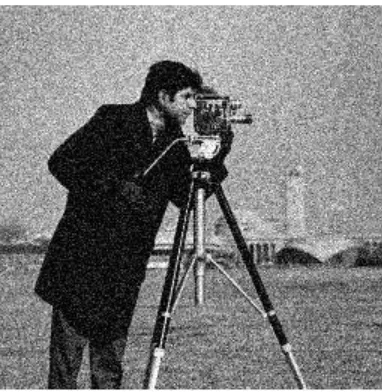
Fig. 2 The image with 5% noise
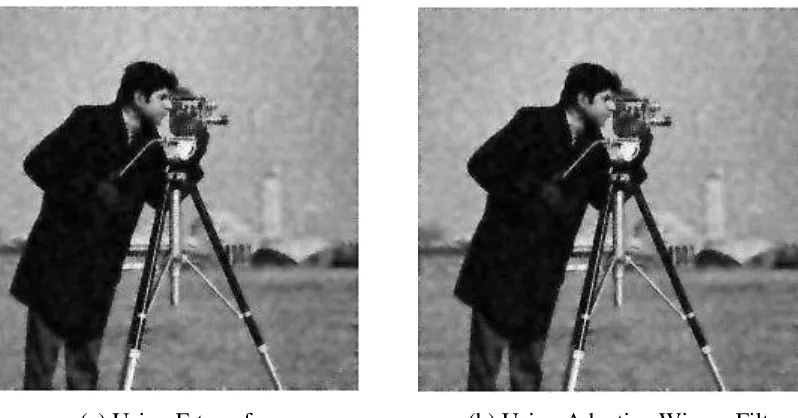
(a) Using F-transform (b) Using Adaptive Wiener Filter
Fig. 4 The image with 10% noise
(a) Using F-transform (b) Using Adaptive Wiener Filter
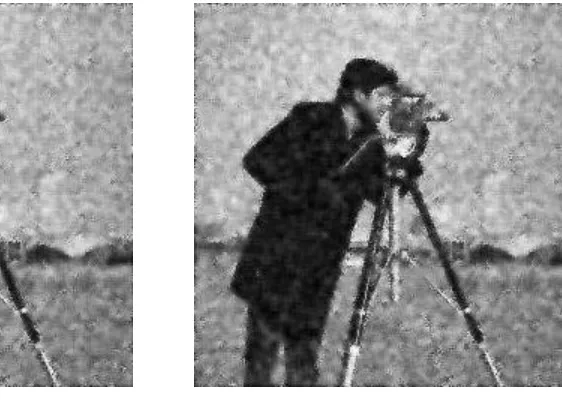
Fig. 6 The image with 20% noise
(a) Using F-transform (b) Using Adaptive Wiener Filter
Fig. 7 Resulting images
To compare between results from using the F-transform and Adaptive Wiener Filter, we
compute the quality of each resulting image by comparing it with the original image, we use the
following relation [9].
𝑄(𝑓) = (1 −∑ ∑ |𝑓(𝑖, 𝑗) − 𝐼(𝑖, 𝑗)|
𝑁 𝑗=1 𝑀 𝑖=1
∑ ∑𝑁 𝐼(𝑖, 𝑗)
𝑗=1 𝑀 𝑖=1
) × 100 (3)
Where I the original image of size M×N.
variation 5% 10% 20%
Adaptive Wiener Filter 92.66% 89.81% 86.45%
F-transform 92.72% 89.91% 86.56%
The algorithm in table (1) is implemented as a user subroutine in the mathematical code
MATLAB [8]. Fig. (1) shows the original cameraman image, figures (2), (4), and (6) show
cameraman image after adding Random Variation Impulsive Noise with rates 5%, 10%, and 20%
respectively. Figures (3.a), (5.a), and (7.a) show images after applying F-transform Algorithm.
Figures (3.b), (5.b), and (7.b) show images after applying Adaptive Wiener Filter.
As we see in Table 2, results obtained by applying the F-transform gives better results than ones
obtained by Adaptive Wiener Filter for different noise rates.
6. Conclusions
In this paper; We developed Perfilieva I. F-transform algorithm for image fusion to be used
for removing Random Variation Impulsive Noise. Results obtained were slightly better than using
Adaptive Wiener Filter, our results encouraged us to consider the F. transform as a powerful tool
for removing noise and to curry out future research with a modified F-transform Algorithm to get
better results, and to develop the algorithm to remove other types of noises.
Conflict of Interests
The authors declare that there is no conflict of interests.
REFERENCES
[1] Abu-Saman A. and El-Zerii H., Numerical Solution of initial value problems using Fuzzy Transform, International Journal of Applied Engineering Research, 9(2014), 13667-13675.
[2] Abu-Saman A. and El-Zerii H., Fuzzy Transform Algorithm for partial fractional differential equations, Journal of Mathematical and Computational Science, 6(2016), No. 2, 235-246.
[3] Abu-Saman A. and El-Zerii H., Solving Fractional Order Differential Problems using Fuzzy Transform, Journal
of informatics and mathematical Sciences, 7(2015), 163-171.
[4] Abu-Saman a. and El-Zerii H., Solving elliptic partial differential equations using Fuzzy Transform, International Journal: Mathematical Manuscript, in press.
[6] Dankova M. and Valasek R., Full fuzzy transform and the problem of image fusion, Journal of Electrical Engineering 57(2006), Issue 12, 1-6.
[7] Jain Y. and Kolhe Y., Removal of salt and Pepper Noise from Satellite Images, International Journal of
Engineering Research and Technology 2(2013), Issue 11, 2051-2058. [8] MATLAB User’s Guide, Version 9, The Math Works Inc., 2013.
[9] Martino F. and Sessa S., Image matching by using Fuzzy transforms, Advances in Fuzzy Systems 2013(2013), Article ID 760704.
[10] Perfilieva I., 2004, Fuzzy transforms: Theory and applications, Fuzzy Sets and Systems 157(2006), 993-1023. [11] Perfilieva I., Fuzzy transforms in image compressions and fusion, Acta Mathematica Universitatis Ostraviensis,
15(2007), No.1, 27-37.
[12] Perfilieva I., Vajgl M. and Hodakova P., Advanced F-transform Based Image Fusion, Advances in Fuzzy Systems, 2012(2012), Article ID 125086.