DEMOGRAPHIC RESEARCH
VOLUME 30, ARTICLE 4, PAGES 111-150
PUBLISHED 17 JANUARY 2014
http://www.demographic-research.org/Volumes/Vol30/4/ DOI: 10.4054/DemRes.2014.30.4
Research Article
Health consequences of child labour in
Bangladesh
Salma Ahmed
Ranjan Ray
© 2014 Salma Ahmed & Ranjan Ray.
This open-access work is published under the terms of the Creative Commons Attribution NonCommercial License 2.0 Germany, which permits use, reproduction & distribution in any medium for non-commercial purposes, provided the original author(s) and source are given credit.
1 Introduction 112
2 Features of child labour in Bangladesh 114
3 Data and descriptive statistics 115
4 Estimation framework 122
4.1 Model of work-health relationship 122
4.2 Instruments 125
4.2.1 Checking the validity of the instruments 125
5 Empirical results 126
6 Robustness checks and extensions 132
6.1 A sensitivity analysis 132
6.2 Controlling for omitted variable bias 133
6.3 Sample selection issues 134
6.4 Isolating the rural sample 137
6.5 Age groups 138
6.6 Heterogeneity of work effect on injury or illness 138
6.7 Severity of injury or illness 140
7 Concluding comments and policy implications 142
8 Acknowledgements 143
References 144
Health consequences of child labour in Bangladesh
Salma Ahmed1
Ranjan Ray2
Abstract
BACKGROUND
The paper examines the effect of child labour on child health outcomes in Bangladesh, advancing the methodologies and the results of papers published in different journals.
OBJECTIVE
We examine the effect of child labour on child health outcomes.
METHODS
We used Bangladesh National Child Labour Survey data for 2002-2003 for our analysis.
RESULTS
The main finding of the paper suggests that child labour is positively and significantly associated with the probability of being injured or becoming ill. Intensity of injury or illness is significantly higher in construction and manufacturing sectors than in other sectors. Health disadvantages for different age groups are not essentially parallel.
CONCLUSIONS
The results obtained in this paper strengthen the need for stronger enforcement of laws that regulate child labour, especially given its adverse consequences on health. Although the paper focuses on Bangladesh, much of the evidence presented has implications that are relevant to policymakers in other developing countries.
1 Corresponding author. Alfred Deakin Research Institute (ADRI). Deakin University, Australia.
Tel.: 0466697123. E-Mail: [email protected].
2 Department of Economics, Monash University, Australia. Tel.: 61 399020276.
1. Introduction
While increased attention is being paid to the school performance of child workers, the effects of work activities on their health have not received the same attention. Identifying the health effects of child labour is indispensable because children‟s health is directly related to their future economic prospects and to their welfare in
their adult life.3 It is also important from a policy perspective to identify the
hazardous types of child labour in which the majority of working children are
engaged.4 Children working in hazardous jobs are subject to acute physical injuries
and illnesses, and this figure is not insignificant. In 2000, the International Labour Organisation (ILO) estimated that 170 million of the total 350 million working children around the world were working in hazardous jobs that had adverse effects on their safety, health, and moral development (Huebler 2006). This dismal picture is remarkably significant in developing countries where children working under hazardous conditions account for up to 10 percent of all work-related injuries (Ashagrie 1997). To date, existing evidence on the health injuries to or illnesses among working children in developing countries is fairly limited and the results, are mixed, yet it supports the hypothesis that child labour is associated with poor health (Guarcello, Lyon, and Rosati 2004; Wolff and Maliki 2008). However, work-related injuries and fatalities to children are not confined to less-developed countries. For example, there is evidence that children working on farms in the United States often experience agricultural-related injuries (see Fassa 2003 for more details).
A number of studies also examine the effect of child labour on health using objective measures of children‟s health that are known to be determined early in an individual‟s life, such as weight-for-age (O‟Donnell, Rosati, and Doorslaer 2005), height-for-age (Kana, Phoumin, and Seiichi 2010; O‟Donnell, Rosati, and Doorslaer
2005), body-mass index (BMI)5 (Beegle, Dehejia, and Gatti 2009; Kana, Phoumin,
and Seiichi 2010), and height growth (Beegle, Dehejia, and Gatti 2009; O‟Donnell, Rosati, and Doorslaer 2005). All of these studies, however, find either little or no correlation between child labour and anthropometric indicators.
Empirical literature also presents some evidence of the positive impact of child labour on the living standards of families and, hence, on the health of the child (Smith 1999; Steckel 1995). This is consistent with the literature that suggest that a disproportionate share of total household income will be allocated to maintain the strength and health of the most productive members, whether the household is modelled as a single decision-making unit or as a collection of bargaining agents (Pitt, Rosenzweig, and Hassan 1990). In addition, any negative impact of child
3 In this paper, we use the terms „child labour‟ and „child work‟ interchangeably.
4 Hazardous work by children is any activity or occupation that by its nature or type has, or leads to,
adverse effects on the child‟s safety, health (physical or mental), and moral development.
labour on an individual‟s health may be obscured by selection of the healthiest individuals into work (see O‟Donnell, Rosati, and Doorslaer 2005 for details).
In this paper, we focus on subjective health assessments by the child or by a parent on behalf of a child as we seek to estimate the contemporaneous effect of
child labour on children‟s self-reported injuries or illnesses.6 Though self-reports of
health are subjected to considerable over-, under-, and misreporting, depending on various circumstances there is evidence that self-reported health is closely correlated with underlying morbidity, and that such self-reporting is a good predictor of future mortality (Idler and Benyamini 1997; Kaplan and Camacho 1983). Moreover, self-reports of health in general have their own distinct scientific value. For instance, it has been shown such reports contain information on health status even after conditioning on objective measures of health (Idler and Benyamini 1997). Thus, results from „subjective‟ measures should not be viewed as some lower order of evidence. Furthermore, the use of such a measure of one‟s health can lead us to identify the direct effect of work on child health.
Research on health outcomes of child labour in Bangladesh is severely limited, and most existing studies on child labour explore mainly whether child work is a deterrent or a complement to school attendance and/or enrolment levels (see, for example, Amin, Quayes, and Rives 2004; Khanam 2008; Ravallion and Wodon 2000; Shafiq 2007). The exceptions include Guarcello, Lyon, and Rosati (2004), who, using the Bangladesh National Child Labour Survey 2002-2003, found that the number of hours had a significant effect on the probability of injury. It is worth stressing, however, that their results are limited in two important respects. First, they do not scrutinise the possible endogeneity of child labour hours. In a model of child health, both children working hours and health outcomes may be determined simultaneously. If so, treating child labour hours as exogenous could result in biased estimates. Second, the authors do not include illnesses due to work that were reported in the data.
This paper differs from the Guarcello, Lyon, and Rosati (2004) study in five ways. First, by acknowledging the multidimensional nature of injury or illness, we, using the same dataset, examine different types of work-related injury or illness. We apply the bivariate probit approach to explore the effect of work on subjective child health, considering the endogeneity problem of child labour. This is similar to the most recent literature on developing countries (see, for example, Wolff and Maliki 2008), which uses the bivariate probit model to identify the effect of child labour. Second, we investigate the relationship between working hours and injury or illness. An indicator of work participation masks the effect of different degrees of work
6 Data limitations prevent us from incorporating anthropometric indicators. However, although
intensity. Although working hours are only an indirect measure of work intensity, long working hours undoubtedly pose health risks and therefore, also merit consideration in examining the effect of child labour hours on health status. We use Robinson‟s (1988) semi-parametric regression estimator (partial linear model), treating child working hours as endogenous. The choice of the semi-parametric estimator is motivated by the fact that it allows for a more flexible relationship between hours worked and health outcomes. More details of the semi-parametric estimation method that we use in this paper are provided in subsequent sections. Third, in a further analysis we study the effect of child work on subjective child health in rural areas and across age groups. Fourth, we investigate whether a relationship exists between the work heterogeneity of child work and health status. In doing so, we examine the effect of hours on health in different sectors by using the semi-parametric specification. Finally, following Guarcello, Lyon, and Rosati (2004), we extend our analysis to study the severity of injury or illness by using a proxy measure, that is, we utilise information on whether children receive any medical treatment. In doing so, we again tested the endogeneity of child labour hours which Guarcello, Lyon, and Rosati (2004) did not consider. Here, we follow Kana, Phoumin, and Seiichi (2010) and apply a method proposed by Ravallion and Wodon (2000).
Our empirical analysis reaches three major conclusions. First, we find evidence of a negative association between child labour and subjective child health when we correct potential sources of endogeneity bias in a bivariate probit model. These conclusions persist even when we consider child labour hours, restrict our analysis to rural children, and split the sample by sectors of employment. Second, we find strong evidence for poor health among younger children, while some evidence for health disadvantages among relatively older children has also been documented. Third, our results show that the severity of injury or illness also should be considered when examining the effect of child labour on health status, as the intensity of injury or illness is significantly higher in construction and manufacturing than in other sectors.
2. Features of child labour in Bangladesh
However, the Bangladesh Export Processing Zones Authority (BEPZA) has restricted the minimum age to 14 for employment in EPZs. Furthermore, since 1990, primary school education has become compulsory in Bangladesh, and the country has adopted school subsidy provisions to improve schooling and thereby attract and retain children. However, previous literature has shown that participation in the child labour force may not be responsive to education-related policy measures (see Ravallion and Wodon 2000 for more details).
The National Child Labour Survey (NCLS) 2002-2003 conducted in Bangladesh finds that 7.9 million children between the ages of 5 and 17 are working and that 8 percent of the working children between the ages of 5 and 17 are hurt or become sick due to work. These child workers often are found to work long hours in a variety of hazardous occupations and sectors that have the potential to seriously
damage their health (e.g., in bidis7, manufacturing, construction, tanneries, and the
seafood and garments industries). Children also work in informal sectors and small-scale firms, which are, by nature, difficult to regulate. Most children who work in these environments are not given protective clothing or equipment, or the clothing provided has generally been designed for adults and is, therefore, useless for children.
3. Data and descriptive statistics
The paper uses individual level data for 2002-2003 from the second National Child Labour Survey (henceforth, NCLS 2002) conducted by the Bangladesh Bureau of Statistics (BBS) within the framework of an Integrated Multipurpose Sample Design (IMPS). The NCLS (2002) included a child population between the ages of 5 and 17 from 40,000 households, which were selected from 1000 Primary Sampling Units (PSUs) covering both rural and urban areas. However, the NCLS (2002) excluded children living in the streets or in institutions such as prisons, orphanages, or welfare centres. The dataset contains information on a range of individual (age, gender, marital status, educational attainment, employment status, hours worked, wages earned) and household-level attributes (household size and composition, land holding, location, asset ownership). In addition, the NCLS (2002) includes information on self-reported illness and injuries for every child (between
the ages of 5 and 17) of the household engaged in economic activities.8,9
Specifically, the question used to define a work related injury or illness in NCLS
7 A bidi is a type of small, hand-rolled cigarette.
8 There is no information on injury or illness of adult members of the household in the dataset.
9 Economic activity contains all market production and certain types of non-market production, including
(2002) was „Has the child ever experienced any injury or illness due to work?‟ The survey, however, did not clearly define the reference period for the self-reported injury or illness. That is, it is unclear whether the reference period for injury or illness was last year, last week, or indeed at any time in the past. Nine health complaints were included in the survey questionnaire, including eye/ear infection, skin infection, stiff neck or backache, problems of stomach or lung disease, tiredness/exhaustion, burns (any type), body injuries, loss of limbs, and „others‟. The respondents were explicitly asked whether they had experienced each one of these nine injuries or illnesses.
We focus on child workers between the ages of 5 and 17 who had worked at least one hour during the reference week (the week preceding the day of the survey) as paid employees (paid in cash or in kind), who were self-employed, or who worked as unpaid employees (e.g., who work on the family farm or in the family
business for profit or family gain) related to the household head.10 Therefore, the
reference period for child work and that for the occurrence of injury or illness does not coincide. Unfortunately, there is no way to overcome this problem (see also Guarcello, Lyon, and Rosati 2004). This is why some caution should be given to the
causal effect of child work.11
Following Beegle, Dehejia, and Gatti (2009), we include children who are enrolled at school to avoid the issue that child labour can affect contemporaneous
schooling decisions.12 However, we cannot include children performing domestic
chores, as the NCLS (2002) dataset does not collect any information on injury or illness directly related to domestic chores. The data also do not allow us to identify any precise nature of child‟s work (e.g., whether a child is involved in operating any machine or heavy manual job). In addition, children with missing ages or missing work and/or health variables are excluded. Therefore, the analysis is based on 16,010 children, of which 77 percent (12,363) are male and 23 percent (3,647) female children. Of this sample of 16,010 children, nearly 90 percent (14,437) are economically active. This estimate is comparable to the other datasets from Bangladesh, such as the Labour Force Survey 1999.
We examine two health indicators as dependent variables for this analysis. The first indicator is whether a child reports any work-related injury or illness. This
10 Regarding the definition of child labour, we follow NCLS (2002), which classifies it as pertaining to
all children ages 5-17 who are economically active except (i) those who are under five years old and (ii) those between 12-14 years old who spend less than 14 hours a week on their jobs, unless their activities or occupations are hazardous by nature or circumstance. Added to this are 15-17 year old children in the worst form of child Labour (i.e. those who work 43 hours or more per week). Ray (2004) also followed a similar definition in his study on child labour.
11 We would like to thank an anonymous referee on this point.
12 In doing so, we may identify a „pure‟ child labour effect among the sample of children who work. At
variable may reduce the omitted variable bias to some extent if there is co-morbidity. The second indicator is whether a child reports any work-related symptoms of injury or illness. The choice of these two health indicators is mainly based on questions available in NCLS (2002). These are the typical questions used for identifying the morbidity status of children in developing countries (see, for example, the Vietnam Living Standards Survey, the Cambodia Child Labour Survey). For both health indicators, we generate a binary variable, taking value 1 if a child reports any injury or illness or symptoms of injury or illness and 0 otherwise. The health complaints or symptoms of the injury or illness used in our setting are divided into four categories: tiredness/exhaustion, backache, body injury (including „loss of limbs‟), and other health problems (e.g., infection, burns, and
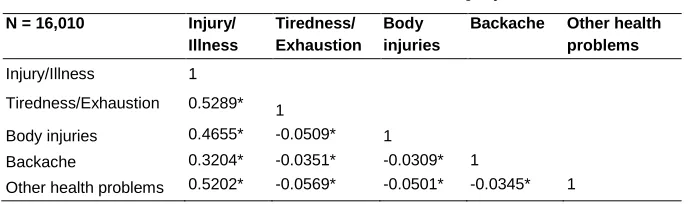
lung diseases)13. Correlations between different forms of injury or illnesses that are
used in this paper are presented in Table 1.
Table 1: Correlation between different forms of injury/illness
N = 16,010 Injury/ Illness
Tiredness/ Exhaustion
Body injuries
Backache Other health problems
Injury/Illness 1
Tiredness/Exhaustion 0.5289* 1
Body injuries 0.4655* -0.0509* 1
Backache 0.3204* -0.0351* -0.0309* 1
Other health problems 0.5202* -0.0569* -0.0501* -0.0345* 1
Note: Data are from NCLS (2002). *** p<0.01,** p<0.05, * p<0.1.
We consider two different measures of child labour. The first measure is a dummy variable indicating whether the child is simultaneously employed and enrolled in school one week before the survey. The second measure is the number of hours worked by the child in the reference week during which the child was employed. We include a rich set of covariates that are intended to control for individual and household characteristics that may affect health outcomes and child labour choice. Individual characteristics include the child‟s age and a quadratic of the child‟s age (Guarcello, Lyon, and Rosati 2004; Kana, Phoumin, and Seiichi
2010),14 the child‟s gender, the child‟s vaccination status, the child‟s protection at
13 Infection includes „eye/ear‟ and „skin‟ infections.
14 In the health equation, the child‟s age is included to capture the notion that some health conditions may
the workplace, and the child‟s sector of employment. Sectors of employment may capture the type of hazards to which the child worker is exposed. In our analysis we consider the main sectors of employment, i.e. agriculture, manufacturing, wholesale and retail, and construction. With respect to health outcomes, work in construction appears to be the most hazardous form of child labour because of the use of dangerous tools and machinery and the exposure to falling objects (see Guarcello, Lyon, and Rosati 2004 for more details). As it is likely that gender bias, if any, may change with age (as older girls may have to care for siblings), we use the interaction between the female dummy variable and age. At the household level, parental age and education, household composition, dwelling characteristics, and facilities enjoyed by the household are included. The remaining measure includes a dummy variable indicating urban residence to control for differential labour markets of children and their parents. Definitions and descriptive statistics for key regressors are given in Appendix Table A1 based on child work status (i.e. working and non-working children).
Table 2: Percentage of health conditions of children, by gender and work status
Workers Non-workers
N Mean Std. Dev. N Mean Std. Dev. t -test
By work status
Injury/Illness 14,437 0.1814 0.3854 1,573 0.0801 0.2715 10.15 ***
Tiredness/Exhaustion 14,437 0.0580 0.2337 1,573 0.0248 0.1555 5.50 ***
Body injuries 14,437 0.0454 0.2083 1,573 0.0197 0.1390 4.78 ***
Backache 14,437 0.0221 0.1470 1,573 0.0089 0.0939 3.48 ***
Other health problems 14,437 0.0559 0.2297 1,573 0.0267 0.1613 4.91 ***
Males Females
N Mean Std. Dev. N Mean Std. Dev. t -test
By gender
Injury/Illness 11,401 0.2143 0.4104 3,036 0.0575 0.2331 20.19 ***
Tiredness/Exhaustion 11,401 0.0650 0.2465 3,036 0.0316 0.1750 7.00 ***
Body injuries 11,401 0.0552 0.2285 3,036 0.0086 0.0922 11.02 ***
Backache 11,401 0.0253 0.1572 3,036 0.0099 0.0989 5.16 ***
Other health problems 11,401 0.0686 0.2531 3,036 0.0076 0.0867 13.12 ***
Notes: Data are from NCLS ( 2002). Std. Dev. is standard deviation. t-test for difference (Working-Non- working children) and (Males-Females). *** p<0.01,** p<0.05, * p<0.1.
Figure 1: Work hours and health injury/illness of children aged 517, by gender
Source: Data are from NCLS (2002).
Table 3 shows that approximately 61 percent of the working children (aged 5-17) are in agriculture. This is not surprising given the economic activities represented in agricultural sector (livestock, fishery, daily work for poor wages, and unpaid family businesses). Work in wholesale and retail is the second-most common form of child work, with 21 percent of working children engaged in this sector, while relatively few children work in construction (3 percent).
7.79
3.02 7.4
5.04 53.1
21.62 75.89
10.0 80.88
23.33 72.21
55.36
0 20 40 60 80
Pe
rc
e
n
ta
g
e
1-14 15-29 30-35 36-42 43-50 50+
Weekly working hours
Table 3: Age and health conditions of working children, by sectors of employment
Mean Age 59 Age 1013 Age 1417 Age 517 By age
Agriculture 13.04 45.35 66.94 54.23 61.40
Manufacturing 12.98 22.25 12.66 10.96 12.23
Construction 14.02 1.13 1.29 4.60 2.59
Wholesale and Retail 13.42 26.76 17.87 24.53 20.72
Service 14.29 4.51 1.24 5.67 3.07
N 355 8,388 5,694 14,437
Injury /Illness
Tiredness/
Exhaustion Body injuries Backache
Other health problems By health conditions
Agriculture 48.84 60.93 20.1 47.02 58.74
Manufacturing 22.87 18.04 29.73 30.09 19.45
Construction 8.21 5.5 18.75 3.45 4.34
Wholesale and Retail 17.07 12.43 26.07 19.44 13.63
Service 3.02 3.11 3.35 0.00 3.84
N 2,619 837 656 317 807
Note: Data are from NCLS (2002).
Furthermore, given the legislative framework in Bangladesh, one would expect there to be different aged children across the sector. This is evident in NCLS (2002) data. The mean age of children employed in agriculture, manufacturing, and wholesale and retail is 13 years, while the mean age is 14 years for those in construction and service sectors, respectively (see Table 3). The sample statistics
further show that approximately 45 percent of the youngest children (ages 59) is
likely to be in agriculture. This proportion drops to approximately 27 percent in wholesale and retail and 22 percent in manufacturing. At the same time, the
proportion of oldest children (ages 1417) is also high in agriculture at
approximately 54 percent. The corresponding proportions for the oldest children are 25 percent in wholesale and retail and 11 percent in manufacturing.
activities in developing countries are often involved in applying pesticides and/or operating machinery. With respect to symptoms of injury or illness, approximately 61 percent of children experienced tiredness/exhaustion in agriculture, the corresponding numbers in manufacturing and wholesale and retail are approximately 18 percent and 12 percent, respectively. While approximately 30 percent of children report body injuries in manufacturing, the corresponding number in agriculture is approximately 20 percent. These results demonstrate that heterogeneity of child work that takes place over different sectors have different impacts on child health.
4. Estimation framework
4.1 Model of work-health relationship
We first explore the effect of child work participation on health outcomes.15 The
health status equation and the labour market outcome can be expressed as follows:
(1)
(2)
where and are binary measures of, respectively, health status (it is a
self-reported illness or injury or occurrence of symptoms of injury or illness) and labour
choice of child . More specifically, as we are only aware of the occurrence of
injury or illness, we have when the child says he or she is injured or ill or
has any symptoms of injury or illness ( ) and , otherwise (
). On the other hand, it is important to note that the child labour choice is the
observed one in the child health equation. Therefore, we have if
and , otherwise if . In all the estimates, is a vector of individual
and household level characteristics for child , which are assumed to be
predetermined to health outcomes and child labour choice. The coefficient represents the contemporaneous association between work and health outcomes
and and are random factors.
There is a strong reason to remain concerned about the potential endogeneity of child labour variable in the health outcome of Eq. (1), as it is not reasonable to
assume that corr( ). First, if child labour and health outcomes are
determined simultaneously, reverse causal pathway is possible. Some recent
15 For reasons of space and clarity of presentation, we have not provided the details on the econometric
evidence for this reverse causality is O‟Donnell, Rosati, and Doorslaer (2005), who argue that a health shock may derive from a workplace accident or be the accumulated effect of past work experience. Second, child work could be correlated with unobserved factors (such as unobserved personal traits or parental preferences) that are related to health outcomes, which are undetermined a priori (O‟Donnell,
Rosati, and Doorslaer 2005). In , we include control for factors that may affect
health outcomes directly and also may affect current work status through parental preferences. We have not been able to completely account for these unobserved variables; and thus relegate these factors to the error terms of Eqs. (1) and (2). However, doing so would lead to biased estimates of the impact of child labour on child health (this issue will be addressed in subsequent section). Third, a child‟s current health status depends on the child‟s initial endowment of health, and gross investment (and thus inputs used to produce investments) in all previous periods
(Grossman 1972). In , we control for factors that may affect current health status
through prior health investment, such as the child‟s gender (Burgess, Propper, and Rigg 2004). However, it is possible that this factor may not completely account for such effects, and that these factors remain in the error terms of Eqs. (1) and (2).
We address the simultaneity bias by using the recursive bivariate probit model. Following the prior research (O‟Donnell, Rosati, and Doorslaer 2005; Wolff and
Maliki 2008), we extend Eq. (2) by including a set of variables ( ) but exclude
them from the health status equation. The full econometric specification in estimable form is given by Eqs. (1), (2ʹ), and (3) below. The bivariate probit model
assumes that the error terms and in Eqs. (1) and (2ʹ) are jointly distributed as
bivariate normal with means zero, variance one and correlation , and the equations
are estimated simultaneously using the maximum likelihood method. The
instruments ( ) in Eq. (2ʹ) are discussed in Section 4.2 and justified in Section
4.2.1.
(1)
(2ʹ)
* + [( ) [ ]] (3)
model) to understand the association between hours worked and subjective child
health.16 More specifically, the health status equation has the following form:
( ) (4)
where is now the number of hours worked during the reference week (one week
before the survey) that enters the equation non-linearly according to a non-binding
function . To control for confounding effects, we include the (log) of weekly
hours worked. The health status equation includes all the controls ( ) that were
used in the bivariate probit specification.
There is some concern, however, that is endogenous in health status
equation (see, for example, Kana, Phoumin, and Seiichi 2010). If ( ) ,
the above estimators will not be consistent. To take the potential endogeneity of into account, we use the augmented regression technique proposed by Holly and Sargan (1982). Assume that
(5)
with ( ) (6)
and ( ) (7)
Then the health status Eq. (4) can be rewritten as
( ) ̃ (8)
with ( ̃ ) (9)
Because is not observed, we estimate Eq. (5) by OLS and obtain the
residual ̂ , which is the consistent estimate of . Note that in Eq. (5),
( ) includes similar sets of covariates that were used in Eq. (2ʹ). The instruments
( ) in Eq. (5) are the same as those used for the bivariate probit specification. Eq.
(8) will now be applied with replaced by ̂ . An estimation of Eqs. (4) to (9)
uses data on 14,437 individuals, who report positive working hours. We dropped the observations for zero working hours because the logarithm of zero is undefined. However, doing this may lead to sample selection bias, but we address this estimation bias in subsequent section.
16 It is common to use linear probability models where we treat a binary outcome variable as a
4.2 Instruments
The challenge inherent in implementing either the bivariate probit or the semi-parametric methods requires the existence of at least one exogenous variable that is significant with the determinants of child labour but that is not directly related to the probability of being injured or ill. We consider first a dummy variable which indicates the migration status of the household if the household leaves the usual place of residence to find work. The migration status of the household has often been used as an instrument for child work based on the argument that living standards and child work will be influenced by the conditions of the economy and the labour market where the household lives (O‟Donnell, Rosati, and Doorslaer 2005). It is, therefore, necessary to construct an interaction term between the migration status and the location (rural or urban areas) of the household. This is a second instrument. We assume that migration choice of the household is exogenous as long as it is not correlated with unobserved determinants of the child health status. Although one could argue that it is endogenous to the extent that households migrate to areas with availability of health services or job opportunities which would improve child health through a higher level of household income. This suggests that there are some weaknesses for the two instrumental variables outlined above; therefore, we decided to conduct a sensitivity analysis to assess the sensitivity of results of identifying assumptions (see Section 6.1 for details). The other instrument is a proxy for school quality. The quality of schooling is a potentially important determinant of child labour (O‟Donnell, Rosati, and Doorslaer 2005). For the school quality measure, we generate a binary variable, which is equal to 1 if the child reports that his source of education is an informal school, and is 0 otherwise. The term „informal school‟ refers to informal education activities (e.g., family education and others) as indicated in NCLS (2002). In the case of school education in an informal school, it is reasonable to assume that it may not directly affect the intensity of injury or illness. This informal schooling could be used as a good predictor of child labour, as it is well-known in Bangladesh that this kind of education is of lower quality compared to public schools. The relevance of these instruments is verified in the following section.
4.2.1 Checking the validity of the instruments
migration status of the household, an interaction term between the migration status and the household location, and the school quality) in both the health status and labour market equations. Interestingly, all three variables were statistically significant predictors of health outcomes (at the 5 percent level), which reduces confidence in our identification strategy in all the health models. However, the exclusion restriction is not rejected if we use only the school quality variable to identify the model and include the migration status and an interaction term between the migration status and the household location in the health outcome equation (except for reporting any injury or illness, body injuries, and backache). The estimates for the work coefficient are fairly robust to variations on the identification strategy (results not reported here).
In partial linear regression models, we estimate treating working hours as endogenous and include the migration status of the household and the school quality in the instrument set, but we drop an interaction term between the migration status and the household location because these are not significant determinants of working hours. The relevance of the remaining instruments is verified with empirical tests. The relevant test lends strong credence to our use of two identifying
variables.17 In addition, the Hansen test for over-identification indicates that the
instruments are valid in the sense that their influence works only through the
endogenous variable but not for all of the health conditions that we considered.18
Instead, we focus on the partial linear model estimates for the main results of the paper and provide specification test results for the parametric against the partial linear model as a reference (see footnote 25).
5. Empirical results
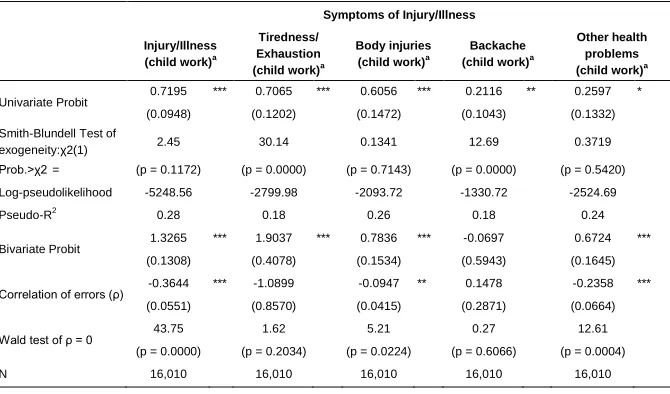
Table 4 presents the results of the recursive bivariate probit model. As a benchmark, we have also provided the estimates gained from the univariate probit model. It is clearly evidenced that the exogeneity of child work is rejected in the univariate probit model at any reasonable levels of significance in all health conditions except for body injuries and other health problems, suggesting that there is no advantage of the univariate probit model over the bivariate probit model in this analysis. This is confirmed by a Smith-Blundell test in the univariate probit model.
17 We perform an F-test such that the coefficients on the instruments are jointly zero. The first stage
F-statistic is 4.53 with a negligible p-value of 0.0108. The value of R-squared is 0.27, indicating that the instruments add significantly to the prediction of the (log) of the number of working hours.
18 The Hansen test for over-identifying restrictions gives a ( ) test statistic of 5.49 (p-value = 0.0191)
Table 4: Effect of child work on injury/illness, for various specifications
Symptoms of Injury/Illness
Injury/Illness (child work)a
Tiredness/ Exhaustion (child work)a
Body injuries (child work)a
Backache (child work)a
Other health problems (child work)a
Univariate Probit
0.7195 *** 0.7065 *** 0.6056 *** 0.2116 ** 0.2597 *
(0.0948) (0.1202) (0.1472) (0.1043) (0.1332)
Smith-Blundell Test of
exogeneity:χ2(1) 2.45 30.14 0.1341 12.69 0.3719
Prob.>χ2= (p = 0.1172) (p = 0.0000) (p = 0.7143) (p = 0.0000) (p = 0.5420)
Log-pseudolikelihood -5248.56 -2799.98 -2093.72 -1330.72 -2524.69
Pseudo-R2
0.28 0.18 0.26 0.18 0.24
Bivariate Probit
1.3265 *** 1.9037 *** 0.7836 *** -0.0697 0.6724 ***
(0.1308) (0.4078) (0.1534) (0.5943) (0.1645)
Correlation of errors (ρ) -0.3644 *** -1.0899 -0.0947 ** 0.1478 -0.2358 *** (0.0551) (0.8570) (0.0415) (0.2871) (0.0664)
Wald test of ρ = 0 43.75 1.62 5.21 0.27 12.61
(p = 0.0000) (p = 0.2034) (p = 0.0224) (p = 0.6066) (p = 0.0004)
N 16,010 16,010 16,010 16,010 16,010
Notes: Data are from NCLS (2002).a‘Child work’ is a binary variable. Standard errors in parentheses and are computed robustly to account for heteroskedasticity. ‘Body injury’ includes ‘loss of limbs’. Variables included but not reported for different specifications are child’s age (in years) and its square term, sex of child, the interaction between child’s age and sex, child’s vaccination status, dummies for sector of employment, urban areas, age of parents, the number of children for each child in the household, the number of adults over 17 years, dummies for parental education, protection at the workplace, dummies for dwelling characteristics and facilities enjoyed by the household and the number of rooms in the household. *** p<0.01,** p<0.05, * p<0.1.
The univariate probit estimates in Table 4 indicate a positive and significant relationship between current injury or illness and child work. This relationship indicates that labour force participation is associated with poor health. The result persists when we turn to different injury or illness symptoms. For example, for children who work, the probability of experiencing tiredness/exhaustion is approximately 71 percent, while the probability of suffering from other health problems is approximately 26 percent. The magnitude of these estimates is systematically higher than those reported elsewhere (see, for example, Wolff and Maliki 2008). We are not sure what is driving this result. This could be due to various forms of tasks performed by children across different sectors of employment in Bangladesh. This information is however not available in NCLS (2002) datasets and, therefore, we are not able to make an inference that the working conditions in Bangladesh are more serious than other developing
countries.19 The relationship between current injury or illness and child work
increases substantially in magnitude when moving to the bivariate probit model, with the exception of backache, suggesting a more robust effect of child labour on
health.20 The Wald specification test of the correlation coefficient of errors suggests
that child work is endogenous in all health conditions except for tiredness/exhaustion and backache (see Table 4). In addition, the coefficient of correlation between the residuals of the health outcomes and the child work equation is always significantly negative in three out of the five health conditions,
implying that considering child work as exogenous leads to biased estimates.21
The effects of other covariates of the bivariate probit model are provided in Appendix Table A2. Consistent with our descriptive analysis, girls are less likely to report injury or illness, suggesting that the nature of work undertaken by girls may
be less onerous.22 Interestingly, protection (use of working dress) at the workplace
does not reduce injury or illness except for tiredness/exhaustion and body
injuries.23,24 These findings are similar to those reported by Guarcello, Lyon, and
20 We further investigate our analysis by including dummy variables for regions (Chittagong, Rajshahi,
Khulna, Barisal, Sylhet, and Noakhali - the reference category is Dhaka) in our baseline model to capture the unobserved factors (e.g., climate, hospital facilities, and public hygiene) that may affect the causal relationship between health and labour supply. Of course, there are still other unobserved factors driving the correlation between child work and subjective child health. In general, we find (not shown) a strong positive association between child labour and the probability to report any injury or illness, which reiterates our findings from Table 4. These results suggest that the effect of work on health seems to be mediated through regional dummies and, hence, these factors perhaps are important determinants.
21 O‟Donnell, Rosati, and Doorslaer (2005, p.454) obtained a similar negative value of the correlation
coefficient of errors in rural Vietnam and interpreted this result as „selection into work on the basis of unobserved health determinants‟.
22 The findings may be under-reported because NCLS (2002) does not report injury or illness attributed
to domestic work, and this is the type of work that female children most often do. Thus, some caution should be given to this result.
23 At this point it should be noted that these strange results do not disappear when controlling for the
interaction between protection and sectors of employment and regressing health outcomes on protection, sectors of employment and an interaction between protection and sectors of employment at the same time. However, we do find the expected sign for the coefficient on the interaction between protection and sectors of employment. This indicates that safety levels reduce the risk of injury or illness across sectors of employment.
24 It is important to note that protection at the workplace may be a potentially endogenous variable due to
Rosati (2004) for Cambodia. In line with their findings, our results indicate that the use of protective clothing is not sufficient to fully compensate for the additional risks related to the work. As expected, children are more likely to report backaches if they work in agriculture, although the effect is not statistically different from zero at conventional levels of significance. Clearly, construction and manufacturing jobs appear to endanger child health as the coefficients for poor health conditions are greater in magnitude than they are in other sectors, although the estimated coefficients for tiredness/exhaustion, backache, and other health problems in the construction sector and tiredness/exhaustion in manufacturing sector are not statistically significant. This result supports the global consensus that construction jobs are more hazardous in nature and thus raise health risks for children.
When turning to the parental characteristics, we find that a mother‟s higher education (secondary education) relates negatively with all health outcomes. A similar result was found by O‟Donnell, Rosati, and Doorslaer (2005) for rural Vietnam. The results most likely suggest that highly educated women may be more aware of the adverse impact of child work through access to information (i.e. exposure to media) and, consequently, adopt necessary steps (e.g., use preventive and curative medicines and treat illness) to reduce child health problems. However, the father‟s higher education (secondary education) has the reverse effect on health conditions, such as, body injuries. One possible explanation could be that child labour does not necessarily substitute for adult labour income and, hence, yields negative effects on health due to work. Safe drinking water, satisfactory sanitation, and the number of rooms in the household significantly reduce the probability of injury or illness. As the focus of this paper is on the impact of child labour on health status, the apparent impact of these household characteristics will not be discussed further.
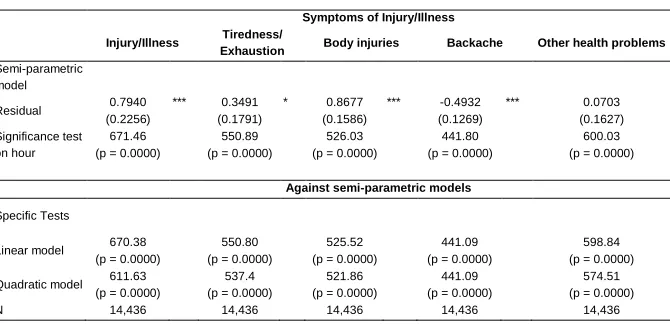
Next, we turn to the results of partial linear models when children‟s working hours are taken into account and when controlling for similar sets of covariates as in
the bivariate probit model (Table 5).25 The estimate of residual is significant for all
health conditions (except for other health problems), implying that exogeneity of hours worked is rejected in a partial linear regression model at conventional levels of significance. Regarding the effect of the (log) of the number of hours worked, the significance test of the hour variable indicates that the number of hours worked significantly influences the probability of injury or illness (in every case, the p-value is 0.000). To show how occurrence of injury or illness varies with working hours, we show the non-parametrically estimated relationship between the (log) of the number of hours worked and health conditions in Figure 2. Reporting any injury
25 The bottom panel of Table 5 presents a one-sided specification test result for the parametric against the
or illness clearly decreases with the number of working hours, as do other health problems (see Figures 2a and 2e), but increases with the number of working hours after a certain threshold (i.e. 19 hours a week for reporting any injury or illness, which is equivalent to exp(2.945) and 18 hours a week for reporting other health problems, which is equivalent to exp(2.910)). The nonlinearity we find may be attributed to the fact that a certain number of working hours is associated with a particular age and gender composition or other characteristics (e.g., task performed), which strengthens the occurrence of injury or illness after a certain threshold. While body injury and backache (Figures 2c and 2d) are generally constant with the number of hours worked, tiredness/exhaustion (Figure 2b) steadily increases with the number of hours worked (the threshold level in this case is 20
hours a week, which is equivalent to exp(2.977)).
Table 5: Effect of working hours on injury/illness partial linear model estimates
Symptoms of Injury/Illness
Injury/Illness Tiredness/
Exhaustion Body injuries Backache Other health problems
Semi-parametric model
Residual 0.7940 *** 0.3491 * 0.8677 *** -0.4932 *** 0.0703
(0.2256) (0.1791) (0.1586) (0.1269) (0.1627)
Significance test on hour
671.46 550.89 526.03 441.80 600.03
(p = 0.0000) (p = 0.0000) (p = 0.0000) (p = 0.0000) (p = 0.0000)
Against semi-parametric models
Specific Tests
Linear model 670.38 550.80 525.52 441.09 598.84
(p = 0.0000) (p = 0.0000) (p = 0.0000) (p = 0.0000) (p = 0.0000)
Quadratic model 611.63 537.4 521.86 441.09 574.51
(p = 0.0000) (p = 0.0000) (p = 0.0000) (p = 0.0000) (p = 0.0000)
N 14,436 14,436 14,436 14,436 14,436
Notes: Data are from NCLS (2002). ‘Hour’ is (log) of the number of hours worked by the child. Standard errors in parentheses. Body injury’ includes ‘loss of limbs’. ‘Other health problems’ include infection, burns, and lung diseases.
Figure 2: Non-linear relationship between hours (in logs) and health, outcomes
Source: Data are from NCLS (2002).
Table A3 in the Appendix provides the estimates of other covariates in the partial linear model. The results of the parametric aspect suggest that partial linear model estimates are qualitatively similar to the bivariate probit specifications,
0
1
1.
5
-0.
5
0.
5
1 2 3 4 5
(Log) of weekly working hours (a) Any injury/illness
0
1
1.
5
-0.
5
0.
5
1 2 3 4 5
(Log) of weekly working hours (b) Tiredness/Exhaustion
0
1
1.
5
-0.
5
0.
5
1 2 3 4 5
(Log) of weekly working hours (c) Body injuries
0
1
0.
5
1 2 3 4 5
(Log) of weekly working hours (d) Backache
0
1
-0.
5
0.
5
1 2 3 4 5
although the magnitude of the impact of covariates is considerably smaller than that of the bivariate probit estimates. It is worth noting that jobs in agriculture and in wholesale and retail are found to be detrimental to a child‟s health. For example, children are more likely to report any injury or illness or backache when they work in agriculture and wholesale and retail, implying that the risk of poor health conditions increases the longer the children are exposed to health hazards in these sectors.
6. Robustness checks and extensions
6.1 A sensitivity analysis
While the bivariate probit model and partial linear regressions are formally identified with exclusion restrictions in the main analysis, doubts remain about the validity of the identifying instruments and the inferences that are based on them. Some factors that influence the migration decision of the household, such as job opportunities, are likely to improve household living standard, and hence child health through a higher level of household income. In this circumstance, we explore the sensitivity of our estimates that may be more informative when exclusion based restrictions are hard to justify. In doing so, we re-ran Eqs. (1)-(2), but constrained (the correlation between unobservables that determine child labour and the various outcomes of child‟s health) to the specified value (e.g., from 0.1 to 0.5). This is similar to the work of Altonji, Elder, and Taber (AET, 2005), who analyse the effect of Catholic high school attendance on educational attainment and test scores. Similar to the AET approach, we conducted our exercise without exclusion restrictions (i.e. the same set of covariates is included in both Eqs. (1)-(2)).
Identification comes from both the restriction on as well as from functional form
(Altonji, Elder, and Taber 2005). The approach demonstrates a robustness check to determine whether the effect of child labour on health outcomes is sensitive to various levels of imposed correlation between the unobserved determinants of both
outcomes.26 We apply the AET approach only to a binary labour market outcome.27
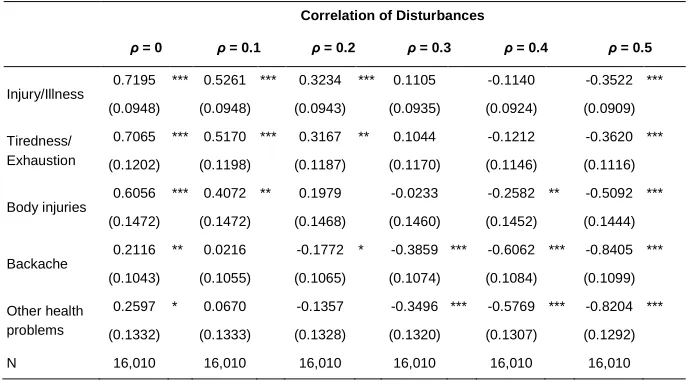
Table 6 shows the results from the empirical strategy proposed by Altonji, Elder, and Taber (2005), which does not rely on identifying assumptions. Column (1) of Table 6 reproduces the standard univariate probit findings from Table 4, which is
26 This is the first part of the AET (2005) approach, while the second part of the method uses the degree
of selection on observed characteristics to set the degree of selection on unobserved characteristics at a level that could be considered to be conservative. Because the latter assumption is unlikely to hold in reality, we do not explore the estimated correlation coefficient derived from the second approach.
27 The AET (2005) approach can be applied in the setting of a continuous dependent variable, but we did
based on the assumption of no selection along unobserved factors. The columns to the right of column (1) show estimates of the effect of child labour on health outcomes from bivariate probit models without any identifying exclusion
restrictions. We see that when = 0.1 the work coefficient for reporting any
injury/illness is 0.5261, the figure declines to 0.3234 when = 0.2 and to 0.1105
when = 0.3 (though not significant at conventional levels). Given the strong effect
of child labour when = 0, the effect is considerably weaker when constraining
to the specified value. These findings are similar to the results for symptoms of injury or illness, such as tiredness/exhaustion, and body injuries. Overall, the sensitivity analysis suggests that in spite of different degrees of selection on unobservables, we find a strong positive effect of child labour of reporting any injury/illness, tiredness/exhaustion, and body injuries.
Table 6: Effect of child work on injury/illness given different assumptions on the correlation of disturbances in bivariate probit models
Correlation of Disturbances
ρ = 0 ρ = 0.1 ρ = 0.2 ρ = 0.3 ρ = 0.4 ρ = 0.5
Injury/Illness 0.7195 *** 0.5261 *** 0.3234 *** 0.1105 -0.1140 -0.3522 *** (0.0948) (0.0948) (0.0943) (0.0935) (0.0924) (0.0909)
Tiredness/ Exhaustion
0.7065 *** 0.5170 *** 0.3167 ** 0.1044 -0.1212 -0.3620 ***
(0.1202) (0.1198) (0.1187) (0.1170) (0.1146) (0.1116)
Body injuries 0.6056 *** 0.4072 ** 0.1979 -0.0233 -0.2582 ** -0.5092 *** (0.1472) (0.1472) (0.1468) (0.1460) (0.1452) (0.1444)
Backache
0.2116 ** 0.0216 -0.1772 * -0.3859 *** -0.6062 *** -0.8405 ***
(0.1043) (0.1055) (0.1065) (0.1074) (0.1084) (0.1099)
Other health problems
0.2597 * 0.0670 -0.1357 -0.3496 *** -0.5769 *** -0.8204 ***
(0.1332) (0.1333) (0.1328) (0.1320) (0.1307) (0.1292)
N 16,010 16,010 16,010 16,010 16,010 16,010
6.2 Controlling for omitted variable bias
As outlined above, we interpreted our coefficient on child labour as causal effect. Of course, this interpretation is only valid if there are no omitted variables which are correlated with the error term and child labour. Parental preference is an example of such an unobserved omitted variable. A standard approach of dealing with omitted variable is the use of panel data. Unfortunately, we do not have access to panel data. The other possibility is pursued in this paper, which is to use a sub-sample of two or more children ages 5-17 from the same household who may work to estimate household fixed effects health equations. The true causal effect of child labour on child health can be identified by exploiting variations across children within a given household. We have performed regressions using the fixed effect logit models with the number of hours worked by the child. Insights from the fixed effect logit model based on the select sample of households with only two working children indicate that controlling for unobserved heterogeneity does not affect our previous conclusion: We obtain a significantly positive coefficient of child labour hours on the probability of reporting injury or illness. The (unreported) results are similar to those in Table 5. For example, the point estimates for reporting any injury or illness are 2.337 (z = 30.79); the corresponding values are 1.302 (z =13.92) for tiredness/exhaustion; 1.478 (z = 15.81) for body injuries; 1.092 (z = 9.66) for backache; and 2.340 (z = 18.51) for other health problems.
6.3 Sample selection issues
It is possible that persons for whom the number of hours worked is positive may not be a random draw from the population, but a self-selected group. As a simple check on the possibility of sample selection into the sample of children with positive
working hours, we adopt the Heckman (1979) two-step approach.28 We included
two additional variables in regression models for this exercise, such as the number of children between 0 and 4 years old, and the number of school children between ages 5 and 17 in the household, but excluded the number of children for each child in the household. The other variables are the same as those used for the main analysis.
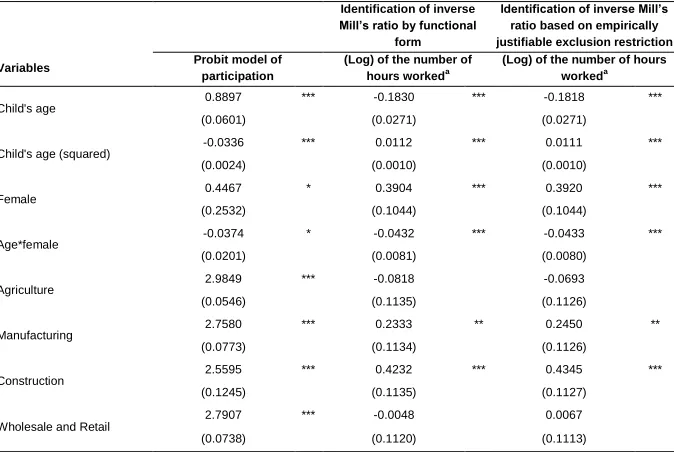
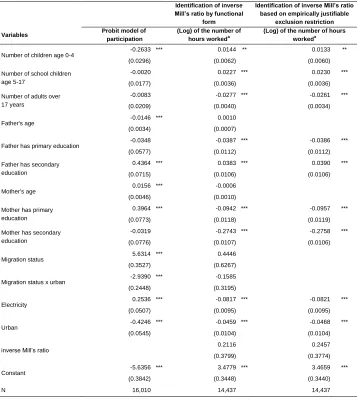
As is well known, the sample selection model requires an exclusion restriction, in the form of one or more variables that appear in the participation equation but not in the outcome equation (the log of the number of hours worked). Given the lack of credible exclusion restriction, we followed two alternative approaches to achieve
28 The Tobit procedure has been used in the literature to model censored dependent variables but it is a
identification of the selectivity term, the inverse Mill‟s ratio, although neither may be ideal. First, identification through functional form and, second, using variables that are significant in the participation equation (the selection equation) but
insignificant in the outcome equation (the log of the number of hours worked).29
The selectivity corrected equations of the (log) of the number of hours worked, conditional on participation, are presented in Table 7, using both methods of identification of the inverse Mill‟s ratio. Both approaches show that selectivity into participation is unimportant. The sign of the inverse Mill‟s ratio (although insignificant) is as expected; that is, those who are likely to participate in the labour force are those who work more hours than do children in general. One possible explanation is that children who participate must be those with higher ambition and/or motivation. Given the imperfect selectivity correction strategy and, more importantly, given the inverse Mill‟s ratio is not statistically significant, we suggest
that the censoring effect appears to be trivial in our analysis.30
Table 7: Heckman sample selection model estimates
Identification of inverse Millʼs ratio by functional
form
Identification of inverse Millʼs ratio based on empirically justifiable exclusion restriction
Variables Probit model of participation
(Log) of the number of hours workeda
(Log) of the number of hours workeda
Child's age
0.8897 *** -0.1830 *** -0.1818 ***
(0.0601) (0.0271) (0.0271)
Child's age (squared)
-0.0336 *** 0.0112 *** 0.0111 ***
(0.0024) (0.0010) (0.0010)
Female
0.4467 * 0.3904 *** 0.3920 ***
(0.2532) (0.1044) (0.1044)
Age*female
-0.0374 * -0.0432 *** -0.0433 ***
(0.0201) (0.0081) (0.0080)
Agriculture
2.9849 *** -0.0818 -0.0693
(0.0546) (0.1135) (0.1126)
Manufacturing
2.7580 *** 0.2333 ** 0.2450 **
(0.0773) (0.1134) (0.1126)
Construction
2.5595 *** 0.4232 *** 0.4345 ***
(0.1245) (0.1135) (0.1127)
Wholesale and Retail
2.7907 *** -0.0048 0.0067
(0.0738) (0.1120) (0.1113)
29 Using a similar procedure, Kingdon (2002) corrected sample selection bias due to selection of
individuals with positive years of schooling.
Table 7: (Continued)
Identification of inverse Millʼs ratio by functional
form
Identification of inverse Millʼs ratio based on empirically justifiable
exclusion restriction
Variables Probit model of participation
(Log) of the number of hours workeda
(Log) of the number of hours workeda
Number of children age 0-4
-0.2633 *** 0.0144 ** 0.0133 **
(0.0296) (0.0062) (0.0060)
Number of school children age 5-17
-0.0020 0.0227 *** 0.0230 ***
(0.0177) (0.0036) (0.0036)
Number of adults over 17 years
-0.0083 -0.0277 *** -0.0261 ***
(0.0209) (0.0040) (0.0034)
Father's age -0.0146 *** 0.0010
(0.0034) (0.0007)
Father has primary education -0.0348 -0.0387 *** -0.0386 ***
(0.0577) (0.0112) (0.0112)
Father has secondary education
0.4364 *** 0.0383 *** 0.0390 ***
(0.0715) (0.0106) (0.0106)
Mother's age 0.0156 *** -0.0006
(0.0046) (0.0010)
Mother has primary education
0.3964 *** -0.0942 *** -0.0957 ***
(0.0773) (0.0118) (0.0119)
Mother has secondary education
-0.0319 -0.2743 *** -0.2758 ***
(0.0776) (0.0107) (0.0106)
Migration status
5.6314 *** 0.4446
(0.3527) (0.6267)
Migration status x urban
-2.9390 *** -0.1585
(0.2448) (0.3195)
Electricity
0.2536 *** -0.0817 *** -0.0821 ***
(0.0507) (0.0095) (0.0095)
Urban
-0.4246 *** -0.0459 *** -0.0468 ***
(0.0545) (0.0104) (0.0104)
inverse Millʼs ratio 0.2116 0.2457
(0.3799) (0.3774)
Constant
-5.6356 *** 3.4779 *** 3.4659 ***
(0.3842) (0.3448) (0.3440)
N 16,010 14,437 14,437
6.4 Isolating the rural sample
In this sub-section, we examine the robustness of our results when we restrict ourselves to the sample of rural child workers ages 5-17, given the fact that the majority of child workers in Bangladesh are in rural areas. Focusing on the impact of child work participation on child health outcomes, it is noted that bivariate probit
estimates for rural areas are quite similar to those for the full sample.31 The one
notable change is that the work coefficient for backache becomes statistically
significant; it rises in magnitude but remains negative (i.e. 2.4510; z =
-17.76). These results are obtained by using only the migration status of the
household and the school quality variables as instruments.32 The relevance of these
instruments is checked by running bivariate probit models with and without these instruments. The likelihood ratio (LR) test results suggest that adding these instruments to the model significantly improves the fit of the model compared to a
model without these instruments.33
Turning finally to the impact of child working hours, partial linear estimates show an effect very similar to that of the full sample. Again, most estimates regarding the residual are statistically significant, suggesting that working hours are endogenous. Analysing the child‟s working hours‟, we find that the hour effect is significantly different from zero (in every case, the p-value is 0.000). This is confirmed by a significance test on hour. The instruments are the same as those used for the bivariate probit model for the rural sample. These instruments perform
better with respect to the over-identification test and are now even stronger.34 As in
the full sample, we find the non-linear relationship between the (log) of the number of working hours and health outcomes.
31
The complete set of results corresponding to rural sample is available upon request.
32 In the rural sample, in the estimated bivariate model, we experimented with total household land
holdings as a possible determinant of child work (Cockburn and Dostie 2007). While the significance of this instrument is confirmed in the work equation, the exclusion condition appears to be rejected in all health conditions.
33 In the first health indicator (any injury/illness), the ( )= 4.65 with a p-value of 0.0977 In the case of
different health conditions (symptoms of injury/illness), the corresponding values are ( ) = 5.52, with a p-value of 0.0634 (tiredness/exhaustion); ( )= 6.42 with a p-value of 0.0403 (body injuries); ( )= 25.04 with a p-value of 0.000 (backache); and ( ) = 5.89 with a p-value of 0.0526 (other health problems).
34The Hansen test for over-identifying restrictions yields a ( ) test statistic of 9.80 (p-value = 0.0017)
6.5 Age groups
Guarcello, Lyon, and Rosati (2004) find that work-related injury or illness increases with age, although they did not offer any consistent explanation for this. The findings could be interpreted as support for the notion that older children work more hours than do younger children, hence their health conditions worsen. Therefore, the health outcomes for different age groups are not essentially parallel. In this sub-section, we investigate the relationship between work and subjective child health according to age.
We consider three age groups (10-13, 14-17 and 10-17) and estimate bivariate probit models for each group using similar sets of covariates and instruments that were used in the main analysis. We find some evidence that the probability of
reporting injury or illness is somewhat larger in the oldest age group.35 This holds
particularly in the case of tiredness/exhaustion. One possible explanation could be that older children are most likely to be chosen for physically demanding activities that cause them to become tired/exhausted at the end. The point estimates for tiredness/exhaustion are 1.0068 (z = 4.20) for ages 10-13 and 2.0315 (z = 24.15) for ages 14-17. For the other health outcomes, the results are mixed across age groups. For example, we find weak evidence for reporting any injury or illness (except for age group 10-17). Furthermore, we find evidence that work increases the likelihood of backache and other health problems but does so much more strongly for younger
children than for older children.36 The results may be associated with the view that
some health conditions are age-related. However, conclusions from this analysis should be viewed with caution given the fact that the reference period for child work and that for the occurrence of injury or illness does not coincide. As one referee noted, “if those children who experienced injury a long time ago tend to work less now, the results are likely to underestimate the true impact of child work.
On the other hand, those with injury a long time ago tend to work more now
because of the low household income, the results are likely to overestimate the true
impact.”37
6.6 Heterogeneity of work effect on injury or illness
We also analyse the heterogeneity of the work effect on subjective child health. Heterogeneity can take place among child workers who work in different sectors. We also need to know how working hours affect the health of the child across
35 The complete set of results is available upon request.
36 The points estimates for backache and other health problems are 1.7503 (z = 3.31) and 1.0855 (z =
6.22) for ages 10-13; the corresponding values for ages 14-17 are 0.7048 (z = 1.52) and 0.5250 (z = 1.71), respectively.