DEMOGRAPHIC RESEARCH
VOLUME 29, ARTICLE 11, PAGES 275-306
PUBLISHED 20 AUGUST 2013
http://www.demographic-research.org/Volumes/Vol29/11/ DOI: 10.4054/DemRes.2013.29.11
Research Article
Love, marriage, then the baby carriage?
Marriage timing and childbearing in Sweden
Jennifer A. Holland
© 2013 Jennifer A. Holland.
This open-access work is published under the terms of the Creative Commons Attribution NonCommercial License 2.0 Germany, which permits use, reproduction & distribution in any medium for non-commercial purposes, provided the original author(s) and source are given credit.
1 Introduction 276
2 Theoretical background 277
3 A typology for the meaning of marriage 279
3.1 Family Forming marriage 279
3.2 Legitimizing marriage 280
3.3 Reinforcing marriage 281
3.4 Capstone marriage 281
3.5 Other marriages 282
3.6 Cohort change 282
3.7 Within-population heterogeneity 283
4 Data and methods 284
4.1 Data 284
4.2 Methods 286
5 Results 289
5.1 Marriage among women of the 1950 to 1977 birth cohorts 289 5.2 Cohort changes in the context of marriage 291 5.3 Educational differentials in the context of marriage 294
6 Discussion 297
7 Acknowledgements 300
Love, marriage, then the baby carriage?
Marriage timing and childbearing in Sweden
Jennifer A. Holland1
Abstract
BACKGROUND
Some scholars claim that marriage is an outmoded institution, decoupled from the childbearing process in Sweden. However, it is likely that the presence of children is still linked to marriage, since most children born to cohabiting couples experience the marriage of their parents. The temporal ordering of childbearing and marriage may be informative as to the meaning of marriage.
OBJECTIVE
I develop a typology of marriage, structured around four possible meanings of marriage as a Family Forming, Legitimizing, Reinforcing and Capstone institution.
METHODS
I analyze administrative register data covering all Swedish women born between 1950 and 1977, who have lived continuously in Sweden and were never married and childless at age 18 (N = 1,396,305). I tabulate the incidence and type of all first marriages by age and educational attainment.
RESULTS
Family Forming marriage (prior to a first conception) is the dominate first marriage type across all cohorts. The share of Legitimizing marriages (post-conception or within 12 months of a first birth) has declined across cohorts. There is an emerging trend toward Capstone marriage (after the birth of two or more children). There is an educational gradient in the experience and type of first marriage. Tertiary-educated women more frequently marry prior to a first birth (Family Forming or Legitimizing marriage). While fewer less-educated women marry, there is greater diversity in the timing of their marriages relative to childbearing.
CONCLUSIONS
Results demonstrate a continued link between childbearing and marriage, although the ordering of these events may be changing for some subpopulations.
1. Introduction
Marriage is a core institution of family life. Even in Sweden, a country identified as being on the leading edge of the family demographic changes observed in the last 60 years, a majority of individuals have favorable views of marriage and will eventually marry (Bernhardt 2002, 2004; Ohlsson-Wijk 2011; Wiik, Bernhardt, and Noack 2010). However marriage occurs at later ages, nearly all marriages are preceded by a lengthy period of cohabitation, and cohabiting couples are slower to formalize their unions through marriage (Duvander 1999; Heuveline and Timberlake 2004; Wiik, Bernhardt, and Noack 2010). Furthermore, childbearing is increasingly likely to occur outside of marriage: more than half of all births are non-marital in Sweden, although nearly 84% of those are born to cohabiting couples (Bernhardt 2004; Duvander 1999). Although cohabitation is normatively considered a suitable union for childbearing and cohabiting couples are granted nearly the same legal rights and responsibilities as married couples in Sweden, lifelong cohabitations are rare, particularly once a couple has shared children (Bernhardt 2002). It is likely that the presence of children is still linked to marriage, as the vast majority (81.6%) of children who are born to cohabiting couples will experience the marriage of their parents (Heuveline and Timberlake 2004).
Using population registers, I apply this typology for the meaning of marriage to all Swedish women born between 1950 and 1977, living continuously in Sweden, and who were never married and childless at age 18. I demonstrate the prevalence of types of first marriage in order to explore the relevance of marriage and to highlight differences across cohorts, shedding light on how the meaning of marriage may have changed over time in Sweden. Then, for a subsample of women for whom I can observe first marriage behavior until middle age, I investigate differences in the experience and context of marriage by socioeconomic status. Given the centrality of the Nordic context for justifying claims of the diminished salience of marriage in Western societies, an investigation into the relationship between the timing of childbearing and marriage in Sweden is valuable for building theory about the nature of the institution of marriage in industrialized nations more broadly.
2. Theoretical background
Union formation and parenthood are interrelated processes. Social norms and social policy dictate that a child‘s parents are the primary parties responsible for the care, socialization, and support of their children. Furthermore, norms emphasize that stable committed unions (either marital or cohabiting) are the most appropriate context for bearing and raising children (Hobcraft and Kiernan 1995; Roussel 1989). Within unions both parents have direct access to the child for both socialization and the transfer of resources. Furthermore, time resources and parental support to children can more easily be balanced by two residential parents. As a consequence union formation is an integral part of the procreation process and ―individual desires for children [seem to] influence union formation and its timing,‖ as partners strive to create the economic and social conditions for childbearing (Baizán, Aassve, and Billari 2004, p. 537). Bennett and colleagues (1995) and Lichter and Graefe (2001) show that pre-union childbearing increases the likelihood of forming an informal union. Non-marital pregnancies and births also increase the risk of marriage, particularly among cohabiting couples (Berrington 2001; Goldscheider and Waite 1986; Manning and Smock 1995); however this relationship may vary within populations (e.g., Harknett and McLanahan 2004).
to cohabiting parents (Bernhardt 2004). More broadly, births to cohabiting parents in Europe and the United States are on the rise: in the 1970s fewer than one in ten births occurred to non-married cohabiting couples in Northern, Central, Eastern, and Anglo-Saxon Europe; by the beginning of the 21st century, approximately half of all births in Scandinavia, one-third in France, over one-quarter in the UK and Austria, and just under one-fifth in the Netherlands, Hungary, Russia, and the United States were to cohabiting couples (Bernhardt 2004; Duvander 1999; Kennedy and Bumpass 2008; Perelli-Harris et al. 2012).
As a consequence of these demographic trends some have suggested that marriage may no longer be an integral part of the childbearing process. As cohabitation becomes a less selective intimate union and family form, scholars suggest that it may become an alternative to or indistinguishable from marriage (Heuveline and Timberlake 2004; Kiernan 2001; Rindfuss and VandenHeuvel 1990). At this stage in the evolution of family forms, cohabitation becomes a culturally approved union type in which to bear and rear children and there is greater institutional support for cohabiting unions (Heuveline and Timberlake 2004). Both individuals and their children increasingly spend a larger proportion of their lives in cohabiting unions. Sweden has been identified as one context where cohabitation has reached this stage in the evolution of family life.
3. A typology for the meaning of marriage
Marriage may take on different meanings depending on the context in which it occurs. Although differences in the timing and context of marriage have been linked to other outcomes, such as union stability (e.g., Reinhold 2010) and child wellbeing (e.g., Brown 2010), and scholars have traced the history of marriage systems and the rise of companionate and individualized marriage (Cherlin 2009; Thornton, Axinn, and Xie 2007), to date there has been no attempt to identify different ideal types of modern-day marital unions. Family scholars have long recognized the diversity of non-marital cohabitation (Heuveline and Timberlake 2004; Hiekel, Liefbroer, and Poortman 2012; Kiernan 2001; Rindfuss and VandenHeuvel 1990), and over the last three decades researchers have developed and refined a typology of cohabitation. Beginning with a simple two-category model for the United States distinguishing cohabitation as a prelude or an alternative to marriage, the typology has grown to include at least six categories covering couples in Europe and the United States (Heuveline and Timberlake 2004). Excepting recent work by Hiekel and colleagues (2012), these cohabitation typologies are based upon: (1) the duration of the cohabiting union; (2) the experience of childbearing within the cohabiting union; and (3) pathways out of cohabitation (dissolution vs. marriage). Each of these metrics is retrospective, meaning that it is only possible to identify a particular cohabitation type once the union has transitioned to marriage, dissolved, or produced a child (Hiekel, Liefbroer, and Poortman 2012). Moreover, none of the extant cohabitation typologies have incorporated information about the context of cohabitation initiation, which may be very important for understanding what individuals and couples are trying to achieve through cohabitation (Sassler and Miller 2011).
The typology of marriage developed here does not require observing future behavior, such as marital duration or dissolution. Rather it is based on the relationship context at the outset of the marital union. It requires only information on childbearing behavior (parity and age of first born child), but can be extended if pre-marital cohabiting histories are available. This typology is designed to be broadly applicable to allow for cross-national applications beyond the Swedish context.
3.1 Family Forming marriage
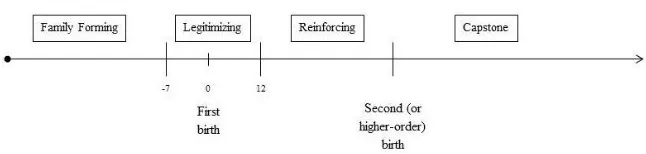
particular, such an expression is necessary for the transition to parenthood. I classify marriages as Family Forming if the woman is childless and has not conceived a child (Figure 1).
Figure 1: Stylized model of marriage types
Where cohabitation histories are available, Family Forming marriage can be further disaggregated into Direct Family Forming marriage, where the couple has not yet begun cohabiting at the time of marriage, and Co-residential Family Forming marriage, where marriage is preceded by cohabitation. This distinction is very relevant in contexts where norms sanctioning non-marital cohabitation are strong and where marriage is considered to be a necessary legal and symbolic prerequisite for both co-residence and childbearing. This distinction is less relevant in the Swedish context, where the vast majority of marriages occur after a period of cohabitation and direct marriage accounts for less than 5% of Swedish marriages (Andersson and Philipov 2002). Moreover, the Swedish administrative register data used for these analyses do not include full cohabitation histories. Therefore I do not make the distinction between Direct and Co-residential Family-Forming marriage in the analyses presented here.
3.2 Legitimizing marriage
In this case, although marriage is not normatively necessary for conception, marriage is still closely linked to the birth of the couple‘s first child.
3.3 Reinforcing marriage
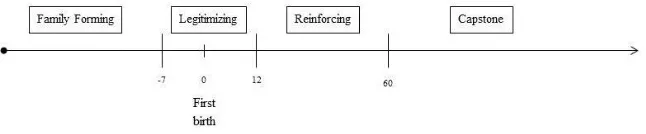
Where marriage occurs a year or more after a first birth but before subsequent births it may be taken as an indication of reinforcement. The transition to parenthood may be an explicit expression of seriousness and commitment. Marriage is not necessary for childbearing; however, the legal nature of the marital contract may provide an added sense of security, stability, or permanency for the union. The introduction of a child into the union changes the couples‘ circumstances in such a way that marriage becomes desirable. Marriages taking place when the couple has only one child between 12 and 60 months old are considered Reinforcing marriages (Figure 1). These marriages can be considered ‗inter-birth‘ marriages. I limit the ‗inter-birth‘ period to 60 months based on norms about child spacing (Andersson 2004a). Once a first-born child reaches 60 months without a sibling, I assume the child will be an ‗only child‘ and subsequent marriages will be classified as Capstone marriage, as further detailed below.
3.4 Capstone marriage
Marriage may also occur sometime after the completion of childbearing. This type of marriage may be viewed as the Capstone of family life: now that the family is complete, the couple will marry (Cherlin 2004). Capstone marriage, too, demonstrates long-term commitment, as well as broader family and economic stability. With respect to childbearing, Capstone marriage is not associated with the mere expectation or presence of children, as with Family Forming, Legitimizing or Reinforcing marriage, but rather with achieving a desired family size. The long-term commitment of these unions is considered self-evident, demonstrated by childbearing. The Capstone marriage demonstrates an achievement and is a symbol of success (Cherlin 2004, 2009; Edin and Kefalas 2005). I identify Capstone marriages as those which occur after a second or higher order birth (Figure 1).
Therefore I will also identify a marriage that occurs after a lone child reaches 5 years old as a Capstone marriage (Figure 2).
Figure 2: Stylized model of marriage types, ‘only-child’ special case
3.5 Other marriages
Two additional types of first marriage can be identified. Because the typology of marriage developed here relies upon parity progression, marriages occurring after a multiple first birth (e.g., twins, triplets, etc.) cannot be classified. In the case of a multiple first birth, a woman progresses from parity zero to parity greater than one (e.g., two, in the case of twins; three, in the case of triplets; etc.). Although these births are rare events, I classify marriages occurring after a multiple first birth separately. Marriages occurring after a second or higher order multiple-birth, where the first birth was a singleton birth, correspond to Capstone marriages as discussed above.
It is also possible that a first marriage will occur after the dissolution of a first childbearing union (i.e., a step marriage). First marriages in stepfamilies are less frequent at the population level than first marriages occurring prior to or within first childbearing unions. Even so, they represent an additional important type of first marriage that I identify separately. The meanings attached to these marriages may be more complex and the link to childbearing may be less straightforward, particularly when there are differences between partners‘ parity (Holland and Thomson 2011). Consequently, I do not distinguish step marriages by parity.
3.6 Cohort change
divorced). This early decline is attributed to the emergence of informal cohabitation as an increasingly important family form. The rate of decline was most pronounced in the 1960s, easing somewhat from 1972 to 1998, with some periods that countered the trend in the 1970s and in 1989. Since 1998 there has been a notable increase in marriage rates. Some of this increase is due to the Millennium Effect (a preference for marrying in the year 2000) (Andersson 2004b) and compositional changes in the population with respect to educational attainment and childbearing (Ohlsson-Wijk 2011). However, net of these factors there is clear evidence of increased first marriage risks, particularly among women 29 years and older (Ohlsson-Wijk 2011).
Fluctuation in first marriage rates is due to both the absolute number of people entering marriage (quantum) and the timing and context of marriage (tempo). Across Europe there is a uniform trend toward later marriage, which contributes (at least in part) to falling period marriage rates (Kalmijn 2007; Ohlsson-Wijk 2011; Sobotka and Toulemon 2008). Increasingly partnerships in Western societies begin as cohabitation rather than direct marriage (Sobotka and Toulemon 2008), but still there are few life-long cohabitations, even in the Nordic context (Bernhardt 2002; Heuveline and Timberlake 2004). Marriage and cohabitation seems to increasingly be independently valued, suggesting that each may serve different purposes over the family life-course (Björnberg 2001; Wiik, Bernhardt, and Noack 2009). Finally, the timing and incidence of marriage relative to childbearing has also changed over the period. The share of extra-marital births has increased in all Western countries and, again, Sweden can be considered a ―forerunner‖ of this trend (Andersson 1998; Sobotka and Toulemon 2008). By 1980, in Sweden the average age of first marriage was later than the average age of first birth for women (Statistics Sweden 2002). Despite this reversal there is evidence to suggest that pregnancy and childbearing may still be a trigger for marriage (Baizán, Aassve, and Billari 2004; Duvander 1999; Manning and Smock 1995). Indeed, unmarried women with one child have the highest risk of marriage as compared to women at higher parities and women without children (Andersson 2004b).
These trends have emerged across time and across cohorts. Although we are limited in our ability to discuss changes across cohorts because we cannot follow the most recent cohorts to the end of their childbearing years, comparing cohorts at similar ages will provide insight into the meanings more recent cohorts attach to the marital institution.
3.7 Within-population heterogeneity
symbolic meaning of marriage may differ by class, norms, and values. Consequently it is important to capture differences in marriage behavior over time and across socioeconomic and attitudinal characteristics (Oppenheimer 1988; Sweeney 2002). Educational attainment is a key marker for (dis)advantage across the life-course. It is an excellent proxy for human capital and socioeconomic status, as well as a strong predictor of future economic attainment. A broad range of research has demonstrated that educational attainment is associated with patterns of family formation (for a review of the literature see Thomson, Winkler-Dworak, and Kennedy 2009). In recent decades a positive educational gradient in marriage has emerged in the United States and in some European countries (Goldstein and Kenney 2001; Martin 2004; Kalmijn 2013). The relationship between educational attainment and marriage may be direct, via postponement of family formation due to longer enrollment periods (Kravdal 1994; Thalberg 2011), increased independence of women (Becker 1991), the increased importance of educational attainment for economic outcomes over the life-course, and via increased educational homogamy leading to stratification in economic and family life (Oppenheimer 1994; Schwartz and Mare 2005). So, too, educational attainment may operate indirectly through divergent values and norms, such as gender egalitarianism and individualism, which may be associated with the acceptance of new family behaviors (Blossfeld and Huinink 1991; Lesthaeghe and Surkyn 1988; Van Bavel 2010). As such, education provides a good proxy for social differences in preferences for, proclivity toward, and the timing of family behaviors, giving us insight into if and how marriage behaviors vary within the broader Swedish population.
4. Data and methods
4.1 Data
Data for these analyses came from Swedish administrative registers. The database Sweden in Time: Activities and Relations (STAR) includes data for all persons residing in Sweden between 1947 and 2007.2 Many events, including marriage, are recorded only from 1968. STAR includes information on births, civil status changes from 1968,3 education, employment and income, and foreign-born status.
2 STAR was created by Statistics Sweden for a consortium of research projects at the Swedish Institute for
Social Research (SOFI) and the Stockholm University Demography Unit (SUDA). The database is maintained at Statistics Sweden and is available only by remote online access.
3
All women born in Sweden between 1950 and 1977 were identified. These birth cohorts were selected in order that full information on civil status changes from age 18 could be obtained (the 1950 birth cohort was 18 in 1968 when the civil status registers began) and to capture full information on all family life-course events up to at least age 30 (the 1977 birth cohort was age 30 in 2007). Information about deaths and emigration from Sweden were obtained from the respective registers. From the civil status register the date and spousal identification number of women‘s first civil status change (i.e., marriage) was identified and merged into the analysis file. Because there is no dwelling register in Sweden it was not possible to identify complete non-marital cohabiting relationship histories.
From the multigenerational register the children of the 1950 to 1977 birth cohorts were identified and their birth information and an identification number for the child‘s father were merged into the analysis file. In the first instance step marriages could be identified by comparing the identification number of the father of the first child (and their full siblings) and the spousal identification number from the civil status register. Additionally, if a woman‘s children did not share the same father, any subsequent marriage was considered a step marriage. It should be noted that a disproportionate number of children were not linked in the multigenerational file to an identified father. Such children could have resulted from artificial insemination or a sexual relationship with an unidentified man, including a man not living in Sweden. It could be determined that they are not children living with cohabiting fathers, as routines for identifying cohabiting fathers at the birth of a child are well established (Thomson and Eriksson forthcoming). This means that the share of stepfamilies identified might be slightly inflated.
Information on educational attainment came from several register sources: the 1970 Population and Housing Census; the Employment Register, which covers the population between 1985 to 1989; and the Longitudinal Integrated Database for Health Insurance and Labor Market Studies (LISA), covering the population from 1990 to 2007.
analyses are conducted based on women‘s demographic and educational characteristics only.
Table 1: Analysis population
N %
Women born in Sweden 1950 - 77 1,465,927 100.0
– Died before age 18 6,245 0.4
– (Ever) Emigrated before age 18 32,096 2.2
– Married before age 18 3,529 0.2
– Had children before age 18 27,752 1.9
Analysis population 1,396,305 95.3
Source: Swedish administrative registers, Sweden in Time: Activities and Relations (STAR) database, 1968 – 2007.
4.2 Methods
I identified all first marriages from age 18 until the end of the register extract in 2007. In order to test for evidence of the meanings of marriage proposed above, I categorized first marriages conditioned on parity and age of firstborn child. I differentiated first marriages that took place when the woman: (a) had no children and has not conceived a first child (at least 8 months prior to a birth) (Family Forming marriages); (b) had conceived a child (7 or fewer months prior to a birth4) or had one child 12 months old or younger (Legitimizing marriages); (c) had one child 13 to 60 months old (Reinforcing marriages); (d) had one child more than 60 months old (‗only child‘) or had two or more children (Capstone marriages). Additionally, I identified first marriages that occurred (e) after a multiple first birth or (f) after the dissolution of a first childbearing partnership (step marriage).
To confirm that I chose appropriate cut-off points relative to a first birth to distinguish Legitimizing marriage (b) from Family Forming (a) and Reinforcing (c) marriage, I estimated the hazard of a first marriage relative to the timing of a first birth for a subsample of the population who experience a first birth and were never married 24 months before the birth (n = 971,018; 69.5% of the analysis population). For women born before 1968 there was a clear spike in first marriage risks after a conception (approximately 7 months before the birth), peaking approximately 4 to 5 months before the birth (Figure 3). Afterward marriage risks fell, reaching the nadir in the month after the birth. A second, lower peak was observed approximately 6 months after a birth. By
4
identifying Legitimizing marriage as those occurring during the period 7 months prior to a birth through 12 months after a birth, I adequately captured these two unique risk periods surrounding a first birth. Although trends in marriage preceding a conception are similar for women of the middle and most recent cohorts, it is notable that there was no increase in the first marriage risk after conception and the second peak observed after the birth was much lower for women born between 1968 and 1977. Rather than suggesting a need for different definitional boundaries for Legitimizing marriage among women of the youngest cohorts, this trend is consistent with a diminished salience of Legitimizing marriage across cohorts.
In a prospective manner, I tabulated the incidence and type of first marriages occurring at each age for all women from age 18 through the end of the register extract in 2007. This means that for the cohort of women born between 1950 and 1957 I had full information on the experience of first marriage from birth until age 50; for the 1958 to 1967 birth cohorts I observed all first marriages until age 40; and for the 1968 to 1977 birth cohorts I observed all first marriages until age 30. These tabulations correspond to the experience of a first marriage by each age, not whether the marriage is still intact. Some women had incomplete, or censored, first marriage records if they died or if they emigrated from Sweden. Additionally, in a handful of cases (n = 3,473; <0.25% of the population) there was an error in the civil status change register. For instance, the record indicated that their civil status changed from single to widowed, or from single to divorced: both cases would suggest either an error or a missing first marriage record. When an error was observed, the individual was censored from that age onward.
Figure 3: Hazard of marriage relative to first birth, women with first births who are never married 24 months prior to birth, by cohort, Swedish women born 1950 – 1977
Source: Swedish administrative registers, Sweden in Time: Activities and Relations (STAR) database, 1968 - 2007.
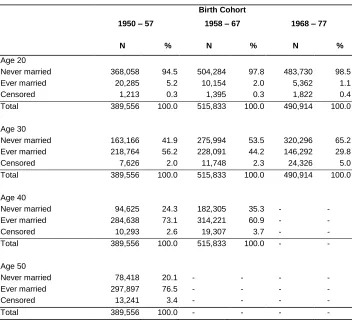
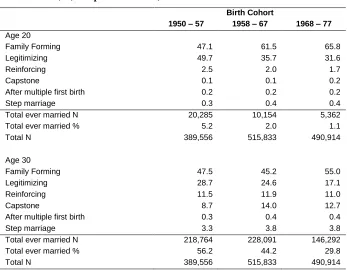
In the first set of tabulations (Table 2) I present the proportion of women entering a first marriage, and the type of marriage, at each age (10-year age intervals), by cohort. These tabulations are particularly well suited to reveal changes across cohorts in the proportion of women married at each age, related to marriage delayed (tempo), marriage foregone (quantum), or both. To better visualize differences across cohorts in the types of first marriage women enter by age, Table 3 depicts the share of each of the categories of marriage among only those experiencing a first marriage.5
Finally, to capture differences in the context of marriage by educational attainment, I present cross-tabulations of the categories of marriages experienced by age 40 by highest lifetime level of education observed in the three census and register databases detailed above: compulsory (primary and lower secondary education), secondary (upper secondary and less than two years of post-secondary education), and tertiary (more than two years of post-secondary education) (Table 5). By assessing first marriages experienced by age 40 I was able to observe most first marriages, even among highly educated women who are likely to postpone marriage until completing education. However, this restriction means that I was only able to make comparisons across two birth cohorts, the 1950 to 1957 and 1958 to 1967 cohorts (n = 905,389).
The data are considered to be a true population: all tabulations correspond to the first marriage experiences of the full population of Swedish women born between 1950 and 1977, continuously living in Sweden, who were never married and childless at age 18. Because no sample was drawn there was no sampling error and it was not appropriate to conduct statistical hypothesis testing based on sampling theory (Berk, Western, and Weiss 1995). The analysis and interpretation were concerned with the magnitude of difference across age and cohorts, and between educational subgroups within the population.
5. Results
5.1 Marriage among women of the 1950 to 1977 birth cohorts
Figure 4: Hazard of first marriage by age and cohort, Swedish women born 1950 – 1977
Source: Swedish administrative registers, Sweden in Time: Activities and Relations (STAR) database, 1968 - 2007.
Table 2: Experience of a first marriage by age and cohort
Birth Cohort
1950 – 57 1958 – 67 1968 – 77
N % N % N %
Age 20
Never married 368,058 94.5 504,284 97.8 483,730 98.5
Ever married 20,285 5.2 10,154 2.0 5,362 1.1
Censored 1,213 0.3 1,395 0.3 1,822 0.4
Total 389,556 100.0 515,833 100.0 490,914 100.0
Age 30
Never married 163,166 41.9 275,994 53.5 320,296 65.2
Ever married 218,764 56.2 228,091 44.2 146,292 29.8
Censored 7,626 2.0 11,748 2.3 24,326 5.0
Total 389,556 100.0 515,833 100.0 490,914 100.0
Age 40
Never married 94,625 24.3 182,305 35.3 - -
Ever married 284,638 73.1 314,221 60.9 - -
Censored 10,293 2.6 19,307 3.7 - -
Total 389,556 100.0 515,833 100.0 - -
Age 50
Never married 78,418 20.1 - - - -
Ever married 297,897 76.5 - - - -
Censored 13,241 3.4 - - - -
Total 389,556 100.0 - - - -
Source: Swedish administrative registers, Sweden in Time: Activities and Relations (STAR) database, 1968 - 2007.
5.2 Cohort changes in the context of marriage
birth and those who were mothers tended to have very young children, and therefore were not yet at risk of a Reinforcing or Capstone marriage. While about equal shares of women in the oldest cohorts experiencing a first marriage entered either a Family Forming or Legitimizing marriage by age 20, shares of Legitimizing marriage declined among women of later cohorts. This suggests that the legitimizing role of marriage may have become less important, at least among those women who marry at very young ages.
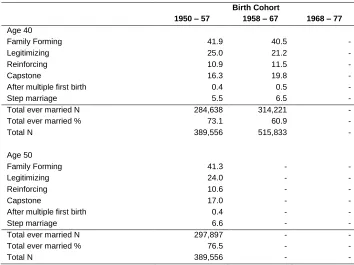
Table 3: Context of first marriage by age and cohort, all first marriages (%, except where noted)
Birth Cohort
1950 – 57 1958 – 67 1968 – 77
Age 20
Family Forming 47.1 61.5 65.8
Legitimizing 49.7 35.7 31.6
Reinforcing 2.5 2.0 1.7
Capstone 0.1 0.1 0.2
After multiple first birth 0.2 0.2 0.2
Step marriage 0.3 0.4 0.4
Total ever married N 20,285 10,154 5,362
Total ever married % 5.2 2.0 1.1
Total N 389,556 515,833 490,914
Age 30
Family Forming 47.5 45.2 55.0
Legitimizing 28.7 24.6 17.1
Reinforcing 11.5 11.9 11.0
Capstone 8.7 14.0 12.7
After multiple first birth 0.3 0.4 0.4
Step marriage 3.3 3.8 3.8
Total ever married N 218,764 228,091 146,292
Total ever married % 56.2 44.2 29.8
Table 3: (Continued)
Birth Cohort
1950 – 57 1958 – 67 1968 – 77
Age 40
Family Forming 41.9 40.5 -
Legitimizing 25.0 21.2 -
Reinforcing 10.9 11.5 -
Capstone 16.3 19.8 -
After multiple first birth 0.4 0.5 -
Step marriage 5.5 6.5 -
Total ever married N 284,638 314,221 -
Total ever married % 73.1 60.9 -
Total N 389,556 515,833 -
Age 50
Family Forming 41.3 - -
Legitimizing 24.0 - -
Reinforcing 10.6 - -
Capstone 17.0 - -
After multiple first birth 0.4 - -
Step marriage 6.6 - -
Total ever married N 297,897 - -
Total ever married % 76.5 - -
Total N 389,556 - -
Source: Swedish administrative registers, Sweden in Time: Activities and Relations (STAR) database, 1968 - 2007.
At age 30 the share of Family Formation marriage among women born between 1950 and 1957 was quite stable: as more women married in their 20s the share of these marriages remained just under 50%. On the other hand Legitimizing marriages constituted a smaller share of first marriages (28.7%). A larger proportion of marriages took place more than one year after the birth of a first child: Reinforcing marriage constituted 11.5% of first marriages by age 30, and Capstone marriage accounted for 8.7% of marriages. The share of step marriages, first marriages occurring after the end of a first childbearing partnership, also rose, to 3.3% of marriages.
age 30 remained stable across cohorts (approximately 11%). The share of Capstone marriage increased from only 8.7% of the marriages of the 1950 to 1957 cohorts to 14% of women‘s marriages in the subsequent cohorts (1958 to 1967). However, among women of the latest cohort the proportion of Capstone marriages at age 30 was reduced somewhat, constituting only 12.7% of first marriages. There was a slight increase in step marriage from the earliest to the intermediate and latest cohorts (3.3% vs. 3.8%).
As women of the earliest cohort aged, the share of marriages occurring after a second or higher order birth, or after an ‗only child‘ was five-years-old, grew. By age 40 the share of Capstone marriages stood at 16.3%, and, by age 50, 17.0%. On the other hand, the shares of first marriages prior to a birth or within the first year of a child‘s life declined. Over these ages, only just over 41% of first marriages were Family Forming and about a quarter were Legitimizing marriages. Reinforcing marriages remained stable at about 10% of all first marriages. The share of women who only married after ending a first childbearing partnership (step marriage) also increased to 6.6% of first marriages by age 50.
For women age 40, we could still compare the context of first marriages across the earliest and intermediate cohorts. Shares of Family FormingandReinforcing marriage were, in fact, quite similar across the two cohorts (just over 40% and 11% of first marriages, respectively). The share of Legitimizing marriage was 3.8% lower among women born between 1958 and 1967. Capstone marriages constituted a larger share of first marriages among the intermediate cohort, reaching nearly 20% of first marriages. The share of first marriages in stepfamilies was 1% higher among women of the later cohort.
5.3 Educational differentials in the context of marriage
Table 4: Highest lifetime level of education by birth cohort, Swedish women born 1950-67, never married and childless at age 18
Birth Cohort
1950 – 57 1958 – 67
N % N %
Compulsory 194,655 50.0 217,457 42.2
Secondary 110,975 28.5 181,124 35.1
Tertiary 80,060 20.6 113,305 22.0
Unknown 3,866 1.0 3,947 0.8
Total 389,556 100.0 515,833 100.0
Source: Swedish administrative registers, Sweden in Time: Activities and Relations (STAR) database, 1968 - 2007.
Figure 5: Hazard of first marriage by age and highest lifetime level of education, Swedish women born 1950 – 67
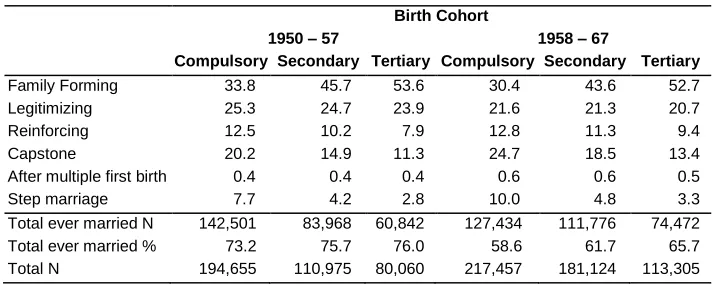
Table 5 presents educational differences in the context of first marriage by age 40 for each birth cohort. Again, there was a clear, positive educational gradient in the proportion experiencing a first marriage by age 40 for all women, although marriage was less selective on lifetime educational attainment among women born between 1950 and 1957: 73.2% of women in the earlier birth cohort with compulsory education married, as compared to 75.7% with secondary education, and 76.0% with tertiary education. Although fewer women in the subsequent cohort were married the selectivity of marriage by educational attainment grew: 58.6% of compulsory educated women, 61.7% of secondary educated women, and 65.7% of tertiary educated women were married by age 40.
Table 5: Educational differences in the context of first marriages at age 40 by birth cohort, all first marriages (%, except where noted)
Birth Cohort
1950 – 57 1958 – 67
Compulsory Secondary Tertiary Compulsory Secondary Tertiary
Family Forming 33.8 45.7 53.6 30.4 43.6 52.7
Legitimizing 25.3 24.7 23.9 21.6 21.3 20.7
Reinforcing 12.5 10.2 7.9 12.8 11.3 9.4
Capstone 20.2 14.9 11.3 24.7 18.5 13.4
After multiple first birth 0.4 0.4 0.4 0.6 0.6 0.5
Step marriage 7.7 4.2 2.8 10.0 4.8 3.3
Total ever married N 142,501 83,968 60,842 127,434 111,776 74,472
Total ever married % 73.2 75.7 76.0 58.6 61.7 65.7
Total N 194,655 110,975 80,060 217,457 181,124 113,305
Source: Swedish administrative registers, Sweden in Time: Activities and Relations (STAR) database, 1968 - 2007.
Note: Individuals for whom educational attainment is missing from the STAR database are omitted from the table. This group
constitutes less than 0.3% of marriages and less than 1% of individuals.
At the other end of the educational spectrum, the vast majority of first marriages among tertiary educated women occurred before a conception or in the period surrounding a first birth. About three-quarters of first marriages were either Family Forming or Legitimizing marriages. Reinforcing marriage was less common among the highly educated (fewer than 1 in 10 marriages). Capstone marriages also constituted a smaller share of marriages for those with a tertiary education, ranging from around 11% to 13% of first marriages. The highly educated were also more likely to experience a first marriage prior to or in a first childbearing union; only around 3% of first marriages were step marriages for this group.
Cross-cohort trends in the distribution of marriages described above were largely stable within each educational group. Family Forming constituted the largest share of marriages across each of the educational categories, and shares of this type of marriage declined only slightly between the two cohorts. There was evidence of reduced shares of Legitimizing marriage and larger shares of Capstone and step marriages among women of all educational levels. Shares of Reinforcing marriage were largely stable for women with a compulsory education, and rose slightly for those women with secondary (+1.1%) and tertiary education (+1.5%).
6. Discussion
preferences for formalizing one‘s union prior to having children or possibly even in the absence of childbearing intentions.
Across cohorts there is evidence that Capstone marriage, whereby individuals marry after an ‗only child‘ is at least 5 years old or after a second or higher-order birth, constitutes an increasingly important marital context. For this growing proportion of individuals, marriage is a secondary expression of commitment and stability, occurring after childbearing. This may suggest that increasingly the label ‗marriage‘ is only placed on a partnership once individuals have expressed their commitment through childbearing. Still, Capstone marriages do not constitute a majority marital experience.
There is evidence of the waning prominence of Legitimizing marriage. The share of individuals formalizing their unions after a conception or in the year following a first birth is decreasing. Taken together, these trends have led to greater diversity in the pool of marriages in Sweden and may indicate divergence in the meaning of marriage: for some, marriage is a prerequisite for childbearing; for others marriage comes only after the completion of childbearing.
This divergence is further evident when exploring subpopulation variation in the ordering of family-life course events among those who marry in Sweden. There is a strong negative gradient in marriage entry and differential marriage patterns across educational groups. Marriage is more common among the highly educated, and this gradient has increased across cohorts. The marriages of the highly educated are more closely tied to a first birth, as compared to the marriages of their compulsory and secondary educated counterparts. There is evidence of a greater diversity of experience in the ordering of family life-course events for those with compulsory or secondary education. These subpopulations are more likely to enter marriage sometime after a first birth or once family building is complete.
In addition to changes in the ordering of family life-course events, underlying all of these results are changes in the quantum and tempo of marriage. There is clear evidence of smaller shares of ever married individuals at age 30 across cohorts. Moreover, there is little evidence for a recovery in marriage rates, as the magnitude of cross-cohort differences in the share of the ‗ever married‘ at age 30 are largely unchanged at age 40. At the same time there is evidence of delayed family formation. There has been dramatic growth in the share of those experiencing neither marriage nor childbearing by age 30 across cohorts: from 25.3% of women in the earliest birth cohorts to 46.6% of women in the latest cohorts observed (tabulations not shown, but available upon request).
the one hand it is notable that, between age 40 and 50, the distributions of marriages for the 1950 to 1957 cohorts do not change greatly. We may therefore be confident that we are gaining a reasonable picture of first marriages, at least through age 40 for cohorts born between 1950 and 1967. On the other hand, as younger cohorts increasingly postpone union and family formation, it may be difficult to capture post-childbearing marriage types, in particular Capstone marriage, which is only observed at older parental ages, after progression to parity two or after an ‗only child‘ reaches age 5. This may limit our ability to detect changes in the meaning of marriage vis-à-vis childbearing among younger cohorts. Unfortunately this limitation can only be resolved by waiting for later cohorts to complete their childbearing and formalize or dissolve first childbearing unions.
A distinct advantage of using register data is having nearly complete and comparable information on the entire population of Sweden. These data are ideal for describing the relationship between marriage and childbearing and how this relationship has changed over time. But this coverage comes at the cost of limited information on socio-cultural and background characteristics. As a result I am limited in my ability to explore the influences of marital intentions, how the context of marriage varies across a broader range of subpopulations, or the causal mechanisms underlying the observed changes over time. Findings regarding variation in the relative timing of marriage and childbearing by educational attainment provide some insights into how the meaning of marriage might vary across socioeconomic status. Future qualitative and survey research will need to draw on a richer set of individual and couple characteristics to further explore individual-level differentiation in the risk and timing of marriage.
7. Acknowledgements
References
Andersson, G. (1998). Trends in marriage formation in Sweden 1971–1993. European Journal of Population/Revue européenne de Démographie 14(2): 157-178.
Andersson, G. (2004a). Childbearing developments in Denmark, Norway, and Sweden from the 1970s to the 1990s: A comparison. Demographic Research, Special Collection 3(7): 155-176. doi:10.4054/DemRes.2004.S3.7.
Andersson, G. (2004b). Demographic trends in Sweden: An update of childbearing and nuptiality up to 2002. Demographic Research 11(4): 95-110. doi:10.4054/ DemRes.2004.11.4.
Andersson, G. and Philipov, D. (2002). Life-table representations of family dynamics in Sweden, Hungary, and 14 other FFS countries: A project of descriptions of demographic behavior. Demographic Research 7(4): 67-144. doi:10.4054/ DemRes.2002.7.4.
Axinn, W.G. and Thornton, A. (2000). The transformation in the meaning of marriage. In: Waite, L.J. (ed.). The Ties that Bind: Perspectives on marriage and cohabitation. Hawthorne, NY: Aldine de Gruyter: 147-165.
Baizán, P., Aassve. A., and Billari, F.C. (2004). The interrelations between cohabitation, marriage and first birth in Germany and Sweden. Population & Environment 25(6): 531-561. doi:10.1023/B:POEN.0000039064.65655.3b.
Becker, G.S. (1991). A treatise on the family. Cambridge, MA: Harvard University Press.
Bennett, N.G., Bloom, D.E., and Miller, C.K. (1995). The influence of nonmarital childbearing on the formation of first marriages. Demography 32(1): 47-62.
doi:10.2307/2061896.
Berk, R.A., Western, D., and Weiss, R.E. (1995). Statistical inference for apparent populations. Sociological Methodology 25: 421-458. doi:10.2307/271073.
Bernhardt, E. (2002). Cohabitation and marriage among young adults in Sweden: Attitudes, expectations and plans. Scandinavian Population Studies 13.
Bernhardt, E. (2004). Cohabitation or marriage? Preferred living arrangements in Sweden. Austrian Institute for Family Studies.
Berrington, A. (2001). Entry into parenthood and the outcome of cohabiting partnerships in Britain. Journal of Marriage and Family 63(1): 80-96.
Björnberg, U. (2001). Cohabitation and marriage in Sweden ‐ Does family form matter?
International Journal of Law, Policy and the Family 15(3): 350-362.
doi:10.1093/lawfam/15.3.350.
Blossfeld, H.-P. and Huinink, J. (1991). Human capital investments or norms of role transition? How women's schooling and career affect the process of family formation. The American Journal of Sociology 97(1): 143-168. doi:10.1086/ 229743.
Bøe, S. (2010). Sambos med Barn Bör Gifta Sig [Cohabitors with Children Should Marry]. Dagens Nyheter. http://www.dn.se/ekonomi/sambos-med-barn-bor-gifta-sig/.
Brown, S.L. (2010). Marriage and child well-being: Research and policy perspectives.
Journal of Marriage and Family 72(5): 1059-1077. doi:10.1111/j.1741-3737.2010.00750.x.
Cherlin, A.J. (2004). The deinstitutionalization of American marriage. Journal of Marriage and Family 66(4): 848-861. doi:10.1111/j.0022-2445.2004.00058.x.
Cherlin, A.J. (2009). The Marriage-Go-Round: The state of marriage and the family in America today. New York: Alfred A. Knopf.
Duvander, A.-Z.E. (1999). The transition from cohabitation to marriage: A longitudinal Study of the propensity to marry in Sweden in the early 1990s. Journal of Family Issues 20(5): 698-717. doi:10.1177/019251399020005007.
Edin, K. and Kefalas, M. (2005). Promises I can keep: Why poor women put motherhood before marriage. Berkeley: University of California Press.
Goldscheider, F.K. and Waite, L.J. (1986). Sex differences in the entry into marriage.
The American Journal of Sociology 92(1): 91-109. doi:10.1086/228464.
Goldstein, J.R. and Kenney, C.T. (2001). Marriage delayed or marriage forgone? New cohort forecasts of first marriage for U.S. women. American Sociological Review 66(4): 506-519. doi:10.2307/3088920.
Harknett, K. and McLanahan, S.S. (2004). Racial and ethnic differences in marriage after the birth of a child. American Sociological Review 69(6): 790-811.
doi:10.1177/000312240406900603.
Hiekel, N., Liefbroer, A.C., and Poortman, A.-R. (2012). The meaning of cohabitation across Europe. Paper presented at the European Population Conference, Stockholm, Sweden, June 13-16 2012.
Hobcraft, J. and Kiernan, K. (1995). Becoming a parent in Europe. In: Evolution or revolution in European population: Proceedings of the European Population Coverence. Milan: FrancoAngeli: 27-65.
Holland, J.A. and Thomson, E. (2011). Stepfamily childbearing in Sweden: Quantum and tempo effects, 1950–99. Population Studies 65(1): 115-128.
doi:10.1080/00324728.2010.543693.
Kalmijn, M. (2007). Explaining cross-national differences in marriage, cohabitation, and divorce in Europe, 1990–2000. Population Studies 61(3): 243-263.
doi:10.1080/00324720701571806.
Kalmijn, M. (2013). The educational gradient in marriage: A comparison of 25 European countries. Demography 50(1): 1499-1520. doi: 10.1007/s13524-013-0229-x.
Kennedy, S. and Bumpass, L. (2008). Cohabitation and children's living arrangements: New estimates from the United States. Demographic Research 19(47): 1663-1692. doi:10.4054/DemRes.2008.19.47.
Kiernan, K. (2001). The rise of cohabitation and childbearing outside marriage in western Europe. International Journal of Law, Policy and the Family 15(1): 1-21. doi:10.1093/lawfam/15.1.1.
Kravdal, Ø. (1994). The importance of economic activity, economic potential and economic resources for the timing of first births in Norway. Population Studies
48(2): 249-267. doi:10.1080/0032472031000147786.
Lesthaeghe, R.J. and Surkyn, J. (1988). Cultural dynamics and economic theories of fertility change. Population and Development Review 14(1): 1-45. doi:10.2307/ 1972499.
Lichter, D.T. and Graefe, D.R. (2001). Finding a mate? The marital and cohabitation histories of unwed mothers. In: Wu, L.L. and Wolfe, B. (eds.). Out of wedlock: Causes and consequences of nonmarital fertility. New York, NY: Russell Sage Foundation: 317-343.
Martin, S.P. (2004). Women‘s education and family timing: Outcomes and trends associated with age at marriage and first birth. In: Neckerman, K.M. (ed.). Social inequality. New York, NY: Russell Sage Foundation: 79-118.
Ohlsson-Wijk, S. (2011). Sweden's marriage revival: An analysis of the new-millennium switch from long-term decline to increasing popularity. Population Studies 65(2): 183-200. doi:10.1080/00324728.2011.574724.
Oppenheimer, V.K. (1988). A theory of marriage timing. The American Journal of Sociology 94(3): 563-591. doi:10.1086/229030.
Oppenheimer, V.K. (1994). Women's rising employment and the future of the family in industrial societies. Population and Development Review 20(2): 293-342.
doi:10.2307/2137521.
Perelli-Harris, B., Kreyenfeld, M., Sigle-Rushton, W., Keizer, R., Lappegård, T., Jasilioniene, A., Berghammer, C., and Di Giulio, P. (2012). Changes in union status during the transition to parenthood in eleven European countries, 1970s to early 2000s. Population Studies 66(2): 1-16. doi:10.1080/003247 28.2012.673004.
Reinhold, S. (2010). Reassessing the link between premarital cohabitation and marital instability. Demography 47(3): 719-733. doi:10.1353/dem.0.0122.
Rindfuss, R.R. and VandenHeuvel, A. (1990). Cohabitation: A precursor to marriage or an alternative to being single? Population and Development Review 16(4): 703-726. doi:10.2307/1972963.
Roussel, L. (1989). La famille incertaine[The Uncertain Family]. Paris: Editions Odile Jacob.
Sassler, S. and Miller, A.J. (2011). Class differences in cohabitation processes. Family Relations 60(2): 163-177. doi:10.1111/j.1741-3729.2010.00640.x.
Schwartz, C.R. and Mare, R.D. (2005). Trends in educational assortative marriage from 1940 to 2003. Demography 42(4): 621-646. doi:10.1353/dem.2005.0036.
Sobotka, T. and Toulemon, L. (2008). Changing family and partnership behaviour: Common trends and persistent diversity across Europe. Demographic Research
19(6): 85-138. doi:10.4054/DemRes.2008.19.6.
Sweeney, M.M. (2002). Two decades of family change: The shifting economic foundations of marriage. American Sociological Review 67(1): 132-147.
doi:10.2307/3088937.
Thalberg, S. (2011). Does money matter? Childbearing behaviour of Swedish students in the 1980s and 1990s. Finnish Yearbook of Population Research 2011: 5-20.
Thomson, E. and Eriksson, H. (Forthcoming). Register-based estimates of parental separation in Sweden. Demographic Research.
Thomson, E., Winkler-Dworak, M., and Kennedy, S. (2009). Education and the family life course. Stockholm Reserach Reports in Demography 2009(3).
Thornton, A., Axinn, W.G., and Xie, Y. (2007). Marriage and cohabitation. Chicago: University of Chicago Press. doi:10.7208/chicago/9780226798684.001.0001.
Van Bavel, J. (2010). Choice of study discipline and the postponement of motherhood in Europe: The impact of expected earnings, gender composition, and family attitudes. Demography 47(2): 439-458. doi:10.1353/dem.0.0108.
Wiik, K.A., Bernhardt, E., and Noack, T. (2009). A study of commitment and relationship quality in Sweden and Norway. Journal of Marriage and Family
71(3): 465-477. doi:10.1111/j.1741-3737.2009.00613.x.
Wiik, K.A., Bernhardt, E., and Noack, T. (2010). Love or money? Marriage intentions among young cohabitors in Norway and Sweden. Acta Sociologica 53(3): 269-287. doi:10.1177/0001699310374488.