in the population sciences published by the Max Planck Institute for Demographic Research Konrad-Zuse Str. 1, D-18057 Rostock · GERMANY www.demographic-research.org
DEMOGRAPHIC RESEARCH
VOLUME 26, ARTICLE 12, PAGES 253-292
PUBLISHED 3 APRIL 2012
http://www.demographic-research.org/Volumes/Vol26/12/ DOI: 10.4054/DemRes.2012.26.12
Research Article
Labour market integration, occupational
uncertainties, and fertility choices
in Germany and the UK
Christian Schmitt
This publication is part of the Special Collection on “Employment Uncertainty and Family Dynamics,” organized by Guest Editors Michaela Kreyenfeld, Gunnar Andersson & Ariane Pailhé.
© 2012 Christian Schmitt.
This open-access work is published under the terms of the Creative Commons Attribution NonCommercial License 2.0 Germany, which permits use, reproduction & distribution in any medium for non-commercial purposes, provided the original author(s) and source are given credit.
1 Introduction 254 2 Cross-national framework and institutional orientation in Germany and
the UK, 1991–2007 256
2.1 Labour market integration and uncertainty in the cross-national
framework 257 2.2 Welfare state support and caregiver models in Germany and the United
Kingdom 258 2.3 Characteristics of the German and British labour markets 261
2.4 Hypotheses 264
3 Data and methods 266
3.1 Database and indicators 266
3.2 Design of the multivariate model 268 4 Results of the descriptive analysis 270 5 Findings of the multivariate analysis 272 5.1 The transition to parenthood in light of labour market integration 272 5.2 Key transitions in the education–work–family nexus 276
6 Conclusion 277
References 280
Labour market integration, occupational uncertainties,
and fertility choices in Germany and the UK
Christian Schmitt1
Abstract
Contrasting the conservative German welfare state with the liberal market economy of the United Kingdom, this paper examines how each welfare regime affects the first-birth decisions of men and women under the conditions of either high labour market integration (full-time work in a permanent position) or occupational uncertainty (part-time work or work with a fixed-term contract). The results, which are based on BHPS and GSOEP data, suggest for Germany that occupational uncertainty hampers transitions to parenthood, but are inconclusive for the UK. Among highly educated women in both Germany and the UK, however, a high degree of labour market integration is found to delay family formation.
1 University of Rostock and German Socio-Economic Panel Study (SOEP) DIW Berlin. E-mail:
1. Introduction
Family formation is a key turning point in the life course, and for many potential parents today, achieving the financial security necessary to start a family is a difficult and time-consuming process. Recent research has focused on how fertility decisions are shaped by the relationship between social policies, labour market conditions, and the changing gender contract (Oppenheimer 1994, Brewster and Rindfuss 2000, Crompton and Lyonette 2006, McDonald and Meyers 2009). This study extends this research by investigating how individual labour market integration (i.e., obtaining a permanent full-time job that is in line with one’s vocational training, and/or acquiring the education or professional record that provides access to such a job) might expedite the realisation of fertility plans by providing the economic resources needed to start a family. The welfare state plays a key role in this process by determining general labour market risks and options. Against this backdrop, couples have to decide whether their family plans require one or both partners to have a stable position in the labour market to compensate for low levels of welfare state support to families (Hobcraft and Kiernan 1995). Furthermore, they must do so in the context of culturally and institutionally embedded gender roles, which in some societies lead to conflicts between the occupational and domestic duties assigned to women.
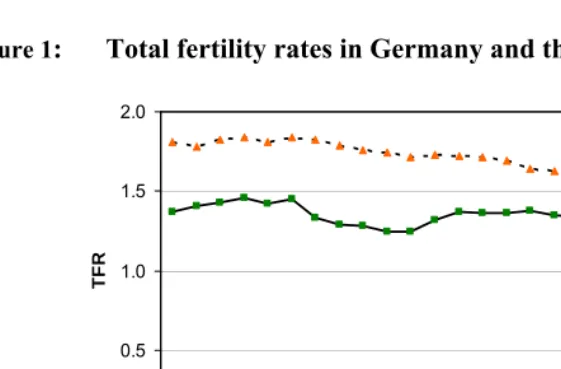
Figure 1: Total fertility rates in Germany and the UK, 1985-2009
0.0 0.5 1.0 1.5 2.0
1985 1990 1995 2000 2005
TF
R
Germany United Kingdom
Source: OECD Family Database – Fertility Indicators (OECD 2011a). Online database. Note: Values before 1990 based on East and West Germany
Distinguishing country- and gender-specific effects, my analysis focuses on two aspects of the relationship between labour market integration and fertility decisions: first, I address the question of how the timing of the first birth is affected by the duration of active labour market participation under the assumption of increasing labour market integration over time; and, second, I investigate whether differences in the first-birth risk depend on being firmly established in the labour market, or on being exposed to occupational uncertainties. In other words, I consider the extent to which the fertility decisions of individuals who are strongly integrated into the labour market (defined as having a stable full-time job and/or high income) differ from those of individuals who are poorly integrated (defined as having discontinuous and/or precarious employment patterns).2
For the cross-national comparison of male and female fertility behaviour, I use microdata from the British Household Panel Study (BHPS) and the German Socio-Economic Panel (SOEP). The window of observation extends from 1991 to 2007. This makes it possible to link fertility choices to work patterns and supplementary biographical data covering more than a decade.
2 A discussion of what constitutes successful labour market integration—as opposed to occupational
The following section (2) discusses relevant features of the welfare regime and the institutional orientation predominant in each country. This will help to establish the comparative framework and highlight how different institutional incentives and disincentives shape the relationship between labour market integration and fertility choices. Section 2 concludes by formulating a set of hypotheses that are deducted from the comparative framework. Section 3 specifies the event history model of transitions to the first birth and provides relevant information on the sample selection using BHPS and SOEP data. Based on these methodological foundations, Section 4 presents the descriptive findings, and Section 5 discusses the multivariate results.
As stated above, this article examines how occupational stability or uncertainty affects fertility choices, and thus assumes that a high level of labour market integration, defined as holding a permanent full-time job, provides a sound economic basis for family formation. At the same time, however, having a high degree of labour market integration with a well-paid job also increases the shadow price of having a child, whereas having a discontinuous career or a job loss may decrease this shadow price. The inverse relationship between occupational stability and the opportunity costs of parenthood is fundamentally mediated by a country’s labour market structure, which differs between men and women to the extent that the welfare state encourages either more egalitarian gender roles or a female caregiver model. This consideration of the role of the welfare state substantiates the comparative perspective of this study.
2. Cross-national framework and institutional orientation in
Germany and the UK, 1991–2007
Against this micro-theoretical backdrop, the orientation of the welfare state plays a key role in determining how occupational stability or uncertainty affects individual childbearing decisions. A highly deregulated labour market, like that of the UK, reduces job stability and signals a higher degree of occupational uncertainty (McGinnity 2004). The more generous German welfare state may reduce some of these uncertainties through its comprehensive system of social protection. However, a highly regulated labour market accentuates the divide between labour market insiders and outsiders (Hall and Soskice 2001). These factors and other differences in welfare state orientation, such as the degree to which traditional gender roles are reproduced, make cross-national comparison a useful analytical tool for investigating the mechanisms underlying the relationship between labour market integration and family formation.
2.1 Labour market integration and uncertainty in the cross-national framework
The British and German welfare states exhibit key differences in the opportunity structures that determine how the individual labour market situation affects fertility decisions. In the context of these structures, occupational uncertainties and discontinuous employment patterns tend to hamper the process of labour market integration. A high level of labour market integration can be defined as holding a stable job - usually a permanent, full-time job with pay and position providing a close fit to the individual’s type and level of skill endowments (see section 3 for a discussion of the operationalisation of this indicator). It has been argued that a stable job is generally a prerequisite for family formation (Andersson 2000, Kreyenfeld 2010). Importantly, this idea of integration into the labour force through a “standard” full-time job is a primarily male occupational model, and women frequently deviate from this pattern, as demonstrated by the high prevalence of part-time employment among women in Germany and the UK. The implications for the modified male breadwinner model prevalent in both societies associate male part-time employment with reduced earnings
capacity. And, while many studies have focused on how fertility transitions affect the labour supply of mothers who tend to reduce their working hours (Blackwell 2001, Zollinger-Giele and Holst 2004, Gregg et al. 2007), little evidence is available on whether female part-time employment delays or expedites family formation (by either reducing financial backing or providing more time for childcare).
consolidated into a position of corresponding status (which may be signalled by part-time employment, fixed-term contracts, or unemployment) is likely to lead to a depreciation of human capital investments. Starting a family in an environment of occupational uncertainty makes it even more difficult to convert educational investments into a stable and rewarding job. For this reason, as well as in order to minimise the risk of becoming financially dependent on a male breadwinner, women who have invested a great deal in their education are likely to seek to attain a stable
labour market position prior to family formation (Brewster and Rindfuss 2000).
Accordingly, Kreyenfeld (2010) has found that, while unemployment generally fosters the transition to motherhood among German women due to the lower opportunity costs associated with having a child when unemployed, this is not the case for women with a university degree. In a similar study, Ekert-Jaffé et al. (2002) found that more highly educated women in the UK also tend to focus on their career, thus delaying fertility choices. These findings correspond with the results of a study by Meron and Widmer (2002), who showed that French women have a lower propensity to
have a child if they are unemployed. Compared to British women, French women seem to have more in common with their male counterparts, for whom unemployment or fixed-term employment generally translate into economic uncertainty, thereby delaying family formation (Kravdal 2002, Tölke and Diewald 2003, Kurz et al. 2005).
2.2 Welfare state support and caregiver models in Germany and the United Kingdom
risks of economic and social dependence3 (DiPrete 2002). This results in an ambivalent
situation for women, with some institutional incentives encouraging continuous labour market participation (in order to maintain transfer eligibility and economic autonomy), and other incentives and social norms strongly encouraging compliance with female caregiver roles. In contrast, the UK provides a lower level of social support, protecting families from only the most severe risks and hardships. This low level of welfare state involvement also means, however, that the British welfare regime is less likely than the German system to reproduce a gender-based division of labour. Moreover, unlike the German system of joint taxation, the UK’s individual-based tax system does not discourage married women from working. This battery of incentives and restricted support promotes a dual-earner family model, particularly among couples in low-paying jobs and precarious employment who need a second income to provide for a family. These factors may cause couples to delay or avoid starting a family.
Meanwhile, the childcare supply in the UK follows the principle of encouraging diversity through a largely privatised system (Mahon 2002: 354). Accordingly, private childcare in the UK ranks among the most costly in the EU (Bradshaw and Finch 2002), rendering it unaffordable for couples in low-paying jobs. The National Childcare Strategy introduced by the new Labour government in 1997 resulted in a slight increase in the supply of public childcare, but did not substantially improve the situation for working mothers (Smith 2003). Moreover, in 1999, under pressure to comply with EU legislation, the UK extended parental protections from a very short period to (unpaid) parental leave of 13 weeks with basic re-instatement rights (OECD 2010a). This limited support places a severe burden on parents in the UK, but particularly on British mothers, who encounter normative expectations that they fulfil the prime caregiver role that are similar to those faced by their German counterparts (Crompton and Lyonette 2006). As in most European countries, the use of childcare leave by men in the UK remained below 2% during the time of observation (as in Germany; see Haas 2003). However, paid paternity leave around childbirth, introduced in the UK in 2003, offers at least a small incentive for fathers to share childcare responsibilities, which suggests that there have been cautious attempts to depart from traditional gender role models. Meanwhile, Germany still lacks a similar form of paid paternity leave (European Commission 2011).
In contrast to the UK, Germany provides generous child-related benefits and generous maternity leave arrangements. Importantly, until 2007, these arrangements tended to reduce the female labour supply by guaranteeing re-instatement rights for as
3 East German women still appear to be affected by the GDR’s persistent legacy of encouraging female
long as three years after childbirth (including two years of paid maternity leave, though some jobs, such as short-term and freelance work, were not covered by this rule; Ondrich et al. 1999). As fathers in both countries rarely use even a portion of the available leave, childcare remains primarily a maternal task. This trend is intensified by the limited supply of publicly subsidised childcare institutions, particularly in West Germany, which makes it difficult for women to combine working and childrearing. There is, however, a greater availability of childcare facilities in East Germany–a lingering reflection of the ideal of the working mother that was prevalent in the GDR. Since 2000, politicians have promised repeatedly to extend the availability of childcare, but the supply has remained virtually unchanged. This confluence of factors—the limited childcare supply, generous benefits and parental leave policies, and a tax structure favouring single-earner families (Apps and Rees 2005)—have led German mothers to retreat from the labour market. When combined with a persistent pay gap between men and women, this system promotes dependence on a male breadwinner. A slight departure from this model occurred with the 2007 parental leave reform, when
Elterngeld was introduced. This benefit, which replaces up to two-thirds of the income
of parents who take parental leave, was designed to encourage mothers to participate in the labour market and fathers to take a portion of the paid parental leave. Because this reform was introduced after our period of observation (1991–2007), it does not affect our view of the incentive structure in German family policy regulations.
2.3 Characteristics of the German and British labour markets
Compared to most other industrialised countries, labour market participation rates are high in both Germany and the UK, especially among women (OECD 2010b). However, many women work only part time. Marginal part-time work in the UK is closely associated with the phenomenon of the working poor, while part-time work in Germany provides job security and wages that significantly bolster women’s economic positions (Prince Cooke 2011).
While female part-time work has been common in the UK over the last decades, it has been increasing steadily in West Germany since the 1970s. The slight stagnation in this growth in the early 1990s was due primarily to the large influx of full-time working women from East Germany into the reunified labour market. In addition to the change in the composition of the labour market, the increase in part-time employment since the 1970s has been crucial in increasing female labour market participation. The high share of women in part-time work reflects their economic vulnerability and their difficulties in establishing themselves on the labour market. Finally, the high share of female part-time employment accounts for a large percentage of the gender wage gap in Germany, and for an even larger percentage of the gap in the UK (McGinnity and McManus 2007).
The combination of high female labour market participation on the one hand, and exceptionally high rates of part-time employment on the other, is closely associated with work-family conflicts (Zollinger-Giele and Holst 2004). The association between time employment and gender role conflicts is also reflected in the fact that part-time work among men is common only for short phases when entering the labour force or transitioning into retirement.
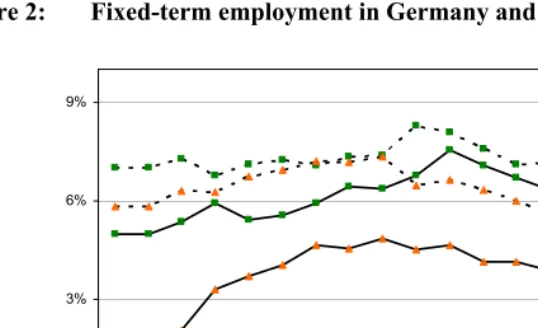
Figure 2: Fixed-term employment in Germany and the UK, 1990-2008
0% 3% 6% 9%
1990 1995 2000 2005
Germany Women UK Women Germany Men UK Men
Source: OECD Employment and Labour Force Statistics (OECD 2010b). Online database.
Differences in employment protection legislation (EPL), as shown in the OECD EPL indicator (scaled from zero to six, with zero representing no employment protection) are seen in the extent of legal protection a) in regular employment, b) in temporary employment, and c) from collective dismissals. Importantly, the UK, with an overall EPL score of 1.1, had a much lower level of protection in 2003 (OECD 2004). With respect to temporary work, however, the German labour market reforms that culminated in the introduction of “Agenda 2010” in 2003 greatly weakened employment protections for temporary workers, reducing the EPL indicator from 3.8 in the early 1990s to 1.8 in 2003 (OECD 2011c). This development also reflects increasing difficulties in the transition from education to a first stable job (Mills and Blossfeld 2005). This means that the relatively unprotected group of fixed-term workers, in which women and young people are overrepresented, became even more vulnerable to occupational uncertainties in the late 1990s and since.
months, and is subject to strict means-testing. Unemployment benefits in Germany provide 60% income replacement (67% for parents), and are available for six to 32 months (depending on contribution duration; European Commission 2006, 2011). The benefit levels and eligibility duration remained stable overall throughout the period of observation, 1991-2007.
However, in Germany, the Agenda 2010 reforms introduced a welfare-to-work programme in 2003, which culminated in the limitation of benefit eligibility duration and more restricted access to subsequent unemployment assistance. In the UK, a similar series of programmes aimed at providing focused support for a target group was introduced under the “New Deal” in 1996/1997. However, the reforms introduced in the 1996 Jobseeker’s Allowance (JSA) led to only minor adjustments in benefit levels and eligibility rules. This system remained widely unchanged until 2000/2001, when JSA eligibility was further restricted for couples, and activation programmes for the long-term unemployed were initiated. A more flexible New Deal activation programme was introduced in 2008-2010, but this is after the period of observation of this study (Smith 2003, European Commission 2011). In theory, the British system provides strong incentives to re-enter the labour market quickly. For childless couples facing occupational uncertainties, this probably serves as a disincentive to start a family.
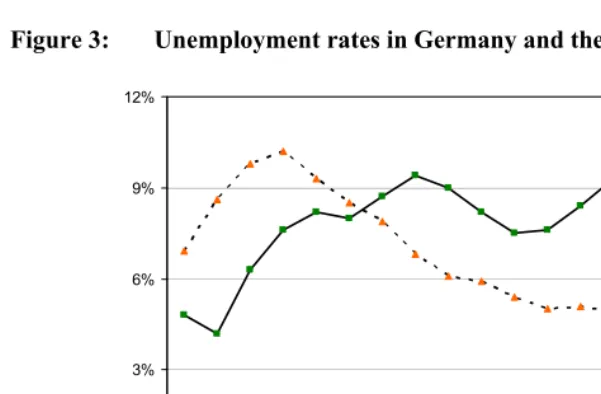
Nevertheless, the comparison of unemployment rates in Germany and the UK shows that the overall risk of job loss has been much lower in the UK since the second half of the 1990s, when the British economy entered a period of rapid growth. Over the same period, by contrast, unemployment in Germany was relatively high (see Figure 3). At the same time, the risk of welfare dependency in Germany increased substantially, with almost 50% of all unemployment being long-term. This was also a consequence of the fact that a growing percentage of German workers had obsolete vocational qualifications, and therefore became increasingly vulnerable to the risk of job loss and the threat of long-term unemployment (Mills and Blossfeld 2003, Kurz et al. 2006). Although government retraining schemes and institutional incentives to invest in employee training used to be key elements of German welfare policies aimed at creating a skilled workforce (Hall and Soskice 2001), labour market deregulation and increasing global competition took a toll beginning in the mid-1990s. In the UK, by contrast, the threat of becoming long-term unemployed was and still is mitigated by a high turnover rate, which makes exits out of employment, as well as re-entries into the labour market, more common (McGinnity 2004: 121)4.
4 British unemployment rates should be taken with a grain of salt: particularly female unemployment, which
Figure 3: Unemployment rates in Germany and the UK, 1990-2008
0% 3% 6% 9% 12%
1990 1995 2000 2005
Germany United Kingdom
Source: OECD Employment and Labour Force Statistics (OECD 2011b). Online database
2.4 Hypotheses
a) Uncertainty versus stability
b) Employment uncertainty and available time
Precarious employment patterns, characterised by long spells of part-time work, fixed-term employment, and unemployment are likely to erode the economic foundations for a future family. However, some of these types of occupational uncertainties also increase the amount of time available to spend on childcare. Hence, the question of whether one should accelerate or postpone parenthood when unemployed or only employed part-time is likely to depend both on the country’s benefit structure and on gender-specific caregiver and breadwinner expectations. In this context, strong labour market integration among men, in the form of permanent full-time employment, should increase the propensity to start a family, since this would conform to the male breadwinner norms that are embedded in both German and British culture. In contrast, women should profit from the increased time available if they have lost a job or entered part-time employment. It can be hypothesised that women employed part-time in Germany should show a higher propensity toward family formation, since the extensive legal protections of part-time work in Germany include generous re-instatement rights, and because these types of jobs are, on average, better paid than in the UK. Moreover, when they are unemployed, German workers receive more generous and less restrictive unemployment benefits than British workers. The threat of long-term unemployment and permanent economic dependence—either on government benefits or on a male breadwinner—should curb this positive fertility effect in Germany, whereas the greater flexibility of the British labour market means that a woman runs a lower risk of lasting labour market exclusion if she is unemployed, making childbearing during phases of unemployment a more attractive choice in the UK than in Germany.
c) Educational differentials
d) Job stability and continuous employment
Consolidating one’s career position through the accumulation of firm- or job-specific human capital, which often increases with the duration of continuous employment, is an indication of strong labour market integration. Thus, the likelihood of starting a family should increase with the duration of continuous employment. The time needed to gain a foothold in one’s profession is likely to be shorter in Germany, as the human capital acquired in vocational training is more focused on specific job profiles and aimed at ensuring that a high percentage workers are appropriately trained (Grunow and Mayer 2007). In contrast, job changes are more frequent in the UK due to the less binding employment relations prevalent there (Hall and Soskice 2001).
3. Data and methods
3.1 Database and indicators
The data used in the empirical analysis came from the British Household Panel Study (BHPS) and the German Socio-Economic Panel (SOEP). 5 Both studies are
representative household surveys based on a longitudinal design, and thus provide an outstanding basis for the empirical analysis of fertility-employment dynamics. The BHPS, which started in 1991, covers over 9,300 households and more than 16,500 individuals, while the SOEP, which started in 1984, offers a database of over 12,600 households and more than 23,800 individuals (as of 2002). Because the surveys are similar in design and rely on a largely similar questionnaire in the relevant areas, they provide a reliable basis for comparison between Germany and the UK.
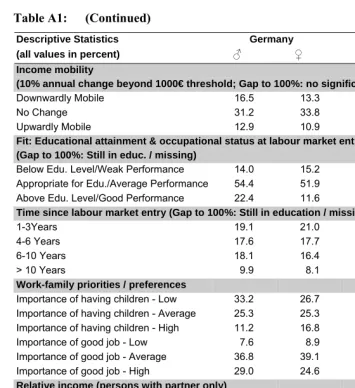
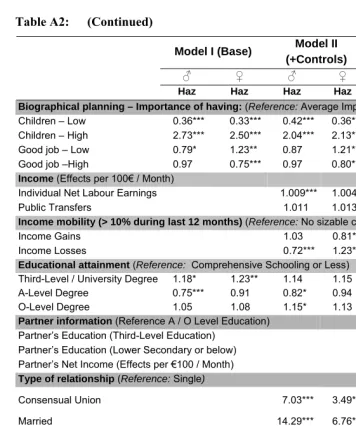
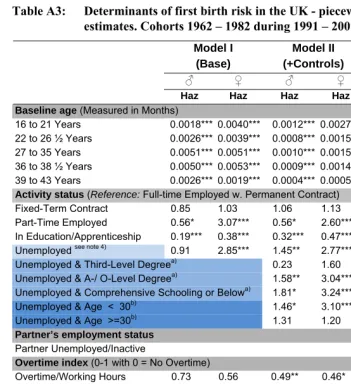
To investigate how precarious employment and the extent of labour market integration affect family formation, I consider the transition to first birth6 (see Table A2
and Table A3). Both the BHPS and the SOEP provide detailed fertility histories of women and men,7 which can be linked to extensive employment histories. A key focus
of the following analysis is the extent of each individual’s integration into the labour
5 For a description of the SOEP data structure, subsamples, and questionnaires, see http://www.diw.
de/en/diw_02.c.222857.en/documents.html (see also Wagner, Frick and Schupp 2007). Information on the BHSP is available at http://www.iser.essex.ac.uk/bhps/documentation (see also Taylor et al. 2010).
6 Most parents have subsequent children relatively soon after their first in order to minimize the duration of
labour market absence and to reduce burdens associated with parenthood (Frejka and Sardon 2007). This would effectively suppress the impact of key factors that are the focus of this study.
7 In case of the SOEP, men’s birth biographies are available only for respondents who entered the panel in
market, as well as the extent of the occupational uncertainty and discontinuous employment the person faces. It is assumed that a stable full-time job with a permanent contract (reference category) closely corresponds to the paradigm of successful labour
market integration. In contrast, occupational uncertainties such as working part-time, holding a fixed-term job, or being unemployed (measured as reported unemployment or
subsequent inactivity) are assumed to indicate a deviation from this ideal, although
part-time employment among women may also act as a coping strategy for reconciling
the demands of work and a future family. I have argued above that unemployment can have different effects with respect to fertility decisions (negative impact on economic resources, and positive opportunity cost effects), and that these effects may vary across educational groups. Accordingly, I consider the interaction effects between educational attainment and unemployment, as well as between unemployment and age, as fertility
plans may be subject to the goal of establishing oneself in the labour market prior to family formation (<30), or to having little time left for childbearing (>=30) (see also Andersson 2000, Vikat 2004).
Aside from these variations in activity status that deviate from the ideal of a permanent full-time job, I consider the time since labour market entry (defined as a
minimum of six months of part-time or full-time work after leaving school or higher
education). I do so in order to investigate whether the transition into the labour market initiates a consolidation process that signals “readiness” for parenthood, regardless of occupational success. Additionally, I take into account whether the initial labour market position—being appropriate to, above, or below the level of skill endowments—
plays a role in signalling a good or bad start to a career (see also Tölke and Diewald 2003). Moreover, I consider income mobility during the last year (defined as changes in
annual income of at least 10% beyond a €1,000 threshold) as a determinant of career progress that might bolster confidence in the ability to support a future family. An index of overtime work in relation to working hours serves to indicate both time constraints
and the degree of occupational attachment.
Additional covariates include net personal income8 (indicating job performance
and economic backing) and public transfers. Whether the person receives public
benefits is taken into account, as it is assumed that this describes the economic situation in detail, and that it also signals economic dependence in the case of high transfers.
Educational attainment is determined by considering the highest level of completed
primary or secondary schooling, as well as any tertiary degrees. As an indicator of personal preferences, I include the importance of having children, as well as the
8 For the UK, only gross income is available. This leads to an estimate bias as redistribution effects of
importance of having a good job, as these indicators might reflect the internalisation of norms, and thus the favoured means of attaining social approval and well-being.
Since childbearing decisions are almost always made by both partners (Thomson and Hoem 1998), I will also consider the partner’s resources in a final set of estimates (Model III). These resources include the partner’s income, education, unemployment, as
well as the predominant work-family arrangement, indicated by the income relationship
between partners, which also signals the relative bargaining power of the partners in decision-making. Except for a control of migration background (foreign region of origin), all of the variables have been recorded as time-varying, including changes in
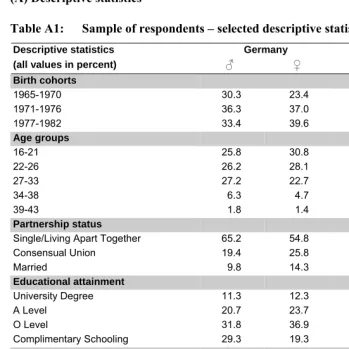
educational attainment or marital status (for descriptive statistics on the set of independent variables, see Table A1).
Analyses for Germany rely on the SOEP subsamples A-F, including the overrepresented East German sample (C); while excluding the recent refreshment sample (H) due to its limited duration of observation, as well as the high-income sample (G) and part of the immigrant sample (D), since the latter two did not use a random sampling procedure. Analysis of the BHPS is limited to the 1991 base sample, since further sample additions, such as the ECHP sample (wave 7+), and the Scotland and Wales samples (wave 9+), are missing retrospective information between 1991 and their introduction (Taylor et al. 2010). The multivariate analyses rely on a semi-balanced rolling panel (respondents have to participate in at least two consecutive waves). This longitudinal design and specific selection of the population at risk (childless men and women from specified birth cohorts) inhibit the application of standard cross-sectional or longitudinal weights. However, most of the factors that are subject to design- and longitudinal-weighting procedures are considered as controls in the multivariate models.9
3.2 Design of the multivariate model
I focus on the transition to the first birth in the context of labour market behaviour; or,
to be more precise, on the decision to have the first child. The focus on the population
at risk made it necessary to limit the analysis to individuals who are (still) able to have a first child based on a range of social and biological factors. This excludes persons who are still in their fertile years but who had already become parents before the period of observation (1991–2007). To minimise a left-censoring bias, I focus the multivariate analyses on the cohorts 1965–1982 (effectively limiting the age range to 16–43). This
9 This includes the distinction between East and West Germany in case of the SOEP, age, income, activity
constitutes a trade-off between covering most of the fertile life span up to the age of 45 and minimising a left-censoring bias. A bias remains, particularly for the older cohorts (1965–1975), with the 1965 cohort entering the sample in 1991 at age 26. Up to this age, however, the first-birth risk remains comparatively low (see Figure 4).
Figure 4: Hazard rates of first motherhood in Germany and the UK (Cohorts 1965-1982)
0 .002 .004 .006 .008
Hazar
d
10 20 25 30 35 40 50
Years of Age (monthly hazards)
UK Germany
nDE = 3.628; nUK = 2.047; eventsDE = 1.443; eventsUK = 850
Source: BHPS & GSOEP 1991 to 2008; (author’s calculations)
The transition to the first birth as a dependent variable is related to parental age. In
approximating the time of the decision to have a child, I backdate the time of birth by
10 months.10 Since the forces that drive fertility decisions vary across age groups, I
apply an exponential hazard model with the extension of piecewise constant estimates.
In this type of model, the estimates between time intervals are based on the calculation of separate baseline hazards. As I base my analysis on a monthly measure of the dependent variable and central covariates (particularly the fertility histories and the recent employment history), these discrete indicators provide a sufficient approximation of the continuous time scale inherent in the exponential model (Jenkins 2005: 19f.).
I define the risk of transition to first birth at a baseline hazard θ , which varies by age with steps around the 16th, 21st, 26th, 34th, and 39th years of life, thus approximating
a normal distribution of the hazard of having a first child, as displayed in Figure 4
10 Evidence of conception probabilities derived from various medical studies suggest that the proportion of
)
(reaching a peak at around the 28th [German women] to 32nd [British women] years of
life). The process time is considered in months since the respondent’s birth. The time at risk of making a first-birth decision is defined as starting with the 16th year of life and
ending with the 43rd year of life (months 192–516). Regression parameters γ and βrefer
to the time-variant (z) or the time-invariant (x) set of covariates considered in the analyses. Thus, the hazard rate θ(t for a first-birth decision is defined as follows:
( )
θ θ
252);(253
52);(253
exp( ( ))
t t t
t = β′X +γ′Z t
n
(0.1)
Where t defines the time intervals with constant baseline hazards:
(0.2)
(193, ,306);(307, 402);(403, 460);(461,516)
DE
t ∈
and tUK∈(193, 2 ,320);(321, 420);(421, 460);(461,516) (0.3)
4. Results of the descriptive analysis
A glance at Figure 4 suggests similar age-specific hazards of first birth among women (cohorts 1965 to 1982) in Germany and the UK. A closer look reveals, however, that the peak of the first-birth risk occurs at a lower age in Germany, and that first-birth hazards in the UK up to the age of 20 exceed the rates in Germany, in line with the commonly reported findings of a high prevalence of teenage motherhood in the UK (Arai 2003, Ermisch and Pevalin 2003). Moreover, Germany shows higher rates of permanent childlessness,11 which is fully in line with the lower German TFR. The
majority of German women make the transition to parenthood within a rather limited time span, between the ages of 20 and 35; whereas in the UK, women tend to delay the transition to motherhood longer. The median age at the transition to first motherhood (fatherhood) is 24.6 (26.8) years in Germany, and 25.8 (28.2) years in the UK. The greater delay in the transition to first parenthood of 2–3 years among fathers is mainly related to the higher average age of men in partnerships, but might also be subject to a certain recall bias among men (Rendall et al. 1999).
11 The findings discussed in this section are based on additional Kaplan-Meier estimates of the transition to
Shifting the focus to the entry into the labour market,12 separate analyses for the
1965 to 1982 cohorts show that this key transition takes place in Germany at a higher age than in the UK. Obviously, the long periods of time spent in education and vocational training in Germany take their toll: the mean age at labour market entry is 20.7 years (with men entering slightly later than women). In the UK, entry usually occurs earlier, at a mean age of approximately 19.2 years. The values for the median labour market entry age diverge even more widely (17.3 in the UK versus 20.0 in Germany). These patterns can be linked to the lengthy programmes of higher education in Germany, which cause a much greater delay in labour market entry than in the UK, particularly among people with tertiary education (see also Haag and Jungblut 2001).
Summarising the above, in Germany, the first step into a career is taken later than in the UK. Yet the transition to the first birth tends to occur at an earlier age in Germany. The lengthy process of educational and vocational training in Germany, combined with what is, on average, an earlier transition to parenthood, can be explained in part by the higher prevalence of first births prior to labour market entry. In Germany, 14.3% (12.8% among men, 15.7% among women) of all first births occur before
entering into employment, versus 10.3% in the UK (11.4% among men, 9.4% among women). This might be related to a stronger tendency among German women to focus on the homemaker role at the expense of a career. Norms of maternal care, as well as social policy frameworks in Germany, encourage this kind of gender specialisation. In the UK, the greater exposure to economic risk and the high level of commodification tend to prevent women from following such a sole homemaker model.
Figure 5 shows the hazard rates of transition to first parenthood among men and women in Germany and the UK who have already entered the labour market. The probability of having a first child increases very rapidly after entry into the labour
market. This effect is accentuated among women, while the pattern of first-birth risk among men resembles a flattened version of the female patterns. As was noted regarding the median age at first birth, men generally reach the peak in first-birth hazard at a later age than women. However, in relation to births occurring after labour market entry, the discrepancy between men and women in the UK is less striking than among their German counterparts. Focusing on cross-country differences, German women show a rapid increase to high birth hazards in Germany, reaching a peak eight years after labour market entry (UK: 11 years). Obviously, the transition to motherhood in Germany follows labour market entry more closely than in the UK. In the UK, the flatter slope of the hazard and the lower peak reached at a later age reflect a greater variance in ages at first birth in relation to labour market entry. This could be related to
12 Defined as at least six months of continuous employment after leaving full-time education (see also Section
the necessity to maintain a dual-earner model, resulting in a stronger reliance on labour market conditions that favour family formation, but that are not necessarily self-chosen.
Figure 5: First-Birth Hazards after Labour Market Entry (Cohorts 1965-1982)
0 .002 .004 .006 .008
Ha
za
rd
2 5 8 11 14 17 20 25
Years since Labour Market Entry (monthly hazards)
Women DE Women UK
Men DE Men UK
nDE = 7.789; nUK = 4.403; eventsDE = 2.536; eventsUK = 1.595
Source: BHPS & GSOEP 1991 to 2008; (author’s calculations)
5. Findings of the multivariate analysis
5.1 The transition to parenthood in light of labour market integration
Focusing the discussion of multivariate results on individuals who have not yet entered the labour market, a central finding is a distinct negative impact of enrolment in full-time education on family formation. This relationship holds true for both men and women in Germany and the UK (see Table A2 & Table A3). It is well-documented in the literature (see, e.g., Upchurch et al. 2002, Morgan 2003, and Billari 2008), and corresponds to norms that encourage delayed family formation until a minimum level of economic independence has been achieved. However, among those who have already entered the labour force, the results suggest there are distinct differences between male and female paths into parenthood.
parenthood decisions (Model I, Table A2 and Table A3). Importantly, among German men, this negative impact of part-time employment vanishes after controlling for income (and public transfers), which in turn exerts a consistently positive impact on family formation in this group. This suggests that, in Germany, it is primarily the direct impact of reduced earnings that undermines the economic basis for starting a family, rather than a signal of reduced breadwinner capabilities, associated with only partial labour market integration in the form of part-time work. Moreover, in a set of basic estimates that focused exclusively on activity status,13 a slight negative impact
of unemployment became apparent for men in both Germany and the UK. The same effect appears in the estimates shown in Model I, but at significance levels below acceptable magnitudes.
However, aside from this quite plausible impact of occupational uncertainties restricting men’s economic means to support a family, the findings suggest an exceptional pattern of transition to fatherhood in the UK. In contrast to men in Germany, where a significant income decline delays the transition to parenthood, downward income mobility among British men does not limit the likelihood of starting
a family, as might be expected based on the arguments presented above. Moreover, a large amount of overtime work—often indicating high career aspirations and thus strong labour market integration—is negatively associated with the transition to
fatherhood, and does not, as hypothesised, signal strong earner qualities. A similar pattern is seen in British men, who exhibit a negative likelihood of starting a family if they place a high priority on having a successful career (among German men, this indicator is not significant). While such a finding would be plausible for female fertility transitions due to the time conflicts women face in a country like the UK, with its dominant male breadwinner and female caregiver norms, a corresponding finding for male fertility patterns is surprising. In this context, male first-birth transitions in the UK show characteristics that resemble those of women in Germany and the UK, with work and family constituting competing life domains. A third finding corroborates this pattern of male work-family conflicts: after controlling for income and receipt of transfers, the initially negative impact of male unemployment reverts to being positive
among men in the UK (Model II). That is, this context, which reflects occupational uncertainty but a larger amount of time available, increases the likelihood of starting a
family, leaving aside the income decline due to unemployment. This relationship is also significant among German men.
While it should be noted that this positive association between male unemployment and transitions to fatherhood may be a methodological artefact, the findings might also hint at a growing strategy among younger couples to increase male
involvement in childcare.14 Regardless of the prevalence of traditional gender roles in
the two countries and the economic uncertainty associated with unemployment, the reduction in opportunity costs might play the key role in initiating family formation. Additional estimates that provide interaction effects between the level of educational attainment and unemployment show that the positive impact of unemployment is predominant only among men with medium (UK) to lower levels of education (Germany and the UK). This contradicts the above speculation to a certain extent, since it might be expected that more highly educated couples would be among the first to assume non-conventional gender roles. On the other hand, for men with medium to low levels of education, family formation might compensate for the status loss resulting from unemployment by boosting their social standing and self-esteem, while the threat of deteriorating human capital may stop more highly educated men from taking similar steps. Finally, such a departure from traditional gender roles could result not only from agreements between partners to lighten the load on the mother through stronger paternal involvement in childcare, but also from the improved bargaining positions of female earners, who assert their own fertility preferences.
Nevertheless, interpreting these facts to suggest that young families are gradually moving toward a female breadwinner model appears somewhat tenuous in light of the tight and unpredictable British labour market and the entrenched traditionalism of gender roles in Germany. The recent changes in social policies designed to promote paternal care through, for example, the introduction of paid paternity leave in the UK in 2003 or the introduction of the Elterngeld in Germany in 2007, came too late to be of
relevance in explaining the above findings. Moreover, government policies are unlikely to induce such swift and fundamental shifts in predominant gender roles, especially in strong male breadwinner countries like the UK and Germany. However, the introduction of these policies might reflect slowly but steadily shifting gender roles in these countries. In any case, the notion that male detachment from the labour market encourages the adoption of caregiver duties will require further study before it can be reliably linked to an emergence of non-traditional gender roles affecting family formation.
Shifting the focus to the fertility decisions of women in the UK, we can see that close labour market attachment and a demanding occupational position clearly work against the decision to have a child. Placing a high value on holding a good job and evidence of extensive overtime work suggest conflicting work-life preferences, with limited time budgets delaying the transition to parenthood (the positive fertility effect of having a sizable income loss corroborates this argument). However, in contrast to this negative effect of strong labour market attachment, women in the UK show distinct
14 In an earlier version of this study, which included older cohorts born after 1955, a similar effect of male
patterns of making the transition to parenthood in precarious employment situations. The impact of unemployment provides considerable evidence of this tendency. Unemployed or inactive women15 are three times more likely to make the transition to
parenthood than those who are employed full-time. Women in the UK show a distinct tendency to have a child if their employment status signals reduced opportunity costs of family formation due to the price-of-time effects. This hypothesis is supported by the finding that female part-time employment in the UK is positively associated with family formation as well. Yet it should also be noted that part-time employment— unlike unemployment—might also be the result of a woman’s deliberate reduction in
working hours in order to balance career and motherhood, especially in institutional contexts in which maternity protection and reinstatement rights remain rudimentary.
Two major principles are at work in determining how labour market integration affects family formation for women in Germany. First, a below-average performance at the point of entry to the labour market, tends to delay the transition to motherhood among German women, but no so among British women. This is probably because an unpromising job start makes occupational integration a more lengthy and difficult process. At the same time, however, the institutional arrangements in Germany provide strong incentives a) to translate educational investments into stable occupational positions, and b) to ensure that the occupational position allows for a return to the labour market after maternal leave at a level commensurate with the individual’s education and experience. This effort to consolidate a career prior to family formation is also reflected in findings indicating that in Germany—unlike in the UK—working with a fixed-term contract tends to delay the transition to motherhood (see Models I & II, Table A2).
This is not only because fixed-term or casual employment are indicators of unstable and precarious employment, but also because temporary jobs often provide only limited eligibility for maternal support. In this context, parental leave provisions, maternity protection, and reinstatement rights offer incentives to attain a minimum level of labour market integration prior to family formation, thus guaranteeing eligibility for these types of support. Importantly, the negative impact of a fixed-term job vanishes after controlling for the presence of a male earner. Finally, among women in Germany—and also among British women, albeit with a weaker level of effect—there is a small amount of evidence that the transition to parenthood is made during times of involuntary labour market exclusion; that is, during periods of unemployment or subsequent inactivity. Interaction effects show that this strategy of exploiting the reduction of opportunity costs during unemployment in order to start a family is
15 Note that the restrictive conditions of eligibility for benefits in the UK, which are suspended after a short
prevalent only among women with medium to low levels of education. For women with tertiary degrees, extending a period of absence from the labour market by starting a family appears to be an unattractive option, since doing so can lead to a depreciation of their human capital investments through prolonged occupational inactivity.
In contrast to the patterns of coping with precarious employment discussed above, the conflict between the demands of career and family in the traditional German breadwinner regime takes its toll on women with a strong attachment to the labour market. Women who have a heavy workload and high career aspirations, as reflected in their reports that they work a large amount of overtime and place a high value on having a good job, consistently show a significantly lower likelihood of starting a family. Generally, it appears that German women aim to consolidate educational investments in a secure job, which also guarantees eligibility for maternity support and reinstatement rights. However, if their labour market attachment is strong, this clearly hampers family formation. It should be noted that these two principles— swift labour market integration (early in one’s career) as a prerequisite for family formation vs. strong labour market attachment impeding family formation—are predominant in different status groups, with work-family conflicts often acting as a limiting factor in family formation for women with high educational investments and skill endowments.
5.2 Key transitions in the education–work–family nexus
In contexts in which institutional arrangements continue to structure life courses, the status passage of labour market entry might encourage the choice to have a first child based on notions of “proper” timing, linking these status passages. Brückner and Mayer (2005) argued that a close temporal link between important life course transitions tends to dissolve in settings where industrial relations are very flexible. In this sense, labour market entry and the transition to parenthood could be expected to occur at a greater temporal distance in a liberal market economy like the UK, in which self-reliance in protecting against life course risks is encouraged (DiPrete 2002), and in which one would expect to find a wider array of individual coping strategies. In a coordinated market economy, like that of Germany, however, more predicable patterns would be expected. The results do not, however, support this hypothesis, as stable and continuous employment, whether for 12 or 24 months, were not found to have an impact on the decision to have a child, either in Germany or in the UK.16
16 Different functional forms of this indicator of continuous employment (e.g., linear impact, decreasing
Moreover, British women are generally reluctant to start a family in the early phases of their careers (see Table A3, time since labour market entry), which
corresponds with the descriptive findings presented in Figure 5. These women show a significantly lower likelihood of starting a family during the first six years after labour market entry, compared to the period 10 or more years after starting the first job. However, this negative correlation between labour market entry and the transition to motherhood vanishes after controlling for income effects and the presence of a second earner. Thus, it appears that, when faced with limited institutional support for family formation, British women tend to reinforce their own labour market position prior to the transition to motherhood. This serves to ensure a future family’s financial security and to establish a positive relationship with an employer that will safeguard the woman’s return to her job after pregnancy in the absence of institutionally embedded reinstatement rights.
In contrast, German men show an increased likelihood of starting a family between three and six years after labour market entry. This effect, although weak, remains in place after controlling for additional characteristics like income, or support by a partner (see Models II & III, Table A3). The findings for this group are the only—albeit weak—evidence of a pattern indicating that the decision to start a family is temporally linked to the status passage of labour market entry. Nevertheless, these results do not provide convincing evidence that the normative relevance of consistently defined life-course scripts leads to close temporal proximity between labour market entry and family formation, as was hypothesised for Germany.
6. Conclusion
Moreover, particularly women with strong labour market attachment—who do a great deal of overtime work and who place a high importance on a successful career— tend to delay family formation. Given the limited time available to them, the strict norms of maternal care prevalent in the society, and the underdeveloped childcare infrastructure, it is difficult for these women to combine work and family. The strong pressure that emerges from the high opportunity costs of motherhood is also reflected in the finding that women with medium to low levels of education are more willing to start a family during periods of unemployment. In contrast to what was hypothesised, the reduced opportunity costs of parenthood during an involuntary labour market absence obviously outweigh the risks of long-term unemployment and prolonged economic dependence.
Furthermore, the hypothesis put forward in Section 2 that a stable job and strong labour market integration among men should tend to favour family formation found little support in the case of Germany, and virtually none with respect to the UK. In Germany, the institutionally encouraged male breadwinner/female homemaker model nevertheless still exerts a profound influence on how German men and women reconcile the transition to parenthood with career aspirations. This is also corroborated by the finding that—although the completion of education remains a precondition for family formation among men and women—part-time employment and the resulting
income reduction have a negative impact on male fertility only. Yet it appears that weak
labour market integration and occupational uncertainties impede the transition to fatherhood in Germany only because they reduce income, thus undermining the man’s capacity to provide financially for a family.
Some results suggest that even couples in which the man is unemployed tend to use this increase in the amount of time available to men to start a family. Perhaps the high opportunity costs of parenthood in the UK encourage a deviation from the traditional division of labour in family duties, with men taking on a greater share of childcare responsibilities during joblessness, thus reducing the burden on the female earner, which might be favourable for family formation. This focus on a primary parent role among men may serve to compensate for the decline in social esteem resulting from job loss, especially in a society that imposes rigid norms of participation in paid work. Some findings point to similar behaviour among German men regarding family formation during phases of unemployment. For both countries, this might hint at a trend towards increasing acceptance of more egalitarian gender roles in younger cohorts. Yet this issue of a reversal in traditional gender roles in the case of male labour market detachment requires further investigation in future research, and remains speculative for the present time.
To conclude, the results indicate that the most distinct differences between Germany and the UK appear to be in the way women shape the transition to parenthood in the context of labour market participation. While there is some evidence that women in Germany tend to first pursue labour market integration and to focus on family formation afterwards, women in the UK show strong tendencies to match the transition to motherhood with occupational phases that provide increased time for parenting, such as part-time work or unemployment. The limited maternity support and benefit provision in the UK obviously encourage women to avoid voluntary and lasting career interruptions caused by childbearing.
References
Andersson, G. (2000). The impact of labor-force participation on childbearing behavior: Pro-cyclical fertility in Sweden during the 1980s and the 1990s. European Journal of Population 16(4): 293-333. doi:10.1023/A:1006454909642.
Apps, P. and Rees, R. (2005). Gender, time use and public policy over the life cycle.
Oxford Review of Economic Policy 21(3): 439-461. doi:10.1093/oxrep/gri025.
Arai, L. (2003). British policy on teenage pregnancy and childbearing: The limitations of comparisons with other European countries. Critical Social Policy 23(1):
89-102.
Billari, F.C. (2008). Lowest-low fertility in Europe: Exploring the causes and finding some surprises. The Japanese Journal of Population 6(1): 2-18.
Blackwell, L. (2001). Occupational sex segregation and part-time work in modern Britain. Gender, Work & Organization 8(2): 146-163. doi:10.1111/1468-0432.00126.
Bongaarts, J. (1982). Infertility after age 30: A false alarm. Family Planning Perspectives 14(2): 75-78. doi:10.2307/2134817.
Bradshaw, J. and Finch, N. (2002). A comparison of Child Benefit packages in 22 countries. York: Department for Work and Pensions. (174). http://campaigns.dwp.gov.uk/asd/asd5/rrep174.pdf.
Brewster, K.L. and Rindfuss, R.R. (2000). Fertility and women's employment in industrialized nations. Annual Review of Sociology 26: 271-296. doi:10.1146/ annurev.soc.26.1.271.
Brückner, H. and Mayer, K.U. (2005). De-Standardization of the life-course: What it might mean? And if it means anything, whether it actually took place? Advances in Life Course Research 9: 27-54. doi:10.1016/S1040-2608(04)09002-1.
Crompton, R. and Lyonette, C. (2006). Work-life balance in Europe. Acta Sociologica
49(4): 379-393. doi:10.1177/0001699306071680.
Daly, M. and Rake, K. (2003). Gender and the Welfare State Care, Work and Welfare in Europe and the USA. Cambridge, UK: Polity Press.
Ekert-Jaffé, O., Joshi, H., Lynch, K., Mougin, R. and Rendall, M.S. (2002). Fertility, timing of births and socio-economic status in France and Britain social policies and occupational polarization. Population (Population-English Edition) 57(3):
475-508. doi:10.3917/pope.203.0475.
Ermisch, J. and Pevalin, D.J. (2003). Who has a child as a teenager? (ISER Working Paper Series30).
Esping-Andersen, G. (1999). Social Foundations of Post-industrial Economies. Oxford:
Oxford University Press. doi:10.1093/0198742002.001.0001.
European Commission (2006). MISSOC. Social protection in the Member States of the European Union. Situation on 1 January 2005. Luxembourg: European Communities.
European Commission (2011). Employment, Social Affairs & Equal Opportunities. MISSOC Database. http://ec.europa.eu/employment_social/missoc/db/public/ compareTables.do?year=20060701&lang=en (Access Date: 08/2011).
Frejka, T. and Sardon, J.-P. (2007). Cohort birth order, parity progression ratio and parity distribution trends in developed countries. Demographic Research 16(11):
315-374. doi:10.4054/DemRes.2007.16.11.
Friedman, D., Hechter, M., and Kanazawa, S. (1994). A Theory of the value of children. Demography 31(3): 375-401. doi:10.2307/2061749.
Gash, V. and McGinnity, F. (2007). Fixed-term contracts—the new European inequality? Comparing men and women in West Germany and France. Socio-Economic Review 5(3): 467-496. doi:10.1093/ser/mwl020.
Gregg, P., Gutiérrez-Domènech, M., and Waldfogel, J. (2007). The employment of married mothers in Great Britain, 1974–2000. Economica 74(296): 842-864. doi:10.1111/j.1468-0335.2006.00574.x.
Grunow, D. and Mayer, K.U. (2007). How Stable are Working Lives? Occupational Stability and Mobility in West Germany 1940s – 2005. (CIQLE Working Paper2007(3)).
Haag, A. and Jungblut, J.-M. (2001). The Changing of Labour Market Patterns during the Nineties in Germany, France, United Kingdom and United States. Paper
presented at the ISA Research Committee on Social Stratification (RC28), Mannheim, April 26-28, 2001.
Haas, L. (2003). Parental leave and gender equality: Lessons from the European Union.
Hall, P.A. and Soskice, D. (2001). An Introduction to Varieties of Capitalism. In:. Hall, P.A. and Soskice, D. (eds.). Varieties of Capitalism. The Institutional Foundations of Comparative Advantage. Oxford: Oxford University Press: 1-70.
Hašková, H. and Klenner, C. (2010). Why did Distinct Types of Dual-Earner Models in Czech, Slovak and East German Societies Develop and Persist? In: Schmitt, C. and Trappe, H. (eds.). Journal of Family Research - Zeitschrift für Familienforschung - Special Issue (Vol. 22, Vol. 3).
Hobcraft, J. and Kiernan, K.E. (1995). Becoming a Parent in Europe. Milano, Italy: European Population Conference (Prepared Paper, September 4-8, 1995). Jenkins, S.P. (2005). Survival Analysis. Colchester: ISER University of Essex.
Kravdal, O. (2002). The impact of individual and aggregate unemployment on fertility in Norway. Demographic Research 6(10): 263-294. doi:10.4054/DemRes. 2002.6.10
Kreyenfeld, M. (2010). Uncertainties in female employment careers and the postponement of parenthood in Germany. European Sociological Review 26(3):
351-366. doi:10.1093/esr/jcp026.
Kroh, M. and Spieß, M. (2008). Documentation of sample sizes and panel attrition in the German Socio Economic Panel (SOEP) (1984 until 2007). (DIW Data Documentation Series 39).
Kurz, K., Hillmert, S., and Grunow, D. (2006). Increasing Inequality in Employment Careers? Men’s Job Mobility and Unemployment in West Germany. A Comparison of the Birth Cohorts 1940, 1955 and 1964. In: Blossfeld, H.-P., Mills, M., and Bernardi, F. (eds.). Globalization, Uncertainty and Men’s Careers: An International Comparison. London: Elgar.
Kurz, K., Steinhage, N., and Golsch, K. (2005). Case Study Germany: Uncertainty and the Transition to Adulthood. In: Blossfeld, H.-P., Klijzing, E., Mills, M., and Kurz, K. (eds.). Globalization and Youth in Society. London: Routledge: 51-81.
Lindenberg, S. (1990). Homo Socio-oeconomicus: The emergence of a general model of man in the social sciences. Journal of Institutional and Theoretical Economics 146(4): 727-748. doi:10.2307/40751361.
Mahon, R. (2002). Child care: Toward what kind of “social Europe”? Social Politics
9(3): 343-379. doi:10.1093/sp/9.3.343.
McDonald, P. (2000). Gender equity in theories of fertility transition. Population and Development Review 26(3): 427-439. doi:10.1111/j.1728-4457.2000.00427.x.
McDonald, P. and Meyers, M.K. (2009). Social Policy Principles Applied to Reform of Gender Egalitarianism in Parenthood and Employment. In: Gornick, J.C. and Meyers, M.K. (eds.). Gender Equality: Transforming Family Divisions of Labor.
New York: Verso: 161-175.
McGinnity, F. (2004). Welfare for the Unemployed in Britain and Germany. Who Benefits? Northampton, MA: Elgar Publishing.
McGinnity, F. and McManus, P. (2007). Paying the price for reconciling work and family life: Comparing the wage penalty for women's part-time work in Britain, Germany and the United States. Journal of Comparative Policy Analysis 9(2):
115-134. doi:10.1080/13876980701311562.
Meron, M. and Widmer, I. (2002). Unemployment leads women top postpone the birth of their first child. Population (English Edition) 57(2): 301-330. doi:10.3917/ pope.202.0301.
Mills, M. and Blossfeld, H.-P. (2003). Globalization, uncertainty and changes in early life courses. Zeitschrift für Erziehungswissenschaft 6(2): 188-218. doi:10.1007/ s11618-003-0023-4.
Mills, M. and Blossfeld, H.-P. (2005). Globalization, Uncertainty and Changes in Early Life Courses. In: Blossfeld, H.-P., Klijzing, E., Mills, M., and Kurz, K. (eds.).
Globalization, Uncertainty, and Youth in Society. New York: Routledge: 1-24.
Morgan, P.S. (2003). Is low fertility a twenty-first-century demographic crisis?
Demography 40(4): 589-603. doi:10.1353/dem.2003.0037.
Nauck, B. (2007). Value of children and the framing of fertility: Results from a cross-cultural comparative survey in 10 societies. European Sociological Review
23(5): 615-629. doi:10.1093/esr/jcm028.
OECD (2004). OECD Employment Outlook.OECD.
OECD (2007). OECD Employment Outlook. OECD.
OECD (2010b). Employment and Labour Force Statistics. [electronic resource] http://stats.oecd.org/index.aspx (Access Date 05/2011).
OECD (2011a). OECD Family Database. Fertility Indicators. [electronic resource] http://www.oecd.org/document/4/0,3746,en_2649_37419_37836996_1_1_1_37 419,00.html (Access date: 12/2011).
OECD (2011b). Employment and Labour Force Statistics. [electronic resource] http://stats.oecd.org/index.aspx (Access Date 05/2011).
OECD (2011c). OECD Indicators of Employment Protection. [electronic resource] http://www.oecd.org/document/11/0,3746,en_2649_37457_42695243_1_1_1_3 7457,00.html (Access date: 08/2011).
Ondrich, J., Spiess, C.K., Yang, Q., and Wagner, G.G. (1999). Full time or part time? German parental leave policy and the return to work after childbirth in Germany.
Research in Labor Economics 18: 41-74. doi:10.1016/S0147-9121(99)18019-1.
Oppenheimer, V.K. (1994). Women's rising employment and the future of the family in industrial societies. Population and Development Review 20(2): 293-342. doi:10.2307/2137521.
Prince Cooke, L. (2011). Gender-Class Equality in Political Economies(Perspectives on Gender). New York: Routledge, Taylor & Francis.
Rendall, M.S., Clarke, L., Peters, H.E., Ranjit, N., and Verropoulou, G. (1999). Incomplete reporting of men's fertility in the United States and Britain: A research note. Demography 36(1): 135-144. doi:10.2307/2648139.
Schmitt, C. (2008a). Increasing Childlessness in Germany. In: Headey, B. and Holst, E. (eds.). A Quarter Century of Social and Economic Change: Results from the German Panel Survey (SOEP). Berlin: DIW Berlin: 23-28.
Schmitt, C. (2008b). Labor market integration and the transition to parenthood - A comparison of Germany and the UK. (SOEP Papers on Multidisciplinary Panel Data Research 119).
Smith, M. (2003). Re-regulating Transitions? Continuity and Change in the UK. In: O'Reilly, J. (ed.), Regulating Working-Time Transitions in Europe. Cheltenham,
UK: Elgar: 280-318.
Thomson, E. and Hoem, J.M. (1998). Couple childbearing plans and births in Sweden.
Demography 35(3): 315-322. doi:10.2307/3004039.
Tölke, A. and Diewald, M. (2003). Insecurities in employment and occupational careers and their impact on the transition to fatherhood in Western Germany.
Demographic Research 9(3): 41-67. doi:10.4054/DemRes.2003.9.3.
Upchurch, D.M., Lillard, L.A., and Panis, C.W.A. (2002). Nonmarital childbearing: Influences of education, marriage, and fertility. Demography 39(2): 311-329. doi:10.1353/dem.2002.0020.
Vandecasteele, L. and Debels, A. (2007). Attrition in panel data: The effectiveness of weighting. European Sociological Review 23(1): 81-97. doi:10.1093/esr/jcl021.
Vikat, A. (2004). Women's labor force attachment and childbearing in Finland. Rostock: Max Planck Institute for Demographic Research. (MPIDR Working Paper Series).
Wagner, G.G., Frick, J., and Schupp, J. (2007). The German Socio-Economic Panel Study (SOEP): Scope, evolution and enhancements. Schmollers Jahrbuch (Journal of Applied Social Science Studies) 127(1): 139-169.